Septic tank sizes: what capacity does your home actually need?
By the SepticMind Editorial Team
TL;DR
- Most single-family homes need a 1,000- to 1,500-gallon septic tank.
- The standard rule is 1,000 gallons for up to 3 bedrooms, plus 250 gallons per bedroom after that.
- State codes set the legal minimum, daily wastewater flow is the real driver, and an undersized tank is one of the fastest ways to wreck a drain field.
Why does septic tank size matter so much?
Get the size wrong and you're facing more than a smelly yard. You're looking at solids washing into your leach field, a drain field that fails years early, and a repair bill that can top $10,000. [1]
A septic tank does two jobs. It holds wastewater long enough for solids to settle to the bottom as sludge and grease to float to the top as scum, and it releases partly treated liquid (effluent) to the drain field at a slow, steady rate. Tank volume decides how long that liquid sits. Too small a tank, and detention time drops below the 24-to-48-hour window that lets solids separate. Solids carry over into the field. The field clogs. Now you have a real problem.
The EPA's SepticSmart program puts it plainly: septic systems "need routine maintenance to function properly," and that maintenance starts with correctly sized components from day one. [2] Size drives everything downstream: how often you pump, how well your field performs, how long the whole system lasts.
Sizing isn't uniform state to state, either. Every state that regulates private wells and septic sets its own minimum tank volumes, usually tied to bedroom count, fixture count, or calculated daily flow. If you're building new or replacing a tank, your county health department or state environmental agency has the final word on what's legal where you live.
What are the standard septic tank sizes available?
Tanks come in more configurations than most homeowners realize. Manufacturers make them in concrete, fiberglass, and polyethylene (plastic), and the common sizes break out like this:
| Tank Size (gallons) | Typical Use Case |
|---|---|
| 750 | Older installations, some vacation/cabin codes |
| 1,000 | 1-3 bedroom homes (most common minimum) |
| 1,250 | 3-4 bedroom homes |
| 1,500 | 4-5 bedroom homes |
| 2,000 | 5-6 bedroom homes or high-flow households |
| 2,500-3,000 | Large estates, small commercial properties |
| 5,000+ | Commercial or multi-unit installations |
The 1,000-gallon tank is by far the most common residential size in the United States. Many states set 1,000 gallons as the hard floor for any new residential installation, no matter how small the house. [3] A few older jurisdictions still permit 750-gallon tanks for replacement-in-kind, but that's getting rarer as codes modernize.
Concrete tanks dominate the installed base because they were the default for decades. Fiberglass and poly tanks have grown since the 1990s because they don't crack, don't corrode, and are lighter to haul. The material doesn't change the sizing math, just the installation logistics and the long-term maintenance profile.
Two-compartment tanks are now required by most state codes for new installations. [4] The first compartment handles the heavy settling; the second polishes the effluent before it exits to the field. A two-compartment 1,000-gallon tank produces cleaner effluent than a single-compartment 1,000-gallon tank, which matters a lot when your soil isn't great.
How is septic tank size calculated for a house?
Two methods are in use: the bedroom-count method and the daily flow method. Most state codes use bedroom count as a proxy because it's simple and conservative. The daily flow method is more precise and is usually required for commercial or non-standard residential jobs.
Bedroom-count method
The most widely cited baseline: 1,000 gallons for up to 3 bedrooms, plus 250 gallons per additional bedroom. A 4-bedroom house needs at least 1,250 gallons, a 5-bedroom house needs 1,500 gallons, and so on up. Some states use a slightly different multiplier, so check your local code. [3]
Why bedrooms and not actual occupants? Bedrooms stand in for the potential occupancy load. A 4-bedroom house might hold 2 people today and 8 next year. Sizing for potential is what protects you when the house fills up.
Daily flow method
The EPA and most engineering standards assume roughly 50 to 100 gallons of wastewater per person per day for residential use. [2] The most commonly cited design figure is 75 gallons per person per day. At 2 people per bedroom as the design assumption, a 3-bedroom house works out to 450 gallons per day (3 bedrooms x 2 people x 75 gallons). Tank volume is typically set at 1.5 times the daily design flow as a floor, which puts that 3-bedroom house at 675 gallons minimum. Since codes floor this at 1,000 gallons, the bedroom-count rule usually produces a bigger tank than the pure flow math requires. That's a good thing.
Garbage disposals and high-fixture-count homes
Got a garbage disposal? Most state codes make you add 250 gallons to whatever the standard calculation produces. [4] The reasoning holds up. Food waste speeds up how fast your sludge layer builds, which means faster pump-out cycles and heavier solids loading on the tank. High-fixture-count homes, homes with hot tubs or big frequent laundry loads, and homes with two dishwashers hit the same wall. When in doubt, size up. The price gap between a 1,000-gallon and a 1,250-gallon tank is usually $200 to $400 at installation. A failed drain field runs $3,000 to $30,000. [5]
What septic tank size do I need by number of bedrooms?
Here's the guide most homeowners actually want. These figures reflect the common state code baseline. Your jurisdiction may require more.
| Bedrooms | Estimated Daily Flow | Minimum Tank Size (typical code) |
|---|---|---|
| 1-2 | 150-300 gpd | 750-1,000 gallons |
| 3 | 300-450 gpd | 1,000 gallons |
| 4 | 450-600 gpd | 1,250 gallons |
| 5 | 600-750 gpd | 1,500 gallons |
| 6 | 750-900 gpd | 1,750-2,000 gallons |
A few caveats. The 1-2 bedroom row often carries a 1,000-gallon floor in practice, because that's the state minimum regardless of bedroom count. A studio ADU or tiny house on its own system may qualify for a 750-gallon tank in some places, but check before you assume.
Buying a home and trying to figure out whether the existing tank is adequate? Start with the bedroom count on the permit and cross-reference the tank capacity in the inspection report. A 3-bedroom house on a 750-gallon tank is either a very old installation or a problem waiting to happen. A septic tank inspection tells you the current sludge depth, so you can calculate how close to failure it really is.
One rule of thumb that holds up: if your tank is more than one-third full of sludge and scum combined, pump it before the solids reach your outlet tee. How often that happens depends on tank size relative to household load. EPA's SepticSmart guidance recommends inspecting your system every 3 years and pumping every 3 to 5 years for a typical household, but smaller tanks in busy houses may need pumping every 1 to 2 years. [2] Timing gets its own treatment in our guide on how often to pump a septic tank.
Does tank material affect what size you should buy?
Material doesn't change the gallonage math. It does change what's available in your area and what the tank actually does over time.
Concrete tanks are measured by interior volume and are cast locally in most regions because they're too heavy to ship far. Catalog capacity matches real-world capacity closely, assuming the tank is in good shape. Concrete cracks from ground movement or corrosive soils, and those cracks let groundwater in (diluting the tank and causing hydraulic overload) or let sewage out. A 30-year-old concrete tank is worth inspecting carefully before you assume it's holding its rated volume. [6]
Fiberglass and polyethylene tanks are built to tight tolerances and stay closer to their rated volume. They won't crack or corrode. They can shift or float in high-water-table areas if they aren't anchored right during installation. That's an installer problem, not a size problem, but it's worth knowing.
For replacement tanks, material sometimes limits size availability. A concrete plant might stock 1,000 and 1,500 but not 1,250. A fiberglass supplier might have 1,050 and 1,500. Don't let availability push you into a tank that's too small. Size up if the exact number isn't stocked, never down.
For what replacement tanks actually cost by material and size, see our breakdown of the cost to put in a septic tank.
What are the signs your septic tank is the wrong size?
Undersized tanks fail in a pattern that's easy to spot once you know it.
The first sign is frequent pumping. If you're calling for a septic tank pump out every 12 to 18 months on a household that isn't doing anything unusual, your tank is probably too small for the load. A properly sized tank for a typical family should go 3 to 5 years between pumpings. [2]
The second sign is slow drains across the whole house that don't trace back to one clogged pipe. When a tank is hydraulically overloaded, the outlet gets sluggish. Water backs up. You notice it in showers and low fixtures first.
The third sign is the worst one: wet, soggy, or smelly ground over your drain field when there hasn't been much rain. That's effluent surfacing. It means solids have been reaching the field long enough to clog the soil. At that point you're past a tank problem and into septic system repair territory.
Oversized tanks are less common but do cause trouble in very low-use situations. If a house is occupied only a few weeks a year and the tank is huge, the lack of steady biological activity can drop treatment efficiency. That's a niche case. For most homeowners, too-small is a far bigger risk than too-large.
Suspect your tank is undersized? Have a licensed inspector measure the sludge and scum layers and calculate the effective liquid volume remaining. That number tells you whether you need a bigger tank or just a pump-out.
How do state codes vary on minimum tank sizes?
This is where homeowners get surprised. Federal law doesn't set septic tank sizing minimums directly. The EPA writes guidance and supports state programs, but the enforceable minimums come from state onsite wastewater regulations, administered at the county level. [7]
Most states have adopted some version of the 1,000-gallon residential minimum, but the details diverge:
- California: The California Plumbing Code and county environmental health departments typically require 1,000 gallons minimum, with sizing tables by bedroom count. Many coastal counties are stricter. [8]
- Florida: The Florida Department of Health requires a minimum 900-gallon capacity for systems installed before 1983 and 1,050 gallons for newer systems, sized by estimated daily flow. [9]
- Texas: TCEQ regulations set 750 gallons as the absolute minimum but effectively require 1,000 gallons for most residential systems once flow calculations are applied. [10]
- New York: DEC and local health departments generally require 1,000 gallons minimum, scaling up by bedroom count per local sanitary code.
The takeaway is simple. Pull your state's onsite wastewater code and your county's amendments before you design or permit a system. What's legal in one county may not fly in the next. If you're doing a septic tank installation, your installer should know this, but verify it yourself.
One stable federal reference: the EPA's "Onsite Wastewater Treatment Systems Manual" covers design principles including tank sizing, and it's the technical backbone many state codes draw from. [7]
How does tank size affect how often you need to pump?
The relationship is direct and mathematical. Sludge and scum build at a rate set by household size and habits. Tank volume decides how much storage exists before that buildup hits the one-third threshold. Bigger tank, longer interval. Smaller tank, more frequent service.
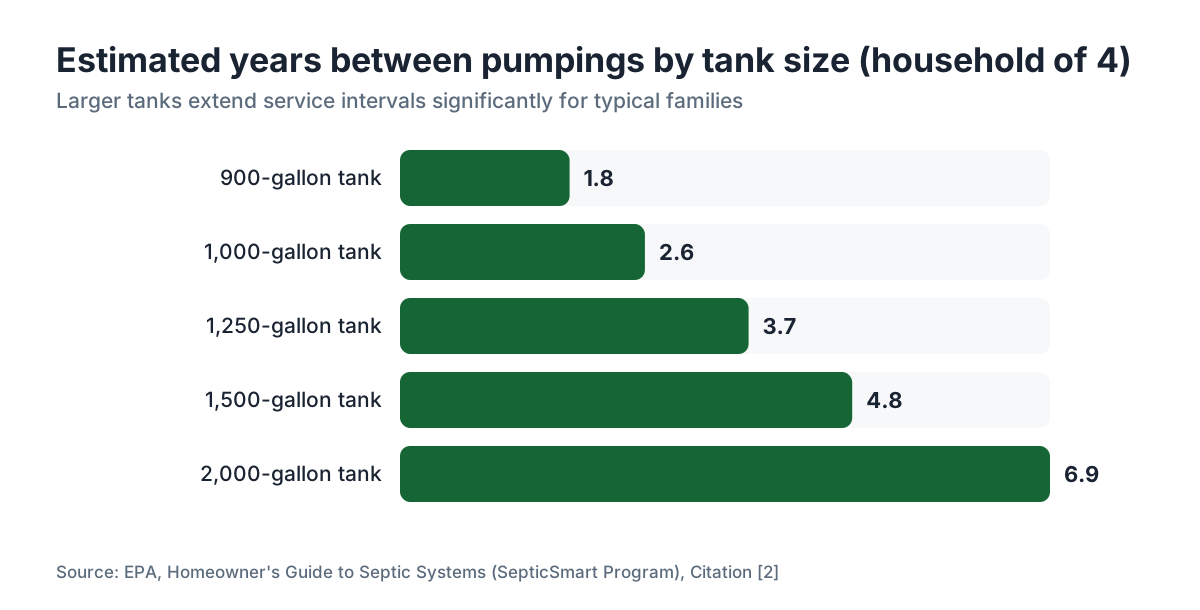
The EPA's rule of thumb for a family of four on a 1,000-gallon tank is roughly every 2.6 years. [2] A 1,500-gallon tank serving the same family might go 4 years or more. Nobody has perfectly clean data on this, because usage habits vary so much. The closest published estimates come from EPA's "Homeowner's Guide to Septic Systems," which lays out a pumping frequency table by tank size and household size.
Here's what that table suggests for a household of 4 people:
| Tank Size (gallons) | Estimated Years Between Pumpings (4 people) |
|---|---|
| 900 | 1.8 years |
| 1,000 | 2.6 years |
| 1,250 | 3.7 years |
| 1,500 | 4.8 years |
| 2,000 | 6.9 years |
Source: EPA, "Homeowner's Guide to Septic Systems" [2]
These are estimates, not guarantees. A household with a garbage disposal, frequent guests, or heavy laundry accumulates sludge faster. Two retirees in a 3-bedroom house accumulate it much slower.
For a closer look at pumping timing, the septic tank pumping guide covers what a service visit looks like and how to read a pump report. Proper septic tank cleaning every time you pump adds meaningful life to the system.
What does it cost to upgrade to a larger septic tank?
If you're already on a working system and just need a bigger tank, the cost swings on whether you're replacing the tank only or reconfiguring the whole system.
Tank replacement alone (excavating the old tank, removing or abandoning it, and installing a new larger one) typically runs $3,000 to $7,000 depending on region, tank material, and how hard the site is to reach. [5] If the drain field connections need rerouting or the distribution box has to move, add $500 to $2,000. If the tank sits in a spot heavy equipment can't reach easily, costs climb fast.
For comparison, fixing a drain field that failed because of an undersized tank runs $3,000 to $15,000 for repair and $10,000 to $30,000 for full replacement. The math strongly favors upsizing early if you know your tank is marginal.
One case where replacement clearly pays: you're buying a home with a 750-gallon tank and plan to add a bedroom or house more than 2 people. Get a full septic tank inspection before closing and negotiate tank replacement into the sale terms. It can save you a large headache later. The full picture of what new systems cost is in our cost to install septic system guide.
SepticMind's operator tools store tank size records and service interval history across customer accounts, which helps service companies flag undersized tanks during routine visits instead of finding them after a failure.
For a full breakdown of replacement versus new installation costs, see septic tank installation.
Can you add a second tank to increase capacity?
Yes, and it's often more practical than full replacement. Adding a second tank in series, where effluent flows from the existing tank into the new tank before reaching the drain field, raises total volume and detention time without pulling the original tank out of the ground. [4]
This works well when the original tank is structurally sound but simply undersized. An installer buries a second 500-gallon or 1,000-gallon tank downstream of the first, connects them with the right inlet and outlet fittings, and the system runs on the combined volume. Total cost is often $2,000 to $4,500 depending on excavation difficulty, well under full tank replacement.
There are limits. The combined system still has to meet current local code, and many jurisdictions require a permit and inspection for the change. Some older primary tanks have compromised outlet structures that need septic tank repair before connecting a second chamber makes sense. And if the drain field is already failing, adding tank volume won't fix it. The field has to be addressed on its own.
Worth raising with your installer if you're trying to solve a capacity problem without paying for a full tank swap.
What happens if your septic tank is too small for your household?
The failure sequence is predictable. When a tank stays overloaded relative to its volume, detention time drops. Solids that haven't settled get pushed into the drain field with the effluent. Over months and years, those solids clog the spaces between soil particles. Biomat, a biological layer that forms when organic matter overwhelms the soil's absorption capacity, speeds the clogging along.
Once the field clogs, you get surfacing effluent in the yard, sewage odors, and eventually a full backup into the house. Now you're looking at septic system repair or full drain field replacement.
The EPA's SepticSmart program states that "a key reason for system failures is that homeowners were not aware of how their system works or what it needs." [2] Undersizing is one of the most common structural causes of early failure, especially where the original system was permitted for 2 bedrooms and the house has since grown or added people.
Caught it early, where pumping frequency is climbing and drains are sluggish but nothing is surfacing yet? You may still have time to upsize the tank before the field is damaged. Get an inspection and a sludge measurement now. Waiting almost always costs more.
How do you find out what size tank is already in the ground?
Start with your county health department. Most counties that permit septic maintain records of the permit, the installer, and the tank specs, some going back decades. Ask for the as-built drawing or permit card for your address.
If records are missing or incomplete, a licensed inspector can locate and inspect the tank. They measure the dimensions (length, width, and liquid depth) and calculate volume from those numbers. A 1,000-gallon concrete tank is typically about 8 feet long, 5 feet wide, and 5 feet deep for a two-compartment design, though dimensions vary by manufacturer.
Buying a home? Always request a septic tank inspection as part of due diligence. The report should list tank size, condition, sludge depth, and an assessment of the drain field. If the seller can't document the tank size, treat that as a red flag, not a paperwork gap.
You can sometimes find the size on the tank lid itself. Concrete tanks made after the mid-1980s often have the capacity stamped or embossed on the lid or riser. Fiberglass and poly tanks almost always carry a label with the rated volume. After years underground the label may be weathered, but it's worth a look when the lid is open during a pump-out.
For everything that happens once the lid is off, see septic tank emptying and septic tank cleaning.
Frequently asked questions
What is the most common residential septic tank size in the US?
The 1,000-gallon tank is the most common residential size. It meets the minimum code for a 1-3 bedroom home in most states and is the default tank specified for new residential construction across much of the country. Larger homes typically need 1,250 or 1,500 gallons.
Is a 750-gallon septic tank big enough for a 3-bedroom house?
Almost certainly not under current code in most states. A 3-bedroom home generating roughly 450 gallons of wastewater per day needs at least 1,000 gallons to hold enough detention time for solids to settle. A 750-gallon tank would need pumping very often and risks sending solids into the drain field.
How many gallons per day does a typical household produce?
Design standards assume 50-100 gallons per person per day, with 75 gallons per person per day as the most commonly used figure for residential design. A family of four produces roughly 300 gallons per day at that rate, though actual usage varies a lot based on habits, fixtures, and efficiency.
Does a garbage disposal change what size septic tank I need?
Yes. Most state codes make you add 250 gallons to the standard calculation if you have a garbage disposal. Food waste raises sludge accumulation rates sharply, so a 3-bedroom home that would normally need a 1,000-gallon tank should have a 1,250-gallon tank if a disposal is in use.
What size septic tank do I need for a 4-bedroom house?
A 4-bedroom house typically needs a 1,250-gallon tank under standard state code formulas, which add 250 gallons per bedroom beyond 3 bedrooms. If the home has a garbage disposal or steady high water use, step up to 1,500 gallons. Always verify with your local health department before permitting.
How long does a septic tank last before it needs to be replaced?
Concrete tanks in good condition often last 40 years or more. Fiberglass and polyethylene tanks can last 30-50 years if installed right. The tank itself rarely needs replacement if it was correctly sized and maintained. What usually fails first is the drain field or the inlet and outlet baffles inside the tank.
Can I use a smaller tank if my household is just two people?
You can use the minimum your state code allows, typically 1,000 gallons regardless of occupancy. Some states permit 750-gallon tanks for 1-2 bedroom dwellings. Even with two people, sizing down to the absolute minimum leaves no buffer for guests, high-use days, or future household changes.
What is a two-compartment septic tank and do I need one?
A two-compartment tank splits the volume into a larger first chamber for primary settling and a smaller second chamber for secondary settling before effluent exits to the drain field. Most states now require two-compartment tanks for all new residential installations. They produce cleaner effluent than single-compartment tanks of the same total volume.
How do I know if my septic tank needs to be replaced or just pumped?
Pumping removes accumulated sludge and scum; it doesn't fix a structurally compromised tank. If the tank shows cracking, collapsed baffles, deteriorated concrete, or has shifted and broken the inlet or outlet connections, those need repair or replacement. A licensed inspector can assess structural condition during or after a pump-out.
Will adding a bedroom to my house require a bigger septic tank?
Possibly. Adding a bedroom raises the permitted occupancy load and triggers a re-evaluation under most state codes. Many jurisdictions require a septic permit as part of the building permit for an addition, and the review may require you to upsize the tank or expand the drain field. Check with your county health department before building.
What is the difference between septic tank size and septic system capacity?
Tank size refers only to the holding volume of the tank. System capacity includes the tank, the distribution system, and most importantly the drain field's ability to absorb treated effluent. A large tank connected to an undersized or failing drain field still has inadequate system capacity. Both components have to be sized correctly.
How much does tank size affect septic tank pumping costs?
Larger tanks cost slightly more per pump-out because there's more volume to haul, but they need pumping less often. A 1,500-gallon tank might cost $50-$100 more per service than a 1,000-gallon tank but could go twice as long between visits. Over a 10-year period, the larger tank often costs less in total pumping expense.
Sources
- EPA, Septic Systems Overview: Drain field failure from system overload can cost tens of thousands of dollars to repair or replace
- EPA, SepticSmart Homeowner Information: EPA recommends inspecting septic systems every 3 years and pumping every 3-5 years; systems need routine maintenance; failure often results from owner unawareness; pumping frequency estimates by tank size and household size
- University of Minnesota Extension, Septic System Owners Guide: Standard sizing rule of 1,000 gallons minimum for 3-bedroom homes, 250 gallons per additional bedroom
- University of Georgia Extension, Septic Tank Guidance: Two-compartment tanks required by most state codes for new installations; garbage disposals require additional tank volume; series tanks can increase system capacity
- EPA, Septic Systems (Costs and Care): Tank replacement and drain field repair costs range from thousands to tens of thousands of dollars
- Penn State Extension, Septic Tank and Soil Absorption Systems: Concrete tanks can crack from ground movement or corrosive soils, affecting effective volume and treatment quality
- EPA, Onsite Wastewater Treatment Systems Manual (EPA/625/R-00/008): Federal technical guidance for septic system design including tank sizing principles; basis for many state code requirements
- California State Water Resources Control Board, Onsite Wastewater Treatment Systems: California requires minimum 1,000-gallon tank for residential systems with sizing tables by bedroom count
- Florida Department of Health, Onsite Sewage Program: Florida requires minimum 900 gallons for pre-1983 systems and 1,050 gallons for newer residential systems with sizing by daily flow
- Texas Commission on Environmental Quality (TCEQ), On-Site Sewage Facilities: Texas TCEQ sets 750-gallon absolute minimum but requires 1,000 gallons for most residential systems under flow calculations
Last updated 2026-07-09