Septic tank installation: cost, process, and what to expect
By the SepticMind Editorial Team
TL;DR
- A conventional septic tank and drain field installation costs $3,000 to $15,000.
- Complex systems (mound, aerobic, drip) run $15,000 to $30,000 or more.
- The work covers site evaluation, permits, excavation, tank placement, drain field construction, and inspection.
- Budget 3 to 7 days of digging and 6 to 16 weeks total, most of it waiting on permits.
What does septic tank installation actually involve?
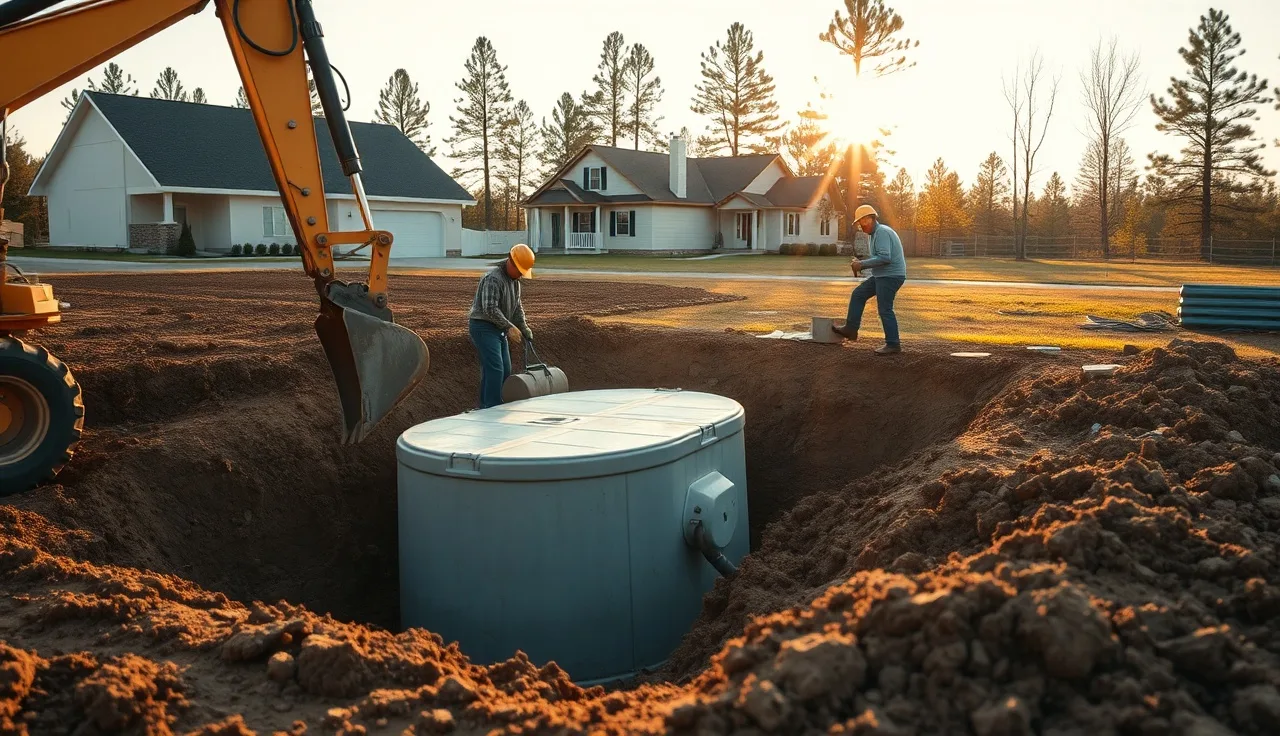
Installing a septic system is more than dropping a tank in a hole. It starts with a soil evaluation, runs through permitting, excavation, tank placement, piping, and drain field construction, and ends with a final inspection from your county health department before anyone flushes a toilet.
The system has three parts. First, the septic tank: a watertight buried container, usually 1,000 to 1,500 gallons for a house, that separates solids from liquids through settling and anaerobic digestion [1]. Second, the distribution system: pipes or a distribution box that carries clarified effluent from the tank outlet to the field. Third, the septic drain field: perforated pipes or chambers in gravel-filled trenches where effluent filters through the soil before rejoining groundwater.
The soil out in that field is doing real biological treatment. That's not a metaphor. Bacteria in the top 2 to 3 feet of native soil remove pathogens, nitrogen, and biochemical oxygen demand from the effluent. Every decision about site selection and drain field sizing exists to keep that process running.
The EPA's SepticSmart program describes the soil treatment zone as the point where "most pathogens are removed before effluent reaches groundwater" [1]. That one sentence explains why a failing drain field is a public health problem and not a backyard nuisance.
How much does septic tank installation cost?
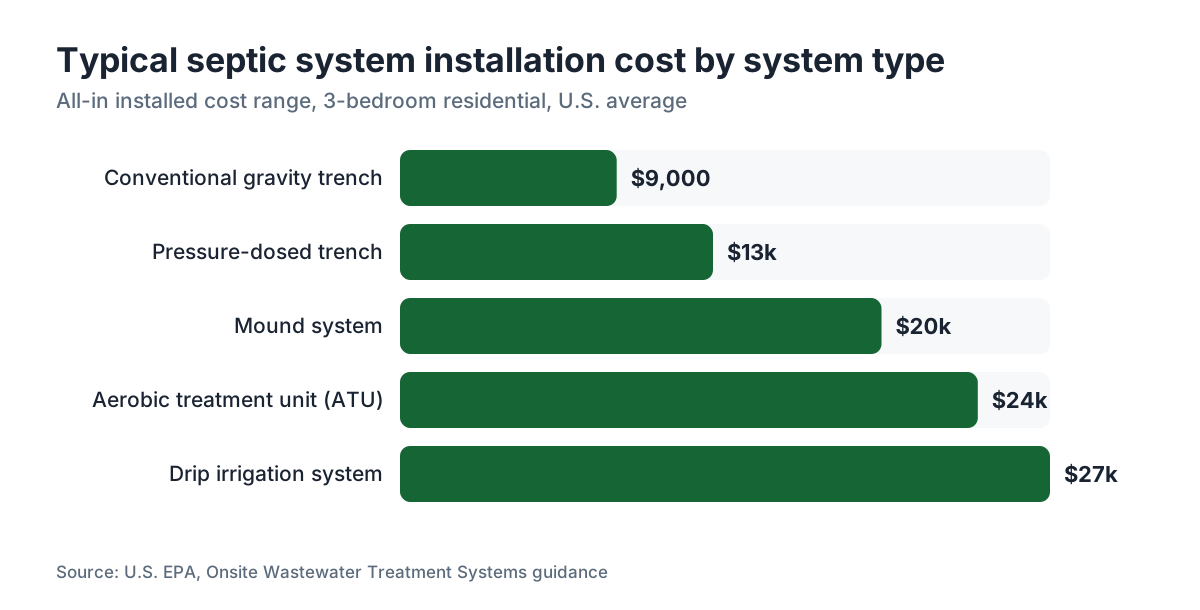
The honest range is wide. A simple conventional system on a flat lot with good sandy loam soil runs $3,000 to $7,000 installed. The same house on a lot with high groundwater, tight clay, or a small footprint might need a mound system or aerobic unit that pushes the total to $15,000 to $30,000 or more [2].
Here's how the cost of putting in a septic tank usually breaks down:
| Component | Typical Cost Range |
|---|---|
| Perc test / soil evaluation | $300, $1,500 |
| Permits and design fees | $400, $2,000 |
| Septic tank (1,000 to 1,500 gal, concrete) | $700, $2,000 |
| Excavation and backfill | $1,200, $4,500 |
| Drain field (conventional trench) | $2,000, $7,000 |
| Distribution box and piping | $200, $800 |
| Final inspection | $100, $500 |
| Total, conventional system | $3,000, $15,000 |
Alternative systems add real money. A mound system (required when the seasonal high water table or bedrock sits too shallow) typically adds $5,000 to $15,000 over a conventional build. Aerobic treatment units that dose treated effluent to drip laterals can run $10,000 to $20,000 for equipment alone [2].
Labor is the hardest line to pin down without a site visit. Excavation cost swings hard with soil type, rocky ground, slope, and equipment access. A contractor who quotes a firm installation price without walking the lot is guessing.
For a closer look at the cost variables, see our guides on the cost to install septic system and the cost to put in a septic tank.
What site conditions determine what type of system you need?
This surprises most homeowners: you don't pick your system type by price. The soil and site conditions pick it for you, and the county health department signs the design.
The percolation test (perc test) measures how fast water moves through your soil. Most states pair it with a site evaluation by a licensed soil scientist or engineer who describes soil texture and structure by horizon. Both results feed directly into drain field sizing.
Minimum soil requirements vary by state, but most track the EPA's general guidance: a minimum of 2 to 4 feet of suitable soil above a limiting layer such as hardpan, bedrock, or a seasonal high water table [3]. Miss that, and you're looking at an alternative system.
Other factors that drive system type and cost:
- Lot size and setbacks. Most state codes require 50 to 100 feet between the drain field and a well, 10 to 25 feet from property lines, and set distances from surface water. Small lots sometimes can't fit a conventional field at all.
- Slope. Steep lots need pressure-dosed systems instead of gravity flow.
- Soil permeability. Too fast (coarse gravel) is a problem, not a bonus. Very fast soils don't give effluent enough contact time for treatment.
- Topography and surface drainage. Ponding near the proposed field is a red flag.
Your state's onsite wastewater code is the binding document. Texas uses Title 30 of the Texas Administrative Code, Chapter 285 [4]. Florida uses Chapter 64E-6 of the Florida Administrative Code [5]. Every state has an equivalent, enforced locally by the county sanitarian or health department. Read your state's rules before you get attached to a budget number.
What is the step-by-step installation process?
Here's what happens between deciding you need a system and flushing the toilet for the first time.
1. Hire a licensed engineer or soil scientist (1 to 4 weeks). Most states require a licensed professional to run the site evaluation and sign the design. This person sets system type, tank size, drain field size, and setbacks.
2. Perc test and soil evaluation (1 day on site, results in a few days). The evaluator digs test pits and runs percolation tests, often in early spring when soils are at their wettest, which is the condition that matters. Some states require a licensed soil scientist to classify soil morphology instead of, or alongside, perc tests.
3. System design and permit application (2 to 8 weeks, sometimes longer). The engineer produces a site plan showing tank location, drain field layout, setbacks, and elevations. It goes to the county health department. Review times swing wildly, from a week in rural counties to months in busy jurisdictions.
4. Contractor selection and scheduling. Get at least three bids. A bid without a site visit is worthless. Verify the contractor is licensed for septic installation in your state and carries liability insurance.
5. Excavation (1 to 2 days). The crew digs the tank pit and drain field trenches. A typical residential field is 3 to 5 trenches, each 50 to 100 feet long and 2 to 3 feet wide [6].
6. Tank placement and inlet/outlet piping (half a day to 1 day). Concrete tanks are set with an excavator. The crew connects the inlet pipe from the house and the outlet pipe to the distribution box or manifold. Inspect the tank for cracks before backfill. It takes five minutes and saves a callback.
7. Drain field construction (1 to 2 days). Gravel goes in the trenches, perforated pipe lays on the gravel, more gravel covers it, and geotextile fabric caps the stone to block soil migration. Chamber systems skip the gravel and use plastic arched chambers instead.
8. Final inspection. The county inspector checks the installation against the approved design. In most jurisdictions this happens before the field is covered. Never let the crew backfill before the inspection is signed off.
9. Backfill and site restoration. The trenches close, the tank pit fills, and the site gets graded to move surface water away from the field.
From permit submission to finished system, budget 6 to 16 weeks total. The digging and installation itself is usually 3 to 5 working days.
How big does a septic tank and drain field need to be?
Tank sizing runs off bedroom count, not the number of people living there. Most state codes track EPA guidance: 1,000 gallons minimum for 1 to 3 bedrooms, 1,250 gallons for 4 bedrooms, 1,500 gallons for 5 to 6 bedrooms [6]. Some states set higher floors. Texas requires 1,000 gallons minimum for up to 4 bedrooms, then adds 250 gallons per additional bedroom [4].
Drain field sizing depends on two things: daily wastewater flow (tied to bedroom count) and the soil's absorption rate from the perc test. The standard estimate is 75 gallons per bedroom per day [9]. A 3-bedroom home generating 225 gallons a day in soil with a 30 minutes-per-inch perc rate needs a trench-bottom area calculated from your state's loading rate tables.
As a rough guide, a typical 3-bedroom conventional field runs 600 to 900 square feet of absorption area, roughly 300 to 450 linear feet of trench. That's a real chunk of yard. You have to protect it from vehicle traffic, tree roots, and construction forever.
Concrete is the most common tank for new installs. Plastic (polyethylene) and fiberglass tanks weigh less, ship easier to remote sites, and don't crack the way concrete does in aggressive soils, but they can float in a high water table if they aren't anchored right. The price gap is small. Plastic tanks cost a little less on the tank itself but may need more careful backfill.
How long does septic tank installation take?
People always underestimate the permitting phase. The physical install of a conventional system takes 3 to 5 working days for an experienced crew. From the day you decide you need a system to the day it's legally approved and running, plan on 6 to 16 weeks.
The timeline breaks down roughly like this:
- Soil evaluation scheduling and site work: 1 to 4 weeks
- Design and permit application prep: 1 to 3 weeks
- County permit review: 2 to 8 weeks (outliers exist both directions)
- Contractor scheduling: 1 to 4 weeks depending on season and demand
- Physical installation: 3 to 7 working days
- Final inspection and permit close-out: a few days to a week
Spring and summer are peak season for installers. If your job isn't urgent, scheduling for fall often buys you faster contractor availability and sometimes quicker permit turnaround when inspectors aren't buried.
Emergency replacements (a failed system with a house nobody can live in) can compress this through expedited permitting, but you still need a perc test and a design before anyone digs. Skipping those steps is exactly how people end up with a system that fails in two years.
What can go wrong during installation, and how do you avoid it?
Most installation failures trace to one of four things: a bad site evaluation, sloppy drain field construction, a tank set at the wrong elevation, or a skipped inspection.
Bad perc test timing. A perc test run in late summer during a drought gives optimistic numbers. Many states now require testing at the seasonally high water table, but enforcement is uneven. Design for fast summer drainage when the soil is actually tight and wet half the year, and the field fails early.
Drain field set too shallow. Most codes require 2 to 4 feet of suitable soil below the trench bottom [3]. A contractor who cuts trenches too shallow to dodge an obstacle is building a treatment failure.
Tank elevation errors. The tank's outlet invert has to sit at a specific elevation relative to the drain field and the inlet pipe from the house. Get it wrong and you either starve the field of flow or flood it from day one.
Backfilling too early. Skip the final inspection, or pressure the crew to cover the field before the inspector shows, and any problem gets buried until the system fails. Insist on inspection before backfill. No exceptions.
Unlicensed contractors. Septic installation is regulated at the state level. Every state licenses installers, and the license carries bonding and insurance for a reason. An unlicensed installer who does sloppy work leaves you holding the repair bill. Check your state's licensing database before you sign anything.
For what happens when a system fails after installation, the septic system repair and septic tank repair guides cover diagnosis and options.
Do you need a permit to install a septic tank?
Yes, always. No jurisdiction in the U.S. lets you legally install a new septic system without a permit. This isn't red tape for its own sake. A failing system can contaminate private wells, surface water, and the neighbors' property. Every state has an onsite wastewater code, and installing without a permit is a violation that can bring fines, a forced removal order, and liability if contamination happens.
The permit process usually runs:
- A licensed professional submits a site plan and soil evaluation results
- County health department or environmental agency review
- Issuance of an installation permit (sometimes called an "authorization to construct")
- A final inspection after installation, before backfill
- A certificate of completion or operating permit
Some states also require an operating permit for alternative systems (aerobic units, drip, mound) that must be renewed periodically and tied to a service contract with a licensed maintenance provider [5].
Pulling permits yourself is rarely worth it. Your licensed installer knows the county paperwork, knows the inspectors, and knows what gets flagged. Let them handle it. Just confirm they actually pulled the permit (ask for a copy) and that the final inspection cleared before the field got covered.
How is a drain field installed?
The septic drain field is where most of the treatment happens and where most septic failures start. Getting it right matters more than almost anything else in the build.
For a conventional gravity trench system, here's how it goes:
- The crew digs parallel trenches, typically 18 to 36 inches wide and 18 to 30 inches deep, spaced at least 6 feet center to center.
- A 6- to 12-inch layer of clean aggregate (3/4-inch crushed stone) goes in the trench bottom [8].
- Perforated PVC pipe, 4-inch diameter, lays on the gravel with perforations facing down.
- More gravel covers the pipe to 6 inches above it.
- Geotextile filter fabric caps the gravel to keep soil from washing in.
- Native soil backfills the trench.
Pressure-dosed systems work differently. A pump in the tank (or a separate pump chamber) doses effluent to the laterals in timed shots, spreading flow evenly across the field and resting sections between doses. On borderline soils, this stretches field life a lot.
Chamber systems (Infiltrator is the best-known brand) drop the gravel entirely and use arch-shaped plastic chambers set right in the trench. They're approved in most states, need less aggregate hauled in, and have a solid track record [8]. They cost about the same as gravel, sometimes a little less when aggregate is expensive to deliver.
Drain field cost ranges from $2,000 for a small conventional field to $15,000 or more for a large mound or drip system. The septic tank and drain field together for a typical 3-bedroom conventional system on a favorable site runs $7,000 to $13,000 all in [2].
What maintenance does a new septic system need from day one?
A new system gets no free pass on maintenance. The habits you set in year one decide how long it lasts.
The biggest task is routine pumping. The EPA recommends pumping every 3 to 5 years for a typical household [1]. A 1,000-gallon tank serving three people builds sludge and scum at roughly 50 to 100 gallons a year. Once solids pass about 30 percent of tank volume, they start escaping to the drain field and clogging the soil. Clogged soil doesn't bounce back. Drain field replacement runs $5,000 to $15,000. A pump-out costs $300 to $600. The math isn't hard.
For a schedule tied to your tank size and household, the how often to pump septic tank guide has the tables. Routine septic tank pumping is the single best maintenance dollar you'll spend on a new system.
Other day-one habits:
- Install septic tank risers to the surface if the design doesn't already include them. They make pumping faster, cheaper, and more likely to actually happen. A buried lid that takes a contractor an hour to find kills service calls.
- Mark the drain field corners with stakes and keep them visible. Nobody should park on it or plant a tree over it.
- Get a copy of your as-built drawing. Most states require the contractor to provide one. File it with your house records.
- Don't flush wipes, grease, or pharmaceuticals. Basic advice, and the number of systems that fail because people ignore it is not small.
SepticMind's homeowner tools track your pump-out history, remind you when service is due, and store your as-built in one place.
Alternative systems (aerobic units, drip, mound) usually require quarterly or annual maintenance contracts with a licensed provider. Budget $150 to $500 a year for that on top of routine pumping.
How do you find and vet a septic installer?
The gap between a careful installer and a careless one is real, and it shows up 5 to 15 years later when the field either keeps working or dies early. Vetting pays off.
Start with your state's licensing database. Every state that licenses septic installers (all of them, in some form) has a public lookup. Search your state name plus "septic installer license lookup." Confirm the license is current and check for disciplinary actions.
Ask for references on systems installed at least 5 years ago, not last month's jobs. An installer proud of 10-year-old systems that still run is a better signal than a smooth sales pitch.
Get three bids, all built on the same engineered design. If one comes in 40 percent under the others, find out why before you sign. It usually means someone plans to cut gravel depth, pipe bedding, or inspection coordination.
Confirm in writing that the contractor coordinates the final inspection and will not backfill before the inspector signs off. Make it explicit in the contract.
For reference: the National Association of Wastewater Technicians (NAWT) and the National Onsite Wastewater Recycling Association (NOWRA) both run training and certification programs for installers [7]. Membership doesn't guarantee quality, but it tells you the contractor takes the trade seriously enough to keep learning.
When does it make sense to repair rather than replace?
Not every septic problem needs a full replacement. The right call depends on where the failure is.
Tank problems (cracks, broken baffles, failed lids) are usually repairable for a few hundred to a couple thousand dollars. A cracked concrete tank can sometimes be sealed. A tank with a collapsed baffle just needs a new baffle. The septic tank repair guide has specifics.
Drain field problems are trickier. A field that's been neglected and carries biomat (a black greasy layer at the soil interface) but hasn't fully failed can sometimes recover with resting, aeration, or remediation treatments. A field crushed by vehicle traffic or flooded by diverted surface water is usually a replacement.
The 25-year rule is a fair heuristic. A system over 25 years old with a failing component usually makes more sense to replace whole, because the other parts are right behind it. A system under 10 years old that failed from one correctable problem (a broken pipe, a crushed distribution box) is worth repairing.
Buying a home with an existing system? Always pay for a septic system inspection before closing. A camera run on the inlet and outlet lines plus a pump-out with baffle inspection costs $300 to $600 and can save you from inheriting a $15,000 replacement. The septic tank pump out or septic tank cleaning visit is the natural time to run that assessment.
SepticMind's operator platform helps service companies track system age, service history, and component condition across their customer base, which makes these repair-versus-replace calls easier to back with data.
Frequently asked questions
How much does it cost to put in a septic tank and drain field together?
A full conventional septic tank and drain field installation runs $7,000 to $15,000 for a typical 3-bedroom home on a favorable site. Complex sites needing mound or aerobic systems push that to $15,000 to $30,000 or more. The tank alone is $700 to $2,000 of the total; excavation, drain field construction, and permitting make up the rest. Get bids after the soil evaluation is done, not before.
How long does a septic tank installation take from start to finish?
The physical install takes 3 to 7 working days. The full process, from soil evaluation through permitting, contractor scheduling, installation, and final inspection, typically runs 6 to 16 weeks. Permitting is almost always the longest stretch. Expedited reviews happen in some counties for genuine emergencies but aren't the norm. Plan for at least two months if you're starting from scratch.
Can you install a septic tank without a permit?
No. Every U.S. jurisdiction requires a permit for new septic installation. Installing without one is a legal violation that can bring fines, a mandatory removal order, and personal liability for any contamination. The permit process also includes a final inspection before backfill, which is the main quality checkpoint. Skip it and you bury problems that surface years later.
What size septic tank do I need for a 3-bedroom house?
Most state codes require a 1,000-gallon tank minimum for a 3-bedroom home. Some states set higher floors, and many engineers spec 1,250 gallons for 3 bedrooms as a practical standard. Tank sizing runs off bedroom count, not actual occupants, because bedrooms proxy for potential household size at resale. Check your specific state code before finalizing the design.
How deep is a septic tank buried?
Typically 1 to 4 feet below finished grade, measured to the top of the tank. Exact depth depends on the slope from the house to the tank, local frost depth, and the elevation needed for gravity flow to the drain field. In cold climates the tank and inlet pipe need enough cover to prevent freezing, usually at least 12 inches and often more.
How long does a septic system last?
A well-installed conventional system on good soil, pumped every 3 to 5 years, routinely lasts 25 to 40 years. The drain field is the life-limiting part. Neglect pumping and solids migrate to the field and clog the soil, cutting that lifespan to 10 to 15 years. Alternative systems with mechanical parts (pumps, aerators) have shorter service lives, typically 10 to 20 years per component.
What's the difference between a conventional septic system and an aerobic treatment unit?
A conventional system uses anaerobic digestion in the tank and soil treatment in the field. An aerobic treatment unit (ATU) injects air into the treatment chamber, producing higher-quality effluent that can go to a smaller or less-permeable field or sometimes straight to surface drip irrigation. ATUs cost more upfront ($10,000 to $20,000 for the unit alone) and need regular service contracts, but they're necessary when soil won't support a conventional field.
How far does a septic tank have to be from the house and the well?
Setbacks vary by state, but typical minimums are 5 to 10 feet from the house foundation, 50 to 100 feet from a private drinking water well, 25 to 100 feet from surface water, and 10 feet from property lines. The drain field has its own setbacks, usually larger than the tank's. Your state's onsite wastewater code lists the exact numbers. These are minimums; engineers often want more buffer.
What type of soil is best for a septic drain field?
Sandy loam or loamy sand with a perc rate of 1 to 60 minutes per inch is generally ideal. Very fast soils (under 1 minute per inch) don't give effluent enough contact time for treatment. Very slow soils (over 60 to 120 minutes per inch, depending on the state) won't absorb enough daily flow. Most state codes list acceptable perc rate ranges in their loading rate tables.
How often should a new septic tank be pumped?
The EPA recommends every 3 to 5 years for a typical household. The exact interval depends on tank size, occupants, and how much solid waste enters the system. A 1,000-gallon tank serving four people should probably get pumped every 3 years. A 1,500-gallon tank serving two people can go 5 to 7 years. After the first pump-out, the technician can tell you exactly how fast sludge builds in your tank.
Can I install my own septic system?
Technically some states allow owner-installed systems on the owner's primary residence, but it's rare and still requires a licensed engineer's design, permit approval, and final inspection. Most counties effectively require a licensed installer because of the insurance and bonding attached to the permit. For most homeowners the answer is no: hire a licensed installer, because the liability from a failed DIY install is enormous.
What's a septic tank riser and do I need one?
A riser is a vertical pipe section that extends the tank's access opening to within a few inches of the ground surface. Without one, contractors spend time digging to find the lid before every service call, which adds cost and delays. Most installers add risers during installation for $100 to $300 each. Do it at install time, since retrofitting later costs more. See the septic tank risers guide for specifics.
Does a new septic system affect property value?
A functioning, permitted, modern septic system generally doesn't reduce property value compared to a public sewer connection. A failing or aging system is a real liability that buyers and inspectors flag fast. In rural markets a new system can be a selling point. The key word is permitted: an unpermitted system creates title issues and can block financing from FHA or VA lenders.
Sources
- U.S. EPA, SepticSmart Program overview: EPA recommends pumping every 3 to 5 years and describes the soil treatment zone as where most pathogens are removed before effluent reaches groundwater
- U.S. EPA, Septic System Costs and Financing (Onsite Wastewater Treatment Systems): Conventional system costs range from roughly $3,000 to $15,000; alternative systems including mound and drip can reach $15,000 to $30,000 or more
- U.S. EPA, Onsite Wastewater Treatment Systems Manual (EPA/625/R-00/008): Minimum of 2 to 4 feet of suitable soil above a limiting layer (hardpan, bedrock, or seasonal high water table) required for conventional drain field installation
- Texas Commission on Environmental Quality, Title 30 TAC Chapter 285, On-Site Sewage Facilities: Texas requires a 1,000-gallon minimum tank for up to 4 bedrooms, then 250 gallons per additional bedroom, under Chapter 285
- Florida Department of Health, Chapter 64E-6 Florida Administrative Code, Standards for Onsite Sewage Treatment and Disposal Systems: Florida requires operating permits for alternative systems including aerobic treatment units, with mandatory service contracts
- Penn State Extension, Septic System Sizing and Design: Standard tank sizing guidance: 1,000 gallons for 1-3 bedrooms, 1,250 gallons for 4 bedrooms, 1,500 gallons for 5-6 bedrooms; typical residential drain field trenches are 50-100 feet long
- National Onsite Wastewater Recycling Association (NOWRA): NOWRA and NAWT maintain training and certification programs for septic system installers and service providers
- University of Minnesota Extension, Septic System Owner's Guide: Conventional gravity trench drain fields use 3/4-inch crushed stone aggregate, perforated pipe, and geotextile fabric; chamber systems are an approved alternative
- North Carolina State University Extension, Residential Wastewater Systems: Drain field sizing is based on daily wastewater flow (estimated at 75 gallons per bedroom per day) and the soil percolation rate
- U.S. EPA, A Homeowner's Guide to Septic Systems: The EPA homeowner guide covers routine maintenance including pump-out frequency, water conservation, and avoiding introduction of harmful substances
Last updated 2026-07-09