Septic tank installers: how to hire one and what to expect
By the SepticMind Editorial Team
TL;DR
- A licensed septic installer handles permits, soil testing, excavation, tank placement, and drain field construction.
- Installed costs run $3,000 to $15,000 or more, driven by soil conditions, tank size, and state rules.
- Verify the installer holds your state's onsite wastewater contractor license before you sign anything.
- An unlicensed install fails inspection and can void the tank warranty.
What does a septic tank installer actually do?
Most homeowners picture a truck dropping a concrete box in the ground. The real job runs a lot deeper than that.
A septic installer is a licensed contractor who reads or designs a site plan, pulls permits, arranges a soil evaluation (the perc test or soil morphology assessment), excavates for the tank and leach field, hauls and sets the tank, connects inlet and outlet piping to the house, builds the distribution system, backfills, and lines up final inspection with the local health department [1]. In most states a licensed person has to be on-site or supervising every phase of the work.
Some installers also hold a design license. Many do not. If your property needs a full site evaluation and system design first, you might hire a licensed soil scientist or onsite wastewater designer separately, then bring in the installer to build what the design calls for. Ask this upfront: do you design as well as install, and if not, who handles the design?
The installer answers to two sets of rules. State licensing governs the contractor. Local health department or zoning rules govern the system itself. Those are not the same thing, and a contractor licensed statewide may not meet one county's specific permit conditions. That gap matters most when your lot sits near a well, a water body, or a property line.
What licenses and certifications should a septic installer have?
Licensing is state-controlled in the U.S., so no single national credential covers everyone [2]. The pattern is consistent anyway: every state that regulates onsite wastewater systems, which is all of them, requires installers to hold a state-issued license, registration, or certification before they can pull a permit.
Here is what to look for in most states:
| Credential | Who issues it | What it means |
|---|---|---|
| Onsite/septic system installer license | State health or environmental agency | Contractor can legally install septic systems in that state |
| Journeyman or apprentice card | Same agency | Allows supervised installation work |
| Plumber's license | State licensing board | Required for interior connections in many states, sometimes separate from the septic license |
| NAWT certification | National Association of Wastewater Technicians | Voluntary national credential; a positive signal but not a substitute for state licensure |
| Soil evaluator/designer license | State agency | Required to conduct perc tests and write system designs; often a separate credential from installer |
The National Association of Wastewater Technicians (NAWT) runs a voluntary installer certification and training program that a number of states accept as part of their licensing pathway [3]. It does not replace a state license. Seeing it on a contractor's wall is a fair quality signal, nothing more.
Verify licensure yourself, every time. Most state health or environmental agencies keep a public lookup. Search "[your state] septic installer license lookup" and check it. Do not take the contractor's word for it. An unlicensed installation will not pass inspection, will likely void the tank warranty, and can create title problems when you sell the house.
How much does a septic tank installer charge?
Honest answer: it swings hard on your site, and anyone who quotes a flat price before reading the soil report is guessing. A quote written before the perc test is a wish, not a bid.
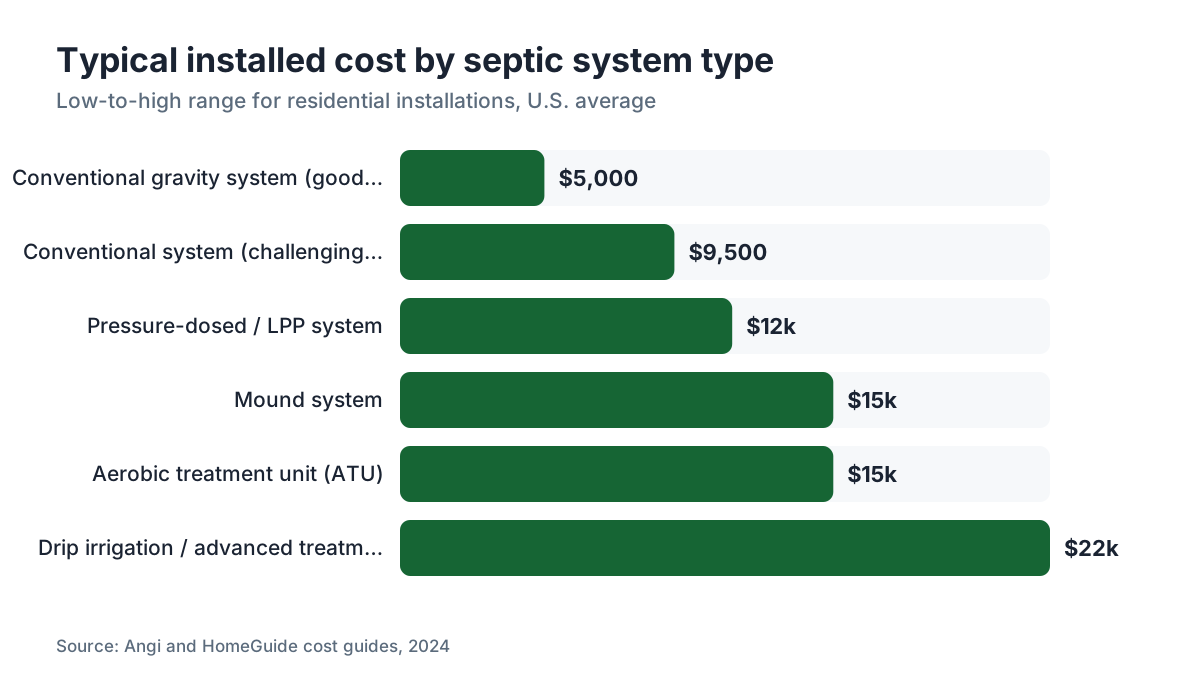
With that said, here are real ranges by system type and typical scope [4][5]:
| System type | Typical installed cost (U.S.) |
|---|---|
| Conventional gravity system, 1,000-gal tank, good soil | $3,000 to $7,000 |
| Conventional system, challenging soil, larger tank | $7,000 to $12,000 |
| Pressure-dosed or low-pressure pipe system | $8,000 to $15,000 |
| Mound system (poor drainage, high water table) | $10,000 to $20,000+ |
| Aerobic treatment unit (ATU) | $10,000 to $20,000+ |
| Drip irrigation or advanced treatment system | $15,000 to $30,000+ |
What drives the number? Labor and excavation are usually the biggest swing. Rocky soil costs more to dig. A high water table forces a mound or modified system. Lot size sets how far the installer runs pipe. Permit fees vary by county and can run from under $200 to over $1,000 on their own. The tank is a smaller slice than people expect: a standard 1,000-gallon precast concrete tank usually costs $600 to $1,200 before delivery and setting [5].
Get at least three written bids after the soil evaluation is done. See our full breakdown at cost to install septic system and cost to put in a septic tank.
One thing I would tell a friend: if the lowest bid sits far below the other two and the contractor cannot explain why, treat it as a warning. Septic work that skimps on depth, pipe slope, or aggregate is not cheaper. It just fails sooner, on your dime.
How do you find a reputable septic tank installer?
Start with your state's licensing database, not Google reviews. Most state health departments or environmental quality agencies publish a searchable list of licensed onsite wastewater installers. That list is your starting point.
From the verified list, use these filters:
Local track record. A contractor who has installed systems in your county already knows the health department inspectors, the common soil types, and what tends to fail inspections. That knowledge is worth real money.
References from recent jobs. Ask for two or three homeowners they installed for in the past year, and actually call them. Ask: did the crew show up on schedule, did the final inspection pass on the first try, and were there surprises in the final bill?
Written, itemized quotes. A reputable installer gives you a proposal that breaks out permit fees, tank cost, excavation, backfill, pipe, and labor. If a quote is a single-line total, ask for the breakdown. You need it to compare bids fairly.
Insurance. Ask for a certificate of general liability and workers' compensation. If someone gets hurt on your property and the contractor carries no coverage, the liability can land on you. This is not hypothetical.
The EPA's SepticSmart program advises working with licensed professionals and warns that systems installed by unlicensed contractors may not meet local codes and can create public health hazards [1]. That is a polite way of saying unlicensed installs go wrong at a much higher rate.
Your county health department is a legitimate referral source too. The inspector who approves systems locally usually knows which contractors pass on the first try. Call and ask. It is completely reasonable.
What happens step by step during a septic system installation?
Knowing the sequence tells you when to be on-site, when to ask questions, and when something is happening out of order.
- Site evaluation and design. A licensed soil evaluator runs a perc test or soil morphology assessment. The results decide what system type is permitted. This step comes before any permit in virtually every state [2].
- Permit application. The installer or homeowner submits the site evaluation, system design, and application to the local health department. Review takes anywhere from a few days to several weeks by county.
- Excavation. The crew marks setbacks (from wells, property lines, water bodies, and structures), then digs the tank pit and the leach field trenches or bed. This is the loudest, most visible day of the job.
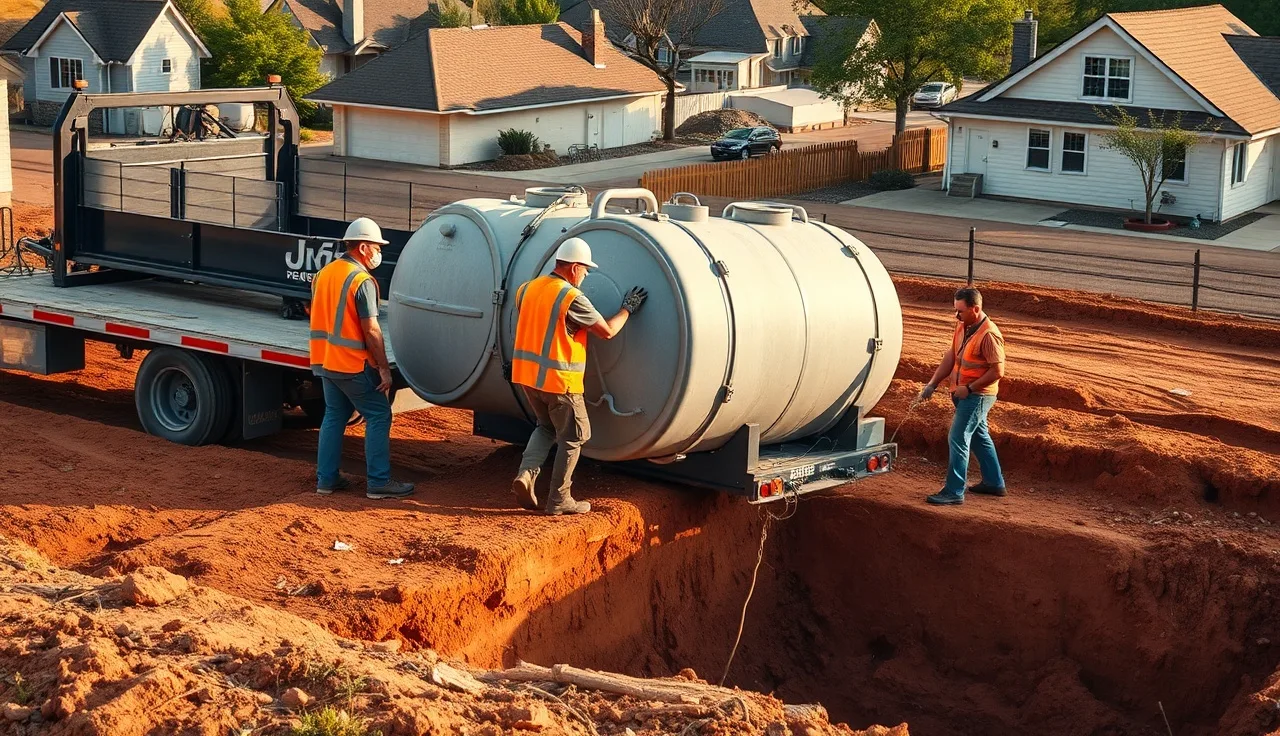
- Tank delivery and setting. Precast concrete tanks usually arrive by flatbed and get set with a crane or excavator. Plastic and fiberglass tanks are lighter but need careful backfilling to keep them from floating in high water table areas.
- Piping connections. The installer connects the inlet line from the house and the outlet line to the distribution system. Slope matters: the inlet pipe generally needs a 1/4-inch drop per foot of run [6]. Too steep and solids race past the tank. Too shallow and you get backups.
- Distribution system installation. Depending on the design, this is leach field trenches with perforated pipe and gravel, a drip network, a mound, or another approved layout.
- Inspection. In most jurisdictions the health department inspector visits before backfill. Do not let the installer cover the system first. This is your legal protection and the inspector's only chance to verify what actually went in the ground.
- Backfill and site restoration. Once the inspection passes, the crew backfills, grades for drainage away from the system, and usually seeds or sods the disturbed areas.
The whole process, from permit application to final sign-off, commonly runs two to eight weeks. Most of that is permit processing and scheduling, not construction. The physical install of a conventional system often wraps in one to three days on the ground.
What questions should you ask a septic installer before hiring?
These are the questions I would ask if it were my property:
Are you licensed in this state and county? (Ask for the license number so you can verify it yourself.)
Will you pull all required permits, or is that on me? (It should be theirs.)
Who performs the soil evaluation, and is that included in your bid?
What system type do you recommend for my site, and why?
What tank material do you use and why? (Concrete, plastic, and fiberglass each trade off differently depending on soil chemistry and water table.)
What is your warranty on labor and installation, separate from the tank manufacturer's warranty?
How do you handle surprises during excavation, like rock or unexpected soil? What is the change-order process?
Who is the on-site supervisor, and will a licensed contractor be present throughout?
Can you give me two or three references from jobs in this county in the past twelve months?
Do you carry general liability and workers' comp, and can you provide a certificate before work starts?
The answers matter, but so does the way they answer. Someone who gets defensive about license verification, or vague about supervision, is telling you something.
What permits and inspections are required for a new septic installation?
Every state requires a permit for new septic installation, and most require one for replacement or major repair as well [2]. The agency varies: some states run it through the county health department, others through a state environmental quality or wastewater management office.
Typical permit requirements include:
- Completed application form
- Soil evaluation report from a licensed soil evaluator
- Approved system design or site plan
- Setback documentation (distances from wells, property lines, wetlands, etc.)
- Application fee (commonly $100 to $500, higher in some jurisdictions)
Inspections happen at least twice in most states. Once during installation before backfill (the "open trench" inspection), and once after completion. Some states add inspections at specific phases, like tank placement or distribution system installation. The inspector signs off on each phase before the next can start.
If your installation gets backfilled before inspection, you may have to dig it back up and expose it at your own cost. That has happened to homeowners who let contractors rush ahead of the inspector's schedule.
After final approval you should receive a permit completion certificate or "as-built" record that documents the system location, tank size, and design. Keep this document. You will need it to sell the house, and it is essential for any future septic tank inspection or repair.
How long does a septic system installation take?
The construction is usually quick. A straightforward conventional system on cooperative soil takes one to three days of ground work. A complex mound system or advanced treatment unit might run four to seven days on-site. Everything around the digging is what eats the calendar.
Soil evaluation scheduling can add one to four weeks depending on the evaluator's calendar and weather. Perc tests often need the soil at a specific moisture level.
Permit processing is the most variable factor. A simple rural county might approve in three to five business days. Suburban counties with high volume or complex review can take four to twelve weeks.
Contractor scheduling adds time too. A good installer who passes inspections consistently is usually booked out. If someone can start tomorrow, ask why.
Total timeline from first site visit to final inspection typically runs six to twelve weeks for a conventional system. If your project needs a variance (say, reduced setbacks because of a tight lot), the review can stretch well past that.
Plan for the longer end if you are on a deadline like a real estate closing. Sellers trying to install a new system as a sale contingency underestimate permit time constantly.
What can go wrong with a septic installation, and how do you protect yourself?
Most installation failures fall into a handful of buckets, and nearly all of them hide until the system is in daily use.
Improper slope on the inlet or outlet pipe. Wrong slope means solids either race through or back up. Hard to catch once it is buried.
Insufficient depth or cover over the tank and field. In cold climates, shallow work leads to freezing. Some contractors cut depth to shave excavation time.
Wrong system for the soil. If the soil evaluation was rushed, wrong, or ignored, the system type may not match actual conditions. A system built for well-draining soil that lands in marginal clay fails early.
Poor backfill compaction around the tank. Weak compaction causes settling, which cracks inlet and outlet fittings and leads to leaks inside the tank or at the lid.
No effluent filter, or the wrong one, at the outlet. Modern installations should include an effluent filter at the tank outlet to protect the drain field. Some older hands skip it.
Here is how you protect yourself. Do not skip the pre-backfill inspection. It is the single best safeguard you have. Get a written contract that spells out the system design, tank size, pipe specs, and warranty terms. Photograph the open trench before backfill. Keep every permit and as-built record.
For repairs down the road, see our guides on septic tank repair and septic system repair. Once the system is running, follow the EPA's SepticSmart guidance to "have your system inspected every 3 years by a licensed contractor and have your tank pumped when necessary (generally every 3 to 5 years)" [1]. Regular septic tank pumping and septic tank inspection are what keep a well-installed system running 20 to 40 years.
How do septic installers work with soil evaluators and health departments?
This relationship shapes your timeline and your cost, so it pays to understand it.
The soil evaluator (sometimes called a soil scientist, perc tester, or onsite wastewater designer) is usually a separate licensed professional from the installer. Their job is to read the lot's soil, set the loading rate and treatment capacity, and specify what type of system can legally go there [2]. In some states the installer holds a dual license and can do the evaluation. In most, they cannot.
The health department reviews the evaluator's report and issues the permit. The installer builds what the permit approves. The inspector verifies the build matches the permit before sign-off.
Things get complicated when the installer and the designer are not talking. If the installer shows up and the site looks different from the design (say, ledge rock three feet down when the design assumed six), they need to stop, go back to the designer and health department, and re-permit before continuing. Installers who improvise without re-permitting create problems that surface later, usually when you try to sell or when the system fails.
If you are managing a multi-party project like this, keep a shared log of who approved what and when. Some operators run field management tools for exactly this documentation. SepticMind, for example, helps service operators track job status, permits, and inspection records across multiple active installations.
When should you replace your septic system versus repair it?
Most homeowners face this question not when buying a new system, but when an existing one is failing.
Repair makes sense when the problem is isolated: a cracked tank lid, a broken baffle, a clogged effluent filter, or a localized pipe failure. You can fix those without touching the rest of the system, and the cost usually lands well under $2,000.
Replacement becomes the answer when:
- The drain field is saturated and cannot recover, typically after years of use or a stretch of hydraulic overload.
- The tank is structurally gone (major cracks, a collapsed inlet or outlet section).
- The system keeps failing inspection and repairs have not fixed it.
- Local codes changed, and the existing system no longer meets setback or treatment rules that trigger a replacement-on-failure requirement.
Drain field failure is the most common driver of full replacement. The EPA puts the average lifespan of a conventional septic system at 20 to 40 years with proper maintenance [7]. Systems that never get pumped fail on the short end, because solids carry into the field and clog the soil.
Buying a house where the seller's disclosure mentions septic trouble? Get a septic tank inspection from an independent inspector before closing. A failing drain field costs $5,000 to $20,000 to replace, and it rarely shows from a surface look.
For maintenance schedules after installation, how often to pump septic tank is a practical starting point.
How do septic installers price and structure their bids?
Most legitimate installers price residential work by scope, not by the hour. A clean bid separates these line items:
- Permit fees (usually passed through at cost)
- Soil evaluation fee (if included; often it is not)
- Tank cost including delivery and setting
- Excavation (tank pit and field trenches)
- Pipe, fittings, and distribution components
- Aggregate or engineered media for the field
- Labor for installation and connections
- Backfill and rough grading
- Any required pumps, control panels, or alarms for pressure or mound systems
- Site restoration (seeding or sod)
Got a quote with no line items? Ask for the breakdown. Comparing two all-in totals is nearly impossible. Comparing itemized quotes shows you where one contractor is saving money or padding.
Change orders are normal on this work. Unexpected rock, groundwater, or soil conditions can add cost mid-project. Ask each bidder how they handle change orders: do they get your written approval before proceeding, or notify you after the fact? Written approval before proceeding is the right answer.
Some installers offer financing or payment plans, especially on higher-cost systems. If you need it, ask. Many will work with you rather than lose the job. SepticMind's operator platform is built for contractors who want to manage bids, job tracking, and customer communication in one place, which cuts the miscommunication behind most billing disputes.
For the full cost picture, see septic tank installation and cost to install septic system.
Frequently asked questions
Do I need a licensed contractor to install a septic tank, or can I do it myself?
In nearly every U.S. state, a licensed contractor is legally required to install a septic system, or at minimum to pull the permit and supervise the work. A few rural states let a property owner install their own system under a homeowner permit, but those states are the exception. Check with your county health department before assuming you can DIY it. An unlicensed installation typically will not pass inspection.
How do I verify that a septic installer is licensed in my state?
Go to your state health department or state environmental quality agency website and search for their onsite wastewater contractor license lookup. Most states publish a searchable public database. Enter the contractor's name or license number and confirm the license is current and in good standing. Do not rely on verbal confirmation or a copy of an old license card.
What is the difference between a septic installer and a septic designer?
A designer (typically a licensed soil evaluator, soil scientist, or onsite wastewater designer) reads your site's soil, specifies the correct system type, and draws the permitted design. An installer builds what the design calls for. In some states one person holds both licenses. In many states they are separate credentials. Make sure both roles are covered before you break ground.
How many bids should I get for a septic installation?
Three is the practical minimum for a job this size. You want enough bids to read the market rate for your area and to catch outliers in either direction. Get all bids after the soil evaluation is complete and the system design is finished, so every contractor prices the same scope. Bids written before the site evaluation are rough guesses and not useful for comparison.
Can a plumber install a septic tank?
A licensed plumber can usually connect interior drain lines to the septic system's inlet pipe, and in some states a plumbing license also covers exterior septic work. In most states, though, onsite wastewater installation requires a separate septic or onsite wastewater contractor license distinct from a standard plumbing license. Confirm with your state licensing agency before assuming a plumber covers the full scope.
How long does a septic tank last after installation?
A well-installed precast concrete tank typically lasts 40 or more years with proper maintenance. Plastic and fiberglass tanks can last similarly long if correctly installed and not damaged during backfill. The drain field is usually the first component to fail, commonly after 20 to 40 years depending on usage, soil, and whether the tank was pumped on schedule. Regular pumping and inspections are the biggest single factor in lifespan.
What size septic tank do I need?
Tank size is set by your local health department based on bedroom count or estimated daily flow. The most common residential minimum in the U.S. is 1,000 gallons for homes up to three bedrooms, with many jurisdictions requiring 1,250 or 1,500 gallons for larger homes. Your installer or designer specifies the required size during the permit process. Bigger is generally better if the budget allows.
What soil conditions make septic installation harder and more expensive?
High water tables, clay-heavy soils with low permeability, bedrock close to the surface, and very sandy soils with excessive permeability all complicate installation and usually force an alternative system type. These conditions raise costs because they may require mound systems, pressure dosing, engineered media, or advanced treatment units. That is exactly why the soil evaluation has to happen before any pricing is final.
Does homeowners insurance cover septic system installation or failure?
Standard homeowners policies generally do not cover septic replacement or failure from age and wear. Some insurers offer septic riders or service-line coverage add-ons that cover sudden failure or collapse. Coverage for damage from a covered peril (like a tree falling on the tank) may apply under the main policy. Read your policy carefully and ask your agent specifically about septic coverage.
What records should I keep after a septic system is installed?
Keep the permit, the as-built drawing showing the exact location of the tank and drain field, the inspection sign-off document, the tank manufacturer's specs, and any warranties from the installer. These documents matter when you sell the house, when you need repairs, and for any future pumping or inspection service. Store copies digitally and on paper.
How often should a new septic system be pumped?
The EPA recommends pumping every three to five years for a typical household, but the right interval depends on household size, tank volume, and what goes down the drains. A newly installed system with a properly sized tank and normal usage will likely need its first pump-out at the three-to-five-year mark. See our guide on how often to pump a septic tank for a table of intervals by household size.
Can a septic installer work across state lines?
Generally no. Septic installer licenses are state-specific and often county-specific in their permit authority. A contractor licensed in one state must separately apply for licensure in neighboring states. This matters if you live near a state border. Always confirm the installer's license is current in your state, more than in a neighboring state where they do more of their business.
What is a perc test and who performs it?
A percolation test measures how fast water drains through your soil, which decides whether a conventional drain field will work and at what loading rate. A licensed soil evaluator, soil scientist, or onsite wastewater designer performs it, not the installer. Many modern jurisdictions use a soil morphology assessment (physical examination of soil layers) instead of or alongside a timed perc test. The result drives the entire system design.
Sources
- U.S. EPA, SepticSmart Program: EPA SepticSmart advises working with licensed professionals and recommends inspection every 3 years and pumping generally every 3 to 5 years; notes unlicensed contractors may not meet local codes and can create public health hazards.
- U.S. EPA, Onsite Wastewater Treatment Systems Manual (EPA/625/R-00/008): Every state requires a permit for new septic installation; soil evaluation and system design must precede permit issuance; installer licensing is state-controlled.
- National Association of Wastewater Technicians (NAWT): NAWT offers voluntary installer certification accepted in multiple state licensing pathways.
- Angi, Septic System Installation Cost Guide: Typical installed cost ranges: conventional system $3,000 to $7,000; mound or advanced systems $10,000 to $20,000+.
- HomeGuide, Septic Tank Cost Guide: A standard 1,000-gallon precast concrete tank typically costs $600 to $1,200 before delivery and setting.
- International Association of Plumbing and Mechanical Officials (IAPMO), Uniform Plumbing Code: Building sewer piping generally requires a minimum slope of 1/4 inch per foot for typical residential pipe sizes.
- U.S. EPA, How Your Septic System Works: EPA states that the average lifespan of a conventional septic system is 20 to 40 years with proper maintenance.
- National Environmental Services Center (NESC) at West Virginia University: Soil evaluation (perc test or morphology assessment) must be performed by a licensed evaluator and must precede system design and permitting.
- Pennsylvania Department of Environmental Protection, Onsite Sewage Facilities: State example of onsite wastewater contractor licensing requirements and permit process for new septic installations.
- Texas Commission on Environmental Quality (TCEQ), On-Site Sewage Facilities: Texas OSSF rules require a licensed installer and licensed designer for all new septic system installations; inspector sign-off required before backfill.
Last updated 2026-07-09