Cleaning a septic system: what it costs and what actually happens
By the SepticMind Editorial Team
TL;DR
- Cleaning a septic system means pumping out the accumulated sludge and scum from your tank, usually every 3 to 5 years.
- Most homeowners pay $300 to $600.
- The job takes 1 to 2 hours.
- Skip it too long and solids overflow into the drain field, which turns a $400 maintenance call into a repair that can top $10,000.
What does cleaning a septic system actually involve?
People use 'septic system cleaning' to mean a few different jobs, so pin down the terms before you hire anyone.
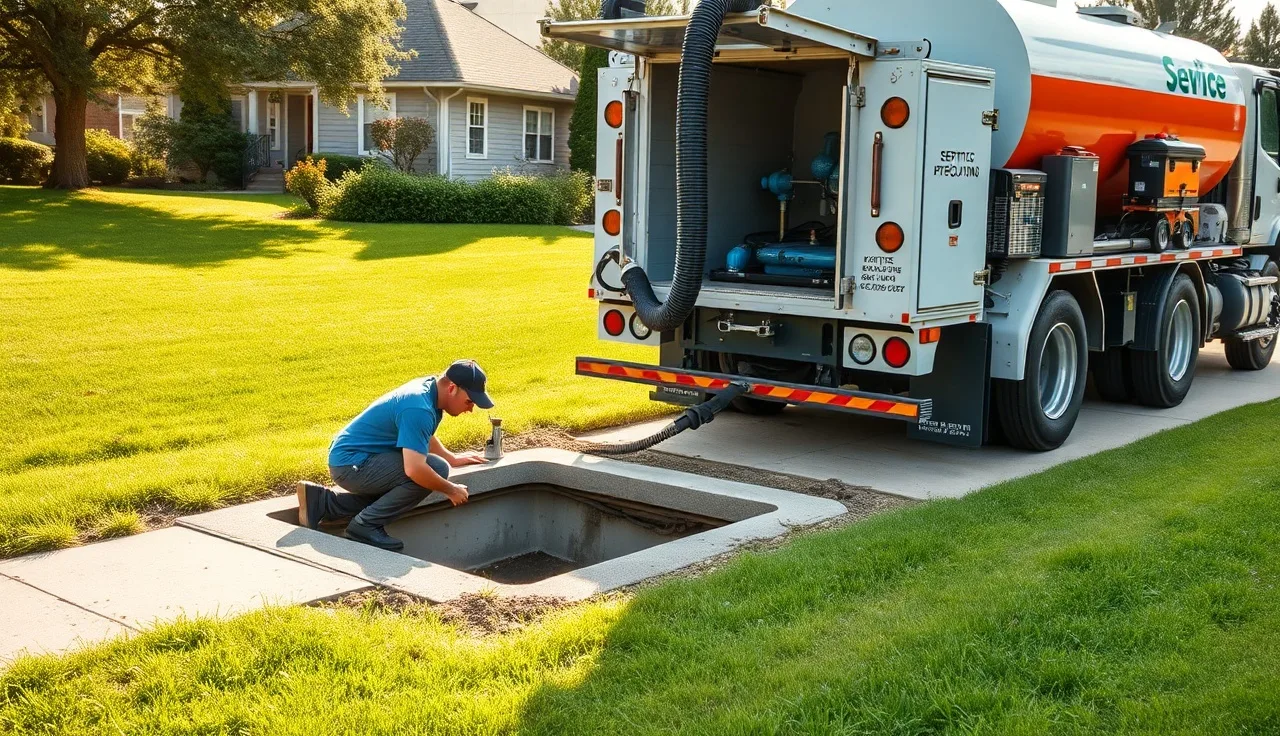
The core service is pumping. A truck with a vacuum hose removes the sludge (settled solids at the bottom) and scum (floating grease and lighter material at the top) from your tank. What's left after a proper pump-out is nothing. The liquid effluent layer that normally drains out to the field on its own gets vacuumed too. A thorough job removes all three layers. Some contractors leave the solids behind, suck off the liquid, and call it done. That's the shortcut you don't want. [1]
Beyond pumping, a real cleaning includes inspecting the inlet and outlet baffles (the T-shaped fittings that keep solids from flowing straight through the tank), checking the distribution box if your system has one, and running a hose into the tank to break up any hardened crust before vacuuming. Some operators also jet or flush the inlet line from the house if they find a partial blockage.
Cleaning the drain field is a different and pricier job. If your field is sluggish or ponding, no pump-out fixes that. You're looking at aeration, hydro-jetting the laterals, or in the worst case, replacement. Don't let a salesperson fold 'drain field cleaning' into a routine pump-out quote without spelling out the extra work. Our guide to septic drain field problems covers what to watch for.
Newer systems change the math. Aerobic treatment units and mound systems have air pumps, spray heads, and chlorine tablets that need their own maintenance separate from the tank pump-out. Pull your system's original permit documents so you know exactly what you own.
How much does septic system cleaning cost?
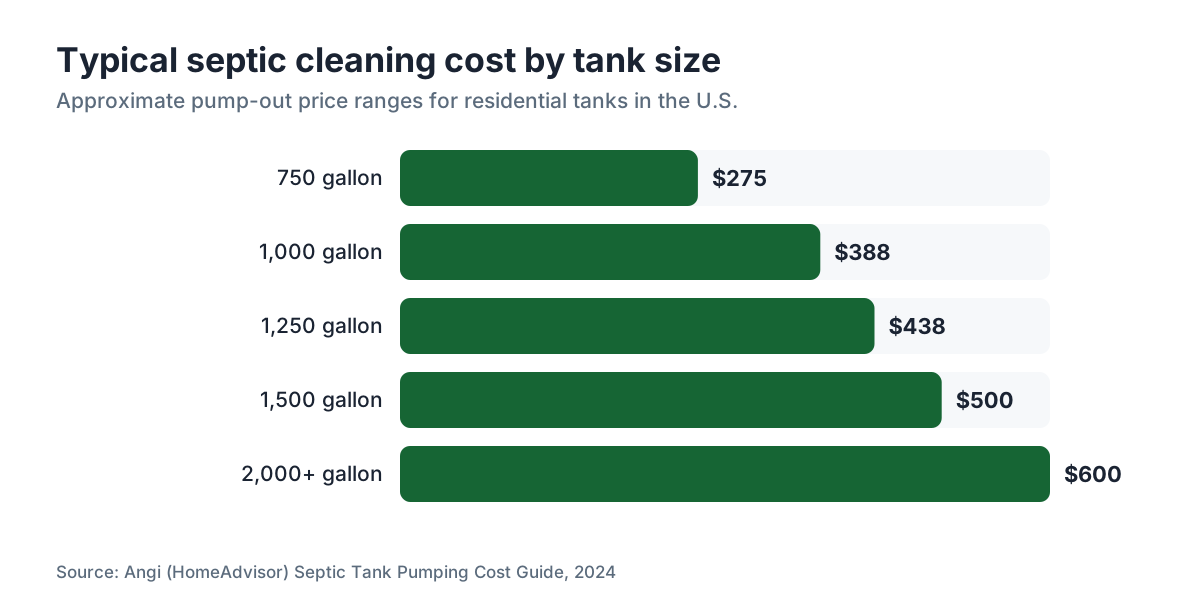
A standard residential pump-out runs $250 to $700, and most homeowners land between $300 and $600. [2] Home services sites peg the national average near $400 to $450 for a typical 1,000-gallon tank. That number moves a lot based on where you live, how long since the last pump, and whether the technician finds a problem.
Here's what drives the price up or down:
- Tank size. A 1,000-gallon tank (common in homes built before 1990) costs less than a 1,500- or 2,000-gallon tank. Contractors charge by the gallon or by time once the truck is on site.
- Access difficulty. If your tank lid sits under a foot of soil and there's no riser, expect a $50 to $150 add-on for locating and digging down to it. Installing a septic tank riser after cleaning kills that charge on every future visit.
- Time since last pump. A tank that hasn't been touched in 10 years may hold hardened sludge that needs extra work and maybe more than one truck load.
- Location. Urban markets with higher labor rates and stricter disposal rules run higher than rural areas where the truck can land-apply waste on nearby farmland.
- Extra services. Baffle inspection, a camera run of the outlet line, or treatment additives all add to the bill.
The table below breaks cost down by tank size. These are approximate ranges from market surveys, and your local prices may differ. [2]
| Tank size | Typical pump-out cost |
|-----------|----------------------|
| 750 gallon | $200, $350 |
| 1,000 gallon | $275, $500 |
| 1,250 gallon | $325, $550 |
| 1,500 gallon | $375, $625 |
| 2,000+ gallon | $450, $750+ |
If a full-service quote comes in under $200, ask what's actually included. Low-ball numbers often cover partial pumping or skip the inspection.
A full septic system installation runs $3,000 to $15,000 or more depending on system type and soil [3]. That puts the $400 cleaning cost in perspective fast.
How often should you clean your septic system?
The EPA recommends inspecting a conventional system every 3 years and pumping every 3 to 5 years. [1] Treat that as a starting point, not a fixed rule. Your real interval rides on four things.
- Household size. The EPA and many state extension programs use a rule of thumb of roughly 50 gallons of wastewater per person per day. A 1,000-gallon tank serving two people fills far slower than the same tank serving five.
- Tank size relative to the house. Older homes often have undersized tanks. If you bought a 4-bedroom house on a 750-gallon tank, pump every 2 years or upgrade to a larger tank.
- What goes down the drain. Garbage disposals add real organic load. Run one daily and you may need to pump every 2 years instead of 4.
- Measured solids. The honest test is the sludge and scum measurement taken during inspection. Once combined sludge and scum fill more than a third of the tank's working volume, it's time to pump no matter what the calendar says. [9]
A good contractor measures sludge depth every visit and records it, so your schedule reflects your actual usage instead of a generic number. If yours doesn't, ask them to start.
For pumping intervals broken out by household size and tank volume, see how often to pump septic tank.
What happens if you skip septic cleaning too long?
Nothing good.
Once sludge builds past the point where the outlet baffle can hold it back, solids flow out of the tank and into the drain field. Soil pores clog with biomat, hydraulic conductivity drops, and the field fails. Now you're past a $400 pump-out. You're looking at a septic system repair or full replacement that runs $5,000 to $25,000 or more depending on system type and soil. [3]
Signs that neglect has already done damage:
- Slow drains in the house that persist even after the tank is pumped
- Wet or spongy ground over the drain field, worse after rain
- Sewage odor near the tank or field
- Sewage backing up into the lowest fixtures in the house
See any of these after a pump-out and the tank wasn't your only problem. You may need a field inspection or a camera run of the outlet line. Catch it early, before the whole field saturates, and you can sometimes get away with a partial repair instead of a full replacement. Don't wait.
The EPA puts it plainly: 'A conventional septic system should last around 40 years' with proper care, though it notes many systems fail far sooner when maintenance gets skipped. [1] Systems that never get cleaned routinely fail in 10 to 15 years.
What's the difference between septic tank pumping, cleaning, and emptying?
In most markets these terms describe the same thing: a vacuum truck removing the contents of the tank.
There are minor distinctions worth knowing. Septic tank pumping is the broadest term and covers any vacuum removal of tank contents. Septic tank cleaning sometimes signals a more thorough job where the technician also rinses the tank walls and breaks up hardened sludge before the final pull. Septic tank emptying and septic tank pump out are basically synonyms for pumping.
When you call around, ask the same set of questions every time: does the service include breaking up hardened crust, rinsing the tank walls, inspecting both baffles, and measuring sludge depth? Yes to all four and the label doesn't matter. Charge extra for any of them and you're comparing services, more than prices.
Some states use these words with legal precision in their onsite wastewater codes. Certain state rules define a 'clean and inspection' as requiring baffle inspection and a written report, while a basic 'pump' carries no documentation requirement. Check your state's onsite wastewater program if you want to know what the regulation actually demands where you live.
How do you find and access your septic tank for cleaning?
Before a contractor pumps your tank, someone has to find it and uncover the lid. On older installations, lids sit buried under grass or landscaping with no marker. On newer or updated systems, risers bring the access point up to or near ground level.
If you don't know where your tank is:
- Check your property records or permit documents (often held by your county health department or building department).
- Look for a state GIS or permit lookup tool online. Many states have digitized their septic permit records.
- A contractor can use a metal probe or snake a sewer camera from a cleanout to find the tank.
- Some crews flush a radio transmitter down the toilet and track it above ground.
Once it's located, a lid buried more than 6 to 8 inches down usually triggers a dig fee. Right after cleaning is the natural time to install a septic tank riser. It runs $200 to $500 installed and pays for itself in skipped dig fees within two or three cleaning cycles.
Most tanks have two access ports, one over the inlet end and one over the outlet. A thorough cleaning opens both. Some contractors open only one. That's a common shortcut, and it makes it impossible to inspect the outlet baffle or confirm solids haven't crept toward the outlet. Ask for both.
Can you clean a septic system yourself, or do you need a pro?
You need a licensed pro for the actual pumping.
Septage falls under specific hauling, transport, and disposal rules in most states, and federal standards regulate how it can be treated and land-applied. [4] You can't legally haul tank waste yourself, and dumping it improperly is a Clean Water Act violation with real penalties. [5] The truck, the vacuum gear, and the permitted disposal site are all things only a licensed pumper brings.
What you can do yourself: find your tank, dig down to the lid to save the labor charge, keep records of pump dates, and eyeball your drain field for wet spots or odor. Some homeowners toss in bacterial additives (enzyme or bacteria packets from the hardware store) to help decomposition, though the evidence that these meaningfully stretch pump intervals is mixed at best. The EPA does not recommend additives as a substitute for regular pumping. [1]
One thing to genuinely avoid: 'septic tank restorers' or chemical treatments sold with claims they eliminate the need for pumping. No product does that. Solids don't fully liquefy and vanish. Pumping is the only way to get them out.
What should a septic cleaning inspection report include?
A professional visit should leave you with more than an emptied tank and a bill. Ask for these, in writing:
- Date of service and tank size pumped
- Sludge depth and scum layer thickness measured before pumping
- Condition of inlet and outlet baffles (intact, cracked, missing)
- Water level in the tank before pumping (a high level before pumping hints at a field or baffle problem)
- Any visible cracks or leaks in the tank walls or lid
- Estimated next service date based on the measured accumulation rate
Some states mandate a written report. California, for example, requires licensed pumpers to track where septage goes through its onsite wastewater policy. [6] Many other states have similar rules under their own onsite wastewater codes.
Hand you only a receipt with a dollar figure and nothing else? That's a problem. Ask for a condition report, or find a contractor who provides one without being asked. The written record matters when you sell (the buyer's inspector will want it) and when you're figuring out whether your pump interval actually fits your household.
Operators managing multiple accounts and tracking inspection records at scale can use tools like SepticMind to handle documentation and alert scheduling so nothing slips.
Are there state or local rules that govern septic cleaning frequency?
Yes, and they vary a lot.
Some states write mandatory minimum pumping frequencies into their onsite wastewater regulations. Others leave the interval entirely to the homeowner. A handful of counties run permit-based inspection programs where you have to prove regular maintenance to keep your operating permit current.
A few examples:
- Massachusetts requires a septic inspection whenever a property is sold, and the Title 5 regulations (310 CMR 15.000) spell out failure criteria that can force immediate repair or replacement. [7]
- Florida requires a licensed contractor for all pumping and mandates that septage go to an approved facility. [8]
- Washington State requires annual inspection for systems serving commercial or high-use properties.
The EPA's SepticSmart guidelines work as a federal best-practice framework, not a mandate, since septic regulation in the U.S. runs primarily at the state and local level. [1] Your state health department or environmental agency holds the specific rules. Many publish them online under 'onsite wastewater' or 'individual sewage disposal.'
If you're in a county with a mandatory maintenance program, non-compliance can bring fines and, in some cases, a lien on the property. Ask your county health department if you're unsure.
What questions should you ask before hiring a septic cleaning company?
For a routine pump, the cheapest truck that shows up is usually fine. But a two-minute phone check before you book is worth it, especially if it's been a long time since the last service.
Ask:
- Are you licensed in this state for septic pumping and septage hauling? (Get the license number and verify it with your state regulator if you want to be sure.)
- Do you open both access ports, or just one?
- Do you measure sludge and scum depth and give me a written report?
- If you find a broken baffle or a cracked tank, do you repair it or subcontract?
- Where does the waste go? (A legitimate hauler can name the permitted disposal facility.)
When you need a licensed pumper, your state's directory is usually on the state environmental or health agency website.
On pricing, get at least two quotes for a first-time service or when you switch providers. Once you've found a contractor who does good work and documents it, price-shopping every cycle isn't worth the hassle. Consistent service history and clean documentation carry real value when you sell or when a failure hits.
Operators running a fleet can track licensing, service history, and next-due dates with software built for the trade. SepticMind is one platform made for this kind of account management.
When does cleaning alone not fix the problem?
Pumping clears the tank. It does nothing for a failed drain field, a cracked distribution box, a clogged inlet line from the house, or roots in the tank.
If your tank is pumped and within days or weeks the toilets slow down again, or the yard over the field stays wet, the tank wasn't the source. That calls for a closer diagnosis, maybe a camera run of the outlet line or a perc test if you suspect the field is saturated.
Septic tank repair covers baffle replacement, tank crack repair, and riser installation. A full septic system repair is what you need when the field or distribution system is shot. And if the system is old enough and failed hard enough, replacement is the only real option. That conversation starts with the cost to install a septic system in your area.
Don't let a salesperson jump you from a pump-out straight to a $15,000 replacement without a clear diagnosis. A camera run of the outlet line plus a field probe test (measuring soil saturation at the laterals) usually tells you whether the field is recoverable or truly dead. That diagnostic step costs a few hundred dollars and can save you from an unnecessary replacement.
Frequently asked questions
How much does it cost to clean a septic system?
Most homeowners pay $300 to $600 for a standard residential pump-out and cleaning. A 1,000-gallon tank typically falls in the $275 to $500 range. Larger tanks, hard access, or a tank that hasn't been serviced in years push the price higher. Adding a riser to improve future access usually costs $200 to $500 on the first visit but cuts your cost on every cleaning after that.
How often should a septic system be cleaned?
The EPA recommends pumping a conventional system every 3 to 5 years. The right interval for your home depends on tank size and how many people live there. A two-person home with a 1,500-gallon tank might safely go 6 or 7 years. A five-person home with a 750-gallon tank may need service every 18 to 24 months. A sludge depth measurement at each visit gives you the most accurate schedule.
What is included in a septic system cleaning?
A thorough cleaning vacuums all sludge and scum from the tank, rinses the tank interior, inspects both inlet and outlet baffles, measures sludge depth before pumping, and checks the water level. Some contractors also inspect the distribution box and camera the outlet line. A written condition report should come with the service. Opening only one access port or skipping the baffle inspection are common shortcuts to watch for.
Can you clean a septic tank yourself?
No. Pumping and hauling septic waste requires a licensed pumper with a vacuum truck and a permitted disposal site. Septage is regulated under federal and state law, and you can't legally transport or dump it yourself. What you can do is locate and uncover the tank lid to save a dig fee, keep service records, and visually check the drain field for saturation or odor.
What happens if you never clean your septic tank?
Solids build until they overflow through the outlet baffle into the drain field. Once solids reach the field, they clog soil pores with biomat and the field fails hydraulically. Field restoration or replacement runs $5,000 to $25,000 or more. Conventional systems that can last decades with care often fail in half that time without regular pumping. A $400 pump-out every few years prevents that outcome.
Is septic system cleaning the same as pumping?
Essentially yes in most markets. 'Cleaning' sometimes signals a more thorough service that rinses tank walls and breaks up hardened crust before vacuuming, while 'pumping' may mean basic removal of contents. In practice, ask the contractor what's specifically included rather than trusting the label. The key tasks: remove all layers, inspect both baffles, measure sludge depth, and hand over a written report.
How long does septic system cleaning take?
For a standard residential tank, plan on 1 to 2 hours from the time the truck arrives. A tank that hasn't been pumped in years, holds hardened sludge, or has a buried lid needing excavation can take 2 to 3 hours. Larger tanks or systems with multiple chambers take longer. The truck usually needs to be within about 100 feet of the tank to hold enough vacuum pressure.
What are signs your septic system needs cleaning?
Slow drains across multiple fixtures, gurgling in the plumbing, sewage odors near the tank or field, unusually green or lush grass over the field, wet or spongy ground above the drain field, and sewage backing up into the lowest fixtures. Any of these means call a licensed pumper right away. If only one fixture drains slow, that's likely a local clog, not a septic problem.
Do septic additives or treatments replace cleaning?
No. Bacterial and enzyme additives from the hardware store may nudge biological activity in the tank, but they don't eliminate solids accumulation. Solids never fully liquefy. The EPA explicitly does not recommend additives as a substitute for regular pumping. Products claiming to end the need for pumping have no credible scientific backing. Regular pump-outs are the only proven way to remove accumulated solids.
Does homeowners insurance cover septic system cleaning?
Standard homeowners policies don't cover routine septic cleaning or pumping. That's normal maintenance. Some policies cover sudden and accidental damage, like a tank collapse or a sewage backup into the home, if you've added sewage backup coverage as a rider. Maintenance failures, including a field ruined by years of skipped pump-outs, are usually excluded as preventable wear and tear. Read your specific policy for septic exclusions.
How do you find a licensed septic pumping company?
Your state's environmental or health agency keeps a directory of licensed septage haulers. Search the state agency site for 'licensed septage haulers' or 'onsite wastewater contractors.' The National Association of Wastewater Technicians (NAWT) also runs a member directory. Ask any contractor for a license number and verify it before service. For ongoing work, get a written record after each visit noting tank condition, sludge depth, and next service date.
How much does a full septic system replacement cost if cleaning comes too late?
A complete replacement typically costs $3,000 to $15,000 for a conventional gravity system, and $10,000 to $30,000 or more for a mound, aerobic, or other alternative system. Costs swing widely by region, lot conditions, permitting, and system type. Partial drain field repairs, caught early, sometimes run $1,500 to $5,000. Regular cleaning is the cheapest way to stay away from those numbers.
What's the difference between cleaning a septic tank and cleaning the drain field?
They're completely different services. Tank cleaning removes accumulated sludge and scum from the tank, a routine job every 3 to 5 years. Drain field cleaning or restoration addresses clogged soil absorption trenches and usually involves hydro-jetting the laterals, aerating the soil, or applying biological treatments to break down biomat. Field work costs more, gives less predictable results, and isn't routine maintenance. A failed field may need full replacement.
Sources
- U.S. EPA, SepticSmart: How to Care for Your Septic System: EPA recommends inspecting septic systems every 3 years and pumping every 3 to 5 years; notes conventional system service life with proper care; does not recommend additives as a substitute for pumping
- Angi (HomeAdvisor), Septic Tank Pumping Cost Guide: Typical residential septic pump-out costs $300 to $600; national average near $400 to $450 for a standard tank
- Angi, Septic System Installation Cost Guide: Full septic system installation costs $3,000 to $15,000 or more depending on system type and soil conditions
- U.S. EPA, Septic Systems (SepticSmart) program pages: Septage is regulated material; hauling and disposal require licensed contractors and permitted facilities
- U.S. EPA, Summary of the Clean Water Act: Improper disposal of sewage waste can constitute a Clean Water Act violation with federal penalties
- California State Water Resources Control Board, Onsite Wastewater Treatment Systems Policy: California requires licensed pumpers to track and document where septage waste is taken
- Massachusetts Department of Environmental Protection, Title 5 Regulations (310 CMR 15.000): Massachusetts Title 5 requires septic inspection at point of property sale and defines failure criteria that mandate repair or replacement
- Florida Department of Health, Onsite Sewage Program: Florida requires licensed septic contractors for all pumping and mandates septage disposal at approved permitted facilities
- Penn State Extension, Septic Systems section: Combined sludge and scum should not exceed one-third of tank working volume; household size and garbage disposal use affect pump interval
- University of Minnesota Extension, Septic Systems section: One person generates approximately 50 gallons of wastewater per day; tank sizing and household size determine appropriate pump frequency
Last updated 2026-07-09