Buncombe County perc test: what to expect and what it costs
By the SepticMind Editorial Team
TL;DR
- A perc test in Buncombe County, NC is a soil evaluation required before any new septic system permit.
- Buncombe County Environmental Health schedules and oversees it.
- Costs run $300, $800 for a licensed soil scientist plus county fees.
- Failing rarely kills a project; alternative systems often still qualify.
- The whole process usually takes two to six weeks.
What is a perc test and why does Buncombe County require one?
A perc test, short for percolation test, measures how fast water moves through soil. That number tells an engineer and the county whether your land can safely absorb the effluent a septic system produces. Without it, nobody can size a drain field, and the county won't issue a permit.
Buncombe County sits in the Southern Appalachian Mountains, and that geography matters here. Much of the land is shallow red clay over fractured rock, which drains slowly. Some ridgeline parcels have sandy loam that percs well. Either way, the county doesn't guess. Every new construction project on land without sewer access has to go through a formal soil evaluation before a permit is issued. [1]
The legal basis is North Carolina Administrative Code Rule 15A NCAC 18A .1900, the state's rules governing on-site wastewater systems. Those rules require a site evaluation that includes soil morphology, landscape position, and a field percolation test when morphology alone is inconclusive. Buncombe County Environmental Health runs that process locally. [1]
Buying vacant land or planning an addition that adds a bedroom? The perc test is your first real gate. The permit process won't move without it. That's true in Asheville's outskirts, Fairview, Weaverville, or any other unincorporated part of the county.
How does the Buncombe County perc test process actually work?
The process has four distinct steps, and knowing the sequence saves you from scheduling mistakes that cost weeks.
First, you or your licensed soil scientist submits a site evaluation application to Buncombe County Environmental Health. The application asks for the parcel PIN, proposed structure size (bedroom count drives the design flow), and a site sketch showing the building footprint, proposed drain field area, and any wells or streams nearby. A county application fee attaches to this step, usually $200, $400 depending on system type. Confirm the current fee directly with the county office at 828-250-5000. [2]
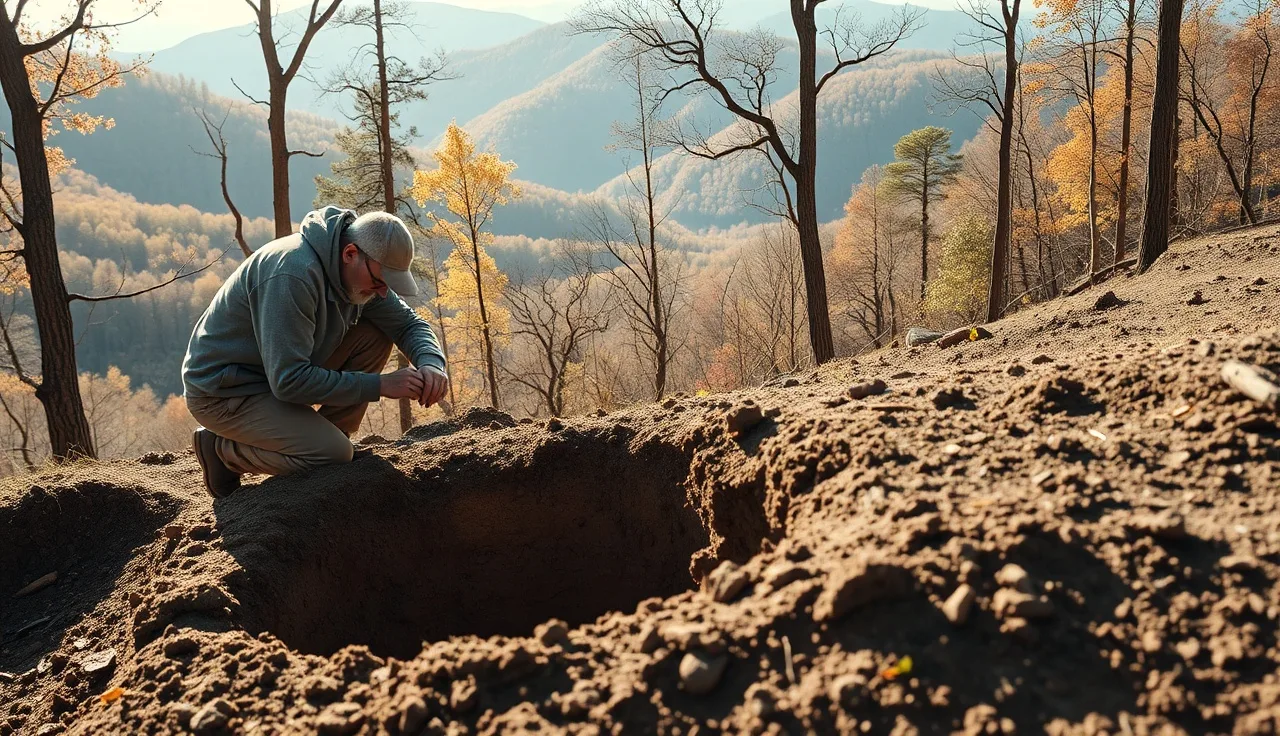
Second, a state-licensed soil scientist (either a county staff evaluator or a private consultant you hire) visits the site. They dig soil profile pits, usually two to four, and examine horizon depth, texture, color, and structure. These observations often predict percolation rates without a formal timed test. North Carolina's rules allow a soil morphology approach as the primary method. A timed percolation test happens when morphology is ambiguous or when the applicant asks for it specifically.
Third, if a timed perc test is done, the evaluator pre-soaks the test holes overnight, then measures how many minutes it takes for water to drop one inch. That rate, expressed in minutes per inch (MPI), sets the design loading rate for the drain field. NC rules cap conventional systems at 60 MPI. Soil slower than that usually needs an alternative or innovative system. [1]
Fourth, the soil scientist issues a written site evaluation report to the county. If conditions support a system, Buncombe County Environmental Health issues an Improvement Permit. That permit spells out system type, location, and sizing. It's valid for five years for residential projects. [2]
The full cycle from application to permit runs about two to six weeks in normal seasons. Late spring and fall back up because contractors and buyers are all moving at once. Winter evaluations are possible, but the county won't evaluate frozen or saturated ground.
What do perc test results mean for your septic system design?
The percolation rate sets the size of your drain field directly. Faster soil means a smaller field. Slower soil means a bigger field, sometimes much bigger.
North Carolina uses a loading rate table tied to soil texture and structure rather than MPI alone, but MPI is the common shorthand. Here's how the general bands map to system outcomes:
| Perc Rate (MPI) | Soil Type (typical) | System Outcome |
|---|---|---|
| 1 to 30 | Sandy loam, loamy sand | Conventional system, standard sizing |
| 31 to 60 | Loam, silt loam | Conventional system, larger field |
| 61 to 120 | Clay loam, some clay | Alternative system required (e.g., LPP or drip) |
| >120 | Heavy clay, fractured rock | Innovative/alternative only, or site may not qualify |
| Site fails entirely | Limiting horizon <12 in, high water table | No permit; engineered variance needed or land can't support on-site sewage |
Low-pressure pipe (LPP) systems and drip-irrigation systems are the two most common alternatives approved in Buncombe County when conventional perc rates fail. Both cost more to install and maintain than a gravity system. A drip system in particular needs a pump, controls, and regular septic tank pumping to keep solids from clogging the emitters. [3]
If the evaluation finds a limiting horizon (rock, seasonal high water table, or a clay pan) within 12 inches of the ground surface in the proposed drain field area, the site may be denied outright. That's not common, but it happens on steep wooded lots and low-lying areas near the French Broad River floodplain. If it happens to you, a second opinion from a private licensed soil scientist is worth the money before you give up on the parcel.
Who can perform a perc test in Buncombe County?
In North Carolina, site evaluations for septic permits must be done by a registered soil scientist or by county Environmental Health staff. You can pick either path, but the private consultant route often moves faster because you're not waiting in the county's scheduling queue.
A Licensed Soil Scientist (LSS) in North Carolina holds a license from the NC Board for Licensing of Soil Scientists. These are the professionals who dig the profile pits, read the horizons, and write the evaluation report the county accepts. [4] Your general contractor or septic installer can't do this work. Hiring someone without the proper license voids the evaluation.
Hire a private soil scientist and they coordinate directly with Buncombe County Environmental Health and submit their report to the county. The county reviews it and issues (or denies) the Improvement Permit. County staff may or may not revisit the site independently, though they keep the right to.
For a straightforward residential lot, a private LSS usually charges $300, $600 for the evaluation. Add the county application fee and you're looking at $500, $1,000 all in before any drilling or soil prep. Complex sites with multiple test areas or appeals run higher. [5]
In Cabarrus County reading this for comparison? The process there follows the same 15A NCAC 18A .1900 rules, but Cabarrus County Environmental Health has its own fee schedule and scheduling queue. The Cabarrus County perc test is structurally identical to Buncombe's because it's the same state code, though Cabarrus soils in the Piedmont tend to hold more clay and perc slower on average.
How much does a perc test cost in Buncombe County?
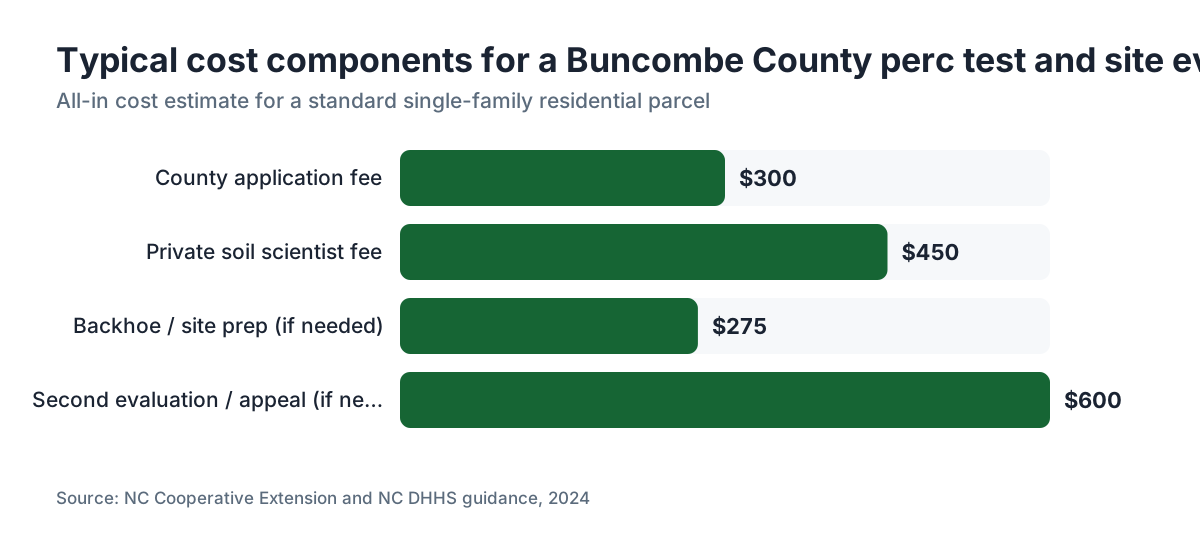
Expect to spend $500, $1,200 total for a standard residential perc test and site evaluation in Buncombe County. That number has three parts: the county application fee, the soil scientist fee, and any site prep work.
The county application fee for a new site evaluation in Buncombe County has historically run $200, $400 depending on system type and number of test areas. Verify the exact current fee with Buncombe County Environmental Health directly, because the fee schedule updates periodically and isn't always posted in a stable online location. [2]
A private licensed soil scientist usually charges $300, $600 for a routine residential evaluation on a single-family parcel. That can climb to $800, $1,500 if the site needs extended testing, multiple deep pit excavations with a backhoe, or a disputed result that triggers a second evaluation round.
Site prep costs are separate and easy to forget. If your lot is heavily wooded, or the evaluator needs a backhoe to dig 48-inch profile pits, you'll pay a contractor for equipment. Budget $150, $400 for backhoe time if the soil is hard or rocky, which is common on Buncombe's mountain terrain.
The whole cost to install a septic system is far larger once you add the tank, drain field, and installation labor. The perc test is a small slice of total project cost, but botching it early is the most expensive mistake homeowners make.
For reference, a complete new septic system in Western NC runs $8,000, $25,000 or more depending on system type. An alternative system like drip irrigation adds $5,000, $15,000 over a conventional gravity system. [6]
What happens if you fail a perc test in Buncombe County?
Failing a perc test doesn't automatically mean you can't build. It means a conventional gravity system won't work. That's a meaningful difference.
Buncombe County Environmental Health, following state rules, evaluates whether an alternative or innovative system can still serve the site. The alternatives approved under NC rules include low-pressure pipe (LPP), drip irrigation, mound systems, and aerobic treatment units (ATUs). Each has different soil and setback requirements. [3]
If the site is denied for all system types, you have options. You can request a variance from the NC Division of Public Health, though variances for on-site systems are granted narrowly and require documented hardship. You can hire a second licensed soil scientist for a new evaluation, which sometimes yields different results if the first one was done in wet conditions or missed a better area of the parcel. You can also subdivide if the parcel is large enough to shift the system location.
What you can't do is build and hope nobody notices. Unpermitted systems violate NC law and carry civil penalties. They also create liability when you sell, because a real estate septic tank inspection will surface the issue.
End up with an approved alternative system? Plan for higher long-term maintenance costs. Drip and LPP systems need more frequent septic tank pump out service and periodic inspection of the distribution components. The EPA's SepticSmart program notes that properly maintained advanced treatment systems can perform well even on challenging sites, but the key word is maintained. [7]
How long is a perc test result valid in Buncombe County?
In North Carolina, an Improvement Permit issued after a successful site evaluation is valid for five years for residential construction. If you don't pull the Construction Authorization inside that window, you have to reapply. [1]
The site evaluation itself, the raw soil data the soil scientist collects, doesn't expire the same way. But if significant site disturbance has happened (grading, fill, land clearing) since the original evaluation, the county can require a new one before issuing a permit.
For buyers of vacant land, this matters a lot. A parcel with a valid Improvement Permit already on file is worth more than one with a perc test report but no permit, and both are worth more than raw untested land. Always ask to see the actual permit document, not the seller's word that "it percs."
The Construction Authorization, which is the step-two document issued once you've picked a contractor and finalized plans, is valid for two years and can be renewed once. If your build drags past the renewal window, you'll resubmit.
What setbacks and site requirements affect your perc test area in Buncombe County?
The location of your drain field isn't a free choice. North Carolina's rules set minimum horizontal setbacks that constrain where the system can go, and those setbacks often erase large parts of a parcel before the soil evaluation even starts. [1]
Key minimum setbacks under 15A NCAC 18A .1900 include:
| Feature | Minimum Setback (conventional system) |
|---|---|
| Private well on same property | 100 feet |
| Private well on adjacent property | 50 feet |
| Surface water (stream, lake, wetland) | 50 feet |
| Property line | 10 feet |
| Building foundation | 10 feet |
| Road right-of-way | 10 feet |
| Swimming pool | 15 feet |
Buncombe County has steep terrain, so slope is another constraint. NC rules generally prohibit drain fields on slopes greater than 30 percent. LPP systems can go on slopes up to 30 percent with terrace construction. Conventional gravity systems work best below 15 percent slope. On mountain lots, this can rule out most of a parcel.
If your lot is small or oddly shaped, a site plan drawn by a surveyor or engineer before the soil evaluation helps the soil scientist know exactly where to focus testing. That saves time and money over evaluating areas that are obviously inside a setback.
Wells are the most commonly overlooked constraint. If you have a well or plan to drill one, its location decides where the drain field can go, and vice versa. Settle well placement first, or at least at the same time as septic planning.
How do you schedule a perc test in Buncombe County?
You have two paths: apply directly through Buncombe County Environmental Health, or hire a private licensed soil scientist who handles the county coordination for you.
The direct path: contact Buncombe County Environmental Health at 828-250-5000 or visit their office at 40 Coxe Avenue in Asheville. Request a site evaluation application, complete the parcel and proposed-use sections, pay the application fee, and wait for a county staff evaluator to schedule a site visit. In busy seasons (spring, early fall) this queue can run three to five weeks. [2]
The private consultant path: hire a licensed soil scientist directly. They handle the application, schedule their own site visit, and submit the report to the county. Turnaround is often faster because you're working around the consultant's calendar rather than the county's queue. Ask your contractor or builder for referrals. They work with the same soil scientists repeatedly and know who's reliable and who's slow.
Either way, be present on evaluation day if you can. Walking the site with the evaluator lets you point out drainage features, old field tile, or previously disturbed areas that might not be obvious. It also gives you a chance to hear the preliminary read on the soil before the formal report.
For operators managing multiple projects across Western NC, tools like SepticMind track permit status, evaluation dates, and contractor assignments so nothing falls through the cracks between the soil evaluation and the construction authorization step.
What should you do before the soil evaluator arrives on your property?
A little preparation goes a long way. The soil evaluator's job is faster when the site is accessible and the basic information is on hand.
Clear a path to the proposed drain field area. Evaluators aren't required to bushwhack through dense undergrowth. If the area is heavily vegetated, cut a walkable path ahead of time. This matters on rural Buncombe County parcels where lots can be thick with trees.
Mark your property corners if you can. If corner pins are buried or overgrown, a surveyor can locate them beforehand. The evaluator needs to know where the setbacks fall.
Gather your site documents: the recorded plat, any well permits or well location records, the proposed house footprint if you have it, and any previous evaluation reports from prior owners. The county records old evaluations by parcel, but having them in hand speeds things up.
Don't saturate the test area before the visit. Irrigating or steering runoff toward the proposed field in the days before the evaluation inflates water table readings and can make a pass site look marginal. Let the soil dry naturally.
Know your bedroom count. Septic systems are designed around design flow, which in North Carolina is 120 gallons per day per bedroom. A three-bedroom house needs a system designed for 360 gallons per day. Adding a bedroom later requires a new evaluation if the original system wasn't sized for it. [8]
For system care after installation, understanding how often to pump a septic tank and keeping up with leach field maintenance are the two biggest factors in avoiding early failure.
How does Buncombe County compare to other NC counties for perc testing?
The state rules are uniform: every NC county follows 15A NCAC 18A .1900 for site evaluations. What varies is soil conditions, county staffing levels, and local fee schedules.
Buncombe County's mountain geology packs many soil conditions into a short distance. You'll find well-draining loamy soils on some ridges and nearly impermeable clay-over-rock on adjacent hillsides. The county's evaluation staff knows these conditions well and generally knows which parts of the county are problematic.
By comparison, the Cabarrus County perc test process serves Piedmont soils that are mostly Cecil and Pacolet series, both moderately fine-textured with naturally slower percolation. Cabarrus County has higher overall system density because it sits in the Charlotte metro orbit, so its Environmental Health office handles higher permit volume. Wait times in Cabarrus can rival Buncombe's busy spring season.
Rural mountain counties like Madison and Yancey, next door to Buncombe, have smaller Environmental Health staffs and sometimes longer waits for county evaluators. If your project is near a county line, it may pay to call the neighboring county to understand their queue.
Fee schedules differ meaningfully across counties. Some counties bundle the soil evaluation into one permit fee. Others bill separately for evaluation and permit. There's no statewide standard on fees. Always call the specific county office for current numbers before budgeting.
How does a perc test fit into the full septic permit and installation process?
The perc test and site evaluation are step one of a four-step permit process in North Carolina.
Step one is the site evaluation and Improvement Permit. This is what most people mean when they say "perc test." The county assesses the soil, approves a system type and location, and issues the Improvement Permit. No construction starts without this.
Step two is the Construction Authorization. Once you have an Improvement Permit, you pick a licensed septic contractor, finalize the system design, and apply for a Construction Authorization. The county may inspect the proposed installation area before issuing this document.
Step three is installation. A licensed contractor installs the septic tank and drain field to the approved design. The county inspects during and after installation. [6]
Step four is the Operation Permit. After a satisfactory final inspection, the county issues an Operation Permit. The system is now legal to use.
Some homeowners try to shortcut this sequence, especially on inherited or purchased land with an existing "informal" system. That almost always creates problems at resale. A full septic system repair or replacement on a property with no permit history is expensive and complicated because you're starting the entire permit sequence from scratch.
SepticMind's project tracking is worth knowing about here. For contractors running multiple Buncombe County permit applications at once, having permit stage, evaluation dates, and contractor assignments in one place prevents the expensive mistake of breaking ground before a Construction Authorization is issued.
Once your system is in the ground, regular septic tank cleaning and inspections keep it running inside the design parameters the perc test set.
Frequently asked questions
Can I do a perc test myself in Buncombe County?
No. North Carolina requires that site evaluations for septic permits be conducted by a licensed soil scientist or county Environmental Health staff. A test you conduct yourself has no standing with the county and won't lead to a permit. Hiring a registered soil scientist licensed by the NC Board for Licensing of Soil Scientists is the only way to get results the county will accept.
How long does a perc test take on the day of the site visit?
The actual site visit usually takes two to four hours for a standard residential lot. Soil profile pits need to be dug, examined, and documented. If a timed percolation test is required (rather than morphology alone), the holes must be pre-soaked overnight, which means the evaluator returns the next day for the timed portion. Complex or multi-acre sites can require multiple visits spread over two days.
How far in advance should I schedule a perc test before closing on land?
Schedule at least four to six weeks before your desired closing date in normal seasons, and eight weeks in spring (March through May). If you're buying vacant land and the sale is contingent on a passing perc test, make sure your purchase contract gives you enough time. A failed evaluation that requires a second opinion can push the total timeline past ten weeks.
Does an old perc test on the property transfer to a new owner?
The Improvement Permit is attached to the parcel, not the owner. If a valid Improvement Permit is on file with Buncombe County Environmental Health and the five-year window hasn't lapsed, a new owner can use it. Ask the seller for the permit number and verify its current status directly with the county before closing. An expired permit means starting the process over.
What is the difference between a perc test and a soil morphology evaluation in NC?
North Carolina primarily uses soil morphology, the visual examination of soil horizon color, texture, and structure, as the basis for site evaluation. A timed percolation test (water drop in minutes per inch) is used when morphology is ambiguous. In practice, many NC evaluations rely entirely on morphology. The end result, a permitted system type and location, is the same either way.
Can I get a septic permit in Buncombe County without a perc test on wooded land?
Yes, in the sense that the evaluation method may be morphology-based rather than a timed perc test. But you cannot skip the site evaluation entirely regardless of vegetation. Every new septic permit in Buncombe County requires an approved site evaluation under 15A NCAC 18A .1900. Wooded land requires the same evaluation as cleared land; the evaluator just works around the trees.
What soil conditions in Buncombe County most commonly cause perc test failures?
Shallow depth to bedrock is the most common failure cause on Buncombe's mountain parcels. The county requires at least 12 to 18 inches of suitable soil above a limiting horizon depending on system type. Seasonal high water tables in low-lying areas near streams are the second most common cause. Heavy Cecil or Hayesville clay subsoils, common on east-facing slopes, also produce marginal perc rates that require alternative systems.
Does a garage, barn, or ADU require its own perc test in Buncombe County?
Structures that generate sewage, including accessory dwelling units with a kitchen or bathroom, require their own sewage disposal capacity. This may mean expanding an existing approved system or getting a new evaluation for the additional flow. Detached garages with no plumbing do not require a sewage evaluation. The determining factor is whether the structure generates wastewater above what the existing permit covers.
How does the perc test result affect how often I need to pump my septic tank?
The perc result affects system type, and system type affects pumping frequency. A standard gravity system on well-draining soil typically needs pumping every three to five years for a three-bedroom home. Alternative systems like drip irrigation or ATUs often require pumping every one to three years because they're more sensitive to solids overloading. Your system's Operation Permit will specify any mandatory maintenance schedule the county requires.
Is the Cabarrus County perc test process different from Buncombe County's?
Structurally identical. Both counties follow North Carolina's 15A NCAC 18A .1900 rules. The differences are in fee schedules, county staff capacity, and typical soil conditions. Cabarrus County is in the Piedmont and has higher clay-content soils on average, which tend to produce slower perc rates than Buncombe's better-draining ridgeline soils. Call each county's Environmental Health office for current fees and scheduling timelines.
What happens if a contractor installs a septic system without an Improvement Permit in Buncombe County?
Installing a system without a permit violates NC law. The county can order the system removed or decommissioned at the owner's expense. Civil penalties apply to both the owner and the contractor. The system will appear as unpermitted in any future title search or real estate inspection, which complicates resale and may trigger lender issues. There is no good outcome from skipping the permit process.
Can I appeal a failed site evaluation in Buncombe County?
Yes. Under North Carolina rules, you can request a review by county Environmental Health supervisory staff. You can also hire a private licensed soil scientist to conduct a new evaluation, which the county must consider. If the county upholds the denial, you can pursue a variance through the NC Division of Public Health, though variances for on-site wastewater are granted narrowly and require documented hardship evidence.
Do I need a perc test to replace an existing failing septic system?
Often yes, at least a partial site evaluation. If you're replacing in the same approved location with the same system type, the county may accept the existing permit data. But if the replacement involves a new drain field location, a system type upgrade, or the original permit is expired, Buncombe County Environmental Health will require a new site evaluation before issuing a Construction Authorization for the repair work.
Sources
- NC DHHS, Division of Public Health, 15A NCAC 18A .1900 Sewage Treatment and Disposal Rules: North Carolina Administrative Code 15A NCAC 18A .1900 governs on-site wastewater site evaluations, percolation test methods, setback requirements, Improvement Permit validity (5 years residential), and approved system types including LPP and drip irrigation.
- Buncombe County Environmental Health, On-Site Water Protection: Buncombe County Environmental Health administers site evaluations, application fees, and Improvement Permits locally, with fee schedules updated periodically; the office is reachable at 828-250-5000.
- NC Division of Public Health, On-Site Water Protection Branch, Alternative Systems Guidance: North Carolina approves low-pressure pipe (LPP), drip irrigation, mound, and aerobic treatment unit systems as alternatives for sites where conventional gravity systems do not qualify based on soil evaluation results.
- NC Cooperative Extension, On-Site Wastewater Systems for Homeowners: Private licensed soil scientist fees for residential site evaluations in North Carolina typically range from $300 to $600 for standard parcels, with higher costs for complex sites requiring backhoe excavation or extended testing.
- NC Division of Public Health, Septic System Installation and Permit Process: The NC septic permit process follows four steps: site evaluation and Improvement Permit, Construction Authorization, installation and inspection, and Operation Permit issuance.
- US EPA, SepticSmart Program, Protect Your Investment: The EPA SepticSmart program states that properly maintained advanced treatment systems can perform well on challenging sites, and emphasizes routine maintenance as the key performance factor.
- NC DHHS, Division of Public Health, Frequently Asked Questions: Septic Systems: North Carolina's design flow standard for residential septic systems is 120 gallons per day per bedroom, used to size both the tank and the drain field.
- US EPA, Decentralized Wastewater Management Program, Onsite Sewage Treatment: EPA guidance identifies shallow depth to limiting horizons (rock, clay pan, seasonal high water table) as the primary causes of site evaluation failures for conventional on-site sewage systems.
- NC State University Extension, Homeowner's Guide to Septic Systems: Total new septic system installation costs in North Carolina range from approximately $8,000 to $25,000 or more depending on system type, with alternative systems adding $5,000 to $15,000 over conventional gravity designs.
Last updated 2026-07-10