Leach field: what it is, how it works, and what it costs
By the SepticMind Editorial Team
TL;DR
- A leach field (also called a drain field) is the underground network of perforated pipes and gravel that takes clarified wastewater from your septic tank and releases it into the soil, where treatment actually happens.
- Installation runs $3,000 to $15,000 depending on soil, size, and system type.
- Maintained well, a leach field lasts 25 to 30 years before it needs replacement.
What is a leach field, exactly?
A leach field is the last treatment stage of a conventional septic system, and it does the real work. Wastewater leaves the house, flows into the septic tank where solids settle out, and the clarified liquid (called effluent) drains by gravity into a network of perforated pipes buried in gravel-filled trenches. The effluent seeps through the gravel, into a layer of biomat that forms at the soil interface, then percolates down through natural soil that filters out pathogens and nutrients before the water reaches groundwater.
The EPA's SepticSmart program describes the drainfield as the component that removes contaminants from effluent "that has percolated through the soil" [1]. That one line captures the whole job. The soil is the treatment plant. The pipes just spread the water out.
Most people picture the leach field as a set of pipes. The biologically active soil zone right under those pipes is doing most of the work. A healthy biomat stays thin and permeable. When it thickens from overload, you start seeing wet spots and smelling sewage in the yard.
"Leach field," "drain field," and "absorption field" all mean the same thing. Some state codes use one word, some use another. Functionally identical.
How does a leach field work with the septic tank?
The septic tank and leach field are not two options to pick between. They're one system. The tank handles the solids, the field handles the liquid, and if either one fails the other goes down with it.
Here is the sequence. Raw sewage enters the septic tank. Heavier solids sink and form sludge. Fats and oils float and form scum. The middle layer, clarified effluent, exits through an outlet baffle into a distribution box (D-box) or manifold that splits the flow evenly across the lateral trenches. Each lateral is a perforated pipe sitting in clean crushed stone, usually 3/4-inch to 1.5-inch washed gravel, buried 18 to 36 inches below grade depending on local code [2].
Gravity does the work in a conventional system. If your lot is flat or the soil is too shallow, a pump chamber pushes effluent up to a raised bed or mound. That adds cost and moving parts, but the treatment principle is the same.
Why can't you skip the tank? Raw solids would clog the gravel and soil in weeks. The tank buys the field a buffer. That's the whole reason septic tank pumping every 3 to 5 years is not optional. A tank that overflows solids into the field is the single most common cause of a leach field dying early.
What are the different types of leach fields?
Not every lot can support a conventional trench. Soil depth, percolation rate, lot size, setbacks, and slope all push you toward different designs. Here are the main types your county health department or engineer might spec out.
Conventional gravel trench. The standard. Parallel trenches 18 to 36 inches wide and 18 to 36 inches deep, filled with washed stone and perforated pipe. Works on lots with enough depth to a limiting layer (seasonal high water table, bedrock, or clay pan) and soil that percolates between roughly 1 and 60 minutes per inch on a perc test [3].
Chamber system. Plastic arch-shaped chambers replace the gravel. Infiltrator and similar products create a void for effluent to pool in before it soaks into the soil. Less excavation, easier in tight spaces, and a smaller footprint than an equivalent stone-and-pipe field.
Mound system. When the native soil or the depth to a limiting layer is too shallow, engineers build a raised mound of imported sand fill on top of the natural surface and pump effluent up into it. These cost a lot more ($10,000 to $20,000 or more) and eat more lot space.
Drip dispersal. Pressure-dosed, small-diameter tubing spreads effluent at shallow depth over a large area. Common in states with tight environmental rules and on lots with poor soil. It needs a pre-treatment unit (aerobic or filtered effluent) to keep the tubing from clogging.
Aerobic treatment unit (ATU) with spray or drip. Not a leach field in the strict sense, but the dispersal field does the same job. ATUs produce cleaner effluent, which can allow a smaller field or surface spray application.
Your local onsite wastewater code decides which types are legal where you live. Most states adopted or adapted the EPA's voluntary guidelines, but the specifics vary a lot [4].
How much does it cost to install a septic tank and leach field?
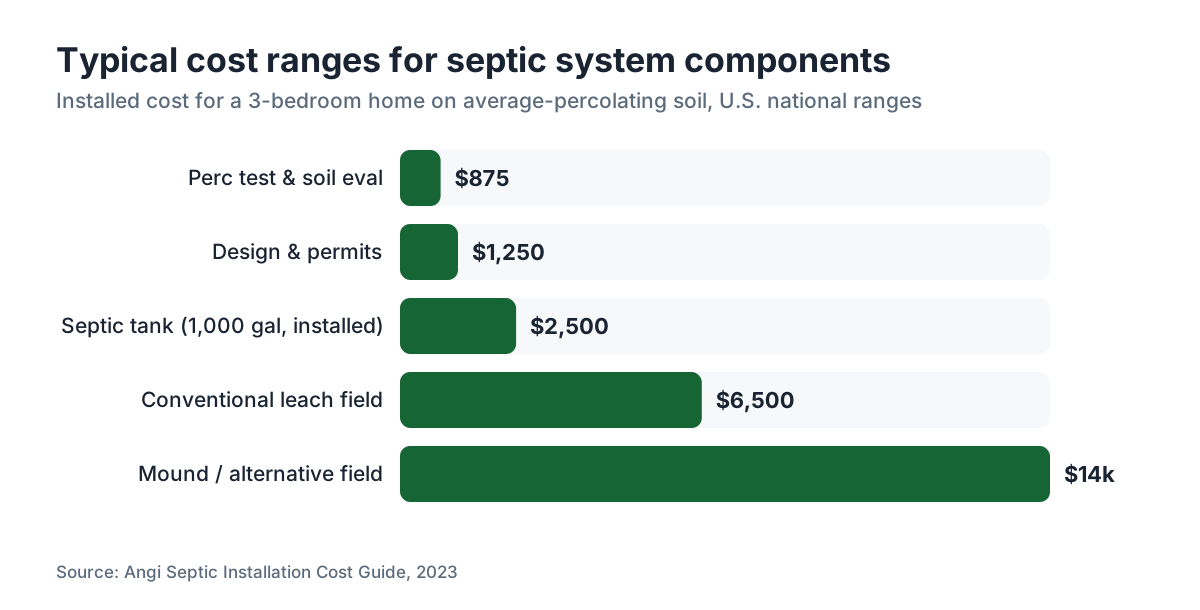
This is where the sticker shock hits. Installing a septic tank and leach field together runs about $6,000 to $25,000 for most homes, with the national average landing near $11,000 to $13,000 according to contractor data aggregated by Angi [5]. The leach field alone accounts for roughly half to two-thirds of that.
Here it is broken out by component:
| Component | Typical cost range |
|---|---|
| Perc test and soil evaluation | $250 to $1,500 |
| System design and permits | $500 to $2,000 |
| Septic tank (1,000 gal, concrete) | $1,500 to $3,500 installed |
| Conventional leach field (3-bed home) | $3,000 to $10,000 |
| Mound or alternative system field | $8,000 to $20,000 |
| Total, conventional system | $6,000 to $15,000 |
| Total, mound or alternative system | $12,000 to $30,000+ |
What drives the number up: rocky or clay-heavy soil that takes more digging, high groundwater that forces a mound, a big household that needs a larger tank and longer laterals, remote lots with hard equipment access, and expensive local labor. On a tough lot in coastal New England or the Pacific Northwest, $20,000 for a complete system is not unusual.
The leach field by itself (no tank) typically runs $3,000 to $15,000 for conventional trenches and $8,000 to $20,000 for mound or engineered alternatives.
For tank-only pricing, see cost to put in a septic tank and septic tank installation. For the full system including permits and design, cost to install septic system walks through the whole thing.
What does a leach field installation involve, step by step?
Planning a new build or a replacement? Knowing the process helps you ask sharper questions and dodge contractor surprises.
Step 1: Perc test and soil evaluation. Before any design, a licensed engineer or soil scientist reads your lot. The perc test measures how fast water drains through your soil. Most conventional systems need soil that absorbs between 1 and 60 minutes per inch. The results set the field size and type. This step is legally required in nearly every state [3].
Step 2: System design. An engineer takes the perc results, a lot survey, setback requirements (typically 10 to 100 feet from wells, property lines, and structures depending on state), and household size, then designs the system. The plan goes to your county health or building department for a permit.
Step 3: Excavation. A crew cuts the trenches to the specified depth and width. In a conventional system, a backhoe digs parallel trenches, usually 50 to 100 feet long for a three-bedroom home, on 6-foot centers between laterals. Topsoil gets set aside for final grading.
Step 4: Gravel bed and pipe. Six inches of washed stone goes in first. Perforated pipe is laid with the holes facing down (counterintuitive, but it stops direct jetting into the soil and spreads the flow evenly). Another 2 inches of stone covers the pipe, then geotextile fabric keeps soil from washing into the stone.
Step 5: Backfill and inspection. The county inspector shows up before backfill to check depth, pipe slope (usually 1/8 to 1/4 inch per foot), and gravel placement. After sign-off, the crew backfills with native soil and grades the surface so water sheds away from the field.
Step 6: Startup. The tank fills and the system goes into service. No startup additives are needed or proven to help. The bacterial community sets up on its own from the first flush.
DIY leach field installation is legal in a handful of states for owner-occupied homes, but most places require a licensed contractor and a permitted design. Building without a permit risks fines, forced removal, and a mess when you try to sell.
How big does a leach field need to be?
Field size is calculated, not guessed. Two inputs drive it: daily wastewater flow (based on bedroom count) and the soil's absorption rate from the perc test.
The EPA's design guidance uses 150 gallons per day per bedroom as the baseline flow [1]. A three-bedroom home is assumed to make 450 gallons a day. If your perc result is 30 minutes per inch, the required trench bottom area gets calculated with your state's formula, which usually lands somewhere between 300 and 500 square feet of trench bottom for that home.
In plain terms, a three-bedroom home on average soil needs roughly 300 to 600 linear feet of lateral trench. That's three to six runs of 100 feet each, which needs a lot area of about 3,000 to 6,000 square feet clear of driveways, structures, and tree roots.
Sandy soil percolates faster and needs less trench. Clay needs more, or an alternative system entirely. Many states also require a reserve area (usually 100% of the primary field) kept clear for a replacement field. That doubles the chunk of your lot committed to septic.
Never plant trees or shrubs over a leach field. Roots wreck pipe and compact gravel. Grass is the right cover. It pulls water and nitrogen out of the field and stays shallow-rooted.
How do you know if your leach field is failing?
Leach field failure rarely happens overnight. It builds over months or years, and the signs are clear once you know them.
The most obvious one is wet, soggy ground or standing water over the field, often with a sewage smell. That means effluent is surfacing instead of soaking in. Slow drains all over the house at once (toilets, showers, sinks) point to a system that can't take any more flow. Sewage backing up into the lowest fixtures is a late-stage alarm.
Unusually lush green grass over the field lines in dry weather is a quieter tell. The soil down there is getting a steady drink of water and nutrients. Not always a problem early on, but worth watching.
Nitrate or coliform in a nearby drinking water well is a public health warning that the field isn't treating effluent before it reaches groundwater [6].
What causes failure? Too much water is the big one (multiple laundry loads in a day, big gatherings, the dishwasher running nonstop). Flushed solids like wipes, grease, and paper towels eventually reach the field. Skipping the septic tank pump out lets solids carry over and permanently clog the gravel. Compaction from vehicles or heavy equipment crushes pipe and destroys the soil structure.
For diagnosis and repair, septic system repair and septic tank repair cover what's actually fixable and what needs full replacement.
Can a failing leach field be fixed, or does it need full replacement?
It depends on why it's failing. That's the honest answer.
If the trouble is biomat buildup from overloading or neglect, resting the field (alternating between two fields if you have a dual-field setup) and fixing the cause (pump the tank, cut water use) can bring back some function. Some contractors offer hydro-jetting or terra-lift aeration to break up biomat and restore permeability. Results are mixed. Nobody has good long-term data on how long these repairs hold, and the honest read is anecdotal: operators report a few years of restored function in mild cases.
If the gravel is permanently packed with fine solids from years of tank overflow, the field is done. You need a new one. Replacement fields go in the reserve area if one was designated, or somewhere else on the lot after a fresh soil evaluation. No reserve area and no suitable spot? You may be looking at a mound or an ATU-based alternative.
A replacement conventional field on suitable soil costs $3,000 to $15,000, more for engineered alternatives. Some states offer low-interest loans or grants for septic repair, especially for lower-income households or systems near sensitive waterways [7].
One thing to say plainly: shock treatments, additives, and enzyme products sold to "restore" a failing leach field have no credible science behind them. The EPA and most state extension programs say they're unnecessary and can harm the bacterial ecosystem in a healthy tank [1].
How long does a leach field last?
A field that's designed right, loaded right, and maintained right typically lasts 25 to 30 years. Some go 40 or more. Some die at 10.
The University of Minnesota Extension, which has published a lot on onsite systems in cold climates, says most systems that fail early do so from hydraulic overloading or skipped tank maintenance, not because the field wore out mechanically [8].
Three things shorten field life more than anything else: letting the tank go unpumped for years (solids carry over and clog the gravel), constant overloading of daily flow (too many people for the design), and physical damage from compaction or roots.
Three things extend it: pumping the tank on schedule (every 3 to 5 years for a typical household), spreading laundry across the week instead of one marathon Saturday, and keeping vehicles and heavy equipment off the field.
See how often to pump septic tank for the pumping schedule most engineers actually recommend.
What are the rules and setback requirements for leach fields?
Every state writes its own onsite wastewater rules, and many counties stack stricter rules on top. There's no single national standard, but the EPA publishes guidance most states used as a starting point [4].
Typical setbacks (these vary, always confirm with your local health department):
| From | Minimum setback (common range) |
|---|---|
| Drinking water well | 50 to 100 feet |
| Property line | 5 to 25 feet |
| Foundation/structure | 5 to 20 feet |
| Surface water (pond, stream) | 50 to 100 feet |
| Wetlands | 75 to 200 feet |
| Irrigation water supply | 25 to 50 feet |
These are ranges across states. Yours could be tighter. Florida requires a 75-foot setback from Class I and II surface waters for onsite sewage systems under Chapter 64E-6 of the Florida Administrative Code [10]. Massachusetts requires a minimum 50-foot setback from private wells under 310 CMR 15.000, the Title 5 regulations [9].
Setbacks shrink the usable area on small lots fast. That's why lot size matters so much when you buy a property on septic, and why a septic tank inspection before purchase is non-negotiable.
Permitting is not optional and not something you fix after the fact. Unpermitted septic work creates title problems, can force removal at your expense, and leaves you liable if the system contaminates a neighbor's well.
How do you maintain a leach field to make it last?
Leach field maintenance is mostly about what you don't do. The field needs almost no active attention if you manage the tank and watch your water use.
The EPA's SepticSmart guidance puts it plainly: "Have your septic system inspected at least every 3 years by a licensed professional and have your septic tank pumped every 3 to 5 years" [1]. That schedule is the highest-leverage thing you can do. A pumped tank can't overflow solids into the field.
Beyond pumping, the practical rules:
Don't flush anything that isn't human waste or toilet paper. Wipes (even the "flushable" ones), feminine products, medications, and paper towels all end up in the field eventually. Spread laundry across several days. A washing machine uses roughly 40 gallons a load, and five loads on one Saturday can blow past your system's daily design flow.
Send roof drains, sump pumps, and surface runoff away from the field. Extra water from any source saturates the soil and stops effluent from soaking in.
Keep a record of where your field sits, and make sure anyone doing yard work, landscaping, or fence installation knows to stay off it. A loaded pickup weighs enough to crack perforated pipe.
Book an inspection every 3 to 5 years even when nothing seems wrong. A licensed inspector can check the distribution box for solids carryover and read the field's condition before a small problem turns expensive. Septic tank cleaning and septic tank emptying are the routine services that protect the field.
Service companies tracking maintenance across many client properties can use tools like SepticMind to automate service reminders and inspection logging, which cuts the odds of a client missing a pump-out.
Leach field vs. septic tank: what's the difference?
These aren't competing options. The question comes up in searches constantly, so it deserves a straight answer.
The septic tank is a watertight buried container (concrete, fiberglass, or plastic) that takes all household sewage and separates solids from liquid by settling. It doesn't treat the wastewater to a safe level on its own. It just clarifies it.
The leach field is where treatment actually happens, in the soil. Together, the two make up what people call a "septic system." Pull out either one and you don't have a working system.
If someone quotes you a price for just a tank or just a field, they're quoting component replacement, not a new system. Most repair jobs swap only the failed part. A structural crack in the tank means you replace the tank. A saturated, biomat-choked field means you replace the field (or add one in a reserve area) and keep the tank you have.
For a full new system, the cost split usually runs 25 to 40% for the tank and associated components and 60 to 75% for the field and site work.
Frequently asked questions
How much does a leach field cost to replace?
Replacing a conventional leach field usually costs $3,000 to $15,000. Mound systems or engineered alternatives on difficult lots run $10,000 to $25,000 or more. The total depends on lot conditions, soil type, required field size, and local labor. Permits, soil testing, and design fees add $750 to $3,500 on top. Get at least three bids from licensed contractors who pull their own permits.
How long does it take to install a leach field?
Active installation runs one to three days for a conventional trench once permits are in hand. The permitting and design phase takes longest: four to twelve weeks in most places, longer where health departments are backlogged. Plan for two to four months from first call to a working system. Counties can sometimes fast-track emergency replacements, but that isn't guaranteed.
Can I install a leach field myself?
In most states, no. Licensed contractors and a permitted design from a professional engineer or soil scientist are required. A few states allow owner-builder permits for owner-occupied homes, but you still need permitted plans and inspections. Unpermitted work creates title problems, potential fines, and real liability if the system fails and contaminates a neighbor's well. Even where it's legal, DIY septic work is high-risk.
What happens if you drive over a leach field?
Vehicle weight compacts the soil and can crack perforated pipes. Even a pickup can damage shallow laterals. Compacted soil loses permeability, so effluent can't absorb and the field fails faster. Keep all vehicles, heavy equipment, and livestock off the field. If you suspect compaction or construction damage, have a contractor scope the laterals with a camera.
How do I find where my leach field is located?
Start with your county health or building department. Permitted systems have as-built drawings on file, usually available as public records. Your tank's outlet pipe points toward the field, so finding the tank (often with a probe rod) gives you a direction. A septic inspector can locate the distribution box and trace the laterals. Some states keep online databases of permitted septic locations.
What is the difference between a leach field and a drain field?
Nothing. The two terms name the same component. "Leach field" is common in many Western and Southern states; "drain field" is more common in the Midwest and East. Some state codes say "absorption field" or "soil absorption system." Your county may prefer one word on their paperwork, but the design, function, and rules are identical no matter what it's called.
Will a leach field work in clay soil?
Clay is the most common reason a conventional leach field can't be permitted. Perc rates below 60 minutes per inch are often still workable with a larger field; rates over 120 minutes per inch usually disqualify a conventional system. Alternatives include mound systems, pressure-dosed drip dispersal, or aerobic treatment units. The perc test result, not a visual guess at soil color, is what your designer and county use to make the call.
Can tree roots damage a leach field?
Yes, and it's a common cause of failure. Roots chase moisture and find perforated pipe. Willow, poplar, and silver maple are especially aggressive. Most codes require trees removed from the field area before installation, with setbacks of 10 to 30 feet depending on species. Large shrubs are a risk too. Grass is the only recommended surface cover over an active leach field.
How do I know if my leach field is failing?
The clearest signs are soggy ground or standing water over the field (especially with a sewage smell), slow drains throughout the house when the tank was recently pumped, sewage backing up into low fixtures, and unusually lush green grass over the field in dry weather. Nitrate or coliform in a nearby well is serious. If you see any of these, get a licensed inspector on-site within days, not weeks.
Do septic additives help a leach field recover?
No credible science supports enzyme or bacterial additives to restore a failing leach field. The EPA's SepticSmart program says they're unnecessary for a healthy system and may disrupt the natural bacterial balance. The root causes of field failure (overloading, skipped pumping, compaction) need physical correction, not chemical treatment. Skip the additives and put the money toward a tank pump-out or a proper inspection.
Does homeowners insurance cover leach field replacement?
Standard homeowners policies typically exclude septic components, including leach fields. Some insurers offer septic endorsements or service line coverage for sudden failures, but not gradual deterioration. A few states run low-interest loan programs for failed septic repair. Check your declarations page for "service line" or "sewer and drain" endorsements, and ask your agent specifically about septic coverage.
How many bedrooms can a leach field support?
The field is sized to the bedroom count, not the actual number of people living there. The EPA standard uses 150 gallons per day per bedroom. A three-bedroom home has a design flow of 450 gallons a day. Add a bedroom and your existing field may be undersized under current code. Adding bedrooms without re-evaluating septic capacity is a common mistake that leads to early failure.
What is the difference between a leach field and a cesspool?
A cesspool is a single buried pit that takes raw sewage directly, with no septic tank pre-treatment. Effluent leaches out through the pit walls while solids pile up inside. Cesspools were common before the 1970s and are now banned for new construction in all U.S. states. Many existing cesspools must be upgraded at sale or renovation. A leach field with a proper tank treats far better and is much less likely to contaminate groundwater.
Sources
- U.S. EPA, SepticSmart Program: EPA guidance on septic system maintenance, drainfield function, pumping schedule of every 3 to 5 years, and statement that additives are unnecessary
- U.S. EPA, Onsite Wastewater Treatment Systems Manual (EPA/625/R-00/008): Design specifications for conventional trench systems including gravel depth, pipe placement, and burial depth of 18 to 36 inches
- U.S. EPA, Onsite Wastewater Treatment and Disposal Systems Design Manual: Perc test requirements and acceptable percolation rate range of 1 to 60 minutes per inch for conventional systems
- U.S. EPA, Guidelines for Management of Onsite/Decentralized Wastewater Systems: EPA voluntary guidelines that states have used as the basis for their onsite wastewater regulations
- Angi (formerly Angie's List), Septic System Installation Cost Guide: National average cost range for septic tank and leach field installation of $11,000 to $13,000 based on contractor data
- U.S. CDC, Private Ground Water Wells: Nitrate and coliform contamination in private wells linked to failing septic systems and inadequate effluent treatment
- U.S. EPA, Septic System Funding Resources: State and federal loan and grant programs available for septic system repair, particularly near sensitive waterways
- University of Minnesota Extension, Septic System Owner's Guide: Most early septic system failures result from hydraulic overloading or lack of tank maintenance rather than mechanical failure of the field
- Massachusetts Department of Environmental Protection, Title 5 Regulations (310 CMR 15.000): Massachusetts requires a minimum 50-foot setback from private wells for septic system components under 310 CMR 15.000
- Florida Department of Health, Chapter 64E-6 Florida Administrative Code: Florida requires a 75-foot setback from Class I and II water bodies for onsite sewage treatment systems
- U.S. EPA, SepticSmart: Homeowner Tips: EPA recommendation to inspect septic systems every 3 years and pump tanks every 3 to 5 years; 150 gallons per day per bedroom design flow standard
Last updated 2026-07-09