Perc test explained: what it is, what it costs, and how it works
By the SepticMind Editorial Team
TL;DR
- A percolation test (perc test) measures how fast soil absorbs water to decide whether land can support a septic drain field.
- It costs $150 to $700 in most states, takes one to two days of soil prep plus a few hours of timed readings, and has to be done by a licensed engineer or certified soil evaluator in most places.
- Failing doesn't always mean no septic system is possible.
What is a perc test and why does it matter for septic systems?
A perc test, short for percolation test, measures how fast water drains through the ground at a specific spot. The number it produces is the percolation rate, and it tells engineers and regulators whether that soil can safely absorb the wastewater a septic drain field sends into it.
The link to your septic system is direct. A conventional leach field is a network of perforated pipes buried in gravel and soil. Wastewater flows out of those pipes and depends entirely on the surrounding dirt to filter it before it reaches groundwater. Too fast, and the soil doesn't treat the waste. Too slow, and the liquid backs up, the field floods, and the system fails.
Most states require a perc test before they issue a permit for any new septic installation. Some also require one for a major repair or a drain field replacement. If you're buying raw land and plan to build, the perc test is often the first thing your lender or county health department asks about.
The official term varies by state. You'll see "percolation test," "soil permeability test," "site evaluation," or "soil morphology assessment" for what amounts to the same job: proving the ground will handle sewage before anyone writes a permit.
How do you do a perc test? The step-by-step process
A perc test has three phases: site prep, saturation, and timed observation. Skip any one of them and the results are void under nearly every state code.
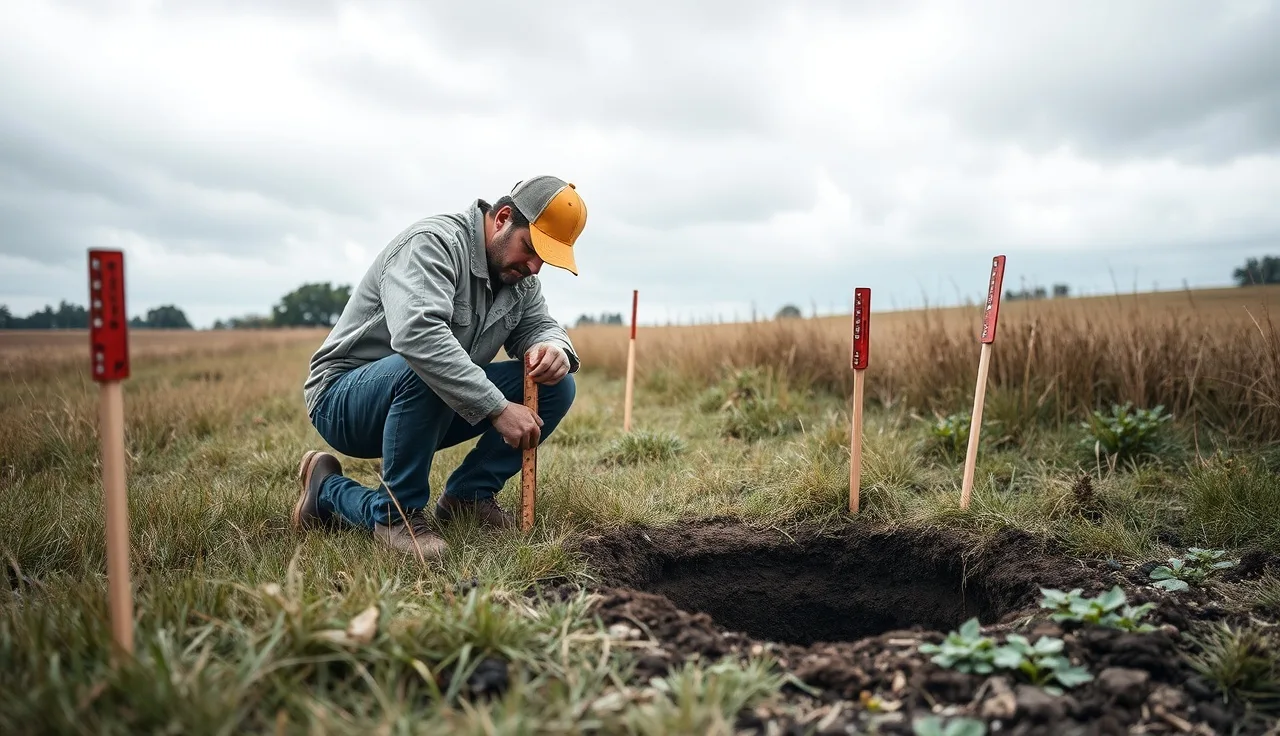
Phase 1: Digging the test holes
Typically two to four holes get dug in the proposed drain field area. Most state codes call for holes 6 to 12 inches in diameter and 24 to 36 inches deep, though this varies. Many states now require at least one soil profile pit dug to four or five feet so the evaluator can read soil horizons, spot mottling (a sign of a seasonal high water table), and find limiting layers like hardpan or bedrock [1].
Phase 2: Pre-soaking (saturation)
This is where DIY attempts fall apart. The holes get filled with water and left to soak overnight, or in some protocols for a full 24 hours, before any timing starts. The point is to fake saturated soil, the worst case the drain field faces during wet season. EPA guidance treats pre-saturation as mandatory, because dry summer soil gives fast readings that lie about real-world performance [2].
Phase 3: Timed percolation readings
After pre-soaking, a standard water depth (usually six inches) goes into each hole. A technician or engineer records how many minutes the water level takes to drop one inch. That measurement, in "minutes per inch" (mpi), is the perc rate. Multiple readings get taken over 30 to 60 minutes and are often averaged. In most jurisdictions the slowest rate, not the fastest, is used for design.
Reading the number
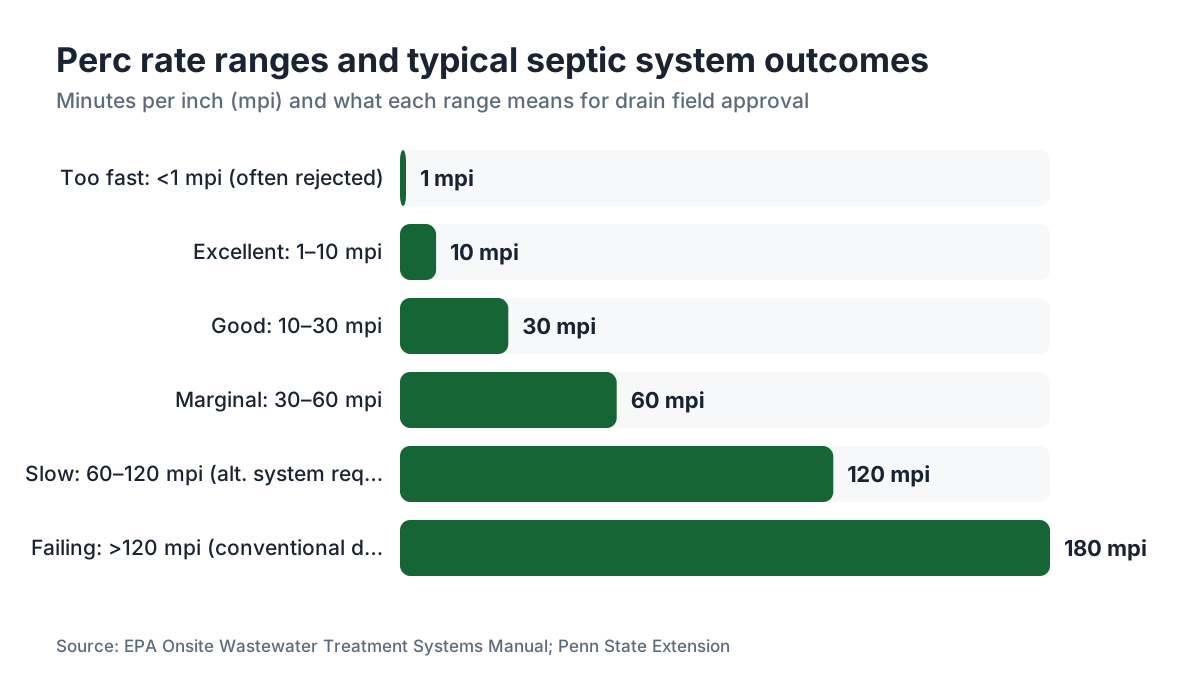
A rate of 1 to 30 minutes per inch is generally fine for a conventional gravity-fed drain field, though the acceptable range varies by state. Rates from 30 to 60 mpi often need engineered alternatives. Above 60 mpi, conventional systems are usually off the table, and you're looking at mound systems, drip irrigation, or other options [3].
The perc rate sets the size of your drain field. A slower rate means a bigger field per bedroom. A bigger field means more land, more excavation, and more money on septic tank installation.
How much does a perc test cost?
A perc test usually runs $150 to $700 for a standard residential site. The range is wide because a handful of factors push the number around.
The biggest variable is who runs the test. Some counties let a licensed contractor or a health department employee do it for a modest inspection fee, which is how you land near $150. Others require a licensed professional engineer or a certified soil scientist, whose time costs more and pushes you toward $500 to $700. A few states fold the perc test into a broader site evaluation with a soil morphology assessment, wetland delineation, and a written engineering report, and that can top $1,000 on complex sites [4].
Geography matters too. Densely populated states like Massachusetts and Connecticut have more rules around onsite systems, and site evaluations there routinely cost $500 to $1,500 because the evaluator is also a licensed engineer signing a report. Rural Midwest states with simpler codes may charge $200 to $400 for the same basic test.
Site conditions add cost when they slow the work. Rocky soil means a jackhammer or excavator just to dig the holes. Steep slopes mean more holes to check different areas. Suspected limiting layers (hardpan, high water tables, bedrock) can trigger extra test pits. If the first test fails or weather delays saturation and a second visit is needed, expect a second site fee.
County permit fees are separate from the testing fee. Many health departments charge $50 to $200 for a perc test permit on top of what the evaluator bills. Always ask whether the quote includes permit fees.
For the full picture of what a passing test leads to, read our guide on cost to install septic system.
Who does a perc test? Licensing and who to hire
Who can legally run a perc test depends entirely on your state and county. There's no national standard.
In many states, the county health department or environmental health office runs the test itself. A county sanitarian schedules a visit, witnesses or performs the test, logs the results, and issues the permit if the site passes. In that model you're not hiring a private contractor at all. You call the county, pay a permit fee, and they show up.
In other states, private soil evaluators, certified professional soil scientists (CPSS), or licensed professional engineers run the test and submit results to the state for approval. The National Society of Professional Soil Scientists keeps a registry of certified soil scientists, and many states require a CPSS or PE signature on the site evaluation report [11].
Some states use a hybrid. A licensed contractor or certified installer can run the test, but a licensed engineer has to sign the final design that uses the data.
To find out who does perc tests near you, call your county health department's environmental health or sanitation division. Ask straight out: do you conduct perc tests, or do I hire a private evaluator? If they point you to private evaluators, ask for a list of approved or licensed ones for your county. Don't trust anyone who says they "do perc tests" without confirming they hold the credential your county actually requires, because unpermitted results are worthless.
Septic contractors usually know the right evaluators locally. A crew that does septic tank installation regularly will have referrals to evaluators who know the local rules, which speeds up the permit.
What soil percolation rates pass or fail, and what counts as good soil?
The passing range varies by state, but a general framework holds across most of the United States. Sandy loam drains well. Heavy clay drains slowly. Coarse gravel drains too fast.
| Perc Rate (min/inch) | General Interpretation | Typical Outcome |
|---|---|---|
| Less than 1 | Extremely fast (gravel or coarse sand) | Often rejected; too little treatment time |
| 1 to 30 | Good to excellent | Conventional drain field usually approved |
| 30 to 60 | Slow but workable | May require larger field or engineered system |
| 60 to 120 | Slow | Alternative systems often required |
| Greater than 120 | Very slow (clay) | Conventional system usually prohibited |
The EPA's onsite wastewater guidance warns that "soils with percolation rates faster than 3 minutes per inch may not adequately treat wastewater," because water moves through too quickly for biological and physical filtration to do its job [2]. Both ends of the spectrum cause failures. Too fast is as much a problem as too slow.
Soil texture gives you a rough preview before any test. Sandy loam and loam tend to fall in the 10 to 30 mpi range. Heavy clay often comes in above 60 mpi. Gravel and coarse sand usually test below 3 mpi. But soil varies enough that you can't reliably guess a perc rate from texture, which is exactly why the timed test exists.
Depth to the seasonal high water table matters on its own, separate from the perc rate. Many state codes require a minimum vertical separation, usually two to four feet, between the bottom of the drain field and that water table. A site can pass the rate test and still fail if mottled soil, which signals seasonal saturation, shows up too close to the surface in the profile pit.
What happens if your land fails a perc test?
A failed perc test doesn't mean you can't build a septic system. It means you can't build a conventional one. What's left depends on how badly the site failed and which alternatives your state approves.
For rates between 60 and 120 mpi, most states allow engineered alternatives. Mound systems build a raised drain field above the natural soil using imported sand fill, which sidesteps poor native dirt. Drip irrigation systems deliver effluent in tiny doses, giving slow soil more time to absorb and treat it. Aerobic treatment units (ATUs) pre-treat wastewater before it reaches the drain field, cutting the load the soil has to carry.
For extremely slow soils or very high water tables, some states allow engineered systems with enhanced pretreatment. These cost a lot more than conventional, sometimes two to three times a standard install.
If the site fails outright and no alternative works, you have a few moves. Testing a different spot on the same parcel sometimes finds better soil. Retesting after conditions change, dry season versus wet season or after drainage improvements, occasionally shifts the result, though most codes require consistent methodology that limits how much you can game it. Some landowners win a variance when adjoining parcels show the regional soil type usually passes.
Buying land? A failed perc test before closing is a negotiating point or an exit ramp. Most purchase contracts let a buyer walk away or renegotiate if a site evaluation fails. Don't close on undeveloped land without a passing perc test unless you've confirmed an alternative system is both approved for that site and inside your budget.
Can you do a perc test yourself?
You can dig holes and time water drainage. Any homeowner can. For permitting, though, a DIY perc test is worth almost nothing.
Every state that requires a perc test for a septic permit also requires the test to be witnessed, conducted, or certified by a licensed official or credentialed professional. A test you run yourself on a Saturday will not fly with your county health department. Period.
That said, a DIY test earns its keep in a couple of ways. If you're thinking about buying raw land and want a rough read on feasibility before paying for a licensed evaluation, an informal test gives you a ballpark. A rate of 200 mpi on your own test tells you the site has a serious drainage problem before you've spent a dime on anyone. A rate of 15 mpi is promising, but it still needs official testing.
Some homeowners run informal tests to figure out whether a failing drain field is a soil saturation problem or a distribution problem. For an existing system, though, a licensed septic tank inspection is the better diagnostic tool.
For anything that leads to a permit, a design, or a real estate decision, hire the licensed professional your county requires. The test fee is small next to the cost of a permitted system.
How long does a perc test take from start to permit?
The clock starts with scheduling, not digging. In rural counties during busy building season, getting on an evaluator's calendar takes two to four weeks. Urban counties with heavy development sometimes have backlogs of four to eight weeks for county-run tests.
Once it's scheduled, the pre-soaking requirement adds at least one overnight. The evaluator makes one visit to dig and saturate, then comes back the next day to time the test. Some protocols require 24 hours of pre-soaking, which stretches this into a two-day gap between visits.
The timing portion itself usually takes two to three hours on-site.
After testing, the evaluator writes and submits a report. If they're a private licensed engineer, that report goes to your state or county agency for review and approval. Review times run from a few days in small counties to several weeks in states with big regulatory backlogs.
Total elapsed time from first call to permit in hand: two to six weeks is typical for straightforward cases. Complex sites, sites that fail on the first try, or jurisdictions with overloaded health departments can take three to six months.
Plan for the long end if you're on a tight timeline. Perc testing is often the longest-lead item in a new construction permit sequence, and rushing it carries regulatory consequences.
How does a perc test relate to septic system design and drain field size?
The perc rate is the core input to drain field sizing. Engineers pair it with the household bedroom count to calculate the required absorption area in square feet. A slower rate needs more area per bedroom, because the soil can only take a limited flow per square foot of surface.
Most state sizing tables run a formula off the perc rate. Virginia's onsite regulations, one of the more detailed state codes, specify that soil with a perc rate of 10 mpi needs 150 square feet of drain field per bedroom, while a rate of 45 mpi needs 300 square feet per bedroom [5]. Roughly double the perc rate, roughly double the land and material cost.
That's why perc results matter so much to the total cost of a septic project. Mediocre soil doesn't just affect the permit. It changes how much gravel, pipe, and excavation you need, how large a cleared area you set aside, and whether your lot even has enough usable space to meet setbacks from wells, property lines, and buildings.
Comparing two adjacent parcels? The one with better soil supports a cheaper, simpler system. That difference can be $5,000 to $15,000 on a full septic tank installation, which is real money in a land purchase decision.
For operators running multiple installs, tracking perc results next to permit timelines and design specs is the kind of workflow SepticMind is built for, connecting site data to job scheduling and permitting documents in one place.
Do existing homes need a new perc test?
If your septic system works and you're not expanding the home or replacing the drain field, you almost certainly don't need a new perc test. The original test that permitted the system is on file with your county.
A new perc test is typically required in three situations. First, if you're adding bedrooms or square footage beyond the original system's design capacity, most state codes treat that as a new installation and require an updated site evaluation. Second, if the existing drain field failed and you're relocating it, the new spot needs its own perc test. Third, if no records of the original test or permit exist, some counties require a fresh evaluation before they'll permit repairs or modifications.
For septic system repair that stays in the same footprint as the original drain field, most states let the original data stand, assuming the system was permitted to begin with.
Real estate deals sometimes trigger perc tests on homes with existing systems when records are missing or the system's age raises questions about its design. A septic tank inspection is usually the right starting point there, not a new perc test, unless the inspector finds drain field failure that forces a relocation.
State and federal regulation: who governs perc tests?
There's no single federal perc test standard. The EPA sets broad guidance on onsite wastewater treatment and leaves the specifics to states, which usually hand them down to counties [2].
The result is 50 different regulatory frameworks, each with its own acceptable rate ranges, testing methods, pre-soak duration rules, licensing requirements, and setback standards. A few examples of the variation:
Massachusetts requires a soil evaluator certified by the state's Department of Environmental Protection and uses a soil morphology approval process that has largely replaced timed perc tests for new installations [6]. California varies by county but generally requires a licensed civil engineer or a registered environmental health specialist. Texas manages onsite sewage facility (OSSF) regulation at the state level through TCEQ, with local health authorities carrying it out [7].
The EPA's SepticSmart program gives homeowners general septic guidance but defers to state and local codes for testing requirements [2]. The closest thing to a national testing methodology comes from ASTM standards, but state adoption of them is inconsistent.
For any specific site, the only authoritative answer on testing requirements is your county health department or state environmental agency's onsite wastewater rules. The National Environmental Services Center at West Virginia University keeps a directory of state programs, though you'll still want to verify current requirements with your local office [8].
Questions to ask before you hire someone to do your perc test
Not all perc test quotes cover the same scope, and the cheapest one sometimes costs you more when it triggers a second visit or gets rejected by the county. Nail these down before you hire anyone.
Ask whether they're licensed or certified for perc testing in your specific county. State licensing and county acceptance lists don't always line up. Ask whether they've done tests in your county recently, because local relationships and familiarity with the county sanitarian's preferences matter.
Ask exactly what's in the price. Does it cover the permit fee? How many test holes? A soil profile pit? A written report with recommendations? A second visit if pre-soaking runs long because of weather? What happens if the site fails and you want to test an alternate spot?
Ask for a timeline. If they can't give you a realistic estimate for when you'll have results and a permit in hand, that's a warning sign about their grip on local processing times.
Ask for references from recent jobs in your county. An evaluator who works your county regularly has a track record you can check.
If your site has obvious red flags, visible clay, standing water, bedrock outcrops, or a history of failed drain fields next door, ask whether they'd recommend a preliminary site walk before committing to a full test. A 30-minute look can save you the cost of a full test on a site with no realistic path to approval.
Frequently asked questions
How much does a perc test cost on average?
Most homeowners pay $150 to $700 for a standard residential perc test. The low end applies when the county health department runs the test for a permit fee. The high end applies when a licensed engineer or certified soil scientist performs and signs a full site evaluation report. Complex sites (rocky ground, steep slopes, suspected high water tables) can push costs past $1,000.
How long does a perc test take?
The physical test takes about two to three hours once the soil has pre-soaked, but the pre-soaking step adds at least one overnight (12 to 24 hours) before timing begins. From first scheduling to a permit in hand, two to six weeks is typical for straightforward sites. High-demand counties or complex sites can stretch to several months.
What is a passing perc rate?
A rate of 1 to 30 minutes per inch is generally good for a conventional drain field in most states. Rates of 30 to 60 mpi may require an engineered or oversized system. Rates faster than 1 mpi are often rejected too, because water moves through the soil too fast for adequate treatment. The exact acceptable range varies by state code.
Can I do a perc test myself?
You can dig holes and time water drainage yourself, but no county will accept a self-performed test for permitting. Every jurisdiction requires the test to be conducted or witnessed by a licensed professional or county official. A DIY test has value only as a rough screen before you spend money on formal evaluation, mainly when you're deciding whether to buy land.
What does a perc test failure mean for buying land?
A failed perc test means a conventional septic system can't go in without an engineered alternative, which costs more and isn't always approvable. Most real estate contracts let you exit or renegotiate if a site evaluation fails. Don't close on raw land without a passing perc test or confirmed approval for a viable alternative system inside your budget.
Who is qualified to perform a perc test?
It depends entirely on your state and county. Some counties have a county sanitarian run the test as part of the permit process. Other states require a licensed professional engineer, certified professional soil scientist, or state-certified soil evaluator. Call your county health department's environmental health division and ask specifically who they accept results from before hiring anyone.
Does a perc test expire?
Yes, in most states perc test results have an expiration date. Common validity periods are two to five years, though this varies a lot by jurisdiction [10]. Some states allow indefinite validity if the report is on file and site conditions haven't changed. If your property sat undeveloped for years after a test, verify the results are still accepted before starting a permit application.
How does the perc rate affect drain field size?
Slower rates require larger fields. Most state sizing formulas increase the required absorption area per bedroom as the rate slows. A site with a 10 mpi rate might need 150 square feet of field per bedroom, while a 45 mpi rate might need 300. That directly affects excavation area, materials cost, and how much usable land your lot has to give up to the drain field.
Is a perc test the same as a soil test?
Not exactly. A perc test specifically measures how fast water drains through soil, in minutes per inch. A soil test can mean many things: a general texture analysis, a nutrient test for farming, or a full soil morphology evaluation that reads soil horizons, color, texture, and limiting layers. Many state septic regulations have moved toward requiring a full soil morphology evaluation alongside or instead of a timed perc test.
Do you need a perc test for an existing house with a septic system?
Generally no, if the system works and was originally permitted. A new perc test is typically required if you're adding bedrooms beyond the system's design capacity, relocating a failed drain field, or if no original permit records exist. A septic inspection is usually the right first step for an existing system, not a new perc test.
What soil types tend to fail a perc test?
Heavy clay is the most common culprit for slow rates (above 60 mpi) that fail conventional standards. Dense hardpan layers and compacted subsoils also produce very slow rates. On the other end, coarse gravels and sands can fail by draining too fast (under 1 mpi), leaving too little contact time for treatment. Rocky sites often need mechanical excavation just to dig the test holes.
What alternatives exist if a perc test fails?
Mound systems build a raised drain field using imported sand above poor native soil. Drip irrigation delivers effluent in small doses to give slow soil more absorption time. Aerobic treatment units pre-treat wastewater before it reaches the soil. Engineered fill systems and constructed wetlands are approved in some states. The right choice depends on how badly the site failed and what your state's rules permit.
How many test holes are required for a perc test?
Most state codes require two to four test holes in the proposed drain field area, plus at least one deeper soil profile pit (typically four to five feet deep) for a soil morphology evaluation. The exact number depends on your state and the size and variability of the site. Larger or more variable parcels sometimes need more holes.
Can weather affect perc test results?
Yes. The mandatory pre-soaking step standardizes conditions and reduces the effect of seasonal moisture, but testing during an extended drought can still give faster-than-representative results. Some state codes require testing when soil is at or near field capacity, and a few require specific seasons. Testing in heavy rain complicates hole prep and site access without necessarily improving reliability.
Sources
- EPA, Onsite Wastewater Treatment Systems Manual: Many states require a soil profile pit dug to four or five feet to identify soil horizons, mottling, and limiting layers as part of a site evaluation.
- EPA SepticSmart, Onsite Wastewater Treatment Systems guidance: EPA notes that pre-saturation is mandatory for perc testing and that soils with percolation rates faster than 3 minutes per inch may not adequately treat wastewater.
- EPA, Onsite Wastewater Treatment Systems Manual (EPA/625/R-00/008): Percolation rates above 60 minutes per inch generally indicate soils unsuitable for conventional gravity drain fields; alternative systems are typically required.
- University of Minnesota Extension, Septic System Owner's Guide: Perc test costs range from roughly $150 for county-run tests to $1,000 or more for licensed engineer site evaluations on complex sites.
- Virginia Department of Health, Sewage Handling and Disposal Regulations (12VAC5-610): Virginia's onsite regulations specify drain field sizing requirements by perc rate, including approximately 150 sq ft per bedroom at 10 mpi and larger areas at slower rates.
- Massachusetts Department of Environmental Protection, Title 5 Regulations for Subsurface Disposal of Sanitary Sewage: Massachusetts requires a licensed soil evaluator certified by the state DEP and uses a soil morphology-based approval process for onsite system siting.
- Texas Commission on Environmental Quality (TCEQ), On-Site Sewage Facilities (OSSF) program: Texas manages onsite sewage facility regulation at the state level through TCEQ, with local health authorities as the implementing agency.
- National Environmental Services Center, West Virginia University, State Onsite Wastewater Program Directory: NESC maintains a directory of state onsite wastewater programs useful for finding state-specific perc test requirements.
- Penn State Extension, Septic System Basics: Soil Evaluation and Percolation Testing: Acceptable percolation rates for conventional systems in most mid-Atlantic states fall between 1 and 60 minutes per inch, with rates outside this range requiring alternative systems or denial.
- University of Florida IFAS Extension, Onsite Sewage Treatment and Disposal Systems: Perc test results have expiration dates in most states, commonly two to five years, after which retesting may be required before a permit is issued.
- National Society of Professional Soil Scientists (NSPSS): The NSPSS maintains a registry of certified professional soil scientists, many of whom are licensed to conduct and certify perc tests and soil morphology evaluations for septic permitting.
Last updated 2026-07-09