Florida septic drain field requirements: the complete state guide
By the SepticMind Editorial Team
TL;DR
- Florida drain fields must sit at least 75 feet from any potable well, keep 24 inches of soil between the trench bottom and the seasonal high water table, and hold a permit under Chapter 64E-6, Florida Administrative Code.
- Soil texture sets the loading rate and field size.
- High water tables push much of South Florida toward mounds, drip, or aerobic units instead of conventional trenches.
What law actually governs Florida drain fields?
Florida's onsite sewage treatment and disposal system (OSTDS) rules live in Chapter 64E-6 of the Florida Administrative Code, administered by the Florida Department of Health (FDOH) through its county environmental health offices. [1] The statute behind those rules is Section 381.0065, Florida Statutes, which gives FDOH authority over onsite systems handling under 10,000 gallons per day of flow. [2]
That statute defines the thing plainly. Florida law calls an OSTDS "a system that contains, treats, or disposes of domestic sewage and is not connected to a centralized sewer system." That one sentence covers conventional gravel trenches, drip irrigation, aerobic treatment units, and mound systems, all under the same rulebook.
Permitting is not optional. Installing, repairing, abandoning, or modifying a drain field without a county health department permit is a violation that carries fines. The application, the site evaluation, the soil testing, all of it runs through the local FDOH office, not the county building department, though some counties coordinate the two.
The EPA's SepticSmart program makes the same point Florida's rules do: how the drain field is sited and sized matters more to long-term performance than almost anything else you do later. [3]
The code is dense. The practical requirements sort into five buckets: setbacks, soil conditions, sizing, system type, and inspections. The rest of this guide walks each one.
What are the minimum setback distances for a Florida drain field?
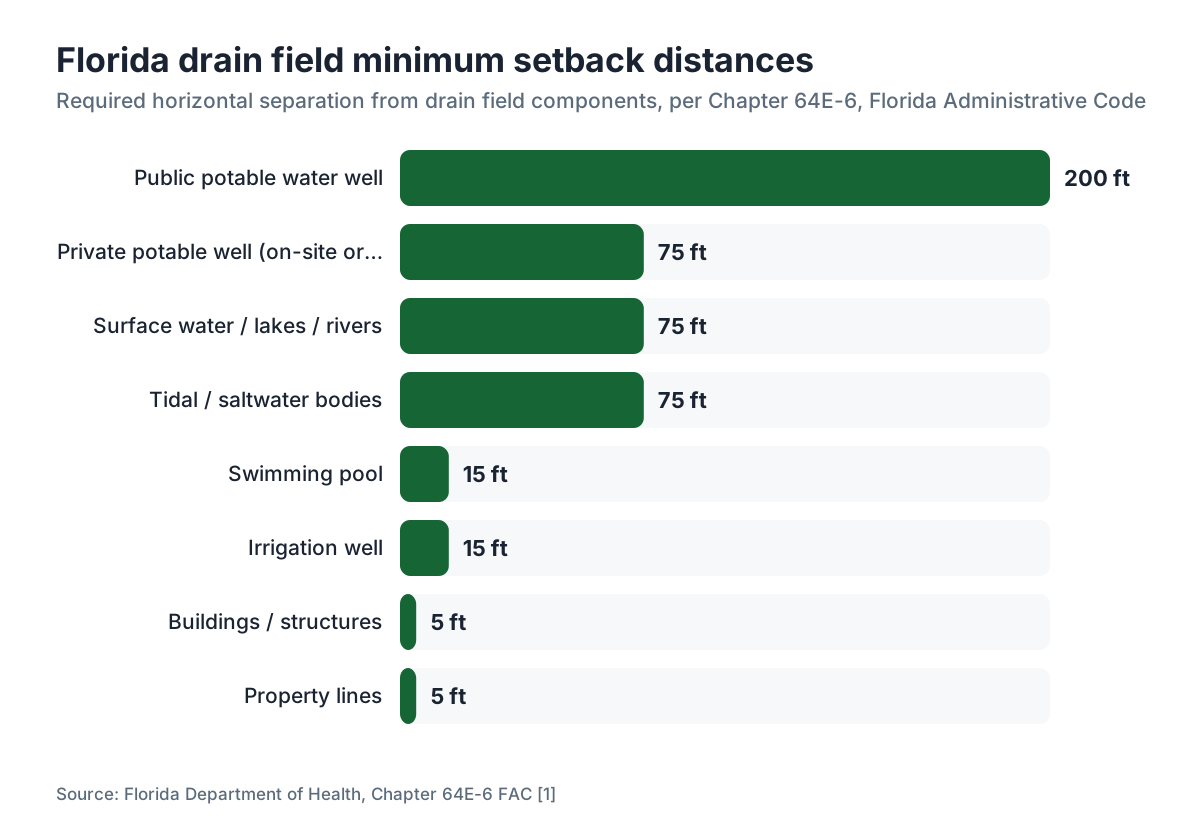
Setbacks are the distances a drain field has to keep from wells, water bodies, property lines, and structures. Chapter 64E-6 spells them out, and they are minimums. Counties can go stricter. None can drop below the state floor. [1]
| Feature | Minimum Setback from Drain Field |
|---|---|
| Potable water well (on-site) | 75 feet |
| Potable water well (off-site neighbor) | 75 feet |
| Private potable well (enhanced protection area) | Up to 200 feet (site-specific) |
| Surface water (lakes, ponds, rivers) | 75 feet |
| Tidal water / saltwater bodies | 75 feet |
| Stormwater retention ponds | 75 feet |
| Property lines | 5 feet |
| Buildings, structures | 5 feet |
| Swimming pools | 15 feet |
| Irrigation wells | 15 feet |
| Public potable water wells | 200 feet |
The 75-foot rule from a potable well kills deals on small lots. A quarter-acre parcel in a rural county often can't fit a well, a tank, and a drain field with every setback honored. That isn't a variance problem. That's a lot that probably can't hold an OSTDS at all.
Some coastal and spring-protection counties add buffers through local ordinance. St. Johns, Alachua, and Marion counties sit over or near Floridan Aquifer recharge zones and have pushed for tighter groundwater rules over the years. Call the county health department before you assume a lot is buildable. The state code tells you the floor, not the local answer.
What soil and groundwater conditions does Florida require?
Florida uses a soil profile evaluation, not a traditional perc test, in most cases. A licensed FDOH site evaluator or a professional engineer reads the soil profile to classify texture and structure and to estimate the seasonal high water table (SHWT). [1]
Here's the number that decides most jobs. The bottom of the drain field trenches or drip tubing has to stay at least 24 inches above the SHWT for a conventional system. [1] Across much of South Florida and the coasts, the water table sits close to the surface, which is why mounds, drip-dose systems, and aerobic units show up far more often there than gravity trenches do.
Soil hydraulic loading rates set the field size. Chapter 64E-6 assigns loading rates in gallons per day per square foot based on soil texture class:
| Soil Texture Class | Hydraulic Loading Rate (gpd/sq ft) |
|---|---|
| Sand (coarse) | 0.96 |
| Fine sand, sandy loam | 0.8 |
| Loamy sand | 0.72 |
| Loamy fine sand | 0.6 |
| Sandy clay loam | 0.48 |
| Clay, heavy clay | System may not be feasible |
Those rates decide how big your field has to be for a given daily flow. More bedrooms means more flow, more flow means more absorption area, and more area means you need more usable lot.
The SHWT reading usually comes from a licensed soil scientist or an FDOH environmental health specialist. Depth to the limiting zone (hardpan, claypan, or rock) is a separate measurement that also drives feasibility. If a limiting layer sits within 12 inches of the surface, conventional systems are generally off the table.
How is a Florida drain field sized?
Sizing starts with estimated daily sewage flow, which Chapter 64E-6 ties straight to the bedroom count. [1] The baseline is 120 gallons per day per bedroom, with a two-bedroom minimum applied even to a one-bedroom home. So the smallest design flow Florida sizes for is 240 gpd.
Take the design flow, divide by the soil's loading rate, and you get the required absorption area in square feet. A three-bedroom house runs 360 gpd. On loamy fine sand at 0.6 gpd per square foot, that's 600 square feet of drain field. That number is the absorption area, not the whole trench footprint.
Florida also makes you set aside a repair area. It's undisturbed soil reserved for a future replacement field, it has to match the primary area in size, and you can't build over it, pave it, or compact it. [1] So plan on roughly double the primary footprint being available on the lot.
Commercial sizing uses fixture unit counts and occupancy, and the math gets heavier. The FDOH site evaluation form (DH 4015) captures the whole calculation. Your contractor or engineer fills it out, but knowing what drives the numbers helps you catch a mistake before it's buried.
If you want the full picture including the tank, the cost to install septic system breakdown pairs well with this.
What types of drain fields are approved in Florida?
Chapter 64E-6 recognizes several system types beyond the classic gravel trench. Which one fits depends on your soil, your lot, and how close you are to sensitive water. [1]
Conventional drainfield: perforated pipe in gravel-filled trenches. Works where there's enough soil above the water table and decent hydraulic capacity. Still common across North Florida and parts of Central Florida where sandy, well-draining soils exist.
Low-pressure dosing (LPD): a pump pushes effluent through small-diameter pipe on timed intervals. Better distribution across the field, and it can work in soils that fail a gravity system. Needs a pump chamber and a dosing controller.
Mound systems: the field gets built above existing grade on imported fill, which creates separation from a high water table or a limiting layer. Common on the coasts and in South Florida. They work well, but the pump and distribution network mean more maintenance than a buried system.
Drip irrigation systems: effluent gets dosed through drip emitters into the upper soil. This requires secondary treatment (usually an aerobic unit) ahead of the field. It's approved where conventional placement is geometrically impossible. Upfront cost runs high, often $15,000 to $30,000 more than a conventional install, but on a small or wet lot it's frequently the only thing that works.
Aerobic treatment units paired with surface or subsurface dispersal are also approved for specific site conditions.
For design principles that apply no matter the state, the leach field basics cover the fundamentals.
Does Florida require a permit to repair or replace a drain field?
Yes, every time. Repairing or replacing any part of an OSTDS, drain field included, requires a fresh permit from the county health department. [2] There's no like-for-like exemption.
A repair permit triggers a new site evaluation. If your original system went in during the 1970s under older rules, a repair can force the whole thing up to current code: current setbacks, current soil separation, current sizing. That's not a hypothetical. It's what buyers of older rural Florida homes run into when the existing field turns out undersized or too close to the well.
Emergency repairs move faster. When a system is actively failing and backing up, county health departments can authorize temporary remediation while the full permit works through. Call the county environmental health office before you call a contractor, because starting work before a permit is issued can get the job rejected and redone at your cost.
For what repair work actually involves, see septic system repair and septic tank repair. The permit path is the same whether the trouble is in the tank or the field.
What inspections does Florida require for a drain field?
A Florida drain field gets inspected at three points: during new construction, during a home sale (when required), and on a set schedule if it's an advanced system.
New construction: the county health department inspector has to visit at least twice, once to check the layout before backfill and once to approve final cover. [1] The contractor can't cover the field before that first inspection. Full stop. Once it's buried, proving compliance gets close to impossible, which is why these violations are treated seriously.
Real estate transactions: Section 381.0065 does not require a septic inspection on every home sale. But lenders often do, FHA and VA especially, and some counties have point-of-sale inspection ordinances. A licensed FDOH inspector or a professional engineer runs it, checking tank condition, effluent levels, and any sign the drain field is failing. [2]
Advanced systems: if you have an aerobic treatment unit or a drip system, Florida requires an annual operating permit plus inspections by a licensed service provider, usually every four to six months. [1] The provider files a maintenance report with the county. Skip it and you're more than out of compliance, you also void the performance warranty on many ATU brands.
For what a full septic tank inspection covers and costs, that guide walks the process.
SepticMind's operations software helps Florida service companies track these mandatory visits and file the required reports automatically, so the technician isn't stuck doing paperwork in the field.
How much does it cost to install or replace a drain field in Florida?
Florida drain field costs swing with system type, lot conditions, and county. Here are honest ranges from contractor pricing across the state for 2024 into 2025.
Conventional drain field, repair or replacement with the existing tank: $3,000 to $8,000. That assumes decent soil and no strange access problems.
Full new system, tank plus field, new construction: $6,000 to $15,000 for a conventional setup on a suitable lot. [4]
Mound system: $10,000 to $20,000, driven mostly by how much fill it needs.
Drip or ATU system: $15,000 to $40,000. The spread reflects site complexity, ATU brand, and whether an existing tank can stay.
Permit fees through county health departments run roughly $200 to $500 for a standard repair permit and more for new construction. The site evaluation fee is either folded into the permit or billed separately at $150 to $300.
Don't forget the repair area. If your lot has to expand the field to hit current code sizing, that labor and material stacks on top of the base number. Digging in the rocky and clay-heavy soils of the North Florida panhandle costs more than working the sandy soils of Central Florida.
For a wider cost view that includes the tank, the cost to put in a septic tank article breaks it down by region and system type.
What can damage or kill a Florida drain field faster than expected?
Florida's warm climate and shallow water tables create failure modes that northern states rarely see.
Hydraulic overload is the usual culprit. Put more water into the system than the soil can absorb, whether from a toilet leaking 200 gpd or a full house running past design flow, and the soil stays saturated. Biomat, the dark biological layer on the soil interface, thickens faster in warm weather and eventually stops effluent cold. Once that happens, the field is dead. It needs replacement or a long rest.
Tree roots are aggressive here. Live oaks, magnolias, and especially willow and cypress send roots long distances toward moisture. They crush and plug perforated pipe, sometimes within a few years of a tree going in too close. Chapter 64E-6 doesn't name a tree setback, but University of Florida IFAS guidance recommends keeping trees well back from the field. [7]
Flooding. South Florida and the coasts flood regularly, and a flooded field absorbs nothing. Extended flooding can collapse trench walls and reset the biomat, which means full replacement. If your field floods seasonally, it's either undersized for the real water table or it needs to become a mound or ATU.
Infrequent pumping lets solids carry into the field and clog the pipes and the soil interface. Septic tank pumping every three to five years (more often for big households) is the cheapest thing you can do to protect a drain field. [7] The how often to pump septic tank guide has the schedule by household size if you're unsure where you fall.
Are there Florida-specific rules for sensitive areas and near the coast?
Yes. Florida's geography means the rules shift by region, aquifer proximity, and water quality classification.
Spring protection zones: counties over primary recharge zones for the Floridan Aquifer (much of Alachua, Citrus, Marion, and Levy) face tighter requirements. Some areas require nitrogen-reducing systems (advanced treatment with drip dispersal) instead of conventional fields, because nutrient loading from septic systems is a documented driver of spring decline. [5]
Coastal high hazard areas: FEMA flood zones AE and VE draw extra scrutiny. Fields in these zones have to account for storm surge, which usually forces an elevated system or a mound.
Okeechobee basin and lake protection: properties near Lake Okeechobee fall under state watershed rules that restrict system types and require nutrient reduction. The 2020 Clean Waterways Act directed FDOH and the Department of Environmental Protection to coordinate basin management action plans that shape OSTDS design in these watersheds. [6]
Mangrove and wetland setbacks: Florida's environmental rules separately require buffers from mangroves and jurisdictional wetlands. Stack that on the 75-foot setback from surface water and some coastal parcels won't hold any OSTDS.
Buying or building in a coastal, spring-shed, or basin area? Get a site evaluation before you close. A failed feasibility finding after closing is a bad surprise with a big price tag.
How do you apply for a Florida drain field permit?
The application goes to your county's FDOH environmental health office. Florida has no single statewide online portal for OSTDS permits. The process is county-run, though the forms are the same statewide. [2]
Step one is the site evaluation application, Form DH 4015, plus a site plan showing lot dimensions, existing and proposed structures, wells, and water features. You need a survey or a scaled drawing. A rough sketch won't clear it.
Step two is the evaluation itself. An FDOH environmental specialist visits, digs soil profile holes (by hand or backhoe, depending on the county), reads the SHWT, and classifies the soil. Expect two to six weeks depending on county workload.
Step three is permit issuance, once the evaluation confirms the lot can hold a system. The permit fixes the system type, size, and location. Permits run 18 months in most counties. Miss that window and you renew.
Step four is construction. Only licensed Florida septic contractors, holding a certified registration under Chapter 489, Florida Statutes, can install an OSTDS. [2] Verify the license through the FDOH environmental health onsite sewage program before you hire anyone. [8]
Step five is the final inspection. The county inspector signs off and the system is legally in service.
On new construction, the septic permit usually gets coordinated with the building permit but comes from the health department, not the building office.
What happens if your drain field fails an inspection or doesn't meet current code?
A failing or non-compliant drain field triggers a Notice of Violation from the county health department. [2] You get a timeline, usually 30 to 180 days depending on severity, to bring the system into compliance.
Active sewage surfacing, effluent pooling on the ground or backing up into the house, counts as an imminent health hazard and gets a much shorter window, sometimes 30 days or less. The county can also issue a cease-use order that blocks occupancy until the system is fixed. That's a real tool, and Florida health departments use it.
On older systems built under looser rules, a failure can force a full upgrade to current code: current setbacks, current sizing, a repair area, and maybe a different system type if the original design wouldn't be permitted today. This is where the sticker shock lives, because you're not fixing what broke, you're rebuilding to a higher standard.
Appeals go through the Department of Health, but they're slow and rarely win against a clear code violation. The better move is usually to hire a licensed engineer to find the configuration that meets the rules for the least money, then run that through the normal permit process.
If your inspector flagged the tank alongside the field, the septic tank pump out and septic tank cleaning articles are worth a read. Sometimes the tank is the easy fix, and handling it first tells you whether the field is actually compromised.
Frequently asked questions
How far does a drain field have to be from a well in Florida?
Florida requires a minimum 75-foot horizontal setback between any drain field component and any potable water well, whether it's on your property or a neighbor's. Public water supply wells require 200 feet. In some aquifer recharge or wellhead protection zones, local rules push the distance further. Chapter 64E-6, Florida Administrative Code sets these floors, and no local rule can go below them.
Can I build a pool or add a room addition over my existing drain field in Florida?
No. Florida prohibits building structures, paving, parking, or placing anything over an active drain field or the designated repair area. The soil above the field has to stay uncompacted and accessible. Violating this voids the system's permitted configuration and would require a new site evaluation and permit to establish a compliant replacement area before you could proceed with the construction.
How long does a Florida septic drain field last?
A well-installed, well-maintained field in suitable Florida soils typically lasts 20 to 30 years. Systems in high water table areas or on heavier soils run toward the low end. The biggest variables are how often you pump the tank, how disciplined the household is with water, and whether tree roots stay away. Poor tank maintenance is the leading cause of early drain field failure in Florida.
Do Florida counties have different drain field rules than the state?
Counties can adopt rules stricter than the state minimum under Chapter 64E-6, and several do. Alachua, St. Johns, and Citrus counties have imposed extra nutrient-reduction or setback requirements for properties near springs or water bodies. Always confirm requirements with the specific county health department before you plan a site. The state rules are the floor, not the ceiling.
What is the minimum lot size for a septic system in Florida?
Florida sets no single statewide minimum lot size. Feasibility depends on whether the lot can fit the required setbacks, the drain field, the repair area, and the structures. In practice, lots under about half an acre often struggle, especially with an on-site well. Many rural counties impose one-acre minimums for lots served by both a well and septic, but that comes from local zoning, not state health code.
Does Florida require a septic inspection when selling a home?
State law doesn't mandate an OSTDS inspection on every home sale, but FHA, VA, and USDA loans typically require one. Some counties have point-of-sale inspection ordinances. Even when it's not required, buyers' agents routinely make it a contract contingency. An inspection by a licensed FDOH contractor or engineer usually costs $200 to $500 and covers tank condition, drainage, and visible drain field status.
What is a Florida OSTDS permit and who issues it?
An OSTDS (onsite sewage treatment and disposal system) permit is the authorization from the county Florida Department of Health environmental health office to install, repair, or modify a septic system including the drain field. Section 381.0065, Florida Statutes requires it. Only licensed contractors holding a Class A or Class C certification under Chapter 489 can legally do the installation work once the permit is issued.
Can I install my own drain field in Florida without a contractor?
No. Florida requires OSTDS installation and repair to be done by a licensed certified contractor registered with the state. Homeowner self-installation is not permitted under Chapter 64E-6. The only exception is certain minor maintenance tasks. Unpermitted DIY installation is a misdemeanor and can result in mandatory removal of the unpermitted system at the homeowner's expense.
How do I know if my drain field is failing in Florida?
The clearest signs are sewage odors outdoors near the field, wet or unusually green patches of grass over it, slow drains throughout the house, or sewage backing up into fixtures. On Florida's flat terrain, surfacing effluent tends to pool rather than run off, which makes it more visible than in hillier states. If you see any of these, stop heavy water use immediately and call a licensed contractor.
What is the groundwater separation requirement for a Florida drain field?
A conventional Florida drain field has to keep at least 24 inches of separation between the trench bottom and the estimated seasonal high water table. If the natural soil profile can't deliver that, the design shifts to a mound, low-pressure dosing, or drip system that builds the required vertical separation through engineered fill or dispersal depth. This is the most common reason conventional systems get rejected in South Florida.
How long does it take to get a drain field permit in Florida?
Timelines vary by county and workload. Scheduling the site evaluation alone can take two to six weeks. After the evaluation, permit issuance usually adds one to four weeks if the site passes. Total permit-to-start time often runs four to ten weeks for a repair and six to fourteen weeks for new construction. Emergency repairs can compress this. Contact the county health department directly to ask about expedited review.
Are alternative septic systems allowed in Florida?
Yes. Chapter 64E-6 approves several alternatives including mound systems, low-pressure dosing, drip irrigation dispersal, and aerobic treatment units paired with subsurface dispersal. These get required where conventional gravity systems can't meet soil separation or setbacks. Alternative systems carry ongoing maintenance contracts and annual operating permits, and they cost meaningfully more upfront than conventional drain fields.
Can a Florida drain field be repaired rather than fully replaced?
Sometimes. If only part of the distribution lines are damaged or root-intruded, spot repair or pipe replacement may restore function. But if the soil itself has failed from biomat buildup, hydraulic overload, or flood compaction, no pipe work fixes it. The soil has to rest or get replaced. A licensed contractor or engineer can tell you whether repair or replacement is the right call after a camera inspection and soil probing.
Sources
- Florida Department of Health, Chapter 64E-6, Florida Administrative Code (OSTDS Rules): Setback distances, soil separation requirements, hydraulic loading rates, drain field sizing, repair area requirements, and inspection requirements for Florida onsite sewage systems
- Florida Department of Health, Section 381.0065 Florida Statutes (Onsite Sewage Treatment and Disposal Systems): Statutory authority for FDOH to regulate OSTDS, permit requirements for installation and repair, contractor licensing requirements, and enforcement provisions
- U.S. EPA SepticSmart Program: Proper siting and sizing of the drain field is the primary factor in long-term septic system performance
- U.S. EPA, Onsite Wastewater Treatment Systems (Septic Systems) program page: Typical installation cost ranges for conventional and alternative onsite sewage systems
- Florida Department of Environmental Protection: Nutrient loading from onsite sewage systems is a documented contributor to spring water quality decline in Floridan Aquifer recharge areas
- Florida Senate, Clean Waterways Act (CS/CS/SB 712, 2020): 2020 Clean Waterways Act directed FDOH and FDEP to coordinate basin management action plans affecting OSTDS design requirements in priority watersheds including the Okeechobee basin
- University of Florida IFAS Extension (EDIS), septic system maintenance guidance for Florida homeowners: Recommended pumping frequency of 3 to 5 years for residential septic tanks in Florida, tree root intrusion guidance, and seasonal flooding effects on drain field performance
- Florida Department of Health, Environmental Health Onsite Sewage Program: Application process for OSTDS permits, Form DH 4015 site evaluation requirements, contractor license verification, and county health department contact information
Last updated 2026-07-09