Fixing a septic system: what's broken, what it costs, and what to do first
By the SepticMind Editorial Team
TL;DR
- Most septic problems land in one of four buckets: a broken tank component, a failed distribution system, a saturated drain field, or a cracked pipe.
- Repairs run from $150 for a baffle to $20,000 for a new drain field.
- Diagnosis always comes before repair.
- Pumping the tank first fixes or unmasks the problem roughly 80% of the time.
How do you know your septic system actually needs fixing?
The symptoms that send people searching for a septic fix are usually one of five: slow drains or gurgling throughout the house, sewage odors inside or out, soggy or oddly green grass over the drain field, sewage backing up into the lowest fixture, or an alarm on a pump-equipped system.
None of those automatically means a major repair. Slow drains can be a clogged house lateral. Odors can be a broken vent cap. A soggy yard in February might just be February. Symptoms tell you where to look, not what to spend.
The honest first step is a septic tank inspection by a licensed onsite professional. They locate the tank, open the lids, and check liquid levels, scum and sludge depths, the condition of the inlet and outlet baffles, and whether the effluent looks clear. That inspection runs $100 to $350 and rules out the cheap problems before anyone quotes you a $15,000 drain field job [1].
If the tank is overdue, get a septic tank pump out done at the same visit. A tank that hasn't been pumped in five or six years often mimics a failing drain field, because solids are carrying over into the distribution system. Pump it, wait a week, reassess. You'd be surprised how often that's the whole fix.
What are the most common septic system problems and repairs?
Septic failures cluster into a handful of categories. Here's the plain breakdown.
Broken inlet or outlet baffle. The baffle is a T-shaped fitting inside the tank that keeps floating scum from leaving and directs incoming waste downward. Plastic baffles crack. Older concrete baffles corrode and fall off. Replacing one costs $150 to $400 in most markets [2]. It's one of the fastest fixes in the trade.
Full or overloaded tank. A tank that missed its pumping schedule fills with sludge, and solids start pushing into the drain field. The fix is septic tank pumping ($275 to $600 for a standard 1,000-gallon tank) plus fixing whatever caused the overload, whether that's a leaking toilet dumping 200 gallons a day or a garbage disposal loading the tank with solids.
Clogged or broken distribution box. The D-box splits effluent evenly among drain field trenches. When it cracks or fills with solids, one trench floods while the others stay dry. Replacing a distribution box runs $500 to $1,500 including excavation [3].
Pump failure on pressure-dosed or mound systems. Effluent pumps last 7 to 12 years. A dead one shows up as an alarm, a full wet well, and zero effluent reaching the field. Pump replacement costs $500 to $1,500 for parts and labor, depending on pump size and access.
Clogged or cracked lateral pipes. The pipe from your house to the tank (the building sewer) and the pipes in the drain field trenches crack from root intrusion, soil settling, or age. A camera inspection of the lateral costs $150 to $300. Spot repairs run $300 to $800. Full lateral replacement can hit $1,500 to $3,500.
Biomat buildup in the drain field. Over time a layer of biological material builds up at the soil interface of the trenches and slows infiltration. Mild biomat responds to resting the field or aeration treatments. Advanced biomat means the field is failing.
Full drain field failure. This is the expensive one. When the soil in the trenches is permanently saturated or clogged beyond recovery, the field needs replacement or an alternative system. Costs run from $3,000 for a simple trench repair to $20,000 or more for a new mound or alternative system on a hard lot [4].
How much does fixing a septic system cost?
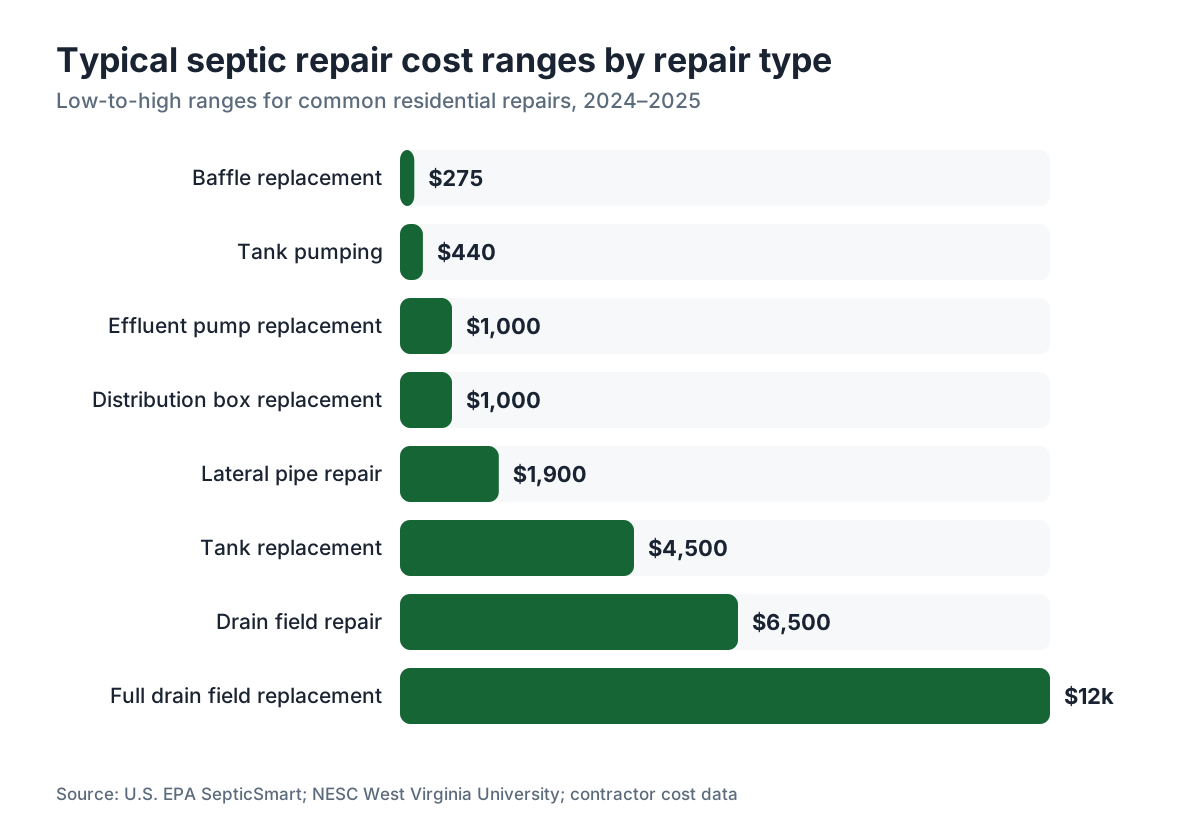
Cost tracks almost entirely to which component failed. Here's what real repair categories run in 2024 to 2025, based on contractor data and state agency cost guides.
| Repair type | Typical cost range | Notes |
|---|---|---|
| Baffle replacement | $150 to $400 | Often done during pumping |
| Tank pumping | $275 to $600 | Per pump, 1,000 gal tank |
| Riser installation | $200 to $600 | Per riser; improves access |
| Effluent pump replacement | $500 to $1,500 | Includes parts and labor |
| Distribution box replacement | $500 to $1,500 | Includes excavation |
| Lateral pipe repair | $300 to $3,500 | Spot repair to full replacement |
| Tank repair (cracks, lids) | $400 to $1,500 | Larger cracks may need replacement |
| Tank replacement | $3,000 to $6,000 | Excludes new system components |
| Drain field repair or expansion | $3,000 to $10,000 | Partial trench addition |
| Full drain field replacement | $5,000 to $20,000+ | Site-dependent; alternative systems higher |
These ranges are wide for three reasons: labor costs swing hard by region, access difficulty drives excavation cost, and permit fees vary by county. A repair in rural Montana carries a different cost structure than the same repair in suburban New Jersey.
The EPA's SepticSmart program puts average conventional system replacement at $3,000 to $7,000 for straightforward residential lots, and notes that alternative systems required on tough sites regularly top $15,000 [1]. Nobody should quote you a final number before seeing the site and pulling the permit requirements from your local health department.
Can a failing drain field be fixed, or does it always need replacement?
Sometimes yes, often no, and the difference costs you thousands. This is the answer homeowners want most, and here's the honest version.
A drain field failing from hydraulic overload (too much water entering the system) can recover if you cut the flow and rest the field. Fix the leaking toilet, spread laundry loads across the week, and stop draining the sump pump into the septic. Give the soil a few months to dry. This works when the underlying soil hasn't been permanently changed.
A field failing from biomat, the biological crust that builds up at the trench bottom, is harder. Aerobic treatment units, peroxide injection, and field aeration have all been tried with mixed results. A University of Minnesota Extension review of these treatments found limited controlled evidence that biomat remediation products reliably restore field performance over the long term [5]. Some contractors swear by them. Others call them a delay tactic. I'd be skeptical about spending more than $500 to $1,000 on biomat treatments without an honest read on how far gone the field already is.
A field with permanently saturated, compacted, or biologically dead soil needs replacement. There is no chemical fix for soil that can no longer infiltrate. Your options become a new conventional system if the lot has room, a mound system, a drip irrigation system, or in some cases a constructed wetland. Each needs a site evaluation and permits. See our full guide to leach field diagnosis and replacement for what that process looks like.
One thing worth knowing: most states require a perc test and soil evaluation before issuing a repair permit for a new drain field. The evaluation itself costs $300 to $800. If your soil fails, alternative systems become the only path, and they cost more.
What does the repair process actually look like from start to finish?
People call a septic company in a panic expecting a crew to show up and fix everything by dinner. That's rarely how it goes for anything past pumping. Here's the real sequence.
Step 1: Diagnosis. An inspection locates the tank, checks liquid and solids levels, examines the baffles and effluent quality, and often includes a camera pass on the lateral. Takes a few hours and produces a written assessment. Cost: $100 to $350.
Step 2: Pumping. Almost always done at diagnosis or right after. It gives you a clean baseline and often clears the immediate backup. Cost: $275 to $600.
Step 3: Permit pull. Any repair beyond a pump or baffle typically needs a permit from your local health department or environmental agency. In most states, drain field repairs require a licensed engineer or soil scientist to sign off. Permit fees range from $50 to $500 or more depending on jurisdiction. Timeline: days to weeks.
Step 4: Repair or replacement. Actual work runs from an hour (baffle swap) to several days (full drain field replacement with excavation, pipe installation, and inspection).
Step 5: Inspection and sign-off. Permitted work usually needs a county inspector to sign off before backfill. Don't let a contractor skip this. It protects you legally and confirms the work meets code.
Total elapsed time for a minor repair: 1 to 5 days. For a drain field replacement: 2 to 8 weeks including permitting. For a complex alternative system: 2 to 6 months is realistic in many jurisdictions.
Operators juggling multiple service calls and repair workflows can use tools like SepticMind to track permit status, job history, and scheduled inspections across accounts without things slipping through the cracks.
Do you need a permit to fix a septic system?
Yes, for almost anything structural. The threshold shifts by state, but the general rule holds: replacing a pump or baffle usually skips the permit, while replacing a tank, repairing or adding drain field trenches, or installing any alternative treatment technology always needs one.
The National Environmental Services Center notes that onsite wastewater systems are regulated at the state level, and every state writes its own rules [6]. Some states hand enforcement to counties. You have to check your local health department.
Unpermitted drain field work is a serious liability. It can void your homeowner's insurance for related claims, and it creates problems when you sell the property. A licensed contractor pulls permits as part of the job. If one offers to skip the permit to save you money and time, walk away. That's not a deal. That's a future problem that lands on you.
What can you fix yourself versus what needs a licensed contractor?
Let's be direct. Most states bar homeowners from doing their own septic repairs, other than tiny maintenance like cleaning effluent filter screens or adding biological additives [7]. Operating a tank vacuum truck requires a licensed hauler. Digging up and replacing drain field lines requires permits and usually a licensed installer.
What you can legitimately do yourself in most states:
- Locate your tank and keep the access points clear
- Check and clean the effluent filter (if your system has one) every 6 to 12 months
- Reset a pump alarm and check the float switch (after confirming no electrical hazard)
- Call for pumping before the tank overfills (every 3 to 5 years for most households)
- Reduce water use to relieve a hydraulically overloaded system
- Cut tree roots away from the drain field surface
What you should never DIY:
- Opening a septic tank and entering or working inside it (confined space, lethal gas)
- Pumping or hauling septage (regulated waste, licensed hauler only)
- Replacing or repairing tank baffles (technically simple, but usually needs a permit and licensed installer)
- Any drain field excavation or modification
- Installing or replacing pumps in pump chambers without confirming your state's requirements
The EPA SepticSmart program warns homeowners against entering or working inside tanks because of toxic and asphyxiating gases, noting hydrogen sulfide can knock a person out before they realize they're in danger [1]. People die in septic tanks every year. It is not a job to save a few hundred dollars on.
How do you find a trustworthy septic repair contractor?
The septic trade has licensed pros, and it has operators who'll tell you the whole system needs replacement when the baffle just needs swapping. Knowing which one you're talking to is the whole game.
Start with your state's licensing board. Every state that licenses septic contractors keeps a public lookup. Verify the license is active, check for disciplinary actions, and confirm they carry liability insurance and are bonded.
The National Onsite Wastewater Recycling Association (NOWRA) and the National Association of Wastewater Technicians (NAWT) both run certification programs that signal a contractor completed documented training beyond the minimum state requirement [8].
Get three written estimates for any repair over $500. Each should spell out exactly what work gets done, what components go in, whether permit fees are included, and what the warranty covers. A contractor who won't put a scope in writing before you sign is a red flag.
Ask directly: Does this repair need a permit, and who pulls it? Will the county inspect the work? What happens if excavation turns up more problems?
For routine pumping, Google reviews and the state contractor board are your best resources. For major repairs, ask the county health department for a list of registered installers. They often have one, and those contractors know the local code interpretations cold.
How do you prevent septic problems from happening again?
The most common reason systems die young is skipped pumping. The EPA recommends pumping a typical residential system every 3 to 5 years, though the real interval depends on household size and tank volume [1]. A four-person household with a 1,000-gallon tank fills it faster than a two-person household. Our guide on how often to pump septic tank walks the math for your situation.
Past pumping, the habits that wreck systems fastest are:
- Flushing anything other than toilet paper (wipes labeled "flushable" are not; the Water Environment Federation has documented their role in pump clogging and baffle damage) [9]
- Running a garbage disposal heavily, which increases solids loading by 50% or more in some studies
- Pouring fats, oils, and grease down the drain, where they harden and clog the inlet baffle and field
- Parking cars or heavy equipment over the drain field, compacting soil and crushing pipes
- Planting trees near the drain field, where root intrusion is a top cause of pipe failure
- Directing roof drains, sump pumps, or surface water toward the field, where saturated soil can't treat effluent
Get a septic tank inspection every 3 years even if you're not due for pumping. A pro can catch a cracking baffle or rising sludge level before it turns into a $10,000 problem. That inspection costs a few hundred dollars. The early catch almost always wins on money.
For a full service schedule, see our guide on septic tank cleaning.
Does homeowner's insurance cover septic system repairs?
Usually not, and it catches a lot of people off guard. Standard homeowner's policies treat septic systems as part of the home's structure but exclude damage from "gradual deterioration," which is how most septic failures get classified [10]. A sudden accidental event, like a contractor puncturing your tank during a dig, might be covered under property damage. A drain field that quietly failed over three years almost certainly isn't.
Some insurers sell optional riders or service line coverage that reaches the sewer lateral and occasionally the tank. Read the policy language. Coverage limits often sit at $5,000 to $10,000, enough for a pump replacement or baffle repair but not a full drain field.
A few states run septic repair loan or grant programs for low-income homeowners. USDA Rural Development's Section 504 Home Repair program offers loans up to $40,000 and grants up to $10,000 for very-low-income rural homeowners to fix health and safety hazards including failing septic systems [11]. Your state environmental or health agency may have more. Worth a 15-minute search before assuming you're on your own.
Buying a home on septic? A pre-purchase septic tank inspection is the best insurance you can buy. Many real estate contracts let you negotiate repair credits or a price cut if the inspection turns up a failing system. That conversation goes a lot easier before closing than after.
When does a repair make sense versus replacing the whole system?
This is a judgment call that turns on the system's age, the scope of the current failure, and what the property needs long-term.
Start with a simple principle: if a repair fixes one discrete failed component and the rest of the system is sound, repair almost always wins. A new outlet baffle on a 15-year-old tank with a healthy drain field is a cheap, easy call.
When several components fail at once, or the drain field has hit the end of its useful life (conventional fields typically last 20 to 30 years with good maintenance, though some run much longer), replacement often beats repeated patching on cost [3].
The tipping point most experienced contractors use: if the repair runs more than 50% of the cost of a comparable new system, and the system is more than 15 to 20 years old, think hard about replacement. You're paying a lot to stretch an aging system, and another failure is likely within a few years anyway.
For cost context, see our guides on cost to install septic system and cost to put in a septic tank. Knowing replacement costs helps you judge whether a repair quote is fair.
SepticMind's repair tracking lets service operators log repair history per system, which makes the repair-versus-replace conversation more data-driven for both the contractor and the homeowner.
What are the signs that a septic repair failed or didn't work?
Repairs fail more often than the industry likes to admit. A drain field "restoration" using injection products may improve drainage for 6 to 18 months before the biomat comes back. A repaired tank crack can re-open as the soil settles. A replacement pump fails again if the original cause (a float tangled on a pipe fitting, voltage spikes on an unprotected circuit) never got corrected.
Watch for these in the weeks and months after a repair:
- Symptoms returning within 30 to 90 days, which strongly suggests the root cause wasn't fixed
- Wet areas reappearing over the drain field, meaning the field still isn't infiltrating
- The pump alarm triggering again after a replacement (float switch problem or an undersized pump)
- Ongoing odors after baffle replacement (check the vent stack; it may be blocked or missing)
- Slow drains after a lateral camera and repair (root intrusion may run deeper than the camera showed)
A good contractor stands behind the work with at least a 1-year warranty on parts and labor for most repairs. Get that in writing before you sign. If symptoms return inside the warranty window, call right away and document the callback.
For a new drain field or major system work, ask your county health department to inspect the completed job before backfill. That inspection is your independent proof the repair was done right.
Frequently asked questions
How long does it take to fix a septic system?
Minor repairs like a baffle replacement or pump swap take 1 to 4 hours of work and often happen within a few days of diagnosis. Major repairs that need permits, like drain field replacement, take 2 to 8 weeks from inspection to finished work in most jurisdictions. Complex alternative systems on difficult sites can stretch to 2 to 6 months because of engineering requirements and permit queues.
Can I use my toilets while the septic system is being repaired?
It depends on the repair. For a pump replacement in a separate pump chamber, normal use may be fine while work proceeds. For drain field excavation or tank repairs, your contractor will usually ask you to minimize or stop water use during active work. On major repairs, a portable toilet on-site is standard. Your contractor should give you clear guidance before starting.
What happens if you ignore a failing septic system?
Untreated failures escalate fast. A slow drain becomes a sewage backup. A saturated drain field starts surfacing effluent, which is a public health violation in every state and can draw fines from the local health department. Ignored failures also damage adjacent soil, turning a $5,000 field repair into a $20,000 replacement. Acting at the first symptom almost always costs less.
How much does it cost to replace a septic drain field?
A conventional drain field replacement costs $5,000 to $15,000 for most residential lots. Sites with poor soil, high water tables, or limited space need alternative systems such as mounds or drip irrigation, which run $10,000 to $30,000 or more. The EPA notes average system replacement runs $3,000 to $7,000 for favorable sites but can top $15,000 for alternative designs. Always get three bids.
Can tree roots damage a septic system and how do you fix it?
Yes. Tree roots are a leading cause of lateral pipe and drain field pipe damage. Roots chase moisture and can crack PVC or clay pipe, block flow, and lift or displace distribution boxes. The fix involves camera inspection to map the intrusion, root cutting or hydrojetting, and in severe cases pipe replacement. Removing the offending tree and treating the stump prevents recurrence. Keep trees at least 30 feet from the drain field.
Is a septic system repair tax deductible?
For a primary residence, septic repairs are generally not federally tax deductible as a routine expense. But if the work qualifies as a capital improvement (adding value or extending the home's life by more than a year), the cost can be added to your home's cost basis, which reduces capital gains when you sell. Consult a tax professional for your situation. Rental properties may allow deduction of repair expenses.
What is the life expectancy of a repaired septic system?
A well-maintained conventional septic system can last 25 to 40 years. A repaired system can approach that if the underlying components are sound. A repaired drain field with a new field added or replaced typically resets the field clock to 20 to 30 years with proper maintenance. Repairs to individual parts like pumps and baffles don't change overall system longevity, since those parts wear out and get replaced on cycle.
Can heavy rain cause a septic system to fail and does it need repair?
Heavy or prolonged rain saturates the soil around the drain field and temporarily cuts its ability to accept effluent. This looks like a failure: slow drains, surface ponding, odors. In most cases it's temporary. If symptoms clear within a few days after the ground dries, the system may be fine. If they linger or return with every big rain, the field is undersized or the soil has been compromised, and a repair evaluation is warranted.
What do septic system additives actually do and should you use them?
Biological additives add bacteria or enzymes meant to improve tank digestion. The EPA's SepticSmart guidance states there is no scientific evidence that additives are necessary for a properly functioning system, and some chemical additives can harm the drain field. A healthy, regularly pumped tank keeps enough biological activity on its own. Skip the monthly treatments. Put the money toward your next pumping instead.
How do you find your septic tank if you don't know where it is?
Start with the as-built drawing filed with your county health or environmental department when the system was installed. If that's gone, trace the sewer pipe leaving the house (it exits near a toilet and heads away from the foundation), then probe the ground about 10 to 25 feet out. A septic contractor can use a metal probe or electronic locator for a modest fee. Some counties keep GIS layers with septic locations.
Does a septic repair affect property value or home sale?
A documented, permitted repair with county sign-off generally doesn't reduce property value and can help a sale by clearing a disclosure issue. An unpermitted repair or an undisclosed failing system can kill a deal or expose the seller to post-closing liability. Most states require sellers to disclose known septic defects. A clean inspection report after a proper repair is an asset, not a liability.
What is a septic system inspection and do you need one before repairs?
A septic inspection involves opening the tank access lids, checking solids and scum depths, assessing baffle condition, observing effluent quality, and often camera-inspecting the lateral and probing the drain field. It costs $100 to $350 and should always come before any repair quote. Without one, contractors are guessing at the problem. A proper inspection tells you exactly which component needs attention and prevents unnecessary work.
Can a cracked septic tank be repaired or does it need to be replaced?
Small hairline cracks in concrete tanks can sometimes be sealed with hydraulic cement or epoxy products rated for wastewater contact. Larger cracks, structural damage at the inlet or outlet, or cracks in the baffle walls usually mean replacement beats repair on cost. Fiberglass and polyethylene tanks rarely crack but can be damaged by bad installation. A contractor assessing a crack should check whether the tank holds a water test after sealing.
Sources
- U.S. EPA, SepticSmart homeowner guidance: EPA recommends pumping every 3 to 5 years; notes average system replacement at $3,000, $7,000 for conventional residential lots; warns against tank entry due to toxic gases
- U.S. EPA, SepticSmart homeowner guidance: Baffle function and maintenance described; baffles direct incoming waste and retain scum, and require repair when cracked or corroded
- National Environmental Services Center (NESC), West Virginia University: Conventional drain fields typically last 20 to 30 years with proper maintenance; distribution box replacement cost and function described
- U.S. EPA, Onsite Wastewater Treatment Systems Manual (EPA/625/R-00/008): Alternative systems on difficult sites can exceed $15,000; mound and drip irrigation systems described with cost context
- University of Minnesota Extension, Onsite Sewage Treatment Program: Limited controlled evidence that biomat remediation products reliably restore drain field performance long-term
- National Environmental Services Center (NESC), West Virginia University: Onsite wastewater systems are regulated at the state level; every state has its own rules, often delegated to counties
- U.S. EPA, SepticSmart: What Not to Flush: EPA warns against flushing anything other than toilet paper and against homeowners performing regulated septic work; toxic gas danger from tank entry
- National Association of Wastewater Technicians (NAWT): NAWT offers professional certification for septic inspectors and pumpers indicating training beyond minimum state requirements
- Water Environment Federation (WEF): Products labeled 'flushable' documented to contribute to pump clogging and baffle damage in onsite systems
- Insurance Information Institute: Standard homeowner's insurance typically excludes gradual deterioration; most septic failures fall into this excluded category
- USDA Rural Development, Section 504 Home Repair Loans and Grants: Section 504 program offers loans up to $40,000 and grants up to $10,000 for very-low-income rural homeowners to address health and safety hazards including failing septic
- National Onsite Wastewater Recycling Association (NOWRA): NOWRA maintains professional certification and member lookup for licensed septic contractors
Last updated 2026-07-09