Cost to install a septic system in 2026: full price guide
By the SepticMind Editorial Team
TL;DR
- A conventional gravity-fed septic system costs $3,500 to $10,000 on a standard lot with good soil.
- Alternative systems (mound, aerobic, drip) run $10,000 to $30,000 or more.
- Soil type, permit fees, tank size, and drain field size drive the price.
- Most homeowners pay around $7,000 to $10,000 all-in for a complete new install.
What does it cost to install a septic system?
A conventional gravity-fed septic system for a 3-bedroom home on good soil costs $3,500 to $10,000 installed in most of the country [1]. Engineered alternatives like mound or aerobic systems push that to $10,000 to $30,000 or more [2]. The honest answer past those ranges is: it depends on soil, lot, system type, and your county's permit fees.
Most homeowners land around $7,000 to $9,000 for a complete new install. Nobody has a single authoritative dataset on this. Figures shift by region and year, so treat any national average as a starting point, not gospel.
Here's what most homeowners get wrong: the tank is usually the cheapest part. A 1,000-gallon concrete tank costs $700 to $1,200 for the tank alone. Excavation, drain field materials, labor, and permits are where your money actually goes.
Budget for these core line items on a full septic system installation: permits and soil testing ($300 to $1,500), tank ($700 to $2,500), excavation and labor ($1,500 to $5,000), and drain field ($2,000 to $10,000+). The septic drain field is often the single most expensive component.
Costs in the Northeast and Pacific Coast run 30 to 60 percent higher than the rural Midwest or Southeast [1]. Labor rates, stricter setbacks, and pricier permits explain most of that gap.
How do different septic system types compare in cost?
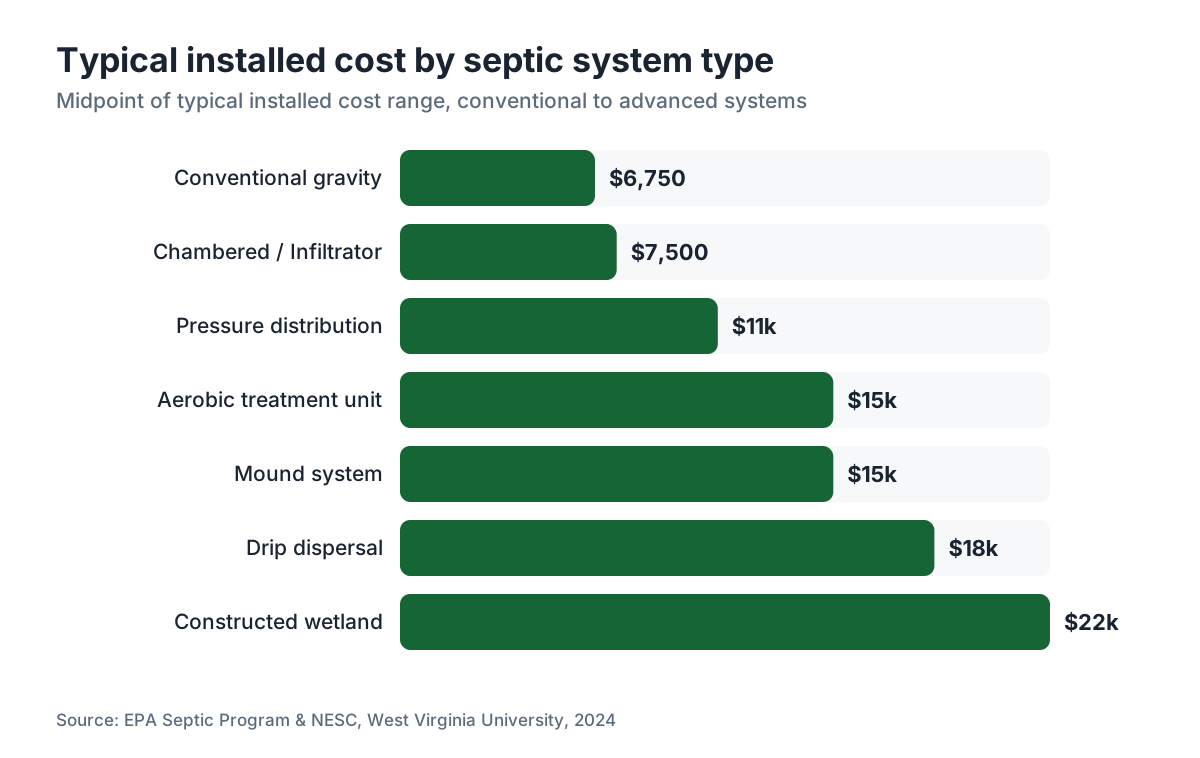
System type is the biggest single variable in your final bill. A conventional gravity system costs about a third of what a constructed wetland runs. Here's how the common options stack up:
| System Type | Typical Installed Cost | Best For |
|---|---|---|
| Conventional gravity | $3,500, $10,000 | Sandy/loamy soil, flat lots |
| Pressure distribution | $7,000, $15,000 | Marginal soil, uneven terrain |
| Mound system | $10,000, $20,000 | High water table, shallow bedrock |
| Aerobic treatment unit (ATU) | $10,000, $20,000 | Poor soil, smaller lots |
| Drip irrigation / drip dispersal | $12,000, $25,000 | Tight setbacks, clay soils |
| Constructed wetland | $15,000, $30,000+ | Environmentally sensitive areas |
| Chambered / Infiltrator system | $4,000, $11,000 | Replacement drain fields |
Conventional systems win on price because they use gravity and simple perforated pipe in gravel trenches. No pumps, no electronics, no maintenance contract required by the permit [2].
Aerobic treatment units spray treated effluent over the yard and are common in Texas and other states with clay-heavy soil. They work. But they need annual service contracts, usually $150 to $300 a year, and parts get expensive. Factor that recurring cost in before you commit.
A mound adds $3,000 to $8,000 over a conventional system because the contractor has to import and grade a sand fill mound above natural grade. Fail your perc test at 18 inches because of a seasonal high water table, and a mound may be your only permitted option.
For a closer look at just the tank and its price, see cost to put in a septic tank.
What factors drive the total septic install cost up or down?
Soil test results matter more than almost anything else. A perc test (percolation test), and often a soil profile evaluation, decide which system type your health department will permit. Soil that perc rates between 1 and 60 minutes per inch usually qualifies for a conventional system. Slower than that and you're into an engineered alternative [3].
Lot size and setback rules decide how much land the contractor has to work with. Most state codes require at least 10 feet from property lines, 50 to 100 feet from wells, and 10 to 25 feet from foundations. Tight suburban lots that barely clear those setbacks sometimes force an expensive alternative system just to fit.
Depth to bedrock and groundwater is a big one. Ledge rock at 4 feet means blasting or a mound. High seasonal water tables push you toward raised systems.
Household size sets tank size. A 2-bedroom home might get by with a 750-gallon tank in some states, but most 3-bedroom permits require at least 1,000 gallons, and a 4-bedroom needs 1,250 to 1,500 gallons [4]. Bigger tanks cost $200 to $600 more and are worth it.
Permit fees range from $150 to over $2,000 by county. Some counties also require a licensed engineer to stamp the design, adding $500 to $2,000.
Access and site conditions run the bill up fast. Rocky hillsides, mature trees over the field area, or a long equipment haul all raise labor. A contractor bidding a flat open lot and one bidding a wooded hillside 200 feet from the road are pricing two different jobs.
How much does a septic system replacement cost?
Septic system replacement costs $5,000 to $20,000 depending on what failed and what replaces it [2]. A cracked tank is the cheap end. A full system on a new part of the lot is the expensive end.
If only the tank failed (cracked shell, collapsed walls, deteriorated baffles), you're on the low side. Swapping a 1,000-gallon concrete tank runs $1,500 to $4,000 installed, assuming the drain field still works. See septic tank repair for when a patch beats a full swap.
If the drain field is failing, costs climb. A field replacement alone runs $3,000 to $15,000 depending on trench footage and soil. Some states require a full system redesign when you replace the field, which stacks on engineering and permit costs. More on the field itself at septic drain field.
Full replacement (new tank plus a new field on a fresh area of the lot) is the worst case. You need a new perc test, new design, new permit, full excavation, and a system that meets current code, which may be stricter than what went in 30 years ago. Budget $8,000 to $20,000 in most markets.
Here's the part people miss: you usually can't replace a failed drain field in place. The soil under the old field is saturated and won't perc. You need virgin soil, so the new field goes somewhere else on the lot. No room? You may be forced into a mound or ATU, both pricier.
Regular pumping is what keeps replacement off your calendar. Read how often to pump septic tank if you want to avoid this section entirely.
What are the permit and inspection requirements for a new septic system?
Every state requires a permit for a new septic system, and nearly all hand the actual permitting to the county health department or an onsite wastewater authority [3]. There is no federal installation permit, though the EPA sets guidance through its SepticSmart program.
EPA's SepticSmart guidance tells homeowners to "have your septic system inspected by a septic service professional every three years" and to have the tank pumped "every three to five years" [5]. Those standards also shape what counties require at installation.
A typical permit process runs like this: you hire a licensed designer or engineer to do soil testing and perc tests, submit a site plan to the county health department, wait for approval (2 to 8 weeks in most places), then pull a construction permit before breaking ground. The contractor schedules a mid-construction inspection before backfilling, then a final inspection once the system runs.
In some states a licensed installer can do their own soil testing. In others, only a licensed soil scientist or engineer can certify the site. That single distinction can add $500 to $2,000 to your pre-construction costs.
Skipping the permit is a genuinely bad idea. Unpermitted systems create title problems at sale, can't be financed by most mortgage lenders, and leave you personally liable for groundwater contamination. Several states have forced unpermitted systems to be decommissioned at the owner's expense, which means paying to tear one out and install a new one.
State onsite wastewater codes vary more than people expect. Texas Chapter 285 governs that state's rules [10]. New York uses Part 75 of the Public Health Law [11]. Florida runs on Chapter 64E-6 of the Florida Administrative Code [6]. Look up your state's rules before you budget. What's standard in one state may be flat-out banned in the next.
How does soil type affect what you'll pay?
Soil is the foundation of how a septic system works, and it's the biggest wildcard in your estimate. A perc test measures how fast water drains through the ground. Most conventional systems need a rate between 1 and 30 minutes per inch [3].
Sandy soils sometimes perc too fast, so effluent slips through before it's treated. Clay soils perc too slowly and the field waterlogs. Loamy or silty soil with moderate drainage is the sweet spot.
Fail the perc test and your options all cost more than a conventional system. Import sand fill and build a mound. Install an ATU that discharges treated effluent instead of raw, which more soils can handle. Or use a drip dispersal system that meters tiny doses slowly over a larger area. Each one adds $3,000 to $15,000.
Some counties now require a detailed soil profile evaluation by a licensed soil scientist, on top of or instead of a simple perc test. It's more accurate, costs $500 to $1,500, and it's non-refundable whether or not you get approved.
Here's the practical advice: don't buy rural land without a perc test contingency written into the purchase contract. A failed perc on a lot with no public sewer nearby can make the land nearly undevelopable, or drive septic costs past $30,000.
Can you save money by doing any of the installation yourself?
In most states, no, at least not legally. Septic installation requires a licensed contractor in the vast majority of jurisdictions. A few rural counties let a homeowner install their own system on their own property, but you still need an approved permit and inspections. Check your county health department before you assume DIY is on the table.
What you can legitimately do yourself: clear brush and site the area before the contractor arrives, restore landscaping after backfill, and install a septic tank riser (in most places, after the system is installed and inspected). Risers are a smart add while you're already paying for install, because they cut future septic tank pumping costs by killing the need to dig up the lid every few years.
Getting multiple bids saves you more than DIY ever will. Three bids on the same permitted design can vary by $2,000 to $4,000 in most markets. The lowest bid isn't automatically right (equipment, backfill quality, and warranty terms matter), and the highest isn't automatically better.
Timing helps too. Installers in cold-climate states are often hungry for work in late fall after the summer rush. That's anecdotal but consistent with what contractors report. Nobody has hard pricing data on seasonal swings in septic install costs.
Operators juggling multiple installs can use tools like SepticMind to standardize bid tracking and permit documentation across a service territory.
What does a new septic system cost by region?
Regional variation in septic costs is real and large. Labor rates, permit fees, regulatory complexity, and soil all shift by state and even by county. A rural Midwestern install and a suburban Northeast install can differ by $15,000 for functionally identical systems.
Here's a rough regional breakdown from contractor pricing data and state health department cost surveys:
| Region | Typical Range (conventional system) | Notes |
|---|---|---|
| Southeast (AL, MS, TN, AR) | $3,500, $8,000 | Lower labor costs, generally favorable soil |
| Midwest (IA, MO, KS, NE) | $4,000, $9,000 | Variable soil; mostly conventional systems |
| South (TX, LA, OK) | $5,000, $15,000 | Clay soils common; ATUs frequent in TX |
| Mid-Atlantic (VA, MD, PA) | $6,000, $15,000 | Strict regulations, higher permit fees |
| Northeast (NY, NJ, CT, MA) | $8,000, $25,000 | High labor, strict codes, older lots |
| Pacific Northwest (WA, OR) | $8,000, $20,000 | Environmental rules, high water table areas |
| Mountain West (CO, MT, ID) | $6,000, $18,000 | Rocky soil common, mound systems frequent |
New England homeowners face some of the highest costs in the country. Massachusetts Title 5 [7] is one of the most detailed and strictly enforced septic codes in the U.S., requiring engineered designs, licensed inspectors, and inspection reporting tied to real estate sales.
Texas is unusual. Aerobic systems are so common there (thanks to clay soils) that many counties layer local rules on top of state Chapter 285 [10]. Those add inspection and maintenance contract requirements that raise lifetime cost.
Compare a rural Midwestern install to a suburban Northeast one and you're easily looking at a $3,500 versus $20,000 spread for systems that do the same job.
What ongoing costs should you budget for after installation?
The install is a one-time hit. Everything after compounds over decades. A realistic 20-year cost of ownership for a conventional system runs $15,000 to $31,000 once you add pumping, inspections, and a likely field replacement.
Pumping is the big recurring cost. A conventional system needs a septic tank pump out every 3 to 5 years on average, though households with garbage disposals or more occupants may need it every 2 to 3 years [5]. Pumping costs $300 to $600 in most markets, more in rural areas with long haul distances. Over 20 years, budget $1,500 to $4,000.
Inspections should happen every 3 years for conventional systems and annually for anything with mechanical parts (pumps, aerators, UV disinfection) [5]. A basic inspection runs $150 to $400. States like Massachusetts require a Title 5 inspection before any home sale, at $400 to $800 [7].
ATUs and pump systems often carry a legally required annual service contract, $150 to $400 a year.
Drain field restoration products are mostly a waste of money, in my opinion. Enzyme additives and bacterial boosters off the hardware store shelf have no peer-reviewed evidence that they prevent field failure. Conservative water use and regular pumping do the real work. That's it.
Put the pieces together: $7,000 to $10,000 to install, $3,000 to $6,000 in pumping and inspections, and a possible $5,000 to $15,000 field replacement at end of life. Regular septic tank cleaning keeps that field healthy. Solids that overflow into the field are the top cause of premature failure.
Are there financing options or grants for septic installation?
Yes, and more than most homeowners know about. The most useful for low-income rural owners is the USDA Section 504 program: loans up to $40,000 at a 1 percent fixed rate, plus grants up to $10,000 for homeowners 62 and older [8]. Income limits apply and the property has to sit in an eligible rural area.
USDA also runs Section 306C Water and Waste Disposal grants to rural communities, which sometimes fund community sewer or shared septic systems rather than individual onsite systems [8].
State revolving funds through EPA's Clean Water State Revolving Fund can finance onsite septic improvements, though the money usually flows through state agencies to homeowners [9]. Ohio, Minnesota, and Vermont, among others, run active programs that subsidize individual upgrades near sensitive water bodies.
Local health departments sometimes have their own programs, especially in areas with documented water quality problems from failing systems. The Chesapeake Bay watershed states (Maryland, Virginia, Pennsylvania) have been active funders because of the bay's nutrient loading.
HELOCs and home equity loans are the most common tool for septic replacement, since the work adds home value and lenders understand the collateral. Personal loans work too, but rates run higher.
Operators handling customer financing conversations can use SepticMind to track which customers are in grant pipelines and schedule the work once funding clears.
How do you get an accurate bid and avoid overpaying?
Get the permit and design done before you solicit bids. That's the whole game. Without an approved site plan, contractors are guessing. With one, they price the same scope, and you can compare apples to apples.
Get at least three bids. Four is better. The spread runs $3,000 to $5,000 on the same permitted job. Ask each contractor for the same line-item breakdown: excavation, tank, distribution system, drain field materials, backfill and grading, permit and inspection fees. Lump-sum bids hide where the money goes.
Verify the license. Most states have an online lookup through the state health department or contractor board. Unlicensed installers may be cheaper, but an unpermitted install costs you far more when you sell or when it fails and you have no warranty.
Ask about warranty terms out loud. A reputable installer warrants the work for at least 1 year, and some offer 2 years on parts and labor. The tank manufacturer usually warrants the tank itself for 5 to 10 years against structural failure.
For septic system repair jobs where full replacement gets floated, always get a second opinion. Drain field "failure" is sometimes a distribution box problem or a clogged outlet baffle, both of which cost hundreds instead of thousands. A contractor pushing a whole-system replacement without diagnosing the actual failure point may not be looking out for your wallet.
Frequently asked questions
How much does it cost to install a septic system for a 3-bedroom house?
A 3-bedroom house typically needs a 1,000-gallon tank and a drain field sized for 300 to 450 gallons per day. On good soil, a conventional system runs $5,000 to $10,000 installed. On marginal soil that requires a mound or aerobic system, costs jump to $12,000 to $20,000. Permit fees and site conditions in your county are the biggest additional variables.
What is the cheapest type of septic system to install?
A conventional gravity-fed system with a concrete tank and gravel trench drain field is the least expensive option, typically $3,500 to $10,000. It has no pumps or mechanical parts, so operating costs stay low too. The catch: it only works on sites with good soil and adequate perc rates. Failing a perc test almost always forces you into a pricier alternative.
How long does it take to install a septic system?
The physical installation usually takes 1 to 3 days for a conventional system once permits clear and equipment is on site. Permit approval from the county health department takes 2 to 8 weeks. Soil testing and design work add another 1 to 4 weeks before you can even apply. Total timeline from start to working system is typically 6 to 14 weeks, longer in busy permit offices.
Can I install a septic system myself to save money?
In most states, no. Septic installation requires a licensed contractor. A few rural counties allow owner-installation on your own property with a valid permit and inspections, but that's the exception. Check your county health department before planning on DIY. The savings are usually too small to justify the liability risk of an improperly installed system.
Does homeowners insurance cover septic system installation or replacement?
Standard homeowners insurance does not cover septic replacement or repair for wear-and-tear or gradual failure, which is how most septic problems get classified. Some policies cover sudden accidental damage, like a tank collapse from a vehicle driving over it. A few insurers offer septic riders or home warranty products that cover component replacement, but read the exclusions carefully. Most homeowners fund replacement out of pocket or through a HELOC.
What is a perc test and how much does it cost?
A percolation test measures how fast water drains through the soil on your lot. A technician digs test holes, fills them with water, and measures the drop rate. Results determine which septic system types get permitted on your property. Perc tests typically cost $250 to $1,000 depending on the number of test holes required and whether a soil scientist must certify the results. Some counties require this before issuing any building permit.
How much does a mound septic system cost compared to a conventional one?
A mound system costs $10,000 to $20,000 installed, versus $3,500 to $10,000 for a conventional gravity system. The difference comes from importing clean sand fill to build the raised mound, extra excavation, and a pump chamber to dose effluent up into it. Mounds are required when seasonal high water tables or shallow bedrock rule out a standard in-ground drain field.
How often does a septic system need to be replaced?
A well-maintained conventional system lasts 25 to 40 years for the tank and 20 to 30 years for the drain field. The field usually fails first, often from solids buildup caused by infrequent pumping. With pumping every 3 to 5 years and conservative water use, many systems pass 30 years before any major work. Neglected systems can fail in under 10 years.
Do I need a new septic system when I buy a house?
Not necessarily, but get an inspection before closing. In Massachusetts and some other states, a Title 5 or equivalent inspection is legally required before a sale. In most states it's not required but is strongly advisable. A licensed inspector can tell you whether the system is functional, sized right for the home, and permitted. If the system is older than 20 to 25 years, budget for possible replacement within 5 to 10 years.
What are the signs that a septic system needs to be replaced rather than repaired?
Multiple failures at once point toward replacement: sewage surfacing over the drain field, persistent odors inside and out, toilets draining slowly throughout the house, and a pump alarm that keeps tripping. If the field stays saturated and won't recover after pumping, the biomat in the soil is usually beyond saving without a new field. Isolated problems like a cracked baffle, broken distribution box, or failed pump are repairs, not replacements.
Are there grants available to help pay for septic system installation?
Yes. The USDA Section 504 program offers loans up to $40,000 at 1 percent interest and grants up to $10,000 for eligible low-income rural homeowners 62 and older. Some states have added programs, especially near sensitive water bodies. Check with your county health department and your state environmental agency for local programs. Income and location eligibility requirements apply to most of them.
How much does it cost to replace just the septic drain field?
Replacing only the drain field, with the existing tank staying put, costs $3,000 to $15,000 depending on soil conditions, trench footage required, and whether a new permit and engineering design are needed. Keep in mind you usually can't replace a failed field in its original spot; the soil is saturated and won't perc. A new field area on the lot is required, which affects cost if space is tight.
What size septic tank do I need and how does that affect cost?
Most state codes tie minimum tank size to bedroom count. A 2-bedroom home often requires a 750-gallon tank; 3-bedroom homes need 1,000 gallons; 4-bedroom homes need 1,250 to 1,500 gallons. A 1,000-gallon concrete tank costs $700 to $1,200 for the tank itself. Stepping up to 1,500 gallons adds $200 to $500. Sizing up slightly is usually worth the small cost difference because it extends pumping intervals.
Does adding a bedroom increase septic installation cost?
Yes, in two ways. First, a higher bedroom count requires a larger tank (typically an extra $200 to $600). Second, many states size the drain field by bedroom count, so a 4-bedroom permit may require 30 to 50 percent more field than a 3-bedroom permit. That can add $1,000 to $4,000 to the field cost alone. Always disclose planned additions to your designer before the permit goes in.
Sources
- HomeAdvisor / Angi, Septic System Cost Guide: Conventional septic systems for a 3-bedroom home on favorable soil run $3,500 to $10,000 installed; regional variation of 30 to 60 percent between low-cost and high-cost states
- EPA, Septic System Types and Technologies: Alternative systems including mound, aerobic, and drip dispersal typically cost more than conventional systems; complete system replacement range cited in onsite wastewater guidance
- University of Minnesota Extension, Septic System Basics: Perc rates between 1 and 60 minutes per inch generally qualify for conventional systems; slower rates require alternative engineered systems
- EPA, Onsite Wastewater Treatment Systems Manual (EPA/625/R-00/008): Tank sizing recommendations by bedroom count; minimum 1,000 gallons for 3-bedroom homes is standard in most state codes
- EPA, SepticSmart Homeowner Guidance: EPA recommends inspection by a septic service professional every three years and tank pumping every three to five years
- Florida Department of Health, Chapter 64E-6 Florida Administrative Code: Florida onsite sewage treatment and disposal system rules governing installation, permits, and inspections
- Massachusetts Department of Environmental Protection, Title 5 Inspection Program: Massachusetts Title 5 requires engineered designs, licensed inspectors, and pre-sale septic inspections costing $400 to $800
- USDA Rural Development, Section 504 Home Repair Loans and Grants: Section 504 offers loans up to $40,000 at 1 percent fixed rate and grants up to $10,000 for homeowners 62+ for qualifying home repairs including septic systems
- EPA, Clean Water State Revolving Fund: EPA Clean Water SRF program can finance onsite septic improvements; money flows through state agencies to homeowners
- Texas Commission on Environmental Quality, Chapter 285 On-Site Sewage Facilities: Texas Chapter 285 governs onsite sewage facility rules including aerobic treatment unit requirements and annual service contract obligations
- New York State Department of Health, Part 75 Individual Household Systems: New York Part 75 of Public Health Law governs individual septic system permitting and installation requirements
- National Environmental Services Center (NESC), West Virginia University, Septic System Costs: Regional septic system cost data and system type cost comparisons for conventional versus alternative systems
Last updated 2026-07-09