Polylok effluent filter: models, installation, and cleaning guide
By the SepticMind Editorial Team
TL;DR
- Polylok makes three main effluent filters, the PL-122, PL-525, and PL-68, that screen solids leaving your septic tank before they reach the drain field.
- They fit 4-inch outlets, cost $30 to $80, and need cleaning every 1 to 3 years.
- Skipping this filter is one of the fastest ways to wreck a drain field, and that repair runs $5,000 to $20,000.
What is a Polylok effluent filter and why does your septic system need one?
A Polylok effluent filter is a cylindrical screen cartridge that sits inside the outlet baffle of your septic tank. Every drop of wastewater leaving the tank for the leach field has to pass through that screen. It catches suspended solids, biomat particles, and lint that the tank's settling process misses.
Polylok is a Connecticut manufacturer that has made septic and stormwater plastic parts since the 1990s. Engineers and health departments spec their filters constantly, partly because the company publishes clear dimensions and flow data, and partly because the filters are cheap enough that a homeowner can keep a spare on the shelf.
Here's why it matters. EPA's SepticSmart program says "most septic system failures are caused by overloading the soil absorption field with solids or hydraulic flows." [1] The effluent filter is the last barrier against solids before they hit that field. Without one, fine solids build up in the drain field pipes and soil, clogging the biomat layer faster than it can clear itself.
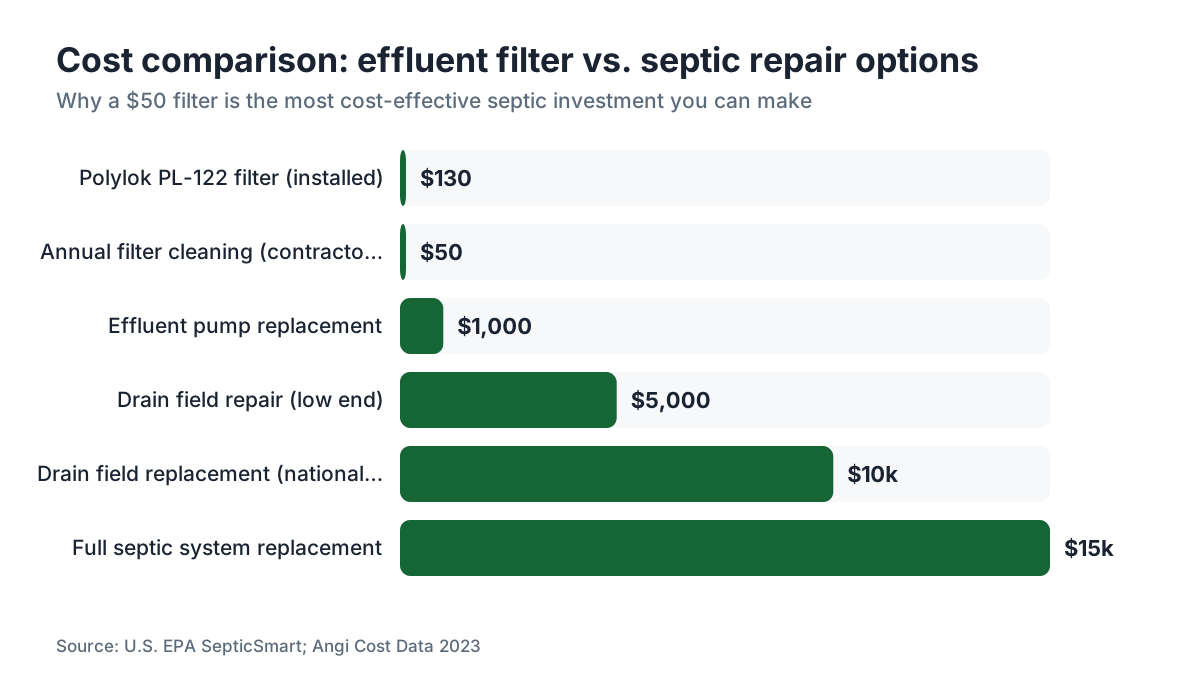
Replacing a failed drain field runs $5,000 to $20,000 depending on your state and soil. A $50 filter and a hosing-off every couple of years is the cheapest insurance in septic ownership.
What are the differences between the PL-122, PL-525, and PL-68?
Polylok makes several models, but three dominate specs and homeowner searches: the PL-122, PL-525, and PL-68. They are not interchangeable. Pick the wrong one and you get a filter that either falls out or refuses to seat.
| Model | Nominal filter length | Housing fits outlet pipe | Slot size | Typical application |
|---|---|---|---|---|
| PL-122 | 18 inches | 4-inch SCH 40 | 1/16 inch | Standard residential tanks |
| PL-525 | 18 inches | 4-inch SCH 40 | 1/16 inch | Higher flow, wider body than PL-122 |
| PL-68 | 12 inches | 4-inch SCH 40 | 1/16 inch | Shallow tanks or limited vertical clearance |
The PL-122 is the most common residential model. It handles typical household flows up to about 1,500 gallons per day without backing up under normal solids loading. The PL-525 has a wider cartridge body, which gives it more surface area and slower velocity through the slots. Engineers spec the PL-525 for larger households, vacation rentals, or any system where the PL-122 keeps plugging between service visits. The PL-68 is a shortened version for tanks where the outlet tee sits close to the bottom, common in some older concrete tanks and certain fiberglass designs.
All three use 1/16-inch (0.0625-inch) slots. That opening stops most suspended solids that foul drain fields while still passing enough flow under normal use. Polylok also makes a 1/32-inch version for finer filtration, but those clog faster and aren't typical for standard residential setups.
How do you install a Polylok PL-122 or PL-525 effluent filter?
Installation is a DIY job for most homeowners if your tank lid is accessible and the outlet baffle is in decent shape. Budget about an hour the first time.
You need the filter cartridge, a filter housing (a short PVC sleeve that glues or friction-fits to the existing outlet pipe), PVC primer and cement if gluing, rubber gloves, and a garden hose.
Step one: find and open the outlet-end lid. The outlet is the side where the pipe leaves toward the yard and drain field. Not sure which end? The outlet baffle sits slightly lower in the tank than the inlet.
Step two: check the existing baffle. If it's a sanitary tee, the housing slides over the top of the tee's down-leg. If it's an old concrete baffle that has crumbled, stop and fix or replace the baffle first. A filter on a broken baffle gives you false confidence and nothing else. See our guide on septic tank repair for baffle replacement details.
Step three: slide the Polylok housing over the outlet pipe. Most PL-122 instructions call for a friction-fit on PVC pipe in good condition, with optional cement if the fit is loose. The housing should sit flush with or slightly above the liquid surface line.
Step four: drop the cartridge into the housing. It clicks or friction-locks in place. Keep the top handle reachable from the surface so you can pull the cartridge for cleaning without climbing into the tank.
Step five: replace the lid and mark the install date on PVC-safe tape or in your maintenance log.
One warning. Some older tanks have outlet pipes in rough shape, or the pipe is cast iron rather than PVC. In those cases, let your pumping contractor handle the install during a scheduled septic tank pump out. They can cement the housing properly and confirm the baffle condition while the tank is open.
How often should you clean a Polylok effluent filter?
Clean it every 1 to 3 years for a properly sized tank on a regular pumping schedule. That's the range most extension services land on. Polylok's own guidance says clean at every pump-out or at least once a year. [2] But the real answer depends on your household size, pumping schedule, and what goes down your drains.
EPA SepticSmart puts general septic maintenance, including filter inspection, on a 3-to-5-year pumping cycle, and notes that "a typical household septic system should be inspected at least every 3 years by a septic service professional." [1] University of Minnesota Extension recommends every 1 to 3 years, with more frequent cleaning for homes with garbage disposals. [9]
In practice, pull the cartridge and look. If the slots are packed with grey or brown biomat, clean it. If it's mostly clear, leave it. A household with a garbage disposal, a big family, or frequent guests can clog a filter in under a year. A two-person house with no disposal and regular pumping might go three years without a hiccup.
Signs it's overdue: slow drains across the whole house (more than one fixture), gurgling after drains run, or sewage backing up into the lowest fixture. Those can point to other problems too, but a clogged filter is the easy first thing to rule out.
Cleaning frequency is also why model choice matters. If a PL-122 clogs every 6 months in your system, moving up to the PL-525 with its larger filtration area often stretches that to 18 months. Usually worth the $20 difference.
How do you clean a Polylok effluent filter without making a mess?
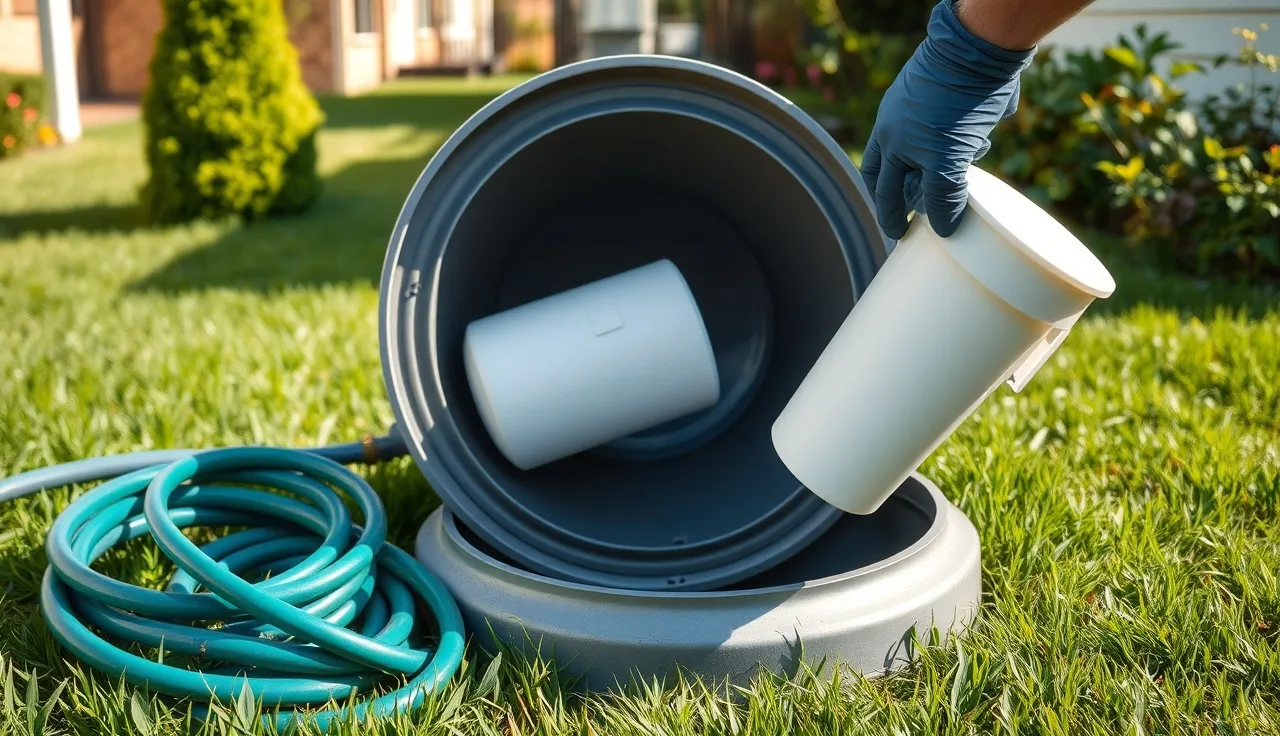
Hold the cartridge over the open tank and hose it off so the solids drop back into the tank. That's the whole trick. It's the part people dread, and it's genuinely manageable.
Wear gloves and old clothes. The cartridge comes out coated in grey sludge and biofilm. Have your garden hose uncoiled and ready before you lift the lid.
Pull the cartridge handle straight up. It'll come out wet and dripping. Do not rinse it over your lawn or into a storm drain. Spray it off over the open tank so everything falls back inside, not onto the soil or into groundwater. EPA guidance and most state onsite wastewater codes require exactly this. [3]
Spray all sides, top to bottom. The slots clear pretty easily under hose pressure. If you spot cracked or broken plastic on the cartridge body, replace it instead of reinstalling.
Drop the cartridge back in, replace the lid. Done.
Skip these: chemical cleaners (they kill the bacteria your tank runs on), aggressive pressure washing (it can widen or damage the slots), and hosing the cartridge off in the yard. That last one dumps raw septage onto the soil surface, a health code violation in nearly every U.S. state. [3]
If you manage multiple properties or run a pumping route, tracking which properties have Polylok filters and which model is installed saves real time. SepticMind keeps this kind of per-system detail, including filter model and last service date, which speeds up dispatch and pre-visit prep.
What does a Polylok effluent filter cost, and is it worth the price?
The part is cheap. A PL-122 usually retails for $30 to $55 online and at plumbing supply houses. The PL-525 runs $45 to $80. The PL-68 is priced similar to the PL-122.
Having a contractor install it during a pump-out adds $25 to $75 in labor, since it tacks on maybe 20 to 30 minutes plus a small markup on the part. Total installed cost lands at $60 to $130 depending on your local market.
Now compare that to drain field repair. EPA estimates repairing or replacing a septic system costs $3,000 to $7,000 on the low end, with complex replacements running well above that in some regions. [1] A 2023 national cost survey found drain field replacements averaging $10,000 to $15,000 in the Northeast and Pacific states, where land and permitting cost more. [4]
Is the filter worth it? Yes. The math isn't close. The only real decision is which model fits your tank and how often you plan to service it.
For operators: effluent filter installs and annual cleaning agreements are a small but steady revenue line, and they genuinely protect the customer. Offering a filter inspection on every septic tank pumping call is something most homeowners appreciate once you walk them through the drain field cost comparison.
Are Polylok effluent filters required by code in your state?
It depends on your state and often your county, and the rules have tightened over the past decade as more jurisdictions updated their onsite wastewater codes.
California: many counties now require effluent filters on all new tank installs, and some require them on older tanks at point-of-sale inspection. [5]
Florida: the Florida Department of Health's onsite sewage rules (Chapter 64E-6, F.A.C.) require effluent filters on new installations in certain system types. [6]
Texas: TCEQ's rules (30 TAC Chapter 285) reference filters in some advanced treatment system specs but don't mandate them across the board for conventional systems. [7]
Most other states follow the same pattern: required for new installs or certain system types, increasingly required at permit and inspection, but not universally mandatory for existing systems. NSF/ANSI Standard 46 sets the performance requirements a filter must meet to be code-compliant in jurisdictions that reference NSF standards, and Polylok filters carry that certification. [8]
Unsure about your local rule? Call your county health department or check your state's onsite wastewater program website. A septic tank inspection by a licensed inspector will also flag whether your system is missing a required filter.
Even where filters aren't mandated, most experienced septic engineers and inspectors recommend them. The drain field protection argument holds regardless of what the law says.
How long do Polylok effluent filters last before they need replacement?
A cleaned-regularly cartridge should last 10 to 15 years in a typical residential install. PVC doesn't rot, and the slotted screen doesn't wear from normal liquid flow. What kills a cartridge is physical damage (someone stepping on it, a pump truck cracking it), UV exposure if it's left in the sun after cleaning, or plastic going brittle in extreme cold.
The housing, the PVC sleeve cemented to the outlet pipe, is effectively permanent if it's installed right. You replace the cartridge. The housing stays.
Inspect the cartridge every time you clean it. Look for cracks in the slotted body, a warped shape that won't seat, a broken handle, and any slots that have been widened or damaged. Any of those, replace it. Replacement cartridges run $20 to $40, so there's no reason to gamble on a questionable one.
One underappreciated failure mode: the filter gets pulled for cleaning, set aside, and never goes back in. It happens during pump-outs when the technician cleans the filter, sets it on the ground, and the homeowner decides it looks old and tosses it without ordering a replacement. The tank then runs bare for months. If you're a service operator, carry a spare cartridge on the truck so you can swap in a new one and let the homeowner keep the cleaned old one as their next spare.
Can a clogged Polylok filter damage your septic system?
Yes, and it surprises homeowners who assume the filter just slows things down.
When an effluent filter fully clogs, liquid can't leave the tank fast enough to keep up with household water use. The tank backs up. That backup pushes wastewater up the inlet pipe and into the house's lowest drains, usually a basement toilet or floor drain. You get sewage inside the house, the worst outcome of any septic problem.
In systems with a pump chamber downstream of the tank, a clogged filter can run the pump dry if the float switch is set wrong, which burns out the pump. Effluent pump replacement runs $500 to $1,500 including parts and labor. See septic system repair for more on pump failures.
Here's the subtler damage path. A partially clogged filter forces liquid to back up to a higher level in the tank, which can re-suspend settled solids and push them out in slugs when the filter partly clears. Those slugs of high-solids effluent are exactly what harms the drain field. So a filter that's almost clogged but not quite can be worse for drain field health than no filter at all during that stretch.
Clean it before it hits full blockage. Not sure where you are in the cycle? Pull it and look. Takes five minutes.
What should operators know about specifying and servicing Polylok filters on a route?
If you run a pumping route or inspection service, effluent filters touch several parts of your workflow.
On pump-out calls: build filter inspection and cleaning into every pump-out by default. The housing is right there at the outlet, and hosing it off while the tank is open adds maybe 10 minutes. Charge for it. $25 to $50 extra per call is reasonable, and most customers accept it without pushback once you explain why.
On inspection calls: document the filter model, condition, and cleaning date in your per-property record. Note whether the system runs a PL-122, PL-525, or PL-68, because knowing the model before the next visit means the technician can bring a spare cartridge if the current one looks close to end-of-life. SepticMind handles this kind of per-property equipment tracking and attaches it to recurring service reminders.
On retrofits: if you're recommending filters on older tanks, the PL-525 is worth the upsell for households with 4 or more people or a garbage disposal. More surface area means longer between cleanings, which means fewer callbacks for a blocked filter and less chance of a customer backup.
On new tank installs: septic tank installation contracts should specify the filter model by part number so there's no ambiguity on the job site. Writing "Polylok PL-122" instead of just "effluent filter" keeps the installer from substituting a cheaper, uncertified product.
On inventory: carry replacement cartridges on the truck. Four to six PL-122 and two to three PL-525 cartridges cover most situations without tying up much cash, since the parts run $20 to $50 each.
How does a Polylok filter compare to other effluent filter brands?
The two most common competitors are Orenco Systems (their Biotube line) and Zabel (now owned by Polylok, which bought the Zabel brand). Some distributors also sell generic or house-brand filters.
Orenco's Biotube filters are well-regarded, especially in the advanced treatment market, and they use a similar slotted screen. Their cartridges run $60 to $120, roughly double the Polylok price. Orenco's engineering data is thorough and their filters get specified on engineer-designed systems for larger flows. For a standard 3-bedroom house on a gravity-flow conventional system, that premium doesn't buy you much functionally.
Zabel filters predate the Polylok acquisition and are still sold. Since Polylok makes them now, parts compatibility and support aren't a problem. If you have an older tank with a Zabel housing, Polylok can help you find the right replacement cartridge.
Generic filters are where I'd be careful. NSF/ANSI 46 certification exists for a reason. A filter with slots labeled 1/16 inch but built without tight quality control can let through solids a certified filter would catch. For a $20 to $40 part that's supposed to protect a $10,000 drain field, buying a certified brand is worth it.
Polylok's advantages: NSF 46 certified [8], widely available through plumbing supply houses and online, clearly documented dimensions for specifying, and a manufacturer that actually answers the phone when you have a compatibility question.
Frequently asked questions
What size tank does the Polylok PL-122 fit?
The PL-122 fits any tank with a 4-inch Schedule 40 PVC outlet pipe, which covers most residential concrete, fiberglass, and poly tanks installed after the 1980s. Tank volume doesn't determine the model. What matters is the outlet pipe diameter and the vertical clearance between the outlet invert and the bottom of the tank. If clearance is under 18 inches, use the PL-68 instead.
Can I install a Polylok effluent filter myself?
Yes. In most states there's no permit required to add a filter to an existing outlet baffle. You access the outlet-end lid, glue or friction-fit the housing to the outlet pipe, and drop in the cartridge. The job takes under an hour for someone reasonably handy. If the baffle is crumbling or the outlet pipe is cast iron or clay, hire a contractor. Working inside a septic tank needs confined-space safety precautions that make it a professional job.
How do I know if my Polylok filter is clogged?
The clearest sign is slow drains throughout the house rather than one fixture, plus gurgling after water runs. A fully clogged filter can back sewage up into the lowest house drain. Confirm by opening the outlet-end lid: if the liquid level is noticeably higher than normal and the outlet pipe isn't flowing, the filter is the first thing to check. Pull it, hose it off over the open tank, and watch whether the level drops.
Where does the rinse water go when I clean the filter?
Spray the cartridge off over the open tank. The solids and rinse water fall back in, settle, and get pumped out at the next service. Never rinse a septic filter onto the lawn, into a storm drain, or down a household drain. Discharging septage to the soil surface is a health code violation in nearly every U.S. state. This isn't a technicality: that liquid carries pathogens and nutrients that can contaminate groundwater.
Does a Polylok effluent filter need to be replaced or just cleaned?
Cleaned, not replaced, in most cases. A PVC cartridge cleaned every 1 to 3 years lasts 10 to 15 years under normal conditions. Replace it only if you see physical cracks, warped plastic that won't seat, broken slots, or a damaged handle. Replacement cartridges run $20 to $40, so if there's any doubt about the cartridge's integrity, replacing it is cheap insurance.
What is the difference between the Polylok PL-525 and PL-122?
Both are 18 inches long and fit 4-inch outlet pipes, but the PL-525 has a larger cartridge body diameter, which means more filter surface area. That means slower velocity through the slots and more time between cleanings. The PL-525 suits larger households, properties with garbage disposals, or any system where the PL-122 clogged more than once a year. Price difference is roughly $15 to $25.
Do effluent filters affect how often I need to pump my septic tank?
Not significantly. The filter removes fine solids from the effluent stream, but those solids still have to go somewhere. When you clean the filter over the open tank, they go back in. Sludge and scum accumulate at the normal rate. Pump on the standard schedule, every 3 to 5 years for a typical household, adjusted up for a garbage disposal or larger family. See our guide on how often to pump septic tank for detail.
Is the Polylok filter NSF certified?
Yes. Polylok effluent filters carry NSF/ANSI Standard 46 certification, which covers septic tank effluent filters and verifies they meet performance requirements for solids removal and flow under standard conditions. NSF 46 certification matters for code compliance in jurisdictions that reference NSF standards, and it backs the manufacturing quality controls behind the 1/16-inch slot size claim.
Can I use a Polylok filter on a pump chamber, more than the main septic tank?
Yes, and it's common in two-compartment or multi-tank systems. Polylok filters get installed on the outlet of the primary tank (before the pump chamber) and on the outlet of the pump chamber before the dose line. Installing at the pump chamber outlet adds a second stage of solids removal before pressurized distribution to the drain field. Just make sure the pump is sized to handle the slight extra head loss.
What should I do if the Polylok filter housing is leaking or cracked?
A cracked housing defeats the whole point, since effluent bypasses the cartridge. The housing is PVC glued to the outlet pipe. If it's cracked, a contractor cuts it out and glues in a new housing section, typically a 30- to 60-minute job. If the outlet pipe itself is compromised, that's a larger septic tank repair job requiring assessment of the baffle and outlet pipe before installing anything new.
Are Polylok effluent filters required by law?
Depends on your state and county. California, Florida, and a growing number of other states require effluent filters on new septic tank installs or at point-of-sale inspection. Most states don't yet require retrofitting existing tanks. Even where they're optional, nearly every septic engineer and extension service recommends them. Your local county health department or state onsite wastewater program website has the definitive answer for your jurisdiction.
How do I find out which Polylok filter model is already installed in my tank?
Open the outlet-end lid and pull the cartridge. The model number is molded into the plastic on the handle or body. PL-122, PL-525, and PL-68 are printed right on the part. If the number has worn off, measure the cartridge length (12 inches is the PL-68, 18 inches is either the PL-122 or PL-525) and the body diameter to tell the two 18-inch models apart. Your original inspection report or permit file may also list the model.
What happens to my drain field if I run without an effluent filter?
Without a filter, fine suspended solids that survive the tank's settling process flow straight into the drain field. They build up in the gravel, perforated pipe, and surrounding soil, speeding biomat formation. Once the biomat gets too thick, effluent can't percolate, the field fails, and you're looking at $5,000 to $20,000 or more for leach field repair or replacement. EPA links most drain field failures to exactly this kind of solids overload.
Sources
- U.S. EPA SepticSmart: How to Care for Your Septic System: Most septic system failures are caused by overloading the soil absorption field with solids or hydraulic flows; typical household systems should be inspected at least every 3 years.
- Polylok Inc.: Effluent Filter Installation and Maintenance Instructions: Polylok recommends cleaning the effluent filter at every pump-out or at least annually.
- U.S. EPA: Septic System Maintenance Guidance: Septage must not be discharged to the soil surface; rinse water from filter cleaning should be directed back into the septic tank.
- HomeAdvisor / Angi: Septic System Repair Cost Guide: Drain field replacements average $10,000 to $15,000 in the Northeast and Pacific states as of 2023.
- California State Water Resources Control Board: Onsite Wastewater Treatment Systems Policy: Many California counties require effluent filters on new septic tank installations and at point-of-sale inspection.
- Florida Department of Health: Chapter 64E-6 F.A.C. Onsite Sewage Treatment and Disposal Systems: Florida's onsite sewage rules require effluent filters on new installations in certain system types.
- Texas Commission on Environmental Quality: 30 TAC Chapter 285 On-Site Sewage Facilities: TCEQ rules reference filters in some advanced treatment system specifications but do not mandate them universally for conventional systems.
- NSF International: NSF/ANSI Standard 46 Evaluation of Components and Devices Used in Wastewater Treatment Systems: NSF/ANSI 46 covers performance requirements for septic tank effluent filters; Polylok filters carry this certification.
- University of Minnesota Extension: Septic System Owner's Guide: Effluent filters should be cleaned every 1 to 3 years for a properly sized and regularly pumped tank; more frequent cleaning is needed for households with garbage disposals.
- Penn State Extension: Maintaining Your Septic System: Effluent filters are recommended as a cost-effective measure to protect drain fields from solids overloading.
Last updated 2026-07-09