Plastic septic tanks: what homeowners need to know
By the SepticMind Editorial Team
TL;DR
- Plastic septic tanks (polyethylene or fiberglass) cost $500 to $2,000 for the tank alone, weigh a fraction of concrete, and shrug off corrosion.
- They work well on sites with poor access or acidic soils.
- But an empty one can float out of the ground in a high water table, and not every county approves them.
- Check your local onsite wastewater code before you buy.
What is a plastic septic tank and how does it differ from concrete?
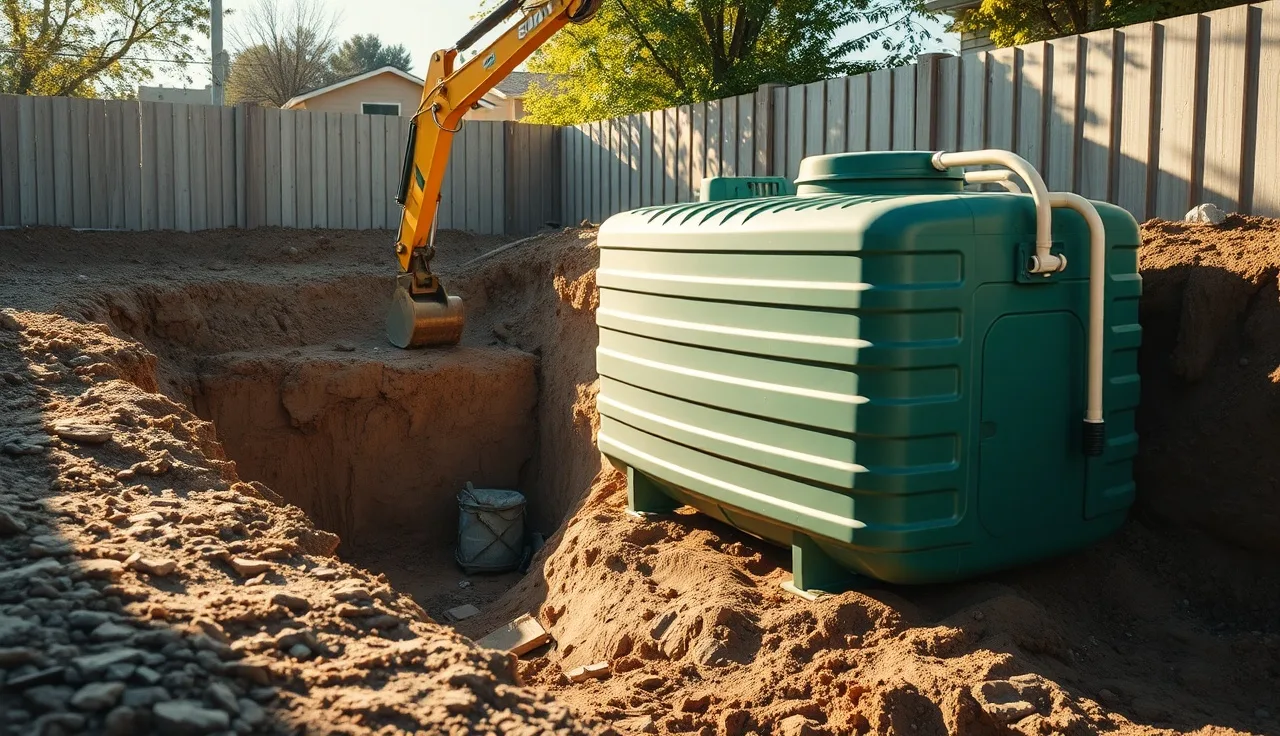
A plastic septic tank is a watertight underground vessel made from either rotationally molded high-density polyethylene (HDPE) or fiberglass-reinforced plastic (FRP). It does the same job as concrete: hold sewage long enough for solids to settle to the bottom as sludge, let grease float to the top as scum, and pass the clarified liquid out to the septic drain field.
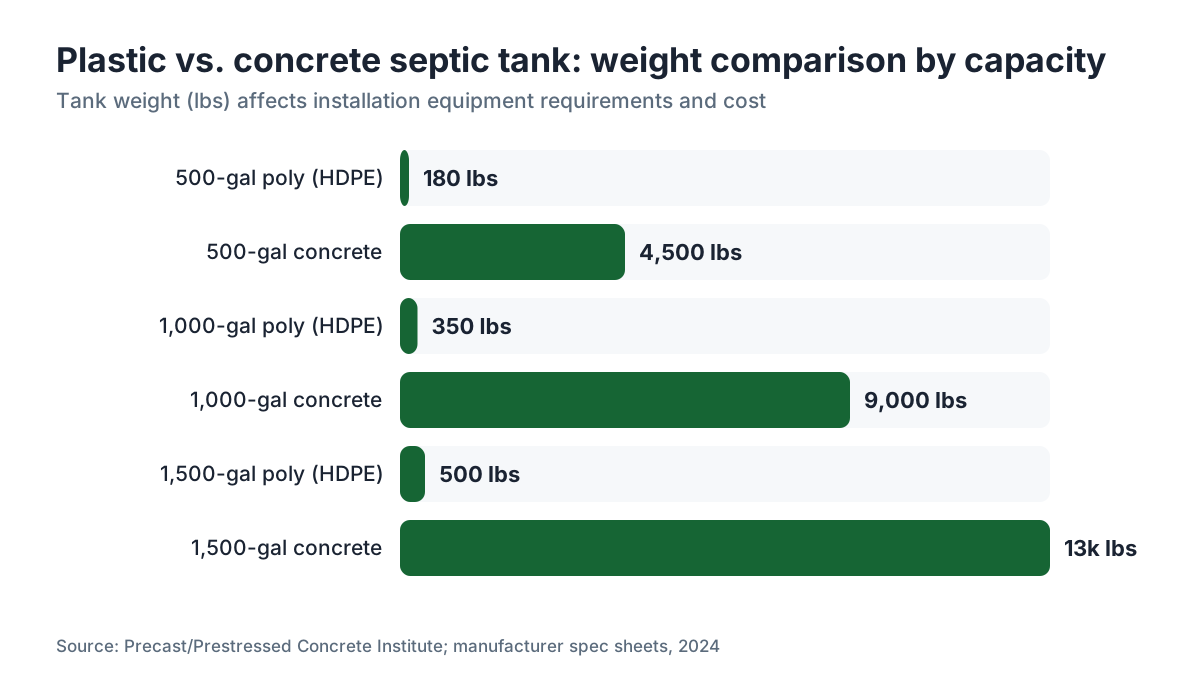
The weight difference is the headline. A 1,000-gallon concrete tank weighs 8,000 to 10,000 lbs [1]. A 1,000-gallon polyethylene tank runs 300 to 400 lbs. That gap changes everything about getting the tank in the ground. No crane. A smaller excavator. Trucks that can't reach a tight backyard can still make the delivery.
Concrete is poured rigid. Poly tanks come as one continuous molded piece, and fiberglass is laminated in sections, so there are no cast joints at the inlet and outlet the way precast concrete has, and those joints are exactly where concrete tends to crack and leak. The trade-off: plastic flexes under soil pressure. Bed it wrong or backfill it carelessly and that flex distorts the walls over time.
The EPA's SepticSmart program is blunt on this point. Every tank, whatever the material, has to be watertight to keep sewage out of groundwater, and it has to be sized to the household [2]. Material is the secondary question. Sizing and installation come first.
What are the real advantages of a plastic septic tank?
Weight is the benefit everyone talks about, and it earns the attention. When the tank has to go into a backyard with no vehicle access, a 350-lb poly unit that two people can roll into place beats scheduling a crane lift for concrete. Landscaping, pool equipment, and tight lot lines all stop being dealbreakers.
Corrosion resistance matters more than most homeowners realize. Anaerobic digestion inside any septic tank produces hydrogen sulfide gas. Over decades that gas attacks concrete from the inside, eating through the alkaline matrix in a process called microbially induced corrosion, or MIC. Plastic doesn't react to it at all. In coastal areas with high-chloride soils, or anywhere the groundwater runs a little acidic, plastic tanks outlast concrete when both are maintained [3].
Installs go faster too. The tank arrives in one piece and drops in without special lifting gear, so crews often finish the excavation and set the tank in a single day on an easy site. That trims labor by a few hundred dollars against a multi-piece concrete job.
Smooth interior walls are a small real bonus. HDPE and fiberglass lack the porous texture of concrete, so solids release cleaner during septic tank pumping and there's less surface for biofilm to grab onto between visits.
Most reputable plastic tanks carry NSF/ANSI 61 certification for the potable-contact side and meet IAPMO standards for onsite wastewater [4]. Read the spec sheet before you write a check.
What are the disadvantages and risks of plastic septic tanks?
Buoyancy is the biggest risk, full stop. An empty or half-empty plastic tank in saturated soil can pop out of the ground. Installers call it flotation or tank uplift, and it isn't rare where seasonal water tables run high or in flood zones. A 1,000-gallon poly tank displaces about 8,330 lbs of water when submerged and empty. Its own weight is maybe 400 lbs. The math wins: it floats unless something holds it down [5].
Manufacturers handle this with anti-flotation collars, concrete deadman anchors, or a specified minimum depth of fill. Your installer has to follow the spec exactly. Skip the anchor to save a few hundred dollars and you can spend $5,000 to $15,000 or more digging the floated tank back out, resetting it, and fixing the pipes it tore loose.
Structural load is the second concern. Plastic handles surface loads worse than concrete. Most residential poly tanks are rated H-10 (passenger cars), not H-20 (heavy trucks). Put an H-10 tank under a driveway that sees delivery trucks and you've built in a failure. Tell your installer exactly what will sit above the tank.
Install damage comes easier than with concrete. A sharp rock or a careless bucket can crack a poly wall in a way that doesn't show up right away but leaks steadily into the soil. Clean sand bedding and careful backfill compaction are not optional.
And not every jurisdiction approves plastic tanks. Some counties ban them outright. Others demand a specific certification. Confirm approval before you order.
How much does a plastic septic tank cost compared to concrete?
The tank alone runs $500 to $2,000 for a standard 1,000-gallon polyethylene unit, depending on the manufacturer, wall thickness, and what your regional distributor tacks on. Fiberglass at the same capacity runs $1,200 to $2,500. A comparable 1,000-gallon precast concrete tank runs $700 to $2,000 for the tank by itself, so on purchase price alone poly is often even with concrete or slightly cheaper [6].
The real money is in labor. Concrete usually needs a crane or boom truck (add $300 to $800 for the lift) and sometimes a second installer just to wrangle it. Plastic often needs only a skid-steer or small excavator and one experienced operator. On a hard-access site that swing can hit $1,000 or more.
Total installed cost to put in a septic tank, counting excavation, piping, risers, and permits, runs roughly $3,000 to $7,000 for the tank portion of a new system, no matter the material. The full cost to install a septic system with a drain field runs $10,000 to $25,000 or more depending on soil, system type, and local permit fees.
One cost people forget: anti-flotation measures. A concrete deadman anchor or collar adds $300 to $600 to a plastic install. Net it all out and the savings over concrete are real but modest, usually $200 to $800 on a typical residential job. Plastic wins more on site feasibility than on price.
| Item | Plastic (HDPE) | Concrete |
|---|---|---|
| 1,000-gal tank purchase | $500 to $2,000 | $700 to $2,000 |
| Crane/lift equipment | Rarely needed | $300 to $800 |
| Anti-flotation anchor | $300 to $600 | Not needed |
| Typical installed savings vs. concrete | $200 to $800 | Baseline |
How long does a plastic septic tank last?
This is where honest uncertainty lives. Manufacturers claim 30 to 50 years for HDPE and fiberglass. Independent long-term field data on plastic tanks is thin, because widespread residential use is fairly recent. What we actually have is accelerated aging tests and shorter field studies.
Fiberglass has been in the ground longer than poly, and there are documented installs in the 30-to-40-year range still doing their job. HDPE has a long track record in industrial liquid containment, but the residential septic use is younger, so 20 to 30 years of real-world data is the more honest number for poly.
What actually sets lifespan: proper bedding and backfill, staying inside the tank's rated structural load, never pumping the tank bone-dry in high-water-table conditions (which risks flotation and can collapse a single-wall tank), and fixing baffle failures promptly during routine septic tank cleaning visits.
A well-made concrete tank in neutral-pH soil can last 40 to 60 years. In corrosive ground that drops fast. So the honest read: in aggressive or coastal soil, a quality plastic tank probably outlasts concrete. In mild clay-loam with neutral pH, concrete may last longer. Neither one survives neglect.
Are plastic septic tanks approved and legal in your state?
Approval swings hard by state and sometimes by county. Do not assume.
Florida, Texas, and much of the Southeast have approved poly and fiberglass tanks for years, each with its own installation rules tied to the onsite wastewater code. Florida's Chapter 64E-6 of the Florida Administrative Code spells out tank construction standards and allows non-concrete tanks that meet ASTM structural standards [7]. Texas rules under 30 TAC Chapter 285 likewise permit approved alternative tank materials [8].
Other states clamp down harder. Some California counties still default to concrete for primary tanks and limit fiberglass or poly to holding tanks and pump chambers. A handful of rural Midwest jurisdictions run older codes that just say "concrete" and never contemplated anything else.
The rule of thumb is simple: pull your county or state onsite wastewater rules before you buy any tank. Your state health department or environmental agency keeps them. The EPA's SepticSmart page links to state contacts [2]. Your county sanitarian or a local installer will know the local status off the top of their head.
Even in states that allow plastic, the specific tank you want usually has to be on an approved products list or carry a certification (often NSF or IAPMO) that your state accepts. Ask the manufacturer for the certification paperwork and check it against your state's list.
Can a plastic septic tank float out of the ground, and how do you prevent it?
Yes, and it happens more often than sellers let on. Flotation hits when the buoyant force on an empty or partially empty tank beats the combined weight of the tank plus the soil sitting on top of it. Saturated soil has almost no grip. A 1,000-gallon tank displaces about 8,330 lbs of water but weighs only 300 to 400 lbs empty. Even under 12 to 18 inches of cover, the math can tip toward flotation during a flood, a seasonal water table rise, or right after a pump-out in wet ground [5].
The damage runs from annoying to ugly. A shifted tank snaps its inlet and outlet connections, can wreck the distribution box or drain field header, and needs a full excavation to reset.
Here's what actually prevents it.
Anti-flotation collars come first. Most reputable plastic tank makers offer or require a cast concrete collar that bolts around the tank's midsection or base, adding 2,000 to 3,000 lbs of deadweight. Follow the spec to the letter.
Backfill timing is second. Never pump the tank empty in saturated soil without either refilling it with water right away or having the anti-flotation hardware already in.
Site selection is third. If the seasonal high water table sits within 18 inches of the tank top, a concrete tank or a heavily anchored plastic one is the safer bet. Ask your installer for a soil boring or perc test that includes water table depth.
If a tank has already floated, septic tank repair or full septic system repair may be needed depending on which connections gave way.
How do you install a plastic septic tank correctly?
Installation is where plastic tanks live or die. Done right, they're excellent. Done carelessly, the trouble starts the same week.
Bedding is the foundation. Level the excavation bottom, then lay 4 to 6 inches of clean, compacted sand or fine gravel. Angular crushed stone is a bad call; it can puncture or abrade the wall. The tank has to sit level both ways. A tilt of more than 1 to 2 degrees throws off baffle positioning and the scum and effluent levels inside.
After you set the tank and connect the inlet and outlet, backfill goes in layers, usually 6-inch lifts of clean sand or approved fill, lightly compacted. The installation guide will spell out compaction. Heavy mechanical compaction jammed against the walls distorts them. Hand tamping, or a plate compactor kept 18 inches off the tank, is the standard.
Risers matter. Put septic tank risers to grade at both access ports so the next septic tank pump out and every inspection skip the shovel work. Plastic riser systems bond well to poly and fiberglass and hold a watertight seal when installed right.
Inlet and outlet baffles in plastic tanks are usually PVC or HDPE sanitary tees, and they're what makes the tank separate solids from effluent at all. Check that they're seated and undamaged before you backfill. Many tanks ship with baffles pre-installed; verify it before the tank goes in the hole.
One thing outranks the tank material: a licensed installer who has actually set this brand of plastic tank before. Ask directly about their experience with the model you're buying.
How often does a plastic septic tank need to be pumped?
Pumping frequency for a plastic tank is identical to concrete of the same size. The EPA recommends pumping a typical household tank every 3 to 5 years [2]. The precise number depends on tank size and how many people use it.
A 1,000-gallon tank serving a 3-bedroom house with 4 people usually needs pumping every 3 to 4 years [10]. The same tank with 2 people can often stretch to 5 or 6 years. A 1,500-gallon tank with 4 people can reach 5 years comfortably.
For guidance broken down by household size and tank capacity, see our full guide on how often to pump your septic tank.
One plastic-specific note. When a vacuum truck pumps a poly or fiberglass tank, the operator should avoid pulling a hard vacuum against the walls. Standard pump-out procedure is fine, but aggressive pumping that chases every last drop while holding full vacuum can stress a thin-walled tank. A pro doing a septic tank emptying on a plastic tank should add a little water back as the last step to equalize pressure. Most experienced operators do this without being asked.
For service operators tracking pump schedules across many properties, tools like SepticMind schedule recurring pump-outs and flag tanks coming due based on household size and tank capacity.
What sizes do plastic septic tanks come in?
Standard residential sizes are 500, 750, 1,000, 1,250, and 1,500 gallons. Some makers push a single poly unit to 2,000 gallons, though a tank that big in one piece gets awkward to haul and handle. Past that, fiberglass has the edge, since it can be built in larger single units, often up to 5,000 gallons, or assembled in place for bigger jobs.
State codes usually set minimum tank size by bedroom count. A common standard: 1,000 gallons for a 1-to-3-bedroom home, 1,250 for 4 bedrooms, 1,500 for 5 [7]. Some states set a flat 1,000-gallon minimum for new construction regardless of bedrooms. Check your state's onsite wastewater rules for the exact minimum [9].
Specialty configurations exist for two-compartment designs (some codes require them for primary tanks), pump chamber tanks for pressure-dosed systems, and aerobic treatment unit (ATU) housings. Plastic makers build all of these, though a two-compartment poly tank is sometimes two separate units joined by a through-pipe rather than a true single-vessel two-compartment tank.
Plastic vs. concrete vs. fiberglass: which septic tank should you choose?
Here's the honest comparison, not a pitch for any one material.
Pick a poly tank when site access is tight, the soil is corrosive or coastal, your budget is lean and the anti-flotation cost is manageable, and local code allows it.
Pick concrete when you've got a high seasonal water table but no budget for solid anti-flotation work, the site will carry vehicle traffic over the tank, you want the longest-proven track record in your specific soil, or local code defaults to concrete anyway.
Pick fiberglass when you need a larger tank (1,500 to 5,000 gallons) that's still lighter than concrete, you're in a high-corrosion environment, or you need a custom shape poly can't mold economically.
Nobody should tell you one material always wins. The right tank is the one that's sized correctly, installed correctly, and approved for your site. A badly installed concrete tank fails just as hard as a badly installed poly one.
| Factor | Poly (HDPE) | Fiberglass | Concrete |
|---|---|---|---|
| Tank weight (1,000 gal) | 300 to 400 lbs | 400 to 600 lbs | 8,000 to 10,000 lbs |
| Corrosion resistance | Excellent | Excellent | Moderate (degrades in acidic/H2S conditions) |
| Flotation risk | High if not anchored | High if not anchored | Very low |
| Traffic load rating | Usually H-10 | H-10 to H-20 | H-20 standard |
| Typical lifespan | 30 to 50 yrs (claimed) | 30 to 50 yrs | 40 to 60 yrs (neutral soils) |
| Cost range (1,000 gal tank only) | $500 to $2,000 | $1,200 to $2,500 | $700 to $2,000 |
| Available in most states | Widely, check code | Widely, check code | Universally |
For operators managing fleets of installed systems, SepticMind's service records track tank material alongside maintenance history, so technicians show up already knowing what they're working with.
What maintenance does a plastic septic tank need?
Maintenance for a plastic tank is basically the same as any other: pump every 3 to 5 years, inspect the baffles and outlet filter (if you have one) at each service visit, and keep a record of the dates.
A few things are plastic-specific. Check the inlet and outlet pipe connections at the tank wall for movement or cracking. Plastic flexes a little with seasonal soil movement, and that flex concentrates stress right at the rigid pipe connections. A small crack at a pipe penetration is a common failure point, and it's usually fixable with an approved flexible coupling or boot seal.
Look at the lid and riser connections too. Poly lid seals can dry out and crack over 10 to 15 years of sun and temperature cycling if the riser sticks above grade. Replacement gaskets are cheap and belong on the routine pump-out checklist.
In a wet climate or flood zone, inspect the anti-flotation collar or anchor hardware for corrosion (on the hardware, not the tank) every time the tank gets pumped.
The EPA's SepticSmart program says to keep a maintenance log and schedule regular inspections, noting that "the average household septic system should be inspected at least every three years by a septic service professional" [2]. That applies to plastic exactly as it does to concrete.
Wet wipes, medications, and household chemicals hurt the bacteria inside a plastic tank as much as inside any other. The material of the vessel doesn't change the biology.
Frequently asked questions
Can a plastic septic tank be used in cold climates?
Yes. HDPE and fiberglass hold their structural properties well below freezing. The cold-climate concern isn't the tank material, it's frost depth and pipe insulation above the tank. Set the tank below the frost line and insulate any shallow pipe runs. Standard practice in Minnesota, Maine, and similar climates uses plastic tanks routinely without trouble.
Will a plastic septic tank crack or collapse under a car driving over it?
It depends on the load rating. Most residential poly tanks are rated H-10, designed for passenger vehicles up to 10,000 lbs axle load. H-20 tanks (20,000 lbs axle load, covering light trucks and delivery vans) are available in both poly and fiberglass. Never drive heavy equipment over any tank not rated for it. Check the manufacturer's spec sheet and confirm burial depth meets the load-rating requirement.
How do I know if my existing plastic tank is failing?
Watch for slow drains or backups in the house, wet or smelly spots in the yard over the tank, unusually green grass above the drain field, or a pump-out tech finding walls visibly distorted or cracked. A camera inspection confirms internal damage. Cracks at pipe penetrations are a repair job. Collapsing walls or a tank that floated and shifted usually means replacement.
Can I repair a cracked plastic septic tank instead of replacing it?
Small cracks at pipe penetrations are often fixable with flexible boot seals or epoxy tank-repair compounds rated for wastewater contact. Cracks in the wall itself are harder. Some fiberglass tanks can be patched by a qualified tech, but a large structural crack in a poly tank usually means replacement. Get a written assessment from a licensed septic contractor before you decide.
Does a plastic septic tank smell more than concrete?
No. Odor comes from gas produced by anaerobic bacteria inside the tank, not from the tank material. Both plastic and concrete contain those gases except through the vent stack. If you smell sewage outside near the tank, it almost always points to a failed lid seal, a cracked riser, or a bad inlet or outlet connection, not the tank material.
What is the minimum size plastic septic tank for a 3-bedroom house?
Most state codes require at least a 1,000-gallon tank for a 3-bedroom home. Some states, including Florida under Chapter 64E-6, set that as an absolute minimum for single-family homes regardless of actual bedroom count. A few states use daily flow calculations instead. Check your state's onsite wastewater rules or ask your county sanitarian for the exact requirement before ordering.
Are plastic septic tanks approved by the EPA?
The EPA doesn't issue product-specific approvals for septic tanks; that happens at the state and county level. The EPA sets guidance and performance standards through programs like SepticSmart and its Onsite Wastewater Treatment Systems Manual. Whether a specific plastic tank is legal where you live depends on your state's onsite wastewater code and any approved products list your state health or environmental agency keeps.
How deep should a plastic septic tank be buried?
Minimum cover is typically 6 to 12 inches of soil in most state codes, but you need enough depth to sit below the frost line in cold climates. Maximum cover is usually 24 to 36 inches for a standard residential poly tank; going deeper without a specially engineered deep-burial tank can collapse the walls under the soil weight. Check the manufacturer's manual for your tank's minimum and maximum burial depth.
Can I install a plastic septic tank myself?
In most states, no. Septic installation requires a licensed contractor and a permit from your local health department or environmental agency. Even where owner-installation is allowed under permit, you're still on the hook for meeting all code and passing inspection. The stakes of a bad install (groundwater contamination, system failure, fines) make licensed professional installation worth the cost.
How much does it cost to replace a concrete septic tank with a plastic one?
Full replacement (excavation, removing or abandoning the old tank, new plastic tank, reconnection, backfill) typically runs $3,000 to $8,000 depending on access, depth, and local labor. If the old concrete tank can be crushed in place and abandoned, as some codes allow, that cuts cost. If it has to come out whole, add $500 to $1,500 for hauling. Permits add another $100 to $500.
Do plastic septic tanks need risers?
Yes, and it's strongly recommended even where code doesn't require it. Risers bring both access ports to grade so you never dig at pump-out again. Plastic riser systems bond well to poly and fiberglass and are widely available. The upfront $200 to $500 for risers pays back right away in lower pump-out labor and makes lid inspections practical. See our full guide on septic tank risers for installation details.
What brands of plastic septic tanks are most widely available?
Snyder Industries, Norwesco, and Infiltrator Water Technologies (part of Advanced Drainage Systems) are among the largest HDPE tank makers in North America. Xerxes and ZCL Composites are major fiberglass makers. Availability varies by region. Your local septic supplier or installer usually stocks one or two brands and can tell you which models your local code approves.
Is fiberglass or polyethylene better for a septic tank?
Both resist corrosion well. Polyethylene is usually cheaper, comes in one piece up to about 1,500 gallons, and is very common for standard residential use. Fiberglass handles larger sizes better, hits higher structural ratings, and is somewhat easier to patch in the field if it cracks. For a standard residential install under 1,500 gallons, either works well when properly installed and approved by local code.
Sources
- Precast/Prestressed Concrete Institute, 'Precast Concrete Septic Tanks': A typical 1,000-gallon precast concrete septic tank weighs approximately 8,000 to 10,000 lbs
- U.S. EPA, SepticSmart Program: EPA recommends pumping household septic tanks every 3 to 5 years and inspection every 3 years by a professional; tanks must be watertight regardless of material
- U.S. EPA, Onsite Wastewater Treatment Systems Manual (EPA/625/R-00/008): Hydrogen sulfide produced in anaerobic septic tanks causes microbially induced corrosion (MIC) that degrades concrete tanks over time; alternative materials resist this process
- NSF International, NSF/ANSI Standard 61: Drinking Water System Components: NSF/ANSI 61 certification applies to materials in contact with potable water components; many plastic tank manufacturers seek this and IAPMO certification for product approval purposes
- University of Minnesota Extension, 'Septic System Owner's Guide': Empty or partially empty plastic tanks can float out of the ground in high water table conditions; anti-flotation measures are required in susceptible sites
- HomeAdvisor / Angi, Septic Tank Installation Cost Guide: 1,000-gallon plastic septic tanks cost approximately $500, $2,000; concrete tanks of the same size run $700, $2,000; total installed system costs range $3,000, $7,000 for the tank portion
- Florida Department of Health, Chapter 64E-6 Florida Administrative Code, Onsite Sewage Treatment and Disposal Systems: Florida Chapter 64E-6 specifies tank construction standards, allows non-concrete tanks meeting ASTM structural standards, and sets 1,000-gallon minimum for single-family homes
- Texas Commission on Environmental Quality, 30 TAC Chapter 285, On-Site Sewage Facilities: Texas 30 TAC Chapter 285 permits alternative tank materials including polyethylene and fiberglass that meet specified structural and watertightness standards
- U.S. EPA, Onsite Wastewater Treatment Systems Manual, Chapter 4: Septic Tanks: Septic tank sizing is typically based on bedroom count: 1,000 gallons minimum for 1 to 3 bedrooms is a common state standard derived from EPA guidance
- North Carolina State Extension, 'Septic System Maintenance': Septic tank pumping frequency depends on household size and tank volume; a 1,000-gallon tank serving 4 residents typically requires pumping every 3 to 4 years
Last updated 2026-07-09