Cost of a mound septic system for a 3-bedroom house
By the SepticMind Editorial Team

TL;DR
- A mound septic system for a 3-bedroom house usually costs $10,000 to $30,000 installed.
- Most homeowners land between $15,000 and $25,000.
- The wide range comes from soil conditions, local permitting, site topography, tank size, and contractor rates.
- States with strict onsite wastewater rules and cold climates push costs toward the high end.
What does a mound septic system cost for a 3-bedroom house?
The honest answer is $10,000 to $30,000, and that range isn't padding. Most 3-bedroom installs land between $15,000 and $25,000 once you add up the tank, the pump chamber, the sand fill, the mound construction, electrical for the dosing pump, and permitting. [1]
The low end is rare. You'd need a forgiving site, a contractor hungry for work, and a state that doesn't demand much engineered oversight. The high end is just as unusual unless you're fighting extremely poor native soil, a large lot that needs long runs of force main, or a jurisdiction that makes a licensed engineer stamp every design.
For context, a conventional gravity-fed septic system on a similar lot runs $3,000 to $10,000 installed. [2] You pay the mound premium because your soil can't pass a standard percolation test, your water table sits too shallow, or state code simply requires elevated treatment. That's not a failure of your property. It's an engineering answer to a soil problem.
The 3-bedroom designation matters because most states size septic systems on bedroom count as a stand-in for daily wastewater flow. A 3-bedroom home is typically assumed to generate 300 to 450 gallons per day, depending on the state's design standard. [3] That assumption drives tank size and mound dimensions, which drive cost.
What's actually included in that price?
Break down the quote and you can compare bids honestly. A complete installation should cover the following.
Septic tank: For a 3-bedroom house, most states require a minimum 1,000-gallon tank, and many require 1,250 gallons. Precast concrete tanks run $700 to $2,000 for the tank itself. [4]
Pump chamber (dosing tank): Mound systems are pressure-dosed. A separate pump chamber, or a second compartment in the tank, holds effluent until the timer or float triggers a dose. Add $500 to $1,500 for the chamber and $300 to $800 for the pump.
Sand fill and mound construction: This is where most of the money goes. Clean sand imported to the site, graded and shaped into the mound, typically runs $4,000 to $12,000 depending on how much fill you need and how far it has to travel.
Distribution network: Perforated pipes, manifolds, and the pressure distribution laterals buried in the sand usually run $1,000 to $3,000.
Electrical: A licensed electrician runs conduit from the house to the pump chamber and installs the control panel with alarms. Budget $500 to $1,500.
Permitting and design: Most counties require a soil evaluation, a site plan, and a permit. Engineering and permitting fees range from $500 to $3,000. Some states require a licensed engineer's stamp, and that alone can add $1,000 to $2,000. [5]
Excavation and site work: Topsoil removal, rough grading, and final landscaping are often itemized separately. Expect $1,000 to $4,000.
Get bids that line-item every component. A contractor who hands you a single lump sum with no materials breakdown is harder to compare against competitors and harder to audit if something goes wrong.
What factors push the cost higher or lower?
Soil conditions are the single biggest variable. If your native soil is tight clay or carries a seasonal high water table within 24 inches of the surface, the engineer may specify a larger mound footprint or a deeper sand bed. More sand, more cost. [3]
Site access matters more than most homeowners expect. A mound system needs heavy equipment: excavators, dump trucks hauling fill, and compactors. A narrow driveway, a steep slope, or mature trees in the way can add access surcharges of $500 to $2,000.
Distance from the house to the mound location adds cost through longer force main runs (the pressurized pipe from the pump chamber to the mound). Each additional 50 feet of pipe and trench adds roughly $300 to $600.
State and county regulations vary enormously. Minnesota, Wisconsin, and several New England states run particularly detailed mound standards that often require licensed designers, specific sand gradations, and inspections at multiple construction stages. [6] Those requirements help systems last, but they add to the permit and design line items.
Contractor supply in your area is a real factor nobody in the trade likes to admit. In rural counties with two or three septic contractors, prices run 15 to 25 percent higher than in competitive suburban markets. Get at least three bids.
Season shifts the price too. Spring installs in northern states sometimes carry a premium because demand spikes once the frost leaves the ground. Fall installs in the same regions can come in a bit lower.
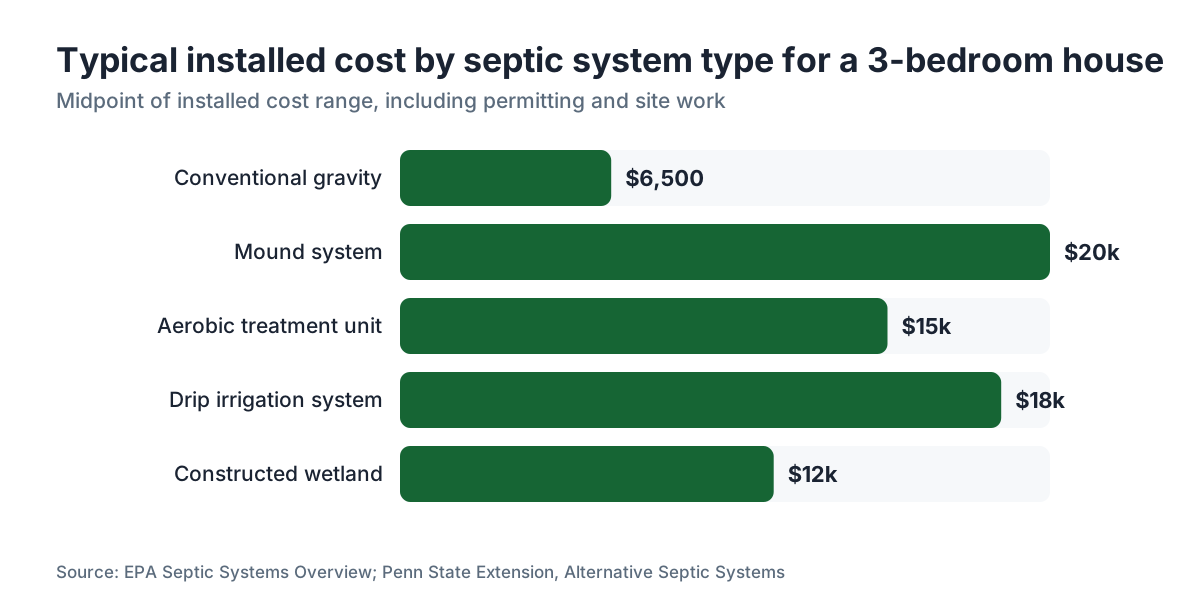
[Infographic placement: cost breakdown chart goes here]
How does mound system cost compare to other septic options?
Here's how the common alternatives stack up for a 3-bedroom house. These ranges reflect installed costs including permitting.
| System Type | Typical Installed Cost | When It's Used |
|---|---|---|
| Conventional gravity | $3,000, $10,000 | Good soil, adequate depth to water table |
| Mound system | $10,000, $30,000 | Shallow soil, high water table, slow perc |
| Aerobic treatment unit (ATU) | $10,000, $20,000 | Poor soil, small lots, strict effluent standards |
| Drip irrigation system | $12,000, $25,000 | Very slow perc, sensitive areas |
| Constructed wetland | $8,000, $15,000 | Limited applications, warmer climates |
| Cesspool (new install) | Banned in most states | Legacy systems only |
If your soil percs fine and you have adequate depth, a conventional system is almost always the cheaper path. The mound isn't a luxury upgrade. It's what you build when a conventional system isn't allowed. [2]
A cost to install septic system comparison across all types shows where the mound sits among your options. For the tank component alone, the cost to put in a septic tank breaks down materials and labor separately.
What size mound system does a 3-bedroom house need?
Tank size and mound dimensions come from estimated daily flow, which most state codes peg to bedroom count. EPA septic guidance references a design flow of 100 to 150 gallons per bedroom per day as a common baseline, putting a 3-bedroom house at 300 to 450 gallons per day. [3]
For a 1,000-gallon tank serving 300 to 450 gallons per day, the tank gives roughly 2 to 3 days of retention, which is the standard treatment goal before effluent moves to the mound.
The mound itself is sized by the linear loading rate, which depends on your soil's percolation rate or hydraulic conductivity. A soil that percs at 30 minutes per inch needs more mound surface area than one that percs at 10 minutes per inch. Your soil evaluator's report drives this number, and it's not negotiable.
Typical mound dimensions for a 3-bedroom house range from about 30 by 60 feet to 50 by 100 feet in plan view. Height above existing grade is usually 2 to 4 feet. A bigger footprint means more sand, more earthwork, and more cost. That's why two neighboring properties with identical house sizes can have mound quotes that differ by $5,000 or more.
Always ask your designer to show you the loading rate calculations. If they can't, find a different designer.
What are the ongoing maintenance costs for a mound system?
A mound system costs more to maintain than a conventional one. That's the honest trade-off.
The dosing pump is the most failure-prone component. Pumps typically last 7 to 15 years. Replacement runs $300 to $800 for the pump plus $150 to $300 for labor. [4] Your control panel has an alarm float that should warn you before a pump failure becomes a sewage backup. Test it once a year.
Pumping the septic tank is the same as any system: every 3 to 5 years for a 3-bedroom household, though actual frequency depends on household size and garbage disposal use. [7] A septic tank pump out for a 1,000 to 1,500-gallon tank runs $250 to $600 depending on location. Skipping pumps is the leading cause of premature mound failure, because excess solids reach the sand bed and clog it.
A septic tank inspection is worth doing every 1 to 3 years on a mound system. The inspector checks pump operation, float settings, effluent quality entering the mound, and any sign of effluent surfacing on the mound. Annual or biennial inspections cost $100 to $300 and catch problems early.
Many states require an annual maintenance contract for mound systems, especially those with ATU pretreatment. Wisconsin, for example, requires a management agreement filed with the county for most non-conventional systems. [6] These contracts typically run $100 to $300 per year.
Some operators use software like SepticMind to schedule and track pump-out reminders and inspection records for clients, which helps close the gaps that turn into expensive repairs. If you're a service provider managing multiple mound-system accounts, automated scheduling prevents the missed visits that lead to premature failures and unhappy customers.
Budget $500 to $1,500 per year for routine maintenance when you average pump replacements, inspections, and periodic septic tank pumping across a 20-year ownership horizon.
How long does a mound septic system last?
A properly built and maintained mound system should last 20 to 30 years. Some installations run longer. The sand bed is the limiting component. Over time, a biomat (a biological layer) develops at the interface between the effluent and the sand, which is normal and part of how treatment works. But if the system is overloaded or under-pumped, biomat grows excessive and hydraulic conductivity drops until the mound can't accept doses.
The EPA's SepticSmart program notes that "a properly maintained system can last a lifetime," while also acknowledging that systems getting poor maintenance often fail in 15 to 25 years. [3] The honest version: the sand bed in a mound is less forgiving of neglect than a conventional drain field, because you can't easily rest it or bring it back the way you can sometimes let a conventional leach field recover.
The dosing pump, electrical controls, and distribution piping are all serviceable. They fail and get replaced. The sand bed and mound geometry are the non-replaceable core. Protect them. Pump on schedule, watch for wet spots or slow drains, and keep vehicles off the mound surface.
If a mound does fail, the repair cost is real. Partial mound replacement runs $5,000 to $15,000. Full replacement approaches a new installation cost. See septic system repair for what those conversations look like.
Can you get permits and financing for a mound septic system?
Permitting is mandatory everywhere in the US for a new mound system. There's no legal way around it, and an unpermitted system creates serious title and liability problems when you sell. The process typically requires a soil evaluation by a certified evaluator, a system design reviewed by the county, and inspections during construction. [5]
Permit fees themselves usually run $200 to $800. The soil evaluation and design work that come before the permit application add another $500 to $2,500. Some counties let contractors handle the application. Others require a licensed engineer or designer. Call your county sanitarian's office before you start gathering bids so you understand what the local process demands.
On financing, a few real options exist. The USDA Rural Development program offers loans and grants for water and wastewater improvements in eligible rural areas under Section 504 and the Rural Water and Waste Disposal programs. [8] Income limits apply and not every county participates, but it's worth checking if your property qualifies.
The EPA has historically pointed homeowners toward state revolving fund programs, some of which have extended financing to onsite wastewater systems in sensitive areas like the Chesapeake Bay watershed. [3] Your state environmental or health department is the right place to ask.
Some lenders will finance a septic installation through a home improvement loan or home equity line of credit. If you're buying a property that requires a mound system as a condition of sale, your lender may also escrow funds for the installation.
A septic tank installation quote from a licensed contractor is usually what lenders want to see for financing approval.
What questions should you ask a contractor before signing?
A mound system is a long-term investment, and the contractor you pick matters as much as the price. Here's what to ask before you sign anything.
Are you licensed in this state for onsite wastewater system installation? Most states require a separate septic license beyond a general contractor's license. Ask to see it.
Who designs the system? Ideally, an independent soil scientist or licensed designer evaluates the site and produces the design. Some contractors do their own design work. That's not automatically bad, but ask whether the design gets third-party review.
What sand specification are you using? Mound systems require specific sand gradation, typically meeting a D10 grain size and coefficient of uniformity standard set by your state. Wrong sand is the single most common construction defect. Get the spec in writing. [6]
What warranty do you provide on labor and materials? One year is common. Some contractors offer longer warranties on the mound structure itself.
Will you pull the permit, or is that on me? Most established contractors handle permitting. If a contractor asks you to pull your own permit, that's a yellow flag worth investigating.
Can I see the inspection reports from your last three mound installations? A contractor confident in the work will say yes. One who hedges is telling you something.
Get at least three bids and make sure they're based on the same design. Comparing a 1,000-gallon system design to a 1,250-gallon design isn't apples to apples, even if the houses are identical.
What are the warning signs that a mound system is failing?
Catching a mound problem early can be the difference between a $500 pump replacement and a $20,000 mound rebuild. Know what to watch for.
Wet spots or lush green growth on top of or around the mound are the clearest sign of surfacing effluent. This is a public health issue more than a maintenance issue, and it warrants an immediate call to your contractor and likely your county.
Slow drains throughout the house, particularly when the pump alarm hasn't triggered, can mean the mound is saturated and no longer accepting doses. If the pump runs normally and the tank keeps filling, the mound is the bottleneck.
Frequent pump alarm activation means either the pump is failing or effluent is entering the pump chamber faster than the mound can accept it. Don't silence the alarm and wait. Call a technician.
Odors near the mound are a clear signal. A working mound produces no detectable odor at grade.
If you suspect trouble, a contractor can check pump operation, measure effluent levels in the dosing chamber between doses, and probe the mound to assess saturation. Early intervention is almost always cheaper than waiting. septic tank repair covers the pump and tank side of failures, while septic system repair addresses the field-side issues.
SepticMind's service tracking tools help operators flag accounts overdue for inspection or with recent alarm events, which is exactly when these failures tend to surface undetected.
Does a mound system affect property value or sale?
Short answer: a functioning mound system is neutral to slightly negative in most markets, and a failing one is a serious problem at closing.
Buyers often react negatively to mound systems because they look unusual and carry a reputation for complexity and cost. An informed buyer's agent will note that a mound system is required by the site's soil conditions, not an inferior choice. That framing matters.
If you're selling a property with a mound system, have it inspected and pumped before listing. A recent inspection report showing a functioning system is the best tool you have for keeping the sale on track. [9] Many buyers will request a septic tank inspection as a purchase condition regardless.
A failing mound discovered during a home sale inspection is a negotiating problem. Buyers will ask for either a repair credit or full replacement before closing. Full replacement bids become the number everyone argues over, and they're not small. Getting ahead of this by maintaining the system is the practical advice.
In rural markets where mound systems are common, buyers are less surprised by them. In suburban markets where most homes are on municipal sewer, a mound can be an unfamiliar obstacle for buyers who've never dealt with septic at all. Good documentation of maintenance history goes a long way.
Frequently asked questions
How much does a mound septic system cost for a 3-bedroom house?
Most 3-bedroom mound system installations run $15,000 to $25,000, with the full range sitting between $10,000 and $30,000 or more. The biggest cost drivers are how much imported sand fill the mound requires, local permitting complexity, site access, and contractor rates in your area. Get at least three itemized bids before committing.
Why is a mound septic system more expensive than a conventional system?
A mound system requires imported sand fill, a pressure dosing pump and control panel, and much more earthwork than a conventional gravity system. The mound itself, built from clean sand graded to specific specifications, is the dominant cost. You also pay for a more complex design, typically requiring a soil scientist and sometimes a licensed engineer.
What tank size does a 3-bedroom house need for a mound system?
Most states require a minimum 1,000-gallon septic tank for a 3-bedroom home, and many require 1,250 gallons. Mound systems also need a separate pump chamber or a second tank compartment to hold doses. Check your state's onsite wastewater code for the specific minimum, because requirements vary by state and sometimes by county.
How long does a mound septic system last?
A properly maintained mound system typically lasts 20 to 30 years. The sand bed is the limiting component. Overloading the system, skipping tank pumping, or letting excess solids reach the mound will shorten its lifespan a lot. Pumps, controls, and distribution pipes are serviceable and get replaced as needed throughout the system's life.
How often does a mound septic system need to be pumped?
Pump the septic tank every 3 to 5 years for a typical 3-bedroom household. Larger households or homes with garbage disposals may need pumping every 2 to 3 years. Skipping pumps is the leading cause of premature mound failure, because accumulated solids eventually reach and clog the sand bed. See how often to pump your septic tank for household-specific guidance.
Can I install a mound septic system myself to save money?
In most states, no. Mound systems require a permit, a soil evaluation by a certified evaluator, and installation by a licensed contractor with inspections at multiple construction phases. The sand specification requirements alone make DIY high-risk even where it's technically legal. A bad install that fails can cost more to fix than a proper install would have cost.
What are the annual maintenance costs for a mound septic system?
Budget $500 to $1,500 per year averaged across a 20-year period, covering periodic tank pumping, annual or biennial inspections, pump replacements every 7 to 15 years, and any state-required maintenance contracts. Mound systems cost more to maintain than conventional systems, mostly because of the dosing pump and the required inspection frequency.
Does a mound septic system smell?
A properly functioning mound system produces no detectable odor at grade. If you smell sewage near the mound, the system is overloaded, surfacing effluent, or has a distribution problem. That warrants immediate inspection. Odors inside the house from a mound system are almost always a plumbing vent issue, not a mound problem.
Does a mound septic system affect home value?
A functioning mound system is generally neutral to slightly negative in markets where buyers are unfamiliar with septic. A well-documented maintenance history helps at closing. A failing mound discovered at inspection is a real negotiating problem. Getting the system inspected and pumped before listing is the most practical way to protect your sale.
What is the difference between a mound system and a conventional septic system?
A conventional septic system relies on gravity to move effluent from the tank to a drain field buried in native soil. A mound system pumps effluent under pressure into a raised bed of imported sand when the native soil can't treat wastewater adequately due to shallow depth, slow percolation, or a high water table. Mound systems cost more and run more machinery.
Are there any grants or loans available to help pay for a mound septic system?
The USDA Rural Development program offers loans and grants for water and wastewater improvements in eligible rural areas under Section 504 and the Rural Water and Waste Disposal programs. Some states have revolving fund programs for onsite wastewater systems in sensitive watersheds. Contact your county sanitarian and your state's environmental or health department to find what's available locally.
How do I know if my property needs a mound septic system?
A soil evaluation by a certified soil scientist or licensed evaluator determines whether a conventional system is feasible. If your native soil percs too slowly, your water table is too shallow, or your soil depth to the limiting layer falls short of your state's standards, a mound system or another alternative will be required. This evaluation happens before any system is permitted.
What happens if a mound septic system fails?
Partial mound failure, where part of the sand bed is clogged, can sometimes be handled by resting sections or replacing distribution components at a cost of $5,000 to $15,000. Full mound failure typically requires complete replacement, approaching the cost of a new installation. Continuing to use a failed mound is a public health violation in most jurisdictions.
Can a mound septic system be installed in cold climates?
Yes. Mound systems are common in cold-climate states like Minnesota, Wisconsin, and Vermont precisely because shallow frost depths and high water tables make conventional systems impractical. Cold-climate installs typically require extra topsoil cover over the mound for insulation, and some jurisdictions require specific cover depths. Wisconsin's mound code is one of the most detailed in the country.
Sources
- HomeAdvisor / Angi, Mound Septic System Cost Guide: Mound septic system installed costs typically range from $10,000 to $30,000 for a residential property
- EPA, Septic Systems Overview: Conventional septic systems cost less than alternative systems; mound systems are used when conventional drain fields are not feasible
- EPA SepticSmart Program: EPA design guidance references approximately 100 to 150 gallons per bedroom per day as a standard design flow; 'a properly maintained system can last a lifetime'
- University of Minnesota Extension, Mound Septic Systems: Mound system components including tanks, pump chambers, and dosing pumps; pump replacement costs and service intervals for residential mound systems
- Minnesota Pollution Control Agency, Mound System Design and Installation: Permitting requirements for mound systems include soil evaluation, engineered design, and multiple construction inspections; permit and design fees
- Wisconsin Department of Safety and Professional Services, Chapter SPS 383 Private Onsite Wastewater Treatment Systems: Wisconsin requires licensed designers, specific sand gradations, and management agreements filed with the county for mound and other non-conventional systems
- EPA, How to Care for Your Septic System: Household septic tanks should be pumped every 3 to 5 years depending on household size and usage
- USDA Rural Development, Water and Waste Disposal Loan and Grant Programs: USDA Rural Development offers Section 504 loans and Rural Water and Waste Disposal grants for water and wastewater improvements in eligible rural areas
- National Association of Realtors, Septic System Disclosures in Home Sales: Septic system inspection reports and maintenance records are increasingly requested by buyers as a purchase condition in home sales
- Penn State Extension, Alternative Septic Systems: Mound systems are required when native soil depth, percolation rate, or water table depth does not meet conventional system standards; cost comparison of septic system types
Last updated 2026-07-09