Cost to replace a septic system: what to expect in 2025
By the SepticMind Editorial Team
TL;DR
- Replacing a septic system runs $3,000 to $15,000 for a conventional gravity system on an easy lot.
- Alternative systems (mound, aerobic, drip) run $10,000 to $30,000 or more.
- Soil conditions, tank size, local permit fees, and whether the drain field needs replacing drive most of the swing.
- Get at least three licensed contractor quotes before you sign anything.
What does it cost to replace a septic system in 2025?
The honest national range is $3,000 on the low end for a basic tank swap with a working drain field, up to $15,000 for a full conventional system, and $20,000 to $30,000 or beyond for alternative systems on hard lots [1]. Those numbers come from contractor data and state extension surveys, not a single federal source, so treat them as a framework, not a quote.
Most homeowners land somewhere around $7,000 to $10,000 once you add a new concrete or fiberglass tank, a distribution box, and drain field trenching on a typical suburban or rural lot. But "average" hides a lot. A homeowner in rural Tennessee replacing a 1,000-gallon concrete tank on sandy loam might pay $4,500 all in. The same project on a New England lot with ledge rock, a high water table, and tight setback rules can hit $18,000 before permits.
Three things move the number most: which system type your site actually qualifies for, how much drain field work you need, and your local labor market. Everything else is noise around the edges.
How much to replace a septic system hinges on whether you need just the tank or the whole system. Cracked tank, healthy field? You might spend $2,500 to $4,500. Field failing too? Budget for the full range above.
What drives the cost up or down?
Soil type and percolation test results. Sandy, well-draining soil lets you use a simple gravity trench field. Dense clay or a high water table forces you into a mound, drip system, or engineered alternative, and those cost two to four times more to build. Your county environmental health office or a licensed site evaluator runs a perc test, usually $200 to $600, before any design work starts [2].
Tank size. A 1,000-gallon tank is standard for a three-bedroom home. A four-bedroom house usually needs 1,250 gallons, and larger homes or homes with garbage disposals often need 1,500 gallons or more. Concrete tanks cost $700 to $2,000 installed depending on size. Fiberglass tanks run $1,200 to $2,500. Polyethylene falls in between [1].
Drain field condition. Plenty of homeowners find out during replacement that the existing field is still serviceable. If it is, you pay only for the tank. If biomat (the black, grease-like clog layer) has choked the field, you're trenching new laterals, and that adds $3,000 to $10,000 depending on linear footage and soil work.
System type. This is the biggest cost lever. See the comparison table below.
Permit and inspection fees. These swing wildly by jurisdiction. Some rural counties charge $150. Some suburban counties charge $1,500 or more and demand multiple inspections. Check with your local health department before you set a budget [3].
Site access. Excavation equipment needs room to work. Tight lots, steep grades, mature trees with roots near the field, or structures blocking access all pile on machine time.
Labor rates. Septic contractors in high-cost areas (coastal California, New England, the Pacific Northwest) charge $100 to $200 per hour for equipment and crew, versus $60 to $120 across much of the South and Midwest.
How much does each type of septic system cost?
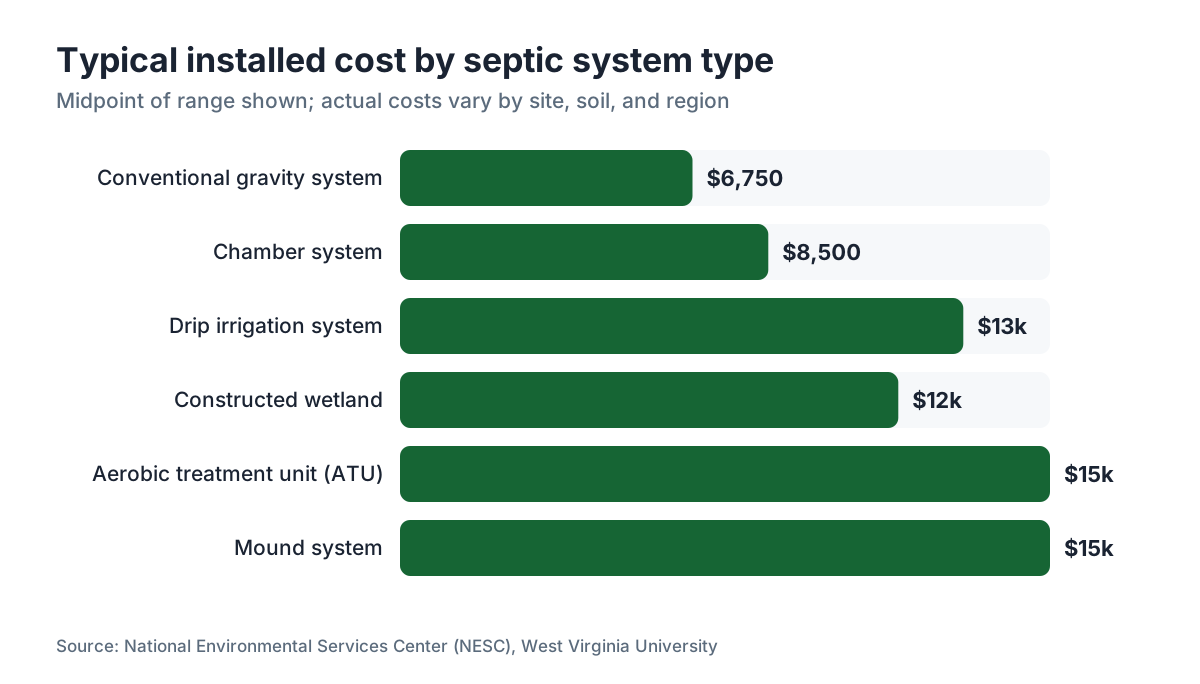
System type is where most of the sticker shock lives. Here's a realistic breakdown by type:
| System Type | Typical Total Installed Cost | Best For |
|---|---|---|
| Conventional gravity (concrete tank + trench field) | $3,500, $10,000 | Average soil, adequate lot size |
| Chamber system | $5,000, $12,000 | Sandy or variable soil |
| Mound system | $10,000, $20,000 | High water table, shallow soil over rock |
| Drip irrigation (drip dispersal) | $8,000, $18,000 | Small lots, shallow soil |
| Aerobic treatment unit (ATU) | $10,000, $20,000 | Poor soil, near sensitive water bodies |
| Constructed wetland | $8,000, $15,000 | Rural, large lots, specific climates |
| Cluster/community system | Varies widely | Multiple homes sharing a field |
Source: State extension services and National Environmental Services Center (NESC) [4]
Conventional gravity systems are cheapest because they have no moving parts and treat waste passively through the soil. Aerobic treatment units (ATUs) need electricity, a timer, an air pump, and a service contract (usually $100 to $300 per year), so you pay more upfront and more every year after. Mound systems eat cost in fill material and the labor to build the mound.
If your perc test fails for a conventional system, you don't get to pick the cheaper option. Site conditions dictate system type, and your local health department has final say. That's why perc results are the first thing any responsible contractor asks to see.
For more on what goes into a new build, the cost to install septic system guide breaks down the full line items.
Is it cheaper to repair or fully replace a septic system?
The answer depends on what's actually failing.
Tank repairs (patching a crack, replacing a baffle, fixing an inlet pipe) run $150 to $1,500 and are almost always worth doing if the tank is structurally sound and the field is healthy. Our guide on septic tank repair breaks down what each fix costs.
Field repairs are trickier. Jetting laterals, treating biomat with aeration, or resting a field by rotating between two areas can buy time, but none of them work forever. A genuinely failed field, where effluent is surfacing or backing up into the house, needs replacement, not repair. Aeration and additive products exist, but the evidence for their long-term value is thin. The EPA recommends finding the root cause instead of dumping in additives [5].
The math flips toward full replacement when:
- The tank is older than 25 to 30 years and concrete is spalling or cracking structurally.
- The drain field has stayed saturated for more than a season.
- You're already spending $1,000 or more a year on repeated pump-outs and repairs.
- You're selling and an inspector flags the system as failed or near end of life.
A rule of thumb borrowed from HVAC thinking: if repair costs top 50% of replacement cost, replace. On a system where full replacement runs $8,000, repairs above $4,000 should start the replacement conversation.
Read through the septic system repair options before you commit to either path.
What does a septic drain field replacement cost on its own?
Drain field replacement alone, with the tank still in good shape, typically runs $3,000 to $10,000 for a conventional trench system. Tough soil, large homes needing bigger fields, or alternative dispersal methods push that to $15,000 or more [12].
Field size comes from soil perc rate and daily wastewater flow. A three-bedroom home producing roughly 300 gallons per day in average-draining soil might need 300 to 600 linear feet of trench. At $10 to $30 per linear foot for trenching and pipe, plus a new distribution box and any fill work, the total climbs fast.
Here's what homeowners miss. Most local codes require a reserved replacement field area on your lot at the time of the original install. If that area got built over or is otherwise unavailable, you may need a variance or a different dispersal method entirely, which snarls permitting and raises cost.
For more on how drain fields work and what failure looks like, the septic drain field guide is the right next read.
After any field work, going back to a regular septic tank pumping schedule (every three to five years for most households) is the single best way to protect your new investment [5].
How much do permits and inspections add to the total cost?
Permits and inspections are the line item most online cost guides ignore or lowball. The reality: total permitting for a full system replacement can add $300 to $2,000 or more depending on your state and county [3].
Here's what you're typically paying for:
- Site evaluation or perc test fee: $200 to $600
- System design review fee: $100 to $500
- Construction permit: $150 to $1,000
- Final inspection: $50 to $300
- Any required water quality testing: $50 to $200
Some states require a licensed professional engineer (PE) to stamp the design for anything beyond a standard gravity system. That PE review adds $500 to $2,000 to the design phase alone.
Call your local health department early. Not after you get a contractor quote. Before. They'll tell you exactly what's required, what the current fees are, and how long the queue runs. In some busy counties, septic permits take six to twelve weeks. That wait shapes your timeline and sometimes your financing if a real estate deal is riding on it.
Are there financial assistance programs for septic replacement?
Yes, and more homeowners qualify than realize it.
The biggest federal program is the USDA Rural Development Section 504 Home Repair program. It offers loans up to $40,000 and grants up to $10,000 for very-low-income homeowners in rural areas for health and safety repairs, including failed septic systems [6]. Income limits apply and vary by county.
The EPA's SepticSmart program points homeowners to their state environmental or health agency to learn about financial assistance, and many states run their own programs [5]. North Carolina operates an onsite wastewater repair fund [9]. Virginia runs a Septic Repair Loan Fund [10]. Check your state's environmental quality or health department website for what's active now.
County and local health departments sometimes have grant pools funded by Clean Water Act money for systems near sensitive water bodies (coastal areas, lakeshores, wellhead protection zones). Those are worth a direct call to your county environmental health office.
Homeowners who itemize can sometimes treat septic work as a home improvement if it's tied to a home office or a rental portion of the property. That's a question for a tax professional, not a generic guide.
If you're an operator juggling multiple service requests and want to track which customers qualify for these programs, tools like SepticMind can flag accounts by county and cross-reference assistance eligibility, which cuts real time off customer support calls.
How long does a new septic system last?
A properly installed and maintained conventional concrete tank lasts 25 to 40 years [7]. The drain field, with regular pumping and no shock-loading from harsh chemicals or heavy water use, lasts 20 to 30 years.
Those ranges shrink fast without maintenance. A tank that never gets pumped builds up sludge that overflows into the field, plugging the soil quicker than almost anything else. The EPA recommends pumping every three to five years for most households, and a large share of system failures trace directly back to years of skipped pump-outs [5].
Alternative components wear out sooner. ATU air pumps and timers usually need replacement every five to ten years. UV disinfection lamps, used in some advanced systems, need replacing annually. Factor those into your lifetime cost when you compare system types.
Fiberglass and polyethylene tanks resist corrosion and cracking but can shift in high-water-table soil if they're not installed with proper ballast. Concrete tanks can crack from root intrusion, soil movement, or plain age. Neither wins in every condition. Site factors drive the choice.
Following the how often to pump septic tank guidance for your household size is the most cost-effective thing you can do after installation.
What are the warning signs that your system needs replacement rather than repair?
Sewage backing up into the lowest drains in your home is the most urgent sign. Stop running water. Call a contractor that day.
Other signals that replacement is coming soon:
- Wet, spongy ground over the drain field that never dries out between rains
- Persistent sewage odor in the yard, especially downslope from the field
- Unusually lush, dark-green grass right over the field lines
- Multiple pump-outs needed in one year because sludge builds faster than normal
- A pump alarm tripping often on a system with a pump chamber
- A tank inspection showing a collapsed baffle, major cracking, or a tank that's sunk
No single sign guarantees full replacement. A licensed inspector or registered sanitarian should assess the system before you authorize major work. Many contractors will run a camera down the outlet pipe and probe the drain field soil for $200 to $400, which gives you real information before you commit to a $10,000-plus project.
If the house is on the market, a failed inspection triggers immediate disclosure obligations in most states and can blow up a sale. Getting ahead of it with a septic tank pump out and inspection before listing is the smart move.
How do you get an accurate quote and avoid overpaying?
Three bids, minimum. That's the single most valuable line in this guide. Septic pricing isn't transparent, it varies hugely even inside one county, and some contractors quote high because they know a scared homeowner will sign fast.
When you call for quotes, hand each contractor the same facts: bedroom count, tank size if known, year installed if known, and a plain description of the symptoms. Ask each one to quote the same scope after the site visit, whether that's tank replacement only or the full system.
Get the quote in writing, line-itemed: excavation, tank cost, field materials, permits, backfill, restoration. Contractors who won't line-item are hiding something.
Check licenses. Every state requires septic contractors to be licensed, usually through the state department of environmental quality or health. License lookup tools live on state agency websites. An unlicensed contractor means unpermitted work, no inspection, and a system that may fail inspection when you sell.
Verify insurance too. General liability and workers' comp. If a worker gets hurt on your lot and the contractor is uninsured, your homeowner's policy may not cover it.
Don't pay more than 10% to 20% upfront. A fair deposit covers permit fees and materials. Full payment before completion is a red flag.
After you pick a contractor, confirm the permit is pulled before any digging starts. You can verify permit issuance directly with your county health department. That step protects you.
For a sense of what the tank piece alone costs, the cost to put in a septic tank breakdown helps you sanity-check quotes.
Does homeowner's insurance cover septic replacement?
Almost never for wear-and-tear or a slowly failing drain field. Standard homeowner's policies exclude gradual deterioration and maintenance-related failures, which is how insurers classify most septic problems.
Sudden, accidental damage is different. If a vehicle drives over your tank and crushes it, or a tree falls and wrecks the system, that might fall under your property damage coverage. Read the exclusion language or call your agent with a specific question before you assume anything.
Some insurers sell home warranty riders or separate service line coverage that includes septic components. Those are worth a look if you have an older system, but read the fine print on what "covered failure" means. Many require the system to have been working and maintained, and they cap payouts well below full replacement cost.
A few states are exploring mandatory disclosure and inspection rules tied to real estate sales, which pushes more homeowners to inspect earlier. The EPA SepticSmart initiative encourages homeowners to "treat your septic system as an asset and protect it" instead of waiting for failure [11]. That framing is the right one. Proactive maintenance and regular septic tank cleaning beat an emergency replacement on cost every time.
What should septic service operators know about replacement project costs?
If you run a septic service company, replacement jobs are where your margin lives and where your liability runs highest. A few things matter more than homeowners realize.
Your site evaluation and design recommendations have to be documentable. If a system you designed or installed fails within a few years, the homeowner will look for someone to hold accountable. Your design notes, perc test results, and permit records are your defense.
Alternative system maintenance contracts are a real revenue line. An ATU or drip system needs regular service visits, often required by the permit itself. That's recurring, predictable revenue on a fixed schedule. Plenty of operators undercharge for it or forget to enroll customers at installation time.
Knowing which customers are overdue for a replacement conversation (older systems, repeated pump-outs, multiple service calls) is a data problem as much as a technical one. SepticMind's service operations software is built to help operators track system age, service history, and maintenance intervals across the customer base, so the replacement conversation happens on your terms instead of after an emergency call at 10 PM on a Sunday.
For managing the pump-out side of the business while replacement projects are in the pipeline, the septic tank pump out workflow documentation matters too.
Frequently asked questions
How much does it cost to replace just the septic tank, not the drain field?
Replacing the tank alone, with the drain field still working, typically costs $1,500 to $4,500 installed. Concrete tanks sit on the lower end, fiberglass a bit higher. That price covers excavation, the new tank, connecting inlet and outlet pipes, and backfill. Permits add $150 to $500 depending on your county. Make sure the old tank gets properly decommissioned (pumped out and crushed or filled), which some contractors include and some quote separately.
How much does a mound septic system replacement cost?
Mound systems cost $10,000 to $20,000 installed in most regions, and complex sites can reach $25,000. The extra cost comes from engineered fill material, a pump chamber, pressure-dosed distribution, and heavier site work. Mounds are required where the water table sits too high or the soil is too shallow for conventional trenches. Annual maintenance costs run higher too, because the pump needs periodic service.
How long does septic system replacement take from start to finish?
Physical installation on a conventional system usually takes one to three days of active work. But the full timeline from first call to finished job runs four to twelve weeks, mostly permit processing at your local health department. Some counties move faster; others sit at six-to-eight-week queues. If you need a PE-stamped design for an alternative system, add two to four weeks for engineering. Plan around it if you're on a real estate deadline.
Can I replace my own septic system to save money?
In almost every state, no. Septic installation requires a licensed contractor and permitted work with inspections. Unpermitted septic work is illegal, creates title problems when you sell, and can bring fines. A few states let owner-builders do their own work under specific conditions, but they still have to pull permits and pass inspections. The liability and complexity make DIY septic replacement impractical for nearly all homeowners.
What is the average lifespan of a new septic system?
A properly maintained conventional system lasts 25 to 40 years for the tank and 20 to 30 years for the drain field. Those numbers assume pumping every three to five years and no extreme loading from heavy water use, garbage disposal abuse, or harsh chemical flushing. Alternative systems with mechanical parts (ATUs, pump chambers) have components that need replacement every five to ten years, though the system itself can last as long as a conventional one with proper care.
Does replacing a septic system add value to a home?
It adds transactional value more than appraised value. A failed or aging system kills most real estate deals. Replacing it before sale clears that obstacle. Appraisers don't add premium value for a new system the way they do for a kitchen remodel, but buyers absolutely discount offers or walk over septic concerns. If your system gets flagged in an inspection, replacing it usually costs less than the price concession a buyer will demand.
How do I know if I need a full replacement or just a repair?
Hire a licensed inspector or registered sanitarian for a proper assessment before you decide. Signs pointing to replacement include a tank older than 25 to 30 years with structural damage, a drain field that stays saturated across a full season, repeated pump-outs within months of each other, and sewage surfacing in the yard. Signs that repair may hold include a single cracked baffle, a broken inlet pipe, or a clog that hasn't yet damaged the field.
Are there any grants or loans to help pay for septic replacement?
Yes. The USDA Rural Development Section 504 program offers grants up to $10,000 and loans up to $40,000 for qualifying low-income rural homeowners needing health and safety repairs, including septic systems. Many states run their own programs funded through Clean Water Act grants. Contact your county health department or state environmental agency to ask what's available near you. Eligibility is typically income-based and tied to rural location.
Does replacing a septic system require moving the drain field location?
Not necessarily. If the existing field location passes the site evaluation and meets current setback rules, you can often rebuild in the same footprint. If the old field is too degraded or local code has changed required setback distances since the original install, you may need to move the new field to the reserved replacement area most codes require on the lot. If that area is unavailable, an alternative system type may be required.
How does household size affect septic replacement cost?
Bedroom count is the standard proxy for wastewater flow that regulators use to size systems. A two-bedroom home may qualify for a 750 to 1,000-gallon tank; a four-bedroom home typically needs 1,250 gallons or more. Larger tanks cost more. Larger daily flow also needs more drain field area, which pushes up trenching and material costs. If you've added bedrooms since the original install, your replacement system may need to be much larger than what you're replacing.
What happens if I ignore a failing septic system?
Sewage backs up into the home, which is a health hazard. Untreated effluent surfaces in the yard and can contaminate groundwater and nearby wells. Local health departments have authority to issue orders requiring repair, and repeated violations can bring fines or a red-tag that prevents habitation. Failing systems near water bodies can trigger enforcement under Clean Water Act provisions. Forced emergency replacement under deadline pressure almost always costs more than planned replacement.
Is an aerobic treatment unit worth the extra cost over a conventional system?
Only when your site requires it. ATUs produce higher-quality effluent that can be dispersed in smaller areas or closer to sensitive features, but they cost $10,000 to $20,000 installed, need electricity, and require service contracts that typically run $100 to $300 per year. If your soil and lot allow a conventional gravity system, that's almost always the better long-term value. If they don't, an ATU may be the only legal option, which makes the comparison moot.
How much does a perc test cost before septic replacement?
Perc tests (percolation tests), or the more current soil morphology evaluations, cost $200 to $600 in most areas, though complex sites needing multiple test holes or a soil scientist can run higher. Some counties bundle the evaluation fee into the permit application. The test is required before any design work and before a permit gets issued. Don't let a contractor skip it to save time. The result determines what type of system is legally permitted on your lot.
Sources
- HomeAdvisor (Angi) - Septic System Installation Cost Guide: Full septic system replacement costs range from $3,000 to $15,000 for conventional systems and $10,000 to $30,000 for alternative systems depending on type, soil, and region
- University of Minnesota Extension - Septic System Basics: Soil percolation tests or soil morphology evaluations are required before system design and cost $200 to $600
- National Environmental Services Center (NESC) at West Virginia University - Septic System Costs: Permit and inspection fees for septic system replacement range from $150 to over $2,000 depending on jurisdiction and system type
- National Environmental Services Center (NESC) at West Virginia University - Types of Septic Systems: Installed costs by system type: conventional $3,500-$10,000; mound $10,000-$20,000; drip irrigation $8,000-$18,000; aerobic treatment unit $10,000-$20,000
- EPA SepticSmart - Homeowner Information: EPA recommends pumping every three to five years for most households and states that homeowners can connect with state agencies to learn about financial assistance programs; EPA guidance states to investigate root causes rather than rely on additives
- USDA Rural Development - Section 504 Home Repair Program: Section 504 offers grants up to $10,000 and loans up to $40,000 for very-low-income rural homeowners for health and safety repairs including failed septic systems
- Penn State Extension - Septic System Maintenance: Properly maintained conventional concrete septic tanks last 25 to 40 years; drain fields last 20 to 30 years with regular maintenance
- EPA - Decentralized Wastewater Management Program: Alternative and advanced treatment systems including aerobic treatment units require electricity and periodic maintenance contracts; EPA guidance documents system type selection criteria based on soil and site conditions
- North Carolina Department of Environmental Quality - Septic Financial Assistance: North Carolina operates an onsite wastewater repair fund providing financial assistance for homeowners with failing septic systems
- Virginia Department of Health - Septic Repair Loan Fund: Virginia operates the Septic Repair Loan Fund providing low-interest loans for eligible homeowners needing septic system repair or replacement
- EPA SepticSmart - Protect Your Investment: EPA SepticSmart initiative states homeowners should 'treat your septic system as an asset and protect it' through proactive maintenance
- Oklahoma State University Extension - Onsite Wastewater Systems: Drain field replacement for a conventional system ranges from $3,000 to $10,000 when the tank is still functional; soil type and linear footage of trenching are primary cost drivers
Last updated 2026-07-09