Flush-time septic tank treatment: does it actually work?
By the SepticMind Editorial Team
TL;DR
- Flush-time septic tank treatments are products you flush down the toilet to seed your tank with bacteria or enzymes.
- EPA and university research consistently find that a healthy septic tank already has sufficient microbial populations, and many chemical additives can damage your drain field.
- Regular pumping every 3-5 years does more for your system than any additive.
What is flush-time septic tank treatment and how does it work?
Flush-time septic tank treatment is any product you drop or pour into your toilet bowl and flush, with the claim that it improves how your septic tank breaks down waste. The category runs wide: packets of freeze-dried bacteria, enzyme concentrates, yeast-based tablets, and chemical solvents sold as 'tank cleaners.' The pitch barely changes brand to brand. Flush once a month, sit back, and your tank takes care of itself.
The mechanism differs by product type. Biological additives (bacteria and enzymes) claim to boost the microbial population that digests solids in the tank. Chemical additives usually claim to dissolve grease or clear outlet baffles. Some products blend both. Prices run from about $10 for a single-dose tablet to $50 or more for a monthly subscription kit.
Here is the honest reality. Your septic tank is already a busy anaerobic ecosystem. Every flush from your household delivers billions of bacteria naturally present in human waste. The question researchers have actually tested is whether adding more bacteria or enzymes from a packet changes tank performance in any measurable way, and whether chemical additives help or hurt. The answers are not kind to the additive industry.
What does EPA say about septic tank additives?
The EPA's SepticSmart program is the clearest federal guidance a homeowner can point to. The agency recommends against septic tank additives because there is no scientific evidence they improve tank performance, and some products can damage drain field soils [1].
That position matches the older but still-cited 1997 report 'Response to Congress on Use of Decentralized Wastewater Treatment Systems,' which reviewed the available studies and found the evidence for biological and chemical additives was weak to nonexistent [2]. The stance has not moved. The ongoing SepticSmart campaign still lists 'use additives' as something homeowners should NOT do.
One EPA warning is worth quoting directly. The agency's SepticSmart materials state that some additives 'can harm your septic system, contaminate groundwater, and create public health hazards.' That language sits in the context of chemical solvents, which mobilize grease and push it into the drain field, where it clogs the soil.
State environmental agencies have followed EPA's lead. At least two states, Washington and Massachusetts, have active regulations or guidance discouraging or restricting certain septic additives [3]. If your state has an onsite wastewater code (most do), check whether it addresses additives. Some codes void your system warranty or inspection clearance if non-approved products have been used.
What does the research actually show about biological additives?
The most-cited independent review is a 2000 study by the Washington State Department of Ecology that tested several commercial septic additives under controlled conditions [3]. The study found no statistically significant improvement in solids reduction or effluent quality in tanks receiving biological additives compared to control tanks getting nothing. After 30 days, the bacterial counts in treated tanks were not measurably higher than in untreated tanks.
A 2004 paper in the journal Bioresource Technology looked at enzyme-based additives and reached a similar conclusion. The native microbial community in a working septic tank is diverse enough that supplemental enzyme packets do not shift the community structure in any lasting way [4]. Enzymes break down when they hit anaerobic tank conditions, and the populations that produce those enzymes naturally are already there.
Nobody has great long-term field data here. Most studies run 6 to 18 months and measure a handful of parameters. It is possible that over a decade a product could show a subtle benefit nobody has cleanly measured. But 'possible' is a long way from the confident language on the box.
What the research does not dispute: a neglected tank, one that has gone 10-plus years without pumping, has a genuinely disrupted microbial balance. Some operators report that biological additives help restart tanks badly stressed by antibiotic overload or chemical dumping. Even then, the more direct fix is a pump-out and a reset, not a monthly additive program. See our guide on septic tank pumping for what a proper pump-out does that no additive can replicate.
Can chemical septic tank additives damage your system?
Yes. This is where the evidence is clearest and the stakes are highest.
Chemical additives, usually organic solvents like methylene chloride or 1,1,1-trichloroethane, were common in older products. Many states now ban or restrict them because they mobilize the grease layer in the tank and drive it into the drain field [5]. Once grease reaches the drain field soil, it clogs the biomat layer, cuts percolation, and can push a field into failure within months. Drain field repair or replacement runs $3,000 to $15,000 depending on soil conditions and system size, far more than any savings from skipping routine pumping [6].
Modern 'natural' or 'green' chemical additives are usually milder but still carry risk. Surfactant-based products can break up the scum layer in the tank, letting finer particles slip through the outlet baffle and reach the distribution pipes. That is a slow-motion failure that is hard to pin on the additive years later.
The safest rule is simple. If a septic product's label does not say 'biological' or 'enzyme-based' and does not list specific bacterial strains, treat it as a chemical additive and skip it. Even biological products are unnecessary for a healthy tank. Chemical products carry actual downside, more than wasted money.
If you are dealing with a failing system rather than a healthy one, the right path is a proper septic tank inspection to find the actual problem, followed by targeted septic tank repair rather than flushing product.
How often should you use flush-time septic treatments if you choose to?
Most biological additive products call for once-monthly dosing. If you have decided to use one despite the lack of evidence for benefit, monthly is the label guidance, and no research suggests more frequent dosing does anything better.
A few scenarios where working operators (not the research) sometimes suggest a one-time biological dose:
After a household course of antibiotics, especially broad-spectrum ones, some operators think the tank's bacterial population takes a temporary hit. The evidence is anecdotal. Antibiotics at the dilution they reach a 1,000-gallon tank are unlikely to cause a real population collapse, but a single biological packet costs little enough that some homeowners find the reassurance worth it.
After extended vacancy (a seasonal home closed 6 months or more), a biological dose before reopening gives the tank a head start before full household loading resumes.
After pumping, some operators add a biological starter dose. This is not EPA-recommended practice, but it is common. The tank re-seeds itself through normal use within 2 to 4 weeks regardless.
Outside those situations, routine monthly dosing of a working tank is a recurring expense with no documented payoff. The EPA's SepticSmart program treats routine pumping, water conservation, and keeping chemicals out of the system as the real maintenance actions that extend system life [1].
What should you actually flush to keep a septic tank healthy?
The honest list is short. Water, human waste, and toilet paper. That is it.
Toilet paper breaks down in a healthy tank without help. 'Septic-safe' labels are real, but most standard single-ply and many two-ply papers break down fine. The products that cause trouble are wet wipes (even the ones marked 'flushable'), paper towels, feminine hygiene products, and anything plastic-based. These items pile up in the scum and sludge layers, shorten your pump interval, and risk blocking the outlet baffle.
On household chemicals, moderate use of bleach, cleaners, and detergents at normal volumes does not sterilize a properly sized tank. Penn State Extension found that routine household cleaning product use at typical concentrations does not significantly alter tank microbial populations [7]. The key word is 'routine.' Pouring a quart of bleach down the drain at once, or running daycare-scale laundry every day, is a different story.
Yeast is a folk remedy older than the commercial additive industry. Some homeowners still flush a packet of dry active yeast every month. There is no peer-reviewed evidence it helps. It does not hurt. It costs less than commercial biological additives. If someone in your life swears by it, they are not damaging their system. They are spending fifty cents on ritual comfort.
For a full look at a service interval, our septic tank cleaning guide covers what gets removed during a proper pump-out and why no additive replaces it.
How do flush-time treatments compare to actual septic maintenance?
Here is a direct comparison of the options homeowners run into, with honest notes on cost and documented benefit:
| Action | Typical Cost | Documented Benefit | Risk |
|---|---|---|---|
| Pump-out every 3-5 years | $250-$600 [8] | Strong: removes accumulated solids, extends field life | Low: standard maintenance |
| Biological additive (monthly) | $10-$50/month | None found in controlled studies | Very low |
| Chemical additive | $8-$30 per dose | None found; older solvents actively harmful | Moderate to high |
| Yeast flush (folk remedy) | <$1/month | No evidence | None |
| Enzyme additive | $15-$40/month | No improvement over control tanks in studies [4] | Very low |
| Drain field aeration service | $500-$2,000 | Some evidence for field restoration [9] | Low |
The pattern is plain. The intervention with the strongest evidence is also the dullest one. Pumping removes solids that no biological or chemical product can eliminate. An additive cannot replace what a vacuum truck does in 30 minutes.
The EPA puts pump-out frequency at every 3 to 5 years for a typical household, though the real interval depends on tank size, household size, and water use [1]. A 1,000-gallon tank serving two people may go 5 to 7 years. The same tank serving five people may need pumping every 2 years. See our detailed breakdown of how often to pump septic tank for the sizing math.
Are there any septic additives that have proven results?
In the biological and enzyme category, no independent study has shown a product that consistently beats a healthy untreated tank. That does not make every product fraudulent marketing. Some may be genuinely inert, no harm and no help. A few products have been tested by their own manufacturers with favorable results, but independent researchers have not replicated those studies.
The National Sanitation Foundation (NSF) does not certify septic additives for performance, only for the absence of harmful ingredients. NSF Standard 40 covers treatment systems, not additives [11]. The missing NSF performance certification is worth noticing when you read product claims.
Drain field restoration is a different category. Products that deliver specific bacteria known to degrade biomat (the clogging layer that forms in aging fields) have shown more promise in a handful of studies. But those get applied directly to the field, not flushed through the tank, and they are professional-grade interventions, not consumer packets. If your field shows signs of failure (wet spots, odors, slow drains), the right first step is diagnosis, not product application. Our leach field guide covers what biomat failure looks like and what actually reverses it.
For operators tracking customer systems who want data-driven maintenance intervals rather than product-push upselling, software like SepticMind can flag accounts due for inspection or pump-out. That is a more defensible service offer than selling monthly additive programs to customers who do not need them.
What happens if you have been using flush treatments for years?
If you have been using biological or enzyme additives for years, you have not damaged your system. You have probably spent somewhere between $120 and $600 a year with no measurable benefit, but your tank is fine.
If you have been using chemical solvents or strong acidic or alkaline products sold as tank cleaners, the picture is murkier. Your tank may be fine if your drain field has good soil capacity and you have kept up with pump-outs. Or you may have sped up the grease migration process. The only way to know is an inspection.
Switching from regular additive use to none takes no transition. Your tank will not notice. The bacteria population runs at its normal level. You will have more money and the same working septic system.
If you have never pumped your tank because you assumed the monthly additive handled it, that is the gap to close now. A tank without pumping builds up sludge at the bottom and scum at the top no matter what biological products you add. When combined sludge and scum fill more than about one-third of tank volume, the risk of solids passing to the drain field rises sharply [8]. Schedule a septic tank pump out and ask the pumper to measure sludge and scum depths so you have a real baseline.
How to read flush-time septic treatment labels and marketing claims
Labels in this category often use language built to sound scientific without making a measurable claim. Watch for these patterns.
'Billions of bacteria' is a volume claim, not an effectiveness claim. Your tank already holds trillions of bacteria. Adding billions more does not move the ecology.
'Enzyme-based formula' is an ingredient disclosure, not a performance claim. Enzymes work as catalysts. They do not remove solids. A product can be entirely enzyme-based and do nothing useful in your tank.
'Recommended by septic professionals' is an unverifiable social proof claim. Ask which professionals, in what capacity, and whether they got paid to recommend it.
'NSF certified' on a septic additive means NSF found it does not contain certain harmful chemicals. It does not mean NSF found it improves tank performance. Those are two different things [11].
The Federal Trade Commission Act prohibits deceptive advertising, but enforcement in the septic additive category has been limited. Some states have done more. Washington State's 2000 review was partly a consumer protection response to aggressive additive marketing [3].
Here is the honest test. Ask any vendor for an independent, peer-reviewed study showing their product beat a control tank in a real-world setting with a sample size larger than 10. Most cannot produce one. That absence is your answer.
What is the real maintenance schedule a septic system needs?
The EPA SepticSmart program sums up real maintenance in four actions: inspect and pump on schedule, use water efficiently, dispose of waste properly, and maintain the drain field [1]. None of the four involve a flush-time product.
For most households, the practical schedule looks like this.
Annual: a visual check of the drain field area (no wet spots, no odors, no unusually lush grass patches). Confirm inspection ports and risers are intact.
Every 1 to 3 years: a professional inspection that measures sludge and scum depths. In many states, lenders require this at point of sale. Some state codes, with Massachusetts Title 5 as the best-known example, require inspection every 3 years or at property transfer [10].
Every 3 to 5 years: a pump-out, or sooner if inspection shows one-third tank capacity reached. The EPA names household size and tank volume as the two variables that matter most for setting this interval [1].
As needed: repair or replacement of baffles, outlet pipes, distribution boxes, or field lines. These are the components that actually fail. Additive programs do not prevent these failures. See our septic system repair guide for what these repairs involve and cost.
For homeowners who want one tool to track inspection dates, pump schedules, and service records in one place, SepticMind's homeowner tools are built for exactly that. It is useful not for replacing service providers but for knowing when you are actually due, rather than guessing.
A pump-out at $250 to $600 every few years is the most cost-effective spend in the septic category. Replacing a failed drain field can run $5,000 to $20,000 or more depending on soil and site conditions [6].
Frequently asked questions
Does flush-time septic tank treatment actually work?
Independent research consistently finds no measurable benefit for biological or enzyme-based flush treatments in healthy tanks. A 2000 Washington State study found no significant improvement in solids reduction or effluent quality compared to untreated control tanks. Your tank already contains the bacteria it needs. The money is better spent on regular pump-outs every 3 to 5 years.
Can flushing septic additives damage your drain field?
Chemical solvent-based additives can mobilize grease from the tank and push it into the drain field, where it clogs soil pores and speeds field failure. Biological and enzyme products carry very low physical risk but offer no documented benefit. The EPA explicitly warns that some additives can harm your septic system and contaminate groundwater. Avoid any additive that does not list specific bacterial strains or enzymes.
How often should you use a flush-time septic treatment?
If you choose to use a biological additive despite the lack of evidence for benefit, follow the label, usually once monthly. No research shows more frequent dosing helps. A one-time dose after extended home vacancy or after heavy antibiotic use is a common practitioner suggestion. For a healthy, regularly pumped tank, zero doses is the scientifically supported frequency.
Is it safe to flush yeast down the toilet for septic tank health?
Yeast flushes are a folk remedy with no peer-reviewed support. A packet of dry active yeast costs under a dollar and carries essentially no risk. It will not hurt your tank, and it probably does nothing measurable. It is a harmless ritual rather than a maintenance strategy. Your tank already contains more diverse microbial populations than yeast alone provides.
What does the EPA recommend for septic tank maintenance?
EPA's SepticSmart program recommends four practices: inspect and pump your tank on a regular schedule (typically every 3 to 5 years), use water efficiently to avoid overloading the system, dispose of waste properly by not flushing harmful materials, and maintain the drain field area. The EPA does not recommend additives and warns some can damage your system.
What is the difference between biological and chemical septic tank additives?
Biological additives contain bacteria or enzymes meant to supplement the tank's existing microbial population. Chemical additives use solvents or surfactants to dissolve grease or solids. Biological products are low-risk but unproven. Chemical additives, especially older solvent-based formulas, carry real risk of mobilizing grease into the drain field and causing field failure. The distinction matters: check labels carefully.
How do I know if my septic tank actually needs treatment?
Signs of a tank that needs service are slow drains throughout the house, gurgling pipes, odors near the tank or field, and wet or unusually green patches over the drain field. None of these are reliably fixed by additive flushing. All of them warrant a professional inspection and likely a pump-out. An additive program does not diagnose or address the underlying cause.
Will using a septic additive let me skip pump-outs?
No. Biological and enzyme additives do not remove accumulated solids from your tank. Sludge settles at the bottom and scum floats at the top no matter what products you flush. When those layers occupy more than about one-third of tank volume, solids risk reaching the drain field. Only a vacuum pump-out removes them. No product changes this physical reality.
How much do flush-time septic treatments cost compared to pumping?
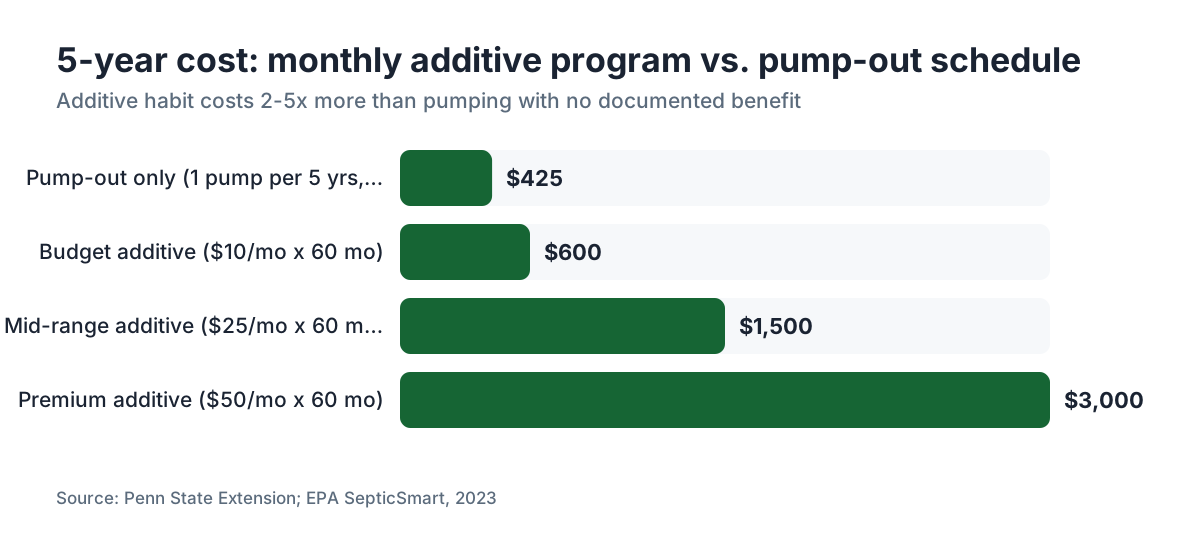
Monthly additive programs run $10 to $50 per month, or $120 to $600 per year, with no documented benefit. A professional pump-out costs $250 to $600 and typically only needs to happen every 3 to 5 years. Over a 5-year period, a monthly additive habit costs $600 to $3,000. Pumping costs $250 to $600 for the same interval. The math is not close.
What states restrict or regulate septic tank additives?
Washington State and Massachusetts have published guidance or regulatory language discouraging or restricting certain septic additives. Washington's Department of Ecology conducted an independent product test in 2000 finding no benefit and some harm from tested products. Massachusetts Title 5 regulations govern system performance standards. Most states follow EPA SepticSmart guidance implicitly. Check your state's onsite wastewater code for specific language.
Can a flush-time treatment help after a large dose of antibiotics in the household?
This is a common practitioner suggestion with limited scientific support. Antibiotics at household dilution rates reaching a 1,000-gallon tank are unlikely to cause population collapse in the tank's microbial community. If you want the reassurance of a one-time biological dose after a course of antibiotics, the cost is low and the risk is negligible. But routine monthly dosing on this basis is not supported by evidence.
Do septic additives have NSF or other third-party certifications for performance?
NSF International does not certify septic additives for performance effectiveness. NSF certifications in this space cover only ingredient safety, meaning the product does not contain certain harmful chemicals. No major third-party body certifies that a flush-time treatment improves tank performance. An NSF mark on an additive package is not evidence the product works; it is evidence it does not contain specific banned substances.
What should I actually flush to maintain a septic system?
Water, human waste, and toilet paper. That is the complete list. Standard toilet paper breaks down without help. Wet wipes, even 'flushable' ones, paper towels, feminine hygiene products, and any solid other than toilet paper accumulate in the tank and shorten pump intervals. Moderate household use of bleach and cleaning products at normal volumes does not sterilize a properly sized tank.
How do I choose a trustworthy septic treatment product if I still want to use one?
Look for products that list specific bacterial strains by genus and species, disclose CFU (colony-forming unit) counts, and make measurable rather than vague claims. Avoid any product using solvent-based chemistry. Ask the manufacturer for independent, peer-reviewed efficacy data. If they cannot provide a study from a university or government lab, the evidence base is the manufacturer's own testing only. Biological products from reputable brands are low-risk even if unproven.
Sources
- U.S. EPA, SepticSmart Program: EPA recommends against using septic additives and states some can harm the septic system, contaminate groundwater, and create public health hazards; recommends pumping every 3-5 years.
- U.S. EPA, Response to Congress on Use of Decentralized Wastewater Treatment Systems (1997): EPA reviewed available studies on septic additives and found weak to nonexistent evidence supporting biological and chemical additive effectiveness.
- Washington State Department of Ecology, Septic Tank Additives Study (2000): Controlled study found no statistically significant improvement in solids reduction or effluent quality in tanks receiving commercial biological additives compared to untreated controls.
- Bioresource Technology, enzyme additive study (2004): Enzyme-based additives did not shift the native microbial community structure in septic tanks in any lasting way; native enzyme-producing populations were already present.
- U.S. EPA, Septic System Owner's Guide: Chemical solvent additives including older formulations were found to mobilize grease from tanks and push it into drain fields, causing soil clogging and field failure.
- Penn State Extension, Septic System Maintenance: Drain field repair or replacement costs $3,000 to $15,000 depending on soil conditions and system size; typical pump-out costs $250 to $600.
- Penn State Extension, Household Chemicals and Septic Systems: Routine household cleaning product use at typical concentrations does not significantly alter tank microbial populations in properly sized systems.
- U.S. EPA, How Your Septic System Works: When combined sludge and scum occupy more than approximately one-third of tank volume, risk of solids passing to the drain field rises sharply; pump-outs typically cost $250-$600.
- University of Minnesota Extension, Septic System Maintenance: Drain field aeration services costing $500-$2,000 have some evidence for field restoration in failing systems.
- Massachusetts Department of Environmental Protection, Title 5 Regulations: Massachusetts Title 5 requires septic system inspection every 3 years or at property transfer.
- National Sanitation Foundation (NSF) International, Standard 40: NSF Standard 40 covers treatment systems; NSF does not certify septic additives for performance effectiveness, only for absence of certain harmful ingredients.
- University of Nebraska-Lincoln Extension, Septic System Care: Septic system pump interval depends on tank size and household size; a 1,000-gallon tank serving two people may go 5-7 years, while serving five people may require pumping every 2 years.
Last updated 2026-07-10