Homemade septic tank treatment: what actually works
By the SepticMind Editorial Team

TL;DR
- Most homemade septic treatments (yeast, baking soda, raw meat scraps) have no proven benefit, and a few can hurt your system.
- Your tank already holds billions of bacteria that arrived in human waste.
- The EPA's SepticSmart program says a normal tank needs no starter cultures.
- Routine pumping every 3 to 5 years does more than any additive, homemade or store-bought.
What is a homemade septic tank treatment and why do people try it?
Walk into any hardware store and you'll see shelves of enzyme packets, bacterial powders, and bottles promising to "activate" your tank. The homemade version is the same idea done cheap: flush a packet of active dry yeast, pour in a cup of baking soda, drop in raw chicken liver, or mix up sugar water to "feed the bacteria." People try these because commercial additives run $10 to $50 a month and a box of yeast costs under $2.
The logic isn't crazy. Septic tanks work through anaerobic bacterial digestion, so giving the bacteria something extra seems like it should help. The biology doesn't work that way, though, and several popular recipes can throw the system off. To see why, you have to know what's actually happening inside that buried tank.
How does a septic tank actually treat waste?
A conventional septic tank is a buried watertight container, usually 1,000 to 1,500 gallons for a typical household, that separates solids from liquids and starts breaking down organic material before the liquid effluent moves to the drain field [1]. Heavy solids sink to the bottom as sludge. Grease and lighter stuff float to the top as scum. The clarified liquid in the middle flows out to the leach field, where soil microbes finish the job.
The bacteria doing the work are already there. They arrive in human waste. A healthy tank holds a mixed community of anaerobic and facultative microbes that digest proteins, fats, and carbohydrates, and those populations self-regulate based on what comes in from your household. The EPA's SepticSmart program says "a properly designed and normally operating septic system needs no additions of 'starter' cultures or enzyme packages to work" [2].
Read that sentence again. It's the agency with direct regulatory jurisdiction over these systems saying the tank doesn't need a biological boost. What it does need is the sludge physically removed when it builds up, which is why septic tank pumping is the single most important thing you can do.
Does flushing yeast into a septic tank do anything?
Yeast is the most popular homemade treatment, and the recipe circulates endlessly: dissolve a packet of active dry yeast in warm water, add sugar, let it proof for 10 to 15 minutes, then flush it. The claim is that the yeast adds live microorganisms to digest solids.
Here's the problem. Yeast (Saccharomyces cerevisiae) is a fungus, not a bacterium, and it prefers oxygen. The inside of a working septic tank is anaerobic. Under those conditions, yeast doesn't thrive or reproduce the way the recipes promise [3]. The small dose you flush gets swamped by the native population, which sits at roughly 10^8 to 10^9 cells per milliliter of sludge.
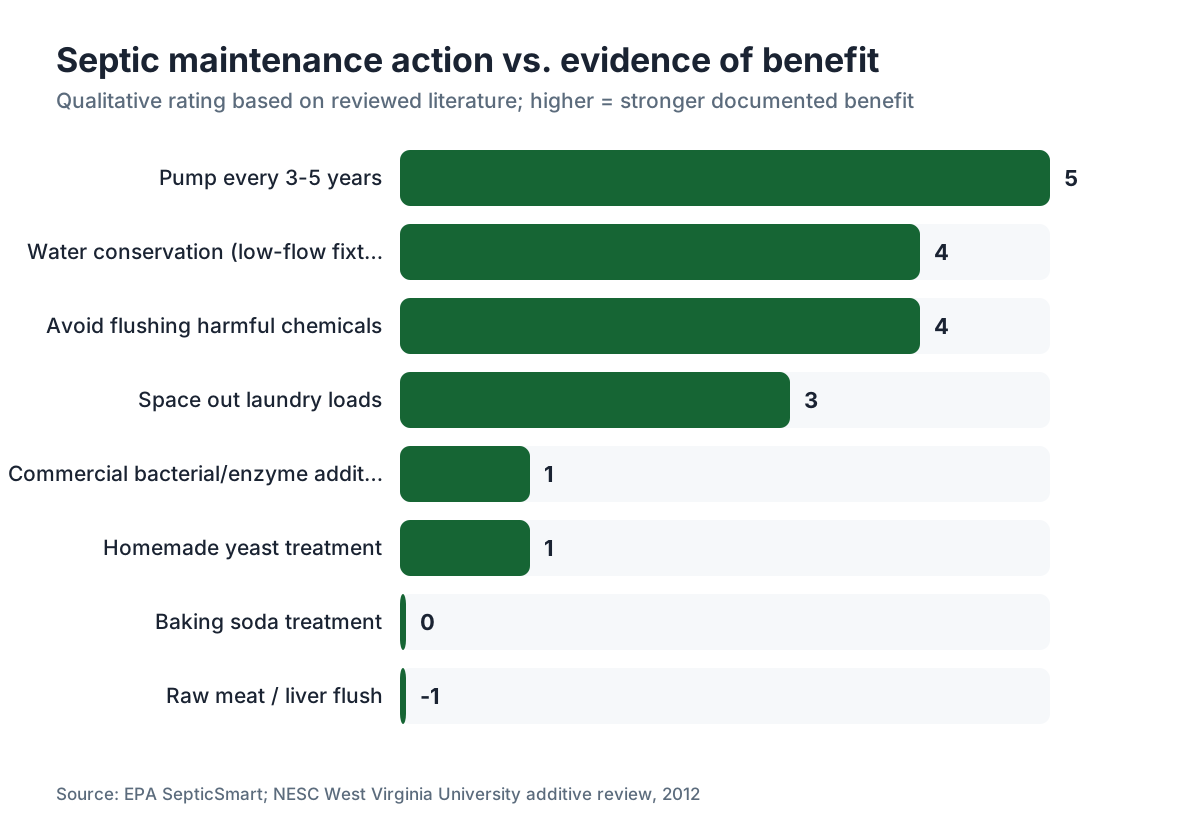
No peer-reviewed study shows that periodic yeast additions cut sludge, stretch pumping intervals, or improve effluent quality in home septic tanks. This isn't a quiet gap in the record. Researchers went looking. A 2012 review of septic additive literature from the National Environmental Services Center at West Virginia University found no controlled studies showing measurable benefit from biological additives, yeast products included [4].
Bottom line on yeast: it probably won't hurt in small amounts, but it won't help, and the effort is wasted.
What about baking soda, vinegar, or other kitchen ingredients?
Baking soda (sodium bicarbonate) gets recommended to neutralize acid in the tank or "fizz out" clogs. Tanks don't usually need pH adjustment. A functional anaerobic tank runs around pH 6.5 to 7.5 on its own. A tablespoon or two of baking soda is trivially small next to 1,000 gallons of liquid. It won't hurt, and it won't move the needle on bacterial activity or sludge.
Vinegar is more interesting because it's acidic. At household cleaning strength (5% acetic acid), occasional use probably doesn't disrupt the tank much. But flushing vinegar regularly as a "treatment" could drop tank pH enough to slow the methanogenic archaea that handle the final breakdown of volatile fatty acids. Don't use it that way. Use it for cleaning, sparingly.
Raw meat, chicken livers, and ground beef show up in recipes as a "bacterial seed" because they carry a mix of microorganisms. Bad idea. The bacteria on raw meat include pathogens, the protein load can stress the tank, and none of those organisms are absent from human waste, which carries far more diversity anyway. The University of Minnesota Extension advises against putting raw meat into septic systems [5].
Sugar water as "bacterial food" misses the same point. The tank already gets a steady supply of organic substrate every time someone uses the sink or toilet. Extra sugar creates a fermentation substrate that can favor yeast and facultative bacteria over the anaerobic community you actually want.
Are commercial septic additives any better than homemade ones?
This one has a cleaner answer than people expect. Wisconsin's Department of Commerce (now the Department of Safety and Professional Services) ran one of the more careful independent evaluations of septic additives and found none of the tested products gave measurable benefit [6]. Several states went further and banned certain additive types outright.
A 2007 review in the journal Bioresource Technology looked at both biological and chemical additives. The biological ones (bacteria, enzymes) showed no statistically significant improvement in effluent quality or sludge reduction under controlled conditions. The chemical ones, especially older organic solvents sold to clear drain fields, actually damaged system components and contaminated groundwater [4].
So the honest answer: commercial additives aren't clearly better than homemade ones. Most are repackaged versions of organisms already living in your tank, at doses too small to matter next to the resident population. The marketing is loud. The evidence is thin.
| Additive type | Evidence of benefit | Risk of harm |
|---|---|---|
| Active dry yeast (homemade) | None found in literature | Very low |
| Baking soda (homemade) | None found | Very low |
| Raw meat / liver (homemade) | None; introduces pathogens | Low to moderate |
| Sugar water (homemade) | None found | Low |
| Commercial bacterial/enzyme packets | Weak to none in controlled studies | Low |
| Commercial chemical drain openers | None; contraindicated | High; groundwater risk |
| Routine pumping (3-5 years) | Strong; primary maintenance method | N/A |
What does the EPA actually say about septic additives?
The EPA runs a public education program called SepticSmart, and it's blunt about additives. The guidance reads: "Biological additives, which introduce bacteria and enzymes into the system, are marketed as ways to help the system work better or to remediate a failing system. Research has not shown these products to be beneficial" [2].
That last line covers the whole category, homemade and commercial alike. The EPA then lays out a four-part maintenance approach: inspect and pump regularly, use water efficiently, maintain your drain field, and dispose of waste properly. No additives appear on the list.
SepticSmart Week, held each September, focuses entirely on behavior and mechanical upkeep, not chemical or biological supplements. Several state agencies echo this. Virginia's Department of Health tells homeowners to "avoid using septic tank additives" and notes some have been shown to damage system components [7].
What can actually harm your septic system that you might flush?
This is where the useful advice lives. Most homemade treatments are harmless time-wasters, but several common household products cause real damage.
Antibacterial soaps and household disinfectants, used heavily, can knock down bacterial populations. You don't need to ban them. Normal use probably has minimal effect. But if you're running bleach down the drain daily, you can disrupt the tank.
Paints, solvents, gasoline, and oil should never go down any drain on a septic system. They kill the microbial community, damage tank components, and pass through to the drain field where they contaminate groundwater.
Heavy garbage disposal use sends large amounts of food solids into the tank and speeds up sludge buildup. The EPA notes that garbage disposals can raise sludge production enough to force more frequent pumping [2].
Flushable wipes are not septic-safe, label or no label. They don't break down in the tank and add to clogs and scum that push pumping dates earlier. This is a documented, ongoing problem.
Prescription medications pass through the body and end up in the effluent. You can't fully control that, but know that pharmaceuticals can affect the microbial community, so don't flush unused meds on purpose.
If you're already seeing symptoms of a struggling system, a septic tank inspection tells you more than any additive ever will.
What maintenance actually works instead of homemade treatments?
The evidence is clear here. The practices that extend system life and prevent failures are mechanical and behavioral, not chemical.
Pumping is the foundation. Sludge and scum build up over time no matter what you flush. Once the combined sludge and scum layers pass about a third of the tank's liquid capacity, solids start escaping to the drain field and clogging it. The EPA recommends pumping every 3 to 5 years for a typical household, though the real interval depends on tank size and how many people live there [2]. For a schedule matched to your tank and household, see how often to pump septic tank.
Water conservation cuts the hydraulic load. High-efficiency toilets (1.28 gallons per flush versus older 3.5 to 5 gallon models), low-flow showerheads, and fixing leaky faucets all reduce the water moving through the tank, which gives solids more time to settle and bacteria more time to work.
Spacing out laundry loads matters more than people think. Four loads in one day can hydraulically overload the tank and push partly treated effluent into the drain field. Spreading loads across the week costs nothing.
Protect the drain field from compaction (no parking, no heavy planters, no paving) and from root intrusion. That keeps the soil's treatment capacity intact. The drain field does most of the water treatment, and once it fails, repair bills climb fast. More on what goes wrong at leach field.
If you want to track pump-out dates and set reminders, a tool like SepticMind's homeowner maintenance tracker keeps you on schedule without leaning on memory.
Are there any homemade approaches with any real basis?
Not many. But a few are directionally reasonable even if nobody has rigorous proof.
Avoiding harsh chemicals is the closest thing to a validated "homemade approach." Picking enzyme-based or plant-based cleaners over bleach-heavy ones probably lowers the chemical stress on the microbial community. That's not adding a treatment. It's removing a stressor. The difference matters.
Restarting a dormant tank at a seasonal home is the one spot where a one-time yeast flush gets a mention. Some extension services suggest it after months of disuse. The University of Minnesota Extension lists this as a possible option for vacation properties closed for long stretches [5]. The evidence is anecdotal, the risk is near zero, and the cost is basically nothing.
Breaking up a blockage in the inlet baffle with a long rod or a high-pressure flush is technically a "homemade repair" that works in specific cases. That's mechanical, not a treatment, and you should only try it if you know what you're doing. If you're unsure, that's when septic tank repair is the right call.
What do state laws and regulations say about septic additives?
Several states regulate or restrict septic additives directly. Indiana requires additives to be approved before sale for septic use and prohibits products with certain organic solvents. Massachusetts restricts additives that add hydraulic load or chemical compounds that could reach groundwater [8].
Florida's Department of Health regulates onsite sewage treatment and disposal systems under Florida Administrative Code Rule 64E-6, which covers design, installation, and operation but endorses no additive category [9]. Most state codes frame it the same way: you're responsible for system function, and anything you introduce that damages the system or contaminates groundwater is your liability.
The EPA's framework under the Clean Water Act and the Safe Drinking Water Act means whatever leaves your drain field can become a federal enforcement matter if it's contaminating a wellhead or waterway. That's not a hypothetical in dense rural areas with shallow water tables.
If your state runs a sanitarian or onsite wastewater licensing program (most do), your local health department is the right source for advice specific to your jurisdiction. The National Onsite Wastewater Recycling Association (NOWRA) keeps a directory of state regulations [10].
For bigger projects like system replacement, pricing out cost to install septic system early saves surprises.
How do you know if your septic tank actually has a bacterial problem?
Short answer: a residential tank almost never runs a bacterial deficiency during normal operation. The scenarios where it might are specific and rare.
Prolonged vacancy is one. Months with no water use means no fresh substrate coming in, and the population can decline. Flushing a yeast packet when you reopen a vacation home is cheap enough that it's hard to argue against, even without strong evidence.
Chemical spills are the other real case. If you dumped a big slug of bleach, a chemical drain opener, or a strong disinfectant, you may have genuinely stressed the population. The tank usually recovers on its own within days to weeks once normal waste resumes. You don't need to add anything.
A slow or failing drain field gets misread as a tank problem needing additives all the time. In reality, slow drains usually point to hydraulic overload, biomat formation in the drain field, or a physical obstruction. Additives fix none of those. A septic tank inspection, followed if needed by septic system repair, is the right path.
Operators who run many systems see this pattern constantly: homeowners who faithfully add a monthly treatment and still hit failures, because the problem was never bacterial. SepticMind's service platform includes diagnostic tracking that helps operators document what treatments a customer has tried before dispatching a technician, which cuts wasted trips.
What's the honest bottom line on homemade septic treatments?
Most are harmless folklore. A few are mildly harmful. None replace septic tank cleaning and regular pumping.
Yeast won't hurt you and won't help you. Baking soda is neutral. Raw meat is a mistake. Strong chemicals are a genuine problem. The tank is a living system built to run on exactly what your household produces, and it doesn't need your help beyond keeping harmful stuff out and pumping the solids on schedule.
The money and time people burn on monthly additives, homemade or commercial, would go much further toward a proper pump-out schedule and a drain field inspection every few years. A septic tank pump out runs $300 to $600 for most residential tanks [11], and it does something real. A box of yeast costs $2 and does essentially nothing.
If you're hunting for a homemade treatment because you have an active problem (backup, odors, wet spots in the yard), those symptoms mean mechanical failure, not bacterial deficiency. Stop adding things and start diagnosing. See septic tank repair for what comes next.
Frequently asked questions
Does flushing a packet of yeast help a septic tank?
Almost certainly not. Yeast is a fungus that doesn't thrive in the anaerobic environment of a septic tank. The tank already holds billions of native bacteria from human waste. A 2012 review by the National Environmental Services Center found no controlled studies showing biological additives, yeast included, reduce sludge or improve effluent quality. It's unlikely to harm anything in small amounts, but it doesn't help.
Can baking soda damage a septic system?
In typical household amounts, no. Baking soda is sodium bicarbonate and mildly alkaline. Flushing a tablespoon now and then won't meaningfully shift the pH of a 1,000-gallon tank. It also won't give any measurable benefit. Don't bother using it as a treatment, and don't panic if you already have.
How often should I actually pump my septic tank?
The EPA recommends every 3 to 5 years for a typical household, but the real answer depends on tank size and the number of people in the home. A 1,000-gallon tank serving four people needs pumping more often than the same tank serving two. See how often to pump septic tank for a size and occupancy chart. No additive regimen changes this interval.
Is raw meat a good septic tank activator?
No. Raw meat introduces pathogens, adds a protein load that can stress the microbial community, and brings in no bacterial species that human waste doesn't already carry at far higher concentrations. The University of Minnesota Extension advises against it. This is one of the homemade treatments that crosses from harmless into potentially harmful.
Can bleach and cleaning products kill the bacteria in my septic tank?
Heavy daily use of bleach or strong disinfectants could reduce bacterial populations. Normal cleaning, meaning occasional toilet bowl cleaner or a bleach wipe-down, is unlikely to cause real harm. The tank's microbial population is large and resilient. That said, pouring big volumes of bleach straight down the drain is a bad idea.
What are signs that my septic tank actually needs treatment vs. just pumping?
Slow drains, gurgling, wet spots or unusually green grass over the drain field, and sewage odors indoors or outdoors all signal system stress. None of them point to a bacterial deficiency an additive can fix. They point to sludge buildup, hydraulic overload, or drain field failure. A septic tank inspection is the right diagnostic step, not a treatment product.
Are any commercial septic additives actually worth buying?
The research doesn't support them. Wisconsin's Department of Commerce evaluation found no measurable benefit from the tested additives. A 2007 Bioresource Technology review reached the same conclusion. Biological additives (bacteria and enzyme packets) are probably harmless but also probably useless. Chemical additives sold for clearing drain fields can damage components and contaminate groundwater and should be avoided.
Does the EPA recommend any septic tank additives?
No. The EPA's SepticSmart program states plainly that 'research has not shown these products to be beneficial' and leaves additives out of its recommended maintenance practices. The EPA recommends inspecting and pumping regularly, conserving water, disposing of waste properly, and maintaining the drain field. Additives appear nowhere in that framework.
Can I use vinegar to clean or treat my septic tank?
Small amounts used occasionally for household cleaning are fine. Deliberately flushing vinegar as a septic treatment is not recommended. Acetic acid lowers pH, and used regularly in large quantities it could slow the methanogens and anaerobic bacteria that handle final breakdown of organic matter. Keep vinegar for surface cleaning only.
Do flushable wipes affect septic system bacteria?
Not directly through chemistry, but they do real mechanical damage. Flushable wipes don't break down in the tank the way toilet paper does. They build up in the scum layer, can wrap around the inlet baffle, and move into the drain field where they cause clogs. That forces earlier pumping and can speed drain field failure. The mechanical clogging matters more than any bacterial effect.
What happens if I never add any treatment to my septic tank?
Nothing bad, as long as you pump on schedule and keep harmful materials out. The bacterial community in a healthy tank is self-sustaining. The EPA, state extension services, and onsite wastewater researchers agree a normally operating tank needs no additives. The single best thing you can do for a tank that never gets treatment is pump it every 3 to 5 years.
Are septic additives regulated by the government?
At the federal level, there's no EPA pre-market approval requirement for biological septic additives. Some states regulate them more tightly. Indiana requires approval before sale. Several states prohibit specific chemical additives that pose groundwater risks. Your state's environmental or health agency is the right source for what's permitted or recommended where you live.
Can a homemade treatment revive a failing drain field?
No. A failing drain field usually has biomat formation (a layer of anaerobic microorganisms and organic material that clogs soil pores), hydraulic overload, or physical damage. No additive, homemade or commercial, reliably reverses biomat formation. Rest periods (redirecting flow to an alternate field) and, in some cases, professional aeration treatments have some evidence behind them. Additives flushed from the house never reach the drain field in meaningful concentrations.
Sources
- EPA, "How Your Septic System Works": Conventional septic tanks are buried watertight containers that separate solids from liquids before effluent moves to the drain field
- EPA SepticSmart program guidance: EPA states a properly designed and normally operating septic system needs no additions of starter cultures or enzyme packages, and recommends pumping every 3 to 5 years
- University of Minnesota Extension, "Septic System Owner's Guide": Yeast does not thrive under the anaerobic conditions of a septic tank and raw meat should not be introduced into the system
- National Environmental Services Center (NESC), West Virginia University, "Septic Tank Additives" literature review: No controlled studies demonstrate measurable benefit from biological additives including yeast-based products; chemical additives can damage system components and contaminate groundwater
- University of Minnesota Extension, "Septic System Owner's Guide": A one-time yeast flush before long absence of a vacation property is mentioned as a low-risk option; raw meat is explicitly advised against
- Wisconsin Department of Commerce, evaluation of septic additives: None of the tested septic additive products provided measurable benefit to septic system performance
- Virginia Department of Health, Onsite Sewage and Water Programs: Virginia advises homeowners to avoid using septic tank additives and notes some have been shown to damage system components
- Massachusetts Department of Environmental Protection, Title 5 Onsite Sewage regulations: Massachusetts restricts septic additives that introduce hydraulic load or chemical compounds that could affect groundwater
- Florida Department of Health, Florida Administrative Code Rule 64E-6, Onsite Sewage Treatment and Disposal Systems: Florida regulates design, installation, and operation of septic systems under Rule 64E-6
- National Onsite Wastewater Recycling Association (NOWRA): NOWRA maintains a directory of state regulations for onsite wastewater systems
- EPA SepticSmart, "Protect Your Investment" cost guidance: A septic pump-out costs $300 to $600 for most residential tanks and is the primary maintenance action
Last updated 2026-07-09