Municipal sewer vs septic: which is actually better for your home?
By the SepticMind Editorial Team

TL;DR
- Sewer and septic each cost you differently.
- Sewer runs $50 to $150 a month in fees but needs almost no owner maintenance.
- Septic costs $6,000 to $20,000 upfront and needs pumping every 3 to 5 years, but carries no monthly bill.
- Rural properties almost always use septic.
- Urban lots almost always require sewer.
What is the core difference between municipal sewer and a septic system?
Municipal sewer sends your wastewater through underground pipes to a central treatment plant run by a government or utility. You pay monthly whether you use a little or a lot. The plant handles everything past your building's lateral connection.
Septic keeps the whole process on your land. Wastewater flows from the house into a buried tank that separates solids from liquids, then the clarified liquid (called effluent) flows to a leach field where soil bacteria finish the job. You own the tank, the pipes, and the drain field. When something breaks, it's your problem and your bill.
That ownership gap is the whole ballgame. Sewer is a utility relationship. Septic is infrastructure you own, closer to your roof or your furnace than to a water bill.
About 21 million U.S. households rely on septic, according to the EPA, while most of the country's 330 million people are served by centralized sewer [1]. Rural and exurban properties almost always use septic because running sewer lines miles into low-density areas doesn't pencil out for utilities.
How much does it cost to connect to municipal sewer vs install a septic system?
This is where numbers get messy, because every locality prices these things its own way. Here are the real ranges.
Municipal sewer connection costs:
The one-time connection fee (also called a tap fee or hookup fee) runs about $3,000 to $20,000 or more depending on your municipality and how far you sit from the main [2]. If the main runs under your street, you're at the low end. If the utility has to extend a line to reach you, that extension alone can hit $15,000 to $30,000 or higher. After hookup, monthly fees usually run $50 to $150, though expensive metros push past $200 [3].
Septic system installation costs:
A conventional system (tank plus drain field) costs $6,000 to $20,000 installed in most markets, with the national average around $9,000 to $12,000 [4]. Hard sites drive costs up fast. A mound system on a high water table lot can hit $20,000 to $30,000. An aerobic treatment unit (ATU) with spray irrigation can run $15,000 to $25,000. More detail lives at cost to install septic system and cost to put in a septic tank.
Ongoing septic costs:
Pumping every 3 to 5 years runs $300 to $600 per visit in most regions [5]. A septic tank inspection at sale or as routine care is $150 to $450. Repairs swing hard: a baffle replacement is a few hundred dollars, a full drain field replacement is $10,000 to $25,000. See septic system repair for the breakdown.
| Cost item | Municipal sewer | Conventional septic |
|---|---|---|
| Upfront connection/install | $3,000 to $20,000+ | $6,000 to $20,000 |
| Monthly operating fee | $50 to $150/mo | $0 (no utility fee) |
| Pumping (every 3 to 5 yrs) | None | $300 to $600 |
| Major repair or replacement | None (utility's job) | $500 to $25,000 |
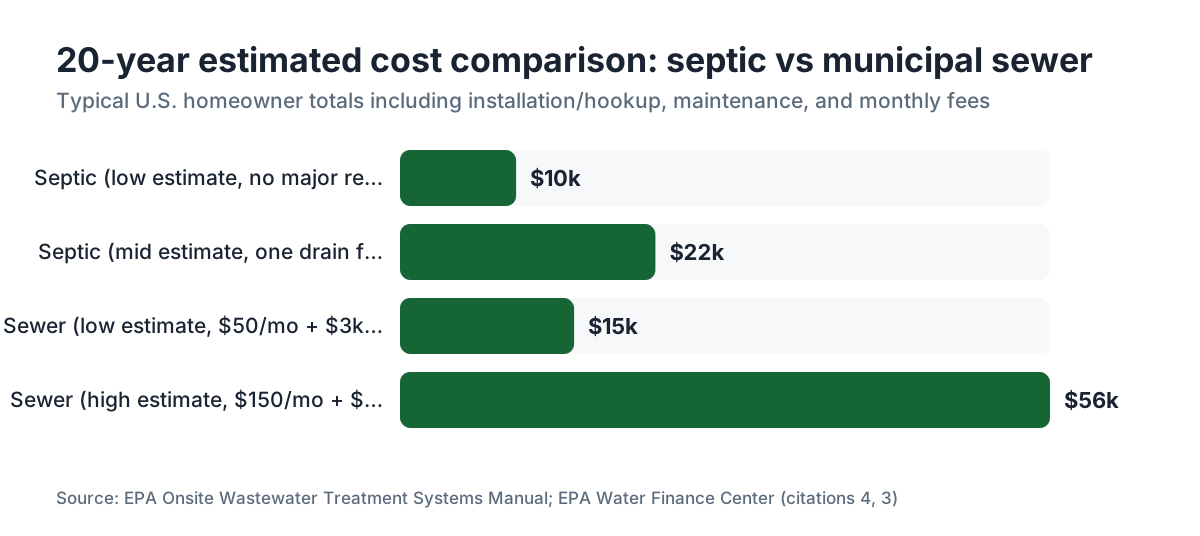
| 20-year estimated total | $15,000 to $55,000 | $10,000 to $35,000 |
The 20-year estimates assume no sewer line failure on your lateral (your responsibility in most jurisdictions) and no drain field replacement. Real totals depend on local rates and how long your system lasts.
For a rural homeowner with a working septic system, switching to sewer when it becomes available rarely wins on math alone. The break-even usually favors staying put unless the system is failing or the connection is legally required.
What are the maintenance differences between sewer and septic?
For a homeowner, sewer maintenance is mostly the lateral pipe running from your foundation to the street. That lateral is your responsibility in nearly every jurisdiction. Tree roots are the usual troublemaker. A root-cutting or hydro-jetting service runs $150 to $500, and a lateral replacement is $3,000 to $10,000 depending on depth and length. Past that, you pay the bill and call if something backs up.
Septic is a different commitment. The EPA's SepticSmart program puts it plainly: "Have your system inspected at least every three years by a professional and pump your tank as recommended by the inspector (generally every three to five years)." [1] That's the floor, not the ceiling.
Beyond pumping, you watch what goes down the drain. Wipes (even the "flushable" ones), grease, medications, and harsh cleaners can wreck the bacteria in the tank or clog the field. None of that limits you on sewer.
If you have a pump chamber (common where the tank sits below the drain field), that pump needs periodic checks and eventual replacement, usually every 10 to 15 years at $500 to $1,500 for the pump itself.
Honest summary: sewer asks almost nothing of you. Septic asks for attention, records, and a budget for pumping. If you defer maintenance on everything you own, a failed septic system is a far worse outcome than a high sewer bill.
For the pumping side, see how often to pump septic tank and septic tank pumping.
Which system has a bigger environmental impact?
Both systems can run clean or run dirty. The outcome rides on maintenance and sizing, not on the type of system.
Municipal plants are regulated under the Clean Water Act and must meet EPA effluent standards through the National Pollutant Discharge Elimination System (NPDES) permit program [6]. Large plants remove nitrogen, phosphorus, and pathogens well. But combined sewer overflows, where stormwater and sewage share pipes and spill during heavy rain, are a real and documented problem in older cities. The EPA counts about 860 communities with combined sewer systems, and overflows happen regularly during storms [7].
A working septic system treats wastewater in place and recharges groundwater. Healthy drain field soil removes pathogens and some nutrients. The problem is failure. A collapsed field or cracked tank leaks untreated sewage into groundwater, surface water, and neighboring yards. Nitrogen from septic systems is a documented driver of algae blooms in coastal and lake waters, especially in dense areas with old systems.
Neither system is the automatic green pick. Sewer wins when the plant is modern and well-run. Septic wins when the system is sized right, maintained, and sited with enough soil between it and groundwater. A neglected septic system in a packed lakeside neighborhood is genuinely worse for water quality than municipal treatment.
Does a septic system or sewer affect your home's value and sale?
Agents, buyers, and appraisers have mixed feelings about septic. Short version: a well-maintained, properly permitted system is a non-issue for most buyers. A failing one is a deal-killer or a big price cut.
In markets where both exist, sewer homes sometimes command a small premium, but the effect is inconsistent and market-dependent. What the data shows clearly is that a disclosed septic failure or an old system with no records creates real trouble at the negotiating table.
Most states require a septic tank inspection at sale, either by law or by lender rule (FHA and VA loans almost always require one). If the inspection turns up problems, you fix them before closing, cut the price, or lose the deal.
Sewer connections don't require a presale lateral inspection, though a buyer can request a camera run of the lateral pipe. Most sewer transactions carry less friction simply because buyers understand these systems and worry about them less.
Selling a home with septic? The single best move is having records: pumping receipts, inspection reports, and the original permit and as-built drawing showing where the tank and field sit. Buyers and their inspectors dig much harder to kill a deal when the paperwork is missing.
Can you switch from septic to municipal sewer, and should you?
You can connect to sewer if the main is reachable from your property and your jurisdiction allows or requires it. In some areas, once a sewer main reaches a neighborhood, connection is mandatory within a set window, usually 1 to 3 years. Check your county's wastewater or environmental health department for the local rule.
The process: apply for a connection permit, hire a licensed plumber or contractor to install the lateral from house to main, pay the tap fee, then decommission your septic tank per state rules. Abandonment usually means pumping the tank, then crushing it in place and filling it with sand or grout, or removing it outright. That costs $500 to $2,500 depending on the method and local rules [4].
Whether you should switch comes down to a few honest factors.
If your septic is working and you're not selling soon, the math usually says stay. You'd spend $5,000 to $20,000 upfront and pick up a monthly bill just to shed maintenance risk.
If your septic is aging (20-plus years), the field shows signs of failure, or you've had repeated repairs, switching then makes more sense because you're comparing hookup cost to drain field replacement cost.
If you're in an area with documented groundwater or surface water problems and your county is pushing conversion, grant money or low-interest loans may be available through state revolving funds under the Clean Water Act to help with the cost.
Operators managing multiple properties or service territories can track system ages and flag conversion candidates automatically. Platforms like SepticMind exist for that fleet-level visibility.
See septic tank repair for how to judge whether your current system is worth keeping.
What do state regulations say about septic systems vs sewer connections?
Onsite wastewater treatment (the regulatory name for septic) is regulated mainly at the state level, with counties and local health departments layering on their own rules. There's no single federal septic code, though the EPA offers guidance through SepticSmart and its Onsite Wastewater Treatment Systems Manual [8].
Every state has an onsite sewage code covering minimum lot size, required soil testing (percolation tests or soil profile evaluations), setbacks from wells, property lines, and surface water, system design standards, installer licensing, and inspection rules.
Florida, for example, requires septic systems set back at least 75 feet from surface water and mandates inspection under its Onsite Sewage Treatment and Disposal Systems law [9]. Texas manages onsite systems through the Texas Commission on Environmental Quality (TCEQ) under Title 30 of the Texas Administrative Code [10].
When sewer is available and within a set distance (often 200 feet from the main), many jurisdictions require new construction to connect instead of installing septic. Existing homes are sometimes grandfathered but may have to connect once the system fails.
The practical takeaway: call your county health department before you buy a rural property or assume you can replace a failing system in place. Rules have tightened in the last decade in a lot of places, and a lot that held a legal septic system 30 years ago may not qualify for a replacement under current soil or setback standards.
Which system is better for rural vs urban properties?
Rural properties almost always use septic by necessity. Sewer infrastructure doesn't reach low-density areas because the pipe cost per home served is too high. If you're buying more than a mile or two outside a town, assume septic unless a utility bill proves otherwise.
Urban and suburban lots in developed areas are almost always on sewer. Many municipalities ban new septic installs inside city limits or anywhere with sewer access.
The messy middle is the rural-suburban fringe: subdivisions platted 30 to 60 years ago that were never sewered, now facing aging septic and encroaching development. These areas see the most conflict between homeowners who don't want the hookup expense and counties or utilities pushing for connection to protect groundwater.
For any buyer, the move is simple: ask directly and verify. County health department records show whether a property has a permitted septic system, its design details, and its inspection history. That's a phone call or a records request, and it's worth doing before you make an offer.
For owners weighing improvements, the real question is time horizon. Selling in two years? Don't drop $15,000 on a new field if the old one is marginal but working. Staying 20 years? A healthy, properly sized system now beats patching an aging one.
What are the health and safety risks of each system?
A working septic system is safe. A failing one is a real health hazard. Untreated sewage carries pathogens: bacteria, viruses, and parasites. When a drain field fails and sewage surfaces in the yard, that's direct exposure for kids, pets, and anyone on the property. Contaminated groundwater from a failed system can reach private wells, a documented cause of waterborne illness outbreaks in rural communities [6].
Sewer systems in good repair carry very low direct risk to homeowners. Their risks are systemic: plant failures, overflows, and contamination of waters used for recreation or fishing.
For homes on both a private well and septic, separation distance matters enormously. Most states require at least 50 to 100 feet between tank and well, and more for the drain field. The EPA recommends a minimum of 50 feet between a septic system and a private well, though some states and soil conditions demand more [8].
On a well and septic together? Test your well water every year for coliform bacteria and nitrates. It's cheap (usually $30 to $100 through a certified lab) and gives you real early warning if the system is fouling your drinking water. Not testing here is genuinely risky, more than overcautious.
What happens when a septic system fails compared to a sewer problem?
Septic failures range from minor to catastrophic. The common ones: a full tank backing up into the house (fixable with a septic tank pump out if caught early), a damaged effluent filter or outlet baffle, a clogged distribution box, and full drain field failure where the soil can no longer absorb effluent.
Drain field failure is the expensive one. You might see sewage surfacing in the yard, wet spots that never dry, or stubborn indoor backups. A failed field usually means replacement or an alternative system. See leach field for how fields fail and what replacement costs.
The timeline from first signs to full failure can be short or drag on for years. Homeowners who ignore early signs (slow drains, odors near the tank, oddly green grass over the field) consistently end up with bigger repairs than those who move early.
Sewer problems, from your side, are almost always the lateral pipe. Root or grease blockages are the usual issue. A backup into the house is miserable and needs fast attention, but the repair scope is predictable: jetting, root cutting, or lateral replacement. You're not staring down a $20,000 drain field job.
For an operator managing client systems, tracking system age and pump history is the best predictor of which systems are near failure. That's the exact case scheduling and records platforms like SepticMind are built around.
For repair specifics, see septic tank repair and septic system repair.
Is septic or sewer better for the long-term value of a property?
Neither system is categorically better for long-term value. Condition and documentation decide it.
A home on sewer, in a neighborhood where sewer is the norm, has a small edge in transaction friction. Buyers don't fret about what they never have to think about.
A home on a well-maintained, documented septic system in a rural market where septic is universal has no real disadvantage. Buyers there understand these systems and price them fairly.
The real long-term risk with septic is deferred maintenance. A tank that's never been pumped, a field with no records, a system installed before current codes: these turn into liability and cost at the worst possible moment, which is when you're trying to sell or refinance.
The long-term upside of septic, if you maintain it, is no monthly utility fee. Over 20 to 30 years, skipping $100 a month in sewer fees adds up to $24,000 to $36,000. That's real money, enough to partly or fully cover responsible maintenance and even one big repair.
For septic tank cleaning guidance and septic tank emptying schedules that keep a system healthy, those resources go deeper on maintenance.
Frequently asked questions
Can I refuse to connect to municipal sewer if I already have a working septic system?
It depends on local ordinance. In many jurisdictions, if a municipality extends a sewer main to your area and your septic system later fails, connection becomes legally required. Some areas mandate it within 1 to 3 years of the main reaching your street even for working systems. Others let existing functioning systems stay. Call your county health or public works department to get the definitive answer for your address.
How long does a septic system last compared to a sewer connection?
A well-maintained concrete or fiberglass septic tank can last 40 years or more. The drain field is usually the limiting part, with a lifespan of 20 to 30 years under normal use. Sewer lateral pipes (your responsibility) can last 50 to 100 years depending on material: cast iron and clay are common in older homes and fail more often than modern PVC. Neither system is truly permanent without occasional repair.
Does having a septic system make it harder to get a mortgage?
Not inherently. FHA and VA loans require a passing septic inspection before closing, meaning the system must work and meet local code at time of sale. Conventional loans carry similar de facto requirements because lenders won't approve a home with a documented system failure. A functioning, permitted system with inspection records doesn't create mortgage problems. An undocumented or failed system does.
What is a sewer lateral and who is responsible for it?
The sewer lateral is the pipe connecting your home's plumbing to the municipal main under the street. In most U.S. cities, the homeowner owns and maintains the entire lateral, including the portion under the public right-of-way. Some cities have started taking responsibility for the section between the main and the property line, but this varies widely. Check with your local utility to know exactly where their responsibility ends.
How often does a septic system need to be pumped?
The EPA recommends pumping every 3 to 5 years for a typical household. The real interval depends on tank size, occupant count, and what goes down the drain. A 1,000-gallon tank serving 4 people usually needs pumping every 3 years. A 1,500-gallon tank for 2 people can often go 5 to 7 years. Have your pumper measure sludge and scum depth to set your specific interval instead of guessing.
What are the signs that my septic system is failing?
Watch for slow drains or gurgling in more than one fixture, sewage odors indoors or near the tank, unusually lush green grass directly over the drain field, wet or soggy yard spots that never dry, and in serious cases, sewage surfacing at ground level. Any of these warrants a professional inspection right away. Catching failure early usually means a much cheaper repair.
Can I install a septic system on any property?
No. A property must pass a percolation test or soil morphology evaluation showing adequate absorption capacity. Minimum lot sizes vary by state and local code. Setbacks from wells, property lines, and water bodies must be met. High water tables, shallow bedrock, or poor-draining clay can make conventional septic impossible, though alternative systems (mounds, aerobic units, drip irrigation) may be permitted on hard sites at much higher cost.
How do sewer rates compare to the cost of maintaining a septic system?
Average U.S. sewer rates run $50 to $150 a month, or $600 to $1,800 a year. In a good year, septic costs nothing beyond peace of mind. Averaged over time, including pumping every 4 years at $400 plus occasional minor repairs, typical septic runs $150 to $300 a year. Over 20 years, septic maintenance usually beats sewer fees, but a single drain field replacement can erase that advantage.
What happens to my septic system if I connect to sewer?
Once you connect to municipal sewer, your septic system must be properly decommissioned per state rules. This typically means pumping the tank empty, then collapsing and filling it with sand or gravel, or removing it entirely. Leaving an old tank in place without decommissioning it is a structural and safety hazard, since the tank can collapse. Abandonment costs run $500 to $2,500 depending on local requirements and tank access.
Does a septic system smell bad?
A properly working septic system shouldn't produce noticeable surface odors. A faint smell near the tank vent pipe now and then is normal. Persistent yard odors, especially near the drain field, point to a problem: a full tank, a broken vent pipe, or field saturation. Indoors, sewer gas smell usually means a dry trap, a cracked vent pipe, or a failing system. Any persistent indoor odor warrants immediate inspection.
Are there grants or subsidies for septic system repair or sewer connection?
Yes, in some cases. The EPA's Clean Water State Revolving Fund provides low-interest loans to states, which sometimes pass those funds to homeowners for septic repairs or sewer connections in areas with documented water quality problems. USDA Rural Development also offers grants and loans for rural wastewater systems through its Water and Environmental Programs. Availability varies by state and income. Contact your state environmental agency or county health department about current programs.
Can a septic system handle the same water usage as a home on sewer?
Yes, if it's sized right. Septic systems are designed on bedroom count (a proxy for occupant load) and soil absorption capacity. A correctly sized system handles normal household use without issue. Trouble comes from undersizing for actual occupancy, from leaky toilets or long showers overloading the tank, or from garbage disposals adding more solids than the design expected. Sewer has effectively no household-level capacity concern.
Is it safe to have a garden or well near a septic system?
Vegetable gardens directly over a drain field aren't recommended, because roots can damage the field and there's a theoretical contact risk with soil that has received effluent. Lawn grass over the field is fine and actually helps with evapotranspiration. Wells must meet state-mandated setbacks from the tank and field, usually 50 to 100 feet or more. Test your well water yearly for coliform bacteria if you're on both a private well and septic.
Sources
- EPA, SepticSmart program overview: About 21 million U.S. households rely on septic systems; EPA recommends inspection every 3 years and pumping every 3 to 5 years
- EPA, Decentralized Wastewater Management Program: Municipal sewer connection tap fees and hookup costs vary widely by locality and distance from the main
- EPA, Water Finance Center: Average U.S. sewer rates and monthly utility fee ranges for wastewater service
- EPA, Onsite Wastewater Treatment Systems Manual (EPA/625/R-00/008): Conventional septic system installation cost ranges and tank abandonment cost ranges
- EPA SepticSmart, Homeowner's Guide to Septic Systems: Septic tank pumping frequency recommendations and typical service cost context
- EPA, National Pollutant Discharge Elimination System (NPDES) program: Municipal treatment plants regulated under Clean Water Act NPDES permits; contaminated groundwater from failed septic systems linked to waterborne illness
- EPA, Combined Sewer Overflows (CSOs): Approximately 860 U.S. communities have combined sewer systems subject to overflows during rain events
- EPA, Onsite Wastewater Treatment Systems Manual: EPA recommends minimum 50-foot separation between septic systems and private wells; state codes may require more
- Florida Department of Health, Onsite Sewage Treatment and Disposal Systems: Florida requires 75-foot setback from surface water bodies for septic systems and mandates inspection under state onsite sewage law
- Texas Commission on Environmental Quality, On-Site Sewage Facilities: Texas regulates onsite sewage facilities under Title 30 of the Texas Administrative Code
- USDA Rural Development, Water and Environmental Programs: USDA offers grants and low-interest loans for rural wastewater systems including septic repair and sewer connection assistance
- EPA, Clean Water State Revolving Fund: Clean Water SRF provides low-interest financing to states that can be passed to homeowners for septic repairs in water-quality-impaired areas
Last updated 2026-07-10