Effluent filter: what it is, how it works, and when to replace it
By the SepticMind Editorial Team
TL;DR
- An effluent filter is a cylindrical cartridge that sits in your septic tank's outlet baffle.
- It screens solid particles before effluent reaches the drain field, which extends field life.
- Clean it every 1 to 3 years during routine pumping.
- A replacement cartridge costs $30 to $200.
- Many states now require them on new installations.
What is an effluent filter and what does it do?
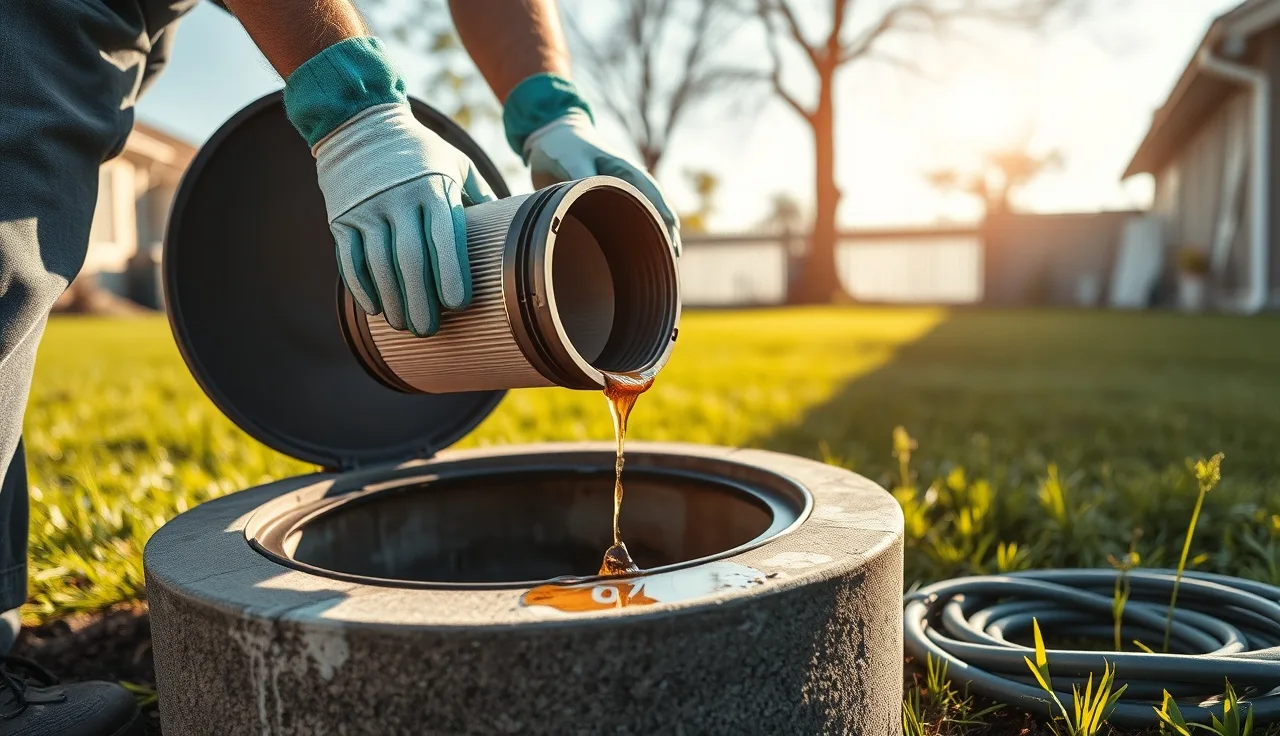
An effluent filter is a slotted cartridge that sits inside the outlet tee of your septic tank, right where partially treated wastewater leaves the tank and heads toward the drain field. Its job is simple. Keep suspended solids from riding out with the effluent.
Without a filter, particles that haven't settled (hair, lint, grease fragments, undigested food) migrate into the soil absorption system and clog the biomat layer in your leach field. Once that happens, you're looking at field repair or replacement, which runs $5,000 to $20,000 depending on soil type and system size [1]. A $50 filter is doing a lot of work for that price.
The filter doesn't treat anything. It adds no bacteria, removes no nutrients, changes no chemistry. It's a physical barrier and nothing more. Think of it as a screen door between the tank and everything downstream.
Most residential filters use vertical slots between 1/16 inch and 1/8 inch wide (roughly 1.5 to 3 mm) [8]. Effluent flows in through the slots, travels up through the center of the cartridge, and exits through the outlet. Solids too big to pass through stay in the tank where they belong, and they get pumped out during routine septic tank pumping.
How does an effluent filter actually work inside the tank?
Picture the outlet baffle as a vertical pipe stub pointing down into the tank. The filter cartridge slides over or into that stub and hangs in the liquid zone, below the scum layer and above the sludge. Effluent enters through the slotted outer wall and exits up the center pipe into the outlet.
When solids hit the slot walls, they slide back down into the sludge or build up on the filter surface. Over time, enough material collects that flow resistance climbs. If the filter gets severely blocked, the liquid level in the tank rises until it backs up into the house. That's unpleasant. It's also a built-in alarm. A backed-up filter tells you service is overdue instead of letting solids silently blow through into the field.
Some designs include an alarm port or bypass channel that trips a high-water sensor when the filter clogs. Worth having if your service intervals are long or your household makes a lot of solids. Garbage disposals, big families, a home with a water softener.
Flow rate matters too. Most residential cartridges are rated for 600 to 1,500 gallons per day. If your household water use is high, check that your filter's rated capacity isn't getting overwhelmed. A filter running near its limit clogs faster than one with headroom.
Do you actually need an effluent filter, or is it optional?
Depends on where you live and when your system went in. In many states it's now mandatory for new construction. Florida's Rule 64E-6 requires effluent filters on new systems [2]. California, Texas, and Minnesota have written similar requirements into their onsite wastewater codes. The EPA's SepticSmart program recommends filters as a best practice for all systems, describing an effluent filter as a device that "prevents solids from leaving the tank" [3].
For older systems built without one, retrofitting is almost always worth it. The job is straightforward. A pump technician removes the old outlet baffle, installs a riser if needed to bring the access point to grade, and drops in a filter cartridge. Labor and parts usually run $100 to $300 when done during a scheduled pump-out [4].
The cases where a filter is genuinely optional are rare. A two-compartment tank does better solids separation, but it still benefits from a filter. A system with a dosing pump already has some protection from a pump screen, but the outlet filter on the main tank still matters.
If you're on a system with an advanced treatment unit (aerobic treatment unit, peat filter, drip irrigation), check your manufacturer's spec. Some units have their own filtration built in. Most still want a primary tank effluent filter upstream.
How often should you clean a septic effluent filter?
Clean the filter every time you pump the tank. For most households that's every 3 to 5 years, which matches EPA guidance on pumping frequency [3]. If you have a garbage disposal, a large family, or a home that generates high solids, pump and clean every 2 to 3 years.
Some homeowners clean the filter themselves between pump-outs by pulling the cartridge and rinsing it with a garden hose back into the tank. That works. The trick is to rinse the cartridge over the inlet side of the tank (or over a bucket) so the solids fall back into the tank and not into the outlet zone. Spray it into the outlet side and you've just pushed solids toward the field.
Signs the filter needs attention sooner than scheduled: slow drains throughout the house with no plumbing blockage, gurgling at fixtures, or a septic alarm going off. If those symptoms clear up after a cleaning, the filter was the culprit.
How fast a filter clogs depends on household habits more than anything else. Flushing wipes (even the ones labeled flushable), heavy garbage disposal use, and chemical drain cleaners that kill tank bacteria all speed up clogging. Cut those habits and the filter lasts longer between cleanings.
What does an effluent filter cost to buy and install?
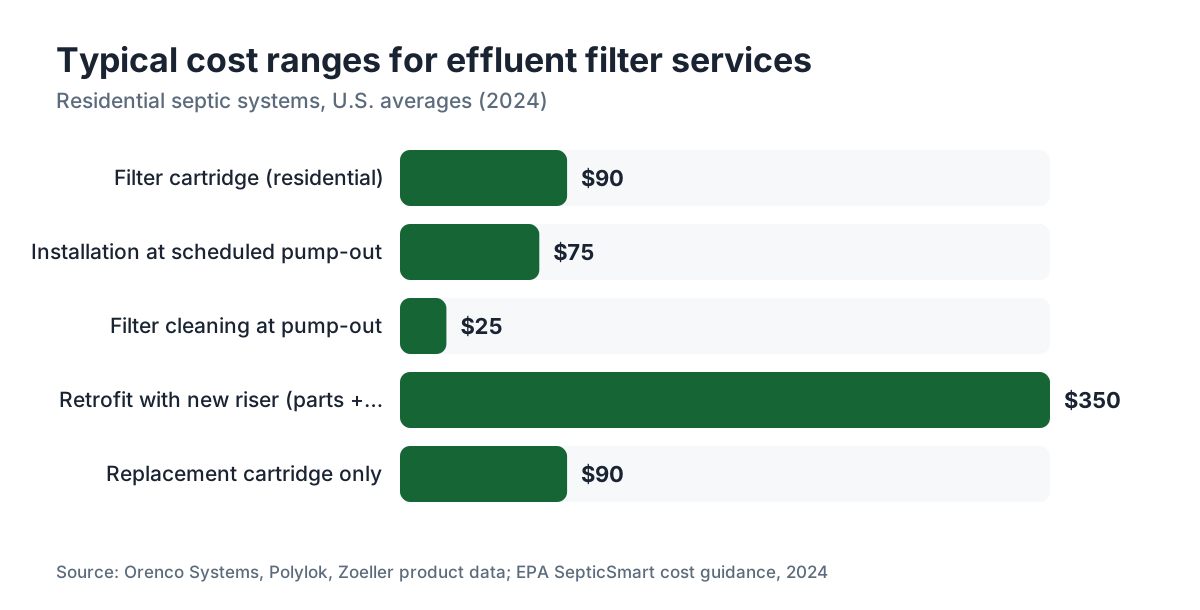
Filter cartridges run $30 to $150 for residential units, depending on size and brand. The two common residential sizes are 4-inch and 6-inch diameter, matching standard outlet tee dimensions. A Zoeller or Polylok cartridge at a plumbing supply house is typically $50 to $90 [10][11]. Orenco makes filters for engineered systems that run higher, $100 to $200, built for harder-duty applications [4].
Installation during an existing pump-out adds roughly $50 to $100 in labor if the access is already open. Retrofitting a filter to a system that has no riser means paying for the riser too, which adds $200 to $500 depending on depth and local rates.
Cleaning at each pump-out is usually included in the pump-out price or adds $25 to $50. Some pumpers charge a flat rate for the whole service call and don't itemize. Ask before you schedule.
Replacing a worn cartridge costs the same as buying new: $30 to $150 for parts plus a service call. Cartridges don't have a fixed lifespan measured in years. They last until the plastic cracks, the slots warp, or the end caps fail. A well-made filter cleaned regularly runs 10 to 20 years before it needs replacement.
| Item | Typical cost range |
|---|---|
| Filter cartridge (residential) | $30 to $150 |
| Installation at pump-out | $50 to $100 labor |
| Retrofit with new riser | $200 to $500 |
| Filter cleaning at pump-out | $0 to $50 |
| Replacement cartridge only | $30 to $150 |
What are the best effluent filters for residential septic systems?
There's no single best filter. What matters is slot size, flow capacity, material quality, and whether it fits your outlet. A few brands dominate the residential market for good reasons.
Polylok makes some of the most widely installed residential filters in the U.S. Their cartridges fit standard 4-inch and 6-inch outlet tees, the slots are consistently made, and they're cheap enough to replace without flinching. For an average household, a Polylok cartridge handles up to 1,500 gallons per day without trouble [10].
Orenco makes the GF series, common in engineered systems and advanced treatment units. Orenco filters are built for higher flow rates and come with better alarm integration options [4]. Overkill for a standard 1,000-gallon residential tank, but appropriate if you have a pump chamber or a larger system.
Zoeller makes the 10-4000 series, a solid mid-range option with a durable PVC body. Pumpers often stock these because they're everywhere through supply houses [11].
Here's what I'd actually do. For a standard 3-bedroom home with a single 1,000 to 1,500 gallon tank, buy a Polylok or Zoeller 4-inch cartridge. Spend the money you save on a riser if you don't have one, because easy access is the difference between a filter that gets cleaned on schedule and one that gets ignored. A $50 filter cleaned every 2 years beats a $150 filter ignored for 10 years, every time.
Skip the very fine mesh filters (under 1/16-inch slots) for standard gravity systems. They clog too fast, especially with a garbage disposal, and the extra protection isn't worth the maintenance.
Why is your septic effluent filter clogging so fast?
If you're cleaning the filter yearly or more often and it's heavily loaded each time, something upstream is making more solids than a normal household should. A few common causes.
Garbage disposal use is the biggest single accelerant. The EPA notes that garbage disposals add solids to the tank and can require more frequent pumping [3]. Ground food waste sends material into the tank that bacteria can't fully break down between pump cycles, so it piles up and hits the filter.
Flushing non-flushables. Wipes, paper towels, feminine hygiene products, and dental floss don't break down. They mat against filter slots fast.
A failing tank. If the baffles inside the tank are deteriorating, the inlet and outlet zones aren't separated, and solids that should settle mix into the liquid zone and hit the filter instead. Worth a septic tank inspection to check.
High water use. A household running several loads of laundry daily or with a leaky toilet flushing nonstop can hydraulically overload the tank, pushing effluent through faster than solids can settle. That short-circuits the tank and delivers poorly settled liquid to the filter.
If the filter is clogging in under 12 months consistently, pull the service records, check the causes above, and think about whether you need a larger tank or a two-compartment system. A filter reports symptoms as much as it protects.
Can a clogged effluent filter damage your drain field or cause sewage backup?
A clogged filter that causes a backup in the house is unpleasant, but it's protective. The wastewater can't escape the tank, so it backs up through drains. That's the system doing its job. The failure is contained and fixable.
The dangerous scenario is a filter that partially fails, or one that's absent entirely. Then solids move through the outlet into the distribution system. The biomat in the leach field thickens faster than biology can maintain, and soil permeability drops. Once a drain field is clogged with solids, you generally can't recover it. Resting it sometimes helps. It rarely restores full capacity.
State extension research and EPA documentation consistently point to premature solids transport as one of the top causes of drain field failure [1][5]. A maintained filter doesn't let that happen.
So a clogged filter causes a messy inconvenience. A missing or failed filter can cause a $10,000 to $30,000 drain field replacement. The math is not close.
Had a backup? Get the filter cleaned and inspected right away. Then look at your septic tank pump out schedule. If the tank was overdue, that's your answer. If it was recently pumped and the filter clogged anyway, find the upstream cause before the next pump cycle.
How do you clean a septic effluent filter yourself?
Cleaning your own filter is doable if you have access to the outlet riser and a garden hose. Here's the honest process.
First, find the outlet-side riser, the one closest to the drain field. Remove the lid. You'll see the filter handle sticking up from the tee. Pull it straight up. It'll be heavy and wet with solids. Do this gently. Jerking it can snap the handle.
Hold the cartridge over the inlet side of the tank or over a bucket and rinse it with a garden hose. Spray from the inside out so solids fall back into the tank. Wear gloves and eye protection. The stuff rinsing off is raw sewage.
Inspect the cartridge while it's out. Look for cracked slots, warped end caps, brittle plastic. If it's damaged, replace it.
Slide the cartridge back into the tee, make sure it's fully seated, replace the lid.
That's it. The whole job takes 10 to 15 minutes once you have access. The reason most people skip it is no riser access. If your tank has no risers and you have to dig to the lid every time, you won't clean the filter on schedule. If you're spending money on septic tank repair anyway, adding risers is one of the cheapest upgrades you can make.
For operators managing multiple systems, software like SepticMind lets you log filter cleaning dates per property and set service reminders, so nothing slips across a large account list.
Are effluent filters required by code in your state?
Requirements vary a lot by state and by year of installation. Here's the general picture as of 2025.
Florida requires effluent filters on new systems under Rule 64E-6 [2]. California's Title 22 and local county codes require them in many jurisdictions for new and replacement systems [12]. Texas Commission on Environmental Quality rules recommend or require them depending on system type [6]. Minnesota's Chapter 7080 requires outlet filters on new systems installed after 2000 [7].
If your system went in before 2000, there's a good chance no filter was required. That doesn't mean you shouldn't have one. It means you should think hard about retrofitting, especially if your system is near or past the 25 to 30-year design life for a drain field.
The EPA's SepticSmart guidance doesn't set mandatory requirements (states do that), but it treats effluent filters as a recognized best practice for protecting soil absorption systems [3].
Buying a home on septic? A septic tank inspection should confirm whether a filter is present and when it was last cleaned. No filter on an older system isn't a dealbreaker, but note it and budget for it.
| State | Filter requirement (new systems) | Notes |
|---|---|---|
| Florida | Required | Rule 64E-6 |
| California | Required (most counties) | Title 22 + local codes |
| Texas | Recommended/Required by system type | TCEQ rules |
| Minnesota | Required | Chapter 7080, post-2000 |
| Federal (EPA) | Best practice guidance | Not mandatory |
| Other states | Varies | Check local onsite wastewater code |
How does an effluent filter compare to other septic system protections?
Several components protect your drain field from solids. Knowing how they compare helps you spend maintenance money well.
The inlet baffle is the first defense. It slows incoming sewage and keeps it from short-circuiting straight to the outlet. Without it, raw sewage channels across the tank surface. It doesn't filter. It slows and redirects.
The outlet baffle draws effluent from the middle liquid zone, below the scum and above the sludge. That's separation work, not filtration. The effluent filter sits on the outlet tee and adds actual physical screening.
A two-compartment tank separates solids better than a single-compartment tank because solids settle in the first compartment before liquid transfers to the second. Even so, a two-compartment tank benefits from a filter on the final outlet.
Pump screens on dosing chambers filter effluent before distribution, but that's downstream of the main tank. The main tank's filter and the pump chamber screen are two separate barriers.
Advanced treatment units (aerobic systems, recirculating sand filters) add biological treatment. They have their own filtration, but most still want an effluent filter on the primary clarifying tank.
The effluent filter is the most cost-effective single upgrade you can make to a standard gravity system. Nothing else at $50 to $150 delivers that level of field protection. If you're asking how to extend drain field life, this is the answer. For operators, the how often to pump septic tank schedule and filter cleaning are the two most controllable variables affecting system longevity.
What happens if you don't have an effluent filter on your septic system?
Most systems installed before the mid-1990s have no effluent filter. Many of them still work. So the absence of a filter isn't an automatic death sentence.
What it means is that your drain field relies entirely on in-tank settling and the soil's biological filtering to handle anything that migrates through. Soil is good at this, which is why the original systems worked without filters. The catch is that soil capacity is finite, and solid loading over 20 to 30 years adds up.
Systems without filters that also get pumped on schedule and have low solid inputs (no garbage disposal, careful flushing habits, moderate water use) can run for decades without field failure. When they do fail, it's often because solids have accumulated in the distribution pipes and biomat over a long period. By the time you notice symptoms, the damage is done.
Retrofitting a filter at any point in the system's life helps. Even a 25-year-old system that gets a filter today protects whatever field life it has left. The cost to install septic system replacement is high enough that protecting even 5 extra years of field life more than pays for the filter.
SepticMind's service records, kept by operators tracking hundreds of systems, show that systems with documented filter maintenance history have longer average intervals between major repairs. That's anecdotal across a software platform's users, not a controlled study, but it lines up with what the academic literature shows about solids management and field longevity [5].
Frequently asked questions
What size effluent filter do I need for my septic tank?
Match the filter diameter to your outlet tee. Most residential tanks use 4-inch outlet tees; larger or commercial systems use 6-inch. Measure the inside diameter of the outlet pipe before ordering. Length matters too: a longer cartridge (4 feet vs 2 feet) gives more filter surface area and clogs slower, which is worth it for high-use households or systems with garbage disposals.
Can I install an effluent filter myself?
Yes, if your tank has riser access and you're comfortable working around sewage. The cartridge slides into the existing outlet tee and locks in place with a handle. The harder part is that older tanks often lack risers, requiring excavation to reach the lid. If you need to dig or modify the tank outlet, hire a licensed septic contractor. Check local code: some states require licensed installers for any tank work.
How do I know if my septic tank has an effluent filter?
Ask your pump technician to check during the next pump-out. Or open the outlet-side riser lid (the one closest to the drain field) and look into the outlet tee. A filter has a visible handle or pull-strap sticking up. If you see a plain pipe tee with nothing inside, there's no filter. Inspection records from a recent septic inspection should also note filter presence or absence.
Does a septic effluent filter affect how well the tank treats wastewater?
No. The filter screens solids but doesn't change biological treatment. The tank's bacteria break down organics in the liquid zone whether or not a filter is present. The filter's only job is to stop particles above a certain size from leaving the tank. It adds no treatment capacity, removes no nutrients like nitrogen or phosphorus, and improves effluent quality only through physical solids removal.
What slot size should I choose for an effluent filter?
For most residential gravity systems, 1/16-inch slots (about 1.5 mm) hit the right balance between protection and clogging frequency. Finer slots catch more particles but clog faster, so you clean more often. Coarser slots (3/16 inch) reduce clogging but let more fine solids through. If you use a garbage disposal or have high solids loads, stick with 1/16-inch slots and clean more often rather than going coarser.
Will cleaning the effluent filter myself void any warranty?
Filter cartridges generally don't carry warranties tied to who performs maintenance. Check the product documentation for your specific cartridge. What can void system permits or compliance in some states is doing work on a septic system without a licensed contractor where local code requires one. Cleaning a filter is usually low-risk legally, but full tank work (replacement, baffle repair) often requires licensed contractors under state onsite wastewater rules.
How long does an effluent filter last before needing replacement?
A quality PVC cartridge cleaned regularly lasts 10 to 20 years before physical degradation forces replacement. Inspect it every cleaning: look for cracked slots, warped end caps, or brittle plastic. UV exposure isn't a factor since filters stay submerged. The main killers are physical impacts during removal, chemical exposure from harsh drain cleaners, and age-related embrittlement of the plastic over many years.
Is an effluent filter the same as a septic tank filter?
Yes, the terms are used interchangeably. Some brands and regulators say "effluent filter," some say "septic tank outlet filter" or just "tank filter." They all describe the same device: a slotted cartridge installed in the outlet tee of the primary septic tank to screen solids before effluent exits toward the drain field. The word "effluent" just means the partially treated liquid leaving the tank.
Can an effluent filter cause problems if it gets completely blocked?
A fully blocked filter causes sewage backup into the house, usually showing first as slow drains and then as overflows at the lowest fixtures. Messy and urgent, but it's the intended failure mode: wastewater backs up inside instead of pushing solids into the drain field. Call a pump service right away. The fix is filter cleaning (and possibly pumping if the tank is full). Field damage from a blocked filter is rare.
Do effluent filters help prevent drain field failure?
Yes, and that's their main purpose. Premature solids transport is one of the leading causes of drain field failure according to state extension research and EPA documentation. By keeping larger particles in the tank, the filter preserves soil permeability in the leach field and slows biomat buildup. Even on older systems, retrofitting a filter can extend remaining field life meaningfully and delay an expensive replacement.
Does a two-compartment septic tank still need an effluent filter?
Yes. A two-compartment tank separates solids better than a single-compartment tank, but it doesn't remove fine particles from the effluent. The second compartment cuts the solids load reaching the outlet, which keeps the filter cleaner longer. But a filter on the final outlet of a two-compartment tank is still best practice and required in many state codes for new installations regardless of compartment count.
What is the difference between an effluent filter and a pump screen?
An effluent filter sits in the outlet tee of the primary septic tank, screening gravity-flow effluent before it enters the distribution system. A pump screen is a basket or strainer inside a separate pump chamber (dosing chamber), protecting the pump impeller from debris before effluent is pressure-dosed to the field. Two different devices in two different locations. Many systems have both, and both need regular cleaning.
Sources
- EPA, Septic Systems Overview: Drain field replacement costs and the role of solids in premature field failure
- Florida Department of Health, Onsite Sewage Treatment and Disposal Systems (Rule 64E-6): Florida requires effluent filters on new septic system installations under Rule 64E-6
- EPA, SepticSmart Program for Homeowners: EPA SepticSmart recommends effluent filters as a best practice to protect drain fields from solids and recommends pumping every 3 to 5 years
- Orenco Systems, Effluent Filter Product Documentation: Orenco GF-series effluent filters are rated for high-flow engineered systems and are priced above standard residential filters
- National Environmental Services Center, West Virginia University: Solids management and effluent filtration are associated with longer drain field service life
- Texas Commission on Environmental Quality, On-Site Sewage Facilities: TCEQ rules recommend or require effluent filters depending on system type
- Minnesota Pollution Control Agency, Subsurface Sewage Treatment Systems (Chapter 7080): Minnesota Chapter 7080 requires outlet filters on new systems installed after 2000
- National Environmental Services Center, West Virginia University, Pipeline Newsletter on Effluent Filters: Effluent filters with slot sizes between 1/16 and 1/8 inch are standard for residential gravity systems
- Polylok Inc., Effluent Filter Product Specifications: Polylok residential effluent filter cartridges are rated up to 1,500 gallons per day for standard 4-inch outlet configurations
- Zoeller Pump Company, Effluent Filter Series: Zoeller 10-4000 series effluent filters are widely stocked by septic supply distributors for residential retrofit installations
- California State Water Resources Control Board: California Title 22 and local county codes require effluent filters in many jurisdictions for new and replacement onsite wastewater systems
Last updated 2026-07-09