Effluent filter outside septic tank: what it means and what to do
By the SepticMind Editorial Team
TL;DR
- An effluent filter sitting outside a septic tank was either pulled for cleaning and never put back, or pushed out by pressure during a surge.
- Either way, a missing or loose filter lets raw solids run straight into your drain field.
- That risks a $5,000 to $20,000 field failure.
- Clean it, check the housing, and reseat it before running any water.
What is a septic tank effluent filter and where does it normally live?
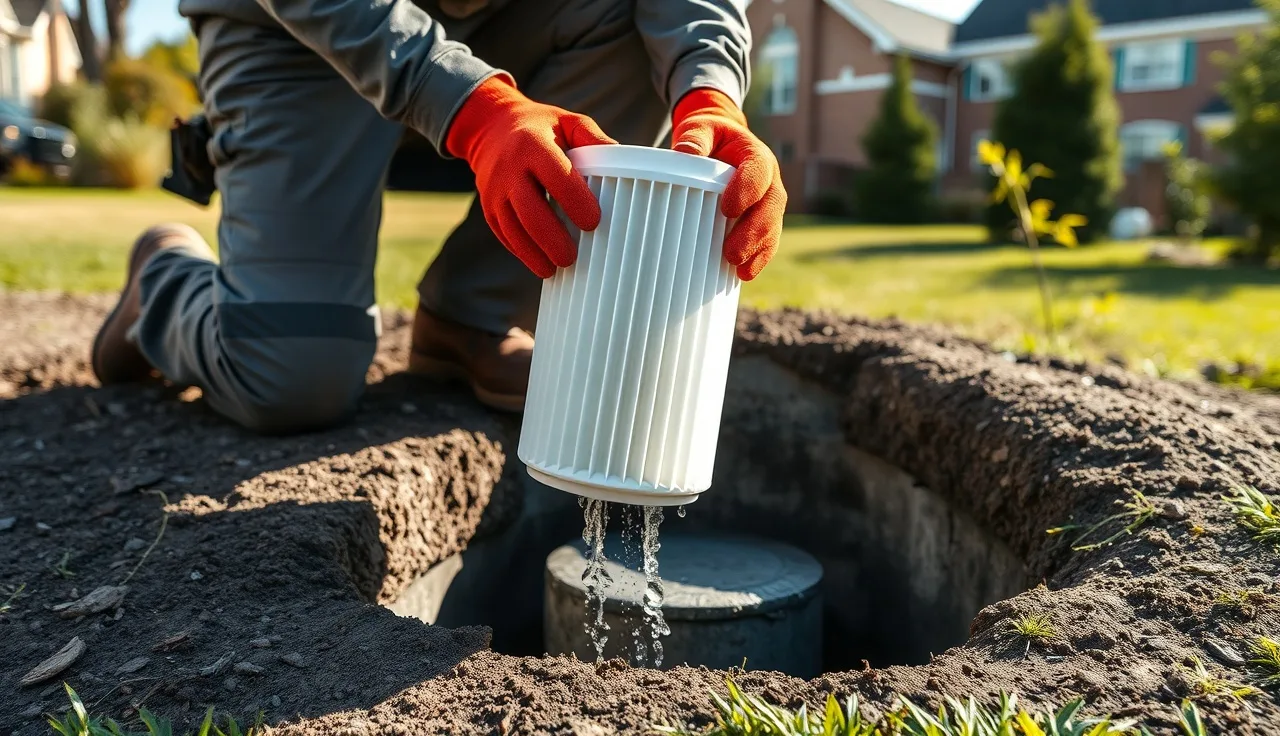
A septic tank effluent filter is a cylindrical cartridge that sits inside the outlet baffle of your tank, right where clarified liquid (effluent) leaves for the drain field. It screens out suspended solids and floating scum that would otherwise ride into the leach field pipes and clog them.
Most filters are 4 to 6 inches across and 12 to 18 inches tall. They slide into a sleeve or housing that is glued or threaded onto the outlet tee. The Zabel filter (made by Zoeller) is one of the most common brands in North America. Its A-100 and A-1800 series are what you will find on most residential tanks installed or retrofitted after the mid-1990s [1].
The EPA's SepticSmart program describes an effluent filter as a component that 'prevents solids from leaving the tank and entering the drainfield' [2]. Simple job, big stakes. A drain field hit with solids builds a biomat layer in the soil that can permanently cut its ability to absorb water. Rebuilding a failed drain field runs $5,000 to $20,000 depending on region and soil [3].
The filter belongs inside the tank at all times except during a scheduled cleaning, which usually happens every one to three years during septic tank pumping visits.
Why would an effluent filter be found outside the septic tank?
Four things realistically cause this.
Someone pulled it to clean it and never put it back. This happens more than you would think. A pumper or homeowner hoses the filter off over the tank opening, sets it aside to finish other work, and forgets it. It sits in the grass next to the riser lid, sometimes for years. If you found a cartridge in the yard or in a bucket, this is almost certainly the story.
Pressure ejected it. If the tank got badly overloaded, say after a big party, a broken pipe flooding it, or a blocked outlet building backpressure, the filter can be forced up and out of its housing when the retaining clip has failed or was never seated right. Unusual, but not rare on older Zabel A-series housings where the retaining tab wears down [1].
Someone removed it on purpose. A previous owner or contractor pulled it to stop nuisance clogging. That is a bad trade: you swap a manageable cleaning chore for a catastrophic drain field risk. Some operators do this at a homeowner's request instead of diagnosing why the filter keeps clogging (usually too much solids, which means the tank needs more frequent septic tank pump out service).
An inspector left it out. During a septic tank inspection, the filter comes out, gets flagged as worn, and never goes back in. Always ask whether the filter was reinstalled after any service call.
Is it dangerous to run your household without the filter in place?
Yes. The risk is real, not theoretical.
Without the filter, every flush and every washing machine drain sends a slug of effluent toward the field. The outlet baffle by itself does not catch small suspended solids, and it does nothing about floating grease or lint. Those particles travel into the distribution pipes and pack into the soil pores around your trenches.
Biomat forms slowly, then becomes irreversible past a certain density. The EPA lists solids carryover as one of the main mechanical causes of drain field failure [2]. A failed leach field usually means full replacement, not a patch. Our leach field guide walks through what that looks like.
Here is the practical rule. Stop all non-essential water use until the filter is clean and back in place. One or two flushes while you go buy a new cartridge will not kill a healthy field. A week of dishwasher runs, laundry loads, and showers with no filter is a different animal.
How do you clean and reinstall an effluent filter?
Cleaning is easy and messy. Here is the actual process.
Find the outlet end of your tank, the end closer to the drain field. If your tank has two risers, the outlet baffle sits under the lid farther from the house. Remove the lid.
Pull the cartridge straight up out of the housing. Hold it over the open tank opening, never over the ground, and rinse it with a garden hose. The solids wash back into the tank where they belong instead of into your yard where they become a pathogen hazard [4]. Gloves and eye protection are smart here. Septic effluent carries fecal coliforms and other pathogens, so that is not paranoia [4].
Inspect the cartridge. Look for cracked fins, broken end caps, or brittle plastic. Zabel A-series cartridges and most competitors last roughly 5 to 10 years, though UV exposure and harsh wastewater chemistry shorten that. If the plastic is brittle or fins have snapped off, replace it before reinstalling.
Slide the clean cartridge back into the housing until it seats fully. The 'flow' arrow on Zabel and most brands points toward the outlet (toward the drain field). Most housings have a retaining clip or tab. Confirm it engages. Put the riser lid back on.
The whole job takes 20 to 45 minutes. If you want to track cleaning alongside your pump-out schedule, SepticMind has a maintenance calendar that operators can share with homeowners for exactly this kind of recurring task.
What does installing an effluent filter in an existing septic tank involve?
If your tank has no filter and you want to add one, that is a retrofit. Putting a filter in a tank that was never designed for one takes a bit more than dropping in a cartridge.
The outlet tee has to accommodate a filter housing. Many tanks built before 1990 have cast-iron or concrete outlet baffles that are not sized for a standard 4-inch housing. A licensed contractor opens the outlet side, cuts back or removes the old tee, and glues in a new Schedule 40 PVC tee with the right sleeve diameter, usually 4-inch or 6-inch depending on tank outflow.
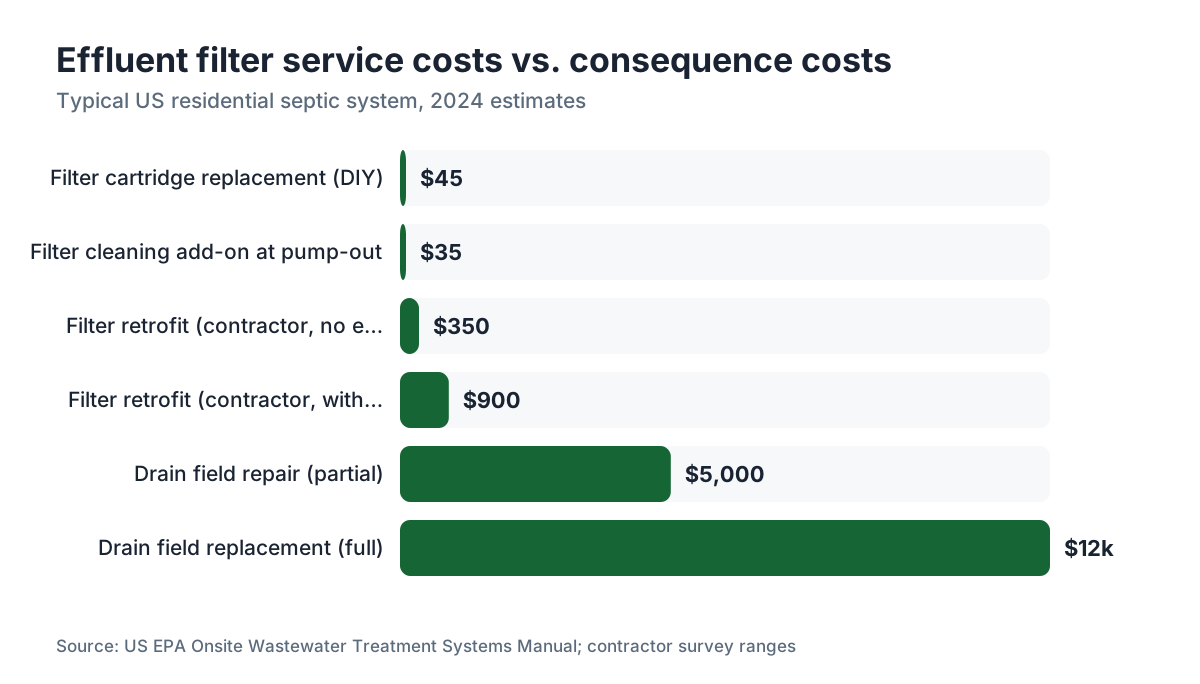
Parts are cheap. A Zabel A-100 housing with cartridge runs about $30 to $60 at supply houses. Higher-capacity models like the A-1800 run $60 to $100 [1]. Contractor labor to retrofit an accessible tank usually runs $150 to $350, which puts total installed cost at $200 to $450. If the outlet side needs excavation to reach, the number climbs fast.
Many states now require filters on all new installs and on tanks that get a permitted repair or modification. Florida requires outlet filters on most new installations under Rule 64E-6.013 [6]. California's Title 22 sets treatment standards for certain system types that functionally require filtration [5]. If you are doing a septic tank repair that needs a permit, call your county health department first. Your permit may require adding a filter even if the repair itself has nothing to do with it.
For the wider picture, the septic tank installation guide covers what contractors look at on new builds.
How often should you clean a septic effluent filter?
Honest answer: it depends on how much solids your tank sees, and there is no one-size-fits-all number.
The most defensible rule is to clean the filter every time the tank gets pumped. For a household following normal usage that is every three to five years [7]. If your household throws off heavy solids (big family, garbage disposal running constantly, frequent large laundry loads), clean it yearly instead.
Some housings support an alarm. Zabel's A-series housing has a port for a float switch. When the filter clogs enough that effluent backs up to the float, an alarm trips. If your alarm keeps going off, the filter is not the problem. The tank needs pumping more often. See how often to pump septic tank for the breakdown by household size and usage.
A filter that clogs within weeks of cleaning is almost always telling you the tank is taking on too many solids, not that the filter is too small. Check garbage disposal use, non-flushable wipes, and grease habits before you blame the hardware.
What do different effluent filter brands offer and how do they compare?
The market is small. A handful of brands cover most residential installs in the US and Canada.
| Brand / Model | Nominal size | Flow capacity | Approx. cartridge cost | Notes |
|---|---|---|---|---|
| Zabel A-100 | 4" | Standard residential | $20 to $35 | Most common retrofit; fits most 4" tees |
| Zabel A-1800 | 4" | High-flow residential | $35 to $60 | Larger filter area, good for 3+ bedroom homes |
| Polylok PL-525 | 4" | Standard residential | $25 to $45 | Integrated housing and cartridge unit |
| Orenco FSI-series | 4" or 6" | Residential to light commercial | $50 to $120 | Common in pressure-dosed and drip systems [9] |
| Bio-Microbics RetroFAST | Custom | Advanced treatment | $150 to $300+ | Overkill for standard gravity systems |
For a standard 3-bedroom gravity system, any of the first three perform about the same. I would put a Zabel A-1800 on any house with a garbage disposal or more than four regular occupants, purely for the larger filtration surface.
Brand matters less than sizing and installation. A 4-inch housing in a tank with a 6-inch outlet tee will not seat right and will let flow bypass the filter entirely. Match the housing diameter to the outlet tee, every time.
What are the signs that your effluent filter is clogged or missing?
A clogged filter mimics early drain field failure, which triggers a lot of unnecessary alarm and unnecessary septic system repair spending.
Slow drains throughout the house, gurgling from lower fixtures, and sewage odor inside or near the tank are the usual signs. If a plumber snakes your lines and finds no house-side blockage, the next step is to open the outlet side of the tank and check the filter.
A fully clogged filter shows effluent backed up well above the filter inlet slots. The tank level reads visibly higher than normal on the outlet side. In bad cases you may see sewage surfacing near the tank instead of the field. That is actually the better outcome, because it means the filter did its job and kept solids out of the field.
A missing filter usually shows no immediate symptoms at all. The tank drains normally, effluent flows to the field, everything looks fine. The damage happens quietly in the soil. By the time symptoms show, the biomat has already degraded field performance. That silence is exactly why a missing filter is the more dangerous case.
If you suspect your tank has no filter, a basic septic tank inspection or septic tank cleaning visit will confirm it.
Can you replace a septic effluent filter yourself, or do you need a licensed contractor?
Cleaning and reinserting a filter you already removed is DIY work. No permit, low skill. The real hazards are pathogen exposure (gloves, wash your hands well, keep kids and pets clear) and dropping the cartridge into the tank, which means fishing plastic out of liquid sewage.
Retrofitting a housing onto a tee that was never built for one is a gray area. In most states, any modification to the tank itself technically requires a permit and a licensed contractor. California's State Water Resources Control Board classifies septic tank modifications as regulated work [5]. Florida's Chapter 64E-6 likewise requires permitted work for tank alterations [6].
In practice, plenty of homeowners glue in a new tee and housing and nobody ever notices. But if the drain field fails later, an unpermitted homeowner modification can complicate an insurance claim or a resale disclosure.
My honest take: if the housing is already there and you just need to clean or swap the cartridge, do it yourself and keep the money. If you are retrofitting a housing, or the outlet tee looks cracked or deteriorated, bring in a contractor. A septic tank repair that includes a proper filter install is worth a few hundred dollars when it protects a field that costs 20 times that to replace.
How much does effluent filter installation, cleaning, or replacement cost?
Cost depends on whether you are cleaning an existing filter, swapping the cartridge, or doing a full retrofit.
Cleaning during a pump-out: most pumping companies include filter cleaning free, or charge $20 to $50 as an add-on. If they do not offer it, ask directly. Some skip it unless prompted. The septic tank pumping guide has regional price ranges for service visits.
Cartridge replacement only: $20 to $120 depending on brand and model, plus your time. If a contractor swaps it during a visit, add $50 to $100 in labor on top of the part.
Full retrofit (new housing plus cartridge, contractor installed): $200 to $500 for an accessible tank with no digging. Add $300 to $800 if excavation is needed to reach the outlet end.
The math is lopsided. The EPA calls premature drain field failure from solids carryover one of the most preventable forms of septic failure [2]. Spending $300 to protect a field that costs $8,000 to $20,000 to replace is not a close call. For the full replacement picture, see cost to install septic system.
Operators tracking these line items across many accounts can keep filter service records next to pump schedules in SepticMind, which was built for running a septic service business at scale.
What do state codes and EPA guidance say about septic effluent filters?
Federal guidance is strong but not binding on its own. The EPA's SepticSmart initiative recommends effluent filters as a maintenance component. Its guidance is that filters should be cleaned whenever the tank is pumped [2]. That is guidance, not a federal rule, because onsite wastewater systems are regulated at the state and local level.
State requirements vary a lot. As of the mid-2020s:
Florida requires effluent filters on new septic installations and permitted repairs under Florida Administrative Code Rule 64E-6.013 [6]. California's Title 22 sets treatment standards for recycled water and certain system types that functionally require filtration [5]. North Carolina's 15A NCAC 18A .1900 rules for onsite wastewater require filtering devices on new systems and major repairs in many counties [8]. Many other states have adopted similar requirements through their health or environmental quality rules.
If your system predates your state's filter requirement and has never had a permitted modification, you may not technically be required to have one. Add it anyway. The cost is low, the protection is real, and several states require disclosure of known system deficiencies at sale. A septic tank inspection tied to a real estate deal may flag a missing filter as a deficiency that has to be corrected before closing.
Check your state's department of health or environmental quality website for the code section that applies to your county. Local rules sometimes go beyond state minimums.
Frequently asked questions
What happens if you run the septic system without the effluent filter installed?
Solids, grease, and lint that the filter would normally catch flow straight into your drain field pipes and soil. Over weeks to months that builds a biomat layer that cuts the soil's absorption capacity. Damage from solids carryover is largely irreversible. A full drain field replacement runs $5,000 to $20,000. Stop non-essential water use and reinstall the filter as fast as you can.
Can an effluent filter be installed outside the septic tank instead of inside?
No. Effluent filters are built to sit inside the outlet baffle housing, submerged in the tank. Mounting one externally in a pipe run does not work: the filter relies on the tank's liquid level to backwash solids toward the bottom during low-flow periods. An external filter would clog fast, bypass, or fail structurally. Every major manufacturer and state code requires in-tank installation.
How do I know if my septic tank has an effluent filter?
Open the lid on the outlet side of your tank (the side closer to the drain field). Look inside the outlet baffle or tee. A filter shows up as a cylindrical cartridge, usually white or gray, sitting in a housing. If you see a plain tee or baffle with no cartridge, your tank has no filter. A pumper can confirm this during a routine service visit.
How long does a Zabel septic tank effluent filter last before it needs replacement?
Zabel A-series cartridges are generally rated for 5 to 10 years. Actual lifespan depends on solids loading, cleaning frequency, and chemical exposure. A cartridge cleaned every one to three years typically outlasts one left in place for five or more years without cleaning. Check the plastic for brittleness or broken fins at each cleaning and replace it if you see structural damage.
Why does my effluent filter keep clogging so fast?
A filter that clogs within weeks of cleaning is a symptom, not the cause. Common reasons: a tank overdue for pumping and holding too many solids, heavy garbage disposal use, flushing non-flushable wipes or hygiene products, or a household that outpaces the tank's capacity. Fix the solids loading problem instead of removing the filter.
Does the effluent filter need to be cleaned before or after pumping?
Clean it first. Pull the filter and rinse it back into the tank before the pumper vacuums out the contents. That keeps the solids you knock loose inside the tank where they get removed with the pump-out. Clean it after pumping and those solids drop into an otherwise clean tank and sit there until the next visit.
What size effluent filter does a 3-bedroom home need?
A standard 4-inch housing with a high-capacity cartridge like the Zabel A-1800 or equivalent suits most 3-bedroom homes. If the outlet tee is 6 inches, you need a 6-inch housing. The specification that matters is matching the housing diameter to the outlet tee, not bedroom count alone. A licensed installer can confirm sizing during a retrofit visit.
Is it safe to clean an effluent filter yourself?
Yes, with basic precautions. Wear nitrile gloves and eye protection. Rinse the cartridge over the open tank, not onto the ground, so solids go back in. Wash your hands well with soap afterward. Keep kids and pets away from the work area. The main practical risk is dropping the cartridge into the tank; a zip tie looped through the top cap and draped over the riser edge prevents that.
Will adding an effluent filter void my septic tank warranty?
Adding a properly sized filter with the manufacturer-specified housing and a licensed contractor will not void a tank warranty. An improperly installed filter, or one that requires cutting or drilling the tank wall, might. Check your tank manufacturer's documentation and your state permit requirements before any retrofit. Most tank warranties cover manufacturing defects, not downstream components.
Do all septic tanks require an effluent filter by law?
Not retroactively in most states, but many require filters on all new installations and on tanks undergoing permitted repairs or modifications. Florida and North Carolina are examples with explicit filter requirements in their onsite wastewater codes. If your system predates the requirement and has never been modified under permit, you may not be legally required to add one, but doing so is smart given how cheap it is against the protection it buys.
Can a clogged effluent filter cause sewage backup into the house?
Yes. When a filter clogs badly, liquid backs up in the tank and eventually in the household drain lines. Fixtures on the lowest level, usually a basement toilet or floor drain, show backup first. This is actually the filter doing its job by preventing a drain field flood. The fix is to clean or replace the filter, not remove it.
How do I find a contractor to install or retrofit an effluent filter?
Call a licensed septic pumping company or onsite wastewater contractor in your county. Most pumping companies carry common filter housings on their trucks and can retrofit during a service visit. Your state's department of health website usually has a licensed contractor lookup. Avoid unlicensed handymen for any work that opens or modifies the tank, since unpermitted modifications can complicate resale and insurance claims.
Sources
- Zoeller Pump Company, Zabel A-Series Effluent Filter product documentation: Zabel A-100 and A-1800 series are among the most widely installed residential effluent filter products in North America; retaining tab wear is a known failure mode on older housings
- US EPA SepticSmart program, Homeowner's Guide to Septic Systems: EPA SepticSmart states outlet filters prevent solids from leaving the tank and entering the drainfield and recommends cleaning filters whenever the tank is pumped
- US EPA, Onsite Wastewater Treatment Systems Manual (EPA/625/R-00/008): Drain field replacement costs range from approximately $5,000 to $20,000 depending on region, soil conditions, and system type
- US EPA, Septic Systems and Groundwater guidance: Septic effluent contains fecal coliforms and other pathogens; solids rinsed from filters should be directed back into the tank rather than onto the ground
- California State Water Resources Control Board, Title 22 Recycled Water Regulations: California Title 22 sets treatment standards for certain system types that functionally require filtration; septic tank modifications are classified as regulated work requiring permits
- Florida Department of Health, Florida Administrative Code Rule 64E-6, Onsite Sewage Treatment and Disposal Systems: Florida Rule 64E-6.013 requires effluent filters on new septic system installations and permitted repairs
- US EPA SepticSmart, Maintaining Your Septic System: EPA recommends pumping most residential septic tanks every three to five years as part of routine maintenance
- North Carolina Department of Health and Human Services, 15A NCAC 18A .1900 Onsite Wastewater Systems Rules: North Carolina 15A NCAC 18A .1900 requires filtering devices on new onsite wastewater systems and major repairs in many counties
- Orenco Systems, FSI Effluent Filter product specifications: Orenco FSI-series filters are available in 4-inch and 6-inch sizes for residential to light-commercial applications and are commonly used in pressure-dosed and drip-irrigation septic systems
- National Onsite Wastewater Recycling Association (NOWRA), Septic System Owner's Guide: Industry guidance from NOWRA recommends effluent filter inspection and cleaning at every pump-out service visit as best practice for system longevity
Last updated 2026-07-09