City sewer vs septic: costs, pros, cons, and how to choose
By the SepticMind Editorial Team
TL;DR
- City sewer pipes your wastewater to a municipal plant.
- You pay a monthly bill and maintain nothing.
- Septic treats wastewater on your own lot: higher upfront cost, low running cost, and every repair is your problem.
- Over 20 years the totals often land within a few thousand dollars of each other.
- Your lot size, local hookup fees, and how long you'll stay decide it.
What is the difference between city sewer and septic?
City sewer sends all your household wastewater through underground pipes to a central treatment plant run by your town or utility. You pay a monthly or quarterly bill. The utility handles treatment, disposal, and every regulation attached to it. There's no tank on your lot, no drain field, and no real maintenance beyond keeping grease and wipes out of your drains.
Septic is a private treatment system that lives on your property. Wastewater flows from the house into a buried tank, where solids settle and start breaking down. The liquid on top drains out to a leach field (also called a drain field or absorption field), where soil filters it before it re-enters the groundwater. You own the whole thing. You maintain it too.
About 21 million U.S. households run on septic, which is roughly 20 percent of all homes, according to the EPA [1]. In rural counties that number climbs far higher. In dense suburbs and cities, municipal sewer is standard. The dividing line is mostly geographic: live more than a few hundred feet from the nearest sewer main and extending service to your lot gets expensive fast, so septic is often the only practical option.
Here's the real difference. City sewer hands the treatment problem to a public utility. Septic keeps it in your yard. Both do the same job when they work, which is safe disposal of household wastewater. Neither one is automatically better. Each carries tradeoffs worth understanding before you buy a home, plan a remodel, or decide whether to connect when a new main runs down your street.
How much does city sewer cost compared to septic?
This is the question most homeowners actually care about, and the honest answer is that it swings hard on where you live and how you count. Here's a realistic breakdown.
City sewer ongoing costs: Monthly sewer fees range from about $14 to $135 across the U.S., with the median near $40 to $60, according to the Value of Water Campaign's 2022 index [2]. Call it $500 to $1,500 a year. A handful of high-cost cities now bill over $100 a month for sewer alone. You also pay a water bill, since your water usage drives the sewer calculation, but you'd pay for water on septic too.
City sewer one-time connection costs: If a main runs past your lot and you connect (by choice or by mandate), you pay a connection fee (sometimes called a tap or capacity fee) plus the cost of running a lateral pipe from the main to the house. These fees run roughly $1,000 to $20,000 or more depending on the town and distance, with $5,000 to $10,000 common in mid-sized communities [3]. Some towns offer financing. Some require you to connect within a set number of years once a main goes in.
Septic upfront installation costs: A new conventional system runs $3,000 to $15,000 in most states. Engineered or alternative systems, which difficult soils force on you, run $15,000 to $50,000 [4]. See the full breakdown at cost to install septic system and cost to put in a septic tank.
Septic ongoing costs: Pumping every 3 to 5 years costs $300 to $600 per service call in most markets [5]. Annual inspections run $100 to $300. Dodge the big failures and your yearly septic cost averages $150 to $300, well under a sewer bill. The catch is the rare large repair. A drain field replacement runs $5,000 to $20,000, and a full system replacement can top $30,000 on a tight lot [8].
| Cost category | City sewer | Septic |
|---|---|---|
| Monthly/annual ongoing | $500 to $1,500/yr | $150 to $300/yr avg |
| One-time connection / installation | $1,000 to $20,000 (hookup) | $3,000 to $50,000 (new system) |
| Major repair | Utility responsibility | $5,000 to $30,000+ |
| 20-year total (mid estimate) | $12,000 to $35,000 | $8,000 to $30,000 |
Over 20 years the totals sit close for most homeowners. Septic wins on annual cash flow. Sewer wins by taking catastrophic repair risk off your plate. [1][4][5]
What are the pros and cons of city sewer?
Pros of city sewer:
Zero maintenance on your end. The utility handles treatment, compliance, and infrastructure repair. You never think about wastewater once it leaves the house. For people who travel a lot or just hate managing things, that's worth something real.
No catastrophic on-site failure to fear. Drain field collapse, a backed-up tank, a dead pump: none of that happens with municipal sewer. Backups can still hit if the main clogs, but that liability sits with the utility, not you.
No property space eaten up. A septic system needs serious lot area for the tank, the drain field, and required setbacks from wells, property lines, and buildings. Sewer frees all of it.
Easier permitting for additions. Adding a bedroom, an ADU, or a big bathroom is simpler on sewer because there's no tank-sizing rule tied to bedroom count.
Cons of city sewer:
A monthly bill forever. You can't opt out. Even a tiny household that barely uses water usually pays a fixed or semi-fixed fee.
Rate hikes are out of your hands. Sewer rates have climbed faster than inflation in many markets over the past decade as aging pipes need replacing [2].
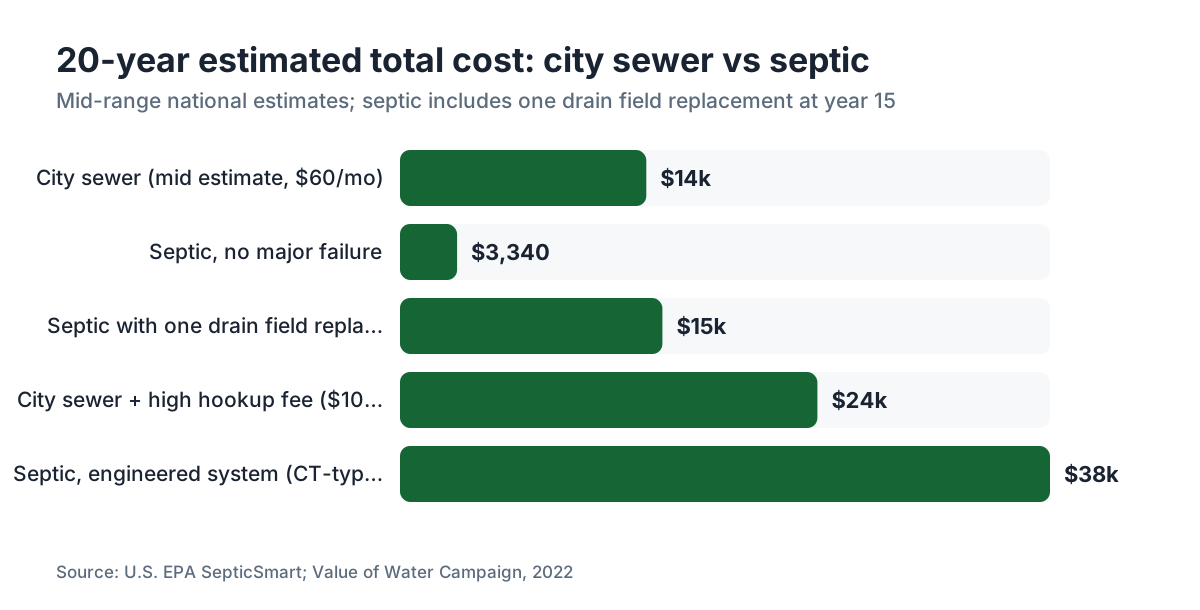
Connection fees can hurt. If sewer just reached your area, a mandatory hookup plus a $10,000 tap fee is a real short-term hit.
No local water recharge. Septic returns treated water to the groundwater table, which matters in dry regions. Municipal sewer discharges treated effluent to surface water. That's fine, but it doesn't recharge your local aquifer.
What are the pros and cons of septic systems?
Pros of septic:
Lower yearly cost in a normal year. Pump on schedule, don't flush garbage, and your out-of-pocket cost stays modest next to a monthly sewer bill.
No utility rate hikes. Your costs are predictable and, aside from inflation on service calls, largely flat.
It works where sewer doesn't reach. For millions of rural homes, septic isn't a preference. It's the only option there is.
With real maintenance, systems last 25 to 40 years. The University of Minnesota Extension puts well-maintained conventional systems at 25 to 40 years, with drain fields at 20 to 30 [10]. The tank usually outlives the field.
Cons of septic:
Everything is your responsibility. Neglect leads to failure, and failure is expensive and unpleasant. Pumping isn't optional. It's the floor. Read how often to pump septic tank for an honest schedule.
Drain field failures cost real money and sometimes can't be avoided. Soil compaction, root intrusion, biomat buildup, and plain old age all kill fields. See leach field for what goes wrong.
Property constraints are real. You can't build over a tank or drain field. Add bedrooms and you may trigger an engineered upgrade.
Selling usually means passing an inspection. A failed septic inspection can sink a sale or force a $10,000 to $30,000 repair before closing. See what inspectors check at septic tank inspection.
Septic asks for discipline from the whole household. Wipes, grease, medications, and heavy water use all damage the system.
Which system costs more over time: sewer or septic?
Run the math honestly and neither system has a clear 20-year edge in most cases. The winner flips on a few variables: your local sewer rate, whether your drain field goes bad, and whether a big connection fee landed on you.
Here's how to think about it. Say you pay $60 a month on city sewer. That's $720 a year, $14,400 over 20 years, before any rate hikes. Now say you have a conventional septic system with a $400 pump-out every four years ($100 a year) and a $200 inspection every three years ($67 a year), roughly $167 a year, or $3,340 over 20 years. Septic saves you about $11,000 in that scenario.
Add one drain field replacement at year 15 ($12,000) and the math flips. Total septic cost hits $15,340 against $14,400 for sewer. The risk premium on a field failure is exactly what makes this comparison uncertain.
In high-rate markets, like many Northeast cities, septic wins lifetime cost more decisively. In markets with cheap sewer rates and rough soil, sewer wins clearly when it's available. Connecticut is the classic example: rocky ground and high water tables push many lots toward mound or drip systems that cost $25,000 to $50,000, far more than a conventional tank-and-field setup [6].
The honest conclusion is to run the numbers for your own address. Get a local sewer rate and a local install or inspection estimate before you assume either one is cheaper.
Does septic or sewer affect your home's value?
The research here is genuinely mixed, and anyone quoting you a confident number is guessing.
A commonly repeated figure is that septic homes sell for 3 to 7 percent less than comparable sewer homes, but the underlying studies vary a lot by region and property type. In rural areas where every home is on septic, there's no gap because there's nothing to compare against. In suburbs where half the homes have sewer and half have septic, buyers often lean toward sewer, especially buyers who've never owned septic and see it as a risk.
A failing or aged system is a clear value hit. A system facing a $20,000 replacement inside five years knocks roughly that much off the negotiated price. A recently inspected and pumped system with 20 years of life left barely moves the needle. That's exactly why a septic tank inspection before listing pays off.
Flip side: in areas with steep sewer rates, some buyers prefer septic because the lower annual cost is visible. Value impact is local, full stop.
Buying a septic home? Get your own inspection, separate from the seller's. Selling? Pump and inspect before you list. Those two steps cost maybe $700 together and can head off a $15,000 negotiation hit.
Can you switch from septic to city sewer, and should you?
Yes. If a municipal main is within reach of your property, you can apply to connect. The process varies by town but usually runs through a connection application, a tap or capacity fee, inspections, and a new lateral pipe from the main to the house. Once you're connected, the septic system goes out of service and gets filled or decommissioned to local code.
Whether you should switch is a cost-benefit call. Some cases where it makes sense:
Your septic system is failing and needs a full $15,000 to $30,000 replacement. If sewer is available and the hookup runs $8,000 to $12,000 all in, connecting and erasing future septic risk can be the smarter spend.
Your town is mandating hookup. Some states and municipalities legally require connection within a set window after a main goes in on your street. Connecticut, for one, has provisions under its Public Health Code requiring connection in certain cases [6]. Fighting it usually fails and sometimes brings fines.
Your lot is too tight to repair or replace a failing field. No replacement area means no other choice.
Where staying on septic wins: your system is healthy, your lot is large, sewer rates are high, and you've got years left. Spending $10,000 on a hookup to save nothing per year in the near term doesn't add up.
One thing worth knowing: decommissioning the old tank properly matters. An abandoned tank that isn't crushed or filled can collapse and open a sinkhole. Hire a licensed contractor and do it right. See septic tank repair for what that involves.
What is Connecticut's septic vs city sewer situation?
Connecticut is a useful case because it shows how local geology rewrites the economics.
Much of the state has shallow soil over bedrock or restrictive layers, especially in Fairfield County, Litchfield County, and rocky central Connecticut towns. Conventional gravity-fed septic is often impossible there. Engineered alternatives (mound systems, drip irrigation, low-pressure dosing) are required instead, and they cost a lot more, typically $20,000 to $50,000 for a new install [6].
The Connecticut Department of Public Health regulates on-site sewage disposal under the Public Health Code, specifically the Subsurface Sewage Disposal Regulations, which set minimum lot sizes, soil evaluation rules, and system design standards [6]. In towns with difficult soils, a small lot may not qualify for septic at all, which makes any available sewer connection valuable.
Connecticut's older cities and inner suburbs (the Hartford, New Haven, Bridgeport, and Stamford areas) run established municipal sewer with rates that, while rising, stay manageable for most homeowners. There the choice is usually made for you: sewer is available, new septic isn't approved, and the only real question is what your hookup costs.
For rural Connecticut towns without sewer, a failed septic system is a genuine crisis. Replacement runs high and sometimes isn't technically possible on a small or rocky lot. That's one reason a septic tank inspection before buying a Connecticut home isn't optional.
How do you maintain a septic system properly?
The EPA's SepticSmart program lays out four maintenance basics: inspect and pump frequently, use water efficiently, dispose of waste properly, and protect the drain field [1]. The program's own framing is blunt: a well-maintained septic system "protects property value and the health of your family, community, and environment" [1].
In practice, that means the following.
Pump on schedule. A typical 3-bedroom home with a 1,000-gallon tank needs pumping every 3 to 5 years. See how often to pump septic tank for the household-size guidelines. Skip pumping and solids carry over into the drain field, which is the leading cause of early field failure. A full septic tank pumping or septic tank pump out runs $300 to $600 in most markets.
Inspect annually if you can swing it. At minimum, get a professional look every 1 to 3 years. A $150 inspection catches problems before they turn into $15,000 repairs. Operators using platforms like SepticMind can automate inspection scheduling and route planning, which cuts the friction for homeowners who forget to call.
Protect the field. Don't drive over it, don't plant trees near it, and don't route roof drains or sump pumps toward it. Waterlogged soil can't absorb effluent.
Watch what goes down the drain. The short list of septic killers: flushable wipes (they don't actually break down), grease, harsh antibacterial cleaners in volume, and medications. None of it belongs in the system.
For septic tank cleaning and septic tank emptying, hire a licensed pumper who dumps septage at a permitted facility. That's legally required in every state.
When does a septic system fail, and what does it cost to fix?
Septic systems fail in a few distinct ways, and the cost depends entirely on what broke.
Tank failure: Concrete tanks crack. Fiberglass tanks can shift or pop. A cracked tank lets groundwater in or sewage out, both bad. Repair runs $500 to $1,500. Replacing the tank alone runs $1,500 to $5,000. See septic tank repair for what repair looks like.
Drain field failure: This is the big one. Fields fail when too many solids reach them (from skipped pumping), when the soil saturates and can't absorb effluent, or when biomat (a layer of bacterial slime) clogs the soil interface. Symptoms: slow drains, sewage odors outside, wet spots over the field, and sewage backing into the house. Options range from resting and aerating the field (sometimes works, a few hundred dollars) to full replacement ($5,000 to $20,000) [8]. On a tight lot, a replacement engineered system can hit $25,000 or more.
Pump failure: Pressurized systems use a pump to move effluent. A dead pump costs $500 to $1,500 to replace and is one of the easier fixes. Most pump chambers have an alarm. If yours goes off, call right away.
Baffle failure: The inlet and outlet baffles guide flow and keep solids from passing through. Damaged baffles are common and cheap, usually $100 to $300. A good inspection catches this.
For a full look at repair costs and options, read septic system repair.
The EPA estimates that failing septic systems degrade groundwater and surface water across the country, which makes timely repair both a financial and an environmental decision [9].
How do you decide between city sewer and septic for a new home purchase?
Buying a home, you usually don't get to choose. The place is on sewer or it's on septic. But knowing what you're walking into shapes your negotiating position and your first-year maintenance calls.
For a home on city sewer, ask for the current monthly rate and whether any increases are scheduled. Check for pending infrastructure assessments (some towns bill property owners directly for sewer line replacements in their street). That's usually public information.
For a home on septic, require a full inspection before closing. Not a basic visual pass. A pumping-and-inspection where the tank gets opened, pumped, and the components checked. It costs $300 to $600 and shows you the real state of the system. Ask specifically about the drain field: how old, ever repaired, any wet spots or odors above it? A seller who refuses a proper inspection is a red flag.
Find out when the tank was last pumped. If the answer is "we don't know" or "ten years ago," negotiate a pump-out credit into the deal. A septic tank pump out before you move in is a fair ask.
Ask about the design. Conventional gravity-fed systems are the most reliable and cheapest to run. Pressurized systems, mounds, aerobic treatment units, and drip systems all work, but they carry more components that can fail and higher maintenance costs.
Buying in Connecticut or another state with strict soils? Verify the system has a valid permit and was installed to current state code. An unpermitted system is a liability.
Run the 20-year cost comparison from above for your specific address and local rate, even on a napkin. It'll tell you more than any general advice.
Frequently asked questions
Is septic or city sewer better for a house?
Neither is objectively better. City sewer costs more annually but needs zero maintenance and takes drain field failure risk off your plate. Septic costs less annually but puts all repair responsibility on you. In rural areas, septic is usually the only option. The best system matches your lot, your location, and how much management you're willing to do.
How much does it cost to switch from septic to city sewer?
Total costs usually run $5,000 to $20,000, covering the municipal tap or connection fee ($1,000 to $15,000 depending on town) plus running a lateral pipe from the main to your house and decommissioning the old septic system. Some towns offer financing. If your septic is already failing and facing a $20,000 replacement, connecting to sewer instead can be the better financial move.
What are the signs that a septic system is failing?
The clearest signs are slow drains throughout the house, gurgling pipes, sewage backing up into tubs or toilets, soggy ground over the drain field, and strong sewage odors outside. Any one of these warrants an immediate inspection. Drain field failure is the most expensive outcome, and catching it early sometimes allows cheaper fixes like aerating the field before a full replacement.
How often does a septic tank need to be pumped?
The EPA recommends pumping every 3 to 5 years for a typical household. The exact interval depends on tank size and household size. A 1,000-gallon tank serving four people should be pumped roughly every 3 years. A 1,500-gallon tank with two people might go 5 years or more. Skipping pumping sends solids into the drain field, which is the leading cause of early field failure.
Does a home on septic sell for less than one on city sewer?
Sometimes, mostly in suburban markets where both options exist and buyers are unfamiliar with septic. A commonly cited discount is 3 to 7 percent, but it varies a lot by region. In rural areas where every home has septic, there's no gap. A recently inspected, well-maintained system with years of life left has far less impact than an aging or failing one.
What can you not flush or put down the drain with a septic system?
Avoid flushable wipes (they don't dissolve), grease, cooking oils, medications, harsh antibacterial cleaners in large amounts, paint, solvents, and heavy bleach use. These kill the bacteria that make the system work or cause physical clogs. Flushable wipes are one of the most common causes of pump failures in systems with effluent pumps.
Does city sewer require any maintenance from the homeowner?
Very little. You're responsible for the sewer lateral (the pipe from your house to the main) in most jurisdictions, so occasional inspection of that pipe makes sense, especially in older homes with clay or cast-iron laterals. Root intrusion into the lateral is the most common homeowner-side problem. The utility handles everything past the property line.
What is the lifespan of a septic system?
A well-maintained conventional system lasts 25 to 40 years, per the University of Minnesota Extension. The concrete or fiberglass tank often outlives the drain field. Fields typically last 20 to 30 years with proper care; neglect can cut that to 10 to 15. Engineered systems with pumps, aerators, and UV filters have shorter component lives, but the overall system can still last decades with upkeep.
Are septic systems bad for the environment?
A properly working septic system isn't bad for the environment. It returns treated water to the local groundwater table, which can help dry aquifers. Failing systems are the problem: they release pathogens and nutrients (especially nitrogen) into groundwater and nearby surface water, feeding contamination and algal blooms. The EPA estimates 10 to 20 percent of U.S. septic systems are failing or malfunctioning at any given time.
Can a septic system handle a home addition or more bedrooms?
It depends on the system's design capacity. Septic systems are sized by bedroom count, which estimates daily wastewater flow. Adding bedrooms may require upgrading the tank or expanding the drain field, and local codes typically require a new permit and inspection for any addition that raises bedroom count. Check with your local health department before starting any addition.
What does Connecticut require for septic systems?
Connecticut regulates on-site sewage disposal under the Public Health Code's Subsurface Sewage Disposal Regulations, administered by the Department of Public Health. Soil evaluations by a licensed soil scientist are required for new systems. Many Connecticut properties need engineered alternative systems due to shallow bedrock or high water tables, which cost $20,000 to $50,000. Municipalities can also require connection to public sewer when a main is installed on your street.
Is it worth paying for an annual septic inspection?
Yes, for most households. An annual inspection costs $100 to $300 and catches failing baffles, rising sludge, pump problems, and early drain field stress before they turn into $10,000 to $30,000 repairs. If money is tight, a pump-and-inspect every 3 years is the minimum. The math is simple: $200 a year against the risk of a $15,000 drain field replacement.
How do you find out if a house is on septic or city sewer?
Check the property's water and sewer bills. If you only see a water bill with no separate sewer charge, the home is likely on septic. You can also call the local municipality and ask whether the address is connected to public sewer. The MLS listing or disclosure forms should state it. During a home inspection, the inspector will typically confirm which system is present.
Sources
- U.S. EPA, SepticSmart Program: About 21 million U.S. households rely on septic systems; EPA recommends inspecting and pumping every 3 to 5 years; four maintenance basics; well-maintained systems protect property value, health, and environment.
- Value of Water Campaign, The Waterworth Index 2022: Average U.S. monthly sewer rates range from $14 to $135 with median around $40 to $60; rates have risen faster than inflation in many markets.
- U.S. EPA, Water Infrastructure and Financing: Municipal sewer connection (tap) fees commonly range from $1,000 to $20,000 depending on municipality and distance from the main.
- U.S. EPA, Types of Septic Systems: Conventional septic system installation costs $3,000 to $15,000 for standard systems; engineered alternative systems required on difficult soils can cost $15,000 to $50,000.
- U.S. EPA, How Your Septic System Works: Routine septic tank pumping is necessary every 3 to 5 years; service costs run $300 to $600 in most markets.
- Connecticut Department of Public Health, Subsurface Sewage Disposal Regulations: Connecticut regulates septic under state Public Health Code; many properties require engineered alternative systems due to shallow bedrock; municipalities can require hookup when sewer mains are installed.
- U.S. Census Bureau, American Housing Survey: Approximately 20 percent of U.S. homes use on-site septic or cesspool systems, concentrated in rural areas.
- National Environmental Services Center (NESC), West Virginia University: Drain field (leach field) replacement costs range from $5,000 to $20,000; full system replacement can exceed $30,000 on constrained lots.
- U.S. EPA, Nonpoint Source Pollution: EPA estimates 10 to 20 percent of septic systems in the U.S. are failing or malfunctioning, contributing pathogens and nutrients to groundwater and surface water.
- University of Minnesota Extension, Septic Systems: Well-maintained conventional septic systems last 25 to 40 years; drain fields typically last 20 to 30 years with proper maintenance; neglect can cut field life to 10 to 15 years.
Last updated 2026-07-09