Septic tank emptying: how it works, how often, and what it costs
By the SepticMind Editorial Team
TL;DR
- Septic tank emptying pulls the sludge and scum out of your tank every 3 to 5 years for a typical household.
- A standard pump-out runs $300 to $600 in most U.S.
- markets.
- Skip it too long and solids spill into your drain field, which turns a $400 service call into a $5,000 to $30,000 repair.
- The math makes regular pumping easy.
What actually happens during septic tank emptying?
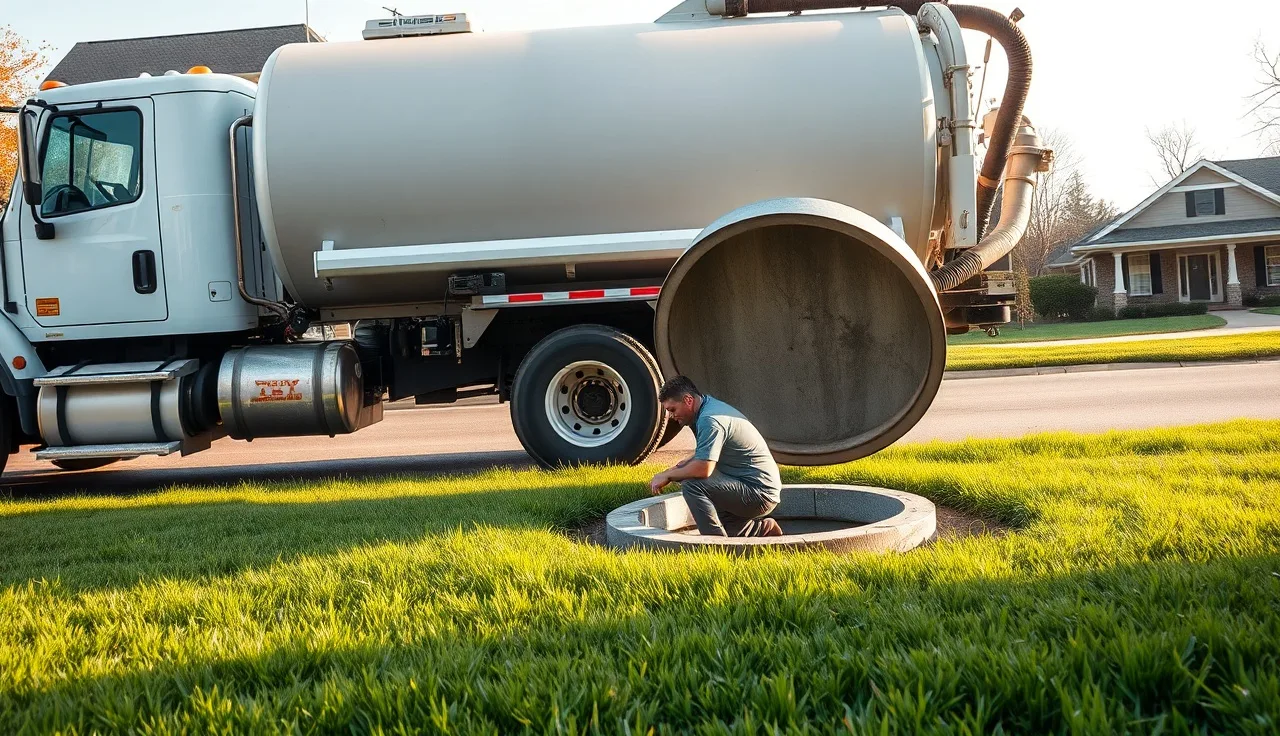
A pumper truck shows up, the technician finds your tank lids, opens the access port, and drops a 4-inch vacuum hose into the tank. The truck's pump pulls between 10 and 25 inches of mercury of vacuum. The contents (sludge on the bottom, liquid effluent in the middle, and a floating scum mat on top) get sucked into a sealed holding tank on the truck [1]. A good technician breaks up the scum layer by hand and rinses the tank walls with effluent from the truck to pull every bit of solid material loose. That rinsing step matters more than most homeowners realize. Tanks that get a quick pull-and-go leave behind a thick sludge cake that cuts years off your next interval.
Once the tank is empty, the tech should check the inlet and outlet baffles, look at the tank walls for cracks or roots, and confirm the effluent filter (if you have one) isn't clogged. This takes maybe ten minutes and costs nothing extra with most reputable companies. If the tech skips it, ask why.
The pumped waste goes to a licensed treatment facility or, in some states, gets land-applied on approved agricultural sites under EPA Class B biosolids rules [2]. You won't pick where it goes. You can ask the company for their disposal permit number if you want proof they're doing it legally.
Some people confuse emptying with cleaning. Septic tank cleaning usually means a fuller service that adds high-pressure jetting of the inlet pipe and a detailed baffle inspection, but the core pumping step is identical. Homeowners use the two words interchangeably. Just ask the company exactly what the service includes before they arrive.
How often does a septic tank need to be emptied?
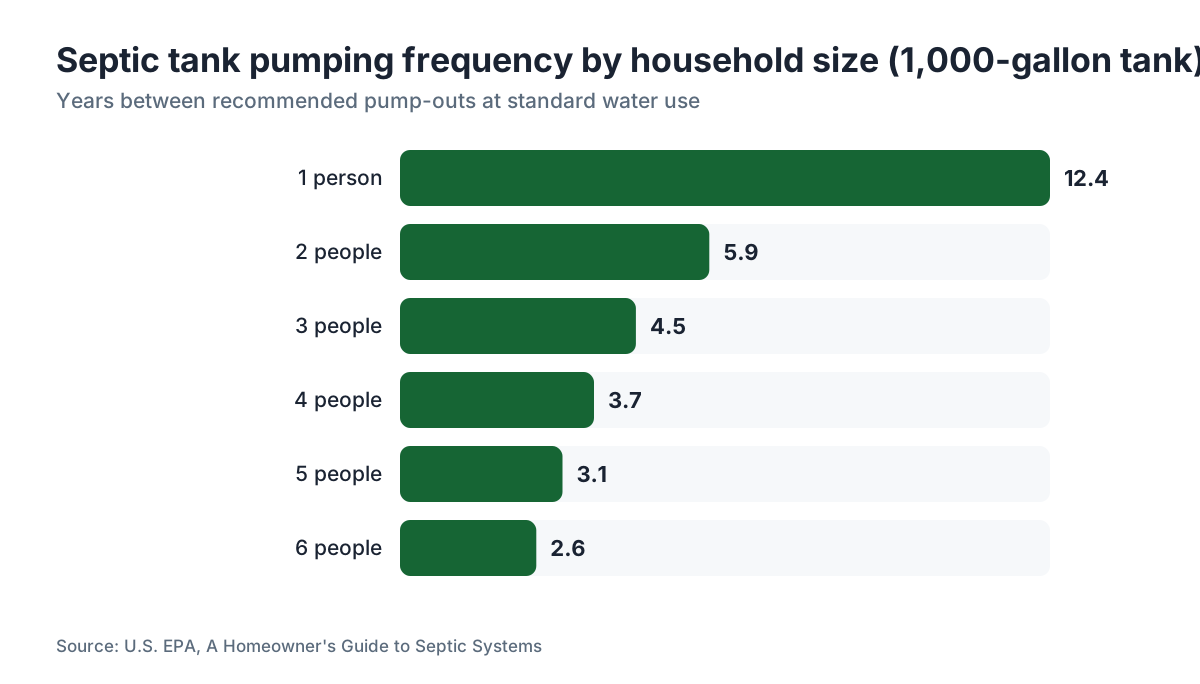
The EPA's SepticSmart program recommends pumping every 3 to 5 years for a typical household [1]. That range is wide, and your number depends on four things: tank size, household size, water use, and whether you run a garbage disposal.
The table below shows EPA-recommended pumping frequencies by household size and tank capacity. These come straight from the agency's guidance, not from guesswork.
| Tank size (gallons) | 1 person | 2 people | 4 people | 6 people |
|---|---|---|---|---|
| 500 | 5.8 yrs | 2.6 yrs | 1.5 yrs | 1.0 yr |
| 750 | 9.1 yrs | 4.2 yrs | 2.6 yrs | 1.7 yrs |
| 1,000 | 12.4 yrs | 5.9 yrs | 3.7 yrs | 2.6 yrs |
| 1,250 | 15.6 yrs | 7.5 yrs | 4.8 yrs | 3.3 yrs |
| 1,500 | 18.9 yrs | 9.1 yrs | 5.9 yrs | 4.0 yrs |
Source: EPA, Homeowner's Guide to Septic Systems [1]
A few habits shorten that interval fast. Running a garbage disposal every day adds a real organic load, and some extension research suggests it can cut your interval by 30 to 50 percent [3]. A water softener that backwashes into the septic adds salt and extra water. Long-term houseguests count too. Any of these pushes you toward the short end of the range.
Want to calculate your own schedule? Our full guide on how often to pump a septic tank walks through it.
One honest caveat: nobody has solid national data on actual pumping intervals. The EPA figure comes from sludge accumulation modeling, not a long-term study of real pump records. It's the best number we have, and the 3-to-5-year rule holds up in practice for a family of four with a 1,000-gallon tank.
What does septic tank emptying cost?
Most homeowners pay $300 to $600 for a standard pump-out in the United States, with the national average around $400 to $450 [4]. Cost swings hard on geography, access, and tank size.
Urban and suburban markets in the Northeast and on the West Coast routinely run $500 to $700. Rural markets in the South and Midwest can come in at $200 to $300. If your tank hasn't been pumped in ten years and is packed solid, expect to pay extra for the added time and haulage volume.
The main cost drivers:
- Tank depth and access. A buried lid with no riser means the crew digs by hand or machine. Expect a $50 to $150 dig-up fee. Installing a septic tank riser after the first pump-out usually pays for itself in two or three visits.
- Tank size. Most standard trucks handle up to 1,500 gallons in one pull. Tanks over 2,000 gallons may need two trips or a larger truck, adding $100 to $200.
- Effluent filter cleaning. If your tank has an outlet filter (most post-1990 installs do), cleaning it is usually included. Confirm before you book.
- Emergency or weekend service. After-hours calls often carry a $75 to $150 surcharge.
- Location. A company driving 40 miles to a rural property charges more than one working a dense suburban route.
For UK readers: if you're searching for septic tank emptying in Bognor Regis or elsewhere in West Sussex, the Environment Agency requires waste carriers to be registered under the Environmental Permitting Regulations [5]. Prices there typically run £150 to £300 for a standard residential pump-out. You can verify a contractor's waste carrier licence on the Environment Agency's public register before booking.
Want the full cost picture for service and installation together? Our cost to put in a septic tank guide covers both.
What are the warning signs your septic tank needs emptying now?
Don't wait for symptoms. By the time your system shows distress, you've already let it go too long and you may be looking at more than a simple pump-out. But if you see any of the following, call today, not next month.
Slow drains everywhere. One slow drain is a clog. Every drain in the house running slow at once points to a full tank or a drain field problem [1]. The difference matters. If pumping restores flow, you had a full tank. If the system backs up again within days, you likely have a drain field problem that pumping alone won't fix.
Gurgling from toilets or floor drains. That's the tank's effluent layer pushing back up through the plumbing under slight pressure. Not a good sign.
Odors inside the house, or in the yard over the tank or drain field. Septic gas (mostly hydrogen sulfide and methane) should travel one direction: out through the vent stack and into the air. Smell it inside, or catch a persistent rotten egg smell above the tank, and the system is telling you something.
Wet, spongy ground or bright green grass over the drain field. That's effluent surfacing. If solids have already carried over from an overfull tank into the drain field, you may be facing a septic drain field repair or replacement on top of the pump-out.
Sewage backing up into the lowest fixture in the house, usually a basement toilet or floor drain. This is the emergency version of slow drains. Call a pumper the same day.
None of these are subtle. Two or more at once? Pump first, then inspect.
What's the difference between septic tank emptying and pumping?
Nothing, functionally. "Emptying" and "pumping" describe the same service: a vacuum truck removes the contents of your septic tank. The industry uses both terms, homeowners use both terms, and you'll see both on service company websites.
Where some distinction creeps in: a few companies market "full-service cleaning" as a premium tier that adds high-pressure jetting of the inlet and outlet pipes, baffle inspection with a camera, and a written condition report. That's worth paying for on an older tank or a property you just bought. For a tank you've kept on schedule, a standard septic tank pump out does everything you need.
One thing to watch for: companies that push "septic tank treatment" or enzyme additives as a substitute for pumping. The EPA is blunt about this: "The EPA does not recommend the use of biological or chemical additives to supplement a properly functioning septic system" [2]. Additives don't digest the inorganic solids that make up a big chunk of sludge, and no additive can replace physical removal. Save your money.
How do you find and prepare for a septic tank emptying service?
Finding a licensed pumper is usually easy. Your state environmental or health department keeps a list of licensed septic haulers, and in most states it's searchable online. The National Onsite Wastewater Recycling Association (NOWRA) also runs a contractor locator [6]. In the UK, the Environment Agency's waste carrier register covers licensed haulers [5].
Before the truck arrives, do these things.
Locate your tank. If you don't know where it is, check your property's as-built diagram (often on file with the county health department or the builder), look for a concrete lid in the yard, or probe the ground with a soil rod. A pumper can find it if you truly can't, but they may charge for the time.
Clear access to the lids. Move lawn furniture, potted plants, anything sitting over the tank. Two feet of clearance around each lid is enough.
Know your tank size. It's on the permit or as-built drawing. If you don't have it, the pumper can estimate from the tank dimensions once the lid is open, but having the number ahead of time helps with pricing.
Ask exactly what the service includes. Pumping only? Baffle inspection? Filter cleaning? A written condition report? The answers vary by company and they all matter.
For operators managing service routes, platforms like SepticMind schedule recurring pump-outs, track service history, and flag overdue accounts automatically, so nothing slips on busy route days.
After the service, ask for a written report showing the date, tank condition, sludge and scum depth before pumping, and any noted problems. Keep it for your records. Some states require it for resale disclosure.
Can you empty a septic tank yourself?
Technically possible in a few rural jurisdictions. Practically, no.
Pumped septage is regulated as a hazardous waste in most states and can't be land-applied without an NPDES or state-equivalent permit. In practice you'd need a licensed vacuum truck, a manifold that pulls 15+ inches of mercury, and a licensed disposal site willing to take delivery from a non-commercial hauler. The truck rental alone runs $500 to $800 per day in markets where you can even find one.
The handful of rural states that allow homeowner-hauled septage to approved lagoons or fields require specific permits and testing. If that's your situation, your state environmental agency is the right first call.
For everyone else: hire a licensed pumper. The cost is low enough that DIY makes no economic sense, and the liability for illegal disposal is real. Federal law under the Clean Water Act sets civil penalties for illegal discharge that run into the tens of thousands of dollars per day per violation [7].
If money is the concern, some counties and states run assistance programs for septic maintenance. USDA Rural Development's Section 504 program offers grants and loans for essential home repairs, including septic systems, for qualifying low-income rural homeowners [8].
What happens if you never empty your septic tank?
The sequence is predictable and expensive.
First, the sludge and scum layers grow until they take up most of the tank. The clarification zone in the middle shrinks, so effluent leaving the tank carries more and more suspended solids. The system still runs, but it's doing a poor job of protecting the drain field.
Next, solids carry over into the distribution system and drain field. A biomat (a dense biological layer) builds up in the soil absorption area. Soil permeability drops. Now you see the symptoms from earlier: slow drains, odors, wet spots.
Then the drain field fails. This is where costs blow up. Drain field repair or replacement runs $5,000 to $30,000 depending on soil conditions, system size, and whether you need an engineered alternative [9]. If the original drain field area is saturated, you may have to find new suitable soil on your property, and that isn't always possible.
A $400 pump-out every 3 to 5 years costs roughly $2,000 to $3,000 over 30 years. A single drain field replacement costs more than that in one event, before you count the disruption of digging up your yard. The arithmetic is simple.
For what septic system repair actually involves and costs when things go wrong, that guide walks through the full range of failure modes.
Does emptying a septic tank hurt the good bacteria?
This is one of the most common questions homeowners ask, and the worry is mostly unfounded.
Yes, pumping removes the bacteria in the tank along with the sludge. But the bacteria that drive anaerobic digestion re-establish quickly, within days to weeks, from the wastewater you keep flushing after service [10]. You don't need a "starter" culture, yogurt down the drain, or any bacterial supplement. Your household waste carries more than enough microbial life to restart the process.
The one thing to skip in the two or three days after pumping: heavy doses of antibacterial cleaner or bleach poured straight down the drain. Normal household use at ordinary concentrations doesn't harm the tank's bacteria over time. Dumping a full bottle of bleach right after pumping, when the population is starting from near zero, is worth avoiding.
Worth knowing too: flushing actual antibiotics, or having a household member on regular oral antibiotics, has a measurable effect on tank microbiology according to some research. The tank adapts. It's not a reason to pump more often.
What regulations govern septic tank emptying in the U.S.?
Septic regulation sits mostly at the state and county level in the United States. The EPA sets baseline policy and guidance but does not directly license pumpers or set mandatory pump-out schedules in most cases [2].
At the federal level, the Clean Water Act governs septage disposal, especially discharge to surface water or improper land application [7]. The EPA's Part 503 biosolids rule governs how treated septage can be used as fertilizer or land-applied [2].
At the state level, rules vary a lot:
- Some states (Massachusetts is a well-known example) require inspection at point of sale and mandatory pumping on a schedule set by the local board of health [11].
- Many states require pumpers to be licensed and to submit disposal manifests to the state environmental agency.
- Some counties add requirements on top of state rules, including mandatory service contracts or inspection frequencies tied to permit renewal.
The practical takeaway: check your county health department's rules over anything you read online. Your specific jurisdiction may be stricter or looser than the general picture. And if you're buying a property with a septic system, a pre-purchase inspection is smart no matter what local law requires. Our guide on septic tank repair covers what inspectors look for and what their findings mean.
How do you know if the job was done right?
Most pump-outs go fine. Knowing what a complete job looks like protects you from the ones that don't.
At the end of the service, the tank should be empty. You should be able to see the tank floor through the hatch with a flashlight. Residual liquid is normal. Residual sludge packed against the walls or floor is not.
The tech should have confirmed both baffles are intact. Baffles direct flow through the tank and keep floating scum out of the drain field. A missing or collapsed baffle is a defect that needs fixing. See our septic tank repair article for what that repair involves.
If your system has an effluent filter on the outlet tee, it should have been cleaned and reinstalled. A clogged filter causes backups faster than almost any other single part.
You should get a written service record. If the company doesn't offer one, ask for it in writing or by email. At minimum it should list the service date, tank volume pumped, technician name, and any observed conditions.
For operators running a service business, consistent documentation is where something like SepticMind earns its keep: structured service records, photo capture, and automatic follow-up scheduling keep your operation defensible and your customers retained.
One last thing. If the tech says something "looks off" during the visit, take it seriously. A competent pumper sees dozens of tanks a week and knows what normal looks like. If they flag a cracked inlet baffle or tree root intrusion, get it checked. Ignoring a small defect today is how small repairs become large ones.
Frequently asked questions
How long does it take to empty a septic tank?
For a standard residential tank (1,000 to 1,500 gallons) pumped on schedule, the service takes 30 to 45 minutes from lid-open to lid-close. A badly neglected tank with compacted sludge, or one with hard access, can take 60 to 90 minutes. If the crew has to hand-dig to find buried lids, add another 15 to 30 minutes.
Can you use the toilets and sinks while the tank is being pumped?
You shouldn't run water or flush during the actual pumping. The tank needs to hold vacuum for efficient extraction, and fresh water dilutes the sludge and makes the job harder. Most technicians tell you upfront. Once the lid is closed and the truck pulls away, normal use resumes immediately.
What is the right time of year to empty a septic tank?
Any season works mechanically. Spring or fall is practical for most homeowners: spring because thawed ground makes access easier, fall because pumping before winter starts the cold months at maximum capacity. Avoid pumping when the ground is frozen solid if your lids are deep and need digging. Summer is the busiest season for pumpers, so booking in fall or winter often means shorter waits and sometimes lower prices.
How do I find a licensed septic tank emptying company near me?
Start with your state environmental or health agency's website. Most publish a searchable list of licensed septage haulers. The National Onsite Wastewater Recycling Association (NOWRA) also has a contractor locator at nowra.org. Ask any candidate for their state license number and proof of liability insurance before booking. In the UK, verify the company's Environment Agency waste carrier registration.
Will my homeowner's insurance cover septic tank emptying?
Standard homeowner's policies treat routine pumping as maintenance, which is excluded. Sudden and accidental septic failures may be covered under some policies, but coverage varies widely and many policies specifically exclude septic systems. A few insurers offer septic riders or service line endorsements that cover repair costs. Check your declarations page and call your agent before assuming you're covered.
How much sludge should be in the tank before emptying?
The common rule is to pump when the sludge layer reaches one-third of the tank's liquid depth, or when combined sludge and scum layers take up more than one-third of total volume. Past that point, the clarification zone is too small to keep solids out of the drain field. A technician can measure sludge depth with a Secchi stick or sludge judge tube during a service visit.
Does a new septic tank need to be emptied sooner than an established one?
No. A new tank takes longer to fill because it starts empty and the bacteria need time to establish. Standard pumping intervals apply from the first day of use. One thing does change with a new system: the first pump-out is a good chance to confirm the baffles are intact and the tank took no damage during installation, so booking a service inspection around the three-year mark, even if the tank isn't full, is reasonable.
What's the difference between a cesspit and a septic tank for emptying purposes?
A cesspit (also called a cesspool in the U.S.) is a sealed holding tank with no outlet. It collects all waste and needs pumping far more often than a septic tank, sometimes every 6 to 8 weeks for a family of four instead of every few years. The pumping process is identical, but the frequency and annual cost are dramatically higher. If you have a cesspit and your usage allows, converting to a proper septic system with a drain field is usually worth the money.
Can tree roots damage a septic tank and make emptying harder?
Roots rarely penetrate modern concrete or fiberglass tanks, but they commonly invade the inlet pipe, outlet pipe, and distribution box. Root intrusion in the inlet line slows drainage from the house. Root intrusion at the outlet blocks effluent flow to the drain field. A camera inspection during or after pumping catches root problems early. If roots are in the pipes, jetting and root-killing treatment beat leaving them alone.
Does the number of bathrooms affect how often I need to empty the tank?
Bathroom count is a proxy for household size, but actual water use matters more. A four-bedroom house with two full-time residents uses far less water than the same house fully occupied. Base your interval on real occupancy and water use, not bedroom or bathroom count. State codes often size tanks by bedroom count because it's a conservative proxy for potential occupancy, but real pumping frequency should match real use.
What happens to the waste after a septic tank is emptied?
The pumper hauls it to a licensed municipal wastewater treatment plant, a septage receiving facility, or an approved land application site. EPA Part 503 regulations govern land application, setting pathogen and heavy metal limits [2]. You can ask your pumper for their disposal manifest, which shows where your waste went. Licensed haulers are required to track this in most states.
Is it normal to smell something after a septic tank is emptied?
A brief septic odor in the yard right after pumping is normal. The tank was open and some gas escapes. It should fade within an hour or two. A persistent smell inside the house that lasts more than a day could mean a baffle problem, a cracked tank, or a drain field issue the pumping revealed rather than caused. Worth calling the company back to look at if it continues.
How does a garbage disposal affect septic tank emptying frequency?
Garbage disposals add significant organic solids to the tank. University extension research suggests households using one may need to pump 30 to 50 percent more often than equivalent households that don't. For a family of four with a 1,000-gallon tank on a four-year schedule, that could mean pumping every two and a half to three years instead. If you use your disposal heavily, shorten your interval and consider composting food waste instead.
What should I do if the septic tank is still backing up after it was just emptied?
Backup that returns quickly after pumping almost always means the drain field is compromised. Solids that carried over from a full tank have likely clogged the soil absorption area. Pumping relieves tank pressure temporarily but can't fix a failed drain field. Have a licensed inspector assess the drain field before assuming more pumping will help. You may need aeration, jetting of distribution lines, or in the worst case, partial or full drain field replacement.
Sources
- U.S. EPA, A Homeowner's Guide to Septic Systems: EPA recommends pumping every 3 to 5 years; table of pumping frequencies by household size and tank volume sourced from this document
- U.S. EPA SepticSmart Program: EPA states it does not recommend biological or chemical additives to supplement a properly functioning septic system; EPA Part 503 biosolids rule governs land application of septage
- Penn State Extension, Septic System Maintenance: Garbage disposal use can significantly increase the rate of sludge accumulation, potentially requiring more frequent pumping
- HomeAdvisor / Angi, Septic Tank Pumping Cost Guide: National average cost for septic tank pump-out ranges from $300 to $600, with average around $400 to $450
- UK Environment Agency, Register as a Waste Carrier: Waste carriers in England must be registered under the Environmental Permitting Regulations; public register available to verify contractor legitimacy
- National Onsite Wastewater Recycling Association (NOWRA): NOWRA maintains a contractor locator and resources on state operation and maintenance requirements for onsite septic systems
- U.S. EPA, Summary of the Clean Water Act: The Clean Water Act sets federal civil penalties for illegal discharge, including septage, that run into the tens of thousands of dollars per day per violation
- USDA Rural Development, Single Family Housing Repair Loans & Grants (Section 504): USDA Section 504 program offers grants and loans for essential home repairs including septic systems for qualifying low-income rural homeowners
- U.S. EPA, Septic Systems: Drain field repair or replacement can cost $5,000 to $30,000 depending on system size and soil conditions
- University of Minnesota Extension, Septic System Owner's Guide: Bacterial populations in a septic tank re-establish quickly after pumping from wastewater entering the system; starter cultures are not needed
- Massachusetts Title 5 Regulations, 310 CMR 15.000: Massachusetts requires septic system inspection at point of sale and mandates pumping schedules administered by local boards of health
Last updated 2026-07-09