Septic tank distribution box: what it does, when it fails, and what replacement costs
By the SepticMind Editorial Team
TL;DR
- A septic distribution box (D-box) is a small concrete or plastic junction box buried between your septic tank and drain field.
- It splits effluent equally across every leach line.
- When it cracks, tilts, or clogs, some field lines flood while others starve.
- Replacement runs $500 to $1,500 installed.
- Catch it early and you save a $5,000 to $20,000 drain field.
What is a septic tank distribution box and what does it actually do?
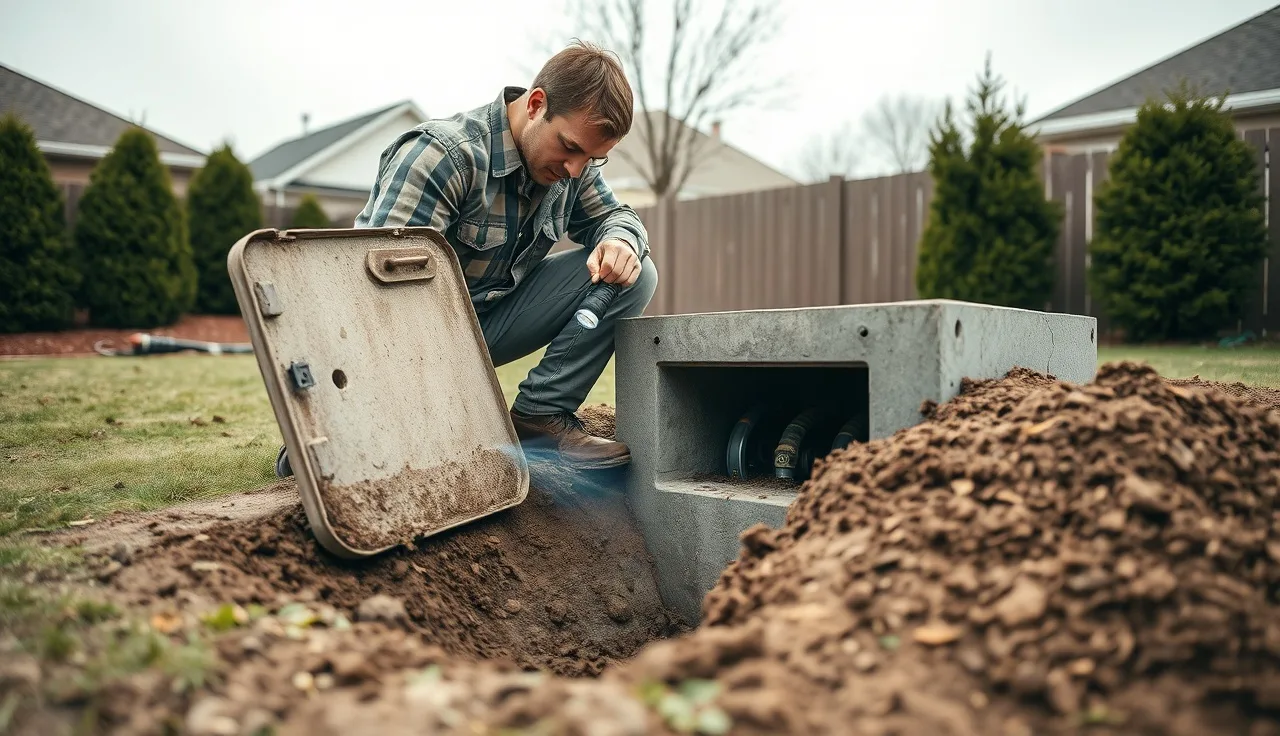
A distribution box, usually called a D-box, sits in the ground between your septic tank and your drain field. Its only job is to take clarified wastewater leaving the tank and split that flow equally among the lateral drain lines that run through the leach field. Could be two lines, could be six. The equal split is the whole point. If one lateral gets more than its share, it saturates and the soil above it can't keep up. The other laterals then sit underused, wasting the capacity you paid for.
Most D-boxes are about the size of a large bucket, sometimes a bit bigger. Older ones are precast concrete. Newer systems often use high-density polyethylene (HDPE) or polypropylene plastic, which shrugs off the corrosion and cracking that gets most concrete boxes eventually. The box has one inlet port on one side and multiple outlet ports on the other side or on adjacent walls. Each outlet connects to a perforated pipe lateral that runs through the drain field trenches [1].
D-boxes are passive. No pump, no float, no valve. Gravity does the work, which is exactly why level matters so much. Tilt the box a fraction of an inch and flow favors the low-side outlet while the others starve. Installers set them with a level for that reason. Frost heave, soil settling, and root intrusion are the main things that knock them off over the years.
Not every septic system has a distribution box. Some older systems used a serial distribution design (also called sequential or drop-box design), where laterals are fed one at a time from a header pipe, each overflowing to the next. Some newer systems pump effluent under pressure through small orifices, which does away with the D-box entirely. But the gravity-fed D-box is still the most common setup for conventional gravity septic systems across the United States [8].
How does a distribution box fit into the whole septic system?
Think of the septic system as three stages. Wastewater from the house enters the septic tank, where solids settle to the bottom as sludge and fats and oils float on top as scum. The middle layer, a relatively clear liquid called effluent, flows out the tank outlet. That effluent travels through a pipe to the distribution box. The D-box then splits the flow and sends it to the leach field, where perforated pipes release it into gravel and soil for final treatment and absorption [1].
People sometimes lump the D-box in with the drain field, but it's a separate part. If your installer listed it as its own line item on your septic tank installation contract, that's accurate. It also gets inspected separately, which matters if you're buying a home on septic. A septic tank inspection that skips the D-box, or never even probes for it, is incomplete.
Here's a detail worth knowing. The pipe from the septic tank to the D-box has to hold a minimum slope, usually at least 1/8 inch per foot and often spelled out as 1/4 inch per foot in state codes, so solids don't settle in the line [3]. The D-box itself has to sit dead level. Those two requirements pull in opposite directions along the same run of pipe. That's why D-box installation takes a careful hand.
What are the most common signs of a failing distribution box?
The earliest sign is usually uneven wet spots in the yard. One patch of the drain field stays soggy or grows unusually lush green grass while the rest looks fine. That pattern says one lateral is getting all the flow. Slow drains in the house are another early tell, since a flooded lateral backs pressure up through the whole system.
As it gets worse, you may see effluent surfacing on the ground, catch a sewage smell outside, or find sewage backing into low fixtures inside. Those are the same symptoms as a flooded drain field, and that's no coincidence: a failed D-box will destroy the field if you leave it alone long enough. Technicians often stumble onto D-box problems during a septic tank pump out while tracing why the tank is filling faster than it should.
Here's what actually goes wrong with D-boxes:
- Cracks in concrete from freeze-thaw cycles, letting soil and roots enter
- Tilting from frost heave or soil settling, which redirects flow to the low-side outlets
- Outlet pipes that have pulled out of their fittings
- Solids building up and blocking one or more outlets (effluent is clear, but never perfectly clear)
- Tree roots growing in through cracks or open joints
- A lid that cracks or collapses, which is both a safety hazard and an entry point for surface water
Got concrete distribution boxes more than 20 to 30 years old? They earn an inspection even with no symptoms yet. Concrete spalls from sulfide corrosion on the inside, a slow but relentless process [4].
How do you find your distribution box?
Start with your as-built drawing, sometimes called a permit drawing or site plan. Your local health department or county environmental agency usually keeps these on file, even for systems installed decades ago. That drawing shows rough distances from the house and from the septic tank to the D-box. Call and ask. Most counties will hand over a scan or a copy.
No drawing? A septic technician can find the D-box by probing the ground with a thin metal rod, following the outlet pipe from the tank (find the tank first by locating its access lids), or running a pipe locating transmitter through the outlet line. Some contractors reach for ground-penetrating radar on stubborn cases, though that runs up the bill.
The D-box usually sits 6 to 24 inches below grade, almost always in line with the outlet pipe from the tank, right where the drain field laterals fan out. In a typical residential system it's 5 to 20 feet from the tank outlet. Once you find it the first time, mark it. A small landscaping flag or a buried marker disk saves you the hunt next time.
Whoever does the work should check that the D-box lid is in good shape and seated properly. A missing or cracked lid lets surface runoff pour straight into the distribution system, which overloads the field and thins out the effluent before the soil can treat it [8].
How is a distribution box inspected?
A proper inspection is simple once the box is uncovered. The technician digs to the lid, lifts it, and looks inside while the system is running or while someone runs water in the house to make flow. They're checking a handful of things: whether water flows in from the inlet, whether it reaches all outlets at roughly equal levels, whether the outlet pipes are intact and fully seated, whether debris or roots have gotten in, and whether the walls are cracked.
They'll also check the box's level. Some use an actual level. Others read it by watching which outlets take flow first. If the box has two or three outlets but only one or two are getting effluent, the box has tilted or an outlet pipe has separated.
A septic tank inspection for a real estate sale should always open the D-box if it can be found. Penn State Extension guidance for home-buyer inspections says a proper evaluation covers all system components, not the tank alone [9]. Some states require it by statute for point-of-sale inspections. California, for one, requires inspection of all accessible system components, so distribution boxes get inspected wherever their location is known [3].
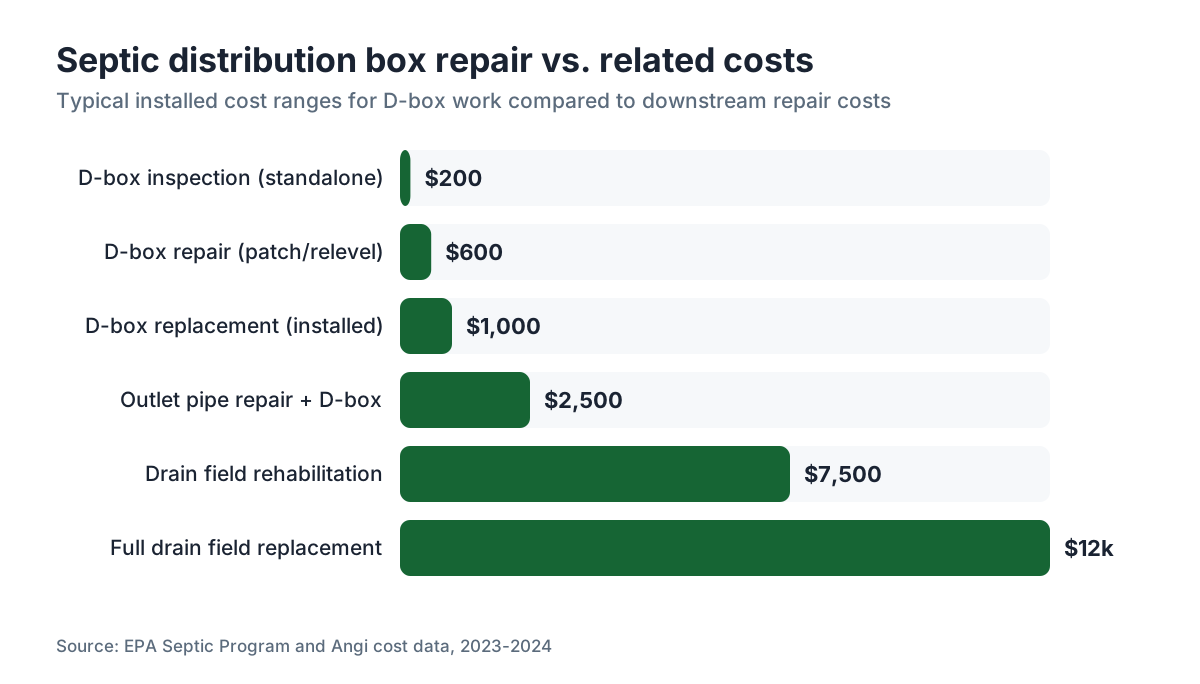
Inspection as a standalone service, not bundled with pumping, usually costs $100 to $300 depending on how much digging it takes to reach the box.
What does it cost to replace a septic system distribution box?
Replacing a septic distribution box generally runs $500 to $1,500 installed. That covers excavation, the new box, outlet fittings, and backfill. The range comes down to labor rates where you live, how deep the box is buried, whether roots or other junk complicate the dig, and whether the outlet pipes need to be reconnected or extended.
Here's a rough breakdown of what you're paying for:
| Component | Typical Cost |
|---|---|
| New D-box (concrete, standard size) | $50, $150 |
| New D-box (HDPE/plastic, leveling feet) | $80, $250 |
| Excavation and backfill (hand or machine) | $150, $600 |
| Outlet pipe reconnection and fittings | $50, $200 |
| Inspection and locating | $75, $150 |
| Total installed | $500, $1,500 |
If the D-box failed because the soil around it settled hard, or roots chewed through the outlet pipes, or the tank outlet baffle is also shot, the bill climbs. A full septic system repair that bundles the D-box with outlet pipe work or field rehab can run $2,000 to $5,000 or more.
Stack D-box replacement against drain field replacement and the math gets obvious. A conventional leach field replacement typically costs $5,000 to $20,000 depending on system size and site conditions [5]. Catching a tilted or cracked D-box before it floods and kills the field is one of the highest-return moves a septic homeowner can make.
When you gather quotes, ask specifically whether the price includes re-leveling the new box, replacing any deteriorated outlet extension pipes, and shooting a photo of the finished install before backfill. Those three requests cost the contractor almost nothing and make future service far easier.
Can you repair a distribution box instead of replacing it?
Sometimes. If a concrete box has one crack that hasn't opened all the way through, a technician can patch it with hydraulic cement or an epoxy compound rated for wet, below-grade conditions. Hydraulic cement sets even against running water and can seal a seeping crack well. Whether the repair holds depends on why it cracked. A crack from one-time soil movement may stay put for years. A crack from ongoing freeze-thaw will come back.
A box that has tilted but is otherwise intact can sometimes be corrected. You excavate around it, relevel, and repack the base. Some plastic D-boxes have adjustable leveling feet that make this painless. Concrete boxes are heavy and stubborn once set.
Outlet pipes that have pulled out of their fittings are a repair, not a replacement. The technician digs to the joint, cleans it, and reseats the pipe with a proper fitting or repair coupling.
My honest take: if a concrete D-box is cracked and more than 20 years old, I replace it rather than patch it. Opening the excavation costs the same either way, and a new plastic box with leveling feet outlasts any patch on old concrete. The material difference is maybe $100 to $200. Not worth skimping on.
For septic tank repair questions beyond the D-box, like inlet baffle damage or outlet tee failures, the logic is the same. If you're already in the ground and the part is old, replace it.
What materials are distribution boxes made from, and which is better?
Two materials show up: precast concrete and plastic (HDPE or polypropylene). Some old systems have D-boxes built from brick and mortar or concrete block. Those are relics, and you should replace them whenever you find them.
Concrete has been the standard for decades. It's heavy and stable, it resists floating in saturated soil, and it's what most older systems have. The catch is corrosion. Bacteria in septic effluent give off hydrogen sulfide gas, which reacts with moisture to form sulfuric acid on the interior concrete. Over 20 to 30 years that acid eats into the concrete, weakens it, and eventually cracks it. Freeze-thaw cycling speeds the damage in cold climates [4].
Plastic boxes are lighter, don't corrode, and often ship with built-in leveling feet or adjustable outlet ports that let you fine-tune the flow balance. They're also more likely to float if the excavation floods during install, so backfill procedure matters. On most replacements I'd spec, I choose a good HDPE box over concrete.
Some states or local codes spell out which materials are acceptable. Check with your county health department before you assume you can swap. Most jurisdictions take both, but some require the replacement to match the original or to come off a state-approved product list.
How do you maintain a distribution box and how often should it be inspected?
Distribution boxes need almost no maintenance between inspections, but they do need to be on your radar. The best time to inspect the D-box is during your regular septic tank pumping, which should happen every 3 to 5 years for a typical household [6]. Ask your pumping contractor to find and open the D-box during the service call. Many will do it for $50 to $100 on top of the pump-out, or throw it in if you ask. It's a bargain.
Between pump-outs, your main job is managing what's around the box. Don't drive over the area with heavy vehicles. Keep deep-rooted trees and shrubs at least 10 feet away, 20 feet is better. Don't plant anything over the D-box except shallow-rooted grass. Grade the yard or cut a swale to steer surface runoff away from the septic area.
Hard winters? Frost heave is the top cause of D-box tilting. A system that's been through 20 or more freeze-thaw cycles deserves a look even with no symptoms.
For operators running multiple properties or service accounts, tracking D-box inspection dates next to pump-out records is the detail that separates a real operation from a sloppy one. Tools like SepticMind can log component-level inspection data per property, so you schedule D-box checks ahead of time instead of waiting for a homeowner distress call.
The EPA recommends having your septic system inspected by a professional every 1 to 3 years, and its guidance is blunt about the stakes: a failing system "can contaminate nearby water sources" [2].
Does a failing distribution box damage the drain field?
Yes, directly and sometimes for good. When a D-box tilts, cracks, or clogs, one or two laterals get far more flow than the soil can absorb. The saturated zone around those lines goes anaerobic. Anaerobic bacteria build a layer of dense, dark slime called a biomat on the soil surface inside the trench. That biomat blocks absorption. Once it forms, aeration and resting the field can sometimes break it down, but heavy biomat can permanently cut or destroy a field's capacity [7].
A field that's been overloaded through a bad D-box for years can keep ponding at the surface even after you replace the box and rebalance the flow. Now you're looking at field rehabilitation (aeration, dosing with specific bacterial products, or resting sections) or full replacement.
The practical read: a D-box problem caught within a season or two of showing up is usually a $500 to $1,500 repair. The same problem ignored for three to five years turns into a $10,000 to $20,000 drain field replacement. See wet spots in your yard? Don't wait for the next scheduled pump-out. Have someone open the D-box.
For more on what drain field failure looks like and how to handle it, read our article on the leach field.
Do all septic systems have a distribution box?
No. The D-box belongs to conventional gravity-fed systems with multiple drain field laterals. Other setups work differently.
Serial or sequential distribution systems use a series of drop boxes instead of one D-box. Each drop box serves one lateral and overflows to the next box downstream. The design uses laterals in sequence on purpose, resting earlier ones while later ones fill. It's common in certain regions and on sloped ground.
Pressure distribution systems use a pump to push effluent through small orifices in the lateral pipes, dosing every orifice at once. No D-box needed, because the pressure itself keeps the dosing even. Many states require these systems on sites with marginal soils, high water tables, or tight space [10].
Chamber systems and drip irrigation systems also tend to use pressure dosing rather than gravity distribution.
Not sure what you've got? The as-built drawing will show it, or a technician can figure it out during inspection. If your home sits on a slope and the drain field runs downhill, you may have a drop-box series instead of a single D-box. The maintenance ideas are similar, but the inspection differs a little, since each drop box has to be opened and checked on its own.
What should you ask a contractor before replacing a distribution box?
This is where homeowners bleed money by not asking the right questions before the work starts.
First: why does the D-box need replacing? Ask the technician to show you the problem, either in person at the excavation or in a photo. A cracked box, a visibly tilted box, or roots growing inside are all fair findings. "It looks old" is not a reason to replace anything.
Second: what material is the new box? Confirm it's concrete or HDPE, not brick or something field-fabricated. Ask whether it has adjustable leveling feet.
Third: will the outlet pipes be inspected and reconnected right? Ask whether the technician will run water through the system and confirm every outlet is getting flow before backfilling.
Fourth: will you get a photo before and after? That protects both you and the contractor.
Fifth: is a permit required? Some jurisdictions require a permit for D-box replacement because it counts as a repair to an onsite wastewater system. Your contractor should know the local rules. If a permit is required and the contractor says it's fine to skip it, walk away [3].
For how D-box replacement fits into bigger repair jobs, see our guides on septic tank repair and septic system repair.
For service companies running many customer accounts, SepticMind's inspection and work order tools make it easier to document D-box findings with photos, tie them to permit records, and schedule follow-up visits automatically.
Frequently asked questions
How long does a septic distribution box last?
Concrete distribution boxes typically last 20 to 40 years before cracking and corrosion turn serious. HDPE and polypropylene plastic boxes can go 50 years or more if nothing physically damages them. Freeze-thaw cycles, tree root intrusion, and sulfide corrosion from septic gases are the main things that shorten a concrete box's life. Plastic boxes dodge the corrosion problem but can crack if backfilled wrong or driven over by heavy equipment.
What does a distribution box look like?
A standard residential D-box is about the size of a 5-gallon bucket, sometimes a bit bigger. It's a square or rectangular box, most often gray precast concrete or black or green plastic, with one inlet port on one side and two to six outlet ports on the other sides. It has a removable lid, square or round, usually buried a few inches to a couple feet down. You won't see it without digging.
Can I replace a distribution box myself?
Technically you can dig up and swap a D-box without special tools, but most states classify it as a repair to an onsite wastewater system and require a licensed contractor plus, often, a permit. Past the legal issue, getting the box level and the outlet pipes reseated takes care. A slightly off install recreates the same problem you just fixed. I'd hire a licensed septic contractor. The cost is low enough against the risk of botching it.
How do I know if my septic system has a distribution box?
Easiest route is pulling the as-built drawing from your county health department. If it shows a single junction box between the tank and the field laterals, you have a D-box system. A septic technician can also confirm it during a pump-out or inspection by tracing the outlet pipe from the tank. Systems on flat ground with multiple parallel drain lines almost always use a D-box. Systems on sloped terrain more often use sequential drop boxes.
What happens if a distribution box is not level?
If the box tilts, effluent flows toward the low-side outlet and pours into one or two laterals while the rest get little or nothing. The overloaded laterals saturate, biomat forms, and field capacity drops. The underloaded laterals sit idle and can dry out. Even a quarter-inch tilt causes measurable imbalance in a box with four outlets. Re-leveling is the fix, but if the cause is ongoing (active frost heave, soil settlement), it may come back.
How often should a distribution box be inspected?
At minimum, inspect it every time you pump the tank, which should be every 3 to 5 years for most households. If your system is more than 20 years old, has a concrete box, or sits in an area with hard winters, an annual check during spring thaw is worth the money. A D-box inspection added to a pump-out usually costs $50 to $100 extra and takes about 20 minutes of added labor.
Will homeowners insurance cover a failed distribution box?
Standard homeowners policies almost never cover septic components, distribution box included. Failure from normal wear, age, or corrosion is universally excluded as a maintenance item. Some insurers sell septic riders or service line endorsements that may cover sudden, accidental failures, but the terms vary a lot. Read the exclusions carefully before you assume you're covered. A few home warranty products cover septic pumping but exclude structural repairs.
How many outlets can a distribution box have?
Standard residential D-boxes have 2 to 6 outlet ports, matching the number of drain field laterals. Four-outlet boxes are common on mid-size residential systems. Larger or commercial installations may use D-boxes with 8 or more outlets, or several D-boxes in series. Each outlet connects to one perforated pipe lateral. If you add or modify drain field laterals, the D-box may need to be swapped for one with more ports.
What is the difference between a distribution box and a drop box?
A distribution box splits flow to all laterals at once, equally. A drop box is used in sequential systems: it serves one lateral and overflows to the next box downstream only after that lateral fills. Sequential systems work well on sloped ground and give the first lateral a rest period. Conventional D-box systems are more common on flat land. They serve different design intents, and the inspection and maintenance approach differs a little for each.
Can tree roots damage a distribution box?
Yes. Roots chase moisture and will grow into any crack or joint gap in a concrete box. Once inside, they block outlets, crack walls further, and can pull outlet pipes out of their fittings. Keep trees and large shrubs at least 10 feet from the D-box, and 20 feet is better for willows, maples, and other aggressive-rooted species. If you find roots inside the box during an inspection, it almost certainly needs replacement rather than repair.
Is a distribution box required by code?
Depends on the system design and your state or local code. Gravity systems with multiple laterals generally require some form of equal distribution, and a D-box is the standard way to get it. Pressure distribution systems meet the same requirement differently and don't need one. Your local health department or onsite wastewater program has the specifics. Most state codes also set minimum materials, setbacks from wells and property lines, and installation standards for distribution boxes.
How does a cracked distribution box affect water quality?
A cracked D-box can let untreated effluent seep into soil outside the engineered drain field, skipping the soil treatment that removes pathogens and nutrients. Nearby surface water and shallow groundwater can be affected. In areas with private wells, that's a real public health concern. EPA guidance identifies failing septic systems as a source of groundwater contamination that can reach drinking water [2].
What permits are needed to replace a distribution box?
Permit rules vary by state and county. Many jurisdictions classify a D-box replacement as a septic system repair, which requires a permit from the county health department or environmental agency and must be done by a licensed contractor. Some states allow like-for-like replacement without a full permit but still require a licensed installer and inspection. Check with your local health department before any work starts. Working without a required permit can complicate home sales and may force you to redo the job.
Sources
- EPA, Septic Systems (Onsite/Decentralized Wastewater) main page: Description of conventional septic system components including the distribution box as the junction that splits flow to drain field laterals.
- EPA, How to Care for Your Septic System: EPA recommends professional inspection every 1 to 3 years and states that failing systems can contaminate nearby water sources.
- California State Water Resources Control Board, Onsite Wastewater Treatment Systems program: State onsite wastewater code requirements for pipe slope, distribution, inspection of all accessible components, and permit requirements for repairs.
- Angi, Septic System Installation and Replacement Costs: Drain field replacement costs typically range from $5,000 to $20,000 depending on system size and site conditions.
- EPA, Septic Systems program (care and maintenance guidance): EPA recommends pumping septic tanks every 3 to 5 years as part of routine maintenance.
- North Carolina State Extension, Septic Systems and Their Maintenance: Overview of distribution box types, materials, and maintenance requirements in conventional gravity-fed septic systems.
- Penn State Extension, Water Resources and Septic Systems: A proper real estate septic inspection should include opening and evaluating the distribution box if it can be located.
- Texas A&M AgriLife Extension: Pressure distribution systems eliminate the need for a D-box by delivering effluent through orifices under pump pressure; required in certain marginal soil conditions.
Last updated 2026-07-09