Aerator septic systems: how they work, what they cost, and when you need one
By the SepticMind Editorial Team
TL;DR
- An aerobic septic system uses an aerator pump to inject oxygen into a treatment chamber, feeding bacteria that break down waste far more thoroughly than a conventional anaerobic tank.
- Treated effluent quality is high enough to irrigate lawns in many states.
- Installation runs $10,000-$20,000+.
- The aerator motor itself costs $300-$800 to replace and must run continuously.
What is an aerator septic system and how does it work?
An aerobic treatment unit (ATU), commonly called an aerator septic system, adds a powered aerator pump to inject air directly into a wastewater treatment chamber. That air feeds aerobic bacteria, the same fast-acting bugs that run municipal sewage plants, rather than the slower anaerobic bacteria in a conventional septic tank. The effluent that reaches your drain field or spray heads is dramatically cleaner.
Most residential ATUs have three to four stages. Wastewater enters a trash or pre-treatment tank that settles solids, then moves to the aeration chamber where the aerator runs continuously. From there it flows to a clarifier or settling zone, and finally to a disinfection chamber (chlorine tablets or UV) before dispersal. Some systems skip the separate clarifier and aerate directly in the main tank.
The aerator itself is a submersible or external compressor-style pump. Submersible aerators sit in the treatment water. Compressor models sit outside the tank and push air down through a diffuser. Both do the same job: getting dissolved oxygen above roughly 2 mg/L in the treatment zone so aerobic bacteria dominate [10]. The EPA notes that ATUs "can achieve secondary treatment or better" compared to the primary-treatment-level output of conventional septic tanks [1].
Because the system is mechanical and runs around the clock, an ATU needs electricity (typically 150-300 kWh per month) and scheduled maintenance that a conventional tank simply doesn't. That's the honest tradeoff.
How does an aerobic septic system differ from a conventional septic tank?
The core difference is biology. A conventional septic tank relies on anaerobic bacteria working slowly in an oxygen-free environment. They break down roughly 30-50% of biological oxygen demand (BOD) before effluent exits to the drain field [10]. Aerobic bacteria in an ATU can reduce BOD by 85-95% or more under good operating conditions.
That better treatment matters in two practical situations. Sites with poor soil percolation, high water tables, or small lots that can't support a full conventional drain field can often legally install a smaller drain field (or none) if the state approves surface or subsurface spray disposal of ATU-treated effluent. And states or counties sometimes mandate ATUs near lakes, rivers, or sensitive aquifers to protect water quality.
Conventional tanks have no moving parts and no electrical demand. They need pumping every 3-5 years and little else. ATUs have a motor that runs 24/7, chlorination to maintain, and quarterly or semi-annual inspections in most states. The comparison table lays it out.
| Feature | Conventional septic | Aerobic ATU |
|---|---|---||
| Effluent quality (BOD reduction) | ~30-50% | ~85-95%+ |
| Moving parts | None (gravity) | Aerator pump, possibly spray pump |
| Power required | None | ~150-300 kWh/month |
| Typical inspection interval | As-needed | Quarterly to semi-annual (state-mandated) |
| Avg. installation cost | $3,500-$10,000 | $10,000-$20,000+ |
| Drain field size needed | Full conventional | Often reduced or spray-only |
| Pumping interval | 3-5 years | 3-7 years (tank stage only) |
If your soil perc test passes and your lot is big enough, a conventional system is almost always cheaper to install and maintain. An ATU earns its cost when regulations or site conditions leave you no other option, or when an old system has failed and you're retrofitting a tight lot.
What does an aerator septic system cost to install?
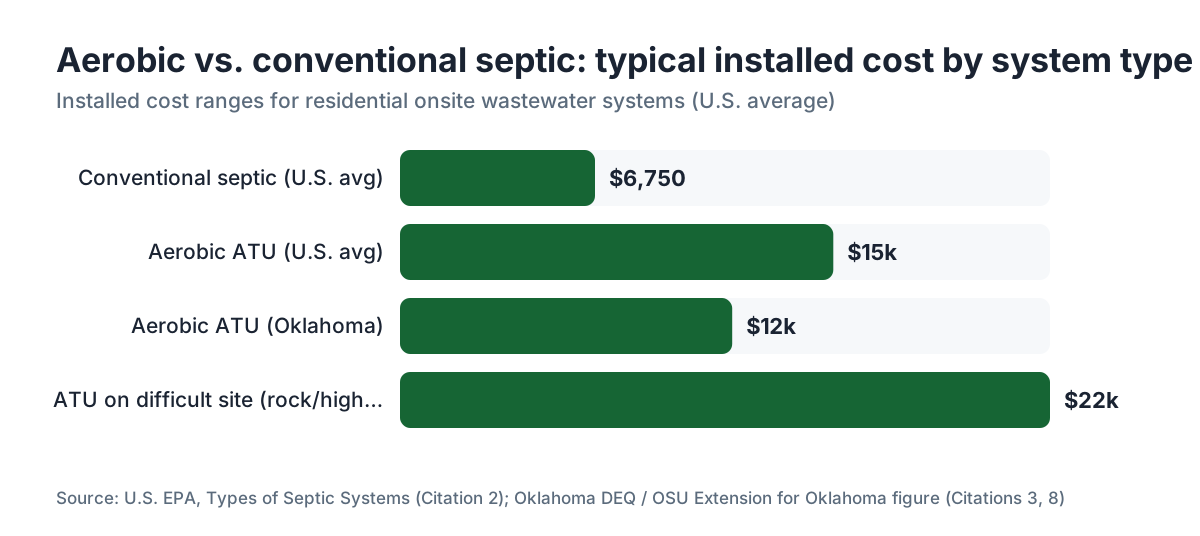
Installed cost for a residential ATU typically runs $10,000 to $20,000 in most of the country, and both ends of that range are real [2]. A few variables drive the spread.
Brand and capacity matter. A single-family unit rated for 500 gallons per day (a common residential size) might cost $4,000-$8,000 for the hardware alone. Add excavation, site evaluation, permits, and the installer's labor and you reach the $10,000-$20,000 range. Sites with rock, high water tables, or difficult access push toward $25,000 or more.
State-required add-ons stack up fast. Most states require an effluent pump, a spray irrigation system or secondary drain field, a control panel with alarm, and disinfection equipment. Each of those is a real line item.
Oklahoma is worth calling out. The state has one of the highest ATU saturation rates in the country, mostly because of soil conditions across much of the state. Cost of aerobic septic system in Oklahoma runs roughly $8,000-$15,000 depending on county requirements and lot conditions [8]. That's below the national average, partly because Oklahoma installers do these systems all day and competition is strong. The Oklahoma Department of Environmental Quality sets the rules under the Oklahoma Pollutant Discharge Elimination System (OPDES) and the state onsite wastewater code [3].
For comparison, a conventional septic tank installation in most of the U.S. runs $3,500-$10,000 [2]. The premium for an ATU is real, typically $5,000-$10,000 more installed, and ongoing maintenance adds $300-$600 per year in service contracts on top of your electricity bill.
What does the aerator pump itself cost?
The aerator pump is the heart of the system and, inevitably, the part that needs replacing. A replacement aerator unit costs $300-$800 for the motor/pump assembly, not counting labor [4]. Labor to pull, swap, and test typically adds $100-$250 depending on your area.
Two aerator types dominate residential ATUs.
Submersible aerators (like those in Norweco Singulair or Jet systems) are self-contained units that drop into the aeration chamber. They're easy to service because a technician pulls the unit out through the riser without excavating. Life expectancy is roughly 5-10 years. Some fail sooner in systems that get heavy use or run in hot climates where motors run hotter [9].
External compressors (common on Whitewater, Clearstream, and others) mount outside the tank, usually in a small housing or the control panel box, and push air down through PVC tubing and a diffuser membrane inside the tank. The compressor itself often costs $200-$500 and can last 10-15 years [11]. The diffuser membrane is a wear item at $30-$100.
If your alarm is going off and the tank smells, the aerator has usually failed or the diffuser is clogged. Before you spend $500 on a new pump, have a technician check the diffuser and the pump capacitor. A capacitor swap is a $20-$50 fix that brings a lot of "dead" aerators back to life.
Brands vary in parts availability. Jet, Norweco, and Clearstream are widely distributed and easy to source. Some cheaper or regional brands have parts that get hard to find within a few years of purchase. That's a real consideration when you choose a system or inherit one with a house purchase.
What maintenance does an aerobic septic system require?
ATUs need far more attention than conventional tanks. This is not optional. Most state codes mandate a maintenance contract with a licensed provider, and operating without one can bring fines or a notice to correct [3].
A typical maintenance schedule looks like this.
Quarterly (or semi-annually, per your state): a licensed service technician inspects the aerator operation, checks dissolved oxygen levels, tests the disinfection system (adds chlorine tablets or checks the UV lamp), inspects the spray heads or distribution system, and checks the control panel and alarm. They log everything, and that log may go to the county health department.
Annually: most contracts include a thorough cleaning of the aerator pump, inspection of the diffuser, testing of all floats and alarms, and a pump test.
Every 3-7 years: the pre-treatment tank and clarifier accumulate sludge and scum that need to be pumped out, just like a conventional tank. The interval depends on household size and loading. See how often to pump septic tank for general guidance. ATUs often go longer between pumpings because the aeration stage reduces solids more aggressively, but they still need it.
Chlorine tablets (calcium hypochlorite rated for septic use, not pool tabs) need refilling every 1-3 months depending on how many people live in the house. This is the one regular task most homeowners handle themselves.
A typical annual maintenance contract from a licensed provider runs $150-$400 per year in most states. That's on top of electricity. Budget $500-$700 a year in total ongoing costs once you factor in average electricity, chlorine, and the service contract.
For operators managing a portfolio of ATU accounts, tracking inspection intervals and service logs across dozens of systems is exactly the kind of workflow where software like SepticMind saves real time by automating reminders and generating state-required service records.
How do I know if my aerator is working?
The clearest sign of a working aerator is sound and smell. A functioning aerator makes a low continuous hum or gurgle (depending on whether it's submersible or compressor-style). The water in the aeration chamber should look agitated and slightly bubbly. Healthy aerobic treatment smells earthy, not like raw sewage.
If the aerator has failed, you'll usually notice one or more of these signs: the alarm light or buzzer on the control panel activates (most systems have a high-water alarm and sometimes a separate aerator fault alarm), the tank develops a septic smell, the aeration chamber water looks dark and still, or spray heads stop working right.
You can open the aeration chamber lid and look. If the water is calm, dark, and smells like a conventional septic tank, the aerator is off or dead. Don't stick your hand in. Use a long stick to check for air bubbles if you need to.
For a precise check, a technician measures dissolved oxygen (DO) with a simple meter. A functioning aeration chamber should read above 1-2 mg/L. Below that, aerobic bacteria start losing to anaerobic competitors and treatment quality drops [1].
Control panel alarms are your early warning system. Don't silence them and walk away. A dead aerator running for even a few days means untreated or under-treated effluent reaching your spray zone or drain field. Most states require the system owner to notify their maintenance provider within 24-48 hours of an alarm.
What are the most common aerator septic system problems?
Aerator motor failure is the single most common component problem. Motors burn out from continuous operation, heat, and sometimes from running dry when the water level in the aeration chamber drops. Replacement is the fix.
Diffuser clogging is nearly as common and much cheaper to fix. The air diffuser (a porous stone, membrane, or perforated tube at the bottom of the aeration chamber) builds up mineral scale and biofilm over time. A technician cleans or replaces it for $50-$150. If the aerator motor runs but the tank looks still, a clogged diffuser is the likely cause.
Chlorine chamber problems are frequent for DIY maintainers. Wrong tablet type (pool chlorine has too-high pH and the wrong chemistry for this job), an empty chlorinator, or a broken chlorinator basket will all cause disinfection failure. Your spray-zone turf or a neighbor's water quality can suffer if disinfection lapses for long.
Spray head clogs and failures are a nuisance more than a crisis. Mineral deposits and biofilm block spray nozzles. Routine cleaning restores them. Some homeowners in hard-water areas clean spray heads every 3-6 months.
The pre-treatment tank, if not pumped regularly, can pass solids into the aeration chamber. Heavy solids clog diffusers and coat the aerator motor. The fix is pumping the pre-treatment tank more often. See septic tank pump out for what that process looks like.
Control panel failures (failed floats, tripped breakers, corroded wiring) are another service call that can mimic aerator failure. Before replacing the aerator, a good technician checks the panel first.
For septic system repair beyond the aerator itself (damaged tanks, failed drain fields), the costs scale up fast.
Are aerobic septic systems safe for lawn irrigation and can you spray treated water on your yard?
In many states, yes, with specific conditions. This is one of the primary design purposes of a residential ATU: producing effluent clean enough for subsurface or surface drip and spray irrigation of lawns, landscaping, and in some states gardens (though vegetable gardens are usually restricted).
EPA and state guidelines for ATU effluent reuse require that disinfection bring total coliform counts below 200 colony-forming units per 100 mL for unrestricted surface irrigation, and typically below 1,000 CFU/100 mL for surface spray in residential settings [7]. Your system's chlorinator or UV unit has to be working right to hit those targets.
State rules vary a lot. Texas requires surface application systems to have setbacks from property lines, driveways, wells, and structures, and mandates that spray happen only when no one is in the spray zone [5]. Oklahoma requires similar setbacks. Some states ban surface spray entirely and require subsurface drip.
If you're buying a house with an ATU, ask the inspector specifically about the spray zone setbacks and whether the system has any history of disinfection failures. A water quality test of the effluent (your maintenance provider or county health department can arrange this) gives you real data on whether the system is performing.
Children and pets should not play in active spray zones, even from a properly maintained system. That's not regulatory paranoia. It's common sense. Schedule spray cycles for early morning when the yard is empty.
The leach field alternative, where treated ATU effluent disperses underground, avoids the spray exposure issue entirely and is required in some states or preferred by some homeowners.
What does an aerobic septic system inspection involve?
A full ATU inspection covers more ground than a conventional septic tank inspection. Expect the inspector or service technician to verify the aerator is running and producing aeration (visual check plus dissolved oxygen measurement), check the pre-treatment tank for sludge and scum depth, inspect the clarifier water clarity, check the disinfection chamber and chlorine tablet supply or UV lamp status, test the control panel alarms (high water, aerator fault), inspect spray heads or drip distribution for clogs or broken heads, observe spray coverage patterns, and review and update the maintenance log.
In states with mandatory maintenance contracts, all of this is documented and may go to the county. Texas, Oklahoma, Louisiana, and several other states have active enforcement programs and will fine homeowners or suspend operating permits for missing inspections [3].
For a home sale, an ATU inspection is more involved than for a conventional system. Some buyers' agents specify that the inspection must include effluent water quality testing, more than a visual check. That adds $100-$200 to the inspection cost but tells you whether treatment is actually working.
The inspection interval under most state codes is quarterly (4 times per year) for the first year after installation, then semi-annual once the system is shown to be stable. Some rural counties in Texas and Oklahoma have lighter enforcement, but the code requirement still applies.
If you want to see what a service provider sees on every ATU visit, the documentation requirements are laid out in your state's onsite wastewater rules, usually administered by the state environmental quality or health department.
Who should install an aerobic septic system and what permits do you need?
ATU installation requires a licensed onsite wastewater installer in every state that regulates these systems. In Texas, installers need a state license from TCEQ [5]. In Oklahoma, the DEQ administers licensing [3]. In most states, the ATU manufacturer must be on an approved products list.
The permit process typically runs like this: a site evaluation (soil borings, perc test, lot survey), system design by a licensed engineer or designer, a permit application to the county or state authority, installation by a licensed contractor, and a final inspection before covering.
Pulling your own permit as a homeowner and doing a DIY install is illegal in most states for an ATU. These systems carry enough complexity (electrical connections, state-approved manufacturer requirements, inspection protocol) that it's simply not a DIY job. You can and should be present during installation to understand what went in and where.
For the cost to install septic system as a whole, the permit and site evaluation fees alone can run $500-$2,000 depending on state and county. Factor that in before you collect installer quotes.
If you're replacing a failed conventional system with an ATU, the permitting is the same as new installation. Some jurisdictions allow a like-for-like replacement of an existing ATU with a streamlined permit, but a system type change (conventional to ATU) almost always requires a full permit.
How long do aerobic septic systems last?
The concrete or fiberglass tank should last 20-40 years if it's installed and maintained well. The tank is rarely the failure point.
The aerator pump motor, as noted, typically lasts 5-10 years for submersible units [9]. Compressor-style aerators can stretch to 10-15 years [11]. Budget for at least one or two aerator replacements over the life of the system.
Control panels and wiring last 15-25 years before corrosion or component failures make replacement more practical than repair. Spray heads and distribution piping last 10-20 years depending on water quality and UV exposure.
Whole-system lifespan from installation to major overhaul or replacement runs 20-30 years if maintained properly, which matches the general lifespan of a conventional system. The difference is that an ATU hits you with more frequent smaller costs (motor replacements, service contracts) across that span, while a conventional tank costs less but stings you occasionally with a pump-out.
Systems that get neglected, especially ones where the aerator fails and sits dead for months, build up anaerobic sludge that takes real labor to clean out. A $500 aerator replacement ignored for a year can turn into a $2,000-$4,000 remediation. That's not hypothetical. It's a common service call story in states with high ATU density.
For tracking maintenance histories, replacement schedules, and service intervals across multiple properties or service accounts, operators use tools like SepticMind to keep accurate records and avoid the lapses that lead to expensive remediation calls.
When does it make sense to choose or upgrade to an aerobic septic system?
Four situations make an ATU a genuine fit over a conventional system.
First: site conditions that won't support a conventional drain field. Clay soils, high water tables, or a small lot that can't fit adequate drain field square footage. ATU effluent quality can legally substitute for the soil treatment conventional systems rely on.
Second: regulatory mandate. Some counties near lakes, rivers, or sole-source aquifers require ATUs for new construction. Some older conventional systems that have failed in sensitive areas must be replaced with ATUs.
Third: a failed conventional system on a constrained lot. If your drain field is shot and you can't build a new one in the same spot or elsewhere on the lot, an ATU with spray irrigation might be the only path forward. See septic tank repair for cases where the tank itself needs work separate from system type.
Fourth: lot size and design preference. Some homeowners with small lots actively prefer spray irrigation because it eliminates a large drain field and gives them more usable yard. That's more a luxury choice than a necessity, but it's legitimate.
Situations where ATUs are often a bad fit: large lots with good soil percolation, where the extra cost and maintenance burden buys you nothing. Rural properties with spotty electricity, because a failed aerator on an off-grid or unreliable grid is a real problem. Seasonal vacation properties with months of very low or zero use, because aerobic bacteria die off when there's no food (wastewater) and the system has to rebuild its biology when use resumes.
If someone is trying to sell you an ATU for a site where a conventional system would work fine, get a second opinion.
Frequently asked questions
How much does an aerobic septic system cost in Oklahoma?
In Oklahoma, a complete aerobic septic system typically costs $8,000-$15,000 installed, below the national average of $10,000-$20,000. Oklahoma's high volume of ATU installations and strong installer competition keep prices down. County permit fees add $300-$800. The Oklahoma DEQ oversees installation and maintenance requirements under the state onsite wastewater code.
How often does an aerobic septic system aerator need to be replaced?
Submersible aerator motors typically last 5-10 years with continuous operation. Compressor-style units can reach 10-15 years. Replacement cost is $300-$800 for the aerator unit plus $100-$250 in labor. A failing capacitor is often mistaken for a dead motor. A $20-$50 capacitor swap sometimes brings the unit back to life, so have a technician diagnose before buying a replacement.
What kind of aerator does an aerobic septic system use?
Most residential ATUs use either a submersible aerator (a self-contained motor-and-impeller unit that sits directly in the aeration chamber) or an external compressor that pushes air through a diffuser inside the tank. Submersible units are easier to pull and replace. Compressor units tend to last longer and work better in very large chambers. Your system brand determines which type fits.
Can I use pool chlorine tablets in my aerobic septic system?
No. Pool chlorine tablets (trichlor) have a pH around 3 and chemistry that damages rubber seals and disrupts septic biology. Use calcium hypochlorite tablets specifically labeled for septic or ATU use. These typically have 65-68% available chlorine and a neutral-to-mild pH. Using the wrong product voids most manufacturer warranties and can cause disinfection failure.
What happens if my aerator stops working?
When the aerator fails, oxygen in the treatment chamber drops, aerobic bacteria die off, and the system reverts to anaerobic treatment, essentially working like a conventional tank but without the design for that mode. Treatment quality drops sharply. Most control panels trigger an alarm within hours. Notify your maintenance provider promptly. Most states require repair within a specific window, often 24-72 hours.
Do aerobic septic systems require a service contract?
In most states where ATUs are permitted, a maintenance contract with a licensed provider is not optional. Texas, Oklahoma, and Louisiana all mandate ongoing service contracts and documentation. Penalties for operating without one can include fines and orders to cease use. Contracts typically run $150-$400 per year and cover quarterly or semi-annual inspections.
Is it safe to water a vegetable garden with aerobic septic system effluent?
Most state codes prohibit using ATU spray effluent on vegetable gardens, especially on edible parts that contact the ground (root vegetables, leafy greens). Even with proper disinfection, regulatory limits on surface application are set for lawn irrigation, not food crops. Check your state's specific rules. Some allow subsurface drip irrigation on non-root vegetables under specific conditions.
How do I know if my aerobic septic system needs pumping?
The pre-treatment tank in an ATU accumulates sludge and scum just like a conventional tank. Most should be pumped every 3-7 years depending on household size. Your maintenance technician measures sludge depth during inspections and recommends pumping when the sludge layer reaches roughly one-third of tank capacity. Don't skip pumpings. Solids overflow into the aeration chamber and damage the aerator.
Can an aerobic septic system be installed on a small lot?
Yes, and this is often the reason ATUs get chosen. When a lot lacks the square footage for a conventional drain field, ATU effluent quality is high enough to allow spray or drip irrigation in a much smaller footprint. Setback requirements for spray zones still apply (typically 10-25 feet from property lines, structures, and wells depending on state), but the overall land requirement is usually smaller than a conventional leach field.
How much electricity does an aerobic septic system use?
A typical residential ATU aerator draws 150-300 watts continuously, which works out to roughly 110-220 kWh per month. At the U.S. average residential electricity rate of about $0.16/kWh, that's $17-$35 per month, or $200-$420 per year. Add the spray pump cycles and control panel, and total annual electricity cost typically lands between $250-$500.
What is the difference between an ATU and a conventional septic tank for resale?
ATUs can help or hurt resale depending on the buyer. Buyers who need the system for a small lot see it as a feature. Buyers unfamiliar with the maintenance requirements sometimes see it as a liability. Full disclosure of maintenance contract status, inspection history, and aerator age is essential. A lapsed maintenance contract or alarm history is a real negotiating point and should be disclosed.
Can an aerobic septic system freeze in cold climates?
The treatment tank itself, being underground, rarely freezes. The bigger risk is the external compressor housing or exposed plumbing and spray heads above ground. Spray irrigation systems are typically winterized (drained and shut down) in freezing climates, and the system runs in a recirculation or reduced mode. Some ATU brands offer insulated compressor housings for cold climates. Talk winterization over with your installer if you're in a northern state.
What is the aerobic septic system aerator pump, and where is it located?
The aerator pump is the motor that drives oxygen into the treatment chamber. On submersible systems, it's submerged inside the aeration tank and accessed through a riser lid, typically a 12-24 inch diameter access port. On compressor systems, it's mounted in a weatherproof housing near the tank or attached to the control panel. It runs continuously and is the component most likely to need replacement over the system's life.
How do I find a licensed aerobic septic system installer or service provider?
Start with your state environmental or health department's licensed contractor database. Texas uses the TCEQ licensing lookup. Oklahoma uses the DEQ. The National Onsite Wastewater Recycling Association (NOWRA) maintains a member directory. For specific ATU brands, the manufacturer (Jet, Norweco, Clearstream) can refer you to authorized service dealers in your area. Avoid any contractor who can't show a current state license for onsite wastewater work.
Sources
- U.S. EPA, Septic Systems Overview: ATUs 'can achieve secondary treatment or better' compared to conventional septic tanks; aerobic treatment reduces BOD by 85-95%+; dissolved oxygen thresholds for aerobic function.
- U.S. EPA, Types of Septic Systems: Cost ranges for aerobic treatment units versus conventional septic systems; ATU installed cost ranges.
- National Onsite Wastewater Recycling Association (NOWRA): Aerator pump replacement cost range of $300-$800; industry standard service intervals and maintenance contract norms.
- Texas Commission on Environmental Quality (TCEQ), On-Site Sewage Facilities: Texas installer licensing requirements, mandatory maintenance contracts, spray application setbacks, and ATU inspection intervals and documentation rules.
- University of Florida IFAS Extension, On-site Sewage Treatment and Disposal Systems: ATU effluent quality standards for surface irrigation, coliform count thresholds, and setback requirements for spray zones.
- Oklahoma State University Extension, Aerobic Septic Systems: Cost of aerobic septic system in Oklahoma ($8,000-$15,000), system components, and maintenance requirements specific to Oklahoma conditions.
- Texas A&M AgriLife Extension, Aerobic Septic Systems: Aerator motor lifespan (5-10 years submersible), maintenance schedule details, and chlorine tablet type specifications for ATUs.
- U.S. EPA, Onsite Wastewater Treatment Systems Manual (2002): Dissolved oxygen thresholds for aerobic bacterial dominance (above 2 mg/L); conventional tank BOD reduction rates of 30-50%.
- National Environmental Services Center (NESC), West Virginia University: ATU electricity consumption (150-300 watts continuous); compressor aerator lifespan (10-15 years); diffuser maintenance intervals.
Last updated 2026-07-09