What does a leach field look like above and below ground
By the SepticMind Editorial Team
TL;DR
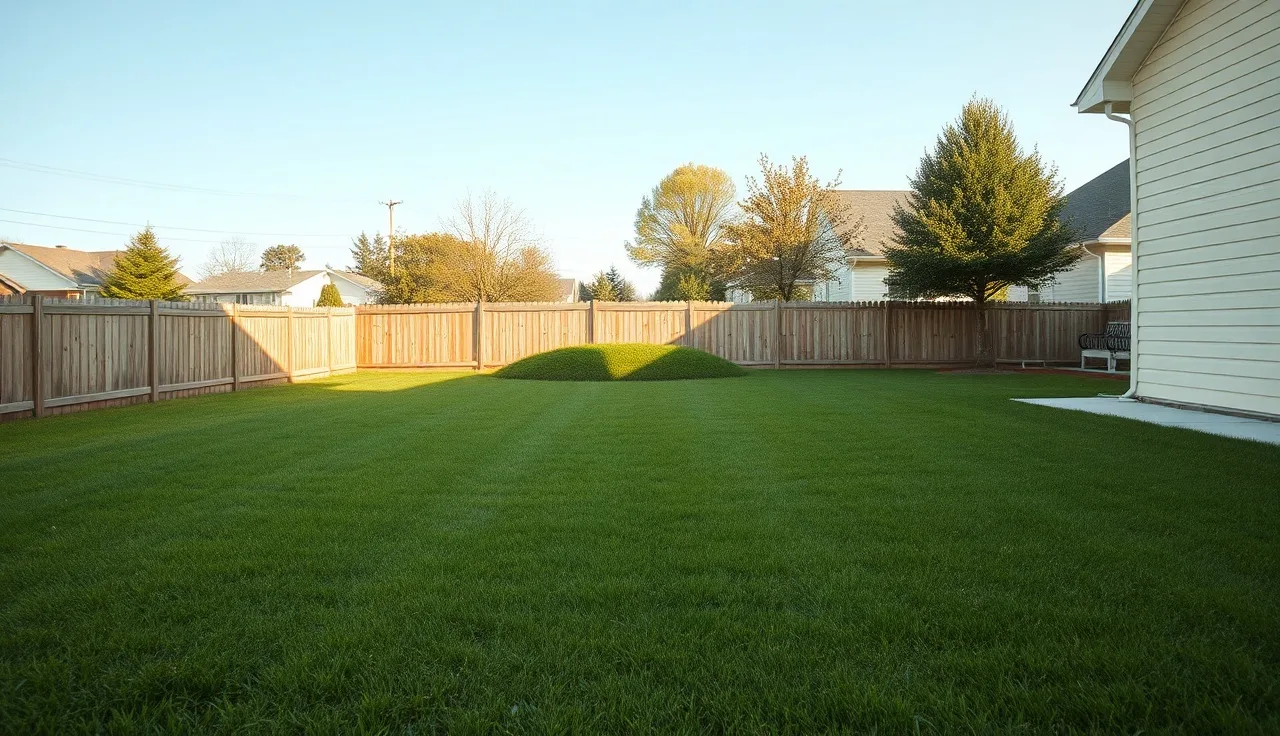
- A leach field looks like an ordinary flat or gently mounded patch of grass in your yard, usually 400 to 2,500 square feet depending on household size.
- Above ground you see no structures, just lawn.
- Underground it's a network of perforated pipes laid in gravel-filled trenches 18 to 36 inches deep.
- Soggy patches, sewage odor, and strips of unusually green grass mean it's failing.
What does a leach field look like from the surface?
From the surface, a healthy leach field looks almost exactly like the rest of your lawn. That's the point. It's a flat or barely raised rectangular or fan-shaped patch of grass with no visible structures, pipe caps, or markers of any kind. Most homeowners who didn't install their own system have no idea where the field is until something goes wrong.
The one clue you might catch: the grass over the trench lines can look a shade greener or grow a little faster than the surrounding lawn. The field delivers a slow trickle of nutrient-rich effluent into the soil just below the root zone, and the grass responds. In a dry summer the effect stands out. During a wet stretch the whole yard looks uniform and you'd never guess the field was there [1].
Some fields have a small green or black plastic cleanout cap sitting flush with or just above the soil at one end. You might also see a single vent pipe, maybe 4 inches across and 6 to 12 inches tall, near the far end of the field to release gases. Neither is universal. Plenty of older installations have neither.
A newer pressure-dosed or drip-irrigation system might show small emitter heads or distribution boxes at the surface. A conventional gravity system shows nothing at all.
What does a leach field look like underground?
Below the grass is where it gets interesting. A conventional leach field, which is what most American homes built before 2000 have, is perforated plastic (or older clay or Orangeburg) pipe laid in parallel trenches. Each trench runs 18 to 36 inches deep, 1 to 3 feet wide, and anywhere from 25 to 100 feet long [2].
The bottom of each trench holds a bed of clean gravel or crushed stone, usually 6 to 12 inches of it. The perforated pipe sits on top of that bed. More gravel packs around and over the pipe, then a layer of filter fabric (geotextile cloth) separates the gravel from the native soil backfill. The fabric keeps dirt from migrating down and clogging the stone. Topsoil and lawn go on top of all of it.
The pipes tie back to a distribution box, a small concrete or plastic junction that splits effluent from the septic tank evenly across every trench. Find the distribution box and you've found the head of your leach field.
Here's the underground cross-section from top to bottom:
| Layer | Material | Typical Depth |
|---|---|---|
| Topsoil and turf | Native soil | 6 to 12 in |
| Filter fabric | Geotextile | 1 in |
| Gravel above pipe | Clean stone | 2 to 4 in |
| Perforated pipe | PVC, 4 in dia | sits in gravel |
| Gravel below pipe | Clean stone | 6 to 12 in |
| Native soil (biomat zone) | Undisturbed | below trench |
The biomat at the trench bottom is a thin layer of microbial slime that does much of the treatment work. It slows the flow just enough to push liquid up through the unsaturated soil above, where bacteria, filtration, and distance to groundwater clean the water before it reaches the water table [3].
How big is a typical leach field?
Size comes down to three things: the number of bedrooms in the house (a stand-in for daily wastewater flow), the soil's percolation rate, and your state's setback rules.
A perc test around 30 minutes per inch and a 3-bedroom home usually calls for 600 to 900 square feet of trench area. A 5-bedroom home on slow-draining soil can need 2,000 square feet or more. The EPA's guidance says soil absorption systems must be sized for daily flows typically estimated at 50 to 120 gallons per bedroom [1].
The yard footprint is bigger than the trench area because trenches need spacing, usually 6 to 10 feet center to center. Add setbacks from property lines, wells, and structures and the protected zone around a field can easily cover 3,000 to 5,000 square feet even when the active trench area is half that.
State sizing tables vary. North Carolina, for example, requires a minimum of 120 linear feet of trench per bedroom for its best-draining soil groups [4]. California uses a sizing matrix tied to perc-rate ranges. Want your own field's exact size? Pull the as-built permit drawing from your county health department. Most jurisdictions keep these on file.
What does a drain field look like when it's failing?
A failing drain field gives you visual warnings before it quits for good. Learn to read them and you can save yourself tens of thousands of dollars.
Soggy or spongy ground. Walk the field after a dry week. If your feet sink slightly and the ground feels wet with no recent rain, the soil is saturated with effluent it can't absorb fast enough. This is the most reliable early sign.
Ponding or standing water. More advanced failure shows pools of gray or brownish water on the surface, and it smells like sewage. This is a public health problem, not a nuisance, and many states require you to stop using the system and call a professional right away [1].
Abnormally lush, dark-green grass. A strip of brilliant green over one or more trench lines in summer means the trenches are pushing more nutrients toward the surface than they should. Earlier stage than ponding, but worth watching.
Slow drains and gurgling inside the house. When the field is saturated, wastewater has nowhere to go and backs up toward the house. Toilets flush slowly. Drains gurgle. This one shows up late in the failure.
Odors in the yard. A sulfur or sewage smell over the field, especially on warm humid evenings, means gases are escaping through the soil surface instead of venting properly.
None of these symptoms belongs to leach field failure alone. A full septic tank creates the same indoor signs. So the first step is always to check when the tank was last pumped before you assume the field is gone. Our guide on how often to pump septic tank has the baseline schedules.
What does a septic drain field look like on a site plan or permit drawing?
On a permit drawing or as-built site plan, the leach field shows up as a run of parallel dashed or dotted lines inside a boundary rectangle, usually labeled 'absorption area,' 'leach field,' or 'drainfield.' Each dashed line is one trench. Arrows sometimes mark flow direction.
You'll also see a small square or rectangle labeled 'D-box' or 'distribution box' at the inlet end of the trenches, connected by a solid line to the septic tank symbol (a larger rectangle or oval). Setback lines run as dotted perimeter borders with dimensions to the nearest well, property line, or structure.
This drawing is the most useful document you can own as a septic homeowner. Request a copy from your county health department or building and codes office. Many counties have digitized permit records back to the 1970s and will email you a scan for free or a small fee. Some states run online septic permit lookup tools.
How do I find my leach field if I don't know where it is?
Start with records. The permit drawing above is the fastest answer. If your county doesn't have it, the previous owner may have left paperwork, or your closing documents might include a septic inspection report with a sketch.
If records come up empty, probe the ground. Rent or borrow a soil probe rod (a 5/8-inch steel rod about 4 feet long with a handle) and push it into the ground in a grid, starting 10 to 20 feet downhill from the septic tank lid. The tank usually sits 10 to 25 feet from the house foundation. When the probe hits gravel at roughly 18 to 36 inches and slides through easily, you've found a trench. Clay and native soil feel firm. Gravel feels soft and crunchy.
A septic pro can also run a sewer camera through the tank outlet pipe to find the distribution box, then trace the trench lines with a pipe locator. This electronic locate takes about an hour and runs $150 to $350 depending on the market.
Don't drive over the area you're probing. Heavy vehicles, riding mowers on soft ground included, can crush old clay tile or thin-walled ADS pipe. The field is more fragile than it looks.
Can you build or park on a leach field?
No, and most state codes say so plainly. The EPA SepticSmart program tells homeowners to keep the area over the leach field clear of structures, pavement, and heavy vehicles [1]. The reasons are practical.
Soil compaction crushes the pore spaces that let effluent percolate. A single pass by a loaded dump truck over saturated trench soil can compact it enough to cut its absorption rate in half, permanently. You won't watch the damage happen. You'll just watch the field fail sooner.
Tree and shrub roots hunt for water and will find perforated pipe within a few years if planted nearby. Willow, poplar, and silver maple are the worst offenders. Most codes require at least 10 feet of clearance from trees and 50 feet from a water supply well [2].
Patios, decks, and sheds over the field seal oxygen out of the soil, stall the biological treatment, and lock you out of maintenance access. Need to replace a trench someday? The structure comes down first, and that adds cost.
The only approved surface cover is low-growing, shallow-rooted grass or ground cover. No irrigation over the field either. Adding water to an already wet system just speeds saturation and failure.
What do alternative leach field designs look like?
Conventional gravity trenches are the default, but a meaningful share of new installations in tough soil conditions use alternative designs that look different both above and below ground.
Mound systems are the most obvious. The field is built on top of the existing ground, using imported sand fill to create the separation from the water table that the native soil can't provide. From the surface it looks like a rectangular berm, 2 to 4 feet tall and 30 to 100 feet long, covered in grass. You can't miss it. Mounds are common in the upper Midwest, especially Minnesota, where the Minnesota Pollution Control Agency publishes detailed guidance on their design and use [5].
Chamber systems swap the gravel-and-pipe assembly for molded plastic arch chambers (Infiltrator is a common brand) that create an open void for effluent to touch the soil directly. From the surface they look identical to a conventional trench field. Underground the chambers look like a run of connected plastic half-pipes.
Drip irrigation fields use small-diameter tubing with emitters buried just 6 to 12 inches deep across a wide area. From the surface you'd see nothing except maybe small purple-cap cleanout ports. These show up in the Southwest, where water conservation and land limits drive the design.
Aerobic treatment units (ATUs) often pair with a spray irrigation field instead of a subsurface leach field. You'd see small sprinkler heads across the yard and a concrete or fiberglass tank near the house with an air pump housing on top. To see the full septic tank installation picture, knowing which field type pairs with which tank matters.
What does the soil look like under a leach field during inspection?
When a licensed inspector or soil scientist evaluates a site or a failed field, they dig a soil profile pit, a hole 5 to 8 feet deep, to read the soil layers (horizons) directly.
Healthy soil under a working field shows a brown or tan topsoil layer, then lighter subsoil, then the mottled gray-and-orange zone that marks the seasonal high water table. The evaluator notes the depth to that mottled layer because most state codes require 2 to 4 feet of separation between the trench bottom and the seasonal water table [2].
Failed or overloaded soil looks very different. The gravel is coated in a thick black or gray biomat that has choked off the soil interface entirely. In bad cases the native soil just below the trench is saturated and reeks of sulfur. That soil may or may not recover, depending on how long the overloading ran.
A rest period of 6 to 12 months with zero loading to the failed trenches can let the biomat dry out and win back some permeability. Some states allow this resting approach as a first step before requiring full replacement, but most homeowners don't have a second field to switch to during recovery.
For an operator tracking site conditions across many properties, a tool like SepticMind can store field inspection notes, soil data, and perc test records digitally so they're at hand on the next service call instead of lost in a paper file.
How much does a leach field replacement cost?
Leach field replacement is the priciest common septic repair. Numbers swing hard by region, site conditions, and system type, but here are honest ranges from contractor pricing surveys.
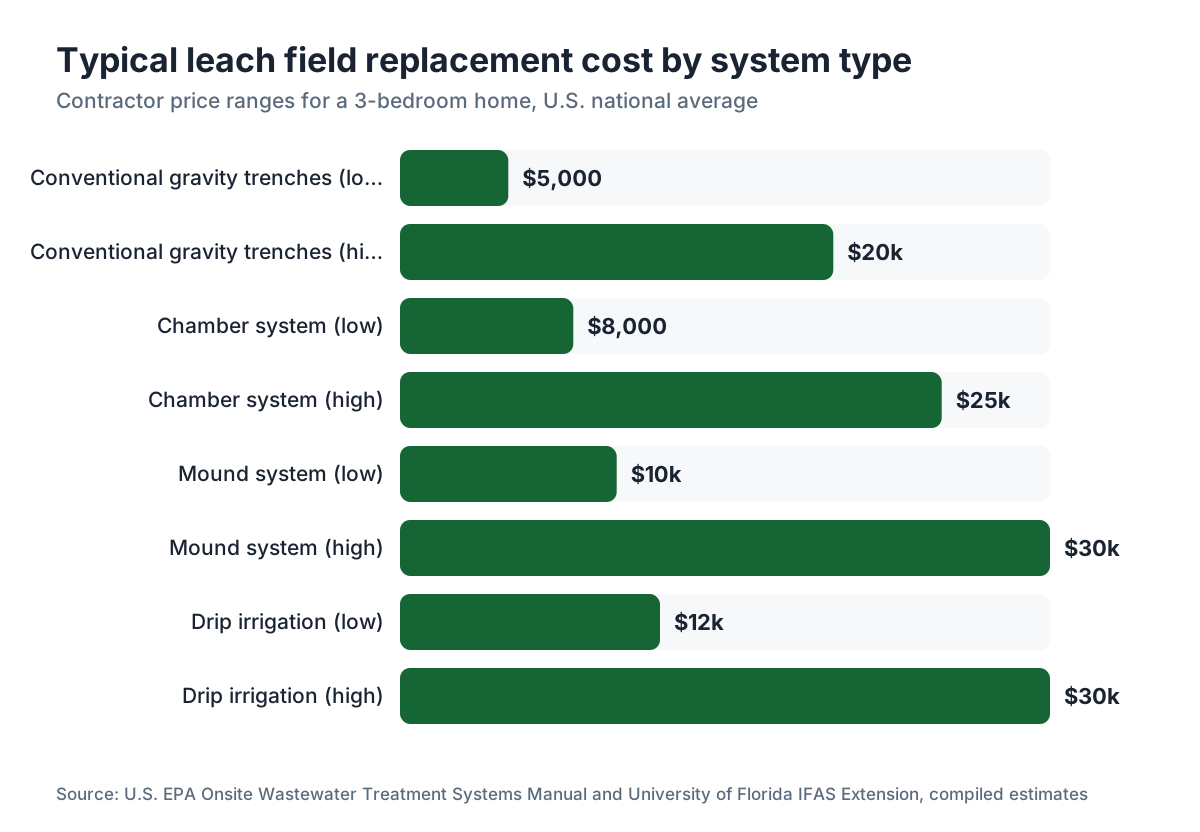
A conventional gravity trench replacement for a 3-bedroom home runs roughly $5,000 to $20,000. The low end assumes good soil, easy access, and a short field. The high end covers rock excavation, difficult access, or systems that need a pump chamber.
Mound installation runs $10,000 to $30,000 or more because of the fill material and pumps. Chamber or drip systems land in the $8,000 to $30,000 range. These are ballpark. Your state's permit fees, a fresh perc test, and local labor rates all move the number.
Nobody has great national aggregate data on this. The closest reliable figures come from state extension cost guides and the EPA's Onsite Wastewater Treatment Systems Manual [3]. For total system costs including the tank, see our breakdown on cost to install septic system.
Here's what I'd actually do: get three bids and ask each contractor to walk you through the permit drawing before you sign anything. A contractor who can't explain the sizing math to you probably isn't doing a properly engineered design.
| Field type | Typical replacement cost | Notes |
|---|---|---|
| Conventional gravity trenches | $5,000 to $20,000 | Most common |
| Chamber system | $8,000 to $25,000 | No gravel, faster install |
| Mound system | $10,000 to $30,000 | Needed on high water table sites |
| Drip irrigation | $12,000 to $30,000 | Requires ATU pretreatment |
How do leach fields get inspected and what should you ask about?
A proper leach field inspection is more than a look at the grass. A licensed inspector usually does several things.
First, they locate and uncover the distribution box. The D-box tells a lot: is it cracked, full of solids, or showing even flow to every lateral? Uneven flow usually means one lateral is clogged and forcing the others to take extra loading.
Second, they probe or camera the laterals to check for backpressure. If water stands in the pipes instead of draining freely, the field is saturated. Some inspectors run a dye test: flush dye tablets down the toilet and watch whether dye surfaces at the field, which confirms surfacing effluent.
Third, they check tank levels and condition. A full or failing septic tank sends solids to the field and clogs it faster than anything else. Solid carryover is the single most preventable cause of leach field failure.
Ask the inspector four things: what is the depth to water table in my field area, how old is this field, are there any signs of surface discharge, and is the distribution box intact? Those cover the main failure modes. A good septic tank inspection should include at least a visual check of the field access points, more than the tank.
What routine care keeps a leach field looking and working right?
Most leach field care is about what you don't do rather than what you do.
Pump the septic tank on schedule. EPA SepticSmart guidance states that 'the most important thing you can do to protect your septic system is to have it pumped regularly,' and recommends an inspection every 3 years and pumping every 3 to 5 years for the average household [1]. Solid carryover into the field is the top cause of early failure.
Control what goes down the drain. Fats, oils, and grease bind to gravel and pipe walls and build biomat faster than normal. Wipes, even the 'flushable' ones, pile up in the tank and wash into the field if you don't pump in time. Garbage disposals add roughly 50 percent more solids to the tank by some estimates and should be used sparingly on septic [6].
Manage water use. A field sized for 300 gallons a day that catches 600 gallons on laundry day gets hydraulically overloaded. Spreading laundry across the week instead of 10 loads on Saturday is a real, no-cost way to stretch field life [6].
Keep traffic off. Mark the field corners with small stakes if contractors are visiting or family members park on the lawn. A concrete truck on a wet field can do permanent damage in one pass.
Skip the additives. The enzyme and bacterial products sold at hardware stores have no proven benefit for a system that's working. The EPA and most state regulators are skeptical of them [1]. Keep the money.
For operators running preventive maintenance schedules across many customer properties, tracking field age, last pump date, and inspection notes digitally in a platform like SepticMind makes it far easier to flag at-risk systems before they fail.
Frequently asked questions
What does a leach field look like in a yard?
It looks like a normal, flat lawn area with no visible structures. The ground may sit slightly higher over the trench lines, and the grass is often a little greener or lusher than the rest of the yard. Some systems have a low vent pipe or cleanout cap at the perimeter, but many show nothing at all. You can walk right over it without knowing it's there.
What does a septic leach field look like when it's failing?
The clearest signs are soggy or spongy ground during dry weather, standing water or puddles with a sewage smell over the field, and strips of unusually dark-green grass over the trench lines. Inside the house you may see slow drains and gurgling toilets. If you see any surface ponding, stop using the system and call a professional. Most states require it.
How do I know where my leach field is located?
Request the as-built permit drawing from your county health department. If records don't exist, hire a septic professional to camera the outlet pipe from the tank and trace the laterals with an electronic pipe locator. You can also probe the yard with a steel rod, looking for gravel at 18 to 36 inches depth, starting about 10 to 20 feet downhill from the septic tank.
What are the lines or bumps I see in my yard over the leach field?
Slight ridges over a leach field are usually the trench fills settling unevenly over time, with the trench soil settling faster than the ground between trenches. They're harmless unless you also see wet soil or smell odors. Clear lines of wet or very green grass suggest effluent may be reaching the surface layer, which is worth an inspection.
Can I mow the grass over a leach field?
Yes, and it's recommended. Low-growing grass over the field is ideal because the roots pull moisture and nutrients from the effluent without going deep enough to damage the pipes. Avoid riding mowers on saturated or soft ground, and don't park the mower on the field for long periods. Stick to a push mower if the ground feels soft underfoot.
What's the difference between a leach field and a drain field?
Nothing meaningful. They're the same thing under different names depending on the region. 'Leach field,' 'drain field,' 'drainfield,' 'absorption field,' and 'soil absorption system' all describe the network of perforated pipes in gravel-filled trenches that take effluent from the septic tank and let it percolate into the soil.
How deep are leach field pipes buried?
Perforated pipes in a conventional leach field sit in gravel about 18 to 36 inches below finished grade. The exact depth depends on state code, site conditions, and how much topsoil needs to stay above the trench for insulation and treatment. Some jurisdictions allow shallower 12-inch installations in certain soils. Check your local health department's onsite wastewater rules for specifics.
How long does a leach field last?
A well-maintained conventional leach field lasts 20 to 30 years, sometimes longer. The variables are soil type, household water use, whether the tank gets pumped on schedule, and whether solids ever reached the field. Fields that take solid carryover from a neglected tank often fail in 10 to 15 years [7]. There's no universal lifespan because site conditions vary so much.
What does a mound septic system look like compared to a regular leach field?
A mound system is unmistakable: a rectangular grass-covered berm rising 2 to 4 feet above the surrounding yard, usually 30 to 100 feet long. A conventional leach field sits flush with or barely above the lawn and stays invisible. Mounds go in when the water table or bedrock is too close to the surface for standard burial depth. They're common in Minnesota and other northern states.
Is the green grass over my leach field a problem?
Slightly greener grass over the trench lines is normal. Effluent delivers moisture and nutrients just below the root zone and the grass responds. On its own it's not a failure sign. The concern starts when the grass is dramatically lusher, wet underfoot, or you can smell sewage near it. That combination suggests effluent is reaching the surface, which warrants an inspection.
What happens if I drive over my leach field?
Heavy vehicles compact the soil and crush the pore spaces that let effluent percolate. They can also crack or collapse old clay tile or thin PVC laterals. A single pass from a loaded vehicle on saturated soil can cause permanent permeability loss. Light foot traffic is fine. If contractors are working near the field, mark it clearly and tell them to keep equipment out.
How much space does a leach field need?
Active trench area typically runs 400 to 2,500 square feet depending on household size and soil type. The total protected zone is larger because trenches need 6 to 10 feet of spacing, plus setbacks from wells (usually 50 to 100 feet), property lines (often 10 feet), and structures (typically 5 to 10 feet). Plan on at least 3,000 square feet of yard being off-limits for other uses.
Can a leach field be repaired, or does it always need full replacement?
Minor issues like a cracked distribution box or a single clogged lateral can often be fixed for a few hundred to a couple thousand dollars. A field with widespread biomat failure across all trenches usually needs replacement, though a 6 to 12-month rest period with no loading sometimes brings partial recovery. Hydraulic fracturing is used in some states to loosen compacted soil around trenches, but results are inconsistent.
Sources
- U.S. EPA, SepticSmart homeowner guidance: EPA recommends keeping the area over a leach field free of structures and vehicles, avoiding additives, and pumping every 3 to 5 years; also states that 'the most important thing you can do to protect your septic system is to have it pumped regularly.'
- U.S. EPA, Onsite Wastewater Treatment Systems Manual (EPA/625/R-00/008): Conventional trench depth is 18 to 36 inches; state codes typically require 2 to 4 feet of separation between trench bottom and seasonal high water table; tree setbacks and well setbacks described.
- U.S. EPA, Onsite Wastewater Treatment Systems Manual, Chapter 4: Soil absorption systems must be sized to handle daily flows typically estimated at 50 to 120 gallons per bedroom; biomat formation at trench bottom is the primary treatment mechanism.
- North Carolina Department of Health and Human Services, Environmental Health (Onsite Water Protection, 15A NCAC 18A .1900): North Carolina rules require a minimum of 120 linear feet of trench per bedroom for its best-draining (Group I) soils in conventional gravity systems.
- Minnesota Pollution Control Agency, Septic systems (SSTS) guidance: Mound systems are built above existing ground on imported sand fill and are common in Minnesota for sites with high water tables or shallow bedrock; typical mound height 2 to 4 feet.
- Penn State Extension, septic system resources: Garbage disposals add approximately 50 percent more solids to the septic tank and should be used sparingly on septic systems; laundry should be spread across the week to avoid hydraulic overloading.
- University of Minnesota Extension, Onsite Sewage Treatment Program (SSTS): A well-maintained leach field lasts 20 to 30 years; solid carryover from a neglected tank is the leading cause of premature field failure.
- National Environmental Services Center (NESC) / West Virginia University: Distribution boxes split effluent flow to field laterals; uneven flow to laterals indicates a clogged trench or failed D-box and is a primary inspection finding.
- California State Water Resources Control Board, Onsite Wastewater Treatment Systems Policy: California uses a perc-rate-based matrix for sizing leach fields; setback requirements include 100 feet from water supply wells in most cases.
- University of Florida IFAS Extension (EDIS): Mound and chamber system cost ranges for replacement; chamber systems eliminate gravel and use molded plastic arches to create void space for effluent treatment.
Last updated 2026-07-09