What is a perc test in real estate and why does it matter?
By the SepticMind Editorial Team

TL;DR
- A percolation (perc) test measures how quickly water drains through soil on a given lot.
- Lenders, health departments, and buyers require it before installing a septic system on any property not served by municipal sewer.
- Failing a perc test doesn't automatically kill a deal, but it changes your options and usually raises costs.
What exactly is a perc test?
A perc test, short for percolation test, measures how fast water moves through the native soil on a parcel of land. The result tells engineers and health department officials whether that soil can absorb the wastewater output of a septic system's drain field without saturating and backing up. [1]
Here's the mechanics. A licensed soil evaluator or civil engineer digs or bores a hole to the depth where the drain field would sit, usually 24 to 36 inches, fills it with water, and times how long the water takes to drop one inch. That number is the perc rate, expressed in minutes per inch (MPI). A rate of 1 to 60 MPI typically qualifies a site for a conventional septic system, though the acceptable range varies by state and county. [2]
The test has limits people overlook. It only measures one soil characteristic. A site can pass a perc test and still fail a full site evaluation because of a high water table, bedrock too close to the surface, or a lot too small to fit the required setbacks from wells, property lines, and structures. Most jurisdictions today require a full soil morphology evaluation alongside the perc test, and many are moving toward that approach entirely. [3]
If a property already connects to a municipal sewer system, a perc test is irrelevant. This matters strictly for properties that need their own on-site wastewater treatment.
Why does a perc test matter in a real estate transaction?
Simple. If a lot can't handle a septic system and has no municipal sewer access, you can't legally put a house on it in most jurisdictions. No perc approval means no building permit. No building permit means you're holding undeveloped land with very limited options. [4]
For buyers purchasing existing homes on septic, a perc test or a review of the original perc records confirms the drain field was sized correctly for the soil. An undersized or mismatched drain field fails early, sometimes within five to ten years instead of the 20 to 30 year life a properly designed system should get. See our guide to leach field problems for what failure actually looks like.
Lenders care too. FHA and USDA rural development loans both require evidence that an on-site sewage disposal system is adequate for the property. A perc test result in the file gives underwriters what they need. [5]
Real estate agents working rural markets deal with this constantly. The perc contingency clause is standard language in purchase agreements for vacant land in areas without sewer. It gives the buyer an exit if the site doesn't pass, and it defines who pays for the test. Know that going in.
How is a perc test done, step by step?
The process is more involved than most people expect, and the steps vary somewhat by state, but the core sequence looks like this.
Site evaluation first. Before any digging, a licensed evaluator walks the lot to assess slope, existing vegetation, proximity to water bodies, and obvious drainage patterns. Some states require a soil scientist or licensed geologist for this phase. [3]
Test holes are dug. Usually two to six holes are required, depending on lot size and local code. Holes go down to the proposed drain field depth. In some systems a backhoe is needed; in others a hand auger works.
Pre-soaking. Holes are filled with water and left to soak, typically for 12 to 24 hours, sometimes longer in clay soils. This simulates real conditions and stops dry soil from skewing results toward faster absorption than actually happens. States that follow EPA guidelines generally require a 24-hour pre-soak when the soil hasn't been saturated recently. [1]
The timed test. After pre-soaking, the evaluator measures the drop in water level at set intervals, often every 30 minutes for four hours or until the rate stabilizes. The slowest or average reading becomes the official perc rate.
Soil profile examination. In most jurisdictions now, the evaluator also digs a soil profile pit to look at layers, texture, color mottling (which signals seasonal high water tables), and restrictive layers like hardpan or bedrock. This can override a passing perc rate if the profile reveals problems. [3]
Report and permit application. The evaluator files a report with the local health department or environmental agency. If the site passes, you get a site approval permit, sometimes called a septic permit or construction permit, that authorizes specific system types and drain field locations.
How long does a perc test take?
The physical test itself, including pre-soak, usually runs one to two days on site. Scheduling and permitting add more time.
From the day you hire a soil evaluator to the day you have an approved permit in hand, expect two to six weeks in most states. That range accounts for the evaluator's schedule, weather (tests can't run in frozen or extremely wet soil), and how backed up the local health department is. In fast-growing rural counties, permit backlogs can push the timeline past two months. [4]
This timing matters enormously in real estate. Write a perc contingency with a 30-day window in a rural county sitting on a six-week backlog, and you've written a contingency that expires before you have an answer. Experienced buyers' agents call the local health department before drafting the timeline.
What does a perc test cost?
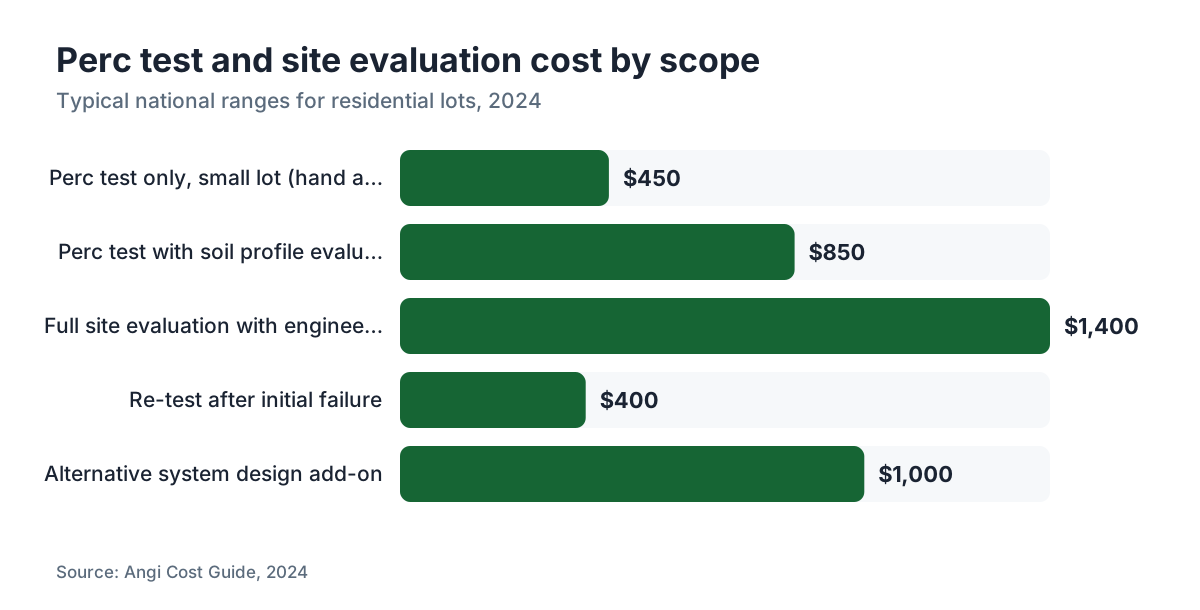
Nationally, a perc test runs roughly $300 to $1,500, with most straightforward residential lots landing between $500 and $900. [6] The range is wide because pricing depends on several real factors.
First, who does it. Some states allow any licensed engineer or soil scientist; others have a narrow list of approved evaluators. Limited supply pushes prices up. Second, how many test holes and whether backhoe excavation is needed. A large lot requiring a backhoe and six test holes costs more than a small lot tested by hand auger. Third, whether a full soil morphology report is bundled in or priced separately.
If the site is complex, with seasonal high water concerns or previous failed tests, expect to pay for additional analysis, alternative system designs, and possibly multiple site visits. That can push total evaluation costs past $2,000 before you've spent a dollar on construction.
The perc test is a small fraction of total septic system installation costs. A conventional septic tank installation for a new home typically runs $3,000 to $12,000 depending on system size and site conditions. Detailed cost breakdowns are in our cost to install septic system guide. The perc test is cheap insurance on whether that investment is even possible.
| Component | Typical cost range |
|---|---|
| Perc test only (small lot, hand auger) | $300 to $600 |
| Perc test with soil profile evaluation | $500 to $1,200 |
| Full site evaluation with engineer's report | $800 to $2,000+ |
| Re-test after initial failure | $200 to $600 |
| Alternative system design (mound, drip) | $500 to $1,500 additional |
What does it mean if a property fails a perc test?
A failed perc test is not automatically a deal-killer, but it's a serious complication. What it actually means depends on why it failed.
Soil that absorbs water too slowly (MPI above 60 to 120, with exact thresholds varying by state) can't support a conventional gravity-fed drain field. But engineers have built systems for exactly this problem. Mound systems raise the drain field above native soil on an engineered fill mound. Low-pressure distribution systems spread effluent more evenly. Drip irrigation systems deliver treated effluent through buried drip lines at low doses. Aerobic treatment units (ATUs) treat effluent more thoroughly before dispersing it, which eases the soil's absorption burden. [7]
All of these alternatives cost more than a conventional system, sometimes a lot more. A mound system can run $10,000 to $20,000 above a conventional setup depending on site conditions and local labor rates. That cost difference is legitimate negotiating room in a purchase price discussion.
Some sites genuinely can't be made to work. If the water table is too high, the lot is too small for any compliant system with required setbacks, or bedrock prevents any viable placement, the site may be denied entirely. In that case you're looking at a property that legally cannot have a habitable dwelling unless municipal sewer can be extended to it.
If you're buying vacant land, a failed perc test with no viable alternative system path is usually a reason to walk away, unless the price reflects that limitation and you have another use for the land.
Who orders and pays for the perc test?
This is a negotiated term in most transactions, and it varies by local custom.
For vacant land sales, the buyer typically orders and pays for the perc test as part of their due diligence, usually through a perc contingency in the purchase agreement. The buyer wants the test done on their timeline and reviewed by professionals they chose.
For sales of existing homes on septic, the dynamic shifts. If the existing system is older or the buyer's lender requires documentation, the seller may agree to provide a current inspection or historical perc records. Some states require a septic inspection at point of sale. [8] See our septic tank inspection guide for what that typically covers.
Whoever orders the test should hire their own evaluator, not rely on a report ordered by the other party. Perc tests have a shelf life. Most health departments accept results for two to five years from the test date, though some are stricter. An old perc test may still be on file with the county, and pulling those records is free or nearly free. Always worth doing before you order a new one.
How does a perc test relate to septic system design?
The perc rate directly determines how large the drain field needs to be. Slower-absorbing soil needs more square footage of drain field to handle the same daily wastewater flow. Engineers use the perc rate alongside the home's projected daily sewage flow (typically estimated at 100 to 150 gallons per bedroom per day under most state guidelines) to calculate minimum drain field area. [2]
A three-bedroom house generating an estimated 450 gallons per day needs a larger drain field on clay soil (slow perc) than the same house on sandy loam (fast perc). That's why two adjacent lots can carry very different septic installation costs and constraints for the same size home.
For operators designing systems, tools like SepticMind track site data, permit records, and design parameters across multiple jobs, so perc results from the site evaluation feed straight into accurate proposals without manual look-up.
The leach field design is where perc test results become physical reality. If the field is undersized relative to the actual perc rate, you get premature failure, biomat formation, and sewage surfacing in the yard. Getting the sizing right at design stage is far cheaper than septic system repair later.
Does a perc test tell you about the entire septic system?
No. And this is a common misconception worth correcting.
A perc test evaluates soil suitability for a future drain field, or confirms the soil conditions under an existing one. It says nothing about the condition of the septic tank, the distribution box, the inlet and outlet baffles, the tank's structural integrity, or whether the system has been maintained.
For a home purchase, a perc test (or a review of old perc records) is one data point. Pair it with a proper septic system inspection that includes septic tank pumping so the inspector can see inside, check baffles, look for root intrusion, and judge the tank's remaining useful life. The EPA's SepticSmart program recommends inspecting a septic system at least every three years and pumping every three to five years. [9]
Buyers who skip the tank inspection because "the perc test passed" are making an expensive assumption. A passing perc test with a failing tank means you're still looking at a septic tank repair bill shortly after closing.
How do perc test requirements vary by state?
Significantly. This is one of the more frustrating parts for buyers who move between states or investors buying in multiple markets.
The EPA sets guidance but doesn't directly regulate on-site sewage treatment. Regulation falls to states, and states delegate to counties in many cases. [10] The result is a patchwork where the same soil type might sail through in one county and require an engineered alternative system one county over.
A few specifics. California's requirements are governed by individual county environmental health departments, with no single statewide perc test standard. Texas uses a tiered system under 30 TAC Chapter 285, with soil analysis requirements that go well beyond a simple perc test for most systems. [11] Florida's Chapter 64E-6 requires percolation testing and soil profile evaluation with specific depth-to-water-table requirements. [12] Many northeastern states have moved toward soil morphology evaluations as primary, with perc tests as a secondary or confirmatory measure.
Always check with the local county health department or state environmental agency before assuming what's required. The evaluator you hire should be licensed in that state and familiar with local codes. An out-of-state engineer's report may not be accepted.
What should buyers ask before making an offer on land without sewer?
A few questions can save a buyer from a very expensive mistake.
First, are there any prior perc test records on file with the county? Many health departments maintain searchable records. A passing test on file can save you the cost and delay of a new one, assuming it's recent enough to still be valid.
Second, is the parcel legally large enough to fit a septic system with all required setbacks from the well, property lines, structures, and wetlands? Some parcels look buildable on paper but have no compliant location for a drain field once setbacks are mapped. This is a question for a local evaluator, not a real estate agent.
Third, has the lot been tested before and failed? Sellers aren't always required to disclose this, though many states require disclosure of known material defects. A failed test on file at the health department is public record. Check before you spend money.
Fourth, what's the cost gap between a conventional system and the alternative system the soil might require? Get a rough estimate from a local installer before finalizing your offer price. Our cost to put in a septic tank guide covers what drives those numbers.
For anyone buying a home that already has a septic system, the how often to pump septic tank guide is useful context on the ongoing maintenance you're taking on.
Frequently asked questions
How long is a perc test valid for in real estate?
Most health departments accept perc test results for two to five years, though exact validity periods vary by state and county. Some jurisdictions allow results to stand indefinitely if site conditions haven't changed; others require a new test for any new permit application. Always verify with the local health department before relying on an older report. Free county record searches can confirm what's on file.
Can you build on land that fails a perc test?
Sometimes, yes. A conventional septic system isn't possible, but many states permit alternative systems like mound systems, aerobic treatment units, or drip irrigation systems for sites with poor soil absorption. Whether an alternative gets approved depends on why the site failed and local regulations. If the site fails due to a high water table, inadequate lot size, or shallow bedrock, building may not be feasible at all.
Who performs a perc test?
Typically a licensed soil evaluator, civil engineer, or soil scientist authorized by the state or county. Requirements vary: some states maintain a specific list of approved evaluators, others accept any licensed professional engineer. Always verify the evaluator is licensed in the specific state where the property sits, because state licensing doesn't transfer and an unlicensed report won't be accepted by the health department.
Is a perc test the same as a septic inspection?
No. A perc test evaluates soil absorption capacity for a future or existing drain field. A septic inspection examines the physical components of an existing system: the tank condition, baffle integrity, inlet and outlet pipes, and drain field performance. For a home purchase, you want both: perc records to confirm the system was properly designed, and a current inspection to confirm the installed components are in good shape.
Does a new home need a perc test even if it's in a subdivision?
If the subdivision connects to a municipal sewer system, no perc test is needed. If lots are on individual septic systems, the developer typically obtained site approvals before the subdivision was recorded, and individual lot perc records are on file with the county. Buyers should pull those records and confirm the lot's approval covers the size and type of home being built or purchased.
What perc rate is needed to pass?
Most states accept perc rates between 1 and 60 minutes per inch (MPI) for a conventional septic system. Some states stretch the upper limit to 120 MPI for certain alternative systems. Rates faster than 1 MPI (very sandy or gravelly soil) can also be a problem because water moves through too fast for adequate treatment before reaching groundwater. Exact thresholds are defined by your state's on-site wastewater code.
How many holes are dug for a perc test?
Typically two to six test holes per site for a standard residential lot, though large parcels or complex sites may require more. Some states specify a minimum number by lot size. Multiple holes are necessary because soil conditions can vary across a lot, and the evaluator needs enough data points to characterize the absorption capacity of the proposed drain field area reliably.
Can rain or dry weather affect perc test results?
Yes, which is why most protocols require a pre-soak period before the timed test. Dry soil absorbs water faster than saturated soil does, so testing in drought conditions without pre-soaking produces artificially optimistic results. Most state guidelines following EPA recommendations require 12 to 24 hours of pre-soaking. Tests run in frozen ground are generally prohibited because frozen soil doesn't reflect actual operating conditions.
Does a perc test affect property value?
Directly, yes. A passing perc result confirms the land can support a dwelling and is typically priced accordingly. Land without a perc approval, or with a failed test on record, sells at a meaningful discount because the development potential is limited or unknown. The exact discount depends on whether alternative systems are viable, local sewer extension prospects, and what other uses the land might support.
Do perc tests cost more on large properties?
Usually. Larger lots often require more test holes, and if the drain field area is spread across varied terrain, additional evaluation points are needed. If backhoe access is required rather than hand auguring, equipment costs add to the total. On very large rural parcels being subdivided, perc testing costs can run well above $2,000 because multiple potential drain field locations must be evaluated separately for each proposed lot.
What happens after a perc test passes?
The evaluator submits a site evaluation report to the local health department or environmental agency. If approved, you receive a site permit or septic permit that authorizes a specific system type, capacity, and drain field location. This permit is typically required before you can pull a building permit for the structure. The permit specifies design parameters the septic installer must follow.
Can I do a perc test myself?
For informal assessment, yes, but not for permit purposes. Any perc test used to obtain a health department approval must be conducted and certified by a licensed professional authorized by the state or county. DIY tests have no regulatory standing. A rough home test can tell you whether a site is obviously problematic before you pay for a formal evaluation, but it cannot substitute for the official process.
Sources
- U.S. EPA, SepticSmart: How Your Septic System Works: Percolation testing and pre-soaking requirements for on-site wastewater system site evaluation
- U.S. EPA, Onsite Wastewater Treatment Systems Manual (EPA/625/R-00/008): Perc rate expressed in minutes per inch and use of soil absorption data to size drain fields; daily flow estimates of 100-150 gallons per bedroom
- U.S. EPA, Septic Systems: What to Do and How They Work: Site approval permit required before building permit for structures on lots using on-site wastewater systems
- USDA Rural Development, Single Family Housing Guaranteed Loan Program: USDA rural development loans require evidence that on-site sewage disposal systems are adequate
- Angi, Cost Guide: Percolation Test: National average perc test cost range of $300 to $1,500, with most residential lots between $500 and $900
- U.S. EPA, Types of Septic Systems: Alternative septic systems including mound systems, drip irrigation systems, and aerobic treatment units for sites with poor soil absorption
- U.S. EPA, SepticSmart: Inspecting Your Septic System: EPA SepticSmart recommends inspecting a septic system at least every three years and pumping every three to five years
- U.S. EPA, SepticSmart Program: Regular inspection and pumping schedule recommended by EPA for on-site septic systems
- U.S. EPA, Regulation of Onsite Wastewater Treatment Systems: EPA sets guidance but states and counties hold primary regulatory authority over on-site wastewater systems
- Texas Commission on Environmental Quality, 30 TAC Chapter 285, On-Site Sewage Facilities: Texas on-site sewage facility rules under 30 TAC Chapter 285 include soil analysis requirements beyond basic percolation testing
- Florida Department of Health, Chapter 64E-6 FAC, Standards for Onsite Sewage Treatment and Disposal Systems: Florida Chapter 64E-6 requires percolation testing and soil profile evaluation with depth-to-water-table requirements
Last updated 2026-07-09