What's a perc test and do you actually need one?
By the SepticMind Editorial Team
TL;DR
- A percolation test (perc test) measures how quickly soil absorbs water at a specific site.
- Engineers and health departments use the results to decide whether a conventional septic drain field will work on your land, what size it needs, and sometimes whether you need an alternative system entirely.
- The test usually takes 2 to 4 hours, costs $150 to $1,500 depending on location and scope, and is typically required before any new septic permit gets issued.
What is a perc test, exactly?
A percolation test measures the rate at which water moves through soil in one spot on your property. "Perc" is shorthand for percolation, the slow seeping of liquid downward through soil particles. The number it produces, called the percolation rate, tells regulators and designers how many square feet of drain field your property needs to safely treat and disperse wastewater from your home.
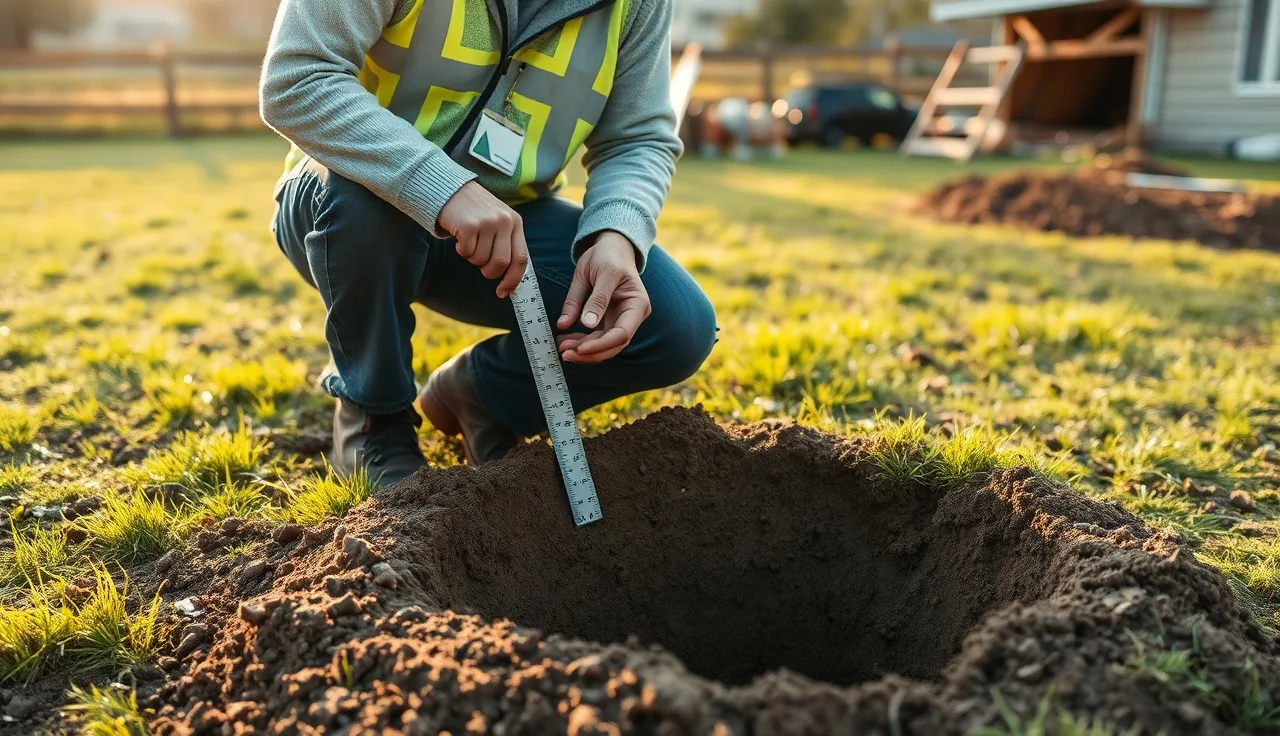
The basic mechanics haven't changed much in decades. A technician digs or drills one or more test holes to the depth where your drain field pipes would actually sit, usually 18 to 36 inches down. Those holes soak with water for a set pre-saturation period, anywhere from an hour to 24 hours depending on your state's rules. Then the tester measures how many inches the water level drops over a timed interval, most often 30 minutes. The result is expressed as minutes per inch, or MPI. A rate of 1 MPI means the water drops one inch every minute. That's fast, sandy soil. A rate of 60 MPI means one inch per hour, which is clay-heavy soil near the slower end of what most states accept.
Perc tests aren't guesswork. The results directly control whether a permit gets issued, what system type gets approved, and how big the drain field must be. If your soil fails, you can't legally install a standard gravity-fed septic system. Period.
Why does the soil absorption rate matter so much for septic systems?
A leach field is a buried treatment zone. Wastewater flows from your septic tank into perforated pipes, seeps into gravel, then into native soil, where soil bacteria finish breaking down pathogens and nutrients before the water reaches groundwater. That whole process only works if soil accepts water at a rate that matches your household's daily output without ponding, surfacing, or backing up.
Soil that absorbs too fast, say under 1 MPI, lets wastewater shoot through before bacteria have time to treat it. That risks contaminating groundwater. Soil that absorbs too slowly, above 60 or 120 MPI depending on your state, floods the drain field, backs up sewage, and puts a public health problem in your yard.
The EPA's SepticSmart program treats soil evaluation as the base of any well-designed onsite wastewater system [1]. Skip it, build a system that doesn't match your soil, and you're looking at premature failure, a septic system repair bill that can run tens of thousands of dollars, and possible fines. The perc test is the minimum viable evaluation. Many states now also require a soil morphology evaluation alongside it, because perc rates alone can miss seasonal high water tables and soil layering that a visual dig test catches.
How is a perc test actually performed, step by step?
The exact protocol is set by your state or county health department, so details vary. The broad sequence stays consistent.
First, the test holes get dug, typically 6 to 12 inches in diameter and down to the proposed drain field depth. Most jurisdictions require at least two holes per test area, often three to six for larger lots or complex sites. Holes go in the area of the proposed drain field, not scattered randomly across the property.
Second, pre-saturation happens. Water is added repeatedly to the holes over a minimum soaking period. This step simulates saturated soil, the worst case for a drain field after a wet season. Some states require 24 hours of pre-saturation. Others require only an hour. The 24-hour version is more conservative and more accurate for clay soils.
Third, the timed test runs. After pre-saturation, water is added to a fixed level and the drop is measured at regular intervals, most often every 30 minutes over a 90-minute to 4-hour window. The technician records the drop rate in each interval. Most protocols use the last one or two readings as the final perc rate, since early readings can be artificially slow before soil fully wets.
Fourth, results get submitted to the local health department with a site sketch, hole locations, soil descriptions, and the technician's license number. In most states a licensed soil evaluator, engineer, or sanitarian must perform or directly supervise the test. You can't just dig a hole yourself and call it done.
The field portion usually takes 2 to 4 hours for a standard residential lot, longer when 24-hour pre-saturation is required.
What perc rate is considered passing or failing?
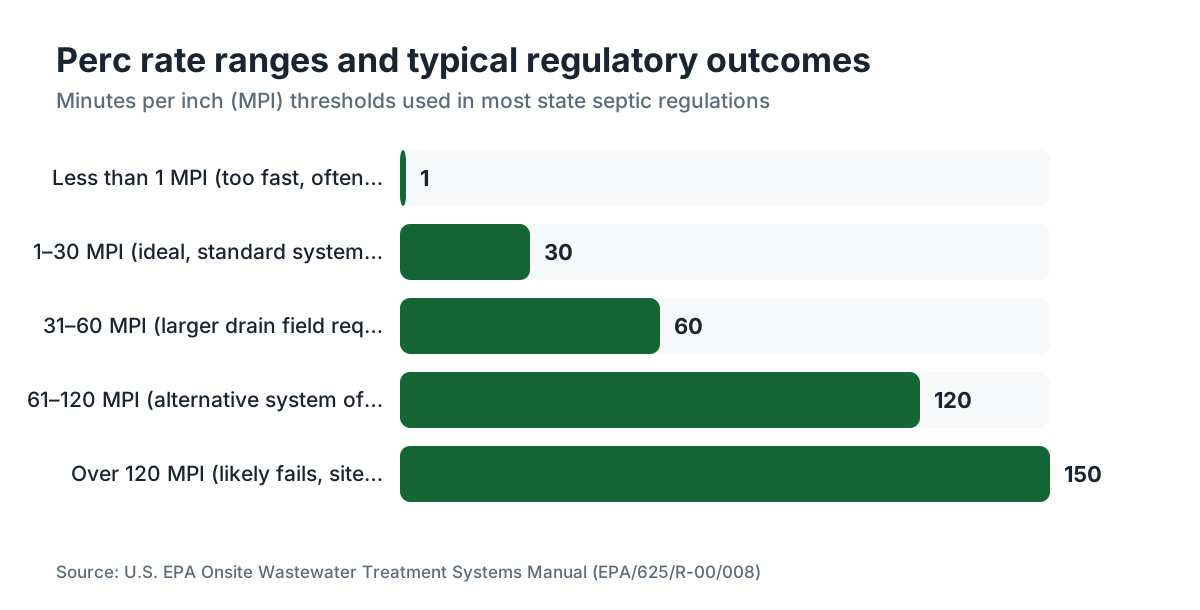
Most states set an acceptable range of roughly 1 to 60 minutes per inch for a conventional gravity drain field, though the exact cutoffs vary widely [2]. Here's the general picture:
| Perc Rate (MPI) | What it Usually Means | Typical Regulatory Outcome |
|---|---|---|
| Less than 1 | Extremely fast (gravel, coarse sand) | Often rejected; treated water may not be adequately filtered |
| 1 to 30 | Ideal range | Standard gravity drain field approved |
| 31 to 60 | Slow but acceptable | Larger drain field required, or modified system |
| 61 to 120 | Slow | Many states require alternative or mound system |
| Over 120 | Very slow (dense clay) | Often fails; alternative system or site rejection likely |
These thresholds are generalizations. California allows up to 60 MPI for standard systems in many counties but sets different limits for specific soil types [3]. North Carolina uses a detailed soil morphology classification rather than numeric perc cutoffs alone. Pennsylvania requires both a perc test and a soil probe test before issuing a permit [4]. Always check your county or state health department's onsite wastewater code for the numbers that govern your site.
A failed perc test doesn't mean your property can't have a septic system. It often just means you need a different kind: a mound system, drip irrigation, an aerobic treatment unit, or a constructed wetland. These alternatives cost more, sometimes a lot more, but they're legal paths when a conventional system won't work.
How much does a perc test cost?
Costs run from about $150 in rural counties, where a single sanitarian visits and runs a simple test, to $1,500 or more on complex sites that need multiple holes, a licensed engineer, and soil morphology reports alongside the perc data. The national middle for a straightforward residential perc test is roughly $300 to $700 [5].
A few things push costs higher. Rocky soil that requires machine boring instead of hand digging adds equipment fees. Sites that need the full 24-hour pre-saturation protocol may require two site visits, doubling travel and labor. If your state requires a licensed professional engineer (PE) to certify results rather than just a licensed soil evaluator, you're paying engineering rates. And in many jurisdictions the local health department charges a separate review and permit fee on top of the test itself, from $50 to several hundred dollars.
Here's what matters. The perc test fee is almost always a small fraction of the total cost to install a septic system. Spending an extra $200 for a thorough test with proper soil profiling can save you from designing a system that fails in five years. Cutting corners here is false economy.
Who can perform a perc test, and do you need to hire someone?
In nearly every U.S. state, perc tests for septic permits must be performed or directly supervised by a licensed professional. Depending on the state, that's a licensed soil evaluator, a registered sanitarian, a licensed site evaluator, or a licensed professional engineer. The specific credential required is set in your state's onsite wastewater code [6].
Homeowners often ask whether they can run their own test. You can informally dig a hole and watch how water drains, and that's a useful sanity check before you buy land. It won't satisfy your health department. Official perc tests require a licensed person, specific protocols, documented results, and submission to the permitting authority. No county health department issues a septic permit based on a homeowner's informal observation.
To find a qualified tester, start with your county health department. Many keep lists of approved soil evaluators or licensed contractors. Your state's onsite wastewater or environmental health division usually keeps a statewide directory. A reputable septic tank installation contractor will either run the test themselves if licensed or work with a soil evaluator they trust. Get quotes from at least two people. Pricing varies more than you'd expect within the same region.
When do you need a perc test?
The most common trigger is building a new home in an area without municipal sewer. Before your county issues a building permit, they usually require a valid perc test and site evaluation confirming the lot can support a septic system of the type and size the proposed structure needs.
Buying raw land is the second major scenario. If you're purchasing rural or semi-rural property to build on, a perc test is one of the most important due diligence steps you can take. A lot that fails a perc test, with no viable alternative system, is essentially unbuildable for residential use. That's not a small detail.
Major system replacement or expansion sometimes triggers a new test. If your existing leach field has failed and you're replacing it in a different spot on the property, the health department may require a fresh perc test for the new area. That's especially true if decades have passed since the original test and soil conditions or local rules have changed.
Real estate transactions on septic homes sometimes include a perc test as part of the septic tank inspection package, though it's more common with vacant land than with existing homes that already have a working system and a permit on file.
Adding a bedroom or a big bathroom expansion can also trigger a permit review in some states, which may require soil testing to confirm the existing or proposed system can handle the added load.
What's the difference between a perc test and a soil evaluation?
This is where a lot of homeowners get tangled up, and honestly the terminology varies by state, which doesn't help.
A perc test is specifically the timed water-drop measurement described above. It produces a single number: minutes per inch.
A soil evaluation (also called a soil morphology study, soil profile analysis, or site evaluation, depending on your state) is broader. The evaluator digs soil profile pits, usually 4 to 6 feet deep, and examines the actual soil layers by hand. They look at texture (sand, silt, clay percentages), structure, color, and particularly mottling, those reddish or grayish streaks that mark where the seasonal high water table historically reached. Mottling depth tells you how close saturated conditions get to the surface, which is often more predictive of failure than the perc rate alone.
Many states now use soil evaluation as the primary design tool and treat the perc test as supplemental or optional. North Carolina moved substantially toward morphology-based evaluation. Other states require both. A few older rural counties still lean almost entirely on the perc test.
The practical upshot: ask your county health department what they require before you hire anyone. You don't want to pay for a perc test only to learn you also needed a full morphology study, or that your county no longer requires the perc portion at all.
How long are perc test results valid, and can they expire?
Yes, they expire. Most states set validity periods of 2 to 5 years for perc test results. If you don't pull a septic permit and start construction within that window, you may need to retest.
The reasoning is practical: soil conditions change. A drought year can produce an artificially fast perc rate. A wet year can reveal a seasonal high water table that a dry-season test missed. Regulations also evolve, so a test run under older protocols might not meet current requirements.
Buying land with an existing perc test on file? Check two things: when the test was performed and whether it was done under the current protocol. A test done 10 years ago under rules that have since changed may need to be redone regardless of age. Your county health department can tell you in five minutes whether the existing test still counts for permitting.
For operators tracking multiple client properties and permit timelines, a system like SepticMind can flag expiring test records and permit windows before they become a problem. For a single property, a calendar reminder does the job.
What happens if your property fails a perc test?
A failing result is stressful. It's not automatically the end of the road. The options depend on what caused the failure.
Soil that's too slow (dense clay, high mottling) often still supports an alternative system. Mound systems elevate the drain field above native soil using engineered fill, getting around slow native percolation. Drip irrigation systems dose small amounts of treated effluent to the root zone. Aerobic treatment units (ATUs) pre-treat wastewater to a higher standard before dispersal, which some states accept on marginal soils. Constructed wetlands and recirculating sand filters are options in certain states. All of these cost more than a conventional system, often 1.5 to 3 times as much [7].
Soil that's too fast (coarse gravel, fractured rock) raises the opposite concern: inadequate treatment. Some states allow systems with additional treatment steps or specific absorption media to compensate. Others simply won't permit any onsite system on certain soil types.
Marginal failures, right at the edge of the acceptable range, sometimes justify retesting in a different season. A test run during a drought can show artificially fast rates. A test in wetter conditions might produce a rate that passes with a larger drain field.
When none of that works, the hard reality is that some parcels genuinely cannot support any legal septic system. Then your options narrow to connecting to a municipal sewer extension if one is planned nearby, installing a holding tank (legal in some states as a stopgap, not a permanent fix), or not building on the site. This is why perc testing land before you buy beats testing it after closing.
How does a perc test connect to the overall septic system design and cost?
The perc rate is the main input to drain field sizing. Most state regulations include a table that maps perc rate to required square footage of drain field per bedroom or per gallon of daily flow. A 3-bedroom home in a jurisdiction using 150 gallons per bedroom per day needs to disperse 450 gallons daily. At a perc rate of 20 MPI, your design square footage might land around 450 to 600 square feet of absorption trench. At 50 MPI, you might need 900 to 1,200 square feet. Bigger drain field means more digging, more pipe, more gravel, higher total cost.
The perc result also shapes the system type, as covered above. A conventional gravity system is the cheapest option. Every step toward an engineered alternative adds cost. This is why the test result matters so much to the final budget. You can't know your real cost to put in a septic tank until you know what the soil demands.
The design engineer reads the perc results alongside lot shape, setbacks from wells and property lines, topography, and soil depth to groundwater. The perc test is one input, not the whole picture. A good site evaluator reviews all of it together before committing a design to paper.
Are perc tests regulated differently by state?
Yes, significantly. The federal government sets broad guidelines through EPA guidance [1], but onsite wastewater regulation is entirely a state and local function. There is no single national perc test standard.
Some states, like Virginia, have detailed statutory onsite sewage regulations that spell out exact hole dimensions, pre-saturation times, observation intervals, and the credentials required of the tester [8]. Others delegate most authority to county health departments, producing a patchwork where the test in one county can be meaningfully different from the test 20 miles away across a county line.
A few examples. California's Onsite Wastewater Treatment Systems Policy and local environmental health codes govern perc testing and vary by county [3]. Texas requires both a site evaluation and a soil characterization report performed by a licensed professional soil scientist or engineer under Texas Administrative Code Title 30, Chapter 285 [9]. Florida's Chapter 64E-6 of the Florida Administrative Code governs onsite sewage treatment and disposal systems and specifies soil evaluation requirements [10].
The practical advice: before you hire anyone or spend a dollar, download your county health department's onsite wastewater guidance document. It tells you exactly what tests are required, who can perform them, what the acceptable results are, and what paperwork gets submitted. This document is almost always free and online. Starting without it is the single most common mistake landowners make.
Frequently asked questions
How long does a perc test take?
The field work usually takes 2 to 4 hours for a standard residential lot. If your state or county requires 24-hour pre-saturation, you'll need a site visit the day before the timed test, spreading the process over two days. Results are typically submitted to the health department within a few days after testing, and permit review can add another few weeks depending on your jurisdiction's backlog.
Can I do a perc test myself?
You can dig a hole and observe drainage informally, which helps when evaluating land before purchase. But official perc tests for septic permits must be performed or supervised by a licensed professional in virtually every U.S. state. A homeowner's self-performed test won't satisfy the health department and won't result in a permit. Hire a licensed soil evaluator, sanitarian, or engineer who knows your county's specific protocol.
What is a good perc test result?
A rate between 1 and 30 minutes per inch is generally ideal for a conventional septic drain field. Rates of 31 to 60 MPI are acceptable in most states but may require a larger drain field. Below 1 MPI is typically too fast for adequate treatment. Above 60 to 120 MPI (the cutoff varies by state) is usually too slow for a standard gravity system and requires an alternative design.
Does a perc test tell you if you can build a house on a property?
It's a big part of the answer. If a property needs a septic system and can't pass any form of soil testing, it generally can't support a permanent dwelling. But failing a perc test doesn't automatically mean no building is possible. Alternative systems (mound, drip irrigation, aerobic units) may satisfy regulators on marginal soil. A full site evaluation with a soil morphology study gives a more complete picture than a perc test alone.
How much does a perc test cost in 2024?
Expect $150 to $1,500 depending on location, site complexity, and the credentials required of the tester. Simple rural tests with a county sanitarian tend to run $150 to $400. Sites requiring a licensed PE, multiple holes, or machine boring can reach $700 to $1,500. The health department's permit review fee is often a separate charge on top of the testing cost.
Do perc test results expire?
Yes. Most states set validity windows of 2 to 5 years. If you don't obtain a septic permit and begin construction within that period, you'll likely need to retest. If regulations have changed since the original test, even a recent result may not be accepted. Always confirm with your county health department before relying on an existing test result, especially when buying property.
What does it mean when a perc test fails?
A failed perc test means the soil absorbed water either too quickly (inadequate treatment time) or too slowly (drain field will flood) for a standard gravity septic system. It doesn't automatically mean the property is unbuildable. Mound systems, aerobic treatment units, drip irrigation systems, and other alternatives are permitted on many sites with failing conventional perc rates. Retesting in a different season is also sometimes worth considering for borderline results.
Is a perc test the same as a soil evaluation or soil test?
Not exactly. A perc test measures the timed water-drop rate in test holes, producing a minutes-per-inch number. A soil evaluation or morphology study involves examining soil profile pits to assess texture, structure, layering, and mottling depth, which indicates seasonal high water table. Many states require both. Some modern regulations rely primarily on soil morphology and treat the perc test as supplemental or no longer require it.
Who pays for a perc test, buyer or seller?
This is negotiable and varies by local custom. When a buyer is doing due diligence on raw land, the buyer typically pays. In some markets, sellers run and pay for a perc test before listing to show the land is buildable. In real estate transactions involving an existing home with a functioning septic system, a perc test is usually not required unless the system is being replaced or expanded.
Do all properties need a perc test before installing a septic system?
Most states require some form of soil testing, but not all require a traditional perc test specifically. Some jurisdictions have moved to soil morphology evaluation as the primary or sole required method. Replacement systems on existing permitted lots sometimes don't need new testing if the drain field location isn't changing. Check your county health department's current onsite wastewater requirements before assuming what's needed.
How many test holes does a perc test require?
The minimum is usually two to three test holes per test area, placed within the proposed drain field footprint. Complex sites, larger lots, or variable soil conditions may require six or more. Each state's protocol specifies the minimum number, placement, and dimensions of holes. More holes give a more representative picture of soil variability across the site, which matters when designing a large or unconventional system.
Can a perc test be done in winter?
In some climates, yes, but timing matters. Frozen ground prevents digging and invalidates results. Many states prohibit testing when ground is frozen. In non-freezing climates, winter tests may actually be more conservative and useful because soil is closer to seasonal saturation. Check your state's rules. Some jurisdictions restrict testing to specific months to ensure results reflect realistic wet-season conditions.
What should I do to prepare for a perc test on my property?
Not much is required from you, but a few things help. Make sure the test area is accessible to equipment if machine boring is needed. Avoid irrigating the test area heavily in the days before testing, which could produce artificially fast rates. Have your property survey and any existing well locations available for the evaluator. And download your county's current onsite wastewater code so you understand what protocol will be used.
Sources
- U.S. EPA SepticSmart Program: Proper soil evaluation is the foundation of any well-designed onsite wastewater system
- U.S. EPA, Onsite Wastewater Treatment Systems Manual (EPA/625/R-00/008): Acceptable percolation rates for conventional drain fields generally range from 1 to 60 minutes per inch across most state regulations
- California State Water Resources Control Board, Onsite Wastewater Treatment Systems Policy: California's onsite wastewater treatment system policy governs perc testing requirements and acceptable rates, which vary by county
- Pennsylvania Department of Environmental Protection, Onlot Sewage Program: Pennsylvania requires both a perc test and a soil probe test before issuing a septic permit
- National Environmental Services Center, West Virginia University: Typical residential perc test costs range from approximately $300 to $700 nationally
- U.S. EPA, Voluntary National Guidelines for Management of Onsite and Clustered (Decentralized) Wastewater Treatment Systems: Perc tests for septic permits must be performed or supervised by a licensed professional, with credential requirements set by each state
- Virginia Department of Health, Sewage Handling and Disposal Regulations (12VAC5-610): Virginia's onsite sewage regulations specify exact hole dimensions, pre-saturation times, observation intervals, and required credentials for perc testers
- Texas Commission on Environmental Quality, On-Site Sewage Facilities (30 TAC Chapter 285): Texas requires a site evaluation and soil characterization report by a licensed professional soil scientist or engineer under 30 TAC Chapter 285
- Florida Department of Health, Chapter 64E-6 Florida Administrative Code, Onsite Sewage Treatment and Disposal Systems: Florida's Chapter 64E-6 governs onsite sewage treatment and disposal systems and specifies soil evaluation requirements
- North Carolina Department of Environmental Quality: North Carolina uses detailed soil morphology classification rather than numeric perc cutoffs alone for septic system permitting
Last updated 2026-07-10