Infiltrator drain field: how it works, costs, and lifespan
By the SepticMind Editorial Team
TL;DR
- Infiltrator drain fields use plastic arch-shaped chambers instead of gravel-and-pipe to treat and disperse septic effluent into soil.
- They need 30 to 40% less trench area than conventional gravel systems, typically cost $3,000 to $10,000 installed depending on size and soil, and last 25 to 50 years with steady maintenance.
- Soil percolation rate and local code drive every sizing decision.
What is an Infiltrator drain field and how does it work?
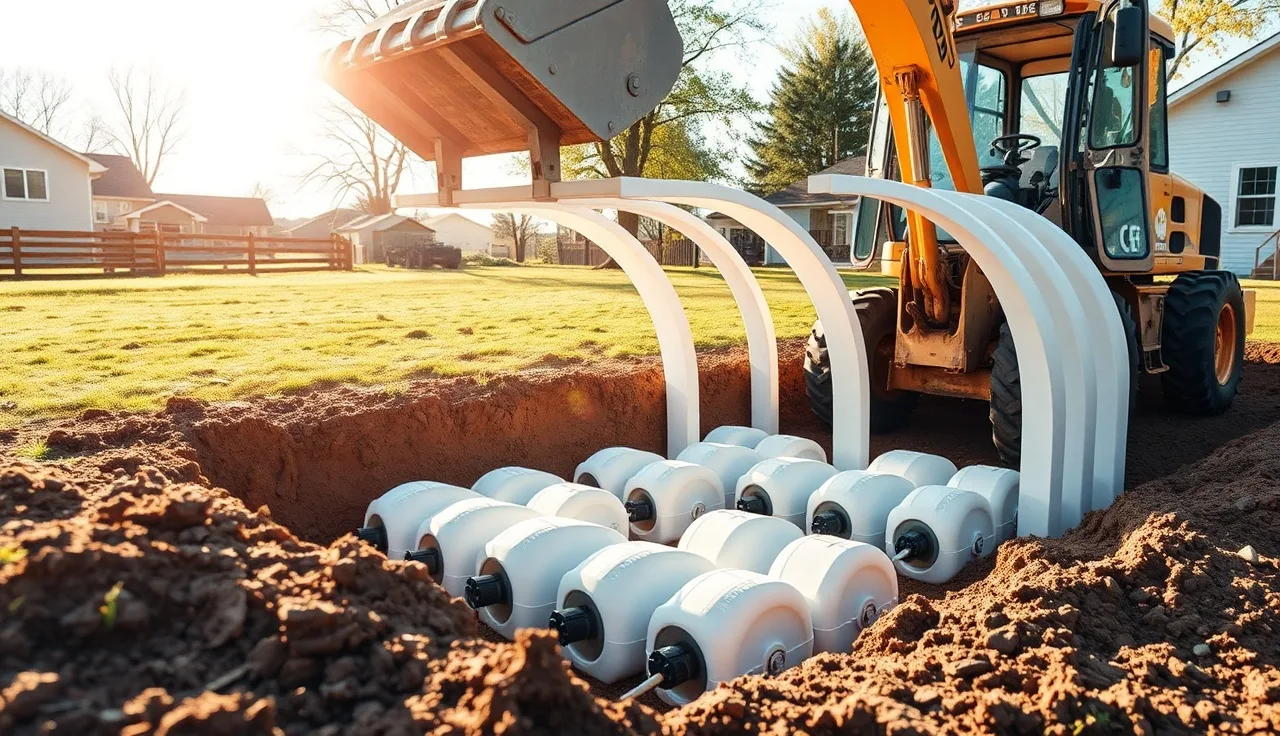
An Infiltrator drain field swaps the old gravel-and-perforated-pipe leach field for interlocking plastic arch chambers buried in trenches. Effluent from the septic tank flows into the chambers, spreads along the bare trench bottom, and soaks down through native soil where bacteria and soil organisms finish treatment. No gravel involved. The open-bottom design puts more soil contact per linear foot than gravel pipe does, and that single fact is why most states hand out a size reduction credit.
Infiltrator Water Technologies, based in Old Saybrook, Connecticut, brought the chamber system to market in the 1980s. Three product lines cover most residential work today: the Quick4 series (the everyday residential unit), the High Capacity (HC) series for tight lots, and the Arc36 for high-flow jobs. Chambers snap together end-to-end, end caps seal the terminations, and inspection ports drop into knockout openings on top so you can check for ponding without digging.
The physics are simple. Gravel-pipe systems lean on the stone bed to spread liquid around. Chambers let the liquid pool for a moment on bare soil, then percolate. That direct soil contact is the whole mechanism. It works well in sandy to silty loam. In slow-perc clay or fast-draining fractured rock, a standard chamber may be the wrong tool, and a good designer will tell you so before you spend a dime.
Want the fundamentals before the chamber specifics? The leach field article covers what a leach field is and how it fits the rest of the system.
What are the dimensions of a typical Infiltrator drain field?
Three inputs drive sizing: daily design flow (gallons per day, keyed to bedroom count), soil absorption rate from a perc test or soil morphology evaluation, and your state's sizing tables. The chambers have fixed footprints, so the designer picks a product and counts how many units fill the required trench area.
The Quick4 Standard chamber is 34 inches wide, 12 inches tall, and 4 feet long. It gives 6.8 square feet of infiltrative area per unit. The Quick4 Plus keeps the same width but stands 8 inches taller, adding storage volume for high water table sites. The High Capacity chamber runs 53 inches wide and delivers 11.05 square feet per unit, handy when you need to pack a large system into fewer, wider trenches [1].
Take a three-bedroom home generating roughly 300 to 450 gallons per day. In a state with moderate percolation (30 min/inch), a designer might size a gravel system at 450 to 600 square feet of infiltrative area. Switch to Quick4 chambers with the 40% size reduction many states allow, and that drops to around 270 to 360 square feet, or roughly 40 to 53 Quick4 units across two or three trenches [2].
Trench width equals chamber width plus any side clearance code requires. Most states want at least 2 feet of native soil between parallel trenches. Minimum trench lengths vary but commonly land at 50 to 100 feet per trench in residential installs.
| Chamber Model | Width | Length/Unit | Infiltrative Area/Unit | Typical Use |
|---|---|---|---|---|
| Quick4 Standard | 34 in | 4 ft | 6.8 sq ft | Residential, standard lots |
| Quick4 Plus | 34 in | 4 ft | 7.5 sq ft | High water table areas |
| High Capacity (HC) | 53 in | 4 ft | 11.05 sq ft | High-flow or tight lots |
| Arc36 | 36 in | 6 ft | 13.5 sq ft | Commercial, large residential |
Those are manufacturer specs [1]. Your state code may spell out which models it recognizes and what size credit it allows, so confirm with your designer before ordering materials.
Drain field dimensions are a local code question first and an engineering question second. Some states make you use the full gravel-equivalent area even with chambers. Others have adopted ASTM F2944 or an equivalent standard that defines the size reduction formula outright [3].
How do Infiltrator chambers compare to gravel-and-pipe systems?
The honest comparison covers installation cost, long-term performance, footprint, and how each one fails. Neither system wins across the board. It comes down to your soil, your budget, and your lot.
Gravel-and-pipe is the traditional build. A backhoe digs trenches 18 to 36 inches deep, workers shovel in 6 to 12 inches of washed stone, set perforated pipe on top, cover with more stone, and cap it with geotextile fabric. The gravel spreads flow and keeps soil out of the pipe. It works, and it has a multi-decade track record. The catch: gravel is heavy, delivery costs real money in remote areas, and biomat (the biological layer that forms between gravel and native soil) can clog faster when the system gets overloaded.
Chambers bring three practical advantages. Excavation is lighter because there is no gravel weight to manage. Delivery is simpler since plastic chambers stack on a flatbed. And the open bottom puts more native soil contact per foot of trench, which is exactly why the size reduction credit exists. A 2009 study in the Journal of Environmental Quality found chamber systems performed on par with stone-and-pipe on treated effluent quality under normal loading [4].
The main downside: chambers concentrate flow differently than gravel. If a pump fails and the field floods, a chamber field can go anaerobic faster than a gravel field with its distributed stone matrix. Chambers also need a flat or gently sloping trench bottom. Uneven excavation leaves some chambers partly unsupported, and that leads to cracking over time.
Cost differences are real but not dramatic. Gravel systems in most markets run $4,000 to $8,000 for a standard three-bedroom home. Chamber systems run $3,000 to $10,000 for the same home, with the low end possible when gravel trucking is expensive and the size reduction credit applies. Where local gravel is cheap, chambers may save you nothing.
The cost to install septic system article breaks down what drives septic pricing across the board.
What do Infiltrator drain fields cost?
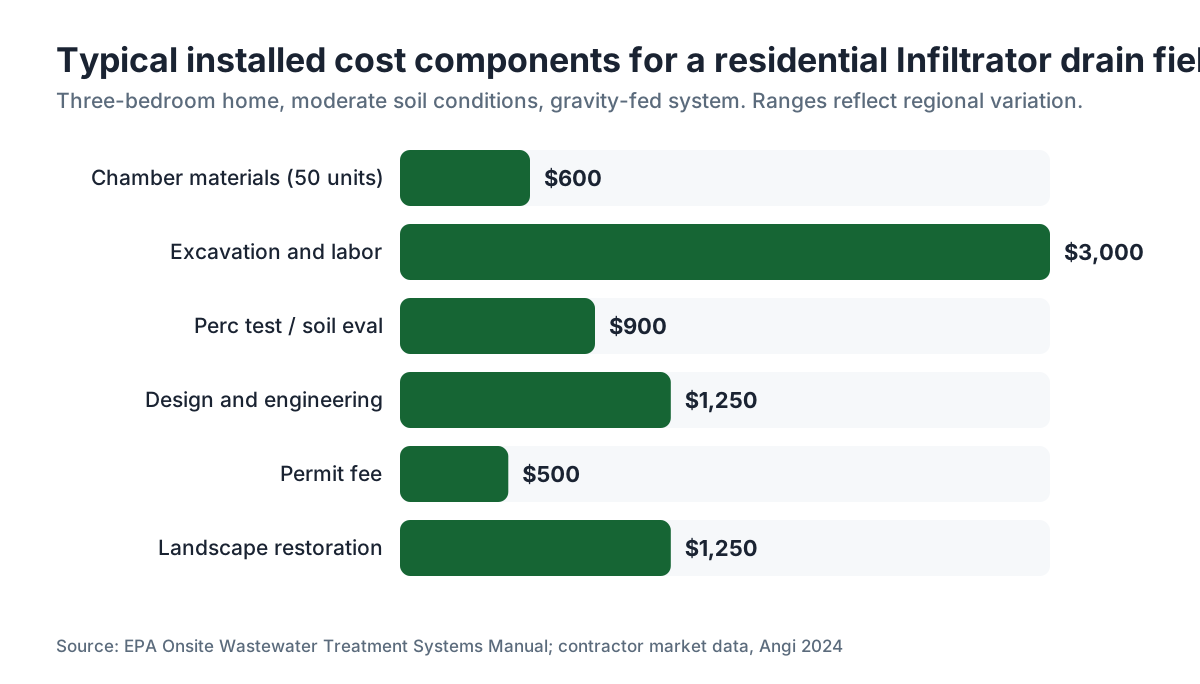
Quick4 Standard chambers run roughly $8 to $15 per unit depending on quantity and region. A 50-unit field spends $400 to $750 on chambers alone. That is cheap next to the total job. Labor, equipment, permits, design, and inspection fees eat most of the bill.
Total installed cost for a residential chamber drain field in 2024 runs from $3,000 on the low end (small system, easy soil, light permitting) to $10,000 or more for hard sites with high water tables, required pumps, or strict codes. The national median for a new leach field install of any type sits around $5,000 to $7,000 in contractor data compiled by Angi, though those numbers are self-reported and lean toward easier jobs [5].
What pushes cost up:
- Perc test or soil morphology evaluation: $300 to $1,500 depending on state requirements
- Design engineer or licensed designer fee: $500 to $2,000
- Permit fee: $200 to $800 at most county health departments
- Pump and dosing system if required: $1,500 to $4,000 extra
- Rock excavation if you hit it: $500 to $3,000 extra
- Restoring landscaping after install: $500 to $2,000
Replacing a failed system instead of building new? Expect the higher end, because the contractor also has to remove or abandon the old field and may reroute distribution lines. The cost to put in a septic tank article has context on the tank side of a full replacement.
One thing worth knowing: many states require a licensed engineer to stamp the design for any alternative system, and most states still classify Infiltrator chambers as an alternative system even though they are everywhere now. Ask your county health department before you assume the cheapest designer quote covers everything the law requires.
How long does an Infiltrator drain field last?
Infiltrator markets a 50-year design life, and the number shows up all over installer literature. The honest read: the plastic itself can last 50 years buried and shielded from UV. Whether the field as a system lasts that long depends almost entirely on how the soil under the chambers holds up.
Drain field failure is almost always soil failure, not chamber failure. The soil stops accepting effluent at the design rate for one of three reasons: biomat buildup from chronic overloading, hydraulic overload from water getting in (groundwater or surface runoff), or grease and solids that escaped the tank because nobody pumped it.
Well-maintained chamber fields in good soil routinely hit 25 to 40 years. The EPA SepticSmart program states that "a properly designed, installed, and maintained onsite septic system can last indefinitely," and it names regular pumping as the single most effective thing homeowners can do [6]. That is not marketing fluff. The systems that die at 10 to 15 years almost always have a history of missed pump-outs, heavy water use, or a tank that let solids slip through.
Chambers add one longevity edge gravel lacks: the chamber interior can sometimes be jet-washed and partly rehabilitated if early-stage biomat forms on the trench bottom. It is not a guaranteed fix, but it has bought field life in documented cases. A failed gravel field usually cannot be rescued mechanically.
Pump frequency is the biggest lever on field life. Most households need pumping every three to five years, and the exact interval depends on household size and tank volume. The how often to pump septic tank article has the full table by tank size and occupancy.
What soil types work with Infiltrator chamber systems?
Soil is the treatment engine. The chambers are just plumbing. That distinction shapes every design decision.
Infiltrator chambers work best in sandy loam, loamy sand, and silt loam with percolation rates between 1 and 60 minutes per inch. EPA onsite wastewater guidance uses the same range as the baseline for sizing conventional systems [7]. Soils faster than 1 min/inch (gravelly sands, some fractured soils) can let partly treated effluent reach groundwater before treatment finishes, and many state codes demand extra pretreatment before a drain field in soil like that. Soils slower than 60 min/inch (clays, silty clays) may not accept effluent fast enough even with the chamber's larger infiltrative surface, and an alternative system like a mound or drip field may be required.
Depth to seasonal high groundwater is regulated too. Most state codes want at least 24 inches of unsaturated soil between the trench bottom and the seasonal high water table, and some states require 36 to 48 inches [2]. Infiltrator's High Capacity and Plus chambers are built to work in shallower soil profiles by holding more effluent volume during peak flow, buying time for percolation between doses.
Get a licensed soil scientist or qualified designer to evaluate the site before the design is final. A perc test tells you the soil's current absorption rate under test conditions. A full soil morphology evaluation tells you more: long-term behavior, seasonal water table depth, soil layering. Some states have moved entirely to morphology-based sizing. Others still require timed perc tests. Check your state's onsite wastewater code before you assume which method applies.
How is an Infiltrator drain field installed step by step?
Sequence matters here. Doing steps out of order or cutting corners on trench prep is the most common reason a new system fails early.
- Site evaluation and design. A licensed designer stakes trench locations off the perc test, soil evaluation, and required setbacks from wells, property lines, structures, and water bodies. Setbacks vary by state but commonly include 100 feet from a well and 10 feet from a property line.
- Permit. The county health department (or equivalent authority) approves the design before any digging starts. Skip this and you void your homeowner's insurance coverage in most states, plus you create a mess at resale.
- Excavation. A backhoe or mini-excavator digs trenches to the designed depth, usually 18 to 36 inches. The trench bottom has to be level or gently sloped (2% max in most codes) and cannot be compacted or smeared by the bucket. Smearing seals the native soil and kills its infiltrative capacity before the system ever runs. If the inspector spots smeared walls, they will order scarification before any chambers go in.
- Chamber placement. Chambers snap together end-to-end in the trench. End caps go on the terminations. Inspection port knockouts get cut and the ports inserted. The plan specifies which end takes the distribution pipe inlet.
- Cover. Geotextile fabric goes over the top of the chambers to keep backfill from falling in through the vent ports. Then native soil or suitable fill is backfilled and mounded slightly for settling. No vehicles, no heavy equipment across the field once it is backfilled.
- Inspection. Most jurisdictions require a final inspection before burial finishes, so the inspector can check chamber placement, inlet elevations, and fabric installation. Schedule it ahead. Inspectors in busy seasons run 2 to 5 day wait times.
- Landscaping. Grass is the right cover. Deep-rooted plants, shrubs, and trees stay off the field. Root intrusion can crack chambers, though it happens less than with pipe systems.
Operators running multiple install crews often track inspection scheduling and permit status in job management software. SepticMind is built for septic contractors and includes permit and inspection tracking in its job workflow tools.
See septic tank installation for the tank side of a new system install.
Does an Infiltrator drain field need a pump?
Not always, but more often than homeowners expect. Whether you need a pump depends on the site's topography, the required trench depth, and local dosing rules.
Gravity works when the septic tank outlet sits high enough to deliver effluent downhill to the distribution box and into the trenches. On flat or gently sloping lots where the field is below the tank, gravity is fine. No pump, no moving parts in the ground, less to maintain.
Pressure distribution comes in when the lot is flat (effluent would pool in the nearest chambers instead of spreading), when the field sits uphill from the tank, or when state code mandates pressure dosing for chamber systems. A separate pump chamber (concrete or poly tank) sits between the septic tank and the field, and a float-controlled pump doses the field in timed cycles. That spreads effluent evenly and lets the soil rest between doses, which helps long-term performance.
A few states, including North Carolina and Virginia, require pressure distribution for drip and chamber systems in certain soil and site classifications regardless of topography [8][11]. If pressure dosing is in your design, budget for the pump chamber tank, the pump itself ($300 to $700), a control panel with alarms, and an annual pump inspection.
A failed pump means the field stops taking effluent. That sounds harmless until the tank backs up into the house, which can happen within 24 to 48 hours at normal household use. High-water alarms on the pump chamber are not optional. They are your early warning.
What maintenance does an Infiltrator drain field require?
The field itself needs almost no direct maintenance under normal conditions. The real work is keeping everything upstream of it in shape.
Pump your septic tank on schedule. This is the single most effective move you can make. A tank that goes too long lets solids carry over into the field, where they clog the soil pores the chambers depend on. Most three-to-four-person households need pumping every three to five years. Larger households or smaller tanks may need it every two years. The septic tank pumping article has the full schedule table.
Protect the surface. No vehicles, no deep-rooted plants, no construction equipment. Compaction crushes chamber arch walls and wrecks the soil structure underneath. The EPA SepticSmart program lists "keep vehicles and heavy equipment off your drainfield" as one of its core homeowner guidelines [6].
Divert surface water. Roof downspouts, sump pump discharge, and paved runoff must not drain toward the field. Saturated soil cannot accept effluent, and standing water for long stretches pushes the field toward the anaerobic conditions that speed up biomat.
Watch for warning signs. Slow drains, gurgling, sewage odors near the field, or wet patches over the trenches all say the field is stressed. Catch it early (often just an overdue pump-out or a pump system check) and you can reverse the damage. Wait until the system fully fails and you are almost always looking at full replacement.
Check the outlet filter if your tank has one. Most tanks installed after 2000 carry an effluent filter in the outlet baffle. Clean it every one to two years. A clogged filter throws the same backup symptoms as a failing field, and it is a five-minute fix.
For the tank-side picture, see septic tank cleaning and septic tank pump out.
Can an Infiltrator drain field be repaired or replaced?
Partial repair is sometimes possible. Full replacement is sometimes unavoidable. The site and the failure decide which.
If the failure is local, meaning one trench shows stress while the others run fine, a contractor may be able to rest the failing trench (divert flow to the others) and give it time to recover. Infiltrator chambers can be excavated, jet-washed, and relaid in some cases. This is not standard service and not every contractor offers it, but it has worked in documented early-failure situations.
If the whole field has gone from chronic overloading or systemic biomat, the realistic options are full replacement in a new spot on the property, or an engineered alternative system if there is no suitable land. Most properties are required to have a reserve drain field area identified when the original permit was issued, for exactly this reason. If that reserve got built over (a deck, a garage, a garden), your options shrink and your costs climb.
Replacing a drain field alone, without touching the tank, usually runs $4,000 to $12,000 for a residential system depending on size, site access, and state rules. Some states require a fresh perc test and full design even for a replacement in the reserve area.
Before you accept a full-replacement verdict, get a septic tank inspection and ask the inspector to camera the distribution lines. Failed fields get misdiagnosed all the time when the real culprit is a crushed pipe, a failed distribution box, or a blocked effluent filter. Fixing the upstream problem and resting the field has saved plenty of systems from an early grave.
See septic system repair and septic tank repair for the full repair decision framework.
Are Infiltrator systems approved in all states?
Nearly every state accepts Infiltrator chamber systems for residential use, but the approval conditions swing a lot from state to state. Infiltrator products carry NSF/ANSI 61 material certification and hold ICC-ES (International Code Council Evaluation Service) evaluation reports that most state health departments recognize [9][12]. Most approvals hinge on the system being designed and installed by a licensed septic designer or engineer and inspected by the local authority.
The size reduction credit, the main practical reason to choose chambers over gravel, is state-specific. Where states allow it, the standard credit is 40% of the infiltrative area a gravel system would need, based on the expanded infiltrative bottom area. Some states allow no reduction and make you design to the same square footage as gravel. A few states run their own chamber sizing tables that differ from the Infiltrator engineering manual.
States with documented Infiltrator approval and size credits as of 2024 include Massachusetts (Title 5 allows chambers under specific conditions [10]), North Carolina, Virginia, Florida, and most Midwestern states. California regulates septic at the county level, so approval and credits vary county by county.
The EPA does not directly approve drain field products. That authority sits with state and local health departments. The EPA's SepticSmart initiative and its onsite wastewater guidance give states language they often reference in their codes, but approval is always a state-level call [7].
Verify current approval status with your state's onsite wastewater program before you specify Infiltrator chambers in a design. Conditions change, and a state's recognized product list usually lives on its environmental or health department website. Operators running projects across multiple jurisdictions know that tracking state-by-state code differences eats a lot of hours. SepticMind's job management platform lets contractors attach jurisdiction-specific compliance notes to each project so nothing slips.
What are the most common Infiltrator drain field problems?
Most problems trace back to the same root causes that sink every drain field, plus a few chamber-specific ones.
Biomat buildup leads the list. Biomat is a dense layer of anaerobic bacteria and their byproducts that forms at the soil-effluent interface. In small amounts it is normal and even helps treatment. It turns into a problem when it grows faster than aerobic soil activity can break it down, which happens when loading rates run too high or the system gets little rest between doses. Chambers do not build biomat faster than gravel. The rate tracks hydraulic and organic loading, not the chamber material.
Chamber flotation is real but uncommon. In high water table areas, chambers that are not properly ballasted or backfilled during construction can float when groundwater rises. Most state codes require the chamber bottom invert to sit at least 24 inches above the seasonal high water table specifically to head this off [2].
Cracked or collapsed chambers from vehicle traffic happen more than they should. Standard Quick4 chambers are rated for H-20 wheel loading during installation but not for sustained traffic. Once backfilled, the field has to stay off-limits to vehicles for good. A single pass from a riding mower is fine. A delivery truck is not.
Improper inlet elevation causes short-circuiting. If the distribution pipe inlet sits at the wrong height relative to the chamber bottom, effluent runs straight to the last chambers in the trench instead of spreading evenly. That overloads the end of the field and starves the front. A sharp inspector catches this at installation. After backfill it is nearly impossible to fix without digging everything back up.
For repair options once problems set in, see the septic system repair guide.
Frequently asked questions
How many Infiltrator chambers do I need for a three-bedroom house?
A three-bedroom home typically generates 300 to 450 gallons per day of design flow. With a moderate soil perc rate around 30 minutes per inch and a 40% size reduction credit, most designers land on 40 to 60 Quick4 Standard chambers for a standard residential job. Your actual count depends on your state's sizing table, your soil perc rate, and which Infiltrator model the designer picks. Have a licensed designer run the numbers for your site.
Can I install an Infiltrator drain field myself?
In most states, no. The design has to come from a licensed designer or engineer, and the installation has to be inspected and approved by the local health department. Some rural states allow owner-builder permits under specific conditions, but you still need a permitted design and a final inspection. Installing without a permit is illegal in nearly every jurisdiction and creates major problems when you sell. Call your county health department first.
How deep should Infiltrator chambers be buried?
Typical burial puts the top of the chamber 6 to 12 inches below finished grade, with the chamber bottom at 18 to 36 inches depending on soil and local code. Minimum cover over chambers is commonly 6 inches of soil per state rules. Depth to the seasonal high water table must be at least 24 inches below the chamber invert in most states. Your site-specific design spells out the exact elevations.
Do Infiltrator chambers smell or attract pests?
A properly installed, functioning chamber field produces no detectable odor at the surface. Odors mean either a system problem (failing field, flooded trenches) or badly vented distribution plumbing. Chambers are sealed except at the inlet, outlet, and inspection ports, so pest access is limited. If you smell sewage near the field, treat it as an early warning sign and schedule an inspection rather than waiting it out.
Can tree roots damage Infiltrator chambers?
Yes, though it happens less than root damage to perforated pipe. Plastic chamber walls resist root penetration better than pipe joints, but roots can enter through inspection port openings and end caps if seals break down over time. Keep aggressive-rooted trees (willows, silver maples, cottonwoods) at least 30 to 50 feet from the field and ornamental shrubs at least 10 feet away. Grass and shallow-rooted groundcovers are the right surface planting for a drain field.
What is the difference between an Infiltrator Quick4 and a Quick4 Plus chamber?
Both are 34 inches wide and 4 feet long. The Quick4 Plus stands 8 inches taller than the Standard, giving it roughly 50% more interior storage volume. That extra volume adds surge capacity during peak daily flow and helps most on sites with shallow depth to groundwater where you need more time between doses. The Plus costs a bit more per unit but may let you use fewer chambers in a pressure-dosed design.
How often should an Infiltrator drain field be inspected?
There is no universal code requirement for routine field inspections beyond the permit inspection at installation, but most septic pros suggest a visual check every three to five years, timed with your tank pump-out. During the pump-out, the pumper should check the distribution box (if present) and the field inlet for solids carryover. If your system has a pump chamber, annual inspection of the pump and floats is standard practice.
Will an Infiltrator drain field work in a cold climate?
Yes. Infiltrator chamber systems are used widely in cold climates, including the upper Midwest, New England, and Canada. The main cold-climate worry is frost reaching shallow systems. Proper cover depth and steady use of the system (wastewater flowing through the field generates biological heat) prevents freeze problems in most cases. Seasonal or vacation properties that sit unused for months are more prone to freeze issues than year-round homes.
What setback distances apply to an Infiltrator drain field?
Setbacks are state and county specific, but typical minimums include 100 feet from a drinking water well, 10 to 25 feet from a property line, 10 to 20 feet from a structure foundation, 25 to 50 feet from a surface water body, and 5 to 10 feet from a septic tank. Some states set tighter setbacks in protected wellhead areas or near wetlands. Your permit application requires the designer to document all setback compliance on the site plan.
Does an Infiltrator drain field require a distribution box?
Not always. Gravity systems sometimes route effluent from the tank outlet to a distribution box that splits flow evenly among trenches. Pressure-dosed systems use a pump chamber and manifold piping instead of a traditional D-box. Some single-trench systems connect the tank outlet straight to the first chamber with no D-box at all. Which approach you get depends on the design, local code, and the number of trenches in the field.
Can an Infiltrator drain field be used with an aerobic treatment unit (ATU)?
Yes, and the pairing is common where soil conditions require pretreatment. An ATU delivers clearer effluent, lower in suspended solids and BOD, than a conventional septic tank, which cuts the organic loading on the field and can stretch its service life. Some states allow smaller field sizing when an ATU sits upstream. Infiltrator chambers work with ATU effluent. Confirm the ATU output quality meets your state's requirements for any field sizing credit.
Is an Infiltrator drain field the same as a leach field?
Functionally yes, technically no. A leach field (or drain field) is the generic term for the soil dispersal part of a septic system. An Infiltrator drain field is one specific type that uses plastic arch chambers instead of gravel and perforated pipe. All Infiltrator drain fields are leach fields, but not all leach fields use Infiltrator chambers. People use the terms interchangeably in casual conversation.
What happens if I pave over an Infiltrator drain field?
Paving over any drain field is prohibited by state and local code almost everywhere, and it is one of the worst things you can do to a septic system. Impermeable surfaces block the oxygen exchange the soil needs for aerobic treatment, stop evapotranspiration, and steer surface runoff onto the field. It also makes the field impossible to inspect or repair. If a prior owner paved over your field, stop using the paved area and call your local health department.
Sources
- Infiltrator Water Technologies, Quick4 Chamber Product Specifications: Quick4 Standard chamber dimensions: 34 inches wide, 4 feet long, 6.8 sq ft infiltrative area per unit; HC chamber 53 inches wide, 11.05 sq ft per unit
- U.S. EPA, Onsite Wastewater Treatment Systems Manual (EPA/625/R-00/008): Standard sizing tables for soil absorption systems; 24-inch minimum vertical separation to seasonal high water table and typical daily design flows by bedroom count
- ASTM International, Standard F2944 for onsite drain field leaching chambers: ASTM F2944 defines the standard method for sizing reduction credit for chamber systems compared to conventional gravel-pipe systems
- Journal of Environmental Quality (Wiley), performance study of conventional and alternative leaching systems in Massachusetts, 2009: Chamber systems performed comparably to stone-and-pipe systems in effluent quality under normal loading conditions
- Angi, Septic System Installation Cost Guide: National median contractor-reported cost range for leach field installation of approximately $5,000 to $7,000 for residential systems
- U.S. EPA, SepticSmart Program homeowner guidance: EPA SepticSmart states 'a properly designed, installed, and maintained onsite septic system can last indefinitely' and lists regular pumping and keeping vehicles off the drainfield as core homeowner practices
- U.S. EPA, SepticSmart soil and site evaluation guidance: EPA guidance specifies percolation rates of 1 to 60 minutes per inch as the standard range for conventional soil absorption system sizing
- North Carolina Department of Environmental Quality, Wastewater Section septic system rules (15A NCAC 18A .1900): North Carolina requires pressure distribution for chamber systems in specified soil conditions and system types
- ICC Evaluation Service (ICC-ES), evaluation reports for Infiltrator chamber systems: Infiltrator chamber products hold ICC-ES evaluation reports recognized by most state health departments for alternative drainfield approval
- Massachusetts Department of Environmental Protection, Title 5 Regulations (310 CMR 15.000): Massachusetts Title 5 allows chamber leaching systems with specific design and installation conditions
- Virginia Department of Health, Sewage Handling and Disposal Regulations (12VAC5-610): Virginia requires pressure distribution for alternative drainfield systems including chambers in certain soil and site classifications
- NSF International, NSF/ANSI 61 Drinking Water System Components Health Effects standard: Infiltrator Water Technologies products hold NSF/ANSI 61 material certification relevant to septic system component approvals
Last updated 2026-07-09