Infiltrator septic systems: how they work, what they cost, and when to choose one
By the SepticMind Editorial Team
TL;DR
- Infiltrator systems use plastic arch-shaped chambers instead of gravel-filled trenches to spread septic effluent into the soil.
- The drain field portion usually costs $3,000 to $10,000 installed, depending on size and soil.
- Chambers need less excavation than gravel, carry approval in all 50 states, and last 25-plus years if you pump the tank on schedule.
What is an Infiltrator septic system and how does it work?
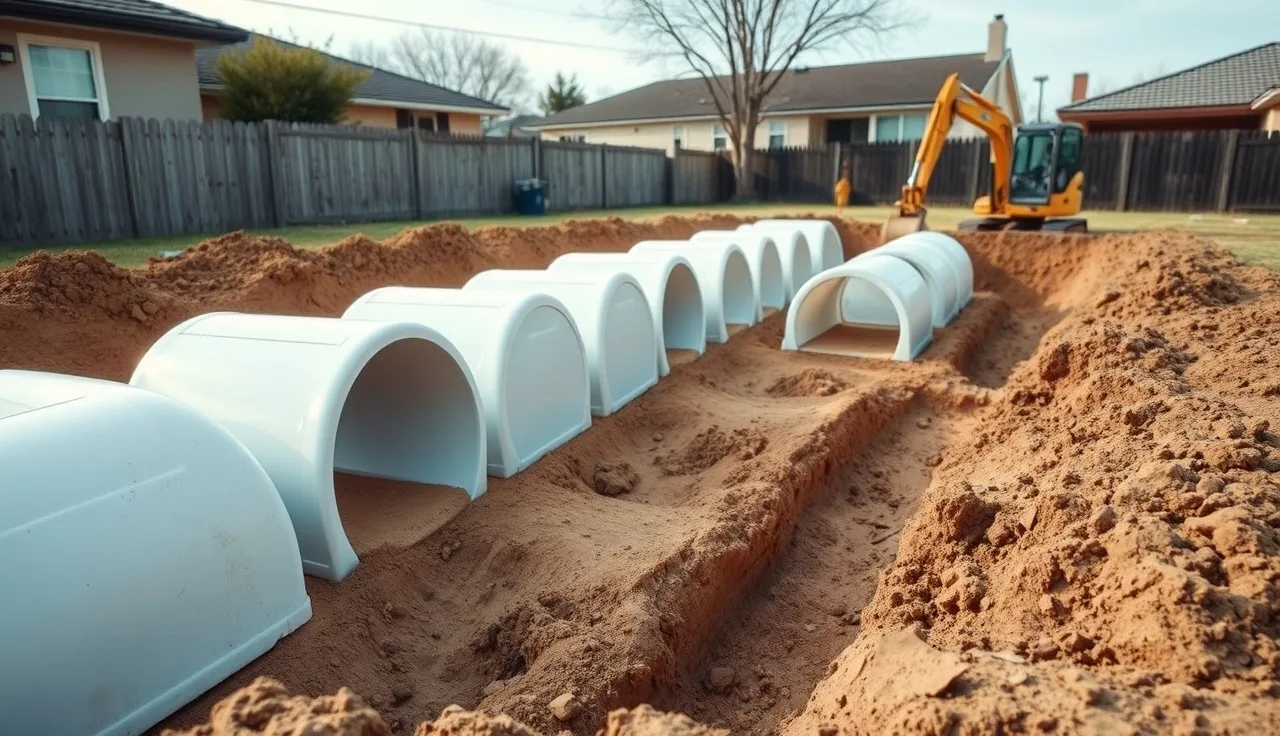
An Infiltrator system is a chamber-based leach field. Instead of filling trenches with crushed stone and laying perforated pipe on top, you snap together hollow plastic arches, bury them in trenches, and let effluent flow through the open bottom straight into native soil. Infiltrator Water Technologies (headquartered in Old Saybrook, Connecticut) makes the most widely installed chamber product in North America. Their Quick4 and IM-Series chambers show up on most residential jobs.
Here is the actual process. Wastewater leaves the house, settles in the septic tank where solids drop out and scum floats, then liquid effluent flows into the distribution box or header pipe and out to the chambers. Inside each chamber, effluent ponds briefly, then percolates down through the soil interface at the chamber bottom. Aerobic bacteria in the top few inches of native soil (the biomat zone) treat pathogens before the water reaches groundwater [1].
What chambers do differently from gravel is give effluent far more open soil surface. A standard Infiltrator Quick4 Plus chamber exposes about 6.8 square feet of infiltrative surface per linear foot of trench. Gravel-and-pipe systems expose roughly 4 to 5 square feet per linear foot once you account for fines migration and gravel voids clogging over time. That gap is why most state codes let chamber systems run 20% to 50% smaller than an equivalent gravel system for the same daily flow [2].
The chambers are ribbed HDPE, rated for H-10 traffic loading (light vehicle loads) or H-20 (full AASHTO truck loads) depending on the product line. They nest for shipping. One pickup can carry enough chambers for an average residential field.
How does an Infiltrator chamber system compare to a traditional gravel leach field?
It comes down to installation speed, sizing, cost, and long-term performance. Neither wins across the board. Which one makes sense depends on your lot, your soil, and your local installer's experience.
| Factor | Infiltrator chambers | Gravel-and-pipe trench |
|---|---|---|
| Typical trench footprint | 20 to 50% smaller (state-dependent) | Baseline |
| Gravel needed | None | 10 to 20 tons for average home |
| Installation time | 1 to 2 days (average residential) | 2 to 4 days |
| Biomat formation | Slower, more gradual | Can form faster under gravel fines |
| Traffic tolerance | H-10 to H-20 rated | Gravel spreads load but pipe can crack |
| Inspection access | Chambers can be opened | Perforated pipe requires camera |
| Cost difference | Often similar; gravel price swings it | Gravel cost is highly regional |
| State approvals | Approved in all 50 states [3] | Universal |
Gravel is still the right call on some jobs. Cheap crushed stone nearby, a long-established gravel installer, and restrictive local code that hasn't credited chamber sizing reductions yet can all tip the math toward gravel. On rocky sites where every hour of excavation costs money, the smaller chamber footprint saves real cash because you dig less.
One honest caveat: chambers are not magic. If your soil perc rate is poor (slower than about 60 minutes per inch) or you have a high seasonal water table, neither chambers nor gravel will work without engineered fill, mounding, or an ATU. The infiltrative capacity of the native soil limits both designs.
How much does an Infiltrator septic system cost?
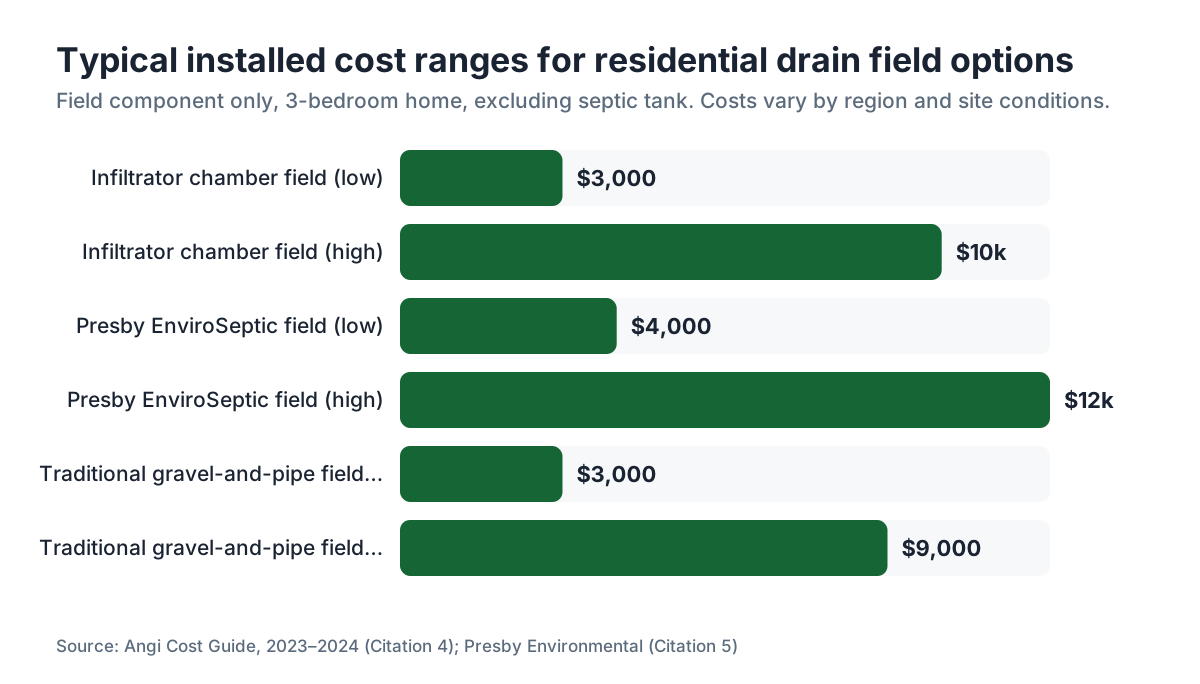
The drain field portion of an Infiltrator system usually runs $3,000 to $10,000 installed for a standard 3- to 4-bedroom home. That range hides real variation. Labor rates swing hard by region. So does access: a flat backyard with room for equipment costs less than a slope with tight clearance.
Here is roughly where the money goes on a chamber-only leach field replacement (tank not included):
- Chamber materials: $500 to $1,500 for a 3-bedroom system (roughly 200 to 400 linear feet of trench)
- Excavation and backfill: $1,200 to $4,000 depending on soil type and site access
- Distribution box or manifold: $150 to $400
- Inspection pipe caps and end caps: $100 to $300
- Permits and perc test (if not already done): $300 to $1,000
- Installer labor: $800 to $2,500
For a full new septic system (tank plus Infiltrator field), budget $8,000 to $20,000+ in most U.S. markets. Replacing only the leach field while keeping a sound tank keeps you inside that $3,000 to $10,000 window [4]. For total installation budgets, see our guide on cost to install septic system.
The Presby EnviroSeptic system (a competing chamber-like product using fabric-wrapped pipe in proprietary layers) runs roughly $4,000 to $12,000 for the field component. Presby septic system cost typically runs 10% to 20% higher than a comparable Infiltrator installation because the Presby design includes multiple pipe rows and a specific engineered sand layer, which adds labor [5]. Both products carry approval in most states and perform comparably in the right soil.
When you compare bids, make each one cover the same scope: materials, excavation, backfill to grade, distribution manifold, permits, and final inspection. Bids that leave out permits look cheaper but aren't.
Operators tracking job cost per linear foot of trench across a fleet of installs can use tools like SepticMind to compare actual installed cost against estimated cost at the job level.
What size Infiltrator system do I need for my home?
Sizing comes from three inputs: daily sewage flow, soil percolation rate, and your state's sizing table for chamber systems. Most state codes size residential systems by bedroom count as a proxy for occupancy, then apply a soil application rate from the perc test [6].
A 3-bedroom home generates a design flow of 300 to 450 gallons per day under most state rules (EPA's model uses 150 gallons per bedroom per day as a starting point [1]). With a soil application rate of 0.8 gallons per square foot per day (typical for a 30-minute perc), you need 375 to 560 square feet of infiltrative bottom area. In a standard 2-foot-wide chamber trench, that works out to roughly 188 to 280 linear feet of chamber. Most state codes allow a 20% to 40% reduction against gravel sizing for approved chamber products, so the actual required trench length often lands around 150 to 220 linear feet in that scenario.
A few things change the math fast:
- Slow soil (60+ min/inch perc): required area jumps; some states require alternate technology
- Multiple distribution rows: some designs run two parallel rows per trench, halving trench length but widening the trench
- Pressure distribution: some codes require or allow pressure-dosed systems, which change the sizing model
- Setbacks: well setbacks (typically 50 to 100 feet), property lines (typically 10 to 20 feet), and structure setbacks all constrain where trenches go and sometimes force longer or extra trenches
Your designer or installer pulls the real sizing from your state's specific table and your perc results. Don't rely on generic rules of thumb for permit applications. The local number is the only one that gets you approved.
What are the pros and cons of Infiltrator chamber systems?
The honest list, from years of field use across the industry.
Pros:
- Smaller footprint than gravel for the same design flow, which matters on tight lots
- No gravel to haul, which cuts truck trips and cost where aggregate is expensive
- Faster installation, often one day for a residential field
- Easy to inspect: pull an end cap and look inside; you can see standing water or root intrusion directly
- Long track record; Infiltrator has sold chambers since the late 1980s and the line has millions of installations across North America [3]
- HDPE does not corrode or crack under normal conditions
- H-20 rated options exist for areas near driveways
Cons:
- The open bottom that makes chambers work also invites roots, so they can fill with roots faster than perforated pipe in gravel when large trees are nearby
- In very coarse or sandy soil, effluent may pass through the biomat zone too quickly; that is a soil mismatch, not a product defect, but it affects system selection
- Some inspectors in older markets know chamber systems less well and may apply outdated sizing skepticism
- Chambers float before backfill; they need anchoring or partial water-filling on high-water-table sites during installation
- Not right in every soil type; rocky ledge or tight clay still needs engineered alternatives
Most of the cons are installation-process issues, not fundamental product problems. The track record is solid.
Is an Infiltrator system approved in my state?
Yes. Infiltrator chamber systems have general use approval in all 50 states and in most Canadian provinces [3]. But "approved" does not mean sized the same way everywhere. Each state's onsite wastewater code sets its own sizing reduction credit for chambers versus gravel. A few examples:
- Florida Rule 64E-6, F.A.C.: permits chamber systems with a 50% reduction in absorption area compared to gravel [7]
- Texas 30 TAC Chapter 285: approves chamber systems; sizing credit varies by chamber type and soil loading rate
- North Carolina 15A NCAC 18E: approves chambers; credits depend on chamber model and soil texture class
- Massachusetts Title 5 (310 CMR 15.000): allows chambers; requires soil evaluation and specific setbacks [8]
EPA's SepticSmart program treats alternative drainfield technologies, including chamber systems, as part of proper onsite system management [1]. The agency does not set national sizing rules (that authority sits with states), but its guidance supports chamber technology as a proven option.
In a coastal zone, a wellhead protection area, or a nitrogen-sensitive watershed (common in parts of New England, the Mid-Atlantic, and Florida), extra treatment requirements may apply no matter what the chamber approval says. In those areas, a conventional Infiltrator field may need an advanced treatment unit (ATU) to meet nitrogen limits.
Always pull your specific state and county code before designing. Your local health department or onsite wastewater regulatory body is the source of truth.
How do you install an Infiltrator chamber system?
A licensed installer does this work; most states require a licensed contractor or designer for permitted septic work. Understanding the process still helps you check that the job is done right.
Step 1: Layout and excavation. Trenches run 18 to 36 inches wide and 24 to 48 inches deep, depending on chamber height and required soil cover. The trench bottom must be level within 1/4 inch per 4 feet. Chambers need a flat bed.
Step 2: Soil preparation. The excavator scarifies (scratches) the trench bottom with the bucket teeth to prevent a smeared, compacted surface. This step matters. A glazed trench bottom cuts infiltration rate hard.
Step 3: Chamber assembly. Chambers snap together at the end ports. End caps close off each trench run. Inspection risers go in at set intervals (typically every 100 feet or per local code). The whole structure is surprisingly rigid once assembled.
Step 4: Inlet connection. The distribution box or manifold feeds the first chamber through a 4-inch PVC inlet fitting. Pressure distribution systems use a network of small-diameter laterals with orifice shields instead.
Step 5: Backfill. Native soil goes back over the chambers in lifts, compacted lightly by hand or a plate compactor set to low pressure. Over-compaction cracks chamber ribs. Final cover is typically 6 to 12 inches of soil; some codes want more.
Step 6: Inspection and permit sign-off. The local inspector usually wants to see the chambers before backfill. Backfill early and you may have to dig them up again.
Total time for a standard 3-bedroom residential field: 6 to 10 hours for an experienced crew.
For what goes into a full new system, see septic tank installation.
How do you maintain an Infiltrator system?
Maintenance for a chamber system is essentially the same as for any gravity septic system. The chambers themselves need no direct service. What matters is keeping the tank healthy and not drowning the field.
Pump the tank on schedule. For most households, that means every 3 to 5 years [1]. Solids that escape the tank and reach the chambers cannot come out without excavation. A floating scum layer that reaches the outlet baffle pushes grease and solids into the field and kills the biomat zone. See our guide on how often to pump septic tank for household-specific schedules.
Water conservation matters. A chamber system sized for 300 gallons per day fails faster if you consistently push 500 through it. Fix dripping faucets, spread laundry loads across the week, and put in a 1.28-gpf toilet if you haven't already.
Don't park on the field or plant deep-rooted vegetation over it. Grasses and shallow groundcovers are fine. Trees and large shrubs chase moisture and will eventually reach the chambers through the open bottom or the end joints.
Skip the septic additives that promise to "restore" your field. EPA's SepticSmart guidance warns that biological additives have not been proven to help properly operating systems and may cause problems in some cases [1]. Your money does more good going toward the next pump-out.
Inspect the system once a year if you can. That means checking the tank level, confirming the outlet baffle is intact, and looking for wet spots or odors over the field. Septic tank inspection and septic tank cleaning do the most to extend field life.
Service operators managing recurring maintenance across multiple properties can track pump intervals, inspection notes, and service history in platforms like SepticMind, built for onsite wastewater contractors.
What are the signs an Infiltrator system is failing?
A failing chamber system looks like any failing drain field: the soil is saturated and can't take more effluent. Watch for one or more of these:
- Wet, spongy, or standing-water patches over the field lines, especially after heavy rain or heavy water use
- Sewage odor in the yard, particularly over the trench runs
- Slow drains or backups inside the house when nothing is visibly clogged
- Lush, unusually green grass directly over the field (nutrient-rich effluent is reaching the surface)
- Sewage odor or discoloration in a nearby ditch or waterway
Before you write off the chambers, rule out upstream problems. A clogged or full septic tank dumps raw sewage into the field; pump the tank first and see if the symptoms clear [9]. A failed distribution box that funnels all the flow into one trench can drown that trench while the others stay dry; redistributing flow sometimes buys real years of life.
True chamber failure (clogged biomat, root intrusion, hydraulic overload) usually can't be reversed by resting the field alone, though resting for 6 to 12 months sometimes restores partial function in mild cases. Aerobic biomat remediation products (high-pressure air injection, chemical oxidation) have mixed evidence and are not endorsed by EPA or most state agencies.
If the field is genuinely dead, see septic system repair for your options, which run from field replacement to advanced treatment units to mound systems.
How long does an Infiltrator system last?
Nobody has good data on this. There is no large-scale published lifespan study specific to Infiltrator chambers, and anyone who quotes a precise number with confidence is guessing. The honest picture: properly maintained chamber systems have been in service since the late 1980s without documented failure rates that differ meaningfully from gravel systems.
The HDPE material itself does not degrade in soil. It outlasts the functional life of the system. What eventually limits a chamber system is the same thing that limits any drain field: progressive clogging of the soil interface by biomat growth, fine particles, and biological buildup. That timeline depends almost entirely on how well the tank is maintained and whether the field gets hydraulically overloaded.
Infiltrator's published guidance points to a design life of 25 to 30 years under proper use [3]. State regulators that accept chamber systems generally do so on the premise that longevity matches gravel systems, which typically last 20 to 30 years with proper pumping and 10 to 15 years without it.
The single best thing you can do to stretch lifespan is pump the tank on schedule. A study published in Small Flows Quarterly found that tanks never pumped showed roughly 50-fold higher suspended solids loading to the drain field than tanks pumped on schedule (nobody has replicated this with chamber-specific data, but the mechanism is the same regardless of field type) [10].
For what a full leach field replacement costs when a system reaches the end of its life, that guide covers your options.
Can you replace a failed septic system with an Infiltrator system?
Yes, and it's one of the most common Infiltrator applications. Many homeowners who had a failing gravel system in the 1990s or 2000s replaced it with chambers during the repair, partly because the sizing credit fit tighter spaces and partly because the no-gravel install was faster and sometimes cheaper.
The replacement follows the same permitting path as a new install: perc test or soil evaluation, design by a licensed professional, permit from the local health department, installation by a licensed contractor, and final inspection. You can't just drop chambers into old gravel trenches. Those trenches are biologically loaded and may have compromised soil structure.
On a small lot, the sizing reduction chambers qualify for under your state code can be the deciding factor. On a half-acre lot with setbacks eaten up by a well, house, and property lines, a 30% smaller field footprint can be the difference between a feasible repair and condemning the system.
Alternate area (a second reserve field location) requirements vary by state. Some states require you to identify and protect a repair area equal to 100% of the primary field; others require only 50%. Check this before designing. It affects where you can put the primary field.
For cost benchmarks on repair versus replacement, see septic system repair and septic tank repair.
Frequently asked questions
What is the Infiltrator Quick4 chamber and how does it differ from the IM-Series?
The Quick4 is Infiltrator's standard residential chamber, roughly 4 feet long, 16 to 34 inches wide depending on the variant, and about 12 inches tall. The IM-Series (Infiltrator Max) is taller and wider, built for sites that need higher flow capacity per trench foot or deeper installation. IM chambers expose more infiltrative area per unit length, which can cut trench count on large systems. Both snap together without tools.
Does an Infiltrator system need a pump?
Not necessarily. Gravity-fed Infiltrator systems work fine when the house elevation lets flow reach the tank and field by gravity. You need a pump chamber (a dosing tank with a submersible effluent pump) when the field sits uphill from the tank or when the design calls for pressure distribution to spread effluent evenly. Some states require pressure distribution above certain soil-loading rates. Ask your designer; a pump adds $800 to $2,500 to the project.
Can I install an Infiltrator system myself?
In most states, no. Onsite wastewater installation requires a licensed contractor and a permit, and inspectors verify the work before backfill. A handful of rural counties allow owner-builder permits with oversight, but that's the exception. Beyond licensing, the work needs an excavator, precise leveling, and soil scarification steps that are easy to botch without experience. Installation errors void most approval benefits and can cause early field failure.
How does an Infiltrator system handle a garbage disposal?
A garbage disposal roughly doubles the solids load to the tank, which speeds up tank filling and sharply raises the risk of solids reaching the field. Most septic pros advise against disposals on any septic system, including Infiltrator. If you insist on one, plan to pump the tank at least twice as often as usual, probably every 1 to 2 years instead of 3 to 5.
Will Infiltrator chambers crack under vehicle traffic?
Standard Quick4 chambers carry an H-10 rating (up to 10,000-lb axle loads) with a minimum 12 inches of cover. Infiltrator's HP (high-profile) and IM-Series chambers are H-20 rated (20,000-lb axle loads) with proper cover. Never drive heavy equipment over non-rated chambers without engineered protection. Check the specific product data sheet for your installed chamber; ratings are not interchangeable between models.
How does an Infiltrator system compare to a mound system?
A mound system builds the drain field above grade in engineered fill when native soil is too poor or the water table is too high for in-ground installation. An Infiltrator chamber system needs adequate native soil below grade. If your perc results are marginal or your seasonal high water table sits within 18 to 24 inches of the surface (thresholds vary by state), a mound or drip-irrigation system may be required no matter which chamber brand you pick.
What is the difference between an Infiltrator system and a Presby system?
Infiltrator uses hollow arch chambers with an open bottom, so effluent contacts the soil directly under each chamber. Presby EnviroSeptic uses fabric-wrapped perforated pipe surrounded by proprietary engineered sand layers. Presby claims aerobic treatment inside the system itself before effluent reaches native soil. Both are approved in most states. Presby septic system cost runs roughly 10% to 20% higher than a comparable Infiltrator install. Performance data comparing the two in similar soils is limited.
How often do I need to pump a septic tank connected to an Infiltrator system?
Same schedule as any septic system: every 3 to 5 years for a typical 3- to 4-bedroom household with a 1,000-gallon tank. The chamber design doesn't change tank pumping frequency. What changes it is household size, water use, and whether you run a garbage disposal. See our full guide on how often to pump septic tank for a household-specific calculation.
Do Infiltrator chambers clog with roots?
Yes, they can. The open-bottom design that makes chambers effective at soil contact also invites root intrusion from nearby trees and large shrubs. Keep trees at least 20 to 30 feet from field lines (check your state code for the required setback). Willows, poplars, silver maples, and other water-seeking species are the worst offenders. If roots get into chambers, removal means excavation; there's no reliable chemical treatment that clears roots without also killing the biomat.
Can an Infiltrator system be used for a new construction home?
Absolutely, and it's one of the most common choices for new construction. Designers like chambers for new builds because the smaller footprint keeps usable yard space and the no-gravel install goes faster. The permitting process is identical to any new septic system: soil evaluation, engineered design, permit, licensed installation, and inspection. Get the soil evaluation done before you finalize a lot purchase if septic is required; poor soil can make the project infeasible or very expensive.
What happens to an Infiltrator system during heavy rain or flooding?
Saturated soil can't accept effluent, regardless of field type. During long rain events or soil saturation, the water table rises and temporarily wipes out the treatment zone above it. This is not an Infiltrator-specific failure; all gravity drain fields react the same way. Cut household water use during extended wet spells. If the system backs up, minimize water use and wait for the soil to drain. Persistent wet-season failures point to a seasonal high water table too close to the chambers.
Is an Infiltrator system good for a vacation home or seasonal property?
Generally yes, with one caveat. Intermittent use means the biomat (the bacterial layer that treats effluent) may dry out and partially die between visits. When you return and flush the system, raw effluent may pass through with less treatment until the biomat rebuilds. This isn't unique to chambers; it affects all onsite systems. Size the tank for peak occupancy, not average use, and pump before extended shutdowns if the tank is near capacity.
Sources
- U.S. EPA, SepticSmart: Protect Your Investment: EPA SepticSmart recommends pumping every 3 to 5 years and warns against biological additives; uses 150 gallons per bedroom per day as design flow baseline
- U.S. EPA, Onsite Wastewater Treatment Systems Manual (EPA/625/R-00/008): Chamber systems provide greater infiltrative surface than gravel and are commonly credited with sizing reductions in state codes
- Infiltrator Water Technologies, Product Overview: Infiltrator chambers are approved in all 50 states; company has been selling chambers since the late 1980s with millions of installations; published design life is 25 to 30 years
- Angi, Septic System Installation Cost Guide: Leach field replacement typically costs $3,000 to $10,000; full septic system installation ranges $8,000 to $20,000+ depending on system type and region
- Presby Environmental, EnviroSeptic System Overview: Presby EnviroSeptic uses fabric-wrapped pipe in engineered sand layers; installation cost is typically 10 to 20 percent higher than comparable Infiltrator systems
- U.S. EPA, Onsite Wastewater Treatment Systems Manual (EPA/625/R-00/008): Residential septic system sizing based on bedroom count as proxy for occupancy; perc rate determines soil application rate and required infiltrative area
- Florida Department of Health, Chapter 64E-6 F.A.C., Standards for Onsite Sewage Treatment and Disposal Systems: Florida Rule 64E-6 permits chamber systems with a 50% reduction in absorption area compared to gravel drain fields
- Massachusetts Department of Environmental Protection, Title 5 (310 CMR 15.000): Massachusetts Title 5 approves chamber drain field systems subject to soil evaluation and specific setback requirements
- U.S. EPA, How Your Septic System Works: A full or clogged septic tank sends raw solids and scum into the drain field, causing premature failure; pumping is the first diagnostic step when field symptoms appear
- Small Flows Quarterly, National Environmental Services Center, West Virginia University: Septic tanks that were never pumped showed approximately 50-fold higher suspended solids loading to the drain field compared to regularly pumped tanks
Last updated 2026-07-09