Cabin Obsession septic tank treatment: does it actually work?
By the SepticMind Editorial Team

TL;DR
- Cabin Obsession is a bacterial and enzyme septic treatment sold mainly to rural cabin owners.
- EPA's SepticSmart program says a well-maintained system doesn't need additives, and no additive replaces pumping.
- It may help after heavy use or an antibiotic course, but it won't rescue a failing system.
- Pump first.
- Treat second, if at all.
What is Cabin Obsession septic tank treatment?
Cabin Obsession is a concentrated bacterial and enzyme formula aimed at seasonal cabin owners and rural homeowners whose septic systems sit idle for weeks or months between visits. It usually comes as a powder or dissolvable packet you flush down a toilet, releasing a blend of aerobic and anaerobic bacteria plus amylase, protease, lipase, and cellulase enzymes. The pitch is simple: replenish the microbes that break down solids so the tank works and the drain field stays clear.
The company targets a real problem. A cabin system that goes unused from October through May can lose a big chunk of its active bacterial colony. Show up in May with a full house of guests, and the tank is starting from scratch biologically. That lag can push solids into the leach field before they're properly digested, and that is genuinely bad for the drain field over time.
Cabin Obsession is not a licensed medication, a registered pesticide, or a regulated chemical treatment. It's a septic additive, and the EPA does not require additives to be proven effective before they go on sale [1]. Keep that in mind while you read any marketing claim.
What does the EPA actually say about septic additives?
The EPA's SepticSmart program is blunt: "There is no 'magic additive' that will fix a broken septic system or maintain it for you" [1]. The program tells homeowners not to lean on biological or chemical additives instead of regular pumping and inspection.
That guidance covers the whole shelf: bacterial additives, enzyme treatments, yeast packets, chemical cleaners. The EPA's position is that a properly designed and correctly loaded septic system already holds billions of naturally occurring bacteria, and those bacteria don't need a supplement to do their job under normal conditions.
The science gets more interesting at the edges. A University of Minnesota Extension review of additive research found that most peer-reviewed studies showed no statistically significant improvement in effluent quality or sludge reduction from bacterial additives, though a handful found marginal benefit in systems recovering from antibiotic contamination or long dormancy [2]. Here's the honest summary. Additives probably don't hurt. They probably don't help much. They definitely don't replace pumping.
Some states go further. Florida requires any additive sold for septic use to be registered with the state Department of Health [3]. Check whether Cabin Obsession is registered in your state before you buy.
How does Cabin Obsession compare to CLR septic tank treatment?
CLR Septic Tank Treatment is one of the more reviewed products in the same category, so a side-by-side helps.
| Feature | Cabin Obsession | CLR Septic Tank Treatment |
|---|---|---|
| Primary mechanism | Bacteria + enzymes | Bacteria + enzymes |
| Target user | Seasonal/cabin owners | Year-round residential |
| Format | Packets/powder | Liquid or pods |
| Typical dose frequency | Monthly or at season start | Monthly |
| Approximate cost per month | $5-$10 (varies by retailer) | $6-$12 |
| EPA-proven efficacy | No (none in category) | No (none in category) |
| State registration | Varies | Varies |
CLR reviews on retail sites tend to average around 4 out of 5 stars, with the positive ones crediting odor reduction and fewer drain slowdowns. Cabin Obsession reviews follow the same shape. In both cases the reviews are self-reported and uncontrolled, so you can't separate the additive's effect from the plain fact that people who buy these products also tend to watch what goes down their drains.
The formulation difference matters less than the marketing difference. Cabin Obsession leans on the seasonal-dormancy angle, which at least maps to a real use case where the biological argument is a little stronger. CLR leans on brand recognition. Neither has published trial data specific to its formula. Choosing on science alone? Flip a coin. Choosing on use case? Cabin Obsession's seasonal framing is the more coherent fit for a cabin system.
When does a septic tank treatment actually make sense?
Three scenarios make the logic for a bacterial additive at least defensible.
First, after antibiotic exposure. If someone in the house has been on a heavy course of broad-spectrum antibiotics, those drugs pass into the septic tank and can knock back the native bacterial population [2]. A bacterial supplement during that recovery window has more rationale than dosing at random.
Second, at startup after a long dormancy. A cabin system that's been empty for six months or more has far less active biology than a year-round system. A bacterial packet at season opening gives the tank a head start before the first weekend crowd shows up. This is the heart of Cabin Obsession's pitch, and it isn't unreasonable.
Third, after a major disturbance like a pump-out or a repair that flushed the tank with disinfectants. The native population needs time to rebuild. A starter dose makes intuitive sense here, even if the proof of measurable benefit is thin.
What doesn't make sense: using additives instead of pumping, hoping they'll clear a clogged drain field, or dosing a system whose real problem is hydraulic overload (too much water going in). No bacterial colony can fix a tank getting three times its design flow. If your toilets are slow, your drains gurgle, or you smell sewage near the leach field, stop buying additives and call a pumper. That's a septic tank repair situation, not a supplement situation.
What do real Cabin Obsession septic treatment reviews say?
The pattern across retailer reviews (Amazon, Walmart, cabin forums) is steady. Positive reviewers say odors near the tank or yard seem better, that they haven't needed emergency service since starting, and that a dose feels reassuring as part of a seasonal opening routine. Negative reviewers say they saw no difference, that the product dissolved too slowly in cold water, or that they needed a pump-out anyway.
Survivorship bias runs deep here. People whose systems are failing rarely post reviews. They call a plumber. People who buy Cabin Obsession and then have zero drama credit the product instead of their otherwise good habits.
A few things stand out in the critical reviews. Several users note that a cold flush doesn't dissolve the packets well. If the cabin is below 50 degrees Fahrenheit when you dose, the bacteria may not activate properly. The fix is easy: dissolve the packet in warm water before flushing, or wait until the cabin has warmed up. That's a usability note, not a product failure, but it matters in a cabin.
No third-party lab analysis of Cabin Obsession's specific bacterial strains or colony counts is public as of this writing. Without it, nobody can independently confirm the product holds what the label claims in the amounts claimed. Same goes for most competitors in this space.
Does septic tank treatment replace pumping?
No. This is the single most important thing to understand about any additive, Cabin Obsession included.
Septic tanks collect inorganic solids, non-biodegradable material, and a dense sludge layer at the bottom that bacteria can't fully digest no matter how healthy the colony. The EPA recommends inspecting septic systems every three years and pumping most household tanks every three to five years [1]. For a cabin with heavy seasonal use, how often to pump your septic tank depends on tank size and number of users. Skipping pumps in favor of additives is a reliable path to drain field failure.
Replacing a failed leach field costs $5,000 to $20,000 or more depending on soil conditions and local rules [4]. A pump-out costs $300 to $600 on average [5]. The math is not subtle.
If you manage cabin systems for clients or as a service operator, this is where tools that track service intervals earn their keep. SepticMind's operations software lets pumping companies schedule and document service visits across many properties, which helps with seasonal cabin clusters where a dozen systems need attention in one short spring window.
The septic tank pump out article on this site walks through what to expect from a professional pump-out in detail.
How should you use Cabin Obsession correctly?
If you decide it's worth trying, use it the way the maker intends instead of improvising. The standard protocol for most bacterial additives in this category:
- Pump first if the tank is overdue. Additives work better in a tank that isn't already choked with sludge. Septic tank cleaning before a new treatment routine gives the bacteria a fighting chance.
- Dose at the start of the season. Flush the packet or measured powder down a toilet, not a drain. A toilet gives a more direct path to the tank than a sink that goes through a trap and maybe a long horizontal run.
- Use warm water. If the cabin is cold, dissolve the packet in warm water first.
- Skip antibacterial cleaners, bleach, and disinfectants in the same week you dose. You're trying to build a bacterial population; killing it the same day defeats the point.
- Keep water use light for the first few days after dosing. Heavy flow flushes the fresh bacteria out of the tank before they can settle in.
- Follow the recommended monthly maintenance dose if the cabin sees regular occupancy. If it's truly one season a year, the opening dose plus a mid-season dose is usually enough per the product's own instructions.
None of this is exotic. It's basic bacterial ecology applied to the practical limits of a seasonal septic system.
Are there any septic additives that are harmful?
Yes, and this deserves a clean line between it and bacterial products like Cabin Obsession.
Chemical solvents sold as septic tank cleaners, especially older formulas with trichloroethylene or other chlorinated solvents, can eat the concrete in septic tanks, wipe out the bacterial population entirely, and push toxic compounds into the drain field and groundwater [1]. The EPA discourages them flatly.
Bacterial and enzyme products like Cabin Obsession are generally considered safe in the sense that they add no chemical hazard. The bacteria are usually non-pathogenic strains of Bacillus or similar species that already live in soil and the human gut. They're not going to poison your drain field.
The worry with bacterial additives isn't toxicity. It's false assurance: a product that feels like maintenance and quietly delays the real maintenance (inspection and pumping) that keeps the system healthy. Washington State studied this and found no evidence that additives reduce pumping frequency [6].
Want to be careful about what you flush? The EPA's SepticSmart guidelines are the reference: flush nothing but human waste and toilet paper, go easy on garbage disposals, and spread laundry loads across the week instead of running them all Saturday morning [1].
What should cabin septic system maintenance actually look like?
A realistic maintenance schedule for a seasonal cabin septic system looks like this:
Every year at season opening: Inspect the tank lid and risers for damage. Walk the area over the drain field for wet spots, odors, or unusually lush grass. Look at the outlet baffle if you can reach it.
Every three to five years: Professional inspection and pump-out. For a cabin used hard all summer with high guest turnover, lean toward three years. For a cabin used lightly by two people for six weeks a year, five years is reasonable. Your pumper can measure sludge and scum layers and give you a number instead of a guess.
After any major household antibiotic course: Consider a bacterial additive dose.
After any pump-out or repair: A starter bacterial dose is reasonable.
If you get a septic tank inspection done annually (some rental markets require it), you'll have real data on sludge buildup and no guesswork.
The EPA's SepticSmart program sums it up: "Have your system inspected regularly by a qualified inspector" and "Pump your septic tank as needed" [1]. That's it. Those two things matter more than any additive regimen.
How much does a septic additive cost compared to a pump-out?
Here's the financial picture in plain numbers.
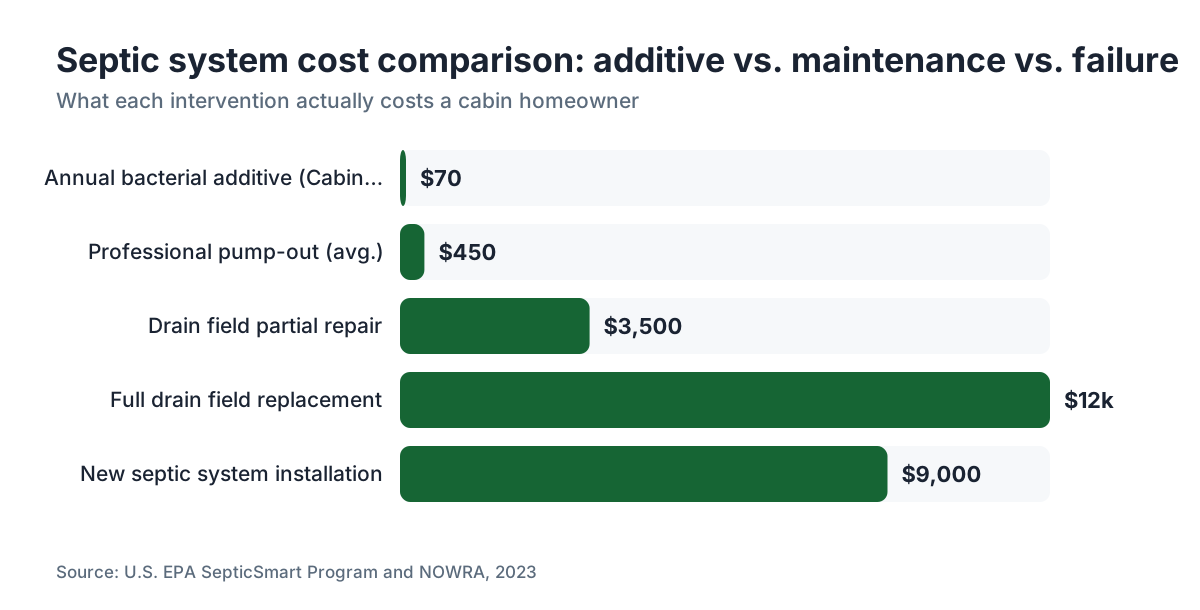
Cabin Obsession and similar products run $30 to $80 for a season's supply depending on tank size and dose frequency. Dose monthly year-round and annual cost lands around $40 to $100.
A professional septic pump-out costs $300 to $600 for a standard residential tank in most regions, with swings for tank depth, access difficulty, and local labor rates [5]. In remote cabin country where access is hard, expect the high end or above.
A drain field repair or replacement costs $1,500 to $5,000 for partial repairs and $5,000 to $20,000 or more for full replacement [4].
A whole new septic system installation runs $3,500 to $15,000 or more depending on site conditions, soil type, and local permitting [7]. You can see current estimates in more detail on the cost to install a septic system page.
The additive is not a meaningful line in this cost hierarchy. Spend $60 a year on Cabin Obsession or spend nothing, the pump-out schedule is what prevents the expensive failures. Spend the $60 if it buys you peace of mind and you know what it can and can't do. Don't spend it thinking it pushes the pump-out date further out.
Should septic service operators recommend bacterial additives to clients?
This is a practical question for any pumping company or inspection service.
The honest operator answer: don't recommend additives as a revenue swap for pumping, but don't wave them off if a client asks. A client using Cabin Obsession isn't doing anything harmful, and if the product gets them thinking about their septic system at all, that's more engagement than the average homeowner has.
What operators should push proactively is a documented service interval, not a supplement. A client who pumps every three years and uses an additive is in far better shape than a client who trusts the additive and hasn't pumped in eight years.
For operators running multiple cabin properties in a seasonal cluster, the spring opening window is a real logistics headache. Scheduling platforms that batch-route several pump visits inside a tight geographic window can make a real difference in efficiency. SepticMind's scheduling and service documentation features are built for that seasonal workflow. It's a business-level call, but it helps to know the tools exist.
If a client asks straight out whether they should use Cabin Obsession: tell them it probably won't hurt, it won't replace the pump-out, and the best thing they can do is keep the pump schedule and avoid flushing anything unusual. That's accurate and defensible.
Frequently asked questions
Does Cabin Obsession septic treatment actually work?
It may give a modest benefit in specific situations, mainly after system dormancy or antibiotic use, by reintroducing bacteria that help break down solids. But no bacterial additive in this category has been proven in peer-reviewed research to significantly improve effluent quality or reduce sludge under normal operation. The EPA's SepticSmart program says additives aren't necessary for a well-maintained system.
Can I use Cabin Obsession instead of pumping my septic tank?
No. Additives can't remove the accumulated inorganic solids and non-biodegradable sludge that build up in a tank over time. That requires physical pump-out by a licensed professional. The EPA recommends pumping most systems every three to five years regardless of additive use. Skipping pump-outs while relying on treatments is one of the most common causes of premature drain field failure.
How do you use Cabin Obsession at the start of cabin season?
Flush the recommended packet or measured powder down a toilet (not a sink drain) after the cabin has warmed above 50 degrees Fahrenheit. Dissolve it in warm water first if the cabin is still cold. Avoid bleach or antibacterial cleaners in the same week. Keep water use light for a couple of days so the bacteria can settle before being flushed through.
How does Cabin Obsession compare to CLR septic tank treatment?
Both are bacterial and enzyme additives with similar mechanisms and prices, roughly $5 to $12 per month. Cabin Obsession markets to seasonal cabin owners and the dormancy problem; CLR markets to year-round residential users. Neither has published clinical efficacy data specific to its formula. The practical difference is the use-case framing, not how they actually work.
Is Cabin Obsession safe for my septic system and drain field?
Bacterial and enzyme additives like Cabin Obsession are generally considered safe. They use non-pathogenic bacterial strains already found in soil and the human gut and add no chemical hazard to the drain field. The risk isn't toxicity; it's false assurance that delays real maintenance like pumping and inspection. Chemical solvent-based additives are the ones to avoid, not bacterial ones.
How often should I use Cabin Obsession in a cabin septic system?
For a cabin used only in summer, a dose at season opening plus one mid-season dose is typically what the product recommends. For a cabin with year-round light use, monthly dosing follows the standard protocol. Always check the label for tank-size-specific dosing. More is not better; overdosing doesn't increase benefit and wastes product.
What are the most common complaints in Cabin Obsession reviews?
The most cited negatives are packets that won't dissolve in cold water, no noticeable change in system performance, and needing a pump-out anyway. The cold-water issue is the most fixable: dissolve in warm water before flushing if the cabin hasn't heated up. The 'no difference' complaints line up with what research says about bacterial additives under normal conditions.
Does my state require septic additives to be registered?
Some do. Florida requires additives sold for septic use to be registered with the state Department of Health. Other states have their own rules or none at all. Check your state's department of environmental quality or department of health before buying. An unregistered product in a registration-required state is technically sold in violation of that state's regulations, which is worth knowing.
Will a septic treatment help with sewage odors near my cabin?
Odor near the tank or yard usually signals a system problem, not a bacteria shortage. Common causes include a full tank, a damaged outlet baffle, a clogged inlet, or a saturated drain field. A bacterial treatment fixes none of those. Strong sewage odors call for a professional inspection, not a packet of bacteria. Additives won't mask a structural failure.
How often should a cabin septic tank be pumped?
For a cabin with heavy seasonal use and lots of guests, every three years is a sound target. For light use by one or two people for a few weeks a year, every five years may be enough. The best answer comes from having your pumper measure sludge and scum depth: when the combined layers hit about one-third of the tank's liquid depth, it's time to pump.
Can I use Cabin Obsession in a mound system or aerobic treatment unit?
Mound systems and aerobic treatment units (ATUs) have different biological environments than conventional septic tanks. ATUs already run forced aeration that supports an active aerobic bacterial population. Adding a bacterial supplement to an ATU is generally unnecessary and may not fit the system's design. Check with your system's manufacturer or a licensed installer before using any additive in an ATU or engineered system.
What happens if a cabin septic system sits unused all winter?
The bacterial population in the tank declines during long dormancy, but the tank keeps its liquid and some biology survives. The bigger winter risks are frost damage to shallow components and sludge that has thickened without active breakdown. A professional inspection at season opening, more than an additive dose, is the right response to a system idle for six months or more.
Are there any EPA-approved septic tank treatments?
The EPA does not certify or approve septic additives as effective. Additives aren't regulated under the same framework as pesticides or pharmaceuticals; they don't require proof of efficacy before sale. The EPA's SepticSmart program tells homeowners to be skeptical of additive claims and to prioritize pumping and inspection over any supplement. 'EPA-registered' on a label refers to product registration, not approval of effectiveness.
Sources
- U.S. EPA, SepticSmart Program: EPA's SepticSmart program states there is no magic additive that will fix a broken septic system and recommends pumping every three to five years; discourages chemical additives.
- University of Minnesota Extension, Septic Tank Additives: A review of additive research found most peer-reviewed studies showed no statistically significant improvement in effluent quality from bacterial additives, with marginal benefit only in systems recovering from antibiotic contamination or extended dormancy.
- Florida Department of Health, Onsite Sewage Program: Florida requires any additive sold for septic use to be registered with the state Department of Health.
- U.S. EPA, Septic System Costs and Homeowner Guidance: Drain field repair or replacement costs range from $1,500 for partial repairs to $20,000 or more for full replacement depending on soil and site conditions.
- National Onsite Wastewater Recycling Association (NOWRA): Average septic tank pump-out costs $300 to $600 for a standard residential tank in most U.S. regions.
- Washington State Department of Health, On-Site Sewage Systems: Washington State found no evidence that septic additives reduce required pumping frequency in their review of onsite wastewater system maintenance practices.
- U.S. EPA, Septic System Installation Overview: New septic system installation costs $3,500 to $15,000 or more depending on site conditions, soil type, and local permitting requirements.
- NSF International, Standard 40 for Residential Wastewater Treatment Systems: NSF Standard 40 sets performance benchmarks for residential wastewater treatment units; bacterial additive products are not tested or certified under this standard.
- U.S. EPA, How Your Septic System Works: EPA guidance states that the EPA recommends inspecting septic systems at least every three years and pumping as needed, typically every three to five years.
- North Carolina State Extension, Septic Tank Additives: Do They Help?: NC State Extension notes that biological additives are generally not harmful but are also generally not necessary for a properly functioning septic system.
Last updated 2026-07-10