Calvert County perc test: rules, costs, and what happens if you fail
By the SepticMind Editorial Team
TL;DR
- A Calvert County perc test measures how fast soil absorbs water to decide whether a property can support a septic drain field.
- The county's Department of Planning and Zoning runs the process under Maryland's On-Site Sewage Disposal rules (COMAR 26.04.02).
- Testing costs $300 to $800 and takes 4 to 10 weeks to schedule and approve.
- Failing soils may still qualify for a mound or drip system.
What is a perc test and why does Calvert County require one?
A percolation test, almost always called a perc test, measures how fast water drains through the soil at a proposed septic site. The result is a number in minutes per inch (MPI). That number tells the engineer and the county how big the drain field has to be and whether a conventional leach field is even possible.
Calvert County sits on the western shore of the Chesapeake Bay. Much of it is sandy coastal plain soil that drains fast. But there are also pockets of restrictive clay, high seasonal water tables, and bedrock close to the surface near the northern edge of the county. Site conditions swing hard from one parcel to the next, so every new lot that will run on an on-site septic system has to be tested before a permit is issued. [1]
Maryland requires the test under Code of Maryland Regulations (COMAR) 26.04.02, the state's On-Site Sewage Disposal rules. The Maryland Department of the Environment (MDE) sets the minimum standards, and Calvert County's Department of Planning and Zoning (DPZ) runs the process locally. The science travels. Catawba County, North Carolina runs perc tests under a different rulebook, but the test is the same: water in a hole, clock running.
EPA's SepticSmart program puts the purpose plainly: a properly sited and designed septic system protects public health and the local water supply. [2] In Calvert County that concern is concrete. Most homes here draw from private wells, and the Chesapeake Bay watershed is downstream of every failing system.
Who actually performs a perc test in Calvert County?
You don't dig your own holes and hand the county a number. Maryland requires a licensed On-Site System Designer (OSSD) or a licensed Professional Engineer with the right experience to run the soil evaluation and testing. The applicant, usually the landowner or their contractor, hires that licensed professional. [3]
DPZ then reviews the submitted data or sends its own Sanitarian to watch parts of the test, depending on the project. For a standard single-family lot, the licensed designer runs the test and files a complete soil evaluation report with DPZ. For subdivisions or commercial properties, MDE review is also required.
Some evaluators are independent consultants. Others work for the bigger septic installers. Getting three quotes is reasonable and worth your time.
The professional you hire should be able to tell you roughly what they expect to find, based on the county's soil survey data, before they ever set foot on your land. If they can't, that's a red flag.
What are the steps to get a perc test approved in Calvert County?
The process has more steps than most people expect, and the delays usually come from paperwork, not the test itself.
- Pre-application research. Pull the Web Soil Survey from the USDA Natural Resources Conservation Service (NRCS) for your parcel. [4] It gives you the mapped soil series, expected percolation rates, and likely limitations before anyone digs. It won't replace the field test, but it tells you whether you're probably in good soil or bad.
- Hire a licensed soil evaluator. They schedule the test with you and notify the county in advance, as Maryland rules require.
- Site preparation. The evaluator digs soil profile pits (typically 4 to 6 feet deep) and perc holes (usually 6 to 8 inches wide, 12 to 24 inches deep) at representative spots across the proposed drain field. The number of holes depends on lot size and system type.
- Pre-saturation. The holes get filled with water and left to drain for at least 24 hours before the timed test. COMAR 26.04.02 requires this pre-soak to mimic wet-season conditions. Shortcut it and the results are void.
- The timed test. Water goes in to a set depth, and the evaluator measures how many minutes it takes the level to drop one inch. Multiple readings are taken. The slowest reading from each hole is the one that counts. [3]
- Report submission. The evaluator files a soil evaluation report with Calvert DPZ. It includes soil profile descriptions, water table data, percolation rates, and a proposed system design.
- DPZ review and approval. The county issues a Site Evaluation Approval or a denial letter. The approval is tied to the specific proposed use and system design.
From hiring the evaluator to a written approval, allow 4 to 10 weeks under normal conditions. DPZ hits backlogs, especially in spring when everyone wants to build.
How much does a perc test cost in Calvert County?
Expect to pay $300 to $800 for the soil evaluation and perc testing on a standard residential lot. That covers the licensed evaluator's time, travel, test materials, and the written report. It does not cover the county's review fee, which Calvert DPZ charges separately. Confirm the current fee schedule with DPZ, because municipal fees change.
Bigger parcels, sites that need more test holes, or lots with rough access (steep slopes, dense brush) push the evaluator's cost higher, sometimes past $1,200. If the first test fails and you need to test another spot on the same parcel, you pay for that work too.
On a new build, the perc test is a small line item next to the whole cost to install a septic system. A conventional system in Maryland runs $8,000 to $20,000 installed. An alternative system, required when perc results are marginal, can run $15,000 to $40,000 or more. The soil data from a $500 test can swing your budget by tens of thousands. [5]
Here's a comparison worth knowing. In Catawba County, NC, the county health department does the evaluation itself and charges a flat permit fee, typically $500 to $900 including the evaluation. That's a different model from Calvert's, which requires you to hire a private licensed professional first. Neither one is better. They just change who you write the check to.
What perc rates does Calvert County consider acceptable?
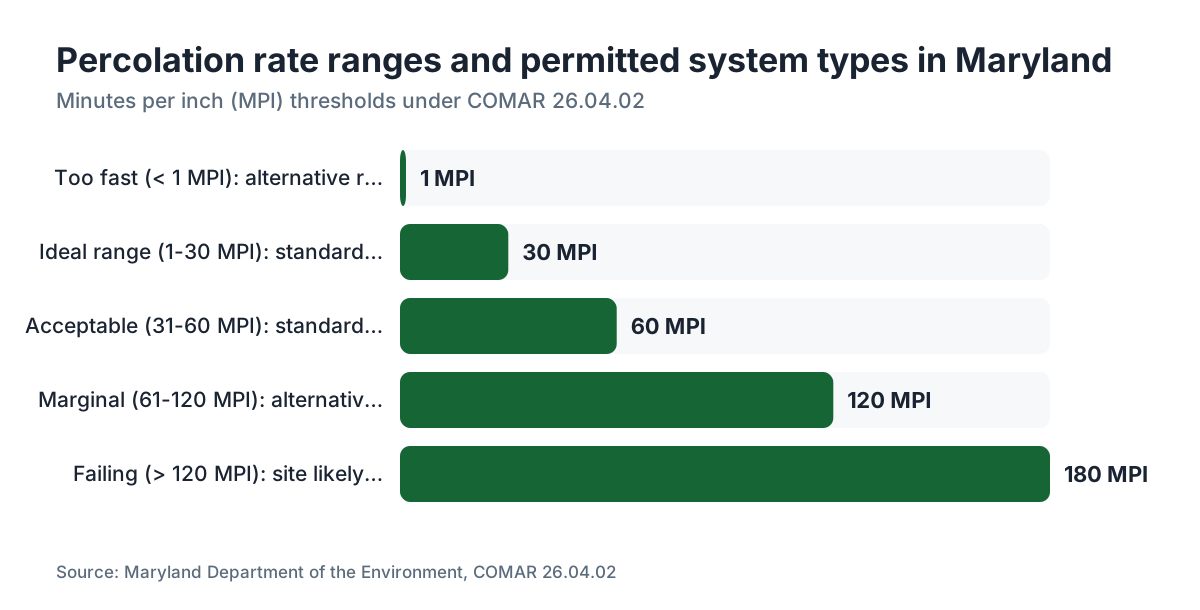
Maryland's COMAR 26.04.02 sets acceptable percolation rates for standard gravity systems at 1 to 60 minutes per inch (MPI). [3] The sweet spot for a conventional drain field is roughly 3 to 30 MPI. Sandy soils below 1 MPI drain too fast, so effluent doesn't get treated before it reaches groundwater. Soils above 60 MPI drain too slowly for a standard system.
Here's how the ranges break down:
| Perc rate (MPI) | Interpretation | System typically allowed |
|---|---|---|
| Less than 1 | Too fast (coarse sand/gravel) | Requires review; possible alternative system |
| 1 to 30 | Good to excellent | Standard gravity drain field |
| 31 to 60 | Acceptable | Standard drain field, may need larger area |
| 61 to 120 | Marginal | Alternative system (mound, drip, etc.) required |
| Greater than 120 | Generally failing | Very limited options; site may be unbuildable |
These thresholds come from state regulation, not county preference. The county can't loosen them. It can only require a more conservative design.
Drain field size ties to both the perc rate and the design flow (gallons per day), which is based on bedroom count. A 3-bedroom home in Maryland carries a design flow of 450 gallons per day. [5] A slower perc rate means more linear feet of trench or more square footage of field to handle the same daily load. That's why the same house on two different Calvert County lots can need wildly different systems.
What happens if your perc test fails in Calvert County?
A failing perc test doesn't automatically mean your lot is unbuildable. It means a conventional drain field won't work there. Maryland and Calvert County allow a range of alternative on-site systems when the standard approach is off the table. [6]
Mound systems sit above the native soil and use engineered fill to create separation from the water table and slow down fast soils. They're visible, they eat more yard, and they cost more (often $15,000 to $30,000 just for the drain field piece). They're also approved and common in Calvert County.
Low-pressure pipe (LPP) systems spread effluent more evenly across a bigger area. Drip irrigation uses small-diameter tubing to apply treated effluent just below the surface. Aerobic treatment units (ATUs) treat the effluent more completely before it hits the soil, which sometimes rescues a marginal site. [6]
If the whole parcel fails and no alternative is permitted, the lot can be ruled unsuitable for on-site sewage disposal. That's a brutal outcome for a raw-land buyer. It's exactly why perc testing before you close on land is standard advice, not paranoia.
Calvert DPZ can sometimes point you toward testing another spot on the same parcel where the soil is better. A good evaluator reads the landscape and the soil survey first, specifically to avoid dropping test holes in the worst ground when better ground is right there.
How does the seasonal water table affect your Calvert County perc test?
Maryland requires soil evaluations to document the seasonal high water table (SHWT). The SHWT is the highest level groundwater reaches in the wettest part of the year, even if the water sits several feet lower on the day you test. [3]
Why does it matter? The drain field needs vertical separation between the bottom of the trench and the SHWT so effluent gets treated before it reaches groundwater. Maryland requires at least 18 inches of separation for most gravity systems. Alternative systems have their own rules.
Soil scientists find the SHWT by reading mottled soil horizons, the grayish, orange, or rust-colored patches in the soil profile, rather than waiting for the wet season to come back around. Those mottles are permanent evidence of periodic saturation. [4] A good evaluator describes these features in the profile report and explains how they shape the design.
Calvert County has big areas of hydric soils near tidal wetlands, streams, and low flats. If your lot sits low or near water, there's a real chance the SHWT is close to the surface. On a well-drained upland, it might be 4 to 6 feet down. Don't guess. Wait for the profile pits.
Do you need a new perc test if you're adding a bedroom or replacing a system?
Additions that increase the design flow require re-evaluation. Adding a bedroom to a Calvert County home on septic raises the design flow, and DPZ will want proof the existing drain field can handle it, or a plan to expand or replace it. [1]
Replacing a failed system is a different animal. If you're reusing or expanding the existing field location, a new soil evaluation may or may not be required, depending on when the original test was done and whether it's on file with DPZ. Check before you assume old data still counts.
Buying a home already on septic? A septic tank inspection at purchase tells you the condition of the existing system but doesn't re-run the perc test. The original perc data should be in county records. Ask DPZ for the file before closing.
Be clear on one thing. Perc tests are for new installation or major alteration permits. Routine septic tank pumping and septic tank cleaning trigger no perc testing at all. That's maintenance, not construction.
How do Calvert County's requirements compare to other Maryland counties?
Maryland's On-Site Sewage Disposal rules (COMAR 26.04.02) set a statewide floor. Every county has to meet it. What changes is the administrative process, the local fees, and any extra county-level requirements bolted on top.
Calvert County uses a private-licensed-professional model for the field evaluation, which is common across Maryland. The county's Sanitarian mostly reviews reports rather than running tests. Some counties with smaller permit volumes have Sanitarians in the field more often.
Turnaround varies. Rural counties with thin staff can run longer waits. Suburban counties with more staff per application often move faster. Calvert DPZ has historically run 3 to 8 weeks for residential evaluations, though that number moves.
Calvert County also takes part in Maryland's Bay Restoration Fund (BRF) program, which gives grants to homeowners replacing failing septic systems with nitrogen-reducing technology. [7] If your system fails and needs replacing, ask DPZ about BRF eligibility before you spend your own money. The grants can cover $5,000 to $20,000 of replacement cost for qualifying systems.
How should you prepare your land for a perc test?
The single most useful thing you can do before the evaluator shows up is make the test area accessible. Clear brush so they can move across the proposed drain field and run the backhoe or hand auger without fighting through it. If there's an existing structure, get utility lines marked before anyone digs. Call Maryland 811, the state's call-before-you-dig service, at least three full business days ahead. [8]
Don't touch the soil before testing. Compacting, ripping, or dumping sand into a low spot to fake better drainage is fraud. Maryland evaluators are trained to spot disturbed soil, and if they find it, the test is void and you can face enforcement.
Timing matters less than people think, because the pre-soak is designed to normalize conditions. Testing in a bone-dry summer can occasionally cause trouble in soils that crack when they dry out. Your evaluator will know whether that's a concern for your soil type.
Have the lot survey ready. The evaluator needs the legal boundaries and the setbacks from property lines, wells, surface water, and wetlands. Maryland's statewide minimums include 100 feet from a private well, 10 feet from a property line for a drain field, and various distances from surface water depending on the water body. [3]
If you're a contractor coordinating multiple perc tests across several properties, tracking scheduling, report submissions, and permit status gets messy fast. Some operators use platforms like SepticMind to keep these workflows in one place, which cuts the odds of a permit lapsing or a follow-up step getting skipped.
What are the most common reasons perc tests fail or get delayed in Calvert County?
Knowing the failure modes saves you time and money.
High seasonal water table is the top disqualifier for conventional systems in Calvert County's low-lying areas. The soil might perc fine on rate alone, but if the SHWT is too close to the surface, you can't get the required separation.
Percolation rate outside the acceptable range is second. Very slow clay soils (above 60 MPI) won't drain fast enough. Very fast sandy soils (below 1 MPI) don't treat the effluent enough. Both blow past the conventional threshold.
Not enough area for the required field hits smaller or oddly shaped lots. Even with good perc results, you might not have enough usable ground once all the setbacks apply. The field can't sit in a floodplain, under a driveway, inside setback distances from wells or wetlands, or where tree roots will invade it.
Incomplete pre-saturation is a procedure failure. If the evaluator or a property owner attempting a DIY pre-soak doesn't keep enough water in the holes for the full required period, the results are invalid and the county rejects them.
Delays, which are common and different from failures, come from DPZ backlog, incomplete applications, and evaluators booked solid in spring. If you want a spring or summer construction start, get the soil evaluation scheduled by January.
What should you do after your perc test is approved?
Approval of the perc test and soil evaluation is the prerequisite, not the finish line, for building a septic system. Next you need a system design from your licensed On-Site System Designer and a construction permit from Calvert DPZ. [1]
The construction permit triggers inspections during and after installation. You have to use an approved installer, because Maryland requires licensure for On-Site Sewage Disposal System Contractors. [3] Either the installer or the designer pulls the construction permit. Nail down which one in your contract.
Once the system is in and inspected, as-built drawings go to DPZ. Those drawings show exactly where every component ended up, which matters a lot if the system ever needs septic tank repair or if you sell and the new owner has to find it.
After that, protect the drain field you sized and located off the perc data. Don't drive over it. Don't plant deep-rooted trees on it. Don't add a pool or a shed. And pump the tank on a schedule (every 3 to 5 years for most households) so solids don't migrate into the field. A clogged drain field is expensive to fix. See how often to pump your septic tank for guidance by household size and usage.
SepticMind's operator tools help contractors and inspectors track as-built submissions and maintenance schedules across a service area, so nothing slips after the permit closes.
Frequently asked questions
How long does a perc test take in Calvert County?
The field portion, including pre-saturation and the timed test, takes 1 to 2 days on site. Scheduling the evaluator and the county review afterward adds 4 to 10 weeks total. Spring is the busiest season. If you need a construction start by summer, schedule the soil evaluation no later than January or February. Delays are mostly administrative, not technical.
Can you do a perc test yourself in Calvert County?
No. Maryland law requires a licensed On-Site System Designer or a qualified licensed engineer to conduct and certify the soil evaluation and percolation test. The results must be submitted as a formal report to Calvert DPZ. DIY test results are not accepted. Hiring a licensed professional is not optional for permit purposes, no matter how much construction experience you have.
What perc test rate is required to pass in Maryland?
Maryland's COMAR 26.04.02 sets the range for a standard gravity drain field at 1 to 60 minutes per inch (MPI). A rate below 1 MPI means the soil drains too fast for adequate effluent treatment. A rate above 60 MPI means too slow for a conventional system. Rates between 61 and 120 MPI may qualify for an alternative design such as a mound or drip system.
How much does it cost to install a septic system in Calvert County after a passing perc test?
A conventional gravity system in Maryland typically costs $8,000 to $20,000 installed. Alternative systems required by marginal soil (mound, drip, ATU) run $15,000 to $40,000 or more. The perc test result directly determines which type is required, so the $300 to $800 test has a major effect on your total budget. Get quotes from multiple licensed installers.
Does a perc test approval expire in Calvert County?
Yes. Site evaluation approvals are not indefinite. Calvert DPZ issues approvals tied to a specific proposed use and system design. If you don't move to a construction permit within the approval window, you may need to re-apply. Confirm the current expiration timeframe with DPZ when you get your approval letter, because administrative policies have changed in recent years.
What is the difference between a perc test and a soil evaluation?
A perc test measures only the drainage rate of water in a prepared hole. A soil evaluation is broader: it profiles the soil layers, identifies the seasonal high water table, assesses limiting features like bedrock or clay pans, and documents the whole site. Maryland requires a full soil evaluation, and the percolation test is one part of it. People use the terms interchangeably, but they aren't identical.
Can a lot with a failed perc test be built on at all in Calvert County?
Sometimes. A failed perc test for a conventional system doesn't automatically kill all construction options. Maryland allows alternative systems (mound, ATU, drip irrigation) on many marginal sites. The evaluator may also recommend testing a different area of the same parcel. But if no location on the lot can support any permitted design, the county may rule the lot unsuitable for on-site sewage disposal.
Are perc tests required when replacing a failed drain field in Calvert County?
It depends on when the original test was done and whether solid documentation is on file with DPZ. In many cases, a new or updated soil evaluation is required before permitting a replacement, especially if the original records are old or incomplete. Contact Calvert DPZ early. Don't assume existing on-file data will automatically satisfy a new permit application.
What setbacks apply to the drain field location in Calvert County?
Maryland's statewide minimums include 100 feet from a private well, 10 feet from a property line, 50 feet from a surface water body, and various distances from wetlands and floodplains. Calvert County may apply additional local setbacks in some zoning areas. The licensed soil evaluator maps all setbacks during the site evaluation to confirm enough usable area remains for the required system size.
Does Calvert County offer any financial assistance for septic system replacement?
Yes. Maryland's Bay Restoration Fund (BRF) provides grants to qualifying homeowners replacing failing septic systems with nitrogen-reducing technology. Grants can cover $5,000 to $20,000 depending on system type and household income. Calvert County takes part in this program. Ask DPZ or MDE about eligibility before committing to a replacement design, since the grant can influence which system type is most cost-effective.
How is a Calvert County perc test different from a Catawba County perc test in North Carolina?
The core science is identical: water drains into a test hole, you measure MPI, and that drives the system design. The main difference is administrative. Catawba County, NC uses county health department staff to run the evaluation and charges a single permit fee (typically $500 to $900). Calvert County requires a privately licensed evaluator hired by the applicant, then separate county review. Both follow their own state's on-site wastewater rules.
What soil types are common in Calvert County and how do they affect perc results?
Calvert County sits on the Atlantic Coastal Plain, so sandy loam and loamy sand dominate the uplands. These typically perc well, often 5 to 20 MPI. Low-lying areas near streams and tidal wetlands have organic or hydric soils with high seasonal water tables that frequently disqualify conventional systems. The northern part of the county has a bit more clay. USDA's Web Soil Survey gives parcel-level soil mapping before any field work.
Do I need a perc test if the property already has a septic system?
Not for routine maintenance. Pumping, cleaning, and minor repairs don't trigger a new perc test. If you're replacing the drain field, adding bedrooms, or installing a new system on a different footprint, Calvert DPZ will likely require a current soil evaluation. Check with DPZ before starting any work that changes the system's design flow or footprint. The required documentation varies by project type.
Sources
- U.S. EPA SepticSmart Program: Properly sited and designed septic systems protect public health and local water supply
- Maryland Department of the Environment (COMAR 26.04.02, On-Site Sewage Disposal): Maryland's COMAR 26.04.02 sets acceptable percolation rates of 1 to 60 MPI for standard gravity systems, requires pre-saturation, minimum setbacks, and licensed evaluators
- USDA Natural Resources Conservation Service, Web Soil Survey: Web Soil Survey provides mapped soil series and estimated percolation rates and seasonal water table data for parcels
- Maryland Department of the Environment (On-Site Wastewater design flows): A 3-bedroom home in Maryland carries a design flow of 450 gallons per day for septic system sizing
- Maryland Department of the Environment (Alternative On-Site Systems guidance): Maryland permits mound systems, low-pressure pipe, drip irrigation, and aerobic treatment units for marginal or failing soil sites
- Maryland Department of the Environment, Bay Restoration Fund: Maryland's Bay Restoration Fund provides grants of $5,000 to $20,000 to homeowners replacing failing septic systems with nitrogen-reducing technologies
- Miss Utility of Maryland / DC (811 call-before-you-dig): Maryland requires calling 811 at least three business days before digging to mark underground utilities
- Calvert County Soil Survey, USDA NRCS Web Soil Survey: Calvert County soils are predominantly Atlantic Coastal Plain sandy loam and loamy sand in uplands with hydric soils in low-lying areas
- North Carolina Department of Health and Human Services (Environmental Health, On-Site Water Protection): Catawba County, NC perc tests are administered by the county health department under North Carolina's on-site wastewater rules, with fees typically $500 to $900
Last updated 2026-07-10