Chamber septic systems: how they work, cost, and last
By the SepticMind Editorial Team
TL;DR
- A chamber septic system uses rows of open-bottomed plastic arches buried in the ground instead of gravel and perforated pipe to treat wastewater.
- They install faster, handle variable water loads well, and cost $3,000 to $15,000 installed depending on system size and site conditions.
- Chambers are now one of the most common alternatives to conventional gravel-and-pipe leach fields in the United States.
What is a chamber septic system and how does it work?
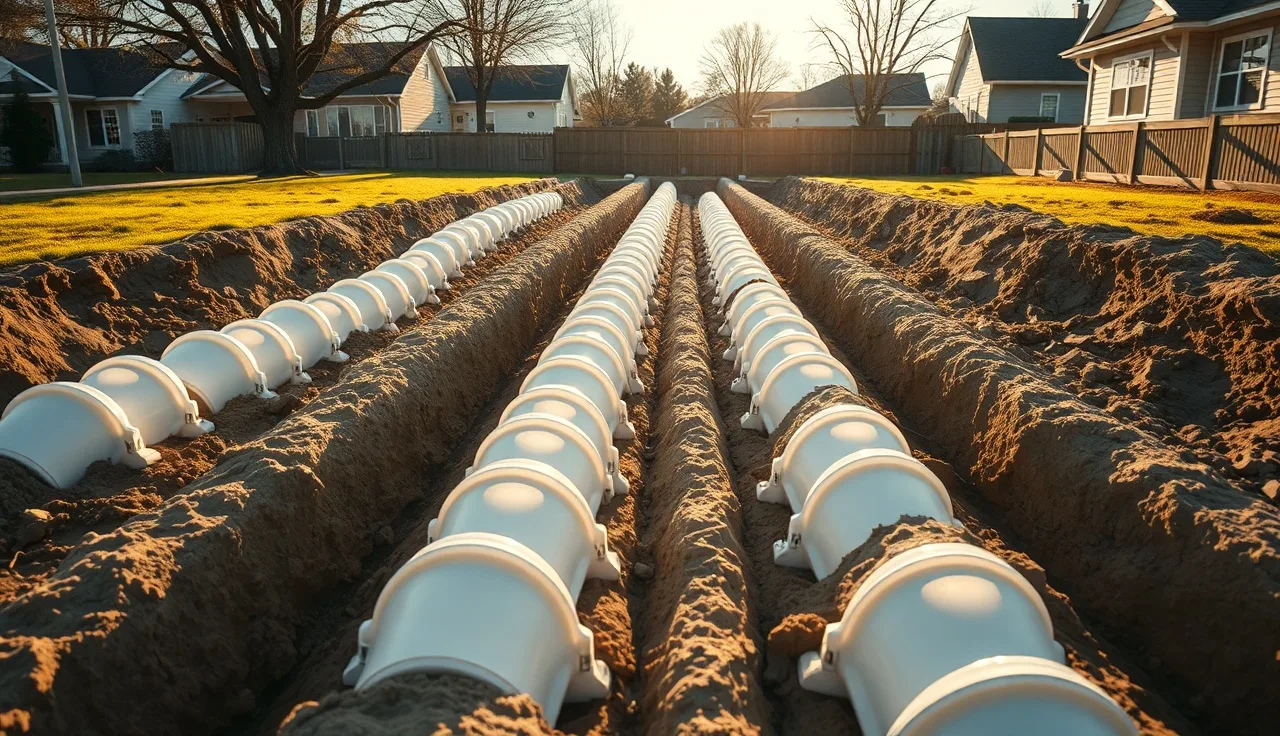
A chamber septic system is a drain field, or leach field, that moves treated wastewater from your septic tank into the soil using rows of hollow plastic arches instead of the old combination of gravel and perforated pipe. Effluent leaves the tank, flows into the chamber rows, and spreads along the open bottom of each arch, where it drips into the soil below. The soil finishes the treatment, filtering pathogens and nutrients before the water reaches groundwater.
The arches snap or lock together end-to-end into long rows. The most widely used product line comes from Infiltrator Water Technologies, though Advanced Drainage Systems (ADS) and a few regional makers sell competing products. Most residential installs use 8-foot to 10-foot individual chamber units, and a typical home system runs two to four rows of 10 to 15 chambers each.
Wastewater moves from the septic tank into a distribution box, which splits the flow evenly among the chamber rows. Inside each arch there's open air above the effluent, and that matters. The air-to-liquid interface speeds up the biological treatment happening in the soil directly underneath. Gravel systems don't give you that same steady air space, because gravel packs down over time and can stay saturated.
The EPA's SepticSmart program lists chamber systems among the accepted alternative technologies for onsite wastewater treatment [1]. All 50 states permit them, though the design rules vary by jurisdiction.
How is a chamber system different from a conventional gravel septic system?
The core difference is what fills the trench. A conventional system packs the trench with crushed stone, then lays perforated pipe on top so effluent weeps out through the holes and percolates through gravel before reaching native soil. A chamber system skips the gravel. The plastic arch itself creates the void space that gravel would otherwise provide.
That changes a few things on the ground. No gravel means no heavy delivery trucks driving across your yard. Chambers are light enough to carry by hand, so installation goes faster and tears up less soil. The inside of a chamber also stays open and clear of debris longer than a gravel void does, which is why it handles surge loading (weekends, holidays, houseguests) better than most gravel systems.
Gravel systems develop something called biomat: a layer of bacterial slime that forms at the soil-gravel interface and slowly chokes off soil absorption. Chambers aren't immune, but the open-air void above the effluent tends to slow biomat formation compared to gravel that sits saturated. University extension programs in the Midwest and Southeast have documented this in field studies [2].
Here's the honest trade-off. Chambers can be a little more vulnerable to crushing than a well-installed gravel bed if heavy vehicles drive over the field. Manufacturers rate their products for H-10 or H-20 traffic loads (10-ton or 20-ton axle weights), and most residential chambers are H-10. So don't park on your chamber field.
For a broader look at how the drain field works in any system, the leach field article here covers the soil science and failure modes in detail.
What does a chamber septic system cost to install?
Installed cost for a typical single-family chamber system runs from about $3,000 on the low end for a small system in good soil to $15,000 or more for larger systems, difficult sites, or states with higher labor costs. For a standard three-bedroom home, the drain field portion alone runs roughly $6,000 to $10,000. That does not include the septic tank, distribution box, or connecting pipes, which add another $1,500 to $5,000 depending on what's already in the ground [3].
What drives the cost up:
- Poor soil that needs a larger field footprint or a mound variant
- Lots with limited usable area that require engineered layouts
- Local permit and inspection fees, from under $200 to over $1,500 depending on the county
- Rocky or wet sites that cost more to dig
- States that require a licensed engineer to design alternative systems
For the full picture on a new system from scratch, see cost to install septic system and cost to put in a septic tank.
Chambers run 10% to 25% cheaper to install than equivalent gravel systems because labor time is lower and there's no stone to haul in. That saving is real and shows up across contractor estimates, though it shrinks on small systems where the cost of just getting a crew and equipment to the site dominates.
How long does a chamber septic system last?
The plastic units are made from high-density polyethylene (HDPE) and sit essentially inert underground. Infiltrator Water Technologies states a 50-year design life for its chambers, and independent assessments don't contradict that for the plastic itself [4].
But lifespan comes down to the soil, not the plastic. A chamber system fails when the soil beneath it can no longer absorb effluent, usually from biomat buildup, soil compaction, or saturation from high groundwater. A well-designed and maintained chamber system realistically runs 20 to 30 years before any remediation, and plenty go longer. Some installed in the early 1990s, when chamber technology first spread widely, are still working today.
What kills chamber systems early is the same list that kills any drain field: hydraulic overload (too much water for the soil), heavy garbage disposal use, flushing wipes or grease, and ignoring the septic tank until solids carry over into the field. A field clogged with solids from a neglected tank is not a chamber problem. It's a maintenance problem.
Regular septic tank pumping is the single most useful thing you can do to protect any drain field. The EPA recommends pumping every three to five years for a typical household [1].
What size chamber system do you need for your home?
Sizing comes from two numbers: estimated daily wastewater flow (based on bedrooms or occupants) and the soil's long-term acceptance rate (LTAR), which comes from a percolation test or soil evaluation done before permitting. Multiply, divide, and you get required area.
The EPA and most state codes assume 100 to 150 gallons per day per bedroom as the design flow [1]. A three-bedroom home is typically designed for 300 to 450 gallons per day. The LTAR for your soil might be 0.4 to 1.2 gallons per square foot per day in moderately permeable ground. Divide daily flow by LTAR to get the infiltrative surface area in square feet. That area then translates into a set number of chamber rows and units.
Your county health department or state environmental agency sets the exact rules, and a licensed installer or engineer has to stamp the design in most places. Don't size a permitted install yourself off an online calculator. Use calculators only to sanity-check a contractor's proposal.
Approximate system sizes by bedroom count and soil type:
| Bedrooms | Design flow (gpd) | Fast perc soil (sq ft) | Moderate soil (sq ft) | Slow-moderate soil (sq ft) |
|----------|-------------------|------------------------|----------------------|----------------------------|
| 2 | 300 | 250 to 300 | 350 to 450 | 500 to 700 |
| 3 | 450 | 375 to 450 | 525 to 675 | 750 to 1,050 |
| 4 | 600 | 500 to 600 | 700 to 900 | 1,000 to 1,400 |
| 5 | 750 | 625 to 750 | 875 to 1,125 | 1,250 to 1,750 |
Values are approximate and for illustration only. Your state and soil conditions govern the actual design.
Can a chamber system be installed in any soil type?
No, and this is a real limit. Chamber systems need soil that can absorb and treat effluent. If your perc rate is too slow (clay-heavy soils slower than 60 to 120 minutes per inch, depending on state rules), a standard chamber system won't get permitted [5]. You'd need a different technology: a mound system, drip irrigation, or an engineered alternative.
Soils that drain extremely fast, like coarse gravel or fractured rock, can also be a problem, because wastewater moves through too quickly for the soil to treat it before it reaches groundwater. Most state codes set minimum soil criteria more often than maximum ones.
The sweet spot is sandy loam to silty loam with a perc rate between about 3 and 45 minutes per inch [6]. That covers a huge share of residential lots in the country, which is exactly why chambers got so common.
Waterlogged sites, or lots with a seasonal high water table within 24 inches of the planned chamber depth, generally won't clear approval for a conventional chamber system [7]. In those cases, a raised or mound-type chamber design can create the vertical separation you need from the water table, but it adds real cost.
Does a chamber septic system need to be pumped?
The chamber field itself is never pumped under normal operation. Pumping happens at the septic tank, which sits upstream of the field. The tank collects solids, and those solids have to come out on a regular schedule so they don't flow into and clog the chamber trenches.
For a typical household, the EPA's recommended pumping interval is every three to five years [1]. Bigger households or homes with garbage disposals should pump more often, frequently every one to two years. A septic tank pump out is straightforward and usually costs $250 to $600 depending on tank size and access.
Some installers and county health departments recommend inspecting the chamber field every five to ten years to check for solids intrusion or root growth. The inspection usually means lifting an inspection port cap, shining a light, and looking for solids or standing water. It's cheap and gives you early warning if something's off.
If the chamber trenches fill with solids from a neglected tank, you can't pump them out effectively. At that point you're looking at field rehabilitation or replacement, which costs a lot more. See septic tank cleaning for what the pumping process actually involves.
What are the signs a chamber septic system is failing?
Sewage backing up into your lowest drains, usually a basement toilet or floor drain, is the clearest sign. You'll also see slow drains throughout the house when the field is saturated. Outside, a failing chamber field often shows wet, spongy, or oddly lush green grass over the trench lines. You might smell sewage in the yard, especially after rain or after running several loads of laundry.
A subtler early sign is effluent surfacing at the low end of a trench. Walk the field after a heavy rain or a high-water day (guests, lots of laundry) and look for saturated patches, discolored soil, or pooling water that doesn't clear within 24 hours.
High nitrate levels in a nearby well can signal a failing field, but you won't catch that without testing. If you're on a well and worried about field performance, an annual water test is worth the $40 to $80 it costs.
For a full walkthrough of what goes wrong and what repair options exist, see septic system repair and septic tank repair. Some early-stage failures can be reversed by resting the field (routing temporarily to an alternate field or a holding tank), jetting the chambers, or applying a bacterial treatment. Full replacement is the last resort.
How does a chamber system compare to other alternative systems?
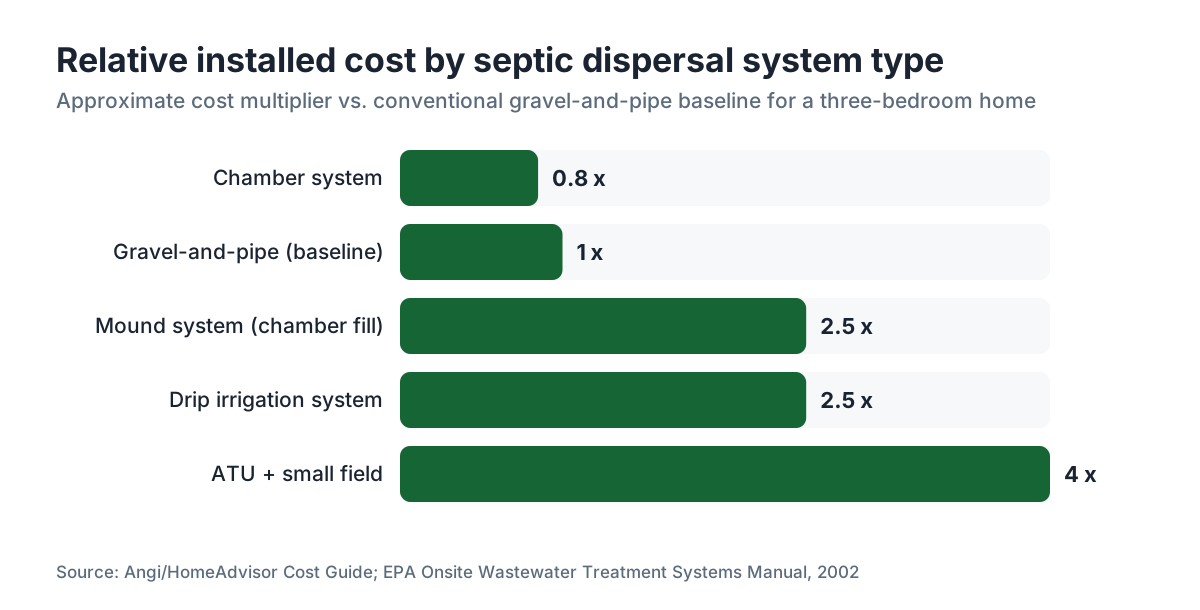
Homeowners run into four main options: gravel-and-pipe (conventional), chambers, drip irrigation (low-pressure dosing), and mound systems. Here's where chambers sit against each.
Gravel-and-pipe vs. chambers: Chambers cost less, install faster, disturb less soil, and handle variable loads better. Gravel systems are more familiar to older contractors and can sometimes fit sites with lower overhead clearance. For most new residential installs in permissible soil, chambers have largely replaced gravel.
Mound systems vs. chambers: A mound goes in when native soil is unsuitable, meaning too wet, too slow, or too close to bedrock. Mounds use imported sand fill above grade to build the treatment depth. You can actually build a mound using chamber arches inside instead of pipe and gravel, which gives you a hybrid. Mounds cost a lot more, typically $10,000 to $30,000, and they're visible from the yard [8].
Drip irrigation vs. chambers: Drip systems use time-dosed pumps to push effluent through small emitters across a wide area. They can treat in soils that fail perc entirely, run under lawns and landscaping, and go easy on marginal soil. But they need electricity, moving parts (pumps, filters, emitters), and more upkeep. Chambers have no mechanical parts to fail.
Aerobic treatment units (ATUs) vs. chambers: ATUs pre-treat effluent to a higher standard before it reaches a smaller dispersal field. They cost more upfront and require ongoing maintenance contracts in most states. They're often required when there's poor separation from groundwater or property lines. Chambers need no pre-treatment beyond a standard septic tank in most jurisdictions.
| System type | Relative install cost | Mechanical parts | Soil requirement | Typical lifespan |
|---|---|---|---|---|
| Gravel-and-pipe | Baseline | None | Moderate | 20 to 30 yr |
| Chambers | 10 to 25% less | None | Moderate | 25 to 40 yr |
| Mound (chamber fill) | 2 to 4x more | None | Poor/marginal | 20 to 30 yr |
| Drip irrigation | 2 to 3x more | Pump, filters | Wide range | 15 to 25 yr (mechanical) |
| ATU + small field | 3 to 5x more | Blower, pump | Flexible | 20 to 30 yr |
Cost multipliers are approximate and relative to a conventional gravel-and-pipe baseline for the same home.
What maintenance does a chamber septic system actually need?
Less than most homeowners expect, honestly, and that's part of the appeal. The field needs no direct maintenance. You're not cleaning chambers, inspecting the plastic, or touching the trenches in a normal year. The schedule that matters is for the septic tank upstream.
Pump the tank on schedule. Three to five years is the EPA's standard guidance [1], but have your pumper measure the sludge and scum layers on each visit so you can dial in the right interval for how your household actually uses water. Some homes need pumping every two years. Others can stretch to seven. The measurement tells you, not the calendar.
Keep records. Write down every pump date, every inspection, any work done. This matters a lot when you sell the house: buyers and their inspectors will ask, and a documented maintenance history can be the difference between a clean sale and a renegotiation. SepticMind's platform lets service operators log every job digitally and share that history with homeowners, so record-keeping happens automatically instead of living on a paper slip in a drawer.
Don't plant trees or deep-rooted shrubs within 10 feet of the trenches. Roots find water, and they will find your field. Grass is fine. Shallow ground cover is fine.
Don't drive over the field. Don't put a pool, shed, or parking pad on top of it. Don't let rain gutters drain toward it.
Cut your water use during wet weather. When the soil is already soaked from rain, your field has almost no capacity left. Spacing out laundry and skipping the long showers after a multi-day storm helps in a real, measurable way. See how often to pump septic tank for setting the right schedule.
How do you get a chamber system permitted and inspected?
Permitting happens at the county or local health department in most states, though a few centralize it at the state environmental agency [10]. The process generally runs like this: site evaluation (perc test or soil evaluation), system design by a licensed designer or engineer, permit application with drawings, installation by a licensed installer, then final inspection by the health department before backfilling.
The details swing wildly. Some rural counties issue permits within a week and want only a basic perc test. Some suburban jurisdictions require a licensed professional engineer to stamp the design, a pre-construction meeting, progress inspections during install, and a post-install record drawing. Budget two to eight weeks for permitting in most places. Backlogged jurisdictions take longer.
Chamber systems are named directly in most state onsite wastewater codes, because they've been in use since the early 1990s. Infiltrator Water Technologies and ADS hold state-level approvals in all 50 states. Your contractor should already know the local requirements. If they don't, that's a red flag.
For resale, a septic tank inspection by a licensed inspector documents current system condition. Many real estate deals require one, and buyers should insist on it regardless of local rules.
Is a chamber septic system right for your property?
For most residential lots with permeable, non-waterlogged soil and no odd space constraints, a chamber system is a very good choice. It costs less than the alternatives, has over 30 years of field data behind it in the United States, needs no electricity or moving parts, and is accepted everywhere.
The cases where it's probably not your best option: lots with high water tables (you need a mound), very slow-draining clay (you need a different technology), sites with extremely limited area (drip systems use space more efficiently), and situations where effluent quality rules demand pre-treatment before dispersal.
If you're replacing a failed gravel-and-pipe field on an existing system, a chamber system is often the easiest upgrade. The arches take up roughly the same footprint as a gravel trench, and most of your existing infrastructure (tank, distribution box, connecting pipes) stays put. Your installer should verify the tank capacity and condition before committing to that plan.
Get at least three bids and ask each contractor to show you the design drawing with the sizing calculations. A contractor who can't produce that document isn't someone you want installing a system that costs you real money if it fails early. The septic tank installation guide here covers what to expect from the full process.
SepticMind's job management tools help service operators track chamber installs and schedule follow-up maintenance automatically, so a homeowner doesn't fall through the cracks after the system goes in.
Frequently asked questions
How long do chamber septic systems last?
The plastic chamber units carry a 50-year design life from major manufacturers. In practice, lifespan depends on the soil, not the plastic. A properly maintained chamber system in suitable soil typically performs well for 20 to 30 years before any remediation, and many installed in the early 1990s still work today. Neglecting the septic tank is the most common reason systems fail early.
How much does a chamber septic system cost?
Installed cost ranges from about $3,000 for small systems in good conditions to $15,000 or more for larger or difficult sites. The drain field portion of a typical three-bedroom home system runs $6,000 to $10,000. Chambers run 10 to 25 percent cheaper than conventional gravel-and-pipe systems of the same size, because there's no gravel to haul and labor time is lower.
Do chamber septic systems need to be pumped?
The chamber field itself is never pumped under normal conditions. What needs regular pumping is the septic tank upstream of the field. The EPA recommends pumping every three to five years for a typical household. Letting the tank go too long lets solids carry over into the chambers and clog them, which is expensive to remediate and can require full field replacement.
What are the pros and cons of a chamber septic system?
Pros: lower installed cost than gravel systems, no heavy stone delivery, faster installation, better surge-load handling, no mechanical parts to fail, a 50-year plastic lifespan. Cons: not suitable for clay or high-water-table sites, slightly more vulnerable to vehicle crushing than some gravel installs, and it needs the same diligent tank maintenance as any system. For most residential sites in permeable soil, the pros clearly win.
Can you install a chamber septic system in clay soil?
Generally no. Clay soils with perc rates slower than about 60 to 120 minutes per inch (the exact cutoff varies by state) aren't approvable for standard chamber systems, because the soil can't absorb effluent fast enough. On clay-heavy sites, a mound system, drip irrigation, or an aerobic treatment unit with a different dispersal method is usually required. A site evaluation with a licensed designer tells you what's possible on your lot.
What brands make chamber septic systems?
Infiltrator Water Technologies (a subsidiary of Advanced Drainage Systems, or ADS) is by far the dominant maker in the United States. Their lines include the Quick4 and Equalizer series. ADS also sells chambers under its own brand. Several regional manufacturers make competing products. All major brands hold state-level approvals across the country, and your contractor typically picks a brand based on local availability and preference.
How deep are chamber septic system trenches?
Trench depth depends on chamber height and the required soil cover. Most residential chambers are 8 to 12 inches tall. State codes typically require 6 to 12 inches of soil cover above the top of the chamber. Total trench depth usually runs 18 to 36 inches from surface to trench bottom, but it varies with topography, chamber model, and local code. Your designer's plan will specify the exact depth.
How do you know if a chamber septic system is failing?
Watch for sewage backup into the lowest drains, slow-draining fixtures throughout the house, wet or unusually lush grass over the trench lines, sewage odors in the yard, or effluent surfacing after high-use days. A saturated patch that won't dry within 24 hours of normal weather is a warning sign. Early diagnosis matters: some failures can be reversed with field resting or jetting if you catch them before the biomat sets fully.
Can a chamber system handle a garbage disposal?
Technically yes, but garbage disposals sharply increase the solids load hitting the septic tank. The EPA and most state extension services advise against garbage disposals with septic systems, or at minimum using them sparingly. If you do use one, pump the tank more often, at least every one to two years rather than three to five. Excess solids from a disposal are a direct path to premature field failure.
Does a chamber septic system require electricity?
No, not for a standard gravity-fed chamber system. Wastewater flows from the house to the tank and from the tank to the field by gravity alone. No pump, blower, or electrical connection needed. If your lot's topography requires pumping effluent uphill to the field, a pump chamber gets added, which does need electricity. But that's a site-specific addition, not a built-in requirement of chamber technology.
Can you add a chamber system to an existing septic tank?
Yes, and it's one of the most common uses. If your existing tank is in good shape and sized correctly, you can replace a failed gravel-and-pipe drain field with a new chamber field while keeping the tank, distribution box, and connecting pipes. Your installer should inspect and measure the existing tank to confirm it's large enough and structurally sound first. A marginal tank may need replacement at the same time.
How far from a well does a chamber septic system need to be?
Most state codes require 50 to 100 feet of horizontal separation between a drain field and a drinking water well. Some states require more depending on soil type and well depth. Local codes govern, not a single federal standard. The EPA's SepticSmart program recommends checking with your local health department for the exact setback in your jurisdiction before any design or installation begins.
What permits are needed to install a chamber septic system?
You'll typically need a site evaluation permit, a system design permit, and a construction permit from your county or local health department. Some states require a licensed professional engineer to design the system. An inspection before backfilling is nearly universal. Permit costs run from under $200 in some rural counties to over $1,500 in more regulated jurisdictions. Installing without permits creates serious liability and can complicate a home sale.
Is a chamber septic system the same as an infiltrator system?
"Infiltrator" is a brand name for chamber products made by Infiltrator Water Technologies, the largest chamber maker in the United States. In casual use, many contractors say "infiltrator system" when they mean any chamber-based drain field. It's like calling every facial tissue a Kleenex. The technology is the same, but chamber systems can use products from several manufacturers. If a contractor quotes an "infiltrator system," ask for the specific product model to confirm what you're getting.
Sources
- U.S. EPA, SepticSmart Program: EPA recommends pumping a septic system every three to five years for a typical household and lists chamber systems among accepted alternative technologies for onsite wastewater treatment.
- University of Minnesota Extension: University extension research documents that chamber systems can slow biomat formation relative to conventional gravel systems due to the open-air void maintained above effluent.
- HomeAdvisor / Angi, Septic System Installation Cost Guide: Installed cost for chamber drain fields ranges from approximately $3,000 to $15,000 for residential applications, with national midpoints of $6,000 to $10,000 for a three-bedroom home field.
- Infiltrator Water Technologies, Product Technical Specifications: Infiltrator Water Technologies states a 50-year design life for their HDPE chamber products.
- U.S. EPA, Onsite Wastewater Treatment Systems Manual (EPA/625/R-00/008): Soils with perc rates slower than 60 to 120 minutes per inch are typically unsuitable for conventional chamber or gravel-and-pipe drain fields under standard state regulatory criteria.
- North Carolina State University Extension: Chamber systems are approved for residential use in all 50 states and work best in sandy loam to silty loam soils with perc rates between approximately 3 and 45 minutes per inch.
- U.S. EPA, Septic Systems Guidance for Homeowners: Seasonal high water table and waterlogged sites within 24 inches of proposed chamber depth are generally not approvable for conventional chamber installations under EPA onsite guidance.
- Purdue University Extension: Mound systems, which can use chamber arches as the internal dispersal media, cost significantly more than conventional chamber systems, typically $10,000 to $30,000 installed.
- U.S. EPA, Types of Septic Systems: The EPA's onsite wastewater framework recognizes multiple alternative dispersal technologies including chamber systems, drip irrigation, mound systems, and aerobic treatment units as approved methods.
- Virginia Department of Health, Onsite Sewage and Water Services: State-level permitting for septic systems, including chamber systems, is administered at the county or local health department level in most states, with permit costs varying widely by jurisdiction.
- National Environmental Services Center, West Virginia University: Chamber system trenches are typically installed at 18 to 36 inches total depth, with 6 to 12 inches of soil cover above the chamber top, depending on local code and site conditions.
- U.S. EPA, SepticSmart Setback Guidance: Most state codes require 50 to 100 feet of horizontal separation between a drain field and a drinking water well, with some states requiring greater separation based on soil type and well construction.
Last updated 2026-07-09