How to unclog a leach field: what actually works
By the SepticMind Editorial Team
TL;DR
- A clogged leach field usually comes from biomat buildup, saturated soil, or solids overflowing from a tank nobody pumped.
- Real fixes range from resting the field (free) to hydro-jetting or terralift aeration ($500, $5,000).
- Full replacement runs $3,000, $20,000+.
- Pump the tank and run a soil test before you spend a dime on anything else.
What does a clogged leach field actually mean?
Your leach field is where clarified wastewater leaves the septic tank, soaks into the ground, and gets cleaned up by soil bacteria. When it clogs, that liquid stops absorbing. It backs up into the tank, then into the house, or it surfaces as a wet patch in the yard.
The word "clog" hides a few different problems, and telling them apart matters because the fixes are not the same. A biomat clog is a layer of anaerobic bacteria and organic slime that builds on the trench walls where effluent meets soil. A physical clog is solids, grease, or debris that slipped past the tank and lodged in the distribution pipes. A hydraulic clog is saturated soil, either from heavy rain or a failed soil structure, where water has nowhere left to go.
None of these is the same as a cracked pipe or a field flooded by a seasonal high water table, even though the symptoms look identical from your kitchen window. Sort out which one you have before you spend money treating it.
What causes a leach field to clog?
The most common cause is a septic tank nobody ever pumps. The EPA SepticSmart program recommends pumping every 3 to 5 years for a typical household [1]. Skip that for a decade and solids climb past the tank's outlet baffle and travel straight into the distribution pipes and trenches. Once solids pack into gravel and perforated pipe, the field often can't recover.
Biomat is the second big one. Every leach field grows some biomat over time, and a thin, active layer actually helps treatment. A thick, oxygen-starved biomat is the enemy. It seals the soil surface and blocks infiltration. It forms faster when you dump too much water at once (eight loads of laundry on a Saturday), or when you keep pouring fats, oils, and grease down the drain [2].
Compacted soil from parking over the field kills the aerobic bacteria that break down waste. Tree and shrub roots invade pipe perforations and crush laterals. And some fields simply wear out because the soil was marginal from day one and has finally used up its infiltration capacity after 20 or 30 years.
Here is how diagnosable each cause is:
| Cause | Symptom | Diagnosable by homeowner? |
|---|---|---|
| Solids overflow (un-pumped tank) | Sewage backup, wet yard near field | Partially, check tank level |
| Biomat buildup | Slow drains, wet spots on field | No, needs soil or dye test |
| Hydraulic overload / saturated soil | Pooling after rain or heavy use | Partially, timing gives a clue |
| Root intrusion | Intermittent backup, visible roots | Needs camera inspection |
| Crushed or broken pipe | Sudden failure, wet line in yard | Needs camera or probe |
| End-of-life soil | Nothing absorbs regardless of load | Needs perc or infiltrometer test |
Read our full guide on leach field basics if you want to understand how the system is supposed to work before you troubleshoot why it doesn't.
How do you know your leach field is clogged and more than flooded?
Timing is your first clue. Wet spots and slow drains that show up after a stretch of heavy rain and clear within a few days point to high groundwater, not a permanent clog. The EPA notes that a saturated drain field during wet seasons does not always mean the system has failed [3].
Stay wet for weeks no matter the weather, and you have a real problem. Sewage odors near the field at any time of year say the same thing. Slow drains that persist no matter how little water you use, gurgling toilets, or sewage backing up into your lowest fixtures (usually a ground-floor shower or laundry tub) are strong signs the trouble is inside the system.
A licensed inspector or pumper confirms it in a few steps. They pump the tank, check the outlet baffle, and probe the distribution box to see whether effluent is moving into the trenches. If liquid ponds in the distribution box instead of flowing out evenly, the field is blocked. Some contractors run a dye test to trace where the water goes, or stops going. A camera inspection of the lateral lines costs $150 to $400 and shows root intrusion, crushed pipe, or solid blockages directly [4].
Can you unclog a leach field yourself?
Realistically, almost nothing you do on your own fixes a biomat-clogged or solids-blocked field. The additives at the hardware store, mostly enzymes and bacteria, have no solid independent evidence behind them. EPA guidance is blunt: biological additives "have not been shown to be effective" at restoring failed drain fields [1]. That line has held up through decades of independent testing.
What you can do is take the load off, which keeps the clog from getting worse:
- Stop using the field. Got a second bathroom or a camper with a holding tank? Use it. Every gallon you keep out improves the odds of partial recovery.
- Fix water leaks in the house. A running toilet adds 100 to 200 gallons a day [2]. That alone keeps a marginal field permanently soaked.
- Divert surface water. Gutters, downspouts, and yard grading that push rain toward the field flood it from outside. Send that water somewhere else.
- Do a planned rest. Fields hurting from biomat rather than structural failure sometimes recover after 6 to 12 months of minimal use. Sandy soils respond better than clay.
None of this is a permanent fix. It buys time. The field still needs a professional look.
What professional methods actually unclog a leach field?
Pros use four methods, and they vary a lot in cost, mess, and success rate depending on what is actually wrong.
Hydro-jetting
A high-pressure water jet runs through the distribution pipes and laterals and scours out grease, soft solids, and some root material. It works on physical clogs and partial root blockages. It does nothing for a sealed biomat out in the surrounding soil. Cost runs $300 to $800 per lateral run depending on length [4]. Reasonable first step when camera inspection shows debris in the pipes.
Terralift or aeration injection
A probe drives 3 to 4 feet into the soil alongside each lateral. Compressed air (sometimes with polystyrene beads or a biological inoculant) fractures compacted soil and forces oxygen in. Oxygen is lethal to the anaerobic biomat bacteria behind most clogs. University extension research shows 50 to 80% improvement in infiltration on fields where the pipe itself is still intact [5]. Cost is $1,000 to $4,000 for a typical field. This is probably the most evidence-supported restoration method out there.
Professional-grade restoration chemicals
Some contractors apply high-concentration hydrogen peroxide or calcium hypochlorite to the soil. Same idea as aeration: oxygen kills the biomat. Results are mixed, and the chemistry can wreck the soil bacteria you need for treatment if it goes in too hot. I wouldn't make this a first choice.
Pipe replacement or partial rebuilding
If camera inspection shows crushed, broken, or root-destroyed laterals, sections of pipe can be swapped without rebuilding the whole field. Figure $1,500 to $6,000 depending on how much pipe needs work [4].
For any of these, pump the tank first. Treating the field while the tank is still overloaded is like bailing a boat with a hole in it.
If your system needs a full septic system repair rather than field restoration alone, the scope and cost change a lot.
How much does it cost to fix or replace a clogged leach field?
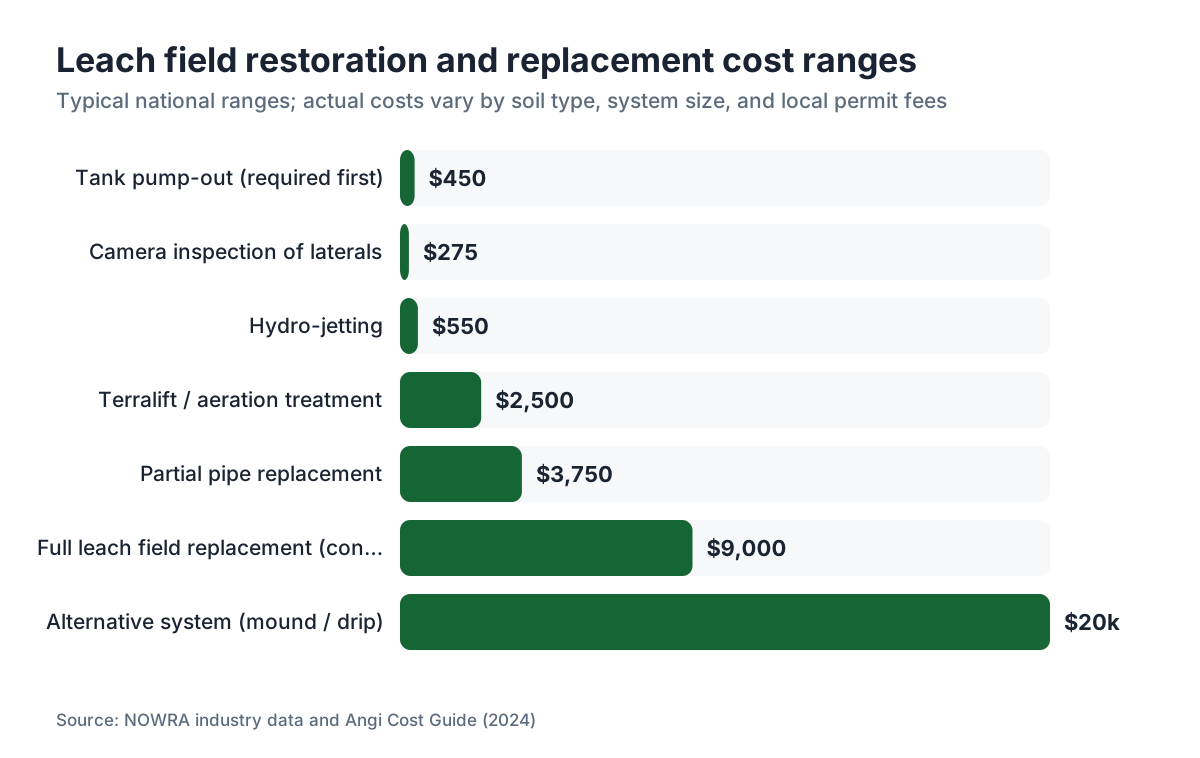
Cost hinges on one question: can the field be restored, or does it need replacing? Here is a realistic range:
| Service | Typical Cost Range |
|---|---|
| Septic tank pump-out (required first) | $300, $600 |
| Camera inspection of laterals | $150, $400 |
| Hydro-jetting | $300, $800 per run |
| Terralift / aeration treatment | $1,000, $4,000 |
| Partial pipe replacement | $1,500, $6,000 |
| Full leach field replacement (conventional) | $3,000, $15,000 |
| Alternative system (mound, drip, etc.) | $10,000, $30,000+ |
Those replacement numbers are national averages. Your real cost swings on soil type, system size, local permit fees, and whether your site can take a conventional replacement or needs an engineered alternative [6]. Some states demand a fresh soil evaluation (perc test) before they issue a replacement permit, which adds $500 to $1,500 to the job.
Before you commit to a full replacement, pump the tank and get a camera inspection. Plenty of fields that look dead were only hydraulically overloaded, and a mix of pump-out, rest, and aeration brings them back for a fraction of replacement cost.
Our septic tank pumping guide covers what the pump-out should include and what to watch for during service.
Does resting a leach field actually fix it?
Sometimes. The evidence is real, but it doesn't apply to every field.
Resting means stopping or drastically cutting water flow into the field for months so aerobic conditions partially return to the soil. That kills off some of the biomat. University of Minnesota Extension research found that alternating fields (running one half while the other rests) can extend system life significantly, and that some clogged fields show measurable infiltration recovery after 6 to 12 months of rest [5].
Here is the catch. Most households have one leach field and one house to live in. You can't just quit using water. The practical version means cutting daily use as hard as you can, fixing every leak, spreading laundry across the week, and skipping anything that dumps a big volume at once (dishwashers on heavy cycles, jetted tubs).
Resting works best when biomat is the main problem and the pipe and soil structure are still sound. It does nothing if the laterals are crushed, if the soil is truly exhausted (no infiltration capacity left, biomat or not), or if you sit in a high-water-table area where the flooding comes from outside.
Do septic additives and drain field restorer products work?
Honest answer: for failed fields, the independent evidence says no.
EPA SepticSmart guidance is direct. Biological and chemical additives have not been shown to restore failed drain fields [1]. State extension programs in North Carolina and Minnesota reviewed the research and landed in the same place [7].
That doesn't mean additives do nothing at all. Some enzyme products may keep a healthy, regularly pumped system slightly cleaner. Using them in a failing system as a stand-in for pumping or inspection is throwing money away and stalling the real diagnosis.
One category has actual mechanism behind it: the high-concentration oxidizing agents (hydrogen peroxide and the like) that professionals apply as a soil treatment. Even those show inconsistent results, and they go in at concentrations that can harm soil biology if misapplied.
Want to try one thing before calling a contractor? Pump and check the tank. A septic tank pump out gives you real information. A bottle of bacteria from the hardware store gives you nothing.
What permits and regulations apply to leach field repairs?
In nearly every state, repairing or replacing a drain field needs a permit from the local health department or environmental agency. Not optional. Install a new field, or even modify the old one, without a permit and you risk fines, forced removal, and a mess when you try to sell the house.
Most state rules trace back to EPA guidance and the standards their own onsite wastewater programs set. The EPA's SepticSmart program lays out best practices that many states reference when they write code [3]. The specifics vary: some states let licensed contractors do certain repairs (pipe replacement inside the existing footprint) without a new soil evaluation, while others require a full permit and fresh perc test for any field work.
Restoration treatments like terralift or aeration sit in murkier territory. Some counties call it maintenance (no permit), others call it repair (permit required). Call your county health department before any contractor breaks ground.
For new installs or full replacements, see what a septic tank installation project involves so you know what to ask your permitting office.
Septic companies juggling job sites across different jurisdictions can use tools like SepticMind to track permit rules and inspection schedules by county, which cuts the odds of starting work before approvals land.
How do you prevent a leach field from clogging again?
Prevention is almost entirely about the tank. A septic tank inspection every 1 to 3 years and a pump-out every 3 to 5 years (more often for a big household) keeps solids from ever reaching the field. The EPA recommends pumping every 3 to 5 years as a general rule [1]. Households with garbage disposals, water softeners, or more than four people should lean toward the short end.
Beyond pumping:
- Spread water use across the day and week. One laundry load a day stresses the field far less than five on Saturday.
- Keep fats, oils, grease, wipes, and non-biodegradable junk out of the drain. They either feed the biomat directly or float in the tank as scum and slip past.
- Keep vehicles, heavy equipment, and anything with a hard surface off the field. Compaction ruins soil structure and crushes pipe.
- Plant only shallow-rooted grass over the field. No trees, no shrubs. Tree roots are one of the top reasons laterals fail in older systems.
- Have the distribution box checked when the tank gets pumped. An uneven box dumps all the flow into one part of the field and starves the rest, cutting the field's life short.
The how often to pump septic tank guide breaks down pumping intervals by household size and tank volume if you want to dial in your schedule.
When is a leach field beyond repair and must be replaced?
Some signs tell you no treatment is going to work.
If a certified soil evaluation shows the soil has hit its hydraulic loading limit, meaning it can't absorb wastewater even with the biomat gone, the field is finished. This happens in clay-heavy soils that have been taking wastewater for 20 to 40 years. The soil structure has changed, and restoration can't undo that.
If camera inspection shows most of the laterals crushed, broken, or packed with debris that hydro-jetting can't clear, the pipes need replacing. If the trench gravel is fully compacted with solids (common after a tank goes unpumped for 10+ years), no amount of aeration fixes it.
A field treated twice with professional restoration and still showing no measurable improvement on a soil infiltration test is done.
Replacement means designing a new field, which requires a fresh soil evaluation and often a perc test, pulling permits, and laying new pipe and gravel (or an alternative drip or mound system if site conditions changed or the lot is tight). The cost to install septic system guide covers what to expect for a full replacement.
SepticMind's job tracking helps operators manage the permit, soil test, and inspection workflow across multiple replacement jobs, keeping every step documented without paper records.
Looking at replacement costs? Check our overview of the cost to put in a septic tank, since the tank often gets replaced at the same time when a field fails on an older system.
What should you ask a contractor before paying for leach field restoration?
Not every company selling leach field restoration has the same skills or the same ethics. Before you write a check, ask these directly:
Have you pumped the tank first? Any contractor proposing to treat the field without pumping the tank first is doing the job wrong. The tank has to be emptied and the outlet baffle inspected before field work starts.
What diagnostic confirmed the field is clogged? You want to hear camera inspection, probe test, or distribution box check. "I looked at the yard" is not a diagnosis.
What's your success rate, and how do you define success? A good contractor will admit restoration has variable results depending on soil type and how long the field has been failing. Anyone guaranteeing full recovery is overselling.
Will this void the warranty on a newer system? Some alternative system makers have specific maintenance protocols, and unauthorized treatments can void coverage.
What happens if it doesn't work? Get that answer in writing before the work starts.
Get at least two quotes. Be suspicious of any quote that skips the diagnostic and jumps straight to a $4,000 treatment. A proper septic tank cleaning and inspection up front should be part of every restoration estimate.
Frequently asked questions
Can a clogged leach field be fixed without replacing it?
Yes, often. If the clog is biomat buildup and the pipe and soil structure are intact, professional aeration (terralift) or hydro-jetting combined with resting the field can restore real function. Success depends on soil type, how long the field has been failing, and whether solids overflow from an un-pumped tank caused the blockage. Get a camera inspection and tank pump-out before committing to any treatment.
How long does it take to unclog a leach field?
Professional treatments like hydro-jetting or terralift take one to two days on-site. Recovery of soil infiltration afterward takes weeks to months. If you're relying on field resting, University of Minnesota Extension research suggests 6 to 12 months of reduced loading may be needed to see meaningful biomat die-off. There is no fast fix for a severely clogged field.
What are the signs that a leach field is clogged?
The common signs are slow drains throughout the house, sewage odors near the field, wet or mushy grass over the field that stays wet regardless of rain, and sewage backing up into the lowest fixtures in your home. Unusually green or fast-growing grass over the field is another classic sign that effluent is sitting near the surface.
Do shock treatments or additives unclog a leach field?
Independent evidence says no. The EPA states directly that biological additives have not been shown to restore failed drain fields. Hardware-store enzyme and bacteria treatments have no documented ability to clear a clogged field. Professional-grade oxidizing agents applied by licensed contractors have some mechanism behind them but show inconsistent results. A pump-out and soil inspection give you real information; additives do not.
How much does it cost to unclog a leach field?
Professional restoration ranges from about $300, $800 for hydro-jetting to $1,000, $4,000 for terralift aeration. Those prices assume the tank is already pumped (add $300, $600). A camera inspection to diagnose the problem costs $150, $400. Full leach field replacement, if restoration fails, runs $3,000, $15,000 for conventional systems and up to $30,000 or more for engineered alternatives.
Can too much rain clog a leach field?
Heavy or extended rain can saturate the soil around the field and temporarily stop absorption, mimicking a clog. If the system recovers within a few days after the rain stops, it's likely a temporary hydraulic issue, not a permanent failure. If the field stays wet or the house drains stay slow long after dry weather returns, a real clog or end-of-life soil problem is more likely. Seasonal patterns matter for diagnosis.
How do you know if your leach field is failing or just flooded?
Timing is the key. A flooded field from rain usually clears within a few days of dry weather. A failing field stays wet, causes slow drains or sewage odors year-round, and does not respond to reduced water use. A contractor can confirm it by checking the distribution box after a pump-out: if effluent pools there instead of flowing out into the laterals, the field is blocked, more than temporarily saturated.
Does resting a leach field actually help?
Sometimes, yes. University of Minnesota Extension research shows that resting a field (reducing or stopping effluent flow) for 6 to 12 months can let aerobic conditions return and partially break down the biomat layer. It works best in sandy soils when the pipe is still intact. It does not work if the soil is structurally exhausted, the laterals are crushed, or the field has been failing for a long time.
What should I not put down the drain to protect my leach field?
Fats, oils, and grease are the biggest threat because they feed biomat growth and travel through the tank as floating scum. Wipes labeled "flushable" are not; they block pipes and the field. Medications, large amounts of bleach, and harsh chemical cleaners kill the soil bacteria that make treatment work. Garbage disposals add heavy solids load and speed up tank filling, which raises overflow risk.
How often should a leach field be inspected?
The EPA recommends a full septic system inspection every 1 to 3 years, plus a tank pump-out every 3 to 5 years for a typical household. The field itself doesn't need separate yearly inspection if the tank is properly maintained. Signs of a field problem, like wet spots, odors, or slow drains, should trigger an inspection right away rather than waiting for the next scheduled service.
Can tree roots clog a leach field and how do you fix it?
Yes. Tree and shrub roots grow toward moisture and enter perforated lateral pipes, eventually crushing or blocking them. A camera inspection confirms root intrusion. Fixes depend on severity: hydro-jetting with a root-cutting head can clear early-stage invasion, but crushed or collapsed pipes need physical replacement. To prevent it, plant no trees or shrubs within 20 to 30 feet of the field, and keep willows or poplars much farther.
What is the difference between a clogged leach field and a failed leach field?
A clogged field has a physical or biological blockage that may be reversible: biomat buildup, roots, solid debris in the pipes. A failed field means the soil itself can no longer absorb effluent at a safe rate, no matter what's in the pipes. Failure is permanent and requires replacement or an engineered alternative. Professional diagnosis, usually a soil infiltration test after clearing the pipes, tells you which one you have.
Do I need a permit to repair or replace a leach field?
Almost always, yes. Replacing any part of the drain field, or installing a new one, requires a permit from your local health department or environmental authority in most states. Some jurisdictions also require permits for restoration treatments. Working without a permit can bring fines, forced system removal, and real problems when you sell the home. Verify permit requirements with your county before any contractor starts work.
How long does a leach field last?
A well-maintained field in suitable soil typically lasts 25 to 30 years or more. Systems that get regular pump-outs, aren't hydraulically overloaded, and are protected from vehicle compaction and root damage often go longer. Fields in poor soil, those that took solids overflow from neglected tanks, or those on lots with seasonal high water tables tend to fail sooner, sometimes in 15 to 20 years.
Sources
- EPA SepticSmart Program, US Environmental Protection Agency: EPA recommends pumping every 3 to 5 years and states biological additives have not been shown to effectively restore failed drain fields
- EPA WaterSense, US Environmental Protection Agency: A running toilet can waste 100 to 200 gallons per day, adding significant hydraulic load to a septic system
- EPA Septic Systems Overview, US Environmental Protection Agency: EPA notes that saturated drain fields during wet seasons do not always indicate permanent failure
- National Onsite Wastewater Recycling Association (NOWRA): Industry cost ranges for camera inspection ($150, $400) and hydro-jetting ($300, $800 per lateral) for leach field restoration
- University of Minnesota Extension, Septic System Owner's Guide: Research shows alternating fields and 6 to 12 months of rest can restore infiltration; terralift aeration shows 50 to 80% infiltration improvement on intact fields
- EPA Onsite Wastewater Treatment Systems Technology Fact Sheet, EPA/832-F-00-023: Replacement costs and system design requirements depend on soil type, lot size, and whether conventional or alternative systems are required
- NC State University Extension, Septic System Additives: North Carolina State Extension review of research concludes biological and chemical additives have no demonstrated effectiveness for restoring failing drain fields
- Washington State Department of Health, On-Site Sewage Systems: State regulations require permits for drain field repair, replacement, and in many cases restoration treatments; perc tests required for new field designs
- Penn State Extension, Septic System Maintenance: Tree and shrub roots are among the most common causes of lateral pipe damage in older septic systems; 20 to 30 foot setbacks from field are recommended
- HomeAdvisor / Angi Cost Guide, Septic System Repair: National average cost data for drain field restoration and replacement: hydro-jetting $300, $800, terralift $1,000, $4,000, full replacement $3,000, $15,000
Last updated 2026-07-09