Union County FL perc test: what to expect and what it costs
By the SepticMind Editorial Team
TL;DR
- A perc test in Union County, FL measures how fast your soil soaks up water, which tells the county whether a lot can hold a septic drain field.
- The Florida Department of Health's Union County Environmental Health office runs it.
- Most standard residential evaluations cost $250 to $600 all in.
- Results come back in 1 to 5 business days.
- Failing soil often still works with an alternative system.
What is a perc test and why does Union County require one?
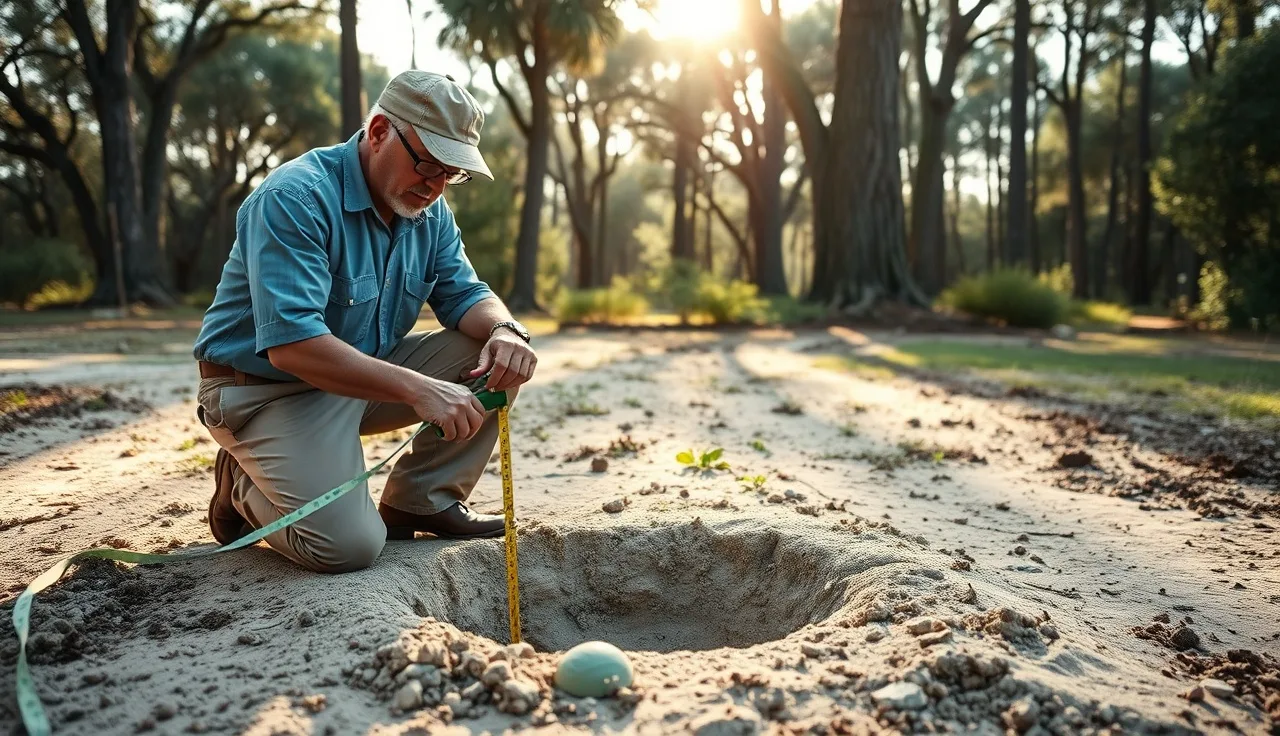
A percolation test, called a perc test by everyone who does them, measures how fast water moves through your soil. You dig a hole, fill it with water, let it drain, and time how long the water level takes to drop a set distance. That rate, written in minutes per inch (MPI), tells the county whether your soil can safely take the effluent flowing out of a septic drain field.
Florida law requires a perc test (or an equivalent soil evaluation) before any new onsite sewage treatment and disposal system (OSTDS) gets a permit. The Florida Department of Health runs this statewide under Chapter 381.0065, Florida Statutes, and the working rules sit in Chapter 64E-6 of the Florida Administrative Code [1][2]. Union County has no municipal sewer serving rural parcels. So nearly every new home or building on a private lot has to pass this evaluation before a permit issues.
The test comes back into play when you expand a structure, add a bedroom, or put a second dwelling on an existing parcel. Any change that raises projected wastewater flow can trigger a fresh evaluation.
Buying raw land? Getting a perc test done before you close is one of the cheapest ways to avoid owning a lot you can never build on.
Who conducts perc tests in Union County, FL?
The Union County Environmental Health office, a field unit of the Florida Department of Health (FDOH), runs the official evaluation. The office sits inside the Union County Health Department on SW 6th Street in Lake Butler. The FDOH district covering this region is the Northeast District out of Jacksonville [3].
For the official permit, an FDOH Environmental Health Specialist has to perform or observe the soil evaluation. That part is not optional. State rule requires a licensed professional to sign off, and in a small county like Union, that person works out of the county health department.
You can still hire a Florida-licensed Professional Engineer (PE) or a licensed septic contractor (C-48 license) to do the pre-application site work and give you an honest read on your soil before the formal FDOH visit. A preliminary look costs money upfront. It can also save you from paying permit fees on a lot that was never going to pass. Ask for someone who holds a Florida C-48 Septic Tank Contractor license or a PE with real onsite wastewater experience.
How does a perc test actually work in Florida?
Florida's perc process follows Rule 64E-6.004, FAC. Here is how it runs.
First, the applicant (you or your contractor) files a permit application with the Union County health department and pays the application fee. The department then schedules a site evaluation visit.
On the day of the visit, the FDOH specialist digs or inspects soil borings to read the soil profile: texture, color, and structure at different depths. They look for limiting conditions. Those are the seasonal high water table (shown by mottling or gleying in the soil), hardpan, rock, or heavy clay that blocks drainage.
Then come the perc holes. Florida's standard calls for holes roughly 12 inches across, dug to the proposed absorption bed depth. The holes get pre-soaked for a set period (usually 24 hours for sandy soils, sometimes 4 hours for the most permeable ones). After that, the specialist measures the water level drop over 30-minute intervals and calculates the perc rate in MPI [2][8].
Florida accepts perc rates between 1 MPI and 60 MPI for a standard drainfield. Soils faster than 1 MPI (think almost pure sand) need special design to slow things down. Soils slower than 60 MPI fail the standard test, though an alternative system can sometimes still get permitted. Union County sits on sandy soils that often perc fast, sometimes under 5 MPI. That helps with permitting but occasionally forces an engineered fix to keep effluent from surfacing.
The whole site visit usually runs 2 to 4 hours, depending on lot size and how many test holes are needed.
What does a perc test cost in Union County, FL?
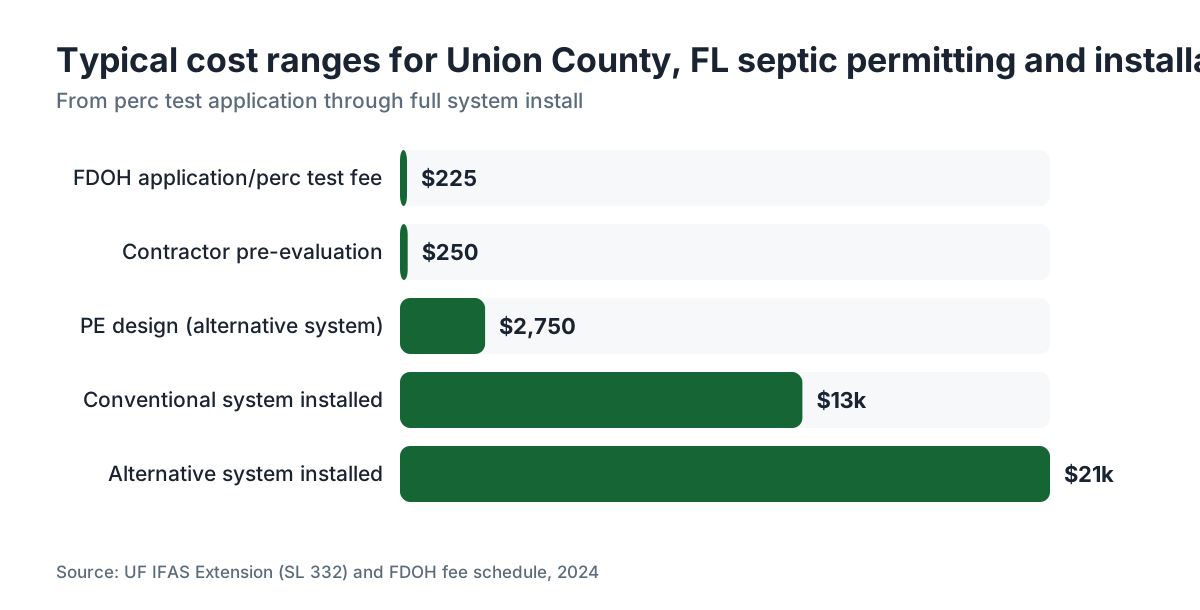
Two buckets drive the cost: the government permit fee, and any contractor fees for site prep or a pre-evaluation. Most standard residential lots land between $250 and $600 all in.
The FDOH Union County office charges an OSTDS permit application fee. Statewide, that fee runs roughly $120 to $325 depending on system type and local adjustments, and Union County follows the state schedule [3][10]. Call the health department to confirm the current number. This fee covers the site evaluation visit.
Hiring a private septic contractor or PE to prep the site, dig test holes, or run a preliminary evaluation before the official visit adds $150 to $350 in most rural North Florida counties.
If the soil evaluation shows you need an alternative or innovative system (more on that below), engineering fees climb fast. A full PE design for a mound or drip irrigation system runs $1,500 to $4,000 before anyone breaks ground. Installed, alternative systems in Florida typically run $12,000 to $30,000, against $8,000 to $18,000 for a conventional system [4].
| Cost item | Typical range |
|---|---|
| FDOH OSTDS application fee (Union Co.) | $120, $325 |
| Contractor site prep and pre-eval | $150, $350 |
| Total for standard evaluation | $250, $600 |
| PE design fee (alternative system) | $1,500, $4,000 |
| Conventional septic installation (total) | $8,000, $18,000 |
| Alternative system installation (total) | $12,000, $30,000 |
How long does the perc test process take in Union County?
Budget 2 to 4 weeks from application to permit in hand under normal conditions. The whole timeline hinges on how backed up the health department is, and Union County is small with a small staff, so scheduling can stretch.
Expect 3 to 10 business days from application submission to your scheduled site visit during normal periods. In spring, when new construction picks up, it can run longer. The evaluation itself takes a few hours on the day.
After the visit, written results and a permit decision usually come back within 1 to 5 business days. Pass, and you get an OSTDS permit to install. Questions or corrections add time to that.
What happens if your lot fails the perc test?
A failed perc test means the soil, as tested, won't support a standard drainfield. It does not automatically mean the lot is unbuildable. It means you have more work to do.
Florida's rules in Chapter 64E-6 lay out a ladder of alternative systems for tough soils [2]. The common options in north Florida:
Mound systems: effluent gets pumped up into an elevated sand mound above natural grade, bypassing the limiting soil layer. These work well where the water table sits high.
Low-pressure dosing (LPD) systems: pressurized distribution through small pipes spreads effluent more evenly across a larger area, which drops the loading rate per square foot.
Drip irrigation systems: slow, metered application just below the surface across a bigger footprint. More expensive and more mechanical, but they can make marginal lots work.
Aerobic treatment units (ATUs): treat effluent to a higher quality before it hits the soil, which relaxes the soil absorption requirement.
For the worst soils (clay-heavy, or very shallow to the water table), sometimes none of these works and the lot genuinely can't hold onsite sewage. Then the only legal path is a community or public sewer connection, which may not exist out in rural Union County. This is exactly the scenario that makes a pre-purchase perc test worth every dollar.
If you're weighing repair against replacement, the guides on septic system repair and septic tank repair walk through how Florida owners handle system upgrades.
What soil types are common in Union County and how do they perc?
Union County sits on the Atlantic Coastal Plain. The dominant soils are sandy flatwoods soils: Entisols and Spodosols with a thin A horizon over deep sandy subsoil, often with a spodic horizon (hardpan) at 20 to 40 inches down. The USDA Natural Resources Conservation Service Web Soil Survey maps every parcel in the county [5].
The sandy surface layers perc fast, often 2 to 10 MPI. Sounds great. But the spodic hardpan below can stop vertical percolation cold, which builds a perched water table in the wet season. The seasonal high water table (SHWT) is the bigger worry here than the raw perc rate. FDOH specialists read soil mottling (rust and gray streaks in the subsoil) to estimate SHWT depth. Florida's standard system requires the bottom of the drainfield to sit at least 24 inches above the SHWT [2].
Lots in low-lying areas, near cypress ponds, or along the Santa Fe River corridor tend to have SHWTs close to the surface and need extra vertical separation, which sometimes forces a mound or elevated system. Higher, well-drained ridge soils are much easier to permit. When you pick a lot, topography and distance from wet areas matter as much as the soil type itself.
Do you need a perc test to sell or buy an existing home in Union County?
No. If an existing septic system is already permitted and working, no new perc test is required to sell or buy the home. The existing system permit stays with the property.
Perc tests come back up in a couple of ways. If the buyer plans an addition (a bedroom, an ADU), the existing system may need an adequacy check. If an old system has failed and needs replacing, the replacement permit triggers a fresh site evaluation.
Buyers should always ask for a septic tank inspection during due diligence. That checks the tank and drainfield condition instead of running a new perc test. A sharp buyer also pulls FDOH records to confirm the system holds a valid permit and has no open violations. Florida public records law makes OSTDS permit history available through the county health department.
How do you apply for a perc test permit in Union County, FL?
The Union County Environmental Health office manages the whole process. The sequence goes like this.
- Get the FDOH application form. Florida uses the statewide OSTDS Application for Construction Permit (DH 4015). Grab it from the Union County health department or download it from the FDOH website [7].
- Fill it out with your parcel information, lot size, number of bedrooms (which sets design flow), and property access details. Attach a scaled site plan showing lot boundaries, the proposed building location, any wells, and setback distances.
- Pay the application fee at the health department office.
- The department schedules a site evaluation. Be there to walk the property, or have your contractor present.
- After the evaluation, the department issues a permit to construct (site passes) or a notice of denial listing the specific failing conditions.
Get the setbacks right on your site plan. Florida requires minimum separations: 75 feet from a private potable well to the drainfield, 10 feet from the tank to a building, 50 feet from surface water to the drainfield, and more, all spelled out in Rule 64E-6.005, FAC [2]. Missing setbacks on the site plan is one of the most common reasons applications stall in rural counties.
What are the setback and sizing rules for Union County septic systems?
Florida's sizing rules tie straight to the perc test result. The perc rate (MPI) sets the loading rate (gallons per day per square foot of drainfield), and the design flow (gallons per day, based on bedrooms and building use) sets how much drainfield area you need [2].
A standard 3-bedroom home uses a design flow of 450 gallons per day (150 gpd per bedroom). At a perc rate of 10 MPI (common in sandy Union County soil), the loading rate table in 64E-6.008 puts you around 0.4 to 0.8 gpd per square foot, so you'd need roughly 560 to 1,125 square feet of absorption area. Your own lot's perc result feeds straight into that math.
Tank sizing is a separate rule. Florida requires a minimum 900-gallon tank for a 1 to 2 bedroom home, 1,050 gallons for 3 bedrooms, and 1,250 gallons for 4 bedrooms [2].
Key setback minimums under Florida Rule 64E-6.005:
| Structure / Feature | Min. setback from drainfield |
|---|---|
| Potable well (private) | 75 feet |
| Public well | 100 feet |
| Surface water | 50 feet |
| Property line | 5 feet |
| Building foundation | 10 feet |
| Swimming pool | 15 feet |
These are state floors. If your site has odd conditions, the FDOH specialist can require bigger setbacks. Know these numbers before you site a well or lay out a footprint. It saves expensive rework later.
For a full breakdown of what a new system costs once you hold your permit, see the guide on cost to install septic system.
How do perc test results affect your drain field design?
The perc rate is more than a pass/fail stamp. It's the main input into your drain field's size and type. A faster rate means more gallons per day soak into each square foot of trench bottom, so you need less pipe. A slower rate means more area to spread the load safely.
Florida's absorption rate table in 64E-6.008 gives specific loading rates for each MPI range [2]. Soil percing at 5 MPI gets a higher loading rate than soil at 45 MPI, so the fast sandy soils in Union County often end up with smaller, cheaper drainfields than the state average. The catch: very fast sandy soils (under 1 MPI) need design features to keep effluent from racing into groundwater before it gets treated.
Size and install a drainfield correctly off an honest perc test, and it should run for decades with basic upkeep. Septic tank pumping every 3 to 5 years is the single best thing you can do to protect that drainfield from a solids overload. A clogged or early-failing drainfield almost always traces back to a tank that went too long between pump-outs. The leach field article breaks down the mechanics of how that failure happens.
Can you retest if your lot fails the first perc test?
Yes. A failed perc test is not permanent. Florida's rules let you reapply with revised site conditions, new test locations on the same parcel, or a proposal for an alternative system that fits the limiting conditions the evaluation turned up [2].
The smartest move after a failure is to hire a licensed PE or an experienced septic contractor to read the FDOH evaluation report. Sometimes a corner of the lot has better soil that never got tested. Season matters too: a lot evaluated in the wet season (July through September in north Florida) shows a higher SHWT than the same lot tested in April. The FDOH specialist applies a seasonal adjustment, but retesting in a drier stretch can still change the effective SHWT finding.
Reapplying means paying the permit fee again. If the alternative is walking away from a lot or paying for an expensive engineered system, a second look at a better test spot usually pencils out.
Operators juggling permit applications across several counties use tools like SepticMind to track permit status, site evaluation notes, and follow-up timelines so nothing slips. Homeowners can use the FDOH public records system to check where their own application stands [3].
How does the EPA's SepticSmart guidance apply to Florida perc tests?
The EPA's SepticSmart program does not run the permitting. Florida does that. But the EPA guidance backs the same ideas that make Florida's system work: proper site evaluation before installation, correct sizing, and steady maintenance once the system is in the ground [6].
The EPA SepticSmart program states that "proper installation in the right location is the most important factor in how well a septic system will function over its lifetime" [6]. That's not bureaucrat-speak. It's exactly right. A system sited and sized off an honest perc test, in the right spot on a lot, will outlast one thrown in without proper testing by 10 to 20 years in most cases.
EPA also pushes homeowners to know how often to pump their septic tank, typically every 3 to 5 years for most households, and to get a professional inspection at least every 3 years [6]. Hit those intervals and you protect the drainfield whose design you paid to get right.
Frequently asked questions
How much does a perc test cost in Union County, FL?
Expect $250 to $600 total for a standard residential lot. That covers the FDOH application fee (roughly $120 to $325 depending on system type) plus any contractor fees for site prep or preliminary testing. If your soil fails and you need a licensed PE to design an alternative system, engineering fees alone can run $1,500 to $4,000 on top of that.
Who do I contact to schedule a perc test in Union County?
Contact the Union County Environmental Health office, which operates under the Florida Department of Health. The office is inside the Union County Health Department in Lake Butler. You can also download the FDOH OSTDS Application for Construction Permit (DH 4015) from the FDOH website and mail or hand-deliver it to start the process.
How long does it take to get perc test results in Union County?
From application to a permit decision, budget 2 to 4 weeks under normal conditions. The site visit gets scheduled within 3 to 10 business days after you apply and pay. Written results come back within 1 to 5 business days after the evaluation. Spring and early summer can be slower because permit volume climbs.
What perc rate does a lot need to pass in Florida?
Florida accepts perc rates between 1 and 60 minutes per inch (MPI) for a standard drainfield. Soils faster than 1 MPI need special design to keep effluent from moving through too quickly. Soils slower than 60 MPI fail the standard test but may still get permitted with an alternative system like a mound or aerobic treatment unit.
Can I do my own perc test in Union County?
No, not for permit purposes. Florida law requires an FDOH Environmental Health Specialist to perform or observe the official soil evaluation. You can hire a private licensed septic contractor or PE for a preliminary test before applying, which gives you a realistic read on your soil, but that preliminary work doesn't replace the official FDOH evaluation the permit requires.
Do I need a perc test to sell my home in Union County?
Not if the existing septic system already has a valid FDOH permit and works. No new perc test is required just for a sale. Buyers should still request a septic inspection during due diligence, and any planned additions or bedroom increases after closing will likely trigger a new system evaluation or permit application.
What happens if my Union County lot fails the perc test?
A failed test doesn't automatically make the lot unbuildable. Florida allows alternative systems including mound systems, low-pressure dosing, drip irrigation, and aerobic treatment units for sites that miss the standard soil absorption criteria. A licensed PE can figure out which options fit your soil. You can also reapply testing a different area of the lot or during a drier season.
What is the seasonal high water table and why does it matter for Union County perc tests?
The seasonal high water table (SHWT) is the highest level groundwater typically reaches on a parcel during the wet season. Florida requires at least 24 inches of vertical separation between the bottom of the drainfield and the SHWT. Union County's flatwoods soils often have SHWTs within 12 to 30 inches of the surface, which makes this the most common reason lots fail or need alternative systems.
How many test holes are required for a Florida perc test?
Florida's Chapter 64E-6 requires a minimum of three percolation test holes for most residential lots, though the FDOH specialist can require more on large or varied parcels. The holes get pre-soaked and measured at intervals to calculate the final MPI rate. The specialist also digs separate soil profile borings to assess texture and estimate the seasonal high water table.
Does Union County have specific rules beyond the state perc test requirements?
Union County follows state FDOH rules under Chapter 64E-6, FAC, with no extra county-specific perc test ordinances beyond what Florida law requires. Some larger Florida counties have adopted more restrictive local rules, but Union County runs on the standard statewide framework. The Union County health department administers and enforces the state program locally.
How does my perc test result affect septic system installation costs?
Directly. A faster perc rate means your drainfield needs less square footage, which cuts trench excavation and pipe costs. A slower rate or a shallow water table forces a larger or elevated system, adding material and labor. Alternative systems like mounds typically cost $12,000 to $30,000 installed, against $8,000 to $18,000 for a conventional system in north Florida.
Can an existing septic system in Union County be repaired instead of replaced after a failed evaluation?
It depends on why the system is failing. If the drainfield is clogged but the soil itself would still pass a current perc test, repair or rehabilitation may be possible. If the original system was undersized or site conditions have changed, replacement with a properly designed system is usually required. The FDOH specifies the required remedy when they issue a violation or repair order.
Sources
- Florida Legislature, Chapter 381.0065, Florida Statutes (Onsite Sewage Treatment and Disposal Systems): Florida law requires a site evaluation and permit before installing any onsite sewage treatment and disposal system (OSTDS).
- Florida Department of Health, Chapter 64E-6, Florida Administrative Code (Standards for Onsite Sewage Treatment and Disposal Systems): Chapter 64E-6 FAC governs perc test procedures, acceptable perc rates (1 to 60 MPI), SHWT separation requirements, tank sizing minimums, setback distances, and alternative system criteria.
- Florida Department of Health, Environmental Health Program and County Health Department Directory: FDOH county environmental health offices administer OSTDS permits including site evaluations; Union County's office operates from the county health department in Lake Butler.
- University of Florida IFAS Extension, Septic Systems and Their Maintenance (document SL 332): Alternative and innovative septic systems in Florida typically cost $12,000, $30,000 installed, versus $8,000, $18,000 for conventional systems.
- USDA Natural Resources Conservation Service, Web Soil Survey: Union County, FL soils are predominantly sandy flatwoods Entisols and Spodosols with spodic horizons at 20 to 40 inches depth and variable seasonal high water tables.
- US EPA, SepticSmart Program: EPA SepticSmart states 'proper installation in the right location is the most important factor in how well a septic system will function over its lifetime' and recommends pumping every 3 to 5 years and inspection every 3 years.
- Florida Department of Health, Onsite Sewage Program, OSTDS Application for Construction Permit Form DH 4015: Florida uses the statewide DH 4015 form to apply for an OSTDS construction permit, including the site evaluation/perc test.
- University of Florida IFAS Extension, Onsite Wastewater Treatment Systems: The Percolation Test (document SS-SOS-14): Florida perc test holes are pre-soaked for 4 to 24 hours depending on soil type, then measured at 30-minute intervals to calculate MPI rate.
- Florida Department of Health, Onsite Sewage Treatment and Disposal Systems, Fee Schedule: FDOH OSTDS permit application fees range approximately $120, $325 statewide depending on system type, with Union County following the state fee schedule.
Last updated 2026-07-09