Replacing a drain field: costs, signs, and what to expect
By the SepticMind Editorial Team
TL;DR
- Replacing a drain field costs $3,000 to $20,000 or more, depending on lot size, soil type, and system design.
- Most homeowners pay $5,000 to $10,000 for a conventional gravel trench replacement.
- Expect permits, a soil evaluation, and 2 to 5 days of excavation.
- Catch failure early and you may only need repairs.
- Wait too long and you're paying for a new field plus tank work.
What does it actually mean to replace a drain field?
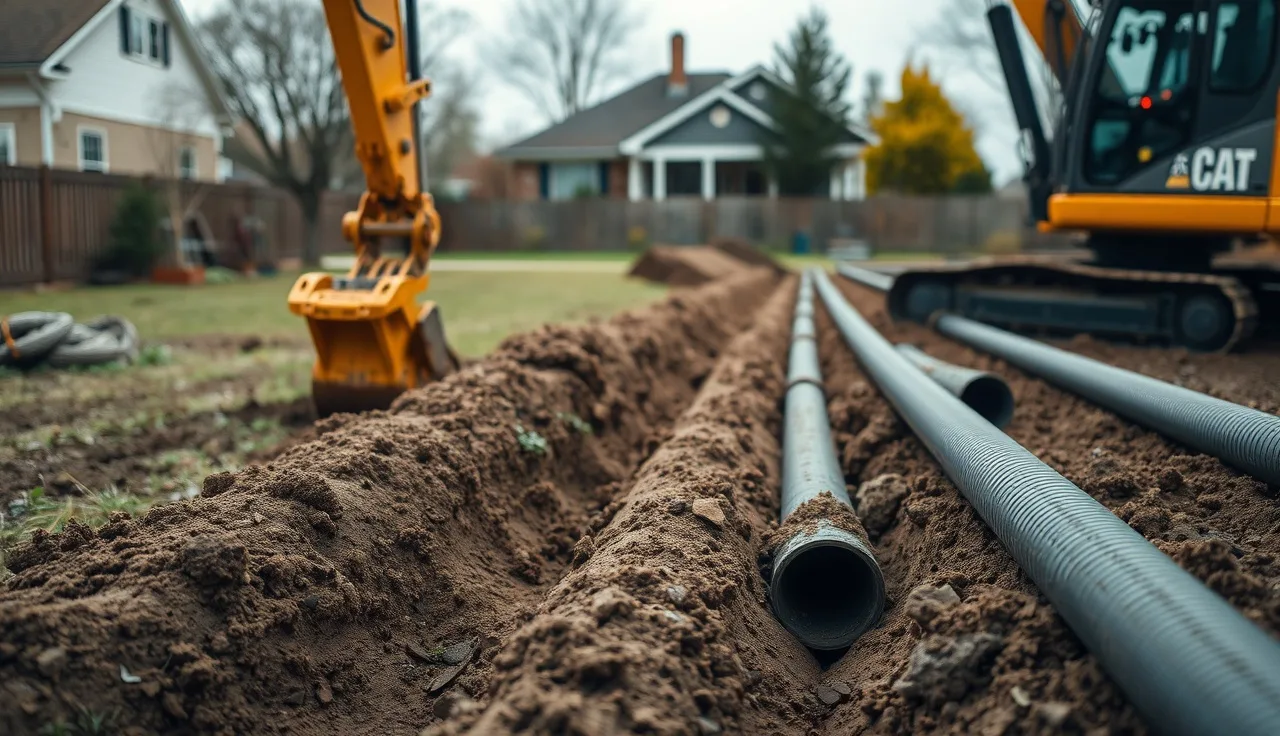
A drain field (also called a leach field or absorption field) is the network of perforated pipes buried in gravel-filled trenches that takes clarified wastewater from your septic tank and lets it seep into the soil. Bacteria in the soil finish the treatment before the water rejoins the groundwater.
Replacing one means excavating the old system, removing or abandoning the failed pipes and gravel, passing a new soil evaluation, pulling permits, and installing an entirely new distribution network, usually in a different spot on your lot. The old field usually stays in the ground unless local code says otherwise.
This is not a repair. Replacing is different from septic system repair, which might mean fixing a single broken pipe or a distribution box. A full replacement is triggered when the soil itself stops accepting effluent and can't recover, a condition called biomat failure or soil clogging. At that point no amount of additives, pumping, or rest will fix it. You need new ground.
One nuance worth knowing. Some jurisdictions let you designate a "repair area" or "reserve area" on the original permit, meaning your installer already picked out a backup zone when the system went in. If yours has one, the new field goes there and permitting moves faster. If it doesn't, you may need a variance or an engineered alternative.
What are the signs your drain field is failing and needs replacement?
The earliest sign is slow drains inside the house when nothing is physically clogged. Not one slow drain (that's a blockage), but every fixture draining sluggishly at the same time. The tank is full, the field won't take more flow, and liquid backs up through the whole system.
Wet spots or spongy ground over the field come next. If the soil feels soft when you mow, or you see pooled gray water on the surface during dry weather, the field is surfacing effluent. That's a health hazard and a code violation in every state.
Odors outside, especially a sulfur smell over the field, confirm active surfacing. So does a patch of lush, oddly green grass directly above the trenches while the rest of the lawn is dry. Plants love the nutrients. It means raw wastewater is feeding them.
Inside, sewage odors near floor drains or a toilet that gurgles when you flush a different toilet point to hydraulic overload. Sewage backing up into tubs or floor drains is the emergency stage. By then a regulatory notice is usually on its way.
The EPA's SepticSmart program lists "lush green grass over the drain field" and "sewage surfacing on the ground" as primary failure indicators [1]. Those aren't minor maintenance issues. They mean you need a licensed inspector on-site within days, not weeks.
Not every wet spot means the field is done. A septic tank inspection first is worth the $100 to $400 it costs. Sometimes the real culprit is a broken outlet baffle sending solids into the field, and catching that early means the field may still recover once the tank is fixed and rested.
How much does it cost to replace a drain field?
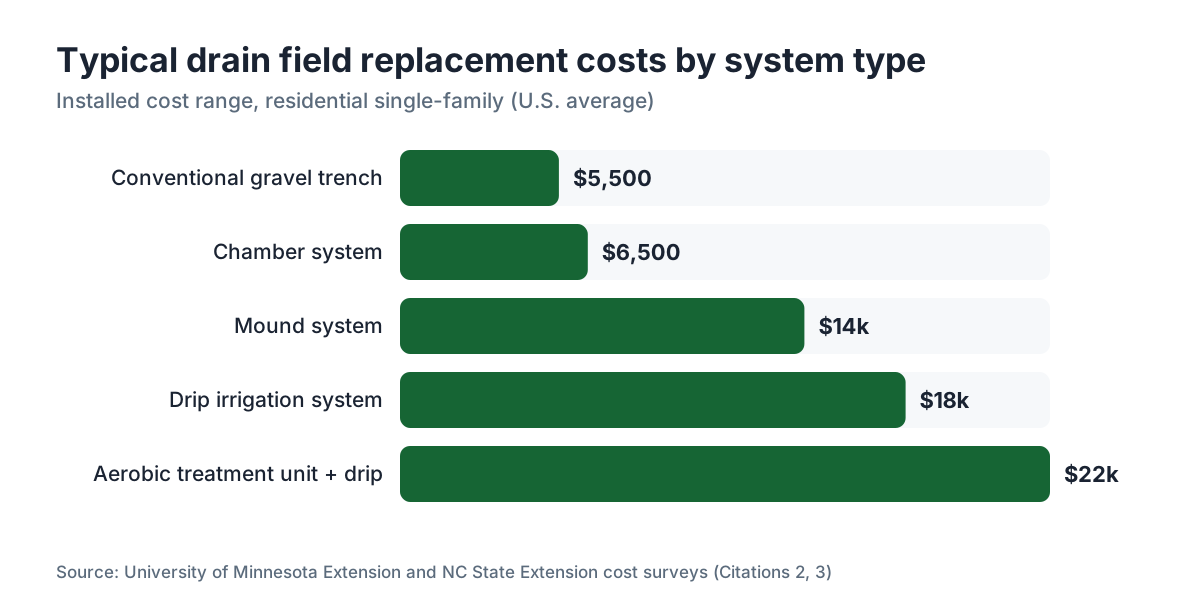
The honest answer is that it depends on things your contractor can't fully know until they dig and run tests. Here are real ranges drawn from state extension cost surveys and contractor pricing.
| System type | Typical installed cost | Notes |
|---|---|---|
| Conventional gravel trench | $3,000, $8,000 | Suitable soil required; most common |
| Chamber system (Infiltrator-style) | $4,000, $9,000 | No gravel; faster install |
| Mound system | $8,000, $20,000 | Required when soil is too shallow or wet |
| Drip irrigation (low-pressure dose) | $10,000, $25,000 | For marginal soils; requires pump |
| Aerobic treatment unit (ATU) with drip | $15,000, $30,000+ | Highly treated effluent; tight-lot option |
The University of Minnesota Extension puts the median installed cost for a standard replacement at $5,000 to $15,000 for most Minnesota homeowners, with mound systems toward the top of that range [2]. NC State Extension cites $5,000 to $10,000 for conventional systems and $15,000 to $20,000 for engineered alternatives [3].
Permits alone run $200 to $1,500 depending on county. Soil evaluations (perc tests or soil morphology assessments) add $300 to $800. If your property sits in a shoreland zone or a wellhead protection area, engineering review can tack on another $500 to $2,000.
Labor is typically 40 to 60 percent of total cost. Excavation equipment, gravel, pipe, and distribution boxes make up the rest. If you're doing a septic tank pump out or tank repair at the same time, you might negotiate a small discount since the contractor is already mobilized.
Get three bids. The spread between the lowest and highest quote on the same project often runs $2,000 to $5,000, and that's not because one contractor is dishonest. Soil conditions, trench depth, gravel haul distance, and permit fees all genuinely vary.
What factors drive the cost up or down?
Soil type is the biggest lever. Sandy loam with good permeability means short trenches, shallow burial, and a fast install. Clay or a high water table means either a mound system (imported fill, engineered design, pump) or an alternative technology. These aren't optional upgrades. Your county health department specifies the system type based on soil and site data, and you don't get to talk them down to a cheaper option if your soil doesn't qualify.
Lot size matters more than people expect. You need enough clear land to place the new field a set distance from wells, property lines, structures, and water bodies. The EPA's general guidance is 50 to 100 feet from drinking water wells, and state codes vary a lot [1]. On a tight lot, an engineer may have to design a smaller-footprint system (drip, mound, or chamber-bed) that fits, and those cost more.
Depth to groundwater or bedrock drives the design. Most states require at least 12 to 24 inches of separation between the bottom of the field and the seasonal high water table [4]. If your soil morphology shows mottling (the rust and gray streaks that mark historic saturation) at 18 inches, a conventional trench won't pass, and you're in mound territory.
Access is a hidden cost. If a contractor has to hand-dig part of the site because an excavator can't reach it, labor climbs fast. Existing landscaping, fences, outbuildings, and buried utilities in the path all add money.
State and county rules differ enormously. Texas gives counties wide discretion over many setbacks. Florida mandates specific separation from surface water. Oregon requires licensed onsite wastewater designers for most systems. Each layer of oversight adds time and cost [5].
Can you repair a drain field instead of replacing it?
Sometimes. It depends on what failed and how long ago.
If the field failed because of a single crushed pipe or a collapsed distribution box, that's a repair, not a replacement. Fix the broken part, pump the tank, give the field 6 to 12 months of lighter use, and the biomat in the soil often breaks down enough for permeability to recover. That outcome isn't guaranteed, but it happens often enough to try before committing to a full replacement.
If the field failed because the household sent raw or poorly treated effluent into it for years (broken tank baffle, no pumping, heavy garbage disposal use), the soil is probably clogged with biofilm and grease down the whole trench profile. Resting won't help much. Some companies sell aeration treatments or hydrogen peroxide injection that claim to dissolve the biomat. The evidence is thin and inconsistent. A Washington State University Extension review found no peer-reviewed studies supporting biological additive treatments for restoring saturated drain fields [6]. Save the money.
Hydro-jetting the laterals to break up accumulated solids does help when the pipes are clogged but the soil still has capacity. It costs $300 to $800 and is worth trying on a relatively young field before you condemn it.
For a full look at repair versus replacement, the septic system repair guide walks through the decision tree in more detail.
What is the process for replacing a drain field, step by step?
Step one is diagnosing the failure properly. A licensed inspector or sanitarian visits, probes the field, checks the tank, and decides whether replacement is actually needed. Don't skip this. Some contractors will quote a replacement for a problem that a septic tank repair would solve.
Step two is a site and soil evaluation. A licensed soil scientist or designer runs either a traditional perc test or, more and more, a soil morphology assessment. The morphology approach (reading soil color, texture, and structure by hand auger) is now accepted in most states and gives more reliable data than a perc test alone [4]. This tells you what type of system your soil can support.
Step three is the permit application. You or your contractor submit the site evaluation, proposed design, and site plan to the county or state health department. Approval can take one week in a rural office that moves fast, or eight weeks in a backlogged urban-adjacent county. Ask the health department directly about current turnaround.
Step four is design. For a conventional replacement in average soils, a standard design from the contractor's engineer is often enough. For alternative systems, you'll likely need a licensed onsite wastewater designer or PE to stamp the plans.
Step five is installation. A conventional gravel-trench field for a 3-bedroom home usually takes 2 to 4 days: one day for excavation and pipe laying, one for gravel and inspection, one for backfill and grading. Mound systems take longer, often 4 to 7 days, because of the imported fill.
Step six is inspection. Most jurisdictions require at least one in-field inspection before backfill. Some require two. The inspector checks trench depth, pipe slope, gravel depth, and setbacks. Do not let your contractor backfill before this inspection. It's more than a code box to tick. It's your only chance to confirm the system was built right.
Step seven is final approval and startup. After it passes, the system is backfilled, the tank is reconnected to the new field, and it goes back into service. You should get a copy of the approved permit and the as-built drawing. Keep that document.
How long does drain field replacement take from start to finish?
From the first call to a contractor until you're back on a working system, plan for 4 to 12 weeks total. The range is that wide because permitting runs the schedule.
A contractor can mobilize in a few days once permitted. The physical install is fast, 2 to 5 days for most residential systems. But soil evaluation, design, permit application, review, approval, and inspection scheduling can easily eat 6 to 10 weeks in a busy season.
In the meantime, if the system has failed completely, you may need to rent a holding tank or a portable toilet, or cut water use hard. Some counties issue emergency permits that compress the timeline when a household has no working sanitation. Ask about that option if you're in an active failure.
Season matters too. In northern states, frozen ground from November through March can make excavation impractical or impossible, and some jurisdictions won't permit winter installs at all. Heading into a northern winter with a failing field, you may be stuck with a temporary holding solution until spring.
Does homeowner's insurance or any financial assistance cover drain field replacement?
Standard homeowner's insurance does not cover septic system failure. Most policies exclude damage from gradual deterioration or wear, which is exactly what biomat clogging is. A handful of specialty policies and home warranty plans include septic coverage, but read the fine print. Many cap the payout at $1,000 to $3,000, which barely touches excavation.
USDA Rural Development's Section 504 Home Repair program offers grants and low-interest loans to very-low-income rural homeowners for septic repairs and replacements [7]. Income limits apply, and the property has to be in an eligible rural area. Applications go through your local USDA Rural Development office.
Some states run their own assistance programs. North Carolina's Clean Water State Revolving Fund, for example, has funded onsite wastewater improvements for failing systems that pose public health risks [8]. Contact your state's department of environmental quality to ask what's active.
County health departments sometimes offer low-interest loans for mandatory replacements, especially in counties with documented groundwater contamination. Ask before you assume none exist.
If you're tracking multiple quotes and managing a replacement, tools like SepticMind help you keep contractor bids, permit timelines, and inspection records in one place. That matters when a county inspection has a narrow scheduling window.
What permits and regulations do you need to follow?
Every state regulates onsite wastewater systems, though the agency varies. In some states it's the department of health, in others the department of environmental quality, and in a few it's both. Counties often stack their own overlay rules on top of state minimums.
The EPA's guidance on onsite systems notes that "all states have regulations governing the siting, design, installation, and management of septic systems" and that local permits are required before any new installation or replacement [9]. You cannot legally replace a drain field without a permit anywhere in the U.S.
Here's what you'll run into in most states:
- Minimum setbacks from wells, property lines, surface water, and structures
- Minimum soil separation from the seasonal high water table (typically 12 to 24 inches)
- Required system type based on soil evaluation results
- Licensed contractor requirement (most states require a licensed installer)
- Mandatory inspections at set construction stages
- As-built documentation filed with the local authority
Texas regulates through the Texas Commission on Environmental Quality (TCEQ) under 30 TAC Chapter 285, which sets minimum standards for all on-site sewage facilities [10]. California works through county environmental health departments under the California Plumbing Code and local ordinances. Florida's Department of Health regulates through Chapter 64E-6, Florida Administrative Code [5].
Hire a licensed professional who knows your specific county's rules. Code violations found after installation mean tearing it out and redoing it on your dime.
How long will a new drain field last?
A well-designed, properly maintained conventional drain field should last 20 to 30 years. Some last longer. Some fail in 10. The difference comes down to usage habits, soil conditions, and whether the tank is maintained.
The single biggest predictor of field longevity is whether the tank gets pumped on schedule. When a tank fills with solids, those solids carry over into the field and clog it. The EPA SepticSmart program recommends pumping every 3 to 5 years for an average household [1]. If you have a garbage disposal, pump more often. Our how often to pump septic tank guide covers intervals by household size.
What goes down the drain matters. Fats, oils, and grease are the main biomat-builders. Antibacterial soaps and bleach in bulk suppress the bacteria that break down solids in both the tank and the field. Medications, antibiotics especially, do the same.
Water conservation directly extends field life. A field sized for a 3-bedroom home at 150 gallons per day lasts much longer if actual use stays well below that design flow. High-efficiency toilets, shorter showers, and spreading laundry across the week instead of six loads on Saturday all help.
Vehicle traffic and heavy equipment compact the soil and crush the pipes. Keep it off-limits. Don't plant trees or shrubs over it either. Root intrusion is a real failure mode, just slower than biomat clogging.
Should you replace the septic tank at the same time?
Not automatically, but it's worth checking. If your tank is more than 30 years old, has heavy concrete deterioration, or has failing baffles, combining tank replacement with the field replacement makes financial sense. The contractor is already mobilized and you share the excavation cost.
If the tank is structurally sound and the baffles are intact, replacing it just because you're doing the field is money wasted. Have the tank inspected first. A septic tank inspection while the contractor is on-site costs little and gives you real information instead of a guess.
One scenario often forces simultaneous replacement. If the county inspector finds the original tank undersized for your current home (you've added bedrooms or bathrooms since install), they may require a tank upgrade as a condition of the new field permit. Ask about this before the permit application, not after.
For what a new tank alone costs, the cost to put in a septic tank guide has current pricing by tank material and region.
How do you maintain a new drain field to avoid replacing it again?
Start with a pumping schedule and stick to it. Set a calendar reminder for every 3 years and don't skip it even when the system seems fine. Early pumping catches problems before they reach the field. The septic tank pumping guide covers how to find a licensed pumper and what to ask.
Get risers installed on your tank lids if you don't have them. Risers make future pumping and inspection faster and cheaper, so contractors are more likely to actually look at the tank instead of skipping it because access is a pain.
Keep a log of every service visit: who came, what they found, what they did. When you sell, a documented maintenance history is worth real money in negotiation, and it protects you from liability if a problem turns up after closing.
Send roof drains and sump pump discharge away from the field. Flooding the field with clean water that needs no treatment eats capacity just like wastewater does. Runoff from driveways and paved surfaces can pond over the field too. Re-grade if you have to.
After installation, stay off the new field with vehicles for at least six months while the soil settles and grass takes hold. Keep a 10-foot buffer on each side clear of any structure or permanent planting.
Operators running multiple properties or service routes can use SepticMind's scheduling and inspection tools to flag properties approaching their service interval so nothing slips.
For a broader look at what septic tank cleaning involves and why it matters to field health, that guide covers the process end to end.
Frequently asked questions
Can a drain field be replaced in the same location as the old one?
Rarely. Once soil is biomat-clogged, putting a new system in the same trenches usually means it fails fast because the surrounding soil hasn't recovered. Most states require the new field in a different area of the lot. A few allow same-location replacement with significant soil remediation, but that's the exception and needs engineering review.
How do I know if my drain field is failing or just overloaded?
Overload is temporary: the system backs up after heavy water use (multiple laundry loads, a big gathering) and recovers within 24 to 48 hours. Failure is persistent: slow drains and wet spots don't improve with less water use or a dry spell. Have a licensed inspector probe the field and check effluent levels in the distribution box. That's the only reliable way to tell them apart.
Will adding bacteria or enzymes fix a failing drain field?
No. There's no peer-reviewed evidence that commercial biological additives restore soil clogged with biomat. Washington State University Extension reviewed the literature and found none of the tested products produced consistent, meaningful improvement. Save the money for the actual repair or replacement. The EPA and most state health departments take the same position.
How many bids should I get for drain field replacement?
Get at least three. The spread between the lowest and highest bid on identical scopes often runs $2,000 to $5,000 for a residential replacement, and the cheapest bid isn't always the worst work or the best deal. Ask each contractor for references from drain field replacements specifically, more than septic installs, and verify their license with your state's board before signing.
Do I need to vacate my home during drain field replacement?
Usually not, but you'll need to restrict water use hard for 2 to 5 days during active installation. Flushing, showering, and running appliances will be off-limits for parts of each work day. If your system has already failed and sewage is backing up into the house, a temporary holding tank or portable facilities may be needed for the weeks between failure and permit approval.
How far does a new drain field need to be from my well?
The minimum is typically 50 to 100 feet from a private drinking water well, but state codes vary a lot. Some states require 100 feet as a hard minimum; others allow 50 feet with added treatment. Florida, for example, requires 75 feet under most conditions. Always check your specific state and county code. Your soil evaluator or designer verifies setbacks as part of the site plan.
Can a drain field be replaced in winter?
In the northern U.S. and Canada, ground frost can make winter installation impractical or impossible. Some counties won't issue installation permits when ground temperatures are below freezing. In milder climates, winter installation is routine. If you're in a cold-weather state facing active failure heading into winter, ask the health department about emergency permit procedures and whether a temporary holding tank can carry you until spring.
What happens if I replace a drain field without a permit?
The county can require you to excavate and remove the unpermitted system at your own expense, then start the permit process over. You may face fines. More practically, an unpermitted system creates a title problem when you sell. Most real estate deals require a passing septic inspection, and an unpermitted replacement won't pass. Don't skip the permit.
Does replacing a drain field increase my home's value?
It prevents a big loss in value more than it adds new value. A home with a documented failing septic system can lose $20,000 to $50,000 or more in sale price, or fall out of contract entirely. A new permitted system with documentation brings the property back to baseline. Buyers and lenders treat working, permitted septic systems as a basic requirement, not a premium feature.
What is a mound system and when is it required?
A mound system raises the drain field above native grade by placing it in a constructed mound of imported sand and fill. It's required when native soil has too little depth to groundwater or bedrock, or when permeability is too low for conventional trenches. Mound systems cost $8,000 to $20,000 and need a pump to deliver effluent. They're common in the upper Midwest and Florida where water tables run high.
How long after installation before I can use the system normally?
You can usually return to normal water use right after final inspection approval and backfill, often the same day or the next. The system doesn't need a break-in period. The one restriction is keeping vehicles off the field for several months so the soil compacts and grass establishes without crushing the pipes.
Is a conventional gravel system or a chamber system better for a replacement?
Chamber systems (plastic arch chambers with no gravel) have largely replaced gravel trenches in much of the country: faster install, no gravel hauling cost, equal or better long-term performance, and acceptance by most state codes. The EPA notes chambers are approved in all 50 states. For most replacements with adequate soil, either works fine, but chambers often come in at a similar or slightly lower cost with less time on-site.
What is a reserve area and do I have one?
A reserve area is a backup location on your property identified when the original system was installed, set aside for a future replacement field. If your original permit included one, replacement is faster and cheaper because site evaluation and design are partly done. Check your original permit documents or call the county health department with your address to find out if one was designated.
Sources
- U.S. EPA, SepticSmart: Homeowner Information: EPA SepticSmart identifies lush grass over the drain field, sewage surfacing, and slow drains as primary failure indicators, and recommends pumping every 3 to 5 years.
- University of Minnesota Extension, Septic System Costs: Median installed cost for a standard drain field replacement in Minnesota is $5,000, $15,000, with mound systems at the higher end.
- NC State Extension, Septic System Maintenance and Costs: North Carolina State Extension cites $5,000, $10,000 for conventional drain field replacement and $15,000, $20,000 for engineered alternatives.
- EPA, Onsite Wastewater Treatment Systems Manual (EPA/625/R-00/008): Most states require 12 to 24 inches of separation between the bottom of the drain field and the seasonal high water table; soil morphology assessment is accepted by most states as an alternative to perc testing.
- Florida Department of Health, Chapter 64E-6 Florida Administrative Code: Florida regulates septic system installation and replacement through Chapter 64E-6, Florida Administrative Code, administered by county health departments.
- Washington State University Extension, Septic System Additives: A WSU Extension review found no peer-reviewed studies supporting biological additive treatments for restoring saturated or biomat-clogged drain fields.
- USDA Rural Development, Section 504 Home Repair Program: USDA Rural Development Section 504 offers grants and low-interest loans to very-low-income rural homeowners for septic system repairs and replacements.
- North Carolina Department of Environmental Quality, Clean Water State Revolving Fund: North Carolina's Clean Water State Revolving Fund has been used to fund onsite wastewater improvements in failing systems posing public health risks.
- U.S. EPA, Introduction to Septic Systems: The EPA states that 'all states have regulations governing the siting, design, installation, and management of septic systems' and that local permits are required before any installation or replacement.
- Texas Commission on Environmental Quality, 30 TAC Chapter 285: Texas regulates all on-site sewage facility installations and replacements under 30 TAC Chapter 285, administered by TCEQ.
- EPA, Septic Systems: What to Do After the Flood: EPA guidance notes that plastic chamber systems are approved for use in all 50 states and perform comparably to conventional gravel-trench systems.
Last updated 2026-07-10