Septic tank cleaning: what it is, what it costs, and how often
By the SepticMind Editorial Team
TL;DR
- Septic tank cleaning means pumping out the sludge and scum, rinsing the tank, and checking the baffles.
- Most households need it every 3 to 5 years.
- Typical cost is $300 to $600, and large tanks or buried lids push that higher.
- Skip it and solids reach the drain field, which costs $5,000 to $30,000 to replace.
What is septic tank cleaning, exactly?
A septic tank does one job: separate solids from liquid. Heavy solids sink into a sludge layer at the bottom. Grease and lighter stuff float to the top as scum. The liquid in the middle, called effluent, flows out to the drain field. Over time the sludge and scum layers grow until they crowd out the liquid zone. That's when solids escape into the drain field and clog it.
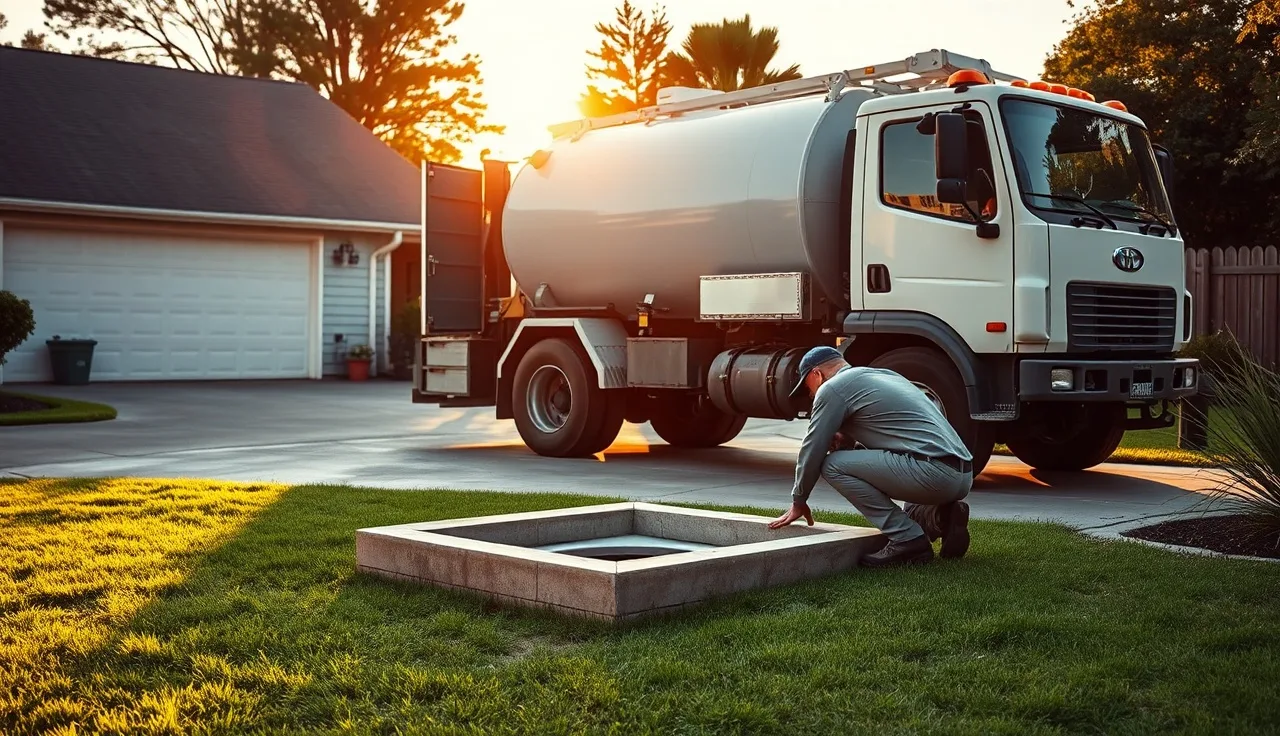
Cleaning stops that. A licensed pumper drives a truck with a big vacuum tank, runs a hose to your access lid, and pulls out everything inside. Good operators also rinse the tank walls, break up hardened sludge with water jets, and look over the inlet and outlet baffles while they have the lid off.
The words "cleaning," "pumping," and "emptying" get used interchangeably, and they mostly mean the same visit. The technical difference is that pumping empties the tank, while cleaning adds a rinse and a visual inspection. Ask specifically whether rinsing and a baffle inspection are included, because some cheap quotes skip them. Our guide to septic tank pumping walks through the process step by step.
Septic cleaning is regulated at the state level. Most states require the waste to go to an approved treatment facility, and the pumper has to hold a state license. The EPA's SepticSmart program sums up the principle: proper maintenance protects your system and the water around it [1].
How is a septic tank different from a municipal sewer?
A septic tank treats your household waste on your own property. A municipal sewer pipes it to a central plant the city runs. That's the whole difference, and it changes everything about who pays and who fixes it.
A septic tank is an underground watertight container, usually 1,000 to 2,000 gallons, made of concrete, fiberglass, or polyethylene. Everything that goes down your drains flows into it [2].
With a sewer, the city owns the system past your property line and sends you a bill. With septic, you own every piece: the tank, the pipes, and the drain field. There's no monthly bill, but there's also no city crew coming to bail you out. Maintenance is on you.
About 21 million households in the United States rely on septic systems, according to the EPA [2]. In rural and suburban areas where sewer lines don't reach, septic is the norm, not the exception.
How much does septic tank cleaning cost?
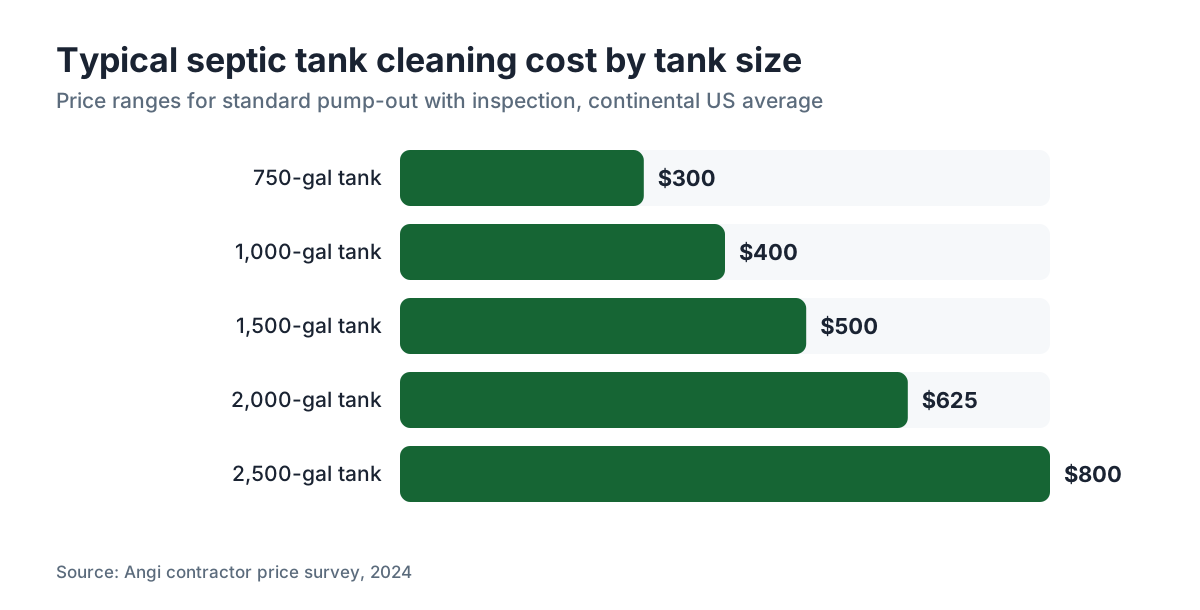
Most homeowners pay $300 to $600 for a standard septic tank cleaning, based on contractor price surveys from Angi and HomeAdvisor [3]. The national average lands around $400 to $450 for a 1,000 to 1,500-gallon tank with normal access.
A few things move the price up or down:
| Factor | Effect on price |
|---|---|
| Tank size (1,000 gal) | Base rate, typically $300 to $400 |
| Tank size (1,500 to 2,000 gal) | Add $50 to $150 |
| Tank size (2,500+ gal) | Add $200 to $400+ |
| Buried lid (excavation needed) | Add $50 to $200 |
| Multiple compartments | Add $75 to $100 per compartment |
| Distance from truck access | Add $0 to $100 |
| Baffle inspection and rinsing | Sometimes included, sometimes add $50 to $100 |
| Rural or remote location | Add 10 to 30% |
Region matters a lot. A pump-out in the rural South can run $250 to $325. The same service in coastal California or the Northeast might hit $550 to $800. Labor rates, disposal fees, and local licensing all vary [3].
Installing a septic tank riser is one of the smartest $200 to $400 moves a homeowner can make. It brings the access lid to ground level so you never pay for excavation again.
If someone quotes you $150 for a full cleaning, walk away. At that price they're either skipping the rinse, dumping the waste illegally, or planning to upsell you hard once the truck is in your driveway. The per-gallon disposal fee alone runs $0.05 to $0.15 in most states.
How often should you clean a septic tank?
The EPA recommends inspecting your septic system every 3 years and pumping it every 3 to 5 years for the average household [1]. That's the honest baseline for a family of four with a 1,000 to 1,500-gallon tank.
The real answer depends on actual sludge, not the calendar. The standard rule: pump when the sludge layer reaches within 12 inches of the outlet baffle, or when scum comes within 6 inches of the outlet [9]. A good inspector measures both on every visit.
Our guide on how often to pump a septic tank covers the math. Here's a quick reference:
| Household size | Tank size | Typical pump interval |
|---|---|---|
| 1 to 2 people | 1,000 gal | 5 to 7 years |
| 3 to 4 people | 1,000 gal | 3 to 5 years |
| 3 to 4 people | 1,500 gal | 4 to 6 years |
| 5 to 6 people | 1,500 gal | 2 to 4 years |
| 5 to 6 people | 2,000 gal | 3 to 5 years |
A garbage disposal shortens all of these. The EPA notes that garbage disposal use can nearly double the rate of sludge accumulation [1]. If you run one every day, shave at least a year off whatever the table says.
Pumping every year "just to be safe" wastes money unless a licensed inspector has measured the layers and confirmed you need it. Once the tank is clean, more pumping buys you nothing.
What happens during a professional septic cleaning visit?
A thorough visit runs four steps: uncover the lid, vacuum the tank, inspect the baffles, and haul the waste to an approved site. Knowing the sequence helps you tell whether a contractor actually did the job.
First, the technician finds the tank and uncovers the access lid. No riser? They'll probe the yard and maybe dig. They should mark the lid with a stake before they leave so you know where it is next time.
Next, they drop the vacuum hose and pull the contents out. A proper cleaning takes everything, including the packed sludge at the bottom. Some operators add water to loosen compacted sludge, then vacuum again. That rinse step matters. Hard sludge left behind speeds up the next buildup cycle.
With the tank empty, a good technician checks the inlet and outlet baffles. Baffles are the T-shaped fittings that keep solids from flowing into the drain field. They crack, corrode, or fall off over the years. Replacing a bad one runs $150 to $400 and takes maybe 30 minutes [10]. Miss a missing baffle and your drain field is eating solids right now.
Last, they note the sludge depth (if they measured it), confirm the tank refills from normal household flow, and haul the waste to a permitted facility. You should get a written receipt or service record. Keep it. Many states make homeowners prove maintenance history when selling, and some lenders want a recent inspection [4].
If a technician won't let you watch, skips the baffles, or can't tell you where the waste goes, call someone else.
What's the difference between cleaning, pumping, and jetting?
Cleaning and pumping empty the tank. Jetting clears the pipes. That's the distinction that saves homeowners from paying for a service they don't need.
Septic tank pumping or pump out is the standard vacuum service described above. It removes the solids and liquid from the tank. Most routine maintenance is exactly this.
Septic tank emptying is another word for pumping. Same service, different label.
Hydro-jetting (sometimes called pressure jetting) is a separate job that clears blockages in the pipes between your house and the tank, or between the tank and the drain field. It blasts grease, roots, or debris out of clogged lines with high-pressure water. A basic jetting job runs $200 to $600, and you only need it when there's an actual blockage, never as routine maintenance [3].
Chemical additives are their own category. Products sold as septic tank cleaners or treatments claim to break down sludge or boost bacteria. The EPA has looked at these and found no evidence they cut the need for pumping or improve performance [1]. Some may hurt the bacterial balance that runs your tank. Don't bother. Put that money toward actual pumping.
Can you clean a septic tank yourself?
Technically, no. Practically, absolutely not. In nearly every state, pumping and hauling septic waste requires a licensed hauler with a permitted vacuum truck and an approved disposal site.
Doing it yourself would break state licensing laws, waste disposal rules, and probably local health codes. Fines for illegal sewage disposal run from hundreds to thousands of dollars in most states [4].
What you can do yourself is keep conditions that slow sludge buildup. Spread laundry loads across the week instead of running seven on Saturday. Fix leaky faucets, since extra water stresses the system. Keep fats and oils out of the drains. Flush nothing but toilet paper. The EPA's SepticSmart program publishes a homeowner checklist covering exactly these habits [1].
Some homeowners add enzyme or bacterial products between pumpings. The science here is weak. The EPA doesn't endorse them, and no controlled study has shown they meaningfully slow sludge buildup. If you want to spend $15 on a probiotic packet, it probably won't hurt anything. Just don't count it as maintenance.
What are the signs your septic tank needs cleaning now?
The worst time to learn your tank is overdue is when sewage backs up into the house or pools in the yard. By then you're already looking at septic tank repair costs on top of the cleaning.
Watch for these earlier signals.
Slow drains across more than one fixture point to a full tank or a blockage between the house and tank. One slow drain is usually a pipe problem. All of them slowing at once points to the tank.
Gurgling after a flush or a drain can mean the tank is at capacity and gases are pushing back up the lines.
Wet, spongy ground over the drain field, or a patch of grass that's suddenly greener than the rest of the yard, suggests the tank is pushing effluent out before solids can settle into the septic drain field.
Odors near the tank or drain field are a late warning. A working tank shouldn't smell at the surface.
Seeing any of these? Don't just book a routine cleaning and hope. Call a licensed inspector first. You may have a failure building that cleaning alone won't fix.
How does septic tank cleaning affect the drain field?
Regular cleaning is what keeps solids out of the drain field, and the drain field is the most expensive part of the whole system. A conventional leach field replacement costs $5,000 to $20,000. Advanced setups like mound systems or aerobic treatment units run $15,000 to $30,000 [5]. Our guide on cost to install a septic system breaks those numbers down.
Drain fields fail when solids reach them. They're built to receive clarified liquid only. Let a tank go too long and the sludge layer rises to the outlet baffle. Solids flow out with the effluent, hit the drain field trenches, and plug the soil pores that let liquid soak away. Once that clogged biomat forms, the field is usually done.
Cleaning at the right interval for your household is the single best way to stretch a drain field's life. The EPA puts the design life of a properly maintained conventional drain field at 20 to 30 years [5]. Systems that skip regular pumping often fail in 10 years or less.
Buying a home with septic? A current cleaning and full inspection before closing is basic due diligence, not an extra. Many states now require it by statute [4].
How do you find and vet a good septic cleaning service?
Start with your state's environmental or health agency website. Every state that allows private septic maintains a list of licensed pumpers and haulers. Hire an unlicensed operator and you can be on the hook for illegal disposal even though you never touched the truck.
For operators juggling multiple accounts, scheduling, and reminders, tools like SepticMind keep inspection records and pump-out histories in one place, which helps once a septic services business grows past a few dozen customers.
Beyond licensing, ask these before you book.
Do they include a baffle inspection with the cleaning? It should be standard.
Where does the waste go? They should name a specific licensed treatment facility.
Will they give you a written report with sludge depth measurements? That's the only objective record of what your tank actually needed.
Do they take photos of the interior? Not universal, but useful and more common every year.
Get at least two quotes. A 20 to 30 percent spread for the same service is normal. A spread of 50 percent or more usually means someone is cutting corners or setting up an upsell.
Check with neighbors who have similar tanks in similar soil. Their interval and cost are a fair reference for yours.
What state and federal regulations govern septic cleaning?
Federal oversight runs through the EPA's Clean Water Act framework and its guidance for onsite wastewater systems. The EPA publishes a homeowner guide through SepticSmart that covers maintenance standards, but enforcement happens entirely at the state and local level [1].
State rules vary enormously. Some states mandate minimum pump intervals. Florida's Department of Health, for example, requires septic systems to be inspected every 5 years under its Onsite Sewage Treatment and Disposal Systems rules [6]. Other states leave the interval up to the homeowner. Many counties layer their own rules on top, especially near watersheds, coastal areas, or wellhead protection zones.
Pumpers are licensed under state programs, usually through a Department of Environmental Quality, Department of Health, or a similar agency. They must haul waste to permitted septage treatment facilities. Dumping is a criminal offense in all states and carries heavy civil penalties [4].
The EPA states that a properly maintained septic system "can provide excellent wastewater treatment" when homeowners keep up with inspection and pumping [1]. Private ownership, private responsibility. That's the whole regulatory philosophy.
Unsure of your state's rules? The National Onsite Wastewater Recycling Association (NOWRA) keeps a state-by-state regulatory directory [7].
What does septic cleaning cost compared to letting the system fail?
The math isn't close. Routine pumping is cheap insurance, and that's arithmetic, not a sales pitch.
A pump-out every 3 to 5 years at $400 works out to about $80 to $133 a year. A drain field replacement costs $5,000 to $20,000 or more, depending on system type and soil [5]. Let a system fail after 10 years of no maintenance and you've "saved" roughly $800 to $1,300 on pump-outs and spent $5,000 to $20,000 replacing the field. The ratio runs 15 to 1 or worse.
Then there are the softer costs. A failed system can block a certificate of occupancy or a home sale. A lender won't close a mortgage on a property with a failing septic system. Real estate deals in many states require a septic inspection to close, and some require proof of recent pumping [4].
If yours reaches the point of no return, our guides to cost to put in a septic tank and septic tank installation show the full replacement picture.
Spend the $400. It's the best deal your septic system will ever offer you.
Frequently asked questions
How much does it cost to clean a septic tank?
Most homeowners pay $300 to $600 for a standard septic tank cleaning, with the national average around $400 to $450 for a 1,000 to 1,500-gallon tank. Larger tanks, buried lids, multiple compartments, and remote locations push it higher. Regional variation is big: the same job that costs $300 in rural Alabama can run $700 in coastal New England.
How often should a septic tank be cleaned?
The EPA recommends pumping every 3 to 5 years for an average household. The exact interval depends on household size, tank volume, and garbage disposal use. A family of four with a 1,000-gallon tank typically needs service every 3 to 4 years. A single person with a 1,500-gallon tank might go 7 years or more. Measuring actual sludge depth beats any fixed calendar.
What is the difference between septic tank cleaning and pumping?
They're mostly the same service. Pumping removes the liquid and solid contents with a vacuum truck. Cleaning usually adds rinsing the interior walls and inspecting the inlet and outlet baffles. When hiring a company, ask specifically whether rinsing and a baffle check are included, since some low-price quotes skip those steps.
Can I use septic tank cleaning additives instead of pumping?
No. The EPA has reviewed septic additives and found no evidence that enzyme or bacterial products reduce sludge accumulation or eliminate the need for pumping. Some chemical additives may harm the bacterial ecosystem that makes the tank work. Physical pumping by a licensed hauler is the only maintenance that actually removes accumulated solids.
What happens if you never clean your septic tank?
Eventually the sludge layer rises to the outlet baffle and solids flow into the drain field. Soil pores clog, the field fails, and you face a $5,000 to $30,000 replacement. Systems without regular pumping often fail in under 10 years. A drain field maintained with regular cleaning can last 20 to 30 years.
Do I need to be home when the septic tank is cleaned?
It's not strictly required, but being home is smart for your first cleaning with a new company. You can confirm they found the correct tank, watch the inspection, ask about baffle condition, and verify they take measurements. You should always get a written service report. Once you trust an operator, a lockbox and remote access work fine.
How long does a septic tank cleaning take?
A straightforward pump-out on an accessible, correctly sized tank takes 30 to 60 minutes. Add time for digging out a buried lid (another 30 to 60 minutes), rinsing, baffle inspection, and paperwork. Plan on a 2-hour window. Badly neglected tanks with hardened sludge take longer, since the operator has to break up compacted material before vacuuming.
Is a septic tank cleaning required when selling a house?
It depends on your state and local rules. Many states require a septic inspection before a real estate transaction closes, and some require proof of recent pumping. Florida requires a system inspection as part of real estate sales in many circumstances. Regardless of what's required, buyers and lenders usually insist on a current inspection, and a recently serviced system speeds the sale.
What should I do to prepare before a septic cleaning visit?
Find your tank's access lid if you know where it is, and mark it. Clear any vehicles, furniture, or structures blocking the truck's path. Know your tank's age, size, and last pump date. Have your service records ready. If you've never had it pumped, tell the technician so they can probe for the lid and quote any excavation charge.
What is a septic system cleaning service visit supposed to include?
A complete septic system cleaning service should include vacuuming out all sludge and scum, rinsing the tank walls, inspecting the inlet and outlet baffles, measuring sludge depth before pumping, and hauling waste to an approved facility. You should get a written service report. Skip any company that won't confirm all of these steps are part of the job.
Does cleaning a septic tank damage the good bacteria inside it?
Pumping removes the existing bacterial population along with everything else, but the tank reseeds itself naturally from incoming wastewater within a few days to a few weeks. You don't need a bacterial starter product after pumping. The balance restores itself, as long as the household isn't regularly flushing antibacterial agents or large amounts of bleach.
How do I find a licensed septic tank cleaning service in my area?
Check your state's environmental or health department website for the official list of licensed pumpers and haulers. Using an unlicensed operator exposes you to legal liability for improper disposal even if you never handled the waste. NOWRA also keeps a state regulatory directory. Ask any candidate where they take the waste and verify it's a licensed septage treatment facility.
Sources
- U.S. EPA, SepticSmart homeowner program: EPA recommends inspecting septic systems every 3 years and pumping every 3 to 5 years; garbage disposal use can nearly double sludge accumulation; additives show no evidence of reducing pump frequency
- U.S. EPA, Septic Systems Overview: A septic tank is an underground watertight container where solids settle and liquid effluent flows to the drain field; approximately 21 million US households rely on septic systems
- Angi, Septic Tank Pumping Cost Guide: National average septic tank cleaning cost ranges $300 to $600; hydro-jetting runs $200 to $600 for pipe blockage clearing
- National Environmental Services Center, West Virginia University: Many states require proof of septic maintenance history at real estate sale; licensed haulers must transport waste to permitted septage facilities; illegal disposal carries heavy civil and criminal penalties
- U.S. EPA, Types of Septic Systems: Conventional drain field design life is 20 to 30 years with proper maintenance; advanced systems like mound systems cost significantly more to install and replace
- Florida Department of Health, Onsite Sewage Treatment and Disposal Systems: Florida requires septic system inspection every 5 years under its Onsite Sewage Treatment and Disposal Systems rules
- National Onsite Wastewater Recycling Association (NOWRA): NOWRA maintains a state-by-state directory of onsite wastewater regulations and licensing requirements
- University of Minnesota Extension, Septic System Owner's Guide: Sludge depth within 12 inches of outlet baffle triggers pump need; scum within 6 inches of outlet also triggers pumping; household size and tank volume determine appropriate pump interval
- North Carolina State University Extension: Riser installation eliminates excavation cost for future service calls; baffle inspection and replacement is essential part of complete cleaning service
Last updated 2026-07-09