Septic drain field: how it works, what it costs, and when to replace it
By the SepticMind Editorial Team
TL;DR
- A septic drain field (also called a leach field) is the network of perforated pipes buried in gravel trenches that releases clarified wastewater from your septic tank into the soil for final treatment.
- Installation runs $3,000 to $15,000 depending on soil type and system size.
- A well-maintained field lasts 20 to 30 years.
- Biomat buildup, soil compaction, and hydraulic overload are the top three reasons fields quit.
What is a septic drain field and what does it actually do?
A septic drain field is the last treatment stage in a conventional onsite wastewater system. Wastewater leaves your house and enters the septic tank, where solids settle out and anaerobic bacteria break down organic matter. The clarified liquid effluent then flows by gravity into a distribution box or manifold that spreads it across a network of perforated pipes. Those pipes sit in gravel-filled trenches below the surface. Effluent drips through the gravel, passes through a thin biological layer called a biomat, and enters the native soil, where bacteria, filtration, and time remove pathogens and nutrients before the water reaches groundwater.
The EPA describes the drain field as the part of the system that provides final treatment and disposal, and estimates that roughly 20 percent of U.S. households rely on onsite systems like this one [1]. When the drain field works, you never think about it. When it fails, sewage backs up, surfaces in your yard, or discharges untreated to surface water. Those outcomes are expensive, and in most states they are a public health violation.
Drain field, leach field, and absorption field all name the same component. Leach field is the older term. Most state regulations and the EPA now say absorption field or soil treatment area, but homeowners use all three, and every plumber knows what you mean.
How does a septic drain field work step by step?
Effluent leaves the septic tank through the outlet baffle (or an effluent filter in newer systems) and travels to the drain field. Four things happen at once when it arrives.
First, the distribution system spreads flow. A gravity system uses a D-box that splits flow to multiple lateral pipes. Pressure-dosed systems use a pump to push effluent in timed doses through a manifold, so every lateral gets an equal slug of liquid instead of the closest pipe getting hammered.
Second, effluent seeps from the pipe perforations down through 12 to 24 inches of washed gravel. The gravel holds the pipe in place and lets liquid spread sideways before it touches native soil.
Third, a biomat forms at the gravel-soil interface over months and years. This thin layer of organic material and bacteria slows the movement of effluent and adds biological treatment. A thin biomat is normal and useful. A thick, clogged biomat is the most common cause of drain field failure [2].
Fourth, the native soil finishes the job. Loamy soils with a percolation rate of 1 to 60 minutes per inch pass most state codes [12]. Clay that percs too slowly and sand that percs too fast both cause problems. Coarse sand or fractured rock can let partially treated effluent reach groundwater before treatment is done.
Resting matters too. That is why many engineers spec alternating fields or demand-dosing controls. Give the soil time between doses and it drains, re-aerates, and recovers.
What does a standard drain field layout look like?
The classic drain field uses parallel trenches, each 18 to 36 inches wide and 18 to 36 inches deep, spaced at least 6 feet apart on center (your state code sets the exact number). Each trench holds a single 4-inch perforated PVC lateral. Laterals run 50 to 100 feet long, and a 3-bedroom home might have three to five of them, for a total absorption area of 750 to 2,500 square feet.
Total required area comes from the perc test result and the anticipated daily flow. A rule of thumb many state health departments use is 1.5 to 2 gallons per day per square foot of trench bottom for a soil percolation rate around 30 minutes per inch. That math sounds dry until you see what it controls: lot feasibility, system cost, and whether you can add a bedroom.
Other layouts exist. Chamber systems replace gravel and pipe with plastic arch-shaped chambers. Drip irrigation fields drip effluent from small-diameter tubing at a shallow depth. Mound systems build an elevated sand bed above native soil. Aerobic treatment units discharge to a smaller secondary field. Your soil and lot decide which layout is even legal where you live.
Setbacks apply to every layout. The EPA and state codes set minimum distances from wells, property lines, structures, and water bodies. Common setbacks are 50 to 100 feet from a drinking water well, 10 feet from property lines, and 5 to 10 feet from the foundation [8]. Some states go stricter. Pull the actual permit records for your property so you know what got approved.
How much does it cost to install a septic tank and leach field?
The cost to install a septic tank and leach field runs from about $3,000 on the low end (a small system on favorable sandy soil) to $25,000 or more for a mound or pressure-dosed field on a hard lot. The middle 80 percent of jobs land between $6,000 and $15,000 for a complete conventional system [3].
The field itself is usually 40 to 60 percent of that total. Digging, gravel, pipe, and labor for the field alone often run $2,500 to $10,000 depending on trench length and whether the soil needs imported fill.
Soil moves the number more than anything else. Favorable loam with a fast perc test cuts install time and material. A site that fails the standard perc test and needs a mound or drip field can add $5,000 to $10,000 or more.
Permitting costs real money. Perc testing and soil evaluation fees run $200 to $1,500 depending on the state and how many tests they require. The permit itself is often $200 to $600. Engineer-stamped designs, required in many states for alternative systems, add another $500 to $2,000.
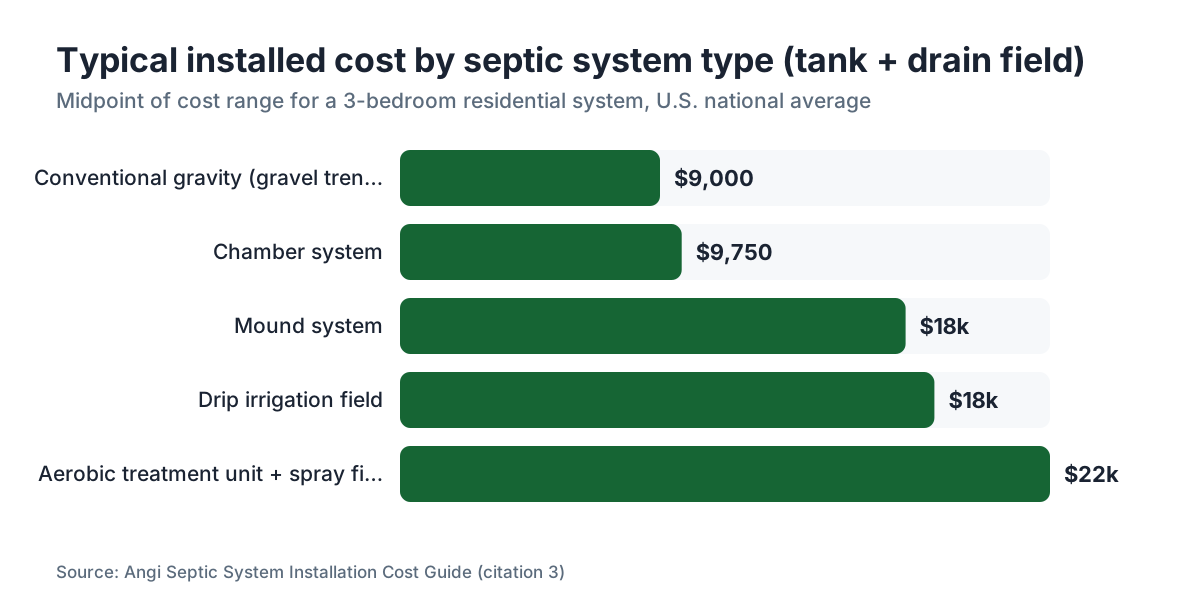
The table below shows typical installed cost ranges by system type.
| System type | Typical installed cost (tank + field) | Notes |
|---|---|---|
| Conventional gravity (gravel trench) | $6,000 to $12,000 | Best soil required |
| Chamber system | $6,500 to $13,000 | Fewer perc requirements |
| Mound system | $10,000 to $25,000 | Needed when water table is high |
| Drip irrigation field | $12,000 to $25,000 | Requires pump and controls |
| Aerobic treatment unit + spray field | $15,000 to $30,000 | Common in Texas and the Southeast |
These figures line up with data from the University of Minnesota Extension and state health department cost summaries [3][4]. Regional labor rates shift them up or down by 20 to 30 percent. For a full breakdown of what drives total project cost, see our article on cost to install septic system.
What does the tank alone cost? A concrete or fiberglass tank set in the ground typically runs $1,200 to $3,500 including installation. That number shows up all over search results, and it is misleading, because you cannot legally run a septic tank without an approved drain field. Budget for the whole system.
How do you install a septic drain field?
Installing a drain field is not a DIY job in most states. Many states require a licensed septic contractor and a permitted design stamped by a professional engineer or licensed site evaluator. Still, knowing the process helps you manage a contractor and catch mistakes.
The sequence runs like this. A site evaluator or engineer tests the soil with a percolation test (water poured into a bored hole, measured for drop rate over a set time) and a soil profile evaluation (a backhoe pit that shows soil layers, mottling from seasonal saturation, and the estimated seasonal high water table depth). Those results set the design.
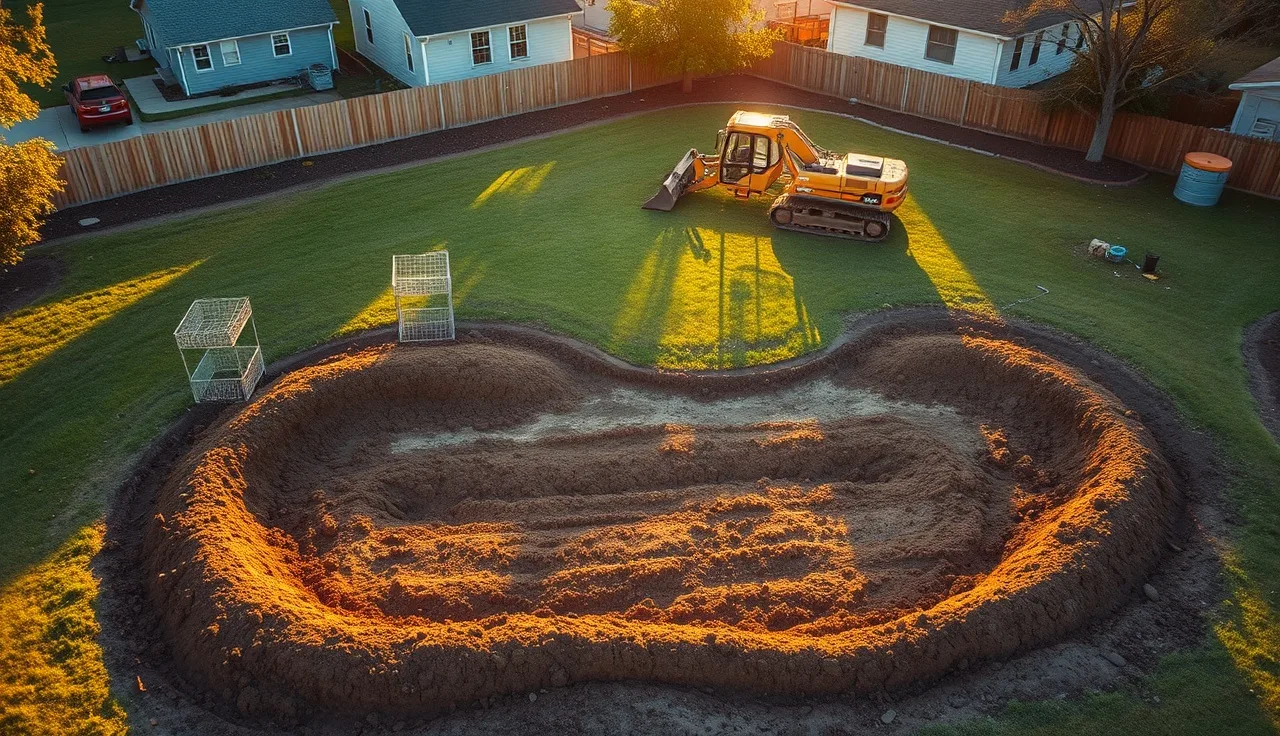
Once the design clears review and the permit issues, the installer marks the field, then digs the trenches with a track excavator to the specified depth, usually 18 to 24 inches for a conventional system. The trench bottom gets graded to fall no more than 2 to 4 inches per 100 feet (many engineers spec dead-level laterals with a pressure-dosed system to force even distribution).
A 6- to 12-inch bed of washed crushed stone goes in first. The 4-inch perforated lateral lays on top, holes down or at the 4 and 8 o'clock positions depending on your state code. Another 2 inches of gravel covers the pipe. A layer of geotextile fabric goes over the gravel to stop native soil from migrating down and clogging the voids. Native soil backfills the rest.
The D-box gets installed dead level. That is the single detail most worth watching. A tilted D-box sends all the flow to the lowest outlet, overloading one lateral and starving the rest. Contractors who rush this step cause fields to fail early.
Last, a soil cover of 6 to 12 inches gets graded over the field and seeded with grass. Never pave the field, cover it with plastic sheeting, or drive heavy equipment over it. For the full installation guide and system types, see septic system installation.
What are the signs that a drain field is failing?
Wet spots or lush green grass directly over the field are the most visible sign. When effluent backs up to the surface, the nutrient load produces greener, faster-growing grass in a pattern that traces the laterals exactly. That is surfacing effluent, and it is a regulatory violation in every state.
Slow drains or sewage odors inside the house come next. If the field is saturated and cannot take more liquid, wastewater backs up through the lowest fixture in the house, usually a floor drain or a first-floor toilet. People blame the tank first and pump it, only to watch the problem come back within days. That is a strong sign the tank is fine and the field is the bottleneck.
A high water table after heavy rain mimics field failure but is a different problem. If your field saturates only after multi-day rain and recovers within a week, that may be seasonal groundwater intrusion rather than biomat clogging. The distinction matters because the repair path is different.
Nitrogen or coliform contamination in a nearby well is the most serious sign, and often the last one you notice, because it hides until a water test finds it. The EPA's SepticSmart program recommends annual inspection and periodic water testing for households with both a well and a septic system [1].
Other tells: gurgling in the pipes after flushing, sluggish flushing across the whole house (more than one slow toilet), or a septic alarm going off if you have a pump system.
What causes drain field failure and can it be repaired?
Biomat overgrowth is the most common cause of failure [2]. The biomat thickens naturally over time, but excess organic loading from a tank that never gets pumped speeds it up hard. When sludge and scum build past the outlet baffle, partially treated solids flow to the field and pile onto the biomat. That is why regular septic tank pumping is not optional. It protects the drain field directly.
Hydraulic overloading from too much water is the second cause. A field sized for 3 bedrooms at 110 gallons per day per bedroom cannot handle the 600 to 800 gallons a day a busy household with a leaky toilet and long showers can generate. Every gallon down a drain eventually passes through the field. Spread laundry across the week instead of running six loads on Saturday.
Physical damage is less common but decisive. Tree and shrub roots invade laterals through the perforations. Vehicles compact the soil and crush pipe. A D-box knocked out of level by frost or settling can redirect flow unevenly for years before anyone catches it.
Repair options depend on the cause and how far it has gone. Resting the field (routing flow to an alternate field if you have one) plus cutting water use sometimes lets the biomat thin over 6 to 12 months. Aeration injection, pumping air into the soil around the laterals, has shown promise in some studies by feeding the aerobic bacteria that eat the biomat [5]. Hydrojetting clears root intrusion and minor clogs. In the worst cases, full replacement is the only fix, and it costs about what the original install did.
For a full walkthrough of repair options and costs, see septic system repair.
Septic service businesses that manage many properties use scheduling and tracking software to flag overdue maintenance before failure. SepticMind is one platform built for that workflow, with tools that show operators which systems are past due for pumping and inspection.
Drain field vs. septic tank: which one actually fails more often?
The drain field fails more often and costs more to repair. That is the honest answer homeowners are after.
The septic tank is a passive concrete or fiberglass vessel. Tanks crack, lids deteriorate, baffles rust or break, and outlet filters clog, but a well-built concrete tank in neutral soil can last 40 years without replacement [6]. Tank repairs, even a full replacement, typically run $1,500 to $5,000 for a single-tank residential system. See septic tank repair for the detailed breakdown.
The drain field deals with living soil, biology, and hydrology. It clogs gradually, and the clogging speeds up as the system ages. It also absorbs every mistake: tanks that go unpumped, detergents that kill soil bacteria, too much water, and roots from nearby trees all wear it down.
A survey of onsite system failures in North Carolina found that leach field problems accounted for roughly 70 percent of failures in that study population [7]. The tank-versus-field split matters for inspection too. A tank can be checked visually in minutes. A field needs soil saturation monitoring, a D-box distribution check, and sometimes a camera run through the laterals.
The takeaway is simple. Protect the tank by pumping it on schedule (every 3 to 5 years for most households). Protect the field by keeping the tank pumped, spreading water use across the day and week, and keeping heavy vehicles and deep-rooted plants off the field.
How long does a septic drain field last?
A well-designed, well-maintained drain field lasts 20 to 30 years on average. Some run 40 years. Some die at 10. The spread comes down to soil conditions, system loading, and how consistently the tank got pumped.
The best predictor of longevity is the quality of the original perc test and soil evaluation. A field installed in soil that barely passed the perc test, or sized at the minimum the code allows, has no margin. A field sized conservatively in favorable soil, with a level D-box and properly graded laterals, usually outlasts the first owner of the house.
California, Florida, and several other states require reinspection or field replacement at point of sale if the system is over a certain age or cannot pass a load test [9]. Check your county health department rules before listing a home with an older system.
No routine maintenance extends field life the way pumping extends tank life. The best you can do is skip the behaviors that shorten it: not pumping the tank, sending garbage disposal solids to the system, running all your laundry in one day, and parking on the field.
What should you not put into a system with a drain field?
The drain field is downstream of everything you send down the drain, so what goes in matters more than most homeowners think.
Solids that do not decompose, like wipes labeled flushable, feminine hygiene products, and paper towels, fill the tank faster and risk pushing solid material to the field. The EPA's SepticSmart guidance is blunt: "Never flush anything besides human waste and toilet paper" [1].
Garbage disposals jack up the organic load to the field. Many installers and county health departments advise against them for septic homes, or recommend a larger tank to compensate. The University of Minnesota Extension notes that garbage disposal use can raise the frequency of required pumping by 50 percent [4].
Household chemicals are a real concern. Bleach in normal amounts (routine toilet bowl cleaning) does not wreck the field's biology at the concentrations that reach the soil. Dumping a gallon of bleach down the drain does. Solvents, paint thinners, motor oil, and medications should never go down a septic drain.
Rain water and sump pump discharge routed to the septic system is a common mistake, especially in older homes where the drain lines got tied together years ago. Groundwater entering the system overloads the field hydraulically during every rain event. This is illegal in most states and should be corrected the moment you find it.
Green septic additives sold to homeowners have no solid evidence behind them for restoring or maintaining drain fields. The EPA does not endorse biological additives for septic systems [1].
How do you find your drain field if you don't know where it is?
Start with the as-built permit records. In most counties, the health department or building department keeps a copy of the original septic permit with a site diagram showing tank and field locations. Call the county, give them your address, and ask for the septic as-built. Many counties have these online now.
No records? Grab a probe. A thin metal rod (1/4-inch diameter, about 4 feet long) pushed into the ground every 3 feet, working from the tank toward the lower ground elevation, hits the gravel layer with a distinct change in resistance. You can usually outline the field boundary in 30 minutes.
A licensed inspector with a pipe camera can run the camera from the tank outlet through the distribution line to the D-box and confirm the field location. That inspection costs $200 to $500 and also tells you the condition of the distribution system.
Once you find the field, mark it so landscapers, utility contractors, and future owners know exactly where it sits. Paint marks or small marking flags along the perimeter work fine. Keeping a site sketch in your home files is one of the highest-return, zero-cost things a septic homeowner can do.
If you want your pump-out schedule and maintenance records in one place, tools like SepticMind are built for septic service tracking, and some homeowners get reminders and inspection history through their service provider on the platform.
How do you maintain a drain field to make it last?
The single highest-leverage move is keeping the septic tank pumped on schedule. The EPA SepticSmart program and nearly every state extension service recommend pumping every 3 to 5 years for a typical household [1][4]. A household with a garbage disposal or more people than the system was sized for should pump closer to every 2 to 3 years. For help scheduling, see how often to pump septic tank.
Past pumping, the checklist is mostly about what not to do. Do not drive on the field. Do not plant trees or shrubs within 30 feet of the laterals (grass is fine, shallow-rooted perennials are fine). Do not connect sump pumps, roof drains, or water softener backwash to the septic system. Do not pour grease down the drain.
Redirect surface water away from the field. If your yard grading channels rain runoff over the drain field, that extra load saturates the soil and cuts its ability to take effluent. A simple swale or grade correction can add years to field life.
Annual inspection does not have to cost much. Walking the field after heavy rain and looking for wet spots or odor costs nothing. A professional inspection with a probe and D-box check runs $100 to $250 in most markets and is worth doing every 2 to 3 years. Some states require periodic inspection by a licensed professional.
The maintenance that protects the field is the same maintenance covered in septic tank cleaning and septic tank pump out. The field and tank are one system.
Frequently asked questions
How deep should a septic drain field be buried?
Conventional drain field trenches run 18 to 36 inches deep, with the perforated pipe sitting on 6 to 12 inches of gravel and covered by at least 6 inches of native soil. Exact depth is set by your state code and depends on the seasonal high water table. The trench bottom must sit at least 2 to 4 feet above the seasonal high water table in most jurisdictions.
Can I drive over my septic drain field?
No. Driving over the field compacts the soil, chokes off the oxygen aerobic soil bacteria need, and can crush the perforated laterals. Even one pass by a heavy truck or loaded concrete mixer can permanently damage the gravel bed. Foot traffic and light lawn mowers are fine. Keep all vehicles, trailers, and heavy equipment off the field at all times.
How do I know if my drain field is failing or just wet from rain?
If the wet area shows up only during and right after heavy rain and dries within 5 to 7 days, the cause may be seasonal groundwater rise, not field failure. If you see persistent wet spots, lush green stripes over the lateral lines, or sewage odor in dry weather, that is field failure. Back up your read with a water use audit and a professional inspection. A saturated field in dry conditions is diagnostic.
Can a failed drain field be repaired, or does it always need to be replaced?
It depends on the cause. Biomat clogging from infrequent pumping sometimes reverses with field resting (6 to 12 months) and reduced water use. Aeration injection has worked in some cases. Root intrusion responds to jetting and root treatment. Crushed pipes need spot excavation and replacement. Soil that has permanently lost its permeability from fine particle migration usually needs full replacement.
How many square feet of drain field do I need for a 3-bedroom house?
A common rule is 150 square feet of trench bottom per bedroom for a soil percolation rate around 30 minutes per inch, which puts a 3-bedroom home at roughly 450 to 750 square feet of trench area. The real requirement is calculated from your specific perc test result and state formula. Soil that percs at 60 minutes per inch may need twice the area of soil that percs at 15 minutes per inch.
What is the difference between a septic tank and a drain field?
The septic tank is a buried watertight container that takes all household wastewater, separates solids from liquids by settling, and holds sludge for periodic pumping. The drain field takes the clarified liquid effluent from the tank and distributes it through perforated pipes into the soil for final biological treatment. They are two separate components of one system, and both must work for the system to run legally.
Do septic additives help the drain field?
There is no solid evidence that biological or chemical additives restore or meaningfully extend drain field life. The EPA does not endorse the use of septic system additives. Some products claim to dissolve biomat or boost bacterial populations, but controlled studies have not confirmed these effects. The money is better spent on regular tank pumping, which has a clear documented benefit to field longevity.
How far does a drain field need to be from a well?
Most state codes require a minimum of 50 to 100 feet between the drain field and a private drinking water well, with many states defaulting to 100 feet. Some states use greater distances for sandy or fractured soils where effluent travels faster. The actual required setback is in your state's onsite wastewater regulations and on your original system permit. Never rely on memory or a neighbor's estimate for this distance.
How long does it take to install a septic drain field?
A conventional trench-style field for a typical home takes 1 to 3 days of actual excavation and installation once the permit is in hand and the contractor is scheduled. The full timeline from permit application to final inspection commonly runs 4 to 12 weeks because of perc testing scheduling, design review, and inspection queues at the county health department. Emergency permits for failing systems sometimes move faster.
Can you put a garden or landscaping over a drain field?
Grass and shallow-rooted ground cover are fine and actually encouraged, since roots help pull moisture and stabilize the soil. Vegetable gardens are a bad idea because root crops grow into the treatment area and edible plants may contact incompletely treated effluent. Trees and shrubs with aggressive roots (willows, maples, certain pines) should stay at least 30 feet away. No raised beds, no plastic sheeting, and no mulch thick enough to block evaporation.
What happens if the drain field is not big enough for the house?
An undersized field gets hydraulically overloaded, meaning it takes more effluent than the soil can absorb in a given period. The water backs up, saturates the soil, and eventually surfaces or backs up into the house. Symptoms show up faster during high-use periods like holidays. The fix is either cutting water use hard, adding a second field if lot space and permits allow, or replacing the system with a larger design.
Does a drain field need an inspection when buying a house?
Yes, and this is one of the most important pre-purchase inspections you can request. A standard home inspection rarely covers the septic system in any meaningful way. Hire a licensed septic inspector separately. A thorough inspection pumps the tank, checks the D-box, probes the field for saturation, and sometimes flows a measured volume of water to test field acceptance. Cost is typically $200 to $500 and can save you from buying a $15,000 field replacement problem.
How often should a drain field be inspected?
Most state extension services and the EPA SepticSmart program recommend a professional inspection every 1 to 3 years, paired with tank pumping every 3 to 5 years. Some states mandate inspections by licensed professionals at set intervals. At minimum, walk the field yourself after every heavy rain and after any stretch of high household water use, looking for wet spots, odors, or unusually lush growth over the lateral lines.
Can tree roots really destroy a drain field?
Yes. Roots seek moisture and will invade perforated laterals through the holes, eventually filling the pipe and blocking flow. Willows and silver maples are especially aggressive and have been documented causing field failures from 50 feet away. Once roots are inside the laterals, hydrojetting clears them temporarily, but if the tree stays, the roots grow back. Removing the tree combined with pipe jetting is the more permanent solution.
Sources
- U.S. EPA, SepticSmart homeowner resources: Roughly 20 percent of U.S. households rely on onsite septic systems; EPA guidance on what not to flush and against use of septic additives
- U.S. EPA, Onsite Wastewater Treatment Systems Manual (2002): Biomat overgrowth at the gravel-soil interface is the most common mechanism of drain field failure
- Angi, Septic System Installation Cost Guide: Typical installed cost for a complete conventional septic system ranges from approximately $3,000 to $25,000 depending on system type and soil conditions
- University of Minnesota Extension, Septic Systems: Recommended pumping interval of every 3 to 5 years; garbage disposal use can increase required pumping frequency by about 50 percent
- National Environmental Services Center (NESC / WVU), Drainfield Restoration Techniques: Aeration injection into soil around drain field laterals has shown promise in some studies by stimulating aerobic bacterial activity that consumes the biomat
- U.S. EPA, How Your Septic System Works: A well-built concrete septic tank in neutral soil can last decades before replacement
- North Carolina State University, Biological and Agricultural Engineering: Drain field (soil absorption system) problems accounted for approximately 70 percent of onsite system failures in the studied population
- U.S. EPA, Septic System setback and siting guidance: Common setbacks include 50 to 100 feet from drinking water wells, 10 feet from property lines, and 5 to 10 feet from structures
- Florida Department of Health, Onsite Sewage Programs: State regulations governing drain field design, setbacks, and required inspections at property sale for older systems
- National Environmental Services Center (NESC / WVU), Percolation Testing Guidance: Suitable soils for conventional drain fields have percolation rates of 1 to 60 minutes per inch; rates outside this range require alternative system designs
Last updated 2026-07-09