Septic system installation: costs, process, and what to expect
By the SepticMind Editorial Team
TL;DR
- A new septic system costs $3,000 to $15,000 for a conventional gravity system, and $10,000 to $25,000 or more for alternative systems on hard lots.
- Cost depends on system type, lot size, soil, and local permit fees.
- The full process takes 4 weeks to 6 months from permit application to final sign-off.
- Get a soil perc test before you buy land or hire a builder.
What does a new septic system cost?
The honest answer: it depends on where you live, what your soil does, and which system the county requires. But real ranges exist, and you can budget against them.
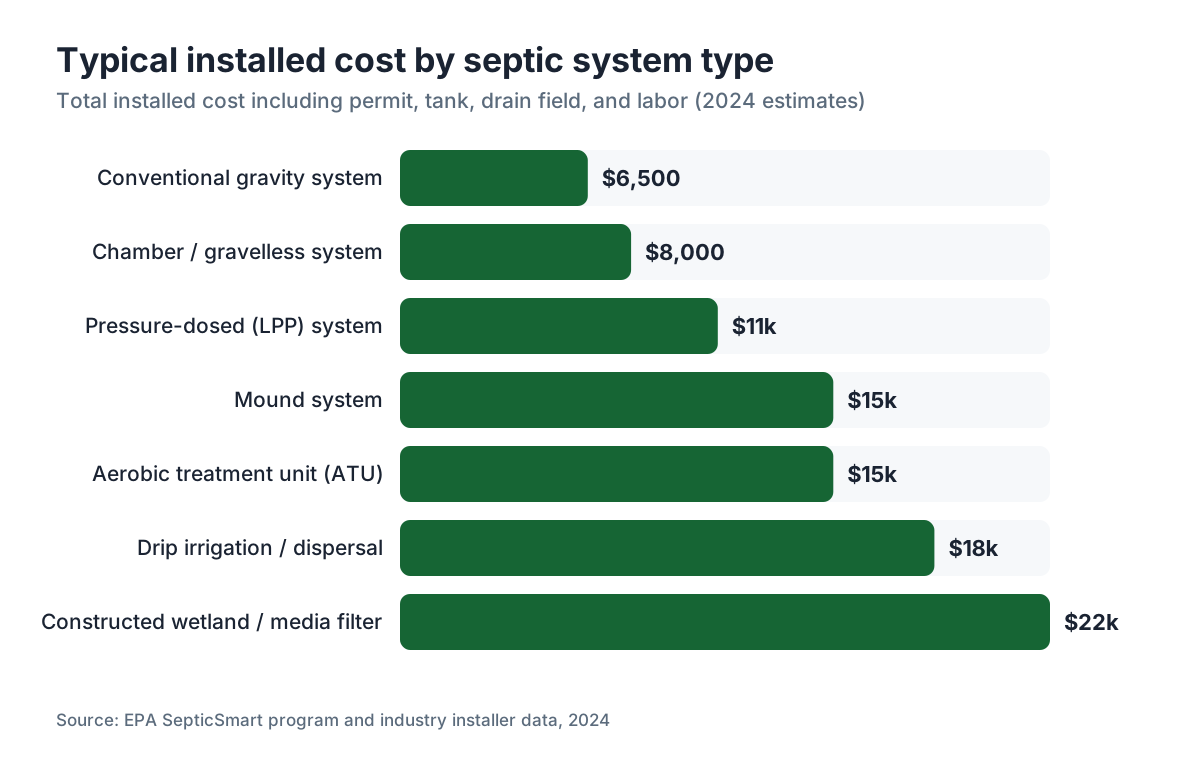
A conventional gravity-fed septic system on a straightforward lot with decent soil costs roughly $3,000 to $10,000 installed in most U.S. markets as of 2024 [1]. Move into alternative systems (pressure-dosed, mound, or aerobic treatment units) and the cost jumps to $10,000 to $25,000, sometimes past $30,000 on a difficult lot [1]. Nobody has clean national median data. Most permits are issued at the county level, and almost none of those databases are public.
The closest reliable benchmark comes from EPA and industry estimates, which put the average new system at $3,000 to $15,000 for a standard install, with alternative systems required in some areas costing considerably more [2].
Labor accounts for roughly 50 to 60 percent of total installed cost. Excavation is usually the single biggest line item, especially if you hit ledge rock or a high water table. The tank itself is often the cheapest component.
See the cost comparison table in the next section for a breakdown by system type.
How much does a new septic system cost by system type?
| System Type | Typical Installed Cost | Best For |
|---|---|---|
| Conventional gravity (concrete tank + gravel trench) | $3,000 to $10,000 | Level lots, good perc, 3 to 4 BR home |
| Chamber/gravelless leach field | $4,000 to $12,000 | Similar to conventional, slightly faster install |
| Pressure-dosed / low-pressure pipe (LPP) | $7,000 to $15,000 | Sites needing more even distribution |
| Mound system | $10,000 to $20,000 | High water table, shallow soil over bedrock |
| Aerobic treatment unit (ATU) | $10,000 to $20,000 | Small lots, poor soil, some state requirements |
| Drip irrigation / drip dispersal | $12,000 to $25,000 | Steep slopes, limited drain field area |
| Constructed wetland / recirculating media filter | $15,000 to $30,000+ | Strict effluent quality requirements |
These figures reflect total installed cost including permits, tank, drain field, and labor. They do not include landscaping restoration, which adds $500 to $3,000 depending on how big the excavation was [1].
Conventional systems still make up most new installs where soil allows. The EPA estimates about 20 percent of U.S. households rely on septic systems, and most of those are conventional gravity designs [9]. If your county is approving mound systems or ATUs, it usually means the conventional option failed the site evaluation.
For a closer look at just the tank piece, see septic tank installation and cost to install septic system.
What factors drive the cost of septic system installation up or down?
Soil is the single biggest wildcard. A percolation test (perc test) measures how fast water moves through the ground. Sandy loam that percs at 30 to 60 minutes per inch is ideal. Clay-heavy soil that takes 120 minutes per inch or longer often means a larger drain field or a more expensive alternative system [3]. Some sites simply fail and can't support any onsite system without engineered solutions.
Depth to groundwater matters almost as much. Most state codes require at least 18 to 24 inches of separation between the bottom of the drain field and the seasonal high water table [3][4]. Closer than that, and the system has to be built up or treated to a higher effluent standard.
Bedrock depth produces the nasty contractor surprises. If your excavator hits ledge two feet down, costs can climb $5,000 to $10,000 in a single afternoon.
House size drives tank sizing. State rules size tanks by bedroom count because bedrooms proxy for occupants, and occupants proxy for daily wastewater flow. A 3-bedroom house in most states needs a minimum 1,000-gallon tank. Four or five bedrooms often push to 1,250 or 1,500 gallons [3].
Permit fees vary wildly. Some rural counties charge $150. Others charge $1,500 or more and require multiple phased inspections [5]. Ask your county health department for the fee schedule before you set a budget.
Contractor availability moves price more than people expect. In high-growth rural areas, licensed installers book 6 to 12 weeks out and price to demand. Always get three quotes.
What is the step-by-step septic system installation process?
The process has more steps than most homeowners expect, and skipping any of them tends to cost more later.
Step 1: Site evaluation and soil testing. Before any permit is issued, a licensed soil evaluator or certified installer runs a perc test and soil profile evaluation. This usually costs $300 to $800 and takes one day. In some states, a licensed professional engineer must stamp the evaluation [4][5].
Step 2: System design. Based on the soil data, bedroom count, and local code, a design is prepared. For a conventional system this is fast. For alternative systems it often needs an engineer and can take 2 to 4 weeks.
Step 3: Permit application. The design goes to the county or state health department. Review takes anywhere from 5 business days to 8 weeks depending on jurisdiction and backlog. Some counties run concurrent review with the building permit. Others require the septic permit first.
Step 4: Excavation. Once the permit is in hand, digging begins. For a conventional system on a cooperating lot, excavation takes 1 to 2 days. Tank placement, inlet and outlet pipe, and drain field trenching follow in sequence.
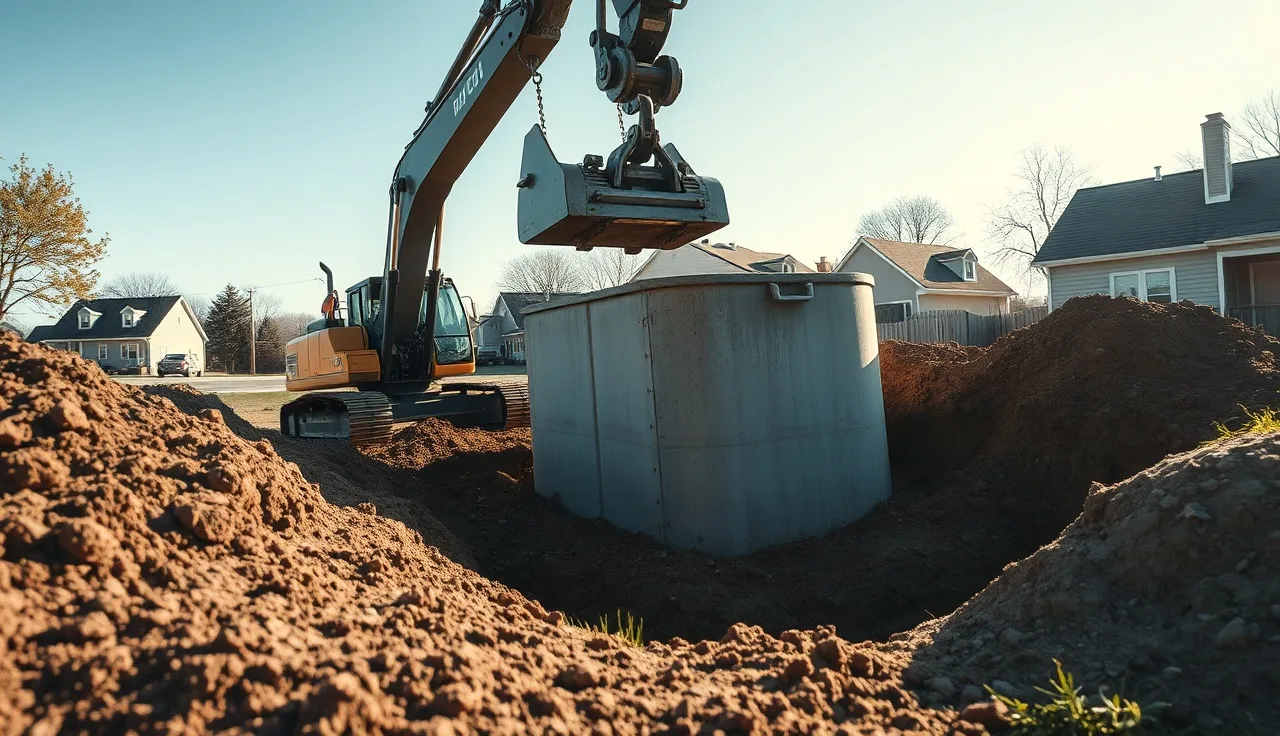
Step 5: Tank installation. Concrete tanks are delivered and lowered by crane or excavator. Plastic and fiberglass tanks are lighter and drop in easily on tight lots. The tank is set on a stable base, baffles are confirmed, and risers bring access lids near or flush with grade. Adding risers now costs far less than digging up the tank for the first pump-out. See septic tank riser for details.
Step 6: Drain field construction. Gravel is placed, perforated pipe is laid to grade, and geotextile fabric covers the stone. The trench depth, width, and total linear footage all come from the permit.
Step 7: Inspection. Most jurisdictions require at least one inspection before backfill. Calling late and letting the contractor cover the field before the inspector arrives is one of the most common and expensive mistakes homeowners make.
Step 8: Backfill and restoration. After the field passes, the site is backfilled and graded. Seeding or sod follows.
Step 9: Final permit sign-off. The inspector issues final approval. Keep this document. You'll need it when you sell or refinance.
From permit application to final sign-off, expect 4 to 10 weeks for a straightforward install, and 3 to 6 months if the design needs engineering or the permit queue is backed up [5].
What permits and inspections does septic system installation require?
There's no single national permit process. Onsite wastewater treatment is regulated mostly at the state level, and most states hand enforcement to county or local health departments [4][5].
Every state has an onsite wastewater code or individual sewage disposal regulations. Many model their rules on EPA guidance, including the EPA's Onsite Wastewater Treatment Systems Manual, which states that "proper siting, design, installation, and management of onsite wastewater treatment systems are essential to protecting public health and the environment" [3].
What you'll almost always need: a site evaluation report from a licensed evaluator, a system design, a permit from the local health department, and at minimum a pre-backfill inspection. Most counties also require a final inspection before an occupancy permit is issued for new construction.
Some states require that only licensed or certified installers pull the permit and do the work. Installing without a license is legal in a handful of states on your own property but prohibited in most [4]. Check your state's department of environmental quality, department of health, or equivalent agency before you assume you can DIY.
Permit fees in 2024 run from around $100 in some rural counties to over $2,000 in states like California where site review is more involved [5]. Aerobic treatment units usually carry an annual operating permit in states that allow them. Budget $100 to $300 a year for that.
To find your state's specific rules, the EPA's SepticSmart program links to state-by-state resources at epa.gov [2].
How long does septic system installation take?
Physical installation on a standard lot takes 2 to 5 days of actual work. The full process takes much longer, and permit review is where the time disappears.
A busy county health department in a rural growth market might take 4 to 8 weeks to review a septic permit. Contractors there won't schedule your job until the permit is in hand, which is the right call. Starting without a permit risks a stop-work order and, in some jurisdictions, mandatory removal of work already done.
Soil evaluation scheduling adds time in late spring and summer when evaluators are booked. If you want to break ground in spring, start the permit process in fall or winter.
Alternative systems add design time. An engineer-stamped design for a mound or ATU can take 2 to 6 weeks. If the first design fails agency review, add more.
Realistic total timeline from first call to a licensed installer through final sign-off:
- Simple site, straightforward county: 4 to 6 weeks
- Moderate complexity, normal permit queue: 8 to 12 weeks
- Alternative system, complex site, or backed-up agency: 3 to 6 months
Plan your closing date or construction draw schedule around the longer estimate, not the shorter one.
What type of septic system is right for my lot?
Your soil and your county code decide, not you. The installer's job is to design the system that passes inspection on your specific site. Knowing the options still helps, because it lets you spot when you're being oversold.
Conventional gravity systems work on lots with suitable soil and room for a drain field. No moving parts in the field, low maintenance cost, long track record. If your perc test supports one, this is the system you want.
Mound systems make sense when the water table is high or the usable soil layer is thin. Imported fill creates an elevated absorption bed. They work, but they cost more, eat yard space, and become a permanent landscape feature that surprises some homeowners.
Aerobic treatment units (ATUs) treat wastewater to a higher standard using an air pump to feed oxygen to aerobic bacteria. They're required in some Texas counties, certain Florida regions, and other areas with strict nutrient limits [12]. They need regular service, usually a contract, and the air pump will eventually fail and need replacing.
Pressure distribution systems use a pump to dose the drain field evenly instead of relying on gravity. They perform better on marginal soil and extend field life by spreading the load.
Drip irrigation systems deliver treated effluent through small-diameter tubing buried shallow. They work on steep slopes and small lots but demand more maintenance and higher-quality effluent, which means a treatment unit upstream.
For how the drain field works and how to keep it running, see septic drain field.
How do I choose a septic system installer?
Licensing comes first. Every state that licenses septic installers keeps a public registry. Check it. A contractor who asks you to pull your own permit or suggests skipping the soil evaluation is a contractor to walk away from.
Experience with your specific system type matters too. Any installer can put in a conventional gravity system. Mound systems, drip dispersal, and ATUs need specific training and, in most states, manufacturer certification. Ask how many of your required system type they've installed in the past year.
Get three bids, and don't automatically take the lowest. A bid 30 percent below the others usually means something important is excluded, the contractor missed the scope, or they're planning shortcuts. Ask each bidder to itemize: permit fees, soil evaluation (if not already done), tank, drain field, excavation, backfill, and restoration.
Ask for references from jobs finished in the past 12 months on similar soil. Call at least two. Ask whether the installer handled permit issues and inspector callbacks like a professional.
Ask specifically what happens if excavation reveals unexpected rock or a failed perc area. You want a contractor with a clear change-order policy, not one who hits you with a verbal bill revision mid-job.
Operators running multiple installs across crews and permit jurisdictions often use job-tracking software to keep permit timelines, inspection scheduling, and soil report filing in one place. SepticMind is built for that workflow, connecting field crews with office staff so nothing falls through between the permit office and the dig day.
What are the most common septic installation mistakes and how do you avoid them?
Skipping the perc test on a purchase. People buy rural land and assume a septic system will fit. Sometimes it won't. A failed perc test can make a lot unbuildable for conventional development. Get the soil evaluation done before closing, not after.
Underbuying tank capacity. Sizing a tank to the bare code minimum when you plan to add a bedroom in three years is a false economy. Going from a 1,000-gallon to a 1,250-gallon tank at install often costs under $500 in concrete. Retrofitting later costs far more.
No risers at installation. Access lids buried under 12 to 18 inches of soil mean your first pump-out starts with a shovel. Concrete risers or plastic riser kits set at tank placement cost $200 to $500 and pay for themselves on the first service call.
Poor drain field placement. The field must be set back from wells, property lines, structures, and water features per code. Installers occasionally misread lot surveys. Review the as-built drawing before you sign off on completion.
Backfilling before inspection. Getting the inspector out takes advance scheduling. If your installer backfills before the inspector arrives, you may be ordered to uncover the field at your expense. Confirm the inspection is scheduled before excavation day.
Not getting the as-built. The as-built drawing shows exactly where the tank and field sit, at what depth, with what components. You need it for future pump-outs, repairs, and sale. If your installer doesn't hand one over, request it in writing before you pay the final invoice.
For what goes wrong after installation and how to fix it, see septic system repair and septic tank repair.
How do you maintain a new septic system after installation?
First rule: don't flush anything except waste and toilet paper. That's not a slogan. It's the single behavior change that protects your drain field more than any product you can buy.
Have the tank pumped every 3 to 5 years. The EPA's SepticSmart program recommends pumping every 3 to 5 years as standard maintenance for a household system [2]. Real frequency depends on household size and tank volume. A 1,000-gallon tank serving five people may need pumping every 2 years. A 1,500-gallon tank for two people might go 7. See how often to pump septic tank for the full breakdown.
Keep accurate records. File your permit, the as-built drawing, the soil evaluation, and every pump-out receipt in one folder. Many states require disclosure of septic records at sale, and some lenders want an inspection report before closing.
Don't park on the drain field or plant trees over it. Compaction cuts oxygen in the soil, which kills the aerobic bacteria that treat effluent. Tree roots hunt moisture and will find your distribution pipes.
Divert surface water away from the field. A saturated field can't take more water. French drains, swales, and proper grading during construction all keep stormwater off the absorption area.
Watch for early failure signs: slow drains, gurgling, wet spots over the field, or sewage odors outside. Catching it early is the difference between a $500 repair and a $15,000 drain field replacement. See septic tank pumping and septic tank cleaning for what routine service looks like.
For operators managing schedules across a customer base, SepticMind's service tools track pump-out history, permit records, and maintenance reminders automatically.
Are there financing or assistance programs for septic installation?
Yes, and more people qualify than realize it.
The USDA Rural Development program offers grants and loans for water and wastewater systems in rural areas through the Section 504 Home Repair program and the Water and Waste Disposal Loan and Grant program [7]. Income limits apply, and eligibility runs by county designation.
Many states run their own low-interest loan programs for onsite septic systems. Virginia has financed failing and new systems at below-market rates in qualifying areas [10]. Check your state's department of environmental quality or department of health for something similar.
The EPA's Environmental Finance Center network helps communities find funding for water infrastructure, septic systems included [8]. The network covers all 10 EPA regions and can point homeowners and local governments to state-specific programs.
In some counties, septic improvement districts let low-income homeowners finance upgrades through special tax assessments repaid over 10 to 20 years. Your county government is the right first call.
For new construction, some lenders roll the septic system into a construction-to-permanent loan. If you're financing a rural purchase, FHA and USDA loans both require a functioning septic system, which sometimes gives you room to negotiate a seller contribution toward installation cost.
What should I know about installing a septic system for a new home build?
Line up the septic permit timeline with the building permit timeline from day one. In most jurisdictions the septic permit must be issued before or alongside the building permit. Plenty of builders forget this, then discover a 6-week permit queue right when they're ready to break ground.
Size the system for the house you're actually building, not the code minimum. If the plans show 3 bedrooms but a bonus room could become a fourth, size for 4. The extra cost at install is small.
Locate the drain field before you finalize the site plan. The field needs separation from the well (typically 50 to 100 feet depending on state), from property lines (typically 10 to 25 feet), and from the foundation (typically 10 feet minimum) [3][4]. Some lots are tighter than they look on paper, and the septic layout has to drive where the house sits, not the other way around.
If your lot has never had a soil evaluation, treat the perc test as a prerequisite to design, not a formality. Failed sites turn up in subdivisions approved decades ago under different rules.
For a detailed breakdown of what just the tank portion costs, see cost to put in a septic tank.
For operators bidding new-construction work, accurate job costing from soil evaluation through final sign-off is where jobs make money or don't. The line items are predictable. The surprises (rock, high water table, permit delays) are where margin disappears.
Frequently asked questions
How much does a new septic system cost on average?
A conventional gravity-fed septic system costs roughly $3,000 to $10,000 installed on a straightforward lot. Alternative systems such as mound systems, aerobic treatment units, or drip dispersal run $10,000 to $25,000 and sometimes higher. The biggest cost drivers are soil conditions, the system type your county requires, lot size, and local labor rates. Get three itemized bids before you commit.
How long does it take to install a septic system?
Physical installation takes 2 to 5 days of work. The full timeline from first permit application to final sign-off is typically 4 to 6 weeks for a simple conventional system in a cooperative county, and 3 to 6 months for an alternative system or a jurisdiction with a slow permit queue. Plan your construction or closing schedule around the longer estimate.
Do I need a permit to install a septic system?
Yes, in every U.S. state. Onsite wastewater systems are regulated at the state level and enforced by county or local health departments. You'll need a soil evaluation, a system design, and a health department permit before any excavation begins. Most jurisdictions also require at least one inspection before backfill. Installing without a permit risks fines, stop-work orders, and mandatory removal.
Can I install my own septic system?
In a small number of states, a homeowner can install a septic system on their own property without a contractor license. Most states require a licensed or certified installer. Even where DIY is legal, you still need the permit, soil evaluation, and inspections. Mistakes in installation, especially in drain field construction, can cost tens of thousands to correct. Check your state's health or environmental agency first.
What is a perc test and why does it matter?
A percolation test measures how fast water drains through your soil. The result decides whether a conventional gravity system is feasible, what size drain field you need, and whether you'll need an alternative system. Perc tests cost $300 to $800 and are required before a septic permit is issued in nearly every jurisdiction. Buying land without one is a real financial risk.
How often should a new septic system be pumped?
The EPA recommends every 3 to 5 years for a typical household system. Actual frequency depends on tank size and household size. A 1,000-gallon tank serving four people may need pumping every 2 to 3 years. A 1,500-gallon tank for two might go 6 to 7 years. Starting pump-out records from the day of installation makes the schedule easy to track. See septic-tank-pumping for full guidance.
What is the difference between a septic tank and a drain field?
The septic tank is a buried watertight container that holds wastewater long enough for solids to settle and float. Bacteria break down the solids partially. The liquid effluent flows out to the drain field, also called the leach field or absorption field, where it disperses into the soil for final treatment. Both are part of a complete system. The drain field is usually the more expensive component to replace.
How long does a septic system last?
A well-maintained conventional system has a typical lifespan of 25 to 40 years. The drain field usually determines the system's life. Overloading with water, flushing non-biodegradable items, and skipping pump-outs are the main causes of early failure. Concrete tanks can crack or corrode after 30 to 40 years. Plastic and fiberglass tanks may outlast the house. Regular pump-outs are the best investment in longevity.
What are signs that a septic installation was done poorly?
Watch for slow drains or backups in the first year, wet or spongy ground over the drain field, sewage odors outdoors near the system, or unusually lush green grass over the field lines. These can point to improper grading, insufficient trench depth, an undersized tank, or a field set in unsuitable soil. Get an inspection if you see any of them. Early intervention is much cheaper than field replacement.
Does a new septic system add value to a home?
A functioning, properly permitted septic system is a baseline requirement for a sale, not a value-add on its own. A failing system is a major defect that buyers price in heavily. An upgraded system, such as an ATU in an area with strict nutrient rules, may expand a property's allowable use or development potential. Buyers and lenders will ask for the permit record and often require an inspection at sale.
What is the difference between an aerobic and an anaerobic septic system?
Conventional septic tanks use anaerobic bacteria that work without oxygen. Aerobic treatment units (ATUs) pump air into the treatment chamber, feeding aerobic bacteria that break down waste more completely and produce higher-quality effluent. ATUs cost more, need electricity, and require a maintenance contract. They're required in some areas with strict water quality rules, and the treated effluent can often disperse in a smaller drain field.
Are there grants or loans to help pay for a new septic system?
Yes. The USDA Rural Development program offers grants and loans for water and wastewater systems in rural areas for qualifying low-income households. Many states have their own low-interest loan programs. The EPA's Environmental Finance Center network can help identify programs by region. Some counties allow financing through special assessment districts repaid over 10 to 20 years. Check your county health department and state environmental agency for local programs.
What size septic tank do I need for a 3-bedroom house?
Most state codes require a minimum 1,000-gallon tank for a 3-bedroom home. Some states set minimums at 1,250 gallons regardless of bedroom count. Sizing by bedroom count is standard because bedrooms proxy for occupants and daily wastewater flow. If you might add a bedroom later, sizing up to 1,250 gallons at installation typically adds only a few hundred dollars and avoids a costlier future upgrade.
What happens if my lot fails the perc test?
A failed perc test means conventional gravity systems can't be approved. Options include an alternative system engineered for poor soil (mound, ATU, drip dispersal), a re-test in a different area of the lot, or in some cases the lot can't support any onsite system and is unbuildable for residential use without public sewer access. If you're buying the land, make sure your purchase agreement includes a perc test contingency.
Sources
- HomeAdvisor / Angi, Septic System Installation Cost Guide: Conventional gravity septic systems cost $3,000 to $10,000 installed; alternative systems can reach $25,000 or more
- U.S. EPA, SepticSmart Program: EPA SepticSmart recommends pumping every 3 to 5 years; average septic system costs $3,000 to $15,000; links to state-by-state resources
- U.S. EPA, Onsite Wastewater Treatment Systems Manual (EPA/625/R-00/008): Soil perc rates, minimum setbacks, tank sizing by bedroom count, and drain field separation from groundwater; proper siting and installation are essential to protecting public health
- National Environmental Services Center (NESC), West Virginia University: Minimum 18 to 24 inches separation between drain field bottom and seasonal high water table; most states require licensed installers for septic permit
- National Onsite Wastewater Recycling Association (NOWRA): Permit fees and inspection requirements vary by jurisdiction; permit review timelines and state-by-state licensing requirements
- USDA Rural Development, Water and Environmental Programs: USDA Rural Development offers grants and loans for water and wastewater infrastructure in rural areas for qualifying households
- U.S. EPA, Water Finance Center: EPA Environmental Finance Center network helps communities identify funding for water and wastewater infrastructure including septic systems
- U.S. EPA, Septic Systems Overview: Approximately 20 percent of U.S. households rely on septic systems for wastewater treatment
- Virginia Department of Health, Onsite Sewage and Water Services: Virginia septic financing programs; state regulations governing soil evaluation, system design, and permit requirements for onsite wastewater systems
- North Carolina State University Extension, Septic Systems and Their Maintenance: Drain field setback requirements from wells, property lines, and structures; guidance on alternative system types
Last updated 2026-07-09