Orenco effluent filter: how it works, maintenance, and costs
By the SepticMind Editorial Team

TL;DR
- An Orenco Biotube effluent filter is a cylindrical screen cartridge that sits in your septic tank's outlet baffle and catches suspended solids before effluent reaches the drain field.
- Clean it every 1 to 3 years.
- The cartridge costs $50 to $90, and a full install runs $200 to $500.
- It's one of the cheapest ways to add years to a drain field.
What is an Orenco effluent filter and how does it work?
An Orenco Biotube effluent filter is a tubular screen cartridge made by Orenco Systems, an Oregon company that has built onsite wastewater components since 1981. The filter slides into a housing that replaces or fits inside your tank's outlet tee. Effluent has to pass through fine slots, typically 1/16 inch (1.6 mm) wide, before it can flow toward your leach field. Solids that would otherwise escape get caught on the screen.
The physics are simple. A septic tank separates waste into three layers: scum floats, sludge sinks, and the clarified liquid in the middle (the effluent) exits through the outlet. That middle layer isn't clean. Small suspended particles, fine grease droplets, and lint-sized solids ride out with the liquid. Over months and years, that material coats drain field soil and eventually clogs it, and fixing that is expensive. Orenco's Biotube runs a central tube down the middle with dozens of smaller tubes radiating out, which packs a lot of filter surface into a small cartridge.
Orenco holds several patents on the Biotube geometry, and the design shows up across state and county approved product lists for advanced treatment systems. The EPA's SepticSmart guidance points to effluent filters directly: "An effluent filter on the outlet of a septic tank can significantly reduce the solids that leave the tank and enter the soil absorption system" [1].
One thing to keep straight. The Biotube is not a treatment device. It doesn't remove nitrogen, phosphorus, or pathogens. It removes physical solids and nothing else. If your system needs nutrient reduction or disinfection, that's a separate set of components.
What are the different Orenco Biotube filter models?
Orenco makes the Biotube in several sizes to match tank outlet dimensions and flow rates. The most common residential model is the Biotube Jr., built for tanks up to 1,500 gallons serving single-family homes at standard flow. The standard Biotube fits larger tanks or homes with heavier water use, and the Biotube Pro is a larger-diameter version for commercial or multi-unit systems.
Two dimensions drive the choice: outlet diameter and the depth from the outlet to the tank bottom, which sets cartridge length. Most residential tanks have 4-inch or 6-inch outlet pipes. Orenco publishes a selection chart that matches cartridge length to tank depth, and most extension programs tell you to check that chart or have a licensed installer confirm fit before you order [2].
Slot size is the other variable. The standard 1/16-inch (1.6 mm) slot works for most gravity systems. Some states and counties require a finer 1/32-inch (0.8 mm) slot near wells, surface water, or sensitive areas. Your local health department or your onsite permit will tell you which one applies.
Orenco also makes a pump vault version, the Biotube Pump Vault, that combines the filter with a dosing pump chamber. That's a different animal, used in pressure-dosed systems instead of gravity systems. If your tank has a pump in it, you probably need that model.
| Model | Typical application | Outlet size | Flow capacity |
|---|---|---|---|
| Biotube Jr. | Single-family, gravity | 4" | Up to 600 gpd |
| Biotube (standard) | Larger homes, gravity | 4" or 6" | Up to 1,500 gpd |
| Biotube Pro | Commercial / multi-unit | 6" | Up to 3,000 gpd |
| Biotube Pump Vault | Pressure-dosed systems | Varies | Depends on pump |
How often does an Orenco Biotube filter need to be cleaned?
Clean it every 1 to 3 years for a typical single-family home. That's the range most manufacturers and state extension programs give [11]. The real interval depends on household size, water habits, and how often you pump the tank. Six people on a 1,000-gallon tank load the filter far faster than two people on the same tank.
The practical test beats any calendar. Pull the cartridge and look. If the slots are coated with gray-brown slime and water barely drips through, it's past due. If it rinses clean with a hose and the slots look open, you have time. Plenty of installers just clean the filter every time they pump the tank, which runs every 3 to 5 years for most households [3]. That's a fine default if you're not watching it closely.
Some Orenco housings include an alarm port. Wire a float switch to an alarm and it trips when the liquid level climbs above normal, which is what a clogged filter does as it backs up flow. That's the best real-time signal, and it earns its keep on a system where you'd otherwise catch a problem late, like a vacation cabin.
Had a solids overload? Check it sooner. A garbage disposal you run hard, or a stretch of high occupancy, both push more solids through. Garbage disposals roughly double the solids load entering the tank, per University of Minnesota Extension [4]. That shortens the cleaning interval noticeably.
How do you clean an Orenco Biotube effluent filter yourself?
Cleaning a Biotube is a real DIY job. It's doable. It's not pleasant. You need rubber gloves (nitrile at minimum, heavier is better), eye protection, a garden hose with a spray nozzle, and a spot to rinse the cartridge where the water won't reach a garden or a well. A big bucket or a tarp handles it. Rinse water should percolate into ground away from water sources, never into a storm drain.
Step one: find and uncover the outlet end of the tank, usually the end farthest from the house. Lift the lid carefully and let any gases clear. The housing handle or pull rod sits at or just below the waterline. Some Orenco housings ride up on a long riser extension so the handle reaches ground level, which makes the whole thing easier.
Step two: pull the cartridge straight up and out, slowly. Don't yank it. Yanking splashes tank contents everywhere. Get the bucket or plastic sheeting under it right away. The cartridge comes out dripping and coated with biofilm.
Step three: rinse it hard with the hose, working from the inside out so loosened solids don't get driven deeper into the slots. Rinse until water runs through freely. Skip the bleach and antibacterial cleaners. They kill the bacteria your tank depends on.
Step four: inspect the cartridge and housing for cracks, warped screens, or broken end caps. A cracked cartridge lets solids bypass the screen entirely. If it's damaged, replace it.
Step five: slide the clean cartridge back in, confirm it seats fully, and put the lid back. Done. The whole job takes about 20 minutes with good access.
Not comfortable doing it? Any licensed pumper can clean it during a septic tank pump out. Many do it for free or a small add-on fee if they're already on site.
What does an Orenco effluent filter cost to buy and install?
The Biotube Jr. cartridge alone runs $50 to $90 online or through a plumbing supply house. The complete housing assembly, with the outlet fitting and riser pieces, runs $150 to $350 depending on tank depth and whether you need a full riser extension. If a licensed contractor supplies and installs it during a tank service call, expect $200 to $500 installed for a standard residential gravity system [5].
Adding a filter during a pump-out is about the cheapest septic upgrade there is. Compare it to drain field repair, which commonly runs $3,000 to $15,000 depending on the failure and your state's restoration rules see [cost to install septic system]. The prevention math is not close.
If your state requires a specific model, your installer will know it. Some states, California and Florida among them, have adopted general requirements for effluent filters on new installations and upgrades, though the approved models vary by county [6]. Confirm with your local health department whether a filter is required, which model meets code, and whether adding one triggers a permit.
Replacement cartridges are where the money makes sense. With the housing already in place, a replacement Biotube Jr. cartridge is $50 to $70 and you swap it in ten minutes. That's the recurring cost for a part that adds years to a system that cost $10,000 to $30,000 to build.
Does an Orenco effluent filter actually protect your drain field?
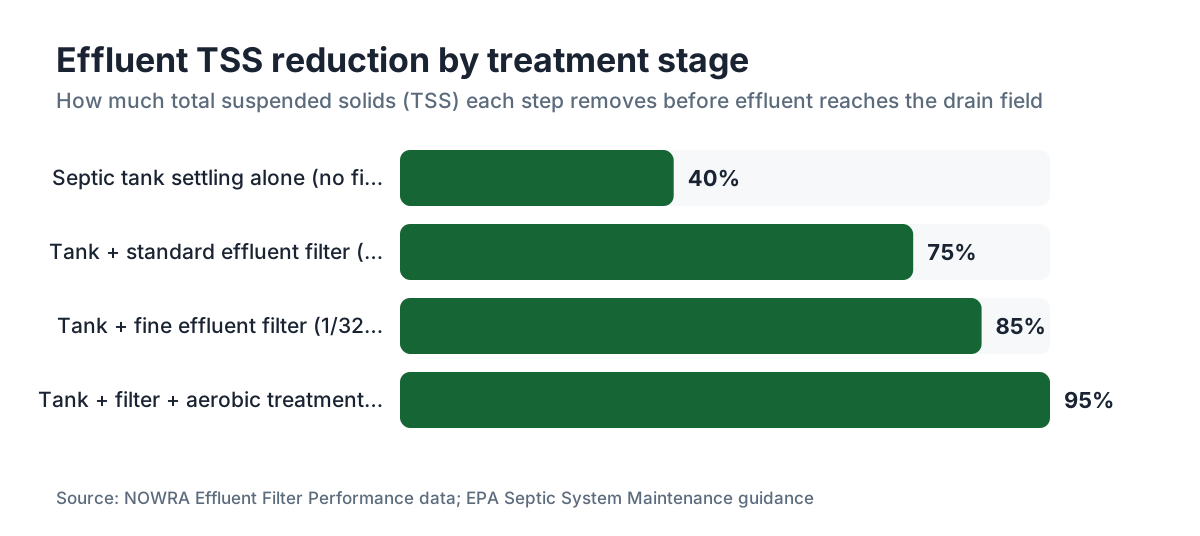
The evidence is good. The filter's job is to cut TSS (total suspended solids) in the effluent leaving the tank. Untreated septic tank effluent typically carries 50 to 150 mg/L of TSS. Studies cited by the National Onsite Wastewater Recycling Association (NOWRA) and state extension programs find that a well-maintained effluent filter cuts TSS leaving the tank by 50 to 90 percent [7].
Here's why that matters. Drain field failure almost always starts with biomat: a dense layer of anaerobic bacteria, fine solids, and grease that seals the soil pores in the absorption field. Once biomat builds faster than the soil can break it down, hydraulic failure follows. The soil stops accepting liquid. Cutting the solids load slows biomat down.
Nobody has clean long-term controlled studies comparing drain field lifespan with and without filters across a big population. Septic systems vary too much, and failures play out over decades. The closest data comes from state extension surveys and retrospective looks at failed systems. The University of Minnesota's wastewater research group reports that reducing effluent TSS is among the most cost-effective ways to extend soil absorption system life [4].
The filter won't save a field that's already failed. It's prevention, not repair. If you're seeing surfacing effluent or slow drains, the answer is septic system repair, not a fresh cartridge. But for a working system, a Biotube is one of the highest-return maintenance moves you can make.
How does an Orenco Biotube filter compare to other effluent filters?
Several other makers build effluent filters. Zabel (now part of Infiltrator Water Technologies), Polylok, and Sim/Tech are the names you'll see most at supply houses. The core function is identical across brands: a slotted or mesh screen that catches solids at the outlet.
The Biotube's edge is its multi-tube geometry, which packs more surface area per unit volume than a flat screen or single-tube design. More surface area means more capacity before clogging and a longer stretch between cleanings, at least on paper. In the field, the difference in cleaning frequency between a good Biotube and a quality Zabel A-Series is modest for most homes.
What matters more than brand: slot size, whether the housing has an alarm port, how easy the riser makes access, and whether the model is on your state's approved list. Orenco, Zabel, and Polylok all appear on most state lists. Sim/Tech shows up in some regions. If your installer pushes a specific brand for your system type, that's usually because they know the local rules and have cleaned that model plenty of times.
Orenco does have one real advantage. They're a full-line maker of advanced treatment components, so if your system ever moves to a more sophisticated treatment train, the pieces tend to fit together without compatibility headaches. For a basic gravity system serving one family, though, any reputable filter brand does the job if it's sized right and cleaned on schedule.
| Brand | Common residential model | Slot size options | Alarm port option |
|---|---|---|---|
| Orenco | Biotube Jr. | 1/16", 1/32" | Yes |
| Zabel/Infiltrator | A-Series | 1/16", 1/32" | Yes |
| Polylok | PL-68 | 1/16" | On some models |
| Sim/Tech | STF-100 | 1/16" | No |
What happens if you don't clean your effluent filter?
A neglected filter clogs solid. When it does, one of two things happens. The common outcome: the liquid level in the tank rises above the outlet and starts backing flow toward the house. You get slow drains, or in bad cases, sewage rising into the lowest fixtures in the home. Ugly, but contained.
The second outcome is worse. If the housing lets effluent bypass the screen when the water gets high, a clogged filter stops filtering. The system looks like it's draining fine, but raw solids are running straight to the drain field. By the time you notice a problem, the field may already carry serious biomat damage.
Orenco designs their housings to back flow toward the house rather than bypass toward the field when they clog. That's the friendlier failure. It's noticeable and fixable. The bypass failure is silent and expensive.
Some states and counties write filter cleaning into their onsite wastewater rules as a required task. Texas, for one, requires maintenance contracts for many aerobic systems that include filter inspection [8]. Even where the law is silent, skipping cleaning throws away the protection you paid for. A badly clogged filter can actually do worse than no filter at all, because it periodically flushes a concentrated slug of solids to the field once pressure builds high enough.
If your system has run for years and you don't know whether it has a filter or when it was last cleaned, get a septic tank inspection and pump-out. A licensed pumper finds the filter if it's there.
Can you add an Orenco effluent filter to an existing septic tank?
Yes, in most cases. The retrofit installs a new outlet housing that accepts the Biotube cartridge, usually during a pump-out when the outlet area is empty and visible. The old outlet tee or baffle comes out (or the new housing goes in around it), and the Biotube housing takes its place.
Two things limit a retrofit: access and tank material. If your outlet is reachable through an existing riser or a lid near the outlet end, the job is easy. If the outlet end is buried deep with no riser and hard soil above it, you're paying for excavation. Concrete tanks, which most residential tanks older than 20 years are, take the retrofit without trouble. Fiberglass and polyethylene tanks sometimes have outlet designs that don't accept standard housing inserts.
Most contractors finish a retrofit in under two hours, often during the same visit as a septic tank pumping appointment. Some states now require effluent filters on any tank that gets repaired or pumped, so if a truck is already at your place, ask whether a filter is required or recommended.
Septic operators who track maintenance across many properties can use a platform like SepticMind to flag which tanks have filters and when each one is due for cleaning. That closes the "set it and forget it" gap that leaves filters clogged and unnoticed for years.
Make one more decision during the retrofit: add a riser if you don't have one. A riser costs $100 to $300 per access point, but it turns every future cleaning and inspection into a 10-minute job instead of a half-day dig. Over the life of the system it pays back many times over.
Are Orenco effluent filters required by code?
It depends on where you live and when your system was permitted. There is no federal requirement for effluent filters. The EPA's SepticSmart program recommends them as best practice but doesn't mandate them [1]. State and county onsite wastewater codes set the actual rules.
Many states added effluent filter requirements to their onsite codes over the past 15 years, usually for new installations and major repairs. California, Florida, Texas, and Oregon are among the states where filters show up in code for various system types, though the specifics change by county and system class [6][9]. Some states require filters only near wells, surface water, or in nitrogen-sensitive areas.
If your system predates common filter use (roughly before 2000 in most states), it almost certainly has no filter unless someone added one later. That doesn't force you to add one now. But an absent filter is a real maintenance gap worth closing.
For new construction or a system replacement, your local health department permit spells out what's required. Ask the permit office directly, or have your installer pull the applicable code section. Rules change, and a licensed installer in your county will know the current standard faster than you'll find it in the regulation text.
There's a resale angle too. Some home-sale septic inspections now flag a missing effluent filter as a deficiency, even where it isn't a code violation. That can turn into a negotiating point during a sale. Installing a filter before you list a home with a septic system heads off that conversation for a few hundred dollars.
What should a septic service operator know about Orenco Biotube maintenance?
For a service business, effluent filters are both an opportunity and a liability. A filter cleaning line item on every pump-out invoice is easy revenue, and for an existing filter the materials cost is near zero. The rinse takes 5 minutes on site.
Documentation is the bigger issue. If you clean a filter and find it in bad shape, photograph it, note how clogged the slots are, and record that you recommended replacement. If a customer declines the replacement and their field fails a year later, that record protects you. If you serviced the system and never looked at the filter, your exposure goes up.
Stock parts on the truck. Keep two or three Biotube Jr. cartridges and one standard cartridge on board. The most common replacement scenario is a cracked or warped cartridge you find mid-visit, and swapping it on the spot saves a return trip. Wholesale pricing through Orenco's distributor network puts the Jr. cartridge at $40 to $55 in single-unit quantities, so break-even on carrying two is immediate.
On big residential routes, tracking filter status per address (present or absent, last cleaned, model, alarm wired or not) changes service quality. A platform like SepticMind is built for that kind of per-property tracking across a route, so cleaning history doesn't live only on a paper work order that vanishes.
Here's the biggest gap most shops have: techs who don't check for a filter during every access. Plenty of techs pump tanks for years and never look at the outlet end, which is exactly where the filter sits. Make outlet-end inspection a non-optional line on the checklist, and filter-related callbacks drop.
Frequently asked questions
How long does an Orenco Biotube effluent filter last before it needs replacement?
The housing and cartridge body typically last 10 to 20 years with regular cleaning. Replace the cartridge if the screen slots crack, the end caps break, or the plastic warps enough that it no longer seats in the housing. With annual or biennial cleaning, most homeowners replace the cartridge once every 10 to 15 years. Budget $50 to $90 for a replacement Jr. cartridge.
Can a clogged Orenco filter damage my septic system?
A clogged filter in a properly designed Orenco housing backs flow toward the house rather than bypassing toward the drain field. That causes slow drains or sewage backup inside, but it protects the field. The real danger is a housing that lets effluent bypass the screen when clogged, sending solids unfiltered to the field. Either way, clean a clogged filter promptly. Long neglect can flush a concentrated slug of solids that speeds up biomat formation.
What size Orenco Biotube filter do I need for my septic tank?
Cartridge length depends on the distance from your outlet pipe to the tank bottom, typically 12 to 24 inches for most residential tanks. Outlet diameter is usually 4 inches. Orenco's sizing chart matches tank depth to cartridge length. For a standard single-family tank up to 1,500 gallons, the Biotube Jr. is the usual pick. Have a licensed installer confirm fit before ordering, or measure the outlet depth yourself during a pump-out.
How do I know if my septic tank already has an effluent filter?
The filter, if it's there, sits at the outlet end of your tank (farthest from the house). Open the outlet-side lid and look for a handle or pull rod at the outlet tee. A cylindrical cartridge with a visible screen or tube structure means you have a filter. A plain PVC or concrete outlet tee with no cartridge means you probably don't. A licensed inspector or pumper can confirm it during a routine service call.
Is it safe to clean an Orenco effluent filter yourself without pumping the tank first?
Yes. The cartridge pulls out of the housing without draining the tank. Wear nitrile or rubber gloves and eye protection, work slowly to avoid splashing, and rinse the cartridge away from well heads and vegetable gardens. The rinse water carries septic effluent and should percolate into ground away from surface water. If the tank is overdue for pumping, schedule that at the same visit.
Does an effluent filter need to be inspected during a home sale septic inspection?
Many licensed inspectors check for a filter as part of a standard septic inspection, and some flag its absence as a deficiency in the report. Whether that's a code violation depends on your state and when the system was installed. In a sale, an inspector finding no filter often leads to a buyer request to install one before closing. Installing a Biotube before listing removes that negotiation point for $200 to $500.
Can I use an Orenco Biotube filter with an aerobic treatment unit or mound system?
Aerobic treatment units (ATUs) and mound systems usually have their own effluent quality requirements and often use pump vaults instead of gravity outlet tees. The standard Biotube Jr. is built for conventional gravity systems. Orenco makes the Biotube Pump Vault for pressurized systems. If you have an ATU or a mound system, check the system's design documents and your local health department before adding any filter component.
What slot size should I choose for my Orenco effluent filter?
The standard 1/16-inch (1.6 mm) slot works for most conventional residential systems. Some states require the finer 1/32-inch (0.8 mm) slot near wells, shellfish waters, or in nitrogen-sensitive areas. Check your permit documents or call your local health department. If no specific requirement applies, 1/16-inch is the common default and gives good protection without clogging too fast under normal household loads.
How much does it cost to have a septic service company install and maintain an Orenco Biotube filter?
Installed cost during a pump-out visit runs $200 to $500 including parts and labor for a standard residential gravity system. Cleaning during later pump-outs is often included, or costs $25 to $50 as an add-on. Replacing a damaged cartridge runs $50 to $90 for parts plus $50 to $100 labor if a tech does it. Over a 20-year system life, total filter costs usually stay under $1,000, against thousands for drain field repair.
Can an effluent filter prevent drain field failure completely?
No filter erases drain field failure risk. Biomat still forms at lower rates even with filtered effluent, and other failure causes (hydraulic overloading, root intrusion, soil compaction, poor original design) have nothing to do with solids loading. What a well-maintained Biotube does is slow biomat down, potentially adding years to the field. It's the most cost-effective preventive step for most gravity systems, but it doesn't make the drain field immortal.
Where can I buy an Orenco Biotube effluent filter?
Orenco distributes through regional plumbing and septic supply houses, and you can find dealers on Orenco's website. Major online suppliers including Ferguson and various Amazon third-party sellers carry Biotube cartridges and housings. Online prices for the Biotube Jr. cartridge run $50 to $90. For a full housing assembly, buying through a local supplier is often faster and makes sure you get the right configuration for your outlet pipe and tank depth.
Does an Orenco effluent filter need to be permitted or inspected after installation?
In most places, replacing a cartridge in an existing housing is routine maintenance and needs no permit. Installing a new housing during a tank repair or upgrade may require a permit in states where any tank modification triggers permitting. New system installs that include a filter are covered under the original system permit. Always confirm with your local health department before any work that changes the tank outlet structure.
What maintenance tasks should happen at the same time as cleaning an effluent filter?
While the tank is open, check the inlet baffle or tee for cracks. Measure the sludge and scum layers to see if the tank needs pumping (sludge at one-third of tank depth, or scum within 3 inches of the outlet, is the standard pump-out trigger). Inspect lid seals and risers for cracks. It's also the right moment to look at the inlet for any signs of backup or damage.
Sources
- U.S. EPA SepticSmart homeowner guidance: EPA states that an effluent filter on the outlet of a septic tank can significantly reduce the solids that leave the tank and enter the soil absorption system
- Orenco Systems, Inc. product documentation: Orenco publishes model selection charts matching cartridge length to tank depth for Biotube product line
- U.S. EPA, How Your Septic System Works: EPA recommends inspecting septic systems every 3 years and pumping tanks every 3 to 5 years for typical households
- University of Minnesota Extension, Septic System Owner's Guide: Garbage disposals roughly double the solids load entering a septic tank; reducing effluent TSS is among the most cost-effective interventions for extending soil absorption system life
- HomeAdvisor / Angi national cost data for septic filter installation: Installed cost for a residential effluent filter during a service visit typically runs $200 to $500
- California State Water Resources Control Board, Onsite Wastewater Treatment Systems Policy: California has adopted onsite wastewater treatment system requirements that include effluent quality standards relevant to filter use in various system types
- National Onsite Wastewater Recycling Association (NOWRA), Effluent Filter Performance: Properly maintained effluent filters reduce TSS leaving the septic tank by 50 to 90 percent compared to unfiltered effluent
- Texas Commission on Environmental Quality, On-Site Sewage Facilities Rules (30 TAC Chapter 285): Texas requires maintenance contracts for aerobic treatment systems including filter inspection under 30 TAC Chapter 285
- Oregon Department of Environmental Quality, Onsite Wastewater Management Program: Oregon has onsite wastewater rules that specify treatment standards and approved component lists for effluent filters in residential systems
- U.S. EPA, Septic System Maintenance Fact Sheet: EPA identifies solids accumulation and biomat formation as primary causes of drain field failure in conventional septic systems
- University of Minnesota Extension, Septic Tank Effluent Filters: Extension guidance confirms effluent filter cleaning intervals of 1 to 3 years for typical single-family residential septic systems
Last updated 2026-07-09