Advanced aerobic septic tank systems: how they work and what they cost
By the SepticMind Editorial Team
TL;DR
- Advanced aerobic treatment units (ATUs) inject air into wastewater to grow aerobic bacteria that break down solids far more thoroughly than a standard septic tank.
- They cost $10,000 to $20,000 installed, need quarterly servicing under most state permits, and make effluent clean enough for surface or drip-irrigation discharge where conventional systems can't get approved.
What is an advanced aerobic septic system?
An advanced aerobic treatment unit, almost always called an ATU, forces air through sewage while it's being treated. That oxygen feeds aerobic bacteria, the same kind that dominate a municipal treatment plant, and those bacteria digest organic matter far more aggressively than the anaerobic microbes inside a conventional septic tank.
A standard septic tank is basically a settling chamber. Solids sink, grease floats, and the clarified liquid in the middle drains out to a leach field where soil finishes the treatment job. An ATU does real biological treatment before anything leaves the tank. The result is effluent that typically meets secondary or even advanced secondary treatment standards before it ever hits the ground [1].
The EPA's guidance on onsite systems notes that alternative and advanced treatment systems may be required where conventional systems would fail because of shallow soils, high water tables, or proximity to water bodies [1]. That's the core use case. An ATU gets you permitted in places a conventional system can't go.
ATUs are not one product. They're a category. Brands like Aerobic Systems Inc., Infiltrator, Norweco Singulair, Premier Tech Aqua, and others each have proprietary designs, but they all share one principle: aeration plus biological treatment in a controlled chamber.
How does the aerobic treatment process work inside the tank?
Most residential ATUs move wastewater through three or four zones, sometimes in separate chambers, sometimes in concentric rings inside a single precast concrete or fiberglass vessel. Each zone does one job.
Trash/pretreatment zone. Raw sewage enters first. Large solids settle here, the same way they do in a conventional tank. Some designs call this the trash tank or anaerobic pre-treatment chamber. It protects the aerobic zone from shock loads and large debris.
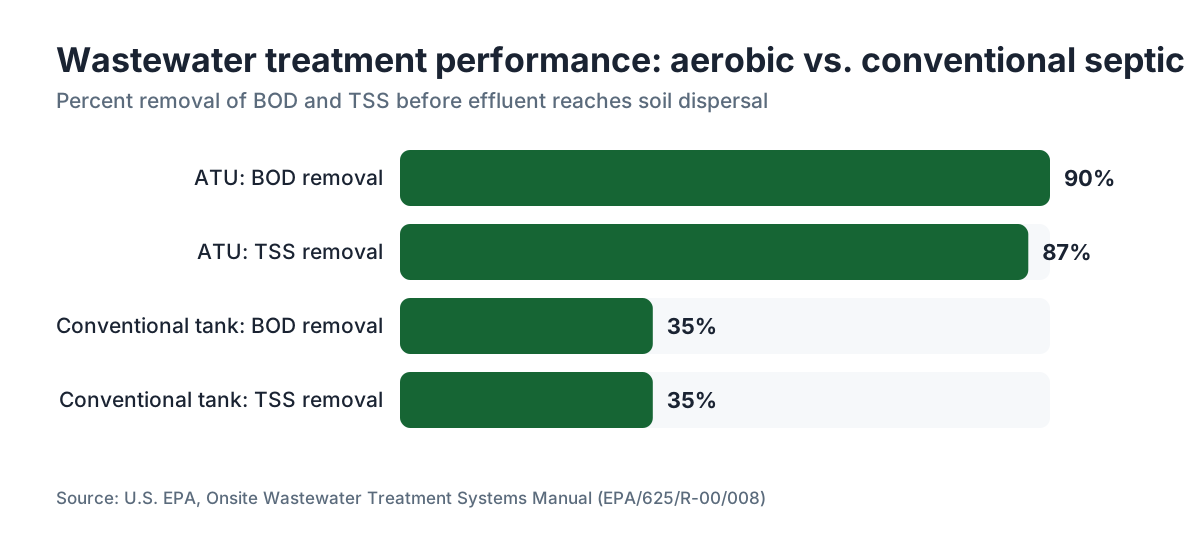
Aeration zone. This is the heart of the system. An electric air pump, either a surface-mounted compressor or a submersible diffuser, forces fine bubbles through the sewage. Aerobic bacteria colonize suspended media (plastic packing, bio-rings, or textile filters depending on the brand) or thrive in the oxygenated liquid. They consume the biological oxygen demand (BOD) and ammonia, cutting BOD by 85 to 95% compared to roughly 30 to 40% removal in a conventional tank alone [2].
Clarification/settling zone. Treated water moves to a settling chamber where suspended bacteria and fine solids drop out. The clarified effluent rises toward the outlet. Sludge settles and gets returned to the aeration zone or the pretreatment chamber for more digestion.
Disinfection zone. Most state permits require a disinfection step before surface or spray discharge. Chlorine tablets (the most common method), UV light, or ozone all work. Chlorine tablet feeders are cheap and simple. UV avoids adding chemicals and leaves no residual toxicity concern. Your permit spells out which is acceptable in your state [3].
The aeration pump runs continuously or on a timed cycle. That electricity, usually 100 to 200 watts for a residential unit, is a real ongoing cost. A unit running at 150 watts adds roughly $13 to $16 per month to your electric bill at national average rates [8].
What are the different types of aerobic septic systems?
The phrase "aerobic septic system" covers several distinct configurations. Which type you have or buy matters, because maintenance requirements and costs differ.
| Type | How it treats | Typical effluent quality | Common brands/examples |
|---|---|---|---|
| Suspended growth ATU | Bacteria float freely in aerated liquid | Secondary (BOD <30 mg/L) | Aerobic Systems Inc., Jet |
| Fixed-film/attached growth ATU | Bacteria grow on plastic media | Secondary to advanced secondary | Norweco Singulair, Orenco AdvanTex |
| Textile filter (recirculating) | Effluent recirculates through textile sheets | Advanced secondary (BOD <10 mg/L) | AdvanTex AX20/AX100 |
| Sequencing batch reactor (SBR) | Fill, react, settle, decant in timed cycles | Advanced secondary, some tertiary | Anua WhiteWater, Hydro-Action |
| Multi-stage with nutrient removal | Adds anoxic zone to remove nitrogen/phosphorus | Tertiary | Waterloo Biofilter, BioMicrobics |
The split between suspended growth and fixed-film matters in practice. Fixed-film and textile units stay more stable under variable loading. They handle a vacation cabin used only on weekends better than suspended-growth systems, which can crash when the bacteria starve between uses [7].
If your permit requires nitrogen reduction, you need a multi-stage system with an anoxic zone specifically. Nitrogen limits are getting more common in coastal states and near sensitive water bodies. Check your state's onsite wastewater code before you assume a basic ATU qualifies [4].
Where are aerobic systems required or preferred over conventional systems?
Aerobic systems get specified in four main situations, and every one of them comes down to the same thing: cleaner effluent buys you a permit where dirty effluent can't.
First, poor soils. If your perc test fails or your soil is too tight, too sandy, or too shallow above bedrock, a conventional leach field can't function. An ATU produces cleaner effluent that some states allow to discharge to a smaller drip-irrigation field, a subsurface drip system, or even surface spray-irrigation under the right permit conditions [1].
Second, small lots. A conventional system needs a primary and a reserve drainfield. Lots under an acre in some states simply don't have room. ATU effluent, because it's cleaner, sometimes gets a 50% reduction in required dispersal area under state code.
Third, proximity to water. Shoreline lots, lots near wells, and lots in nutrient-sensitive watersheds (think the Chesapeake Bay, Florida springs, or Massachusetts Title 5 nitrogen-sensitive areas) may be required to use advanced treatment. Florida mandates advanced treatment within certain setbacks from surface water under its Chapter 64E-6 rule [5].
Fourth, failing conventional systems. A homeowner with a failing leach field sometimes can't get a permit for a conventional replacement. An ATU with drip irrigation or a mound fits smaller footprints and works on sites that would otherwise be condemned.
The states with the most ATU installations are Texas, Florida, Oklahoma, and the Gulf Coast generally. Texas alone has over 200,000 ATUs permitted, largely because shallow clay soils and small lots make conventional drain fields impractical across much of the state [6].
How much does an aerobic septic system cost to install?
Installed cost for a residential ATU runs roughly $10,000 to $20,000 in most of the U.S. as of 2024 to 2025 [9]. That range has real spread, and the factors that move it are worth understanding before you sign anything.
The ATU unit itself, meaning the tank and aeration equipment, typically costs $3,000 to $7,000 for a standard three-compartment fiberglass or concrete unit sized for a 3 to 4 bedroom home. Drip irrigation dispersal adds $4,000 to $8,000 for the tubing, pump chamber, and controls. Permits, site evaluation, and inspection fees vary by county but commonly run $500 to $2,000.
Compared to a conventional system, expect to pay a premium. A basic conventional septic system for a 3-bedroom home runs $5,000 to $12,000 installed in most markets. The ATU premium is real, typically $5,000 to $10,000 more. You pay it for the ability to build on a lot where conventional can't get permitted, or to meet stricter discharge requirements.
For a full breakdown of cost to install a septic system, including regional variation, the factors that move the number are soil conditions, dispersal method, and whether bedrock excavation is needed.
Annual operating costs get underestimated constantly. Here's a realistic picture:
| Cost item | Typical annual cost |
|---|---|
| Electricity (air pump) | $150 to $250 |
| Service contract (required by most permits) | $200 to $500 |
| Chlorine tablets | $50 to $100 |
| Pump-out of sludge (every 1 to 3 years) | $250 to $500 amortized |
| Unexpected repairs (blower, pump, float) | $100 to $300 avg |
| Total typical annual operating cost | $750 to $1,650 |
That ongoing cost is roughly 3 to 5 times what you'd spend maintaining a conventional system in a good year [9][10]. Budget for it.
What maintenance does an aerobic septic system require?
This is where ATU ownership gets real. A conventional tank is mostly passive. An ATU has moving parts, electrical components, and a living bacterial ecosystem. It needs attention, and the schedule is not optional.
Most state permits require a licensed service provider to inspect and service the system quarterly, four visits a year. The tech checks the air pump or compressor, inspects the diffusers, tests effluent clarity, verifies the disinfection system is loaded and working, checks all float switches, and reviews the alarm history. They file a service report with the county health department. Skip this and you can lose your operating permit [3][5].
The air pump or compressor is the most common failure point. Surface-mount diaphragm pumps typically last 3 to 7 years and cost $150 to $400 to replace. Submersible aerators last 5 to 10 years but cost more to swap. Keeping a spare diaphragm kit on hand is genuinely good advice. A dead air pump means the system goes anaerobic within days and effluent quality collapses fast [8].
Chlorine tablet feeders need checking and restocking at every service visit. Some homeowners forget between visits and run for months with no disinfection. That's a permit violation, and if you have surface spray discharge, a real public health problem.
The trash tank still collects sludge that never gets digested away. Plan on a septic tank pump out every 1 to 3 years depending on household size and loading. Neglect it and solids overflow into the aeration chamber and clog diffusers or textile media. It's the single most avoidable expensive repair on an ATU.
For homeowners who want to track service intervals and maintenance history, SepticMind's homeowner portal lets you log service visits, set reminders for chlorine checks, and store permit documents in one place. That's useful when you sell the house and a buyer wants proof the system was maintained.
See also: how often to pump a septic tank for guidance on sludge accumulation rates.
What happens when an aerobic septic system fails or alarms?
ATUs have audible and visual alarms. When yours goes off, don't panic, but don't ignore it for a week either. The alarm is telling you something specific.
The common causes are a dead or struggling air pump, a high-water float tripped by a pump failure in the dosing chamber, or a clogged effluent filter. High-water alarms usually mean liquid isn't leaving the system, either because the dispersal pump is out or the field is saturated after heavy rain. The system may keep treating while alarmed. Check whether it's a true high-water event or a nuisance trigger from a float that shifted.
A failed air pump is the one that kills the bacterial colony fastest. Aerobic bacteria die within 24 to 72 hours without oxygen [8]. When you restart after replacing the pump, it takes 1 to 3 weeks for the population to recover, and effluent quality drops noticeably during that window. Most service contracts cover emergency pump replacement within 24 hours. Confirm yours does before you need it.
Cloudy effluent, foul odors from spray heads, or a system that hasn't been serviced in over a year all mean you call a licensed service provider before you call a repair company. Sometimes what looks like a broken system is just a depleted disinfection reservoir or a float you can reset.
For major mechanical failures beyond pump or float work, see septic tank repair and septic system repair for what typical jobs cost and when replacement beats repair.
How does aerobic system effluent quality compare to conventional systems?
The numbers are not subtle. A well-functioning conventional septic tank removes 30 to 40% of BOD (biological oxygen demand) and 30 to 40% of total suspended solids (TSS) from raw sewage before discharging to the drain field [2]. The soil in the drain field does the rest.
A residential ATU in normal operation hits 85 to 95% BOD removal and 85 to 90% TSS removal before discharge [2]. Some advanced systems with textile filtration push BOD below 10 mg/L, which lands in the range of tertiary municipal treatment.
The EPA's Onsite Wastewater Treatment Systems Manual reports that aerobic treatment units can produce effluent with "BOD5 concentrations less than 30 mg/L and TSS less than 30 mg/L," meeting EPA secondary treatment standards, before the effluent reaches the soil [2].
Fecal coliform is a separate question. Biological treatment alone, even aggressive aerobic treatment, does not reliably knock fecal coliform down to safe levels. That's why the disinfection step is not optional. A properly maintained chlorination or UV system after the ATU reduces fecal coliform by 99.9% or more, which makes surface or spray discharge acceptable under permit conditions [3].
Phosphorus removal is poor in standard ATUs without added chemical precipitation. Nitrogen removal needs an anoxic zone that most basic ATUs don't have. If your permit has nutrient limits, verify the specific system you're buying actually meets them. Don't assume it.
What should you know before buying or installing an aerobic system?
Some things your installer may not volunteer. You should know them going in.
Get your state's onsite wastewater code and read the ATU section before you sign any contract. Every state sets its own rules for setbacks, service contracts, inspection frequency, and approved system lists. Many states keep an approved product list. If a system isn't on it, you can't get it permitted, no matter what the salesperson tells you. Florida's Chapter 64E-6, Texas's 30 TAC Chapter 285, and North Carolina's 15A NCAC 18A .1900 series are examples [5][4].
Confirm the service contract situation before you commit. In many states, your operating permit requires a signed service agreement with a certified provider. If that provider goes out of business or stops serving your area, you have to get a new contract and notify the county. Sounds like paperwork. Counties enforce it. Unpermitted operation can bring fines or a forced shutdown order.
Ask about parts availability for the specific brand you're buying. A few ATU manufacturers have folded or been absorbed, leaving homeowners stranded without replacement parts for proprietary components. Brands with wide distribution and long histories carry lower parts-availability risk.
Size matters. ATUs, like conventional tanks, get sized by bedroom count, because that's the proxy most codes use for daily wastewater flow. A 3-bedroom home in most states needs a system rated for 450 to 600 gallons per day (GPD). Under-sizing is a common installer shortcut that leads to hydraulic overload and early failure.
For installation costs and what to expect from permitting, septic tank installation and cost to put in a septic tank cover the full picture of a new system project.
How do aerobic systems get permitted and inspected?
ATUs get regulated at the state level through your state's department of health or environmental quality, and enforced at the county level by the local environmental health department. The federal EPA sets guidelines and runs research but does not directly permit individual residential systems [1].
The permitting path usually goes like this: site evaluation (soil/perc test plus site survey), design by a licensed designer or engineer, permit application to the county, installation by a licensed installer, installation inspection before backfill, then a final operational permit with the required service contract on file. Some jurisdictions also require an electrical permit for the air pump wiring.
Operating permits for ATUs typically renew annually or every two years, conditioned on service reports being filed. Miss two consecutive quarterly reports in many Texas counties and you'll get a notice of violation. Keep missing them and you can face an abatement order.
When you buy a house with an ATU, the septic tank inspection is more involved than for a conventional system. A good inspector runs the alarm circuit, checks air pump operation, verifies disinfection works, inspects all three or four chambers, and pulls the service history from the county. Budget for a specialized inspection from someone who knows ATUs, not a general home inspector.
Operators who manage multiple ATU service accounts have to track service report due dates, permit renewals, and alarm responses across dozens or hundreds of systems. SepticMind's operator platform automates scheduling and reporting for exactly this kind of high-compliance, high-frequency service model.
What do aerobic systems cost to run over 20 years?
Here's the long-term math nobody puts on a sales brochure.
Say you installed an ATU for $15,000 and pay the realistic operating cost of about $1,200 a year (the midpoint of the $750 to $1,650 range above). That's $24,000 over 20 years in operating costs alone. Add a mid-life air pump replacement at $300, one dosing pump replacement at $500, one major service event or controller repair at $1,000, and a sludge pump-out every two years at $400 ($4,000 over 20 years), and you're looking at $30,000 or more in total lifetime cost beyond the original install.
A conventional system for the same home might run $8,000 installed, $250 a year to operate, pump-outs every 3 years at $400, and maybe one drain field repair or inspection over 20 years. Total lifetime cost over 20 years: roughly $15,000 to $18,000.
The ATU costs more. Full stop. The real question is whether the site requires it, or whether the permit conditions demand it. For the homeowner who needs an ATU to build, or to pass an inspection on a failing system, there's no alternative. For the homeowner who got sold an ATU on a site that could have supported a conventional system, ask your county health department whether a conventional option exists.
For septic tank cleaning costs and septic tank pumping schedules that feed that 20-year math, the linked articles have current regional pricing.
What common mistakes do aerobic system owners make?
Skipping service visits is the most expensive mistake. I get the logic. The system seems to be working, the contract costs $400 a year, and nothing looks wrong. But the service visit is what catches a failing diaphragm pump before it takes out the bacterial colony, a half-empty chlorine feeder before it becomes a permit violation, or a cracked distribution line before the field gets dosed unevenly for a year.
Pouring harsh chemicals down the drain hurts an ATU more than a conventional system. The aerobic bacteria that make the whole thing work are sensitive to bleach, antibacterial soaps used in excess, drain cleaners, and paint solvents. You don't have to avoid every household cleaner, but regular bulk use of disinfectant products directly attacks your system's biology.
Ignoring the alarm for days is a classic. The alarm means something is wrong. It's not a nuisance feature. A dead pump running without air for 48 hours is a manageable repair. A dead pump running without air for 10 days is a system that needs biological recovery time and possibly a full cleaning.
Not pumping the trash tank on schedule kills systems slowly. The pretreatment chamber fills regardless of how well the aeration zone works. When it fills, solids overflow and clog the aeration zone. A septic tank emptying visit on schedule is far cheaper than repairing a packed aeration chamber.
And not keeping key consumables on hand. A bag of chlorine tablets and a spare diaphragm kit for your air pump cost under $75 combined and can save you a week-long wait for parts in a rural area.
Frequently asked questions
How long does an aerobic septic system last?
The tank itself, concrete or fiberglass, typically lasts 20 to 40 years with normal maintenance. The mechanical parts are a different story: surface air pumps last 3 to 7 years, submersible aerators 5 to 10 years, and dosing pumps 7 to 12 years. Control panels and float switches fail unpredictably but usually within 10 to 15 years. Plan on replacing electrical components at least twice over the system's life.
Can I convert my conventional septic tank to an aerobic system?
Technically possible in some configurations, but rarely practical. Some jurisdictions allow retrofitting a conventional tank with an aeration system and a chlorination unit, but most state codes require ATU systems to meet product-specific approval standards that a field retrofit can't satisfy. In most cases a failing conventional system on a difficult site needs a new permitted ATU installation, not a conversion of the old tank.
How often does an aerobic septic system need to be pumped?
The pretreatment (trash) chamber needs pumping every 1 to 3 years for a typical 3 to 4 person household. The aeration and clarification chambers collect less sludge but should be inspected at each quarterly service visit and pumped when the tech finds sludge depth over one-third of chamber depth. Annual pumping is excessive for most systems. Every 2 years is a reasonable default if loading is normal.
What is the spray irrigation discharge from an aerobic system, and is it safe?
Many ATUs in Texas and other states are permitted to discharge treated, disinfected effluent through surface spray heads onto the yard. When the chlorination system works and the system is functioning, effluent BOD and fecal coliform levels meet permit limits. Setbacks from property lines, wells, and structures are required. People and pets should stay off the spray zone during active discharge. A failed disinfection system makes this unsafe, which is why quarterly service is non-negotiable.
Why does my aerobic system have an alarm going off?
The common causes are a dead or struggling air pump, a high-water float tripped by a failed dosing pump or saturated dispersal area, and an empty or disconnected chlorine feeder (on systems with a disinfection monitor). Check the control panel for indicator lights that identify the alarm circuit. Call your service provider if the alarm doesn't reset within 30 minutes or you can't find the cause. Don't just silence it and wait.
Do aerobic septic systems smell worse than conventional systems?
They shouldn't. A properly working ATU produces less odor than a conventional system because aerobic treatment doesn't generate the hydrogen sulfide that anaerobic tanks do. Odors from an ATU usually signal a problem: dead bacteria from a failed air pump, a full pretreatment chamber, or a bad seal on the tank. Surface spray systems can have a faint earthy smell during discharge, which is normal, but a sewage smell from spray heads means a system problem.
Can I use a garbage disposal with an aerobic septic system?
You can, but most service providers advise against it or say to limit use hard. Garbage disposals add substantial organic load and solids to the pretreatment chamber, speeding up sludge accumulation and stressing the aeration zone. If you use one regularly, tighten your pump-out frequency to every 1 to 2 years instead of every 2 to 3, and tell your service tech so they can watch the loading.
What happens to an aerobic system when the power goes out?
The air pump stops, and the system basically becomes a conventional septic tank until power returns. For short outages (a few hours) the bacterial colony survives and recovers fast. Outages of 24 to 72 hours stress the aerobic bacteria and reduce effluent quality for 1 to 2 weeks after power comes back. Extended outages of several days or more can effectively kill the population, forcing a full recovery period. In hurricane-prone areas, a small backup generator for the air pump is worth considering.
What are the rules about aerobic septic systems in Texas?
Texas regulates ATUs under 30 TAC Chapter 285, administered by the Texas Commission on Environmental Quality (TCEQ). Homeowner-operated systems need a signed maintenance contract with a licensed On-Site Sewage Facility (OSSF) maintenance company and quarterly inspections with reports filed with the permitting authority. Surface application of treated effluent is allowed under permit conditions with required setbacks. Texas has more permitted ATUs than any other state, estimated at over 200,000 systems.
How do I find a licensed aerobic septic system service provider?
Start with your county environmental health department. Most keep a list of licensed operators for your area. Your state's licensing board for plumbers or environmental contractors usually publishes a searchable database too. In Texas, TCEQ licenses OSSF maintenance providers and the list is searchable on its site. Ask any candidate how many ATU accounts they manage, which brands they know, and whether they offer emergency response for alarm calls.
Does an aerobic system add value to a home, or make it harder to sell?
It depends on the market. In rural areas where an ATU was required to develop the lot, buyers understand the system and it's neutral to slightly positive. In suburban areas where conventional systems are the norm, some buyers see the maintenance contract and operating cost as drawbacks. The thing that matters most for resale is complete service records showing the system was maintained. A well-documented ATU with a current permit sells far easier than one with gaps in service history.
Can I do my own maintenance on an aerobic system?
In most states, no. Your operating permit requires a licensed service provider to perform and sign off on quarterly inspections, so you can't substitute your own work for those mandated visits. Between visits you can check the chlorine tablet feeder monthly and refill it, listen for the air pump running, watch the alarm panel, and keep the area around spray heads clear of vegetation. The licensed quarterly visit is still required on top of that.
What is the difference between an aerobic system and a mound system?
A mound system is a type of dispersal, not a treatment system. It takes conventionally treated septic tank effluent and doses it into a raised sand mound above grade to get treatment distance from the water table. An ATU is the treatment component. The two aren't mutually exclusive. A common combination is an ATU for treatment followed by a mound or drip system for dispersal on sites with high water tables and poor soil. You can have an ATU without a mound, and a mound without an ATU.
Sources
- U.S. EPA, SepticSmart and Septic Systems program pages: ATUs may be required where conventional systems would fail due to shallow soils, high water tables, or proximity to water bodies; states regulate onsite systems while EPA sets guidelines and does not permit individual residential systems
- U.S. EPA, Onsite Wastewater Treatment Systems Manual (EPA/625/R-00/008): Conventional septic tanks achieve roughly 30-40% BOD and TSS removal; aerobic treatment units achieve 85-95% BOD removal and can produce effluent with BOD5 and TSS less than 30 mg/L meeting secondary treatment standards
- U.S. EPA, Wastewater Technology Fact Sheet: Chlorine Disinfection: Disinfection step required to reduce fecal coliform before surface discharge; chlorination reduces fecal coliform by 99.9%+ when properly maintained
- North Carolina Department of Environmental Quality, onsite wastewater program (15A NCAC 18A .1900): State onsite wastewater codes specify approved ATU products and required treatment levels including nitrogen removal requirements for sensitive watersheds
- Florida Department of Health, Chapter 64E-6 Florida Administrative Code: Standards for Onsite Sewage Treatment and Disposal Systems: Florida mandates advanced treatment for systems within certain setbacks from surface water; operating permits for ATUs require signed service agreement and quarterly inspections
- Texas Commission on Environmental Quality (TCEQ), On-Site Sewage Facilities program, 30 TAC Chapter 285: Texas regulates ATUs under 30 TAC Chapter 285 with required maintenance contracts and quarterly inspections; Texas has more permitted ATUs than any other state, over 200,000 systems
- National Environmental Services Center at West Virginia University, Small Flows publications on aerobic treatment units: Fixed-film and textile ATU designs are more stable under variable loading than suspended-growth systems, making them better suited to intermittently used properties
- University of Minnesota Extension, Septic Systems: ATU air pump electricity consumption typically runs 100-200 watts for residential units; aerobic bacteria die within 24-72 hours without oxygen supply
- Oklahoma State University Extension, aerobic septic system operation and maintenance guidance: Residential ATU installed costs range from $10,000 to $20,000 with annual operating costs of $750-$1,650 including service contracts, electricity, and disinfection consumables
- U.S. EPA, SepticSmart homeowner guidance: ATU systems require regular professional maintenance and have higher ongoing operating costs than conventional systems; service contracts are required by most state permits
Last updated 2026-07-10