Zoeller effluent filter: what it does, how to clean it, and when to replace it
By the SepticMind Editorial Team
TL;DR
- A Zoeller effluent filter (also sold under the AK Industries brand as the AKS13200) sits in your septic tank's outlet baffle and screens solids before effluent reaches the drain field.
- Filters run $30, $120, need cleaning every 1 to 3 years at pump-out, and can prevent drain field failures that cost $5,000, $20,000 to fix.
What is a Zoeller effluent filter and what does it actually do?
An effluent filter is a cylindrical mesh cartridge that inserts into the outlet tee of your septic tank. Raw wastewater flows through the outer mesh, and only liquid effluent passes out toward the drain field. Solids, grease particles, and any debris that makes it past the scum and sludge layers get trapped inside the cartridge.
Zoeller is one of the two or three companies whose name actually shows up in field conversations. Their filters are commonly installed in plastic septic tanks and ATUs (aerobic treatment units) across the U.S. The product is also distributed under the AK Industries label. The AK Industries septic tank effluent filter model number AKS13200 is functionally the same design: a 12-inch polypropylene cartridge with 1/16-inch (1.6mm) slot openings that catches particles larger than that threshold [1].
Why does this matter? The EPA's SepticSmart program lists drain field protection as the single most expensive repair a homeowner faces [2]. The filter is a five-dollar-a-year insurance policy against a $10,000 drain field replacement. It's the most underrated part in residential onsite systems.
How does the Zoeller effluent filter differ from a standard outlet baffle?
A standard outlet baffle (sanitary tee or pipe extension) just prevents scum from floating out of the tank. It has no mesh. Anything that's liquid, or small enough to travel with liquid, passes straight through into the leach field.
The Zoeller filter adds a filtration stage. Effluent has to pass through 1/16-inch slots before it exits. That catches lint, hair, and fine solids that a plain tee would never stop. Several university extension services have noted that effluent filters reduce total suspended solids (TSS) in tank effluent by 50 to 80% compared to a simple outlet baffle [3].
The tradeoff is maintenance. A plain baffle never clogs. A filter does, by design, and if you ignore it for too long it'll back up sewage into the house. That's the deal you're making, and it's worth every penny.
What are the main Zoeller effluent filter models and their specs?
Zoeller's filter line sits under their Flo-Pak and accessory catalog. The most common residential unit is the 12-inch polypropylene cartridge with a 1/16-inch (1.6mm) opening. AK Industries distributes what is essentially the same product family; the AK Industries septic tank effluent filter model AKS13200 is the standard 4-inch outlet version widely stocked at septic supply houses.
Here's a practical comparison of typical specs you'll find from Zoeller and compatible AK Industries units:
| Model / Series | Outlet Size | Filter Slot Opening | Cartridge Length | Approximate Price |
|---|---|---|---|---|
| Zoeller 4" Standard | 4 in | 1/16 in (1.6 mm) | 12 in | $35, $55 |
| Zoeller 6" Standard | 6 in | 1/16 in (1.6 mm) | 18 in | $60, $90 |
| AK Industries AKS13200 | 4 in | 1/16 in (1.6 mm) | 12 in | $30, $50 |
| Zoeller High-Flow / Commercial | 6 in | 3/32 in (2.4 mm) | 24 in | $90, $120 |
Prices vary by region and distributor. The 4-inch, 12-inch cartridge covers most single-family homes with tanks up to 1,500 gallons. Larger households or high-flow systems should look at the 6-inch version.
One thing to check before ordering: confirm whether your tank outlet uses a 4-inch or 6-inch tee. Pulling the wrong size is a simple mistake that wastes a truck trip.
How much does a Zoeller effluent filter cost to buy and install?
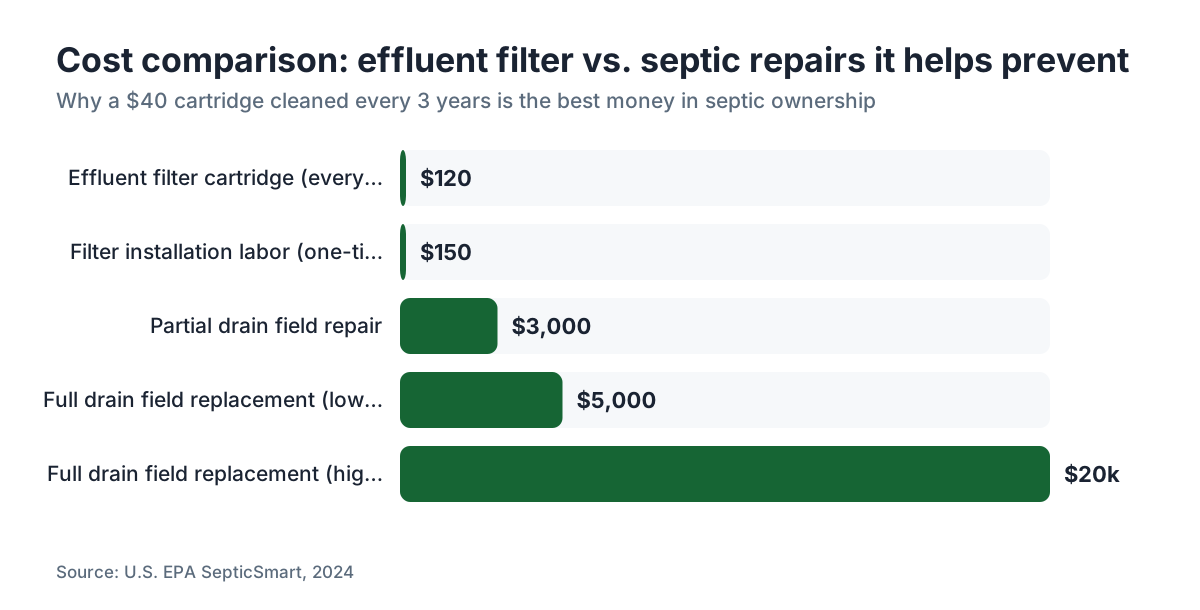
The filter cartridge itself runs $30, $120 depending on size and where you buy it. Supply houses are usually cheaper than home-improvement stores. Online pricing for the AK Industries AKS13200 model ranges from $32 to $52 shipped as of mid-2025.
Installation cost depends on whether it's going into an existing tank or getting specified for a new build.
For an existing tank: a service technician can add it during a routine septic tank pump out. Labor adds roughly $50, $150 to the pump-out bill because the tech needs to locate the outlet tee, drop in the cartridge, and verify fit. Some operators bundle it free if you're already scheduling service. Total out-of-pocket for parts and labor: $80, $270.
For new septic tank installation, most contractors include an effluent filter in the standard build, especially where state code requires it. About 30 states have adopted some version of outlet filtration requirements for new systems [4]. If your contractor isn't including one, ask why.
Compared to the cost of a drain field failure, anywhere from $5,000 for a repair to $20,000 or more for a full replacement, the filter is the cheapest insurance in the system [5].
How often do you need to clean a Zoeller effluent filter?
Clean the filter every time you pump the tank. For most households that means every 3 to 5 years [6]. High-use homes and systems with garbage disposals may need filter service every 1 to 2 years.
You'll also get an early warning. When the filter loads up, effluent backs up slightly in the tank. If that backup reaches the inlet side, you'll notice slow drains or gurgling in the house before you see any sewage. That's the filter working exactly as intended, telling you it's time for service.
Don't wait for symptoms. Just clean it at every pump-out. It takes a technician three minutes to pull the cartridge, rinse it back into the tank (so the solids settle instead of leaving the property), and re-insert. Those three minutes protect the leach field for another pumping cycle.
Operators tracking service intervals across large account lists often use scheduling tools to flag filter-equipped tanks on a tighter cycle. SepticMind's service platform, for example, lets operators attach equipment notes per tank so filter maintenance never gets skipped at a pump-out.
How do you clean a Zoeller effluent filter yourself?
Cleaning it yourself is possible but comes with a fair warning: you're handling material that's been sitting in a septic tank. Gloves, eye protection, and old clothes are non-negotiable.
Here's the process:
- Locate and open the outlet-side access lid. On most tanks this is the lid closest to where the line runs toward the drain field.
- Pull the filter cartridge straight up. It slides out of the housing tee with moderate resistance.
- Rinse the cartridge back into the open tank using a garden hose. Don't rinse it onto the lawn. The solids need to stay in the tank where they can settle and be pumped later.
- Inspect the cartridge for physical damage: cracked ribs, broken end caps, or collapsed mesh. If you see any of that, replace the cartridge rather than reinstalling it.
- Slide the cartridge back into the housing, ensure it seats fully, and close the access lid.
If you open the lid and find the tank is overdue for pumping (sludge level within 12 inches of the outlet), schedule a pump-out before the next filter clean. Septic tank cleaning and filter service go together.
A healthy tank with normal usage typically has 2 to 4 inches of settled solids on the cartridge at a 3-year service interval. If you're pulling a cartridge that's completely buried in sludge, the tank is overdue and the filter has been working overtime.
What happens if you don't clean the effluent filter?
Short term: effluent backs up in the tank. You'll see slow drains and gurgling fixtures. The system still functions, just at reduced capacity.
Long term: if the cartridge completely plugs, effluent has nowhere to go except back up the inlet line into the house, or the pressure can push sewage up to the surface in the yard. Neither is a small problem.
There's also a failure mode people don't think about. If the cartridge physically breaks (from frost, age, or a cracked housing), solids pass straight through as if there's no filter at all. The drain field gets hit with a solid load it was never designed to handle. The EPA's SepticSmart guidance specifically notes that solids reaching the drain field are the leading cause of drain field bioclogging and premature failure [2].
A failed drain field is a septic system repair that costs thousands and sometimes requires full system replacement. The filter is the cheapest single point of protection in the whole system.
When should you replace a Zoeller effluent filter rather than clean it?
A polypropylene cartridge that's in good physical condition lasts 10 to 20 years. You're replacing it when:
- The mesh is cracked or the end caps are broken (no longer filtering)
- Slots are permanently plugged with grease that won't rinse out
- The housing o-ring or gasket is deteriorated and causing bypass around the cartridge
- You're upgrading from a 4-inch to a 6-inch outlet during a tank modification
Replacement cost is just the cartridge price: $30, $120 plus 15 minutes of labor. It's cheap. If there's any doubt about the physical condition of a cartridge you pull out of a 15-year-old tank, just replace it. The cost of hesitating is not worth it.
The housing (the PVC tee that holds the cartridge) rarely needs replacement unless the tank outlet itself is being modified. Check it visually for cracks and confirm the cartridge seats without play.
Is a Zoeller effluent filter required by code in your state?
Requirements vary by state and jurisdiction. As of 2024, roughly 30 states require effluent filters on new septic system installations [4]. Some states require them only in systems serving sensitive areas (wellhead protection zones, watersheds). A handful mandate them on existing systems at time of sale or repair.
States with strong onsite wastewater programs, including California, Oregon, Florida, and Washington, have had outlet filtration requirements on the books for over a decade. The EPA's SepticSmart program encourages widespread adoption and provides homeowner education resources on proper filter maintenance [2].
Even where not required by code, most competent installers recommend them. The NC State Extension onsite wastewater program, for instance, states that effluent filters "reduce the amount of solids leaving the septic tank" and recommends them for virtually all residential systems [3].
If you're buying a home and getting a septic tank inspection first, check whether the outlet baffle has a filter cartridge installed. Its absence on an older system isn't a dealbreaker, but it's worth adding one at the next pump-out.
For tracking code compliance across a service territory, operators managing permit records and inspection histories in SepticMind can tag accounts that need filter retrofits during next scheduled service.
How does the Zoeller effluent filter compare to other brands?
Zoeller and AK Industries are not the only names in this space. Orenco Systems, Polylok, and Bio-Microbics also make effluent filters used in residential and commercial onsite systems. Here's how they generally compare:
| Brand | Common Model | Slot Size | Price Range | Notes |
|---|---|---|---|---|
| Zoeller / AK Industries | AKS13200 | 1/16 in | $30, $90 | Widely stocked, straightforward cartridge design |
| Polylok | PL-525, PL-625 | 1/16 in | $25, $70 | Popular with installers, good availability |
| Orenco Systems | FST series | 1/32 to 1/16 in | $80, $200 | Premium option, used in advanced systems |
| Bio-Microbics | RetroFAST | varies | $150, $300 | Includes treatment; not a direct comparison |
For a standard gravity-fed residential system, the Zoeller and Polylok options are functionally equivalent. The Orenco FST series uses finer filtration and is commonly specified for drip-irrigation and advanced treatment systems where effluent quality matters more.
Buying decisions usually come down to what your local supplier stocks and what fits your existing outlet tee. There's no meaningful performance difference between the Zoeller AKS13200 and a comparably sized Polylok in a standard residential application. Buy whatever your supplier has on the shelf.
Can you add an effluent filter to an older septic tank that doesn't have one?
Yes, and it's one of the best cheap upgrades you can make to an older system. The retrofit requires:
- Pumping the tank first. You need clear access to the outlet end.
- Locating or installing an outlet tee. If the original tee is intact and 4 inches, most Zoeller and AK Industries cartridges drop right in. If the original baffle has deteriorated (common in concrete tanks over 20 to 30 years old), the tech installs a new PVC tee first.
- Inserting the filter cartridge.
The whole job is typically done during a septic tank pumping visit. Total added cost is $80, $200 for parts and labor on top of the pump-out price.
If a septic tank repair is already happening, adding a filter at the same time is a no-brainer. You've already got the tank open and a technician on-site.
The one complication: very old concrete tanks sometimes have outlet baffles cast directly into the concrete or made of clay tile. Those require more work to retrofit. A good technician will assess the outlet condition during the pump-out and tell you what you're dealing with before quoting the upgrade.
What does proper effluent filter maintenance mean for drain field longevity?
The drain field is the most expensive component of the septic system and the one with no cheap repair path. When solids reach the drain field, they bioclog the soil interface. Over time that clogged zone stops accepting effluent. You end up with surfacing sewage or sewage backing into the house.
A functioning effluent filter is the last line of defense before the drain field. University of Minnesota Extension research found that solids loading is the primary driver of drain field failure in conventional gravity systems, and that outlet filtration significantly extends field life [7]. Nobody has perfect controlled trial data on exactly how many years a filter adds, but the mechanism is well understood: less solids in equals less clogging.
When you're deciding how often to pump septic tank, add a filter-equipped tank to your regular schedule and note the cartridge condition at each pump-out. A cartridge that's heavily loaded at a 3-year interval tells you the household is producing more solids than average and the pump schedule should move to every 2 years.
The cost to put in a new drain field, when one fails, ranges from $3,000 to $15,000+ depending on soil conditions and local codes [5]. See our leach field guide for a full breakdown. A $40 filter cartridge cleaned every pump-out is not a guarantee, but it is the most reliable protection available.
Frequently asked questions
What size Zoeller effluent filter do I need for my septic tank?
Match the filter to your outlet pipe diameter. Most single-family homes have a 4-inch outlet tee, which takes the standard 12-inch Zoeller or AK Industries AKS13200 cartridge. Larger homes or tanks over 1,500 gallons often use a 6-inch outlet and need the 18-inch cartridge. When in doubt, measure the outlet pipe diameter before ordering. Using the wrong size means the cartridge won't seat correctly and solids bypass the filter entirely.
Is the AK Industries AKS13200 the same as the Zoeller effluent filter?
For practical purposes, yes. AK Industries distributes effluent filter products that are functionally identical in design and slot size (1/16 inch) to the standard Zoeller residential cartridge. Both use polypropylene construction and fit the same 4-inch outlet housings. If your supplier stocks one but not the other, you can substitute without concern for a standard residential gravity system. Always confirm the physical dimensions before installation.
How do I know if my septic tank has an effluent filter installed?
Open the outlet-side access lid (the one on the side of the tank facing toward the drain field) and look down into the tank. If you see a cylindrical plastic cartridge sitting inside the outlet tee, you have a filter. If you see only a plain pipe or tee with no cartridge, you don't. This is best done during a pump-out when the technician has the tank open anyway. Ask them to check both the inlet and outlet baffles while they're in there.
Can a clogged effluent filter cause sewage backup in the house?
Yes. When the filter cartridge plugs completely, effluent has nowhere to go. It backs up through the inlet pipe and can surface at floor drains, toilets, or the lowest fixtures in the home. Slow drains and gurgling are the early warning signs. If you see those symptoms and haven't had the filter serviced in more than 2 to 3 years, schedule a pump-out and filter cleaning before the situation escalates to active sewage backup.
Do I need to replace my effluent filter every time I pump the septic tank?
Not necessarily replace, but always clean it. Pull the cartridge, rinse it back into the tank, inspect it for physical damage, and re-insert it. Replacement is only needed when the cartridge is cracked, has broken end caps, or has slots permanently blocked with grease that won't rinse out. A structurally sound polypropylene cartridge can last 10 to 20 years with proper cleaning at every pump-out cycle.
What slot size should an effluent filter have for a gravity septic system?
The standard for residential gravity systems is 1/16 inch (1.6mm). This is the slot size used by both Zoeller and AK Industries standard cartridges, and it matches the typical requirement in state onsite wastewater codes that specify effluent filter performance. Finer slot sizes (1/32 inch) are used in advanced treatment systems where higher effluent quality is needed before drip irrigation or subsurface drip distribution.
How long does it take a technician to install a Zoeller effluent filter during a pump-out?
Typically 5 to 15 minutes for a straightforward retrofit. If the existing outlet tee is in good condition, the tech drops the cartridge in and it's done. If the outlet baffle has deteriorated and needs a new PVC tee installed first, add another 20 to 30 minutes. Most operators include filter installation as a minor add-on during a scheduled pump-out rather than a separate service visit.
Does adding an effluent filter change how often I need to pump my septic tank?
It doesn't change the fundamental pumping schedule, which is driven by household size and tank volume. Most systems still need pumping every 3 to 5 years. However, a heavily loaded filter cartridge at a pump-out is a signal that the household is generating solids faster than expected, which might mean moving to a 2-year pump cycle. The filter gives your technician useful information about system load that a plain outlet baffle never would.
Are effluent filters required by code in all states?
No. As of 2024, roughly 30 states require effluent filters on new septic system installations. Requirements vary: some states mandate them system-wide, others only in sensitive watershed areas, and a handful require them at time of sale or major repair on existing systems. Even where not required, most reputable installers recommend them. Check your state's onsite wastewater regulations or ask your local health department for the specific rule in your county.
What happens to the solids I rinse off the filter cartridge?
They fall back into the tank. That's intentional. You always rinse the cartridge into the open tank, never onto the lawn or into a bucket you dispose of off-site. The solids settle back to the sludge layer and get removed during the pump-out. Rinsing solids onto the ground is both an environmental problem and a code violation in most states. If a technician rinses the filter outside the tank, that's a red flag.
Can I install a Zoeller effluent filter myself without a technician?
If your tank was recently pumped and the access lid is reachable, a homeowner can install or clean a filter cartridge. The mechanical task is simple: pull the old cartridge out, rinse it into the tank, inspect it, and re-insert (or drop in a new one). The main risks are working near an open septic tank (real hydrogen sulfide hazard in poorly ventilated tanks), misidentifying the outlet versus inlet, and improper cartridge seating. If you're not certain which side is the outlet, have a professional confirm it first.
How much does it cost to repair a drain field that failed because it had no effluent filter?
Drain field repairs run $1,500, $5,000 for partial remediation and $5,000, $20,000 or more for full replacement, depending on soil conditions, local permitting costs, and system size. In many cases a failed drain field requires a completely new system on a different part of the property, which can cost as much as the original system installation. The effluent filter, at $30, $120 plus cleaning every few years, is the cheapest protection available against that outcome.
Is a Zoeller effluent filter compatible with all types of septic tanks?
Zoeller and AK Industries cartridges are designed for standard 4-inch or 6-inch PVC outlet tees, which are used in most modern plastic and fiberglass tanks and in retrofitted concrete tanks. Very old concrete tanks with original clay tile or cast-in-place concrete baffles may need a new PVC outlet tee installed before the cartridge can be added. Some ATU (aerobic treatment unit) systems use proprietary filter housings that require brand-matched cartridges; confirm with your ATU manufacturer before substituting.
Sources
- AK Industries / Infiltrator Water Technologies, product specifications for AKS13200 effluent filter: AK Industries AKS13200 is a 4-inch, 12-inch polypropylene effluent filter cartridge with 1/16-inch (1.6mm) slot openings
- U.S. EPA, SepticSmart homeowner guidance: Solids reaching the drain field are the leading cause of drain field bioclogging and premature failure; drain field replacement is the most expensive septic repair homeowners face
- NC State Extension, Onsite Wastewater Section, effluent filter guidance: Effluent filters reduce the amount of solids leaving the septic tank and are recommended for virtually all residential gravity-fed systems; university extension research shows 50-80% TSS reduction compared to a plain outlet baffle
- National Onsite Wastewater Recycling Association (NOWRA), State Regulatory Database summary: Approximately 30 states require effluent filters on new septic system installations as of 2024
- U.S. EPA, SepticSmart cost guidance for septic system repairs and replacements: Drain field replacement costs range from $5,000 to over $20,000 depending on system size and soil conditions
- U.S. EPA, SepticSmart, How to Care for Your Septic System: Most septic systems should be pumped every 3 to 5 years; effluent filters should be cleaned at every pump-out
- University of Minnesota Extension, Septic System Owner's Guide: Solids loading is the primary driver of drain field failure in conventional gravity systems; outlet filtration significantly extends field life
- Zoeller Pump Company, product catalog and effluent filter specifications: Zoeller residential effluent filter cartridges are available in 4-inch and 6-inch outlet sizes with 1/16-inch slot openings; pricing ranges from $35 to $120 depending on model
- Orenco Systems, effluent filter technical documentation: Orenco FST series effluent filters use 1/32 to 1/16-inch slot openings and are specified for advanced treatment and drip-irrigation systems
- Washington State Department of Health, On-Site Sewage System Regulations: Washington State requires effluent filters on new septic system installations as part of onsite wastewater code
- Florida Department of Health, Onsite Sewage Treatment and Disposal Systems rules: Florida code includes outlet filtration requirements for new septic systems in certain jurisdictions
- Polylok Inc., effluent filter product specifications: Polylok PL-525 and PL-625 effluent filter cartridges use 1/16-inch slot openings and are priced at $25, $70 depending on outlet size
Last updated 2026-07-10