Percolation test for septic system: what it is, how it works, and what it costs
By the SepticMind Editorial Team

TL;DR
- A percolation test (perk test) measures how fast your soil absorbs water, expressed in minutes per inch.
- Most states require one before approving a septic system permit.
- The test takes 2 to 4 hours on-site, costs $150 to $700 depending on location and required hole count, and decides both whether a conventional drain field will work and how big it needs to be.
What is a percolation test for a septic system?
A percolation test, almost always called a perk test, measures how fast the soil on your property soaks up liquid. You dig one or more holes to the depth where a drain field would sit, soak the soil overnight, then pour in a measured amount of water and time how far it drops. The result is a percolation rate in minutes per inch (MPI). That single number decides whether you can build a conventional septic system, and if you can, how big the drain field has to be.
The test exists because soil is wildly inconsistent. Two lots side by side can absorb water at completely different rates. Sandy soils drain fast, sometimes too fast, letting pathogens slip straight into groundwater before the soil treats them. Heavy clay drains slowly or barely at all, so sewage backs up to the surface. There is a middle zone that works, and the perk test tells you if your soil sits in it [1].
Nearly every state requires a perk test, or a newer equivalent called a soil morphology evaluation, before it issues a septic permit. The EPA's SepticSmart program treats proper site evaluation as the base that a healthy system is built on [2]. Without a passing test on file, you generally cannot get a building permit for new construction on an unsewered lot, and you cannot legally install a new septic system.
How does a percolation test actually work, step by step?
Your state or county health department sets the exact procedure, so details shift from place to place. The core method is steady enough to walk through, though.
Site preparation (1 to 2 days before the test). The tester or a licensed soil evaluator digs the required holes, usually 2 to 6 per proposed drain field, down to the planned trench depth, typically 18 to 36 inches. Hole diameter runs 4 to 12 inches. The bottom and sides get scratched to strip away any smearing from the auger or shovel, and 2 inches of coarse sand or gravel go in the bottom to protect the absorption surface.
Pre-saturation (the evening before). Each hole gets filled with at least 12 inches of water and left to soak overnight, often 12 to 24 hours. This step matters because soil absorbs at different rates depending on how wet it already is. Pre-saturation copies the wet-season condition, which is the worst case a drain field ever has to handle [3].
The timed test (test day, 2 to 4 hours). Water goes in to bring each hole to a set depth, typically 6 inches above the gravel layer. The tester measures how far the level drops over 30-minute intervals and repeats until the rate holds steady across three readings in a row. The most stable reading becomes the percolation rate in minutes per inch.
A few states still allow a stripped-down version where you measure the drop over a single 30-minute stretch. Most programs dropped that for the stabilized-rate method because it is more accurate and easier to reproduce [3].
What do percolation test results mean, and what is a passing rate?
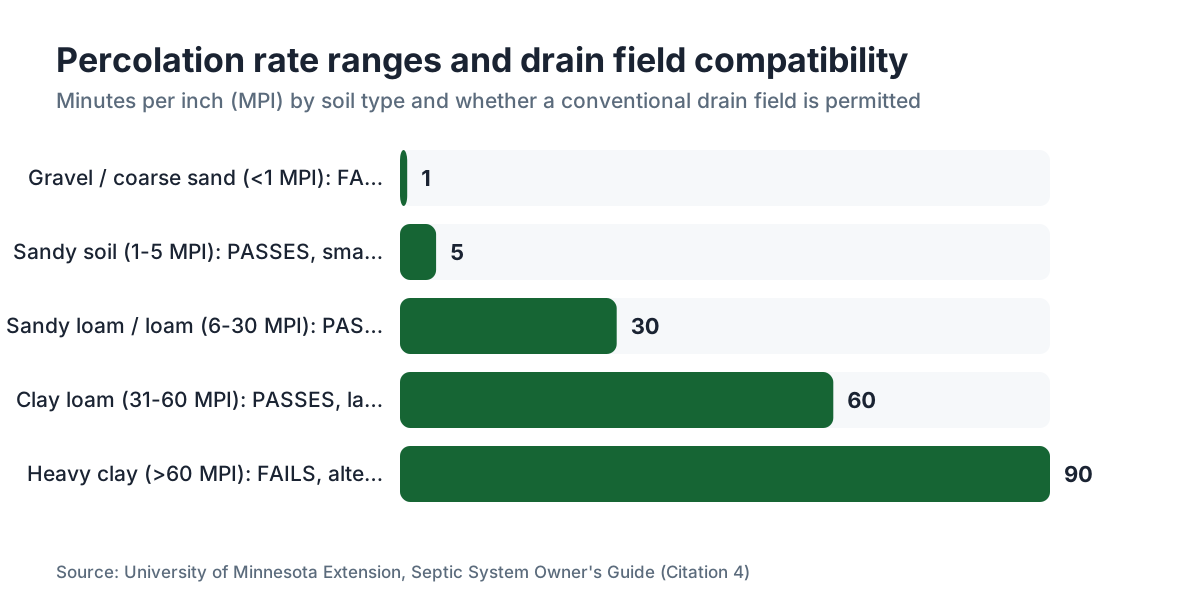
The result is a number: minutes per inch. Lower means faster absorption. Here is how those numbers turn into real outcomes.
| Perc Rate (MPI) | Soil Type | Conventional Drain Field? | Notes |
|---|---|---|---|
| Less than 1 MPI | Gravel, coarse sand | Usually fails (too fast) | Inadequate treatment before reaching groundwater |
| 1 to 5 MPI | Sandy soil | Passes; smaller field possible | Field sizing per state table |
| 6 to 30 MPI | Sandy loam, loam | Passes; standard sizing | Ideal range in most state codes |
| 31 to 60 MPI | Clay loam | Passes in many states; larger field | Some states cap at 45 or 60 MPI |
| Over 60 MPI | Heavy clay | Fails in most states | Alternative system required |
Most state codes accept rates between 1 and 60 MPI for a conventional drain field, with the sweet spot around 6 to 30 MPI [4]. Faster than 1 MPI, and the soil is so coarse it barely filters effluent before it hits groundwater. Slower than 60 MPI (some states draw the line at 45), and the soil cannot take effluent fast enough to stop it from surfacing or backing up.
The perc rate also sets the required size of your leach field. State sizing tables follow a formula where a slower rate demands more square footage of trench-bottom absorption area per bedroom or per gallon of daily flow. A home on 30 MPI soil might need 400 square feet of trench bottom where a home on 10 MPI soil needs 250.
A failure is not always the end of the road. Alternative systems, pressure-dosed mounds, aerobic treatment units, drip irrigation fields, and constructed wetlands can work in soils a conventional system cannot handle. They cost more and need more upkeep, but they exist for exactly this problem [5].
Who can perform a perk test, and do you need a licensed tester?
In most states you cannot run your own perk test and submit it for a permit. It has to be done by, or witnessed by, a licensed soil scientist, professional engineer, registered sanitarian, or county health department inspector, depending on what your state requires [4].
Some rural counties let a licensed septic designer or installer run the test with a health department inspector present. Others make the inspector run it, with you or your contractor just digging the holes ahead of time. A handful of states also want a licensed soil scientist to complete a soil morphology profile, a separate look at soil texture, color, and structure from a soil boring, which gives regulators more than a perc test alone ever could.
Before you schedule anything, call your county health department or state environmental agency and ask two things: who is authorized to run the test, and what the exact pre-saturation and timing protocol is. That call takes 10 minutes and can save you a failed test caused by the wrong procedure. The EPA's SepticSmart resources also point homeowners to local health departments as the right first stop for site evaluation rules [2].
How much does a percolation test cost?
The honest range is $150 to $700 for a standalone perk test, and most homeowners pay $250 to $450 [6]. What moves the price: the number of holes required (which depends on lot size and state code), whether the health department charges a separate witness or inspection fee, local labor rates, and whether a soil morphology evaluation is bundled in.
| What is included | Typical cost range |
|---|---|
| Perk test only (contractor performs, inspector witnesses) | $150 to $350 |
| Perk test + soil morphology profile | $300 to $700 |
| Health department permit/witness fee (separate) | $50 to $250 |
| Perk test as part of full site evaluation (for permit) | $400 to $1,000 |
Some counties fold the perk test inspection into a broader site application fee. Others bill separately for each visit. If your test fails and you need a re-test with new hole locations, expect to pay again, sometimes at a reduced rate, sometimes at full price.
Against a full septic tank installation, the perk test is a rounding error. Full system installation usually runs $3,500 to $12,000 or more depending on system type and site [7]. This is not the place to cut corners. A bad or faked result can lead to a failed system, contaminated groundwater, and real liability.
How long does a percolation test take?
Plan for two days of site activity, though for most of that stretch the soil is just sitting there full of water and nobody needs to be around.
Day one is hole prep, usually an hour or two of digging, then you fill the holes and walk away. Pre-saturation runs 12 to 24 hours. Day two is the timed test, 2 to 4 hours depending on how many holes you have and how fast the rate settles.
Some counties require pre-saturation a full 24 hours before the test, so you schedule around that window. Others allow same-day testing in certain soils, though that is less common and may not fly for permit purposes. Ask your county before you book anything.
Getting on the inspector's calendar can add a week or two in busy spring and summer building seasons. If you are closing on a land purchase that hinges on a perk test result, build two to three weeks into your timeline for scheduling, pre-saturation, testing, and the county's written report.
What happens if a property fails a percolation test?
A failed perk test does not automatically make the land unbuildable. It means a conventional gravity-fed drain field will not work there. You have a few ways forward.
First, test a different area of the lot. Soil varies across a single parcel. A failure in one corner does not doom every corner. A good soil evaluator can often spot more promising ground from topography, soil borings, and a visual read before you spend money on more test holes.
Second, go with an alternative system. Mound systems lift the drain field above grade into imported soil that absorbs better. Aerobic treatment units clean effluent more thoroughly before it hits the soil, so the field can be smaller. Drip irrigation spreads effluent in tiny doses over a wide area. Pressure-dosed systems can work in soils just outside the conventional range. All of these cost more to install and maintain, and most states require a service contract to keep them running [5].
Third, walk away. On a lot with severe soil limits, an alternative system can top $20,000, with ongoing maintenance of $500 to $1,500 a year. That changes the math on a purchase in a hurry. A failed perk test during due diligence is worth its weight in gold.
For operators juggling permit applications and site evaluations across many jobs, tracking test results, re-test dates, and county-specific protocols gets messy fast. That is one spot where a tool like SepticMind helps operators stay organized without letting details slip.
If a property fails and you think a drought, frozen ground, or a procedural error skewed the result, you can request a re-test. Most counties allow it, usually once conditions normalize. Write down your reasoning before you ask.
Is a percolation test the same as a soil evaluation, or are they different?
They are related, but not the same, and the difference matters more than it used to.
A percolation test is a functional test: pour water in a hole, time how fast it drops. A soil morphology evaluation (also called a soil profile or soil boring analysis) is a hands-on read: a licensed soil scientist examines the color, texture, structure, and mottling of a soil core to classify it and pin down the seasonal high water table depth.
Many states started with the perk test alone. Over the past two decades, most have added or swapped in soil morphology because it tells you things a perk test never can. Soil mottling (the gray and orange streaking left by cycles of wet and dry) shows an evaluator where the seasonal high water table sits, which sets the required setback depth for a drain field. A perk test says nothing about that [3].
Some states now accept a soil morphology evaluation on its own to size a system, using published tables that convert soil texture into estimated absorption rates without a timed test. Others want both. A few still take only the perk test for conventional systems. Your state's onsite wastewater program spells out which one applies, and those rules are often buried in administrative code rather than a friendly fact sheet.
The National Environmental Services Center at West Virginia University publishes guidance comparing these methods and holds that soil morphology usually gives a more reliable read on long-term field performance [3].
How does a percolation test affect septic system design?
The perk test result drops straight into the drain field sizing calculation. State codes use a table or formula that takes your household's daily wastewater flow (based on bedroom count or a fixed design flow per person) and divides it by an application rate that comes from your perc rate. The result is the minimum square footage of absorption area the field must have.
Many states use an application rate of 0.6 to 0.9 gallons per square foot per day for soils in the 6 to 30 MPI range, and 0.3 to 0.5 gallons for slower soils. A three-bedroom home generating 450 gallons a day on 20 MPI soil might need 500 to 750 square feet of trench bottom. That same home on 50 MPI soil might need 900 to 1,500 square feet, which means a much bigger chunk of the lot set aside for the field [4].
Field size drives the cost to install the system, how much yard you lose, and whether the lot can hold a reserve field (an untouched backup area most states now require). A perc rate on the slow end of passing does more than pile on cost. It can decide whether a code-compliant system fits on the lot at all.
Designers also use the perc rate to pick between a conventional gravity system, a pressure-dosed system, or a drip system. A borderline slow rate might push a designer toward a pressure-dosed field, which delivers effluent in timed doses instead of a steady trickle, resting the soil between doses and improving long-term performance.
Once the system is in, maintenance stretches field life a lot. Regular septic tank pumping keeps solids out of the field, and a septic tank inspection catches trouble before it turns expensive.
What are the most common percolation test mistakes and how do you avoid them?
The biggest mistake homeowners and contractors make is skipping or shortening pre-saturation. Testing dry soil gives a faster perc rate than the soil will show under steady wet-weather loading. You get a rosy number, an undersized drain field, and a failure a few years down the line. Every serious state protocol requires at least 12 hours of pre-saturation, and most require 24 [3].
Second mistake: testing during drought or frozen conditions. Dry soil absorbs fast. Frozen soil may not absorb at all. Neither reflects normal conditions. If your test lands during an odd weather event, document it and ask the inspector whether the results should be verified later under more typical conditions.
Third: digging holes too close together or too close to site features. A hole next to a tree, a foundation, or an existing septic tank produces a result that does not represent the actual field area. Follow the site plan, not convenience.
Fourth: wrong depth. Some designers want conditions confirmed at 24 inches, others at 36, depending on trench depth. Test at the wrong depth and the result may not match what the system actually encounters. Confirm with the county before digging.
Fifth, and the easiest to avoid: skipping the county's current protocol document. Procedures have changed in a lot of jurisdictions over the past decade as soil morphology requirements got added. An installer who ran dozens of tests under the old rules can still get a result rejected if the pre-saturation timing or interval method changed. One call to the health department kills this risk.
Do you need a perk test when buying land or an existing home?
For vacant land you plan to build on: yes, before you close, no exceptions worth making. A parcel that fails a perk test with no feasible alternative system location can be functionally unbuildable for a house. Make a passing perk test a contingency in your purchase agreement. This is standard practice in rural real estate deals across most states [6].
For an existing home with a working septic system: probably not, unless you are adding bedrooms, the current system is failing, or you are pulling a major remodel permit that triggers a system review. The existing system was already designed around a perk test result on file with the county. That record stays with the property.
There are exceptions. If the old system went in decades ago under old code and you are replacing it, most counties require a new site evaluation before they issue a replacement permit. The original perk test may no longer meet current standards or the current county protocol. Check with the health department before you assume the old record still counts.
Buying a home with a septic system of unknown history? A septic tank inspection plus a records search at the county health department will tell you whether a valid perk test is on file. That inspection is worth doing whether or not a perk test is required, because it tells you the real condition of the tank and field before you own it.
What state and federal rules govern percolation testing?
The federal government sets broad public health goals and hands almost all onsite wastewater regulation to the states. The EPA's SepticSmart program states that "proper siting, design, installation, and maintenance are the keys to a long-lasting, effective septic system," but the specific technical requirements live in state administrative code, not federal law [2].
Every state has an onsite wastewater treatment code, sometimes called an OSWTS (Onsite Wastewater Treatment System) code or just a septic code. These are usually run by the state environmental agency or the state health department and enforced at the county level. Most are posted online through the state's regulatory database.
A few examples of how much state codes vary: North Carolina requires a soil morphology evaluation and reserves the right to also require a perk test [8]. Texas uses the TCEQ's "On-Site Sewage Facilities" rules, which allow several site evaluation methods including perc testing [9]. California's onsite systems fall under the State Water Boards, with heavy county-level variation in testing requirements [10].
Because the rules are local, a result accepted in one county may not meet the protocol one county over. Never assume your installer's usual method is automatically compliant. Pull the current county protocol every single time, especially in states where county health departments can set testing standards above the state minimum.
SepticMind's operator platform has a place to store jurisdiction-specific requirements and protocol documents alongside job records, which helps service companies stay current as state and county codes change.
Frequently asked questions
How long does a percolation test take from start to finish?
Two days of site activity in most cases. Day one is digging the holes and pre-saturating them with water, an hour or two on-site followed by 12 to 24 hours of the soil just soaking. Day two is the timed test itself, 2 to 4 hours. Getting on the county inspector's calendar can add one to two weeks in busy building seasons.
How much does a percolation test cost in 2024?
Most homeowners pay $250 to $450 for a standalone perk test. The full range is $150 to $700 depending on the number of test holes required, whether a soil morphology profile is bundled in, and your county's separate permit or witness fee. A complete site evaluation package with all testing needed for a septic permit typically runs $400 to $1,000.
What is a passing percolation rate for a septic system?
Most state codes accept percolation rates between 1 and 60 minutes per inch for a conventional drain field. The ideal range is roughly 6 to 30 MPI. Rates faster than 1 MPI mean soil too coarse to treat effluent adequately. Rates slower than 60 MPI (some states cap at 45 MPI) mean the soil cannot absorb effluent fast enough for a conventional system to work.
Can I do a percolation test myself?
In most states, no. The test has to be done by or witnessed by a licensed soil scientist, engineer, sanitarian, or county health department inspector for the result to count toward a septic permit. Some counties let a licensed installer perform the test if an inspector witnesses it. Call your county health department before hiring anyone to confirm who is authorized.
What happens if my property fails a perk test?
A failed perk test rules out conventional gravity drain fields but does not necessarily make the property unbuildable. Options include testing a different area of the lot or installing an alternative system such as a mound, aerobic treatment unit, or drip irrigation field. These cost more to install ($10,000 to $25,000 or more) and require ongoing maintenance contracts. A licensed soil scientist can identify the best path forward.
Do I need a perk test to buy land for a house?
Yes, if you plan to use a septic system and there is no existing system on the property. A parcel that fails a perk test with no viable alternative system location can be functionally unbuildable for a house. Make a passing perk test a contingency in your purchase contract before closing. This is standard practice in rural real estate transactions across most states.
Is a percolation test required for an existing home?
Usually not for a home with a working system already installed, because the original perk test result is on file with the county and the system was designed around it. A new test is typically required if you are replacing a failed system, adding bedrooms, or doing a major permitted renovation that triggers a system review. Check with your county health department to confirm what triggers a re-evaluation.
How is a percolation test different from a soil evaluation?
A perk test is a timed functional test where you measure how fast water drops in a hole. A soil morphology evaluation is a visual and tactile analysis of a soil core that identifies texture, structure, mottling, and the seasonal high water table depth. Most states now require the soil evaluation in addition to or instead of a perk test, because it reveals groundwater information a perk test alone cannot provide.
How does the percolation rate affect drain field size?
Directly and significantly. Slower perc rates require more absorption area per gallon of daily wastewater flow. A home on 20 MPI soil might need 500 to 750 square feet of trench-bottom absorption area, while the same home on 50 MPI soil might need 900 to 1,500 square feet. This affects system cost, lot space consumed, and whether a required reserve field can fit on the property.
What is the best time of year to do a percolation test?
Spring is usually preferred because soils are at or near their wettest, which represents the worst case a drain field will face. Testing in dry summer or drought conditions can give a faster, more optimistic rate that does not reflect real wet-weather performance. Avoid frozen ground, which can block proper pre-saturation and produce unreliable results.
How often does a percolation test need to be repeated?
A valid perk test result typically stays on file with the county indefinitely and does not expire for permit purposes, as long as site conditions have not changed. If you are replacing a failed system on a property where the original test was done decades ago, the county may require a new site evaluation under current code standards before issuing a replacement permit.
Does a perc test tell you where to put the septic tank?
No. The perk test determines where and whether a drain field will work. Tank placement is a separate design decision based on setbacks from wells, property lines, buildings, and water features, plus gravity flow from the house to the tank. The county health department or your designer will specify required setbacks, and the tank usually sits between the house and the drain field.
Sources
- EPA, How Your Septic System Works: Soil absorption is central to how a conventional septic system treats wastewater; soil type determines whether effluent is adequately filtered before reaching groundwater.
- National Environmental Services Center, West Virginia University, Percolation Testing: Pre-saturation of 12 to 24 hours is required for valid percolation test results; soil morphology generally provides a more reliable picture of long-term field performance than a perk test alone.
- University of Minnesota Extension, Septic System Owner's Guide: Most state codes accept percolation rates between 1 and 60 minutes per inch for conventional drain fields; perc rate is used directly in drain field sizing calculations.
- EPA, Types of Septic Systems: Alternative systems including mound systems, aerobic treatment units, drip irrigation, and constructed wetlands are designed for sites where soil conditions fail conventional system requirements.
- Penn State Extension, Site Evaluation for Onsite Sewage Systems: Percolation test cost ranges and the recommendation to make a passing test a contingency in rural land purchase contracts.
- HomeAdvisor / Angi, Septic System Installation Cost Guide: Full septic system installation typically costs $3,500 to $12,000 or more depending on system type and site conditions.
- North Carolina Department of Health and Human Services, On-Site Water Protection: North Carolina requires a soil morphology evaluation and reserves the right to also require a percolation test for onsite wastewater permits.
- Texas Commission on Environmental Quality, On-Site Sewage Facilities: Texas TCEQ On-Site Sewage Facilities rules allow several site evaluation methods, including percolation testing.
- California State Water Resources Control Board, Onsite Wastewater Treatment Systems Policy: California's onsite wastewater systems are regulated by the State Water Boards with significant county-level variation in percolation testing requirements.
- University of Florida IFAS Extension, Septic System Site Evaluation: Soil type and seasonal high water table depth are critical factors in site evaluation; soil mottling from borings reveals seasonal water table position that perk tests cannot.
Last updated 2026-07-09