Perc tests in Morris County NJ: what to expect and what it costs
By the SepticMind Editorial Team
TL;DR
- A perc test in Morris County, NJ measures how fast soil absorbs water to decide whether a lot can support a septic system.
- The county Health Department runs it under state code N.J.A.C.
- 7:9A.
- Budget $800 to $2,500 for soil testing plus design work on a typical lot.
- Failing soil sometimes qualifies for an alternative system, but options get thin on tight or rocky lots.
What is a perc test and why does Morris County require one?
A percolation test, almost always shortened to perc test, measures how fast water drains through the soil at one specific spot. You dig a hole, fill it with water, and time how fast the level drops. The result, in minutes per inch (mpi), tells an engineer whether the soil can handle effluent from a septic system without backing up in the yard or leaking into groundwater.
Morris County requires the test because New Jersey's statewide onsite wastewater code, N.J.A.C. 7:9A, makes it mandatory before any new septic tank installation or major repair on a property that isn't on public sewer [1]. The county's Division of Public Health Services runs the requirement locally. No passing test on file means no construction permit for a new home, no added bedroom that raises sewage load, and no new leach field.
The test isn't a rubber stamp. Northern New Jersey, Morris included, sits on geology that swings from fast-draining glacial sand to dense clay and rock. A lot that looks buildable can absorb water at one inch every 90 minutes, which is far too slow for a standard system. Learning that before you buy the land or pull a permit saves real money.
Who runs perc tests in Morris County?
A licensed New Jersey site evaluator does the actual soil and percolation testing on your property, then submits the results to the county or municipal health agency for review [1][2]. The Morris County Department of Human Services, Division of Public Health Services handles onsite sewage permitting, and individual towns keep their own health officers who coordinate with the county.
A site evaluator is more than any contractor. New Jersey licenses them under N.J.A.C. 7:9A, and one has to be present at every test pit and every timed perc reading. Your septic designer (often the same person, sometimes a separate licensed engineer) then turns the evaluator's data into a system design. Never hire anyone who offers to run a perc test without showing you a current New Jersey site evaluator license. The results won't be accepted, and you'll pay twice.
The structure carries over to neighboring counties. Perc tests in Somerset County NJ go through the Somerset County Department of Health, and perc tests in Warren County NJ run through the Warren County Health Department, both under the same N.J.A.C. 7:9A [1][5][6]. The state rules are uniform. The local health office is just your point of contact.
How does the perc test process work step by step?
There are more steps than most people expect, and it rarely wraps up in one afternoon.
Step 1: Site evaluation application. You or your engineer files an application with the municipal or county health department. In Morris County this usually starts with the municipal health officer. You pay an application fee here.
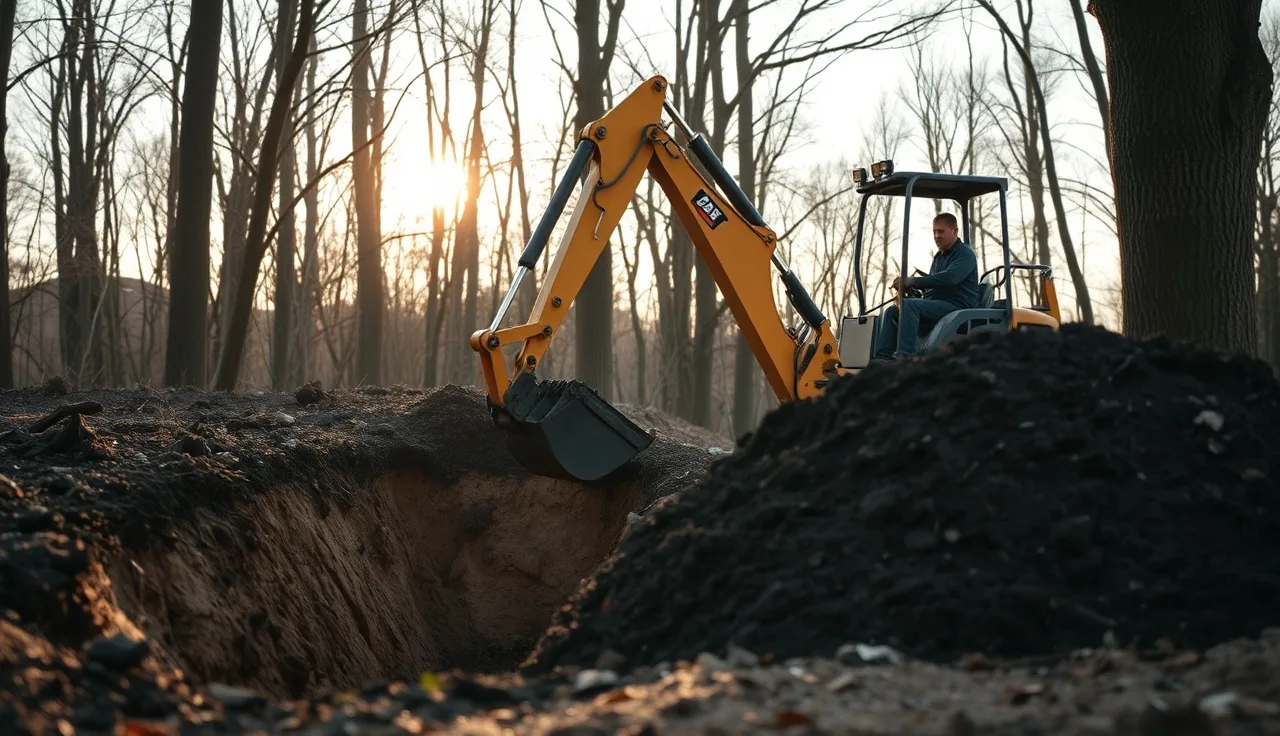
Step 2: Soil boring and test pit excavation. Before the perc test itself, the site evaluator digs test pits (usually with a backhoe) to read the soil profile. They're checking texture, structure, color, and depth to any limiting layer: bedrock, high water table, or dense clay. This step sets the proposed location and depth of the disposal field [1].
Step 3: Saturation period. The code requires pre-soaking the test holes, typically for 24 hours, before the timed reading. That saturates the soil to mimic wet-season conditions, which is the worst case for a system. This is why many tests span two days.
Step 4: Timed percolation test. Water goes in the hole, and the drop is measured at set intervals, usually every 30 minutes. The slowest reliable reading becomes your percolation rate.
Step 5: Report submission and review. The site evaluator files a written report. A reviewer checks it against code. What follows is approval, conditional approval, or denial, sometimes with a request for more test pits.
Step 6: System design. If the soil passes, a licensed engineer designs a disposal system sized to the perc rate and the bedroom count. That design goes back for a construction permit.
Start to permit, the whole sequence runs six weeks to four months. Scheduling, season, and the agency's review backlog decide where you land.
What percolation rates pass or fail under New Jersey rules?
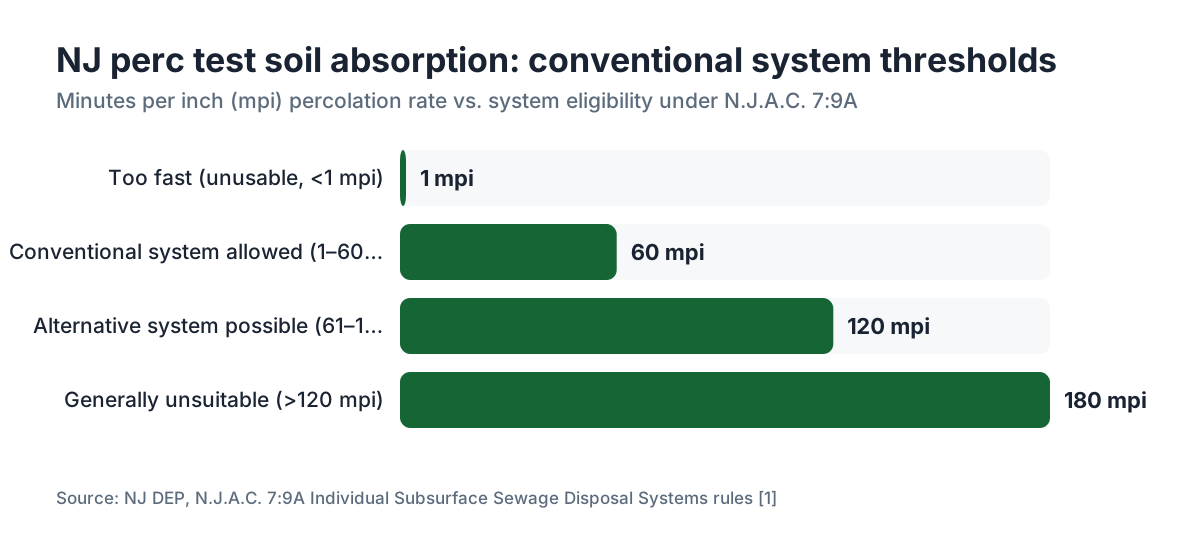
A conventional soil absorption system in New Jersey needs a percolation rate between 1 and 60 minutes per inch, and that number comes straight from N.J.A.C. 7:9A [1]. Faster than 1 mpi drains too quickly for real treatment. Slower than 60 mpi is too tight for a standard trench or bed.
Soil between 61 and 120 mpi may still work with a modified or alternative system, like a pressure-dosed design with a smaller application rate. The design rules get stricter and the cost climbs. Past 120 mpi, the site is generally unsuitable for any in-ground disposal on the standard code pathway.
Depth to a limiting layer counts as much as the perc rate. The code requires vertical separation (roughly 2 feet in Morris County's common geology, though site conditions and setbacks can force more) between the bottom of the disposal field and any limiting layer or seasonal high water table [1]. Ledge rock three feet down can sink a lot even when the perc rate looks great.
Here's a quick reference:
| Perc Rate (mpi) | System Type Typically Allowed |
|---|---|
| Less than 1 | Unsuitable (too fast) |
| 1 to 60 | Conventional trench or bed |
| 61 to 120 | Alternative/pressure-dosed (case-by-case) |
| Greater than 120 | Generally unsuitable |
These thresholds come from the New Jersey individual subsurface sewage disposal system rules [1].
What does a perc test cost in Morris County NJ?
Budget $800 to $2,500 for perc testing through design approval on a typical Morris County residential lot. Nobody publishes a clean statewide fee schedule, so the breakdown below comes from municipal permit fee schedules, contractor forums, and general industry ranges. Treat them as honest estimates, not quotes.
The municipal or county application fee usually runs $200 to $600, and it varies by town. Bedminster Township has historically charged in that range for septic applications, but fees move with municipal budgets, so confirm with your own town before you count on a number.
The site evaluator's fee for the soil borings and perc test typically runs $500 to $1,200 for a straightforward residential lot. Add $300 to $600 if the lot needs extra test pits because of variable soil or an earlier failure. When a licensed engineer (PE) does both the evaluation and the design, the combined fee for evaluation plus a full septic design can run $1,500 to $4,000 or more, depending on complexity.
Backhoe rental or contractor cost to dig the pits is sometimes folded into the evaluator's fee, sometimes billed separately at $300 to $700.
Complex lots with rock, high water, or a failed first test can push the total past $3,500. For scale, septic system installation costs in New Jersey typically run $15,000 to $40,000 or more for a new build, so testing is a small slice. It's still real money if the lot flunks.
When is the best time of year to schedule a perc test in Morris County?
Spring is the standard answer, and it's right for a technical reason. New Jersey's code wants testing to reflect worst-case soil, which means saturated soil. The spring thaw, roughly late March through early May in Morris County, creates those conditions on its own [2]. Health departments know the spring window well.
The catch is that everybody wants the same slots. Backhoe operators, site evaluators, and health department reviewers all get buried. Booking a spring test in January or February is not too early.
Fall tests, September into October, work fine in years with decent rainfall. Summer is the worst time technically, because dry soil drains faster and can pass a test that wet-season soil would fail. Some health officials flag a summer test for that reason or require a wet-season follow-up.
Don't try to test across frozen ground from December through February. You can't dig a proper pit in frozen soil, and most health departments won't accept winter results anyway.
What happens if your lot fails a perc test in Morris County?
A failed perc test is not automatically a dead lot, but it does cut your options down fast.
First, challenge the result. If you think the test hit an unrepresentative patch of the lot, you can ask for a re-test somewhere else on the property. It costs money (another backhoe, another evaluator visit, another application fee) and sometimes pays off on lots with patchy soil.
Second, go alternative. For soils in the 61 to 120 mpi range, New Jersey allows variance applications for technologies like mound systems, drip irrigation disposal, or pressure-dosed shallow systems [1][10]. The EPA's onsite systems guidance notes that alternative systems "can be designed for sites where conventional systems would not be appropriate" [3]. They cost more to install and usually require a maintenance contract, but they can make an unusable lot buildable.
Third, look at an advanced treatment unit (ATU). New Jersey has approved certain ATUs that pretreat wastewater to a higher standard before soil absorption, which allows a smaller or shallower disposal field. They need annual inspections and a maintenance agreement with a licensed operator.
Fourth, accept the limit. If you're buying, a failed perc test is grounds to renegotiate the price or walk. This is exactly why perc test contingencies belong in every land contract in septic country.
For an existing home that needs septic system repair instead of new construction, failing soil may mean the original system was undersized or the field is dying. A septic tank inspection can separate a field problem from a tank problem before you spend on expensive field work.
How do Morris County perc test rules compare to Somerset and Warren Counties?
All three counties run under N.J.A.C. 7:9A, so the technical standards, percolation thresholds, and design requirements are identical statewide [1]. The differences are all administrative.
Morris County is one of the more developed northern NJ counties, mixing suburban townships (Parsippany, Rockaway) with rural terrain (Chester, Mendham). Some Morris towns review applications in-house; others hand the work to the county's public health team. Turnaround swings from two weeks to two months by municipality.
Somerset County's health department, based in Somerville, runs a mostly centralized permit process [5]. Somerset has large areas of glacial till and Triassic shale that produce a real rate of slow-perc failures, especially around the Watchung ridges. Its spring backlog can match Morris County's.
Warren County, in the northwest corner, is more rural [6]. The Warren County Health Department processes fewer applications than Morris or Somerset, which can mean faster turnaround but fewer local evaluators available on short notice. The geology around the Kittatinny Ridge often gives you very shallow depth to bedrock, so the limiting-layer problem shows up more than slow perc.
In all three counties, building without an approved perc test and permit invites stop-work orders, fines, and possible forced removal of anything installed. The state DEP can also step in on a public health complaint [4].
What should you look for when hiring a site evaluator in Morris County?
New Jersey licenses site evaluators through the Department of Environmental Protection, and you can verify a license through the NJ DEP [4]. An unlicensed evaluator's results are invalid, full stop.
Past the license, ask about actual experience in Morris County and the geology of your specific area. Someone who mostly works the flat coastal plain of Burlington County knows the rules but may not have wrestled the glacial and metamorphic ground common in Morris County's hill towns.
Get a written scope before any work starts. It should spell out how many test pits, the saturation period, who hires the backhoe operator, who files the report, and what happens to the application fee if the lot fails. A clear contract heads off fights later.
Some evaluators also do the septic design under their PE license; others pass the design to a separate engineer. Either works, but one person doing both often shaves time off the permit cycle because there's no handoff between firms.
If you run a septic service and juggle permit applications across counties, tracking deadlines, inspection dates, and document submissions across different health departments gets messy fast. SepticMind is built to help operators manage that multi-job, multi-jurisdiction workflow without losing track of where each application stands.
How does a perc test connect to the full septic system permit process in New Jersey?
The perc test is one input into a bigger permit process under N.J.A.C. 7:9A. Here's how the pieces line up.
The site evaluation (which includes the perc test) produces a report that sets the maximum daily sewage flow the lot can handle. That number, paired with the proposed bedroom count or commercial use, decides what system is even possible.
Once the evaluation is approved, a licensed engineer produces a septic design. In New Jersey that design has to include the septic tank size, the disposal area dimensions and layout, every required setback from property lines, wells, buildings, and water features, and the soil absorption rate used in sizing [1]. The design goes back to the health department for a construction permit.
After construction, an inspection is required before backfilling. The installed system has to match the approved plans. The local health officer or the county health department handles that final look [2].
For an existing property selling by owner, a septic tank inspection is commonly required by lenders and sometimes by municipal ordinance. That inspection is different from a perc test: it checks the existing system's condition, not the soil's capacity. A septic tank pump out is usually part of that inspection.
Once the system is in the ground and approved, the job shifts to maintenance. New Jersey doesn't set a statewide pumping schedule by statute, but EPA guidance recommends pumping every three to five years for most households [3]. Regular septic tank pumping keeps solids from riding out to the leach field and stretches the field's life by years.
Can a perc test be transferred to a new property owner or reused for a different project?
This comes up in almost every land deal, and the answer has some nuance.
In New Jersey, an approved site evaluation is generally tied to the approved system design and the specific project it was approved for, more than to the parcel itself. Buy a lot with an existing approved evaluation and propose the same system in the same spot, and the local health department may accept it. Change the layout, add bedrooms, or bring in an approval old enough that officials question it, and you're likely looking at a fresh evaluation.
N.J.A.C. 7:9A doesn't write in a hard expiration date for site evaluations. Even so, many health departments treat approvals older than three to five years as needing confirmation or re-testing, especially if something has changed: new fill on the lot, altered drainage, or a shifting water table seen on neighboring parcels.
If you're a buyer doing due diligence, ask the health department directly whether an existing evaluation is still current and approvable. Don't take the seller's word for it.
What are the common reasons perc tests fail in Morris County's geology?
Morris County sits mostly on Precambrian gneiss and schist in the northern and western townships, Triassic red sandstone and shale through the center, and glacial till and outwash in the valleys [7]. Each brings its own failure mode.
Shallow bedrock is the top problem in the northern highlands: Harding, Chester, Long Hill, Mine Hill. The perc rate can be perfect, but you hit rock at 18 inches and can't get the required vertical separation to the limiting layer. No design trick fixes that without a variance and an engineered raised system.
Slow perc from clay-rich glacial till shows up in the valleys. The soil looks workable, but the fine particles pack into a slow-draining matrix. Readings of 80 to 150 mpi are common. This is the scenario where a mound or drip irrigation system might save the project.
Seasonal high water table failures hide well, because a June test in a dry year can look fine while the same hole in March sits in standing water. A good evaluator reads it from the soil itself: mottled gray and rust-colored patterns (gleying and oxidation) that mark seasonal saturation, more than the water level in the hole that day [1][10].
Fill over native soil trips up old farm properties and lots where past construction shoved material around. Testing through fill to native soil takes deeper pits and a sharper evaluator.
Frequently asked questions
How long does a perc test take in Morris County NJ?
The on-site testing takes one to two days because the soil has to pre-saturate for at least 24 hours before the timed reading. Add two to six weeks for the health department's review and approval. Counting from application to construction permit, four to twelve weeks is realistic, depending on the municipality's backlog and whether extra test pits get requested.
How much does a perc test cost in Morris County NJ?
Total cost including the municipal application fee, site evaluator, and backhoe typically runs $800 to $2,500 for a straightforward residential lot. Application fees alone range from $200 to $600 by municipality. Lots needing extra test pits, re-tests, or alternative system design work can push totals past $3,500. Get an itemized quote from the site evaluator before you sign anything.
Do I need a perc test to sell my house in Morris County?
Not for a standard sale of a home with an existing, working septic system. A perc test is for new systems or major changes. Most buyers' lenders do require a septic inspection before closing, and many municipalities have inspection ordinances triggered by sale. That inspection checks the current system's condition. If the system is failing and needs replacement, that's when soil testing can re-enter the picture.
What is the difference between a perc test and a soil evaluation?
A soil evaluation reads the soil profile in test pits: texture, structure, color, depth to limiting layers, and signs of seasonal saturation. A percolation test is the timed water-absorption measurement. In New Jersey, both are required inside the site evaluation process under N.J.A.C. 7:9A. The soil evaluation often tells you more than the perc rate alone, especially about limiting layers and the seasonal water table.
Can I do a perc test myself on my own land in New Jersey?
No. New Jersey requires a licensed site evaluator to run and certify the test under N.J.A.C. 7:9A. Self-performed tests are not accepted by any county health department in the state. Some homeowners dig their own preliminary holes to get a rough read before paying for a formal evaluation, but that has no official standing and can't substitute for the licensed evaluator's report.
What happens if my perc test fails and I've already bought the land?
You have three practical paths: request a re-test in a different spot on the lot (soil sometimes varies enough to find a passing area), apply for a variance to use an alternative system like a mound or drip-irrigation field, or accept that the lot is unbuildable for septic and check whether a public sewer extension is feasible. Always put a perc test contingency in a vacant land purchase contract for exactly this reason.
Are perc test rules the same in Somerset County and Warren County NJ?
Yes, technically. All three counties operate under NJ state code N.J.A.C. 7:9A, so the percolation thresholds, soil evaluation requirements, and design standards are identical statewide. The differences are administrative: which health department you submit to, application fees (which vary by municipality), and review turnaround times. Geology varies a lot, so failure rates and common system types differ by region.
How many bedrooms does a septic system need to support, and does that affect the perc test?
The perc test doesn't change with bedroom count, but the system size does. New Jersey's design rules allocate 110 gallons per day per bedroom for design flow. More bedrooms mean a larger disposal field to handle that flow at the tested percolation rate. If your lot has marginally passing soil, adding bedrooms later can require going back for an expanded system permit and possibly more soil testing.
How do I find a licensed site evaluator in Morris County NJ?
The NJ DEP maintains a license lookup for site evaluators. You can also ask your municipal health officer for a list of evaluators who regularly work your township; they know who files clean reports and who creates review headaches. Real estate attorneys handling rural Morris County deals often have referrals too. Verify the license before any work starts.
What is a mound system and when is it used after a failed perc test?
A mound system puts the disposal field above the native soil surface in an engineered fill mound. It's used when native soil percolates too slowly (typically 61 to 120 mpi) or when depth to a limiting layer is too shallow for a conventional buried field. Mound systems cost more to install, typically $20,000 to $40,000 or more in New Jersey, and need periodic inspection. They're a real fix for marginal lots, not a last resort, but they need enough lot area and setback room.
Does adding a bedroom to a Morris County home require a new perc test?
Adding a bedroom raises your design sewage flow under N.J.A.C. 7:9A and triggers a septic review permit. Whether you need a new perc test depends on whether the existing disposal field can carry the extra load at the previously tested percolation rate. The health department reviews your existing permit file. If the approved field has enough reserve capacity, you may skip re-testing. If it doesn't, a new soil evaluation is required before the addition can be permitted.
How long is a perc test approval valid in New Jersey?
N.J.A.C. 7:9A sets no fixed expiration on site evaluation approvals, but health departments commonly treat approvals older than three to five years with skepticism, especially if site conditions may have changed. In practice, an approved site evaluation tied to an active construction permit stays valid through that permit's life. On unbuilt lots where the approval is several years old, have the local health department confirm acceptance before you spend money on design.
What setbacks does my septic system need to meet in Morris County?
New Jersey's N.J.A.C. 7:9A sets minimum setbacks that all Morris County systems must meet: typically 50 feet from a potable well, 10 feet from property lines, 25 feet from surface water, and 10 feet from the building foundation, among others. Site-specific conditions, local ordinances, and system type can all force greater distances. Your site evaluator and engineer map these setbacks in the design, and the health department checks compliance before issuing the construction permit.
Sources
- New Jersey DEP, Standards for Individual Subsurface Sewage Disposal Systems (N.J.A.C. 7:9A): New Jersey state code governing perc tests, percolation rate thresholds (1 to 60 mpi conventional), site evaluation, setbacks, and septic system design
- Morris County NJ, Department of Human Services Division of Public Health Services: Morris County public health administration of onsite sewage permitting and inspections
- US EPA, SepticSmart / Onsite Wastewater program: EPA recommends pumping septic tanks every three to five years and notes that alternative systems can be designed for sites where conventional systems would not be appropriate
- New Jersey DEP: NJ DEP licensing and enforcement authority over site evaluators and septic system violations; license verification
- Somerset County NJ, Department of Health: Somerset County Health Department administers septic permitting under N.J.A.C. 7:9A for perc tests in Somerset County NJ
- Warren County NJ, Health Department: Warren County Health Department oversees onsite sewage permitting and perc tests in Warren County NJ
- USDA Natural Resources Conservation Service, Web Soil Survey: Soil type mapping for Morris County NJ showing distribution of glacial till, Triassic shale, and Precambrian gneiss affecting percolation test outcomes
- US EPA, Onsite Wastewater Treatment Systems Manual (EPA/625/R-00/008): EPA technical manual describing percolation test methodology, soil morphology indicators of seasonal high water table, and alternative system design criteria
Last updated 2026-07-09