Perc testing in Newtown Square, PA: what to expect and what it costs
By the SepticMind Editorial Team

TL;DR
- A perc test in Newtown Square, PA measures how fast soil absorbs water, which decides whether you can install a septic system and what type.
- A Delaware County Sewage Enforcement Officer witnesses and signs off.
- Expect to pay $300 to $800 for the test alone, wait four to eight weeks for scheduling, and plan for a mound or engineered system if your soil drains too slow.
What is a perc test and why does Newtown Square require one?
A percolation test, almost always called a perc test, measures how fast water moves through soil. You dig test holes, fill them with water, and time the drop. That rate, in minutes per inch, tells a septic designer how big a drain field has to be and whether a conventional leach field will work on your lot at all.
Newtown Square straddles Newtown Township and Edgmont Township, both in Delaware County, Pennsylvania. Pennsylvania's Sewage Facilities Act (Act 537 of 1966, 35 P.S. §§ 750.1 et seq.) requires a perc test and soil evaluation before any new on-lot sewage system gets a permit. [6] There are no local exceptions. Build a new home, subdivide a lot, or replace a failed system, and the test is mandatory.
The result also shapes everything downstream. A rate between 1 and 60 minutes per inch makes you eligible for a standard gravity-fed system. Land outside that band and you need an engineered alternative, which costs a lot more. The perc test isn't a formality. It's the technical foundation for every decision that follows.
Who administers perc tests in Newtown Square, PA?
Pennsylvania hands sewage permitting to local Sewage Enforcement Officers, called SEOs. Every municipality has to appoint a certified SEO under Act 537. [6] In the Newtown Square area, you'll work with the SEO for Newtown Township or Edgmont Township depending on which side of the line your property falls on. Some smaller townships contract out to a regional SEO or to Delaware County directly.
The SEO has to be present during the official soil evaluation and perc test. You can hire a private soil scientist or licensed engineer to run the work and write the report, but the SEO must witness and sign the results for them to count toward a permit. That two-person requirement is where the schedule jams up. The SEO sets the appointment window, and a busy summer in Delaware County can push your test date back four to eight weeks.
Not sure which municipality covers your parcel? The Delaware County GIS parcel viewer confirms your township boundary in about two minutes. [7] Get that right before you call anyone. It saves real time.
What does a perc test in Newtown Square actually involve?
Pennsylvania runs a two-part process: a soil profile evaluation and a percolation test. They usually happen the same day, but they're separate requirements. [2]
First comes the soil profile pit. A backhoe or hand tools open a pit, typically 48 to 84 inches deep, so the evaluator can log soil texture, color, mottling, and the seasonal high water table. Mottling is those grayish or rust-colored streaks in the soil, and it marks where groundwater sits during wet months. Pennsylvania treats that depth as a limiting factor for where a drain field can go.
Then come the perc holes. Usually six or more, 6 to 8 inches wide and 24 inches deep, spread across the proposed drain field. Each hole gets pre-soaked the day before, or for at least 4 hours before the timed test. During the test, water gets added to a set level and the drop is measured every 30 minutes over a 4-hour window. The slowest steady rate from the final 60 minutes is the number that lands on your permit application.
On a typical half-acre lot in Newtown Square, the field evaluation and perc test run 4 to 6 hours of on-site time. Add the pre-soaking the day before and you're really looking at two days in the field.
Pennsylvania's Chapter 73 regulations (25 Pa. Code Chapter 73) spell out exactly how the measurements get taken and what rates pass. [2] The engineer or soil scientist you hire should be working to those standards, not some generic national protocol.
What are the passing and failing perc rates for a Delaware County property?
Chapter 73 sets the acceptable range for standard on-lot systems at 1 to 60 minutes per inch (MPI). [2] Soil faster than 1 MPI is too coarse, so effluent moves through before it gets biological treatment and can carry contamination toward groundwater. Soil slower than 60 MPI can't move the water a normal household produces.
Newtown Square sits in the Philadelphia Main Line, on soils weathered from Wissahickon schist. Those run to silty loams and clay loams in the uplands, which often test 30 to 60 MPI. Lower ground near Ridley Creek State Park carries more clay and routinely tests at or near the upper limit. Neither result is unusual here.
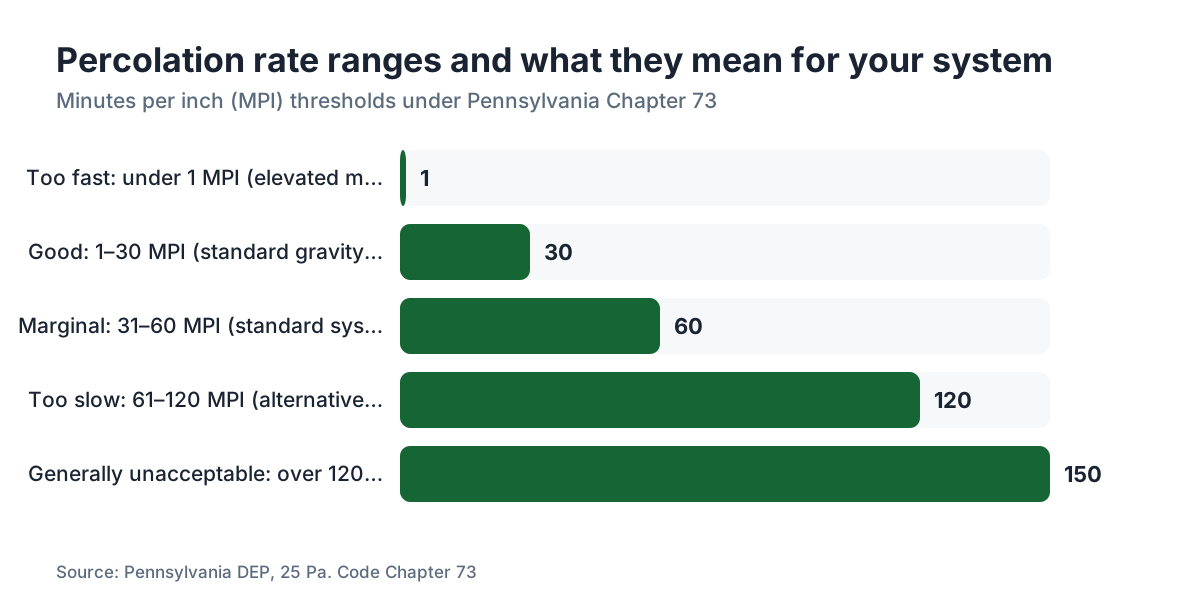
Here's what the rate bands mean in plain terms:
| Perc Rate (MPI) | Classification | Typical System Type |
|---|---|---|
| Less than 1 | Too fast (drainfield not allowed) | Elevated mound or advanced treatment |
| 1 to 30 | Good | Standard gravity trench system |
| 31 to 60 | Marginal | Standard system, larger sizing required |
| 61 to 120 | Too slow for standard | Drip irrigation or elevated mound with modification |
| Greater than 120 | Generally unacceptable | Engineered alternative or public sewer connection |
A result between 61 and 120 MPI isn't a dead end. Pennsylvania allows alternative systems under Chapter 73 when a conventional design can't work. [2] Those cost more upfront, but they keep the property buildable.
How much does a perc test cost in Newtown Square?
The honest answer is $300 to $800 for the perc test and soil evaluation together, depending on lot size, how many test holes are required, and whether you hire the SEO directly or use a private soil scientist who coordinates with the SEO. [3]
That range breaks down roughly like this. The SEO's inspection fee, set by the municipality, usually runs $150 to $350. The soil evaluation from a private certified soil scientist or professional engineer adds another $200 to $500. Larger lots or messy soil profiles cost more, because the engineer is logging multiple horizon depths across a wider test area.
Then there are the indirect costs. The backhoe rental or excavation contractor to open the soil pit runs $200 to $500 in Delaware County. Pre-soaking needs a water source, so an undeveloped lot with no well may need a water truck, which adds time and logistics.
If your test leads to a permit application, the sewage permit fee in Pennsylvania municipalities usually runs $100 to $300 on top of everything. Fail and need an engineered alternative, and the redesign plus extra soil work can add $1,000 to $3,000 before you buy a single piece of hardware.
For a realistic budget on a vacant lot in the Newtown Square area, plan on $800 to $1,500 total from first perc test through permit issuance for a clean, passing result.
How long does the perc test process take in Delaware County?
The physical test takes one to two days. The waiting is where the time actually goes.
Booking an SEO appointment in Delaware County during spring and summer, the busy permit season, can take four to eight weeks. Some townships share a single contracted SEO across dozens of municipalities, so availability is genuinely tight. Submit in late September and you may move faster.
Once the test is done and the SEO signs off, the municipality has 60 days under Pennsylvania law to issue the sewage permit, and most issue it faster than that. [6] Then you still need a building permit before construction starts. That's a separate process.
A realistic total from first call to permit in hand runs 8 to 16 weeks in this area when nothing goes sideways. Add another 4 to 8 weeks if you fail and have to submit an alternative system design. People underestimate this every time, then get blindsided when a closing date or construction start slips.
What happens if your property fails the perc test?
Failing doesn't mean you can't build. It means a standard gravity leach field is off the table, and you need an engineered alternative approved under Chapter 73. [2]
The most common alternative in the Newtown Square area for slow-perc soils is the elevated sand mound. A mound raises the drain field above the natural soil surface to create enough separation from the seasonal high water table. Mound systems in southeastern Pennsylvania typically cost $15,000 to $30,000 installed, against $8,000 to $18,000 for a standard gravity system. [3]
Other options include drip-dose systems, spray irrigation, and constructed wetlands, all of which need Pennsylvania DEP approval as nonstandard designs. These are uncommon on single-family lots but do get installed when a mound won't fit because of slope or space.
Here's one thing people miss. A failing result is a reason to look again at where you tested. If you have the land, the SEO can evaluate a different spot on the parcel. Soil profiles change more across a half-acre than most people expect. A qualified soil scientist, more than your contractor, is the right person to say whether a second test location is worth it.
If the whole parcel genuinely can't support any on-lot system, the property either connects to public sewer (Delaware County has active sewer extension programs in some townships) or it can't legally support a house. That last outcome is rare, but it happens, and it's exactly why you get a perc test before you close on raw land. You can also read our leach field design guide to understand what the footprint of an alternative means for your lot.
Do you need a perc test for an existing home in Newtown Square?
No, not if you're buying an existing home already on a working septic system, unless the system is being replaced or expanded. What you need for a real estate deal is a septic system inspection instead. That's a different job: a licensed inspector pumps and inspects the tank, checks the distribution box, probes the drain field, and hands you a written report on condition.
Pennsylvania has no mandatory statewide septic inspection for home sales. Plenty of lenders and buyers require one anyway, and some Delaware County municipalities require point-of-sale inspections by local ordinance. Check with the township directly. A septic tank inspection before closing is cheap money next to what a replacement costs.
A perc test does come back if your existing system fails and the drain field needs replacing. At that point you're applying for a new sewage permit, and the SEO will want current soil data. If the original perc test was done decades ago, they may require a fresh one rather than lean on old records, especially if drainage or water table conditions on the property have changed since.
How do you find a qualified soil scientist or engineer for perc testing near Newtown Square?
Pennsylvania requires soil profile evaluations be run by a Certified Soil Scientist (CSS) or a licensed Professional Engineer (PE) trained in soil evaluation. The Sewage Enforcement Officer then witnesses and validates the findings. [6]
The Pennsylvania Association of Professional Soil Scientists keeps a directory of certified members and is the fastest route to someone with the right credentials working in Delaware County. Many firms that do perc testing here also handle system design, which saves a hand-off later.
When you call around, ask one question first: do they regularly work with the SEO in your township? A soil scientist who has done dozens of tests with that same officer runs a smoother process than someone who doesn't know that officer's expectations or scheduling habits. Ask what their SEO coordination timeline looks like right now, not in general.
Get at least two quotes. Prices in Delaware County vary enough that a single call leaves money on the table. And ask what they'll do if your test comes back marginal: will they advise on a second test location, or hand you a failing report and walk? That follow-through is the difference between a buildable lot and a wasted deposit.
Operators in this area juggling multiple permit workflows can use SepticMind to track which sites are in the perc-test queue, which SEO approvals are pending, and the next action on each parcel without losing anything in a spreadsheet.
What should you do before the perc test to improve your chances?
The perc test measures what's already there. You can't change your soil. But you can avoid a false fail or a wasted trip.
Get the pre-soaking right. Pre-soaking the holes 24 hours before the test is required under Pennsylvania's protocol, and it's where homeowners cut corners when coordinating with contractors. Soil that isn't fully pre-saturated tests faster than its true long-term absorption rate, which can work against you when the evaluator compares your number to the thresholds. [8]
Time it around the weather. Saturated soils test dramatically slower than normal, and dry soils test faster. Pennsylvania's protocol calls for testing at normal seasonal moisture, not right after a big storm or deep into a drought. Your soil scientist should raise this. If they don't, ask.
Clear the test area. Pull debris, fill material, or compacted soil from old construction or landscaping out of the proposed drain field. Compacted surfaces throw off infiltration rates. The test is supposed to read natural, undisturbed soil.
Have your site plan ready. The SEO needs to know where the drain field, tank, and setbacks from wells, property lines, and structures will go before approving the test location. Show up with a rough site sketch. It saves time and sometimes a return trip.
Think about the full install cost early. If the test passes, you'll want to move fast on design and permit before prices or contractor availability shift. Read cost to install a septic system and cost to put in a septic tank before you take bids so you know what's fair.
How does a perc test connect to the full septic system permit in Pennsylvania?
The perc test is step one of a multi-step permit process under Act 537. [6] After the test, here's the order it runs:
- Soil evaluation and perc test completed, SEO witnessing.
- Permit application submitted to the municipality with a site plan, system design, and perc results.
- Municipality reviews and issues or denies the sewage permit within 60 days.
- Building permit issued by the township (separate process).
- System installed by a licensed septic installer.
- SEO inspects the installation before it's covered.
- Final certificate of completion issued.
Proper siting based on soil is the whole game. The EPA's SepticSmart guidance puts it plainly: "the performance of a septic system depends heavily on the site's soil conditions." [4]
Rush or skip a step and it shows up later, usually as a leach field failure within 5 to 10 years because the system was undersized or sited on the wrong soil. Operators managing permit documentation for multiple installs in Delaware County can use SepticMind's workflow tools to track each step from perc test through final sign-off without documents falling through the cracks.
Once a system is in, the work shifts to keeping it alive: septic tank pumping every 3 to 5 years and periodic septic tank inspection to catch trouble before it reaches the drain field. [10]
Are there any Newtown Square-specific issues that affect perc test results?
A few local factors show up again and again in Delaware County perc evaluations. Know them before you test.
The geology under Newtown Square is mostly Wissahickon Formation metamorphic rock, which weathers into silty, often micaceous soils. They can look workable at the surface and still hide high clay content in the B horizon, the layer where a drain field actually discharges. That clay layer is a common reason for MPI results in the 50 to 90 range, right at or past the conventional limit. [5]
Seasonal high water tables in the flat ground near Crum Creek and Ridley Creek tributaries are the other big one. Mottling often shows up at 18 to 30 inches in those areas, which caps how deep a drain field can go and sometimes forces a mound system even when the perc rate itself would pass.
If your lot was previously filled, common on older graded residential parcels, the fill may not count as natural soil for perc testing. The SEO reads the profile pit for evidence of fill. Fill soil above natural grade doesn't count toward your drain field depth.
One more thing. Parts of Newtown Square have public sewer available. If your property sits inside a sewer service area, Act 537 may require connection to public sewer instead of a new on-lot system, no matter what your perc test shows. [7] Confirming your sewer availability with the township before you spend a dollar on a perc test is a legitimate first move.
Frequently asked questions
How much does a perc test cost in Newtown Square, PA?
Expect $300 to $800 for the soil evaluation and perc test combined in the Newtown Square area, plus $200 to $500 for the backhoe work to open the soil profile pit. The SEO's inspection fee, paid to the municipality, usually runs $150 to $350. Total from first test through sewage permit issuance typically lands at $800 to $1,500 when everything passes the first time.
How long does a perc test take to schedule in Delaware County?
The test itself takes one to two days of field work. Scheduling an SEO appointment in Delaware County takes four to eight weeks during the busy spring and summer season. From first contact to a signed sewage permit in hand, plan on 8 to 16 weeks in the Newtown Square area when nothing goes wrong and the test passes.
What perc rate do you need to pass in Pennsylvania?
Pennsylvania Chapter 73 requires a percolation rate between 1 and 60 minutes per inch for a standard gravity-fed septic system. Faster than 1 MPI means the soil is too coarse; slower than 60 MPI means it doesn't drain well enough. Results between 61 and 120 MPI may still allow an alternative system design. Anything above 120 MPI is generally unacceptable for any on-lot system.
Who performs perc tests in Newtown Township and Edgmont Township?
A Pennsylvania-certified Sewage Enforcement Officer (SEO) must witness and approve any perc test used for a permit application. Each municipality appoints or contracts an SEO under Act 537. You'll typically hire a private certified soil scientist to run the evaluation, and the SEO attends to validate results. Contact your township office directly to identify the current SEO and their scheduling process.
Can you build a house on a lot that fails a perc test?
Sometimes. A failed perc test closes the door on a conventional gravity drain field but not necessarily on building. Pennsylvania allows alternative systems including elevated sand mounds, drip-dose systems, and spray irrigation under Chapter 73. If the entire parcel can't support any on-lot system and public sewer isn't available, the lot cannot legally support a dwelling, but that outcome is rare.
Do you need a perc test to buy a house that already has a septic system?
No. A new perc test isn't required when buying a home with an existing working septic system. What you should get is a professional septic inspection before closing. A perc test only becomes necessary again if the existing system fails and the drain field needs replacement, which triggers a new sewage permit application under Pennsylvania's Act 537.
What is the difference between a perc test and a soil evaluation in Pennsylvania?
They're two related but separate steps. The soil evaluation involves digging a profile pit and logging soil characteristics including texture, structure, color, mottling, and the seasonal high water table depth. The perc test measures the actual water absorption rate in test holes. Pennsylvania requires both under Chapter 73. A soil evaluation can disqualify a site for drainage reasons even if the perc rate itself would pass.
How deep does the seasonal high water table need to be for a septic system in PA?
Pennsylvania Chapter 73 requires a minimum separation of 24 inches between the bottom of the drain field and the seasonal high water table for a standard gravity system. That separation is read from soil mottling patterns in the profile pit during the soil evaluation. If seasonal high water sits too shallow, a raised mound system or other alternative may be required regardless of the perc rate.
Can you do a perc test in winter in Delaware County?
Technically yes, but frozen or snow-covered ground can block a proper soil profile evaluation and mess with pre-soaking. Most SEOs in southeastern Pennsylvania discourage winter testing because frozen soils don't reflect natural drainage. Spring, after soils thaw but before the summer scheduling backlog builds, is usually the best window in Delaware County for a timely appointment and reliable results.
What happens after the perc test passes in Newtown Square?
After a passing perc test, a licensed engineer or soil scientist prepares a system design and site plan. You submit that with your permit application to the municipality. The SEO reviews it, and the municipality has 60 days under Pennsylvania law to issue a sewage permit. Then you get your building permit, hire a licensed installer, and schedule an SEO inspection before the system is backfilled.
How much does a mound system cost in Pennsylvania if you fail the perc test?
An elevated sand mound system in southeastern Pennsylvania typically costs $15,000 to $30,000 installed, against $8,000 to $18,000 for a standard gravity system. The range depends on lot size, required mound volume, and equipment access. You'll also pay for additional engineering and permit fees on top of the original perc test cost.
Is a perc test the same as a perk test?
Yes, same thing. Percolation test gets shortened to perc or perk depending on who's writing. Both spellings show up in common use, and you'll see both in contractor quotes and online. Pennsylvania's regulations use 'percolation test' formally in Chapter 73, but every practitioner in the field reads perc or perk as the same measurement.
Do perc test results expire in Pennsylvania?
Pennsylvania doesn't set a single statewide expiration for perc test results, but SEOs and municipalities can require new testing if results are old or site conditions have changed. In practice, results more than 5 to 10 years old often get questioned, especially if grading, drainage, or land use on the parcel has changed since the original test.
Sources
- Pennsylvania DEP, 25 Pa. Code Chapter 73, Standards for Sewage Disposal Facilities: Chapter 73 defines acceptable percolation rates of 1 to 60 minutes per inch for standard systems, specifies pre-soaking requirements, and establishes 24-inch minimum separation from seasonal high water table.
- Penn State Extension, On-Lot Sewage Program: Typical perc test and soil evaluation costs range from $300 to $800 in Pennsylvania; mound system installations range from $15,000 to $30,000.
- U.S. EPA, SepticSmart Program: EPA SepticSmart states 'the performance of a septic system depends heavily on the site's soil conditions'; proper siting based on soil evaluation is foundational to long-term system function.
- USDA Natural Resources Conservation Service, Web Soil Survey, Delaware County PA: The Newtown Square area is dominated by Wissahickon Formation-derived soils with silty loam and clay loam B horizons that commonly produce percolation rates near or above 60 MPI.
- Pennsylvania DEP, Sewage Facilities Act (Act 537) Program: Municipalities must appoint a certified Sewage Enforcement Officer and have 60 days under Act 537 to issue or deny a sewage permit after a complete application is submitted.
- Delaware County, Pennsylvania, County Government and GIS Services: Delaware County provides a GIS parcel viewer for confirming township boundaries and oversees Act 537 planning; sewer service area designations affect permit eligibility in Newtown and Edgmont Townships.
- Penn State Extension, Percolation Testing for On-Lot Sewage Systems: Pre-soaking for at least 24 hours before the timed perc test is required to accurately measure long-term soil absorption rates; inadequate pre-soaking skews results.
- U.S. EPA, Septic System Owner's Guide: EPA recommends septic systems be pumped every 3 to 5 years and professionally inspected to prevent drain field failure from accumulated solids.
Last updated 2026-07-10