Perc testing land: what it is, how it works, and what it costs
By the SepticMind Editorial Team
TL;DR
- A percolation (perc) test measures how fast water drains through soil, which tells you whether land can support a septic drain field.
- Most counties require one before they issue a septic permit.
- Tests cost $150 to $1,500 depending on location and soil.
- A failed standard test doesn't always kill the project.
- Alternative systems often work on land that percs poorly.
What is a perc test and why does land need one?
A perc test, short for percolation test, measures how fast water soaks into the soil at one spot on a property. That number tells engineers and regulators whether the ground can take wastewater from a septic drain field and treat it without pooling on the surface or fouling groundwater. No acceptable result, no septic permit. No septic permit, no house or plumbed structure on land that isn't hooked to a public sewer.
The test has been around in some form since the 1940s. The methods got more careful over time, but the logic never changed. Soil that drains too slowly can't handle effluent. Soil that drains too fast pushes wastewater toward groundwater before bacteria can treat it. Both extremes fail.
Buying raw land? Rural property? Planning anything with a bathroom on ground the sewer doesn't reach? Perc testing is one of the first due-diligence moves, right next to a survey and a title search. Plenty of people learn that the hard way, after they've closed.
How does a perc test actually work?
The test runs in a few phases. The exact procedure shifts by state and county, but the shape of it holds everywhere.
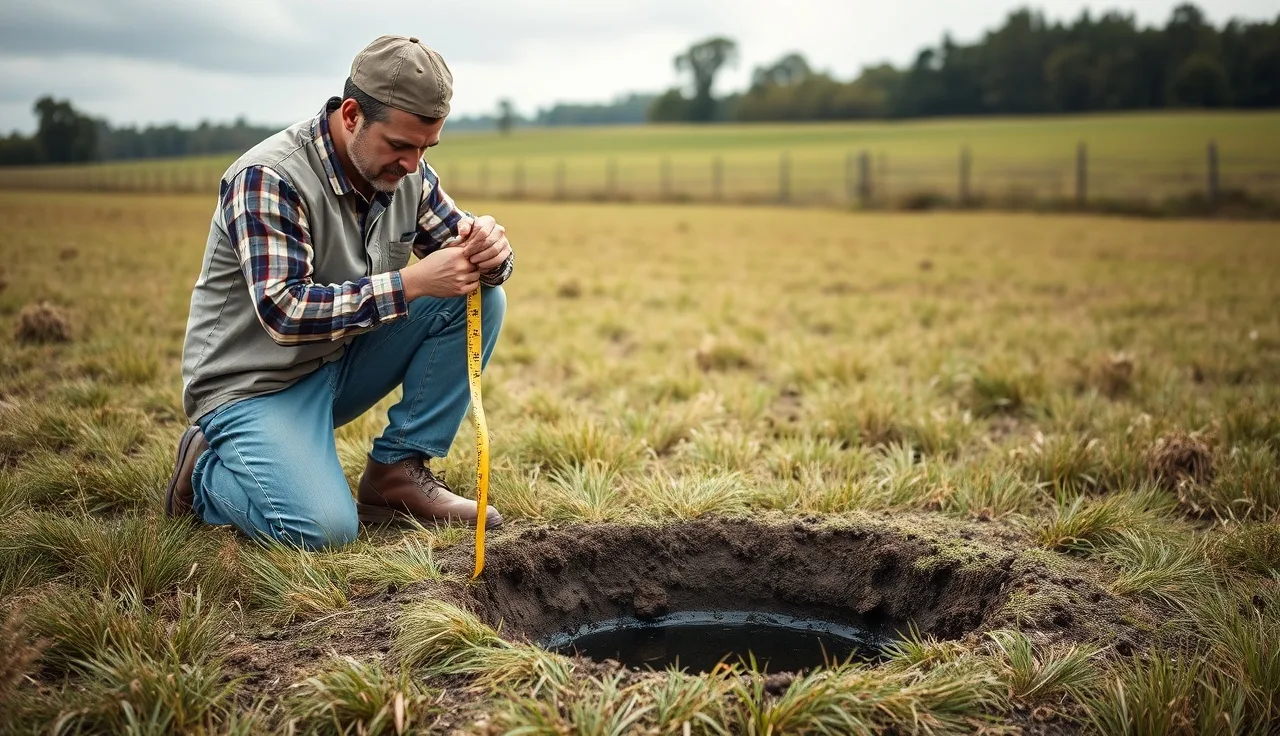
First, a site evaluator (usually a licensed soil scientist, engineer, or sanitarian) digs or bores test holes where the drain field would go. Depth varies. Twelve to 24 inches is common for standard perc holes, and some jurisdictions want deeper borings to read the full soil profile [1]. Local rules set the count. Many counties require at least three.
Then comes pre-saturation. The holes get filled with water and left to soak, usually 12 to 24 hours, sometimes as little as 4 hours in sandy soil. This soaks the ground to the state it would see in wet season or under heavy use. Skip this step and you get a result that looks great and lies.
Now the timing starts. Water goes into the hole to a set depth, usually about 6 inches, and the evaluator measures how far the level drops over a fixed interval, often 30 minutes. The result reads in minutes per inch (MPI): how long the water takes to fall one inch. A reading of 60 MPI means one inch takes an hour to soak away. Faster is better, up to a point.
Most jurisdictions publish acceptable ranges. Perc rates between 1 and 60 MPI pass for a conventional drain field in a lot of codes [2]. Under 1 MPI (sandy or gravelly soil that drains almost instantly) may need special design or pretreatment. Over 60 MPI usually means clay-heavy or compacted soil that won't drain. Some states cap it at 30 MPI. Check your county code, because the number that matters is the one your county uses.
What does a soil profile evaluation add to the perc test?
A soil profile evaluation reads what the soil does over a whole year, more than what it does the day you test it. That's the piece a perc rate alone misses. Many states have moved past perc-only for exactly this reason.
A soil morphology evaluation (also called a soil profile or pedon evaluation) examines a cut or boring for texture, structure, color, and signs of seasonal saturation. Evaluators look for mottling (blotchy gray or reddish discoloration that flags periodic waterlogging), clay content, rock layers, and the depth to the seasonal high water table [3].
Here's why it matters. A perc test tells you how fast water moves today, under test conditions. A soil profile tells you how the ground behaves in April when the water table is high. A site can perc fine in August and still drown a drain field every spring.
Some states, Virginia and North Carolina among them, now treat soil morphology as the primary tool and perc as backup. The EPA's Onsite Wastewater Treatment Systems Manual notes that "soil morphology is a better predictor of long-term system performance than percolation rate alone" [4]. If your state still leans on perc alone, that's not automatically wrong, but know what it can't see.
For sloped sites, rocky ground, or lots where the drain field area is tight, a full soil scientist evaluation is money well spent even when nobody makes you get one.
Who can perform a perc test, and do you need to be there?
Who can legally run a perc test depends entirely on your state and county. In many places the county sanitarian or health department has to witness or conduct it. In others, a licensed professional (usually a soil scientist, professional engineer, or registered sanitarian) runs the test and files the results for county approval [5].
Some places want both. The professional does the work, the county official watches. That creates scheduling headaches, especially in rural counties running short on staff. Waiting weeks for a test date is common.
You don't always have to be there in person. If the seller is arranging the test on land you're buying, the county and the tester can handle it without you. Still, showing up helps. You see the holes, the soil profile, and the tester's reactions in real time, which tells you more than a one-page report ever will.
Never hire anyone who claims they can run an official perc test with no county involvement at all. That's a red flag, and whatever numbers they hand you won't hold up for permitting.
What do perc test results actually mean for your land?
The result, in minutes per inch, feeds straight into the septic system design, mostly the drain field size and type. States publish loading rate tables that turn MPI into required square footage of drain field per bedroom or per gallon of daily flow [6].
Here's the rough map from percolation rate to outcome:
| Perc Rate (MPI) | Soil Type | Typical Outcome |
|---|---|---|
| Under 1 | Very coarse sand, gravel | May need pretreatment or engineered fill |
| 1 to 30 | Sandy loam, loam | Standard drain field, smaller footprint |
| 31 to 60 | Silt loam, some clays | Standard drain field, larger footprint |
| 61 to 120 | Heavy clay | May qualify for alternative system only |
| Over 120 | Dense clay, hardpan | Typically fails conventional; may fail alternative |
A faster perc rate usually means a smaller drain field and a lower per-gallon build cost. A slower rate means a bigger field or a more complex system. This drives the permit and the total cost to install a septic system.
A hard fail doesn't make the property worthless. It means a conventional gravity-fed drain field won't work there. Between a conventional field and nothing sits a spectrum of alternatives: mound systems, drip irrigation, aerobic treatment units, all built to run on land that percs poorly [7]. They cost more. Sometimes a lot more.
How much does a perc test cost?
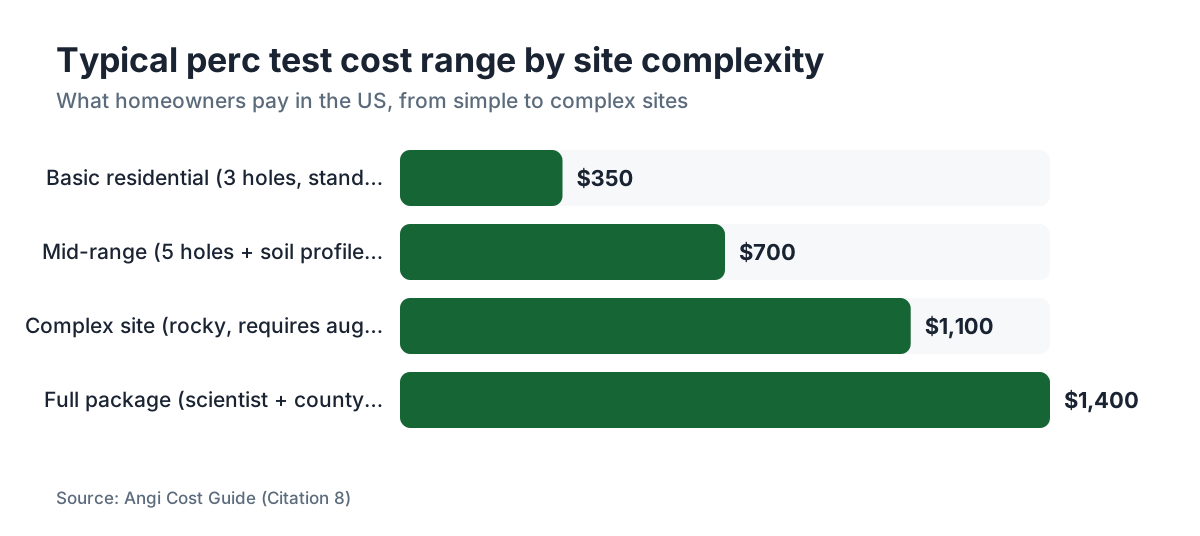
Perc test prices are all over the map. The range you'll see quoted most often is $150 to $1,500, with most standard residential tests landing between $300 and $800 [8]. Here's what moves the number.
Location. Urban counties with a competitive testing market run cheap. Rural counties, especially states that want a licensed soil scientist plus a county witness, run high because you're paying for travel time and scheduling.
Hole count. More holes mean more digging and more billable time. A simple lot might need three. A rough site might need a dozen.
Equipment. A post hole digger by hand is cheapest. Rocky or compacted soil may force a mechanized auger or a backhoe, and rental cost lands on your invoice.
Add-ons. Many companies bundle the perc test with a full site evaluation, soil borings, and a written report. That package runs $700 to $1,200 and gives you far more than a bare perc number.
County fees. Some counties charge $50 to $200 to witness or review the test, on top of the professional's bill.
One thing to keep in mind. If your offer is contingent on a passing perc test, the test fee is trivial next to the risk of buying land you can't build on. Don't skip it to save $400.
When is a perc test required and when can you skip it?
You need a perc test (or an equivalent site evaluation) any time you apply for a new on-site septic permit. That covers buying raw land to build on, adding a structure that generates wastewater, replacing a failed system in some counties, and subdividing land into lots that each need their own system.
You generally skip it if you're connecting to an existing public sewer, if the property already has a permitted septic system and you're not expanding it, or if you're doing repairs that don't trigger a new permit (swapping out a septic tank or a pump).
Some counties honor older perc results, usually if the test ran within the last 5 to 10 years and nobody disturbed the site. Others want a fresh test no matter how recent the old one is. Ask your county health department before you assume an old record transfers.
Timing matters too. Most jurisdictions want perc tests done in a set seasonal window, usually late fall through early spring when the soil sits near its wettest. Tests run in a drought overstate drainage. If a seller's perc test happened in August of a dry year, flag it.
What happens if land fails a perc test?
A failed perc test isn't the end of the line, but it changes the project. Here's the order I'd work through it.
First, confirm the failure is real and not a testing error. Overly dry conditions, disturbed soil, or sloppy pre-saturation all produce misleadingly bad results. If the county ran the test and you have doubts, you usually have the right to hire a private licensed soil scientist for an independent evaluation [5].
Second, find out whether alternatives are permitted in your county. Many allow mound systems, drip irrigation fields, aerobic treatment units, or other engineered options when the soil won't support a conventional field [7]. The EPA's SepticSmart program says alternative systems can provide effective treatment in challenging soil conditions [9].
Third, consider a different spot on the same parcel. Soil changes over short distances. Moving the proposed drain field 50 feet is sometimes the whole difference between a pass and a fail.
Fourth, if nothing works, your options narrow to connecting to a municipal sewer (if one's reachable and feasible), selling the land without expecting to develop it, or accepting that some ground just can't support a wastewater system.
On a land purchase, a failed test is grounds to walk or to renegotiate the price, as long as your offer was contingent on results. Put that contingency language in any offer on undeveloped land.
Already own a home and dealing with a failing drain field? That's a different situation with its own options. There, the perc test is part of figuring out what the replacement can look like.
What is the difference between a perc test and a perk test?
Same thing, different spelling. "Perc" is short for percolation. "Perk" is phonetic shorthand that stuck in some regions, mostly the South and Midwest. Both point at the same soil drainage test. You'll see both spellings in county health documents, real estate listings, and contractor quotes, sometimes in the same county on the same day.
The formal name in most state rules and EPA guidance is percolation test or percolation rate test. Talking to a county official or filling out paperwork? Use "percolation" and skip the confusion.
How long does a perc test take and how far in advance should you schedule it?
The physical test runs one to four hours per visit, but that doesn't count the pre-saturation soak. Most tests take two site visits: one to dig the holes and fill them, and one 12 to 24 hours later to do the timing.
Scheduling is the real bottleneck. County sanitarians in rural areas can carry wait times of two to six weeks for a witnessed test. Licensed soil scientists in busy markets sometimes move faster, but seasonal demand (spring is the crunch) stretches everything.
Working against a purchase deadline? Plan for six to eight weeks from start to finished report, more in a busy rural county or if weather blocks site access. Don't count on turning this around in a week.
Some states allow a preliminary desk review or GIS-based soil mapping to tell you whether a site is even worth testing before you pay for the field work. The USDA Natural Resources Conservation Service Web Soil Survey publishes soil type and drainage class data for most of the country [11]. That can save time and fees when a parcel has obvious disqualifying soil showing in the state data.
How do you find a qualified perc tester for your property?
Start with your county health department or environmental health office. They'll tell you who's authorized to conduct or submit perc tests in that jurisdiction, and they usually keep a referral list. In states where a county sanitarian has to witness the test, you may need to schedule through the county before hiring a private evaluator.
For the private professional, look for a licensed soil scientist (the National Society of Consulting Soil Scientists keeps a member directory [10]), a licensed professional engineer with site or civil experience, or a licensed sanitarian in your state. Real estate attorneys who work rural land deals often have vetted names.
Get quotes from at least two providers. Ask exactly what's included: hole count, pre-saturation, full soil profile evaluation, written report, county coordination. A low-ball quote that leaves out the soil profile report can leave you short the documentation your permit application needs.
Already managing a septic system? Operators who handle septic tank inspection work often know local soil scientists and can refer you. Septic contractors and pumpers are another solid source for which testers have a good reputation with the county.
Can you do anything to improve soil before a perc test?
This comes up constantly, and the honest answer is no, not legitimately.
You can't chemically treat soil to fake a better drainage result. You can't compact or loosen the test hole area to bend the reading. County sanitarians and experienced soil scientists know what tampered or disturbed soil looks like. Trying to game the test is mostly futile, and it can get your permit application flagged or denied.
What you can do legitimately: get the test done at the right time of year (wet season) so you're not chasing an artificially good number that bites you later. Pick the best location on the parcel for the holes, which is a real site planning decision. Make sure pre-saturation gets done right and gets done fully.
If your land passed marginally (say 55 to 60 MPI in a 60 MPI county), build in extra field capacity if the county allows it. A slightly larger drain field costs less than a system failure five years in. For how longevity and upkeep fit together, see where septic tank pumping lands in the maintenance picture.
Service operators running multiple site evaluations across a territory can use software like SepticMind to coordinate soil scientist scheduling, track permit status, and keep evaluation records organized across jobs. That matters when you're managing a pipeline of new installs and replacements.
What regulations govern perc testing, and who sets them?
Perc testing rules are set at the state level, run at the county level, and shaped at the federal level by EPA guidance. There's no single national perc test standard.
The EPA's main framework is the Onsite Wastewater Treatment Systems Manual (2002), which gives technical guidance on soil evaluation methods and system design but isn't binding law [4]. States fold that guidance into their own regulations however they choose. The EPA's SepticSmart initiative adds homeowner-level guidance on siting and site evaluation [9].
State rules vary a lot. Some have adopted uniform statewide standards. Others hand nearly all authority to counties, so the acceptable perc rate in one county can differ from the county next door. A few states, Vermont among them, have moved substantially toward morphology-based evaluation [12].
Doing due diligence on land in a specific state? Start with the state environmental agency or department of health, whichever runs on-site wastewater permits. Most publish their regulations online, and many run searchable permit databases where you can check whether a parcel already has a permitted system or a prior test on record [5].
The cost side of these rules is real. States with stricter setbacks, larger minimum lot sizes per bedroom, or mandatory alternative systems for marginal soil push up the cost to put in a septic tank and the overall septic tank installation cost considerably. Check local rules before you budget the project.
Frequently asked questions
How long does a perc test result stay valid?
It depends on the county. Many jurisdictions accept perc results for 2 to 5 years. Some accept them indefinitely as long as the site hasn't been disturbed. Others require a fresh test for any new permit application regardless of prior results. Check with your local county health or environmental health department before assuming an old test record is still usable.
Can a perc test be done in the winter?
Depends on where you are. In many northern states, testing needs unfrozen ground and happens in late fall or early spring. Frozen soil won't absorb water properly and produces invalid results. In mild climates, winter testing is fine. Some states require testing during specific seasonal windows to capture near-worst-case drainage. Your county sanitarian can tell you when testing is allowed in your area.
Does a failed perc test mean the land is worthless?
Not necessarily. Land that fails a standard perc test can sometimes support alternative septic systems such as mound systems, drip irrigation fields, or aerobic treatment units. These run roughly $10,000 to $30,000 more than a conventional system in many markets. If no on-site system is feasible and no public sewer is available, the land's residential value drops a lot, but it may still hold value for other uses.
Who pays for the perc test when buying land?
It's negotiable, but in most deals the buyer pays for a perc test they commission as part of due diligence, especially when the offer is contingent on results. If the seller already had a passing test done and offers it as a disclosure, the buyer usually accepts those results or pays for independent verification. There's no universal rule. It's a negotiation point like any other inspection cost.
Can you build a house on land that fails a perc test?
Only if you can connect to a public sewer, get approval for an alternative engineered septic system, or in rare cases get a variance. If none of those apply, you can't legally install plumbing in a structure on that parcel. Some buyers accept that limit and use the land for agriculture, recreation, or storage buildings that don't need wastewater systems.
How many test holes are required for a perc test?
Most jurisdictions require a minimum of 3 to 5 test holes spread across the proposed drain field area. Complex sites or larger properties may require more. Multiple holes get a representative sample across the area, since soil can change within a few feet. Using the best single result from one lucky hole isn't valid. The county typically averages results or uses the most limiting reading.
Is a perc test the same as a soil test?
They overlap but aren't the same. A perc test specifically measures water drainage rate in minutes per inch. A soil test in the agricultural sense measures nutrient content, pH, and organic matter for farming. A full on-site wastewater site evaluation includes a perc test plus a soil profile evaluation covering texture, structure, color, mottling, and seasonal water table, which is broader than either term alone.
What perc rate is needed for a septic system to pass?
The most common acceptance range is 1 to 60 minutes per inch (MPI) for a conventional drain field, but it varies by state. Some states cap it at 30 MPI. Below 1 MPI (too fast, usually coarse sand) may require pretreatment before the drain field. Above 60 MPI (too slow, usually clay) typically fails conventional systems. Always confirm the specific threshold in your county's onsite wastewater code.
Do you need a perc test for a replacement septic system?
Often yes, though rules vary. If you're replacing a failed drain field on an existing residential lot, many counties require a new site evaluation to confirm where a replacement field can go, since the original field area is compromised. Some counties allow use of the original perc test data if it's recent and the site is undisturbed. Your county sanitarian can tell you what's required for your situation.
How do I find out if land has already had a perc test?
County health department records are the primary source. Many counties now offer online permit and inspection record searches. Give them the parcel number or address and ask whether any prior perc tests or septic permit applications exist. In some states this shows up in the state environmental agency's permit database. A title search or a real estate attorney who works rural property can also track down historical records.
Can I do a perc test myself?
You can run an informal perc test to get a rough sense of your soil's drainage rate, and it can help you decide whether to pay for a formal one. Dig a hole, saturate it, and time the drop. But unofficial self-tests have no legal standing. For a septic permit, the test must be conducted or witnessed by whoever your county recognizes: a county sanitarian, licensed soil scientist, or licensed engineer. Self-test results won't be accepted.
Does lot size affect whether a perc test passes?
Lot size doesn't change the perc rate, but it decides whether you have enough usable area to site a drain field that meets setback requirements. Even with a good perc rate, a small lot may not have room between the house, property lines, wells, and water bodies to fit a compliant field. Perc rate and lot geometry both have to work for a system to be permittable.
Sources
- EPA, Onsite Wastewater Treatment Systems Manual (EPA/625/R-00/008): Standard perc test hole depths range from 12 to 24 inches; deeper borings evaluate the full soil profile for seasonal high water table
- EPA, Onsite Wastewater Treatment Systems Manual (EPA/625/R-00/008): Perc rates between 1 and 60 MPI are commonly accepted for a conventional drain field, though some states cap at 30 MPI
- EPA, Onsite Wastewater Treatment Systems Manual (EPA/625/R-00/008): EPA manual states soil morphology is a better predictor of long-term system performance than percolation rate alone
- EPA, Septic Systems (SepticSmart): Site evaluation and permitting are administered at the state and county level; independent evaluation may be pursued if results are in doubt
- EPA, SepticSmart Program: State loading rate tables translate MPI results into required drain field square footage per bedroom or daily flow volume
- EPA, Types of Septic Systems: Alternative systems including mound, drip irrigation, and aerobic treatment units can function where conventional drain fields cannot
- Angi, Perc Test Cost Guide: Typical perc test costs range from $150 to $1,500, with most standard residential tests between $300 and $800
- EPA SepticSmart, Homeowner Resources: EPA SepticSmart states that alternative systems can provide effective treatment in challenging soil conditions including clay-heavy or high-water-table sites
- USDA Natural Resources Conservation Service, Web Soil Survey: Publicly available GIS soil mapping can provide preliminary soil type and drainage class data before a formal field evaluation is scheduled
- Vermont Agency of Natural Resources, Wastewater and Potable Water Supply Rules: Vermont has adopted soil morphology-based evaluation standards as primary method for on-site wastewater site assessment
Last updated 2026-07-09