Perc test in Harrisonburg, VA: what to expect and what it costs
By the SepticMind Editorial Team

TL;DR
- A percolation (perc) test in Harrisonburg, VA measures how fast your soil absorbs water, which decides whether your land can support a septic drain field.
- Rockingham County and the City of Harrisonburg both follow Virginia's Sewage Handling and Disposal Regulations (12VAC5-610).
- Testing costs $300 to $1,200 depending on site complexity, and you must hire a Virginia-licensed onsite soil evaluator.
What is a perc test and why does Harrisonburg require one?
A percolation test, almost always called a perc test, measures how fast water drains through soil at the depth where a septic drain field would sit. The number tells your soil evaluator, and eventually Rockingham County's environmental health office, whether the ground can treat wastewater before it reaches groundwater.
Here's why it matters. Untreated sewage that doesn't disperse right can foul drinking wells. The Shenandoah Valley sits over karst limestone in some places and heavy clay in others, and both conditions swing perc rates hard. Soil that drains too fast (coarse gravel) lets water slip past before bacteria can treat it. Soil that drains too slow (tight clay) just floods.
Harrisonburg and surrounding Rockingham County fall under Virginia's Sewage Handling and Disposal Regulations, found at 12VAC5-610 in the Virginia Administrative Code [1]. Any property that can't connect to public sewer and wants a septic system has to pass this evaluation. No approval, no construction. It's that simple.
Who actually runs perc tests in Harrisonburg, VA?
In Virginia, a licensed Onsite Soil Evaluator (OSE) or a Professional Engineer with onsite specialization runs the test. Homeowners can't DIY it for permitting, and generic contractors can't do it either [1]. The Virginia Department of Health (VDH) issues these licenses and keeps a searchable directory.
For properties in Rockingham County and the City of Harrisonburg, the local review office is the Harrisonburg-Rockingham Health District, which sits within VDH's regional structure. The health district reviews the OSE's report and issues the site evaluation approval. You hire the OSE privately; they submit the findings to the district.
Ask any OSE you're considering a few things before you commit. Are you licensed in Virginia? Have you worked in Rockingham County specifically? Can you put an estimate and a timeline in writing? Busy evaluators in the Valley book out several weeks in spring and early summer when new construction picks up. Call early.
How does a perc test actually work, step by step?
The process is more involved than most people picture. Here's how it runs in Virginia.
First, the OSE visits your property for a soil morphology evaluation before any digging. They read soil texture, structure, color, and mottling (rust-colored or gray patches that flag a seasonal high water table). This step is called the soil evaluation, and in Virginia it carries as much weight as the perc test itself [1].
Next, test holes get dug with a hand auger or small backhoe, at the proposed drain field spot and the required depth. Virginia's code calls for presoaking, filling the holes with water and letting them drain over at least four hours, sometimes overnight, before the timed test starts. Presoaking is the part people skip, and skipping it produces fake-fast results.
The timed test fills each hole to a set depth and measures how far the water drops over 30 minutes, sometimes 60. The result comes out in minutes per inch (mpi). Virginia combines that number with the soil morphology findings to assign a long-term acceptance rate (LTAR), which sets how big your drain field has to be [1].
Last, the OSE writes a report with a site sketch, soil profile descriptions, perc results, and a recommended system type. That goes to the health district for the permit. The field work usually takes half a day to a full day on site.
What do perc test results mean, and what counts as passing?
Virginia skips the simple pass/fail. The perc rate sets your system type and drain field size, so it works as a spectrum instead of a yes/no.
A rate under 60 minutes per inch usually clears a conventional gravity-fed drain field. Soils in the 60 to 120 mpi band may still support septic but need a bigger field or a modified design. Above 120 mpi, you're looking at alternative or engineered systems: low-pressure distribution, drip irrigation fields, or mound systems [1].
Rockingham County soils are all over the map. The valley floor around Harrisonburg often sits on limestone, which can create fast-draining pockets or, in karst zones, channels that skip soil treatment entirely. Hillside lots toward the Blue Ridge can have shallow soil over rock. Either one can complicate or kill a perc. Your OSE flags these before you commit.
A full failure doesn't always mean you're stuck. A second evaluation with a different design, a mound system, or an engineered treatment unit may work. Those options just cost a lot more than a conventional system.
How much does a perc test cost in Harrisonburg?
Expect $300 to $1,200 for a perc test and soil evaluation around Harrisonburg. The spread comes from site variables: lot size, access, how many test holes are needed, and whether the OSE has to come out more than once.
The health district charges a separate permit fee on top of the OSE's fee. Virginia VDH permit fees for onsite sewage systems are set by the state and have run in the $200 to $400 range, but confirm the current schedule with the Harrisonburg-Rockingham Health District, since fees change [2].
If your lot fails and you need a re-evaluation with a redesigned system, plan on another visit fee. If a conventional system won't work and you end up needing an engineered alternative, the design fees alone add $1,000 to $3,000 before construction even starts.
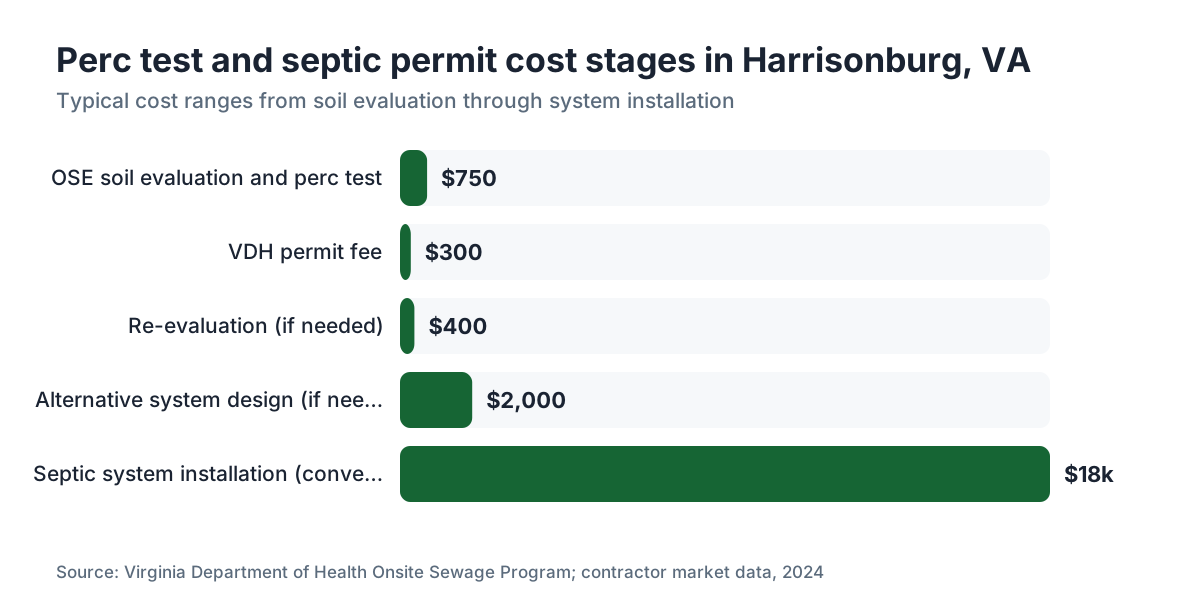
Here's a rough cost table for the full path from bare land to permit:
| Step | Typical cost range |
|---|---|
| OSE site evaluation and perc test | $300 to $1,200 |
| VDH permit fee | $200 to $400 |
| Re-evaluation (if needed) | $200 to $600 |
| Alternative system design (if needed) | $1,000 to $3,000 |
| Septic system installation | $10,000 to $30,000+ |
The perc test is a small line item next to what follows. Don't shave a few hundred dollars here; a soil problem missed at evaluation costs you far more in rework later. If you're building the full cost to install septic system budget, put the evaluation in early.
When do you need a perc test in Harrisonburg specifically?
You need one any time you want to build a structure with a septic system and you're not tying into public sewer. That covers new home construction on raw land, adding a dwelling unit to an existing property, and subdividing land into lots that each need their own system.
You may also need a new evaluation when replacing a failed septic system if the field location is moving, or when you expand a home enough to add sewage load. More bedrooms mean more flow, which can change the required field size and trigger a review [1].
Real estate deals are a different animal. A perc test done for a permit is not the same as a septic inspection done for a home sale. If you're buying a property with an existing system, you want a septic tank inspection, not a perc test. The perc test is for raw land or system replacement; the inspection checks a system that's already in the ground.
One trap catches people often: buying a lot that already has an approved perc evaluation on file. Virginia site evaluations don't expire on a fixed clock, but VDH can require a fresh one if site conditions changed or a lot of time has passed. Verify with the health district that an old approval still holds before you close on land.
How long does the perc test process take in Rockingham County?
From first call to an OSE to a permit in hand, budget four to twelve weeks in Rockingham County. Scheduling the OSE is the biggest wildcard. Spring and fall run busy; call in March and you may wait three to four weeks just for the first site visit.
Once the OSE submits the report, health district review usually takes one to three weeks, assuming nothing's missing. If the district wants clarification or a redesign, add time.
Season affects the test itself. Virginia wants perc tests run when soil conditions are representative, meaning not in an extreme drought when the ground drains faster than normal. Some evaluators won't test in dry mid-summer. If your project has a construction deadline, start the evaluation earlier than feels necessary.
What can cause a perc test to fail in the Harrisonburg area?
A handful of soil and site conditions common to the Shenandoah Valley can sink a perc test.
High clay content is the usual culprit. Heavy clay drains slowly, and if the mpi runs too high for any approved system type, the site can't carry septic. You see this on some of the older farmland around Harrisonburg.
Seasonal high water table is the next one. If the OSE finds mottling in the soil profile at shallow depth, the water table rises close to the surface for part of the year. Virginia's code requires a set separation between the bottom of the drain field and the seasonal high water table, and without that separation a conventional system won't work [1].
Karst features matter here more than in most of Virginia. Rockingham County sits where limestone dissolution has opened sinkholes, fractures, and underground conduits. The U.S. Geological Survey maps this region as karst-vulnerable, where surface water can move straight into the aquifer [7]. If the evaluation shows a direct connection between the surface and groundwater through karst, the site can be nearly impossible to permit.
Shallow depth to bedrock is the last common failure. If rock sits close to the surface, you can't dig a drain field deep enough to meet the required separation distances.
None of these failures makes the land worthless by default. A mound system, aerobic treatment unit, or drip irrigation field can sometimes meet the code where a conventional gravity system can't. Those systems just cost more to install and carry ongoing maintenance contracts.
How does Virginia's onsite sewage code govern perc tests?
Virginia's main regulatory document is 12VAC5-610, the Sewage Handling and Disposal Regulations, administered by the Virginia Department of Health [1]. The code sets soil evaluation methodology, required setbacks (from wells, property lines, streams, and buildings), minimum lot sizes for onsite systems, and the design standards for every system type.
The EPA's SepticSmart program gives the federal-level frame and treats proper siting as the base of any working septic system, with soil evaluation as the first step [4]. Virginia's code goes into more detail than the federal guidance, but both point the same way: get the soil right before you spend money on anything else.
In Harrisonburg, the City runs under the same state code but keeps its own engineering and zoning staff that coordinate with VDH. Rockingham County has a health department office for rural parcel evaluations. If your property straddles both jurisdictions (rare, but it happens near city limits), sort out which office leads your permit before you start.
SepticMind tracks the permit workflows across Virginia health districts if you're an operator running multiple jobs in this region; the software builds in state code requirements so nothing slips through.
One detail worth knowing: Virginia tightened its rules for alternative onsite sewage systems, and those systems now require an Operation and Maintenance (O&M) contract as a condition of the permit [1]. If your perc test points toward an alternative system, budget $200 to $500 per year in O&M fees on top of installation.
Can you do anything to improve a site's chances of passing?
Honestly, not much. You can't amend soil to change the perc rate in any way Virginia will accept for permitting. The evaluation tests what's there, not what you've built up.
What you can do is pick the best spot on your lot. Most lots have soil variability, and the OSE can evaluate several areas to find the best-draining ground. Don't assume the flat, convenient patch near the house is the winner; sometimes a slope or a different corner has much better soil.
Timing helps at the margin. Testing in spring, when soils sit at typical seasonal moisture, gives representative results, which is what the code wants anyway. If your OSE says wait for better conditions, listen.
If a conventional system won't work, ask your OSE whether a mound or alternative system could still get approved. The leach field design shifts a lot for these approaches, and knowing that early saves rework.
For lots that genuinely can't carry any onsite system, the real options are connecting to public sewer (if it's available and affordable) or not building. That's a hard answer, but far better to hear it before you buy.
What happens after the perc test passes and you have a permit?
With an approved site evaluation and permit in hand, you can hire a licensed septic contractor to install the system. In Virginia, septic installers hold a contractor license from the Board for Contractors [5]. The health district inspector visits during and after installation to check the system matches the approved design.
Then the system needs routine care. The EPA recommends pumping a septic tank every three to five years for a typical household [4]. Rockingham County properties on private wells and septic should watch for drain field stress: slow drains, sewage smells, or wet spots over the field. Getting on a septic tank pumping and inspection schedule early in a new system's life sets you up for decades of quiet operation.
If you ever sell, buyers and their lenders want documentation of the system's condition. Keep your permit, the as-built drawing, and pump-out history. When something eventually needs work, those records make diagnosis faster. Our septic tank inspection guide covers what a sale-time check involves.
SepticMind's service management tools help operators in the Harrisonburg area track maintenance and inspection records across their customer base, which counts for a lot given how many rural Rockingham County properties run on private systems.
How does a perc test differ from a full septic inspection?
People mix these up constantly. A perc test is for raw land or new system permitting. It checks whether the soil can carry a drain field. No system exists yet.
A septic inspection checks an existing system, usually for a real estate deal or after a problem shows up. The inspector pumps or assesses the tank, checks the distribution box, and looks at the drain field for signs of failure. The two use different professionals and answer different questions.
Buying a home with an existing septic system in Harrisonburg? Get an inspection, not a perc test. Buying raw land to build on? Get a perc test (or verify one already on file) before you close. Confuse the two and you either pay for the wrong evaluation or, worse, close on land that can't be built on.
Our septic tank inspection guide has more on what an existing-system check covers.
Frequently asked questions
How much does a perc test cost in Harrisonburg, VA?
A perc test in Harrisonburg and Rockingham County typically runs $300 to $1,200, paid to a private licensed Onsite Soil Evaluator. On top of that, the Virginia Department of Health charges a permit fee in the $200 to $400 range. If your site needs a re-evaluation or an alternative system design, add another $200 to $3,000 depending on complexity. Always get a written quote from the OSE before work begins.
Who can perform a perc test in Virginia?
Only a Virginia-licensed Onsite Soil Evaluator (OSE) or a licensed Professional Engineer with onsite wastewater specialization can run a legally valid perc test in Virginia. The Virginia Department of Health licenses them and keeps a directory. You hire them directly; they submit their findings to your local health district for the permit.
How long does a perc test take in Rockingham County?
The field work itself takes half a day to a full day. But scheduling the OSE, running the test, and getting the health district to review and approve the report usually takes four to twelve weeks total. Spring and fall are the busiest seasons. If you have a construction timeline, contact an OSE at least two months before you need results.
What perc rate passes in Virginia?
Virginia doesn't use a simple pass/fail cutoff. A rate under 60 minutes per inch (mpi) supports a conventional gravity drain field. Rates between 60 and 120 mpi may work with a larger or modified field. Above 120 mpi, you're looking at alternative systems like mound or drip irrigation. The soil morphology evaluation the OSE runs carries equal weight to the numerical perc rate.
Can a perc test fail in Harrisonburg due to karst geology?
Yes. Parts of Rockingham County sit over karst limestone, where underground fractures and conduits can move water straight to groundwater without soil treatment. If an OSE finds evidence of karst features during the evaluation, it can make permitting very difficult or impossible for a conventional system. This is one reason local OSE experience in the Shenandoah Valley matters.
Do I need a new perc test if the land already has one on file?
Not always, but verify with the Harrisonburg-Rockingham Health District before assuming an old evaluation still holds. Virginia doesn't set a fixed expiration date for site evaluations, but the district can require a new one if site conditions changed, a lot of time has passed, or the prior approval was for a different system type than you're now proposing.
What's the difference between a perc test and a soil evaluation in Virginia?
In Virginia, a soil evaluation and a perc test are both part of the same site evaluation process, but they test different things. The soil evaluation reads soil texture, structure, color, and mottling to judge drainage capacity and seasonal water table depth. The perc test is the timed water-drop measurement. Virginia code weights both equally; a good perc rate can't override a soil profile that shows a high seasonal water table.
What if my Harrisonburg property fails the perc test?
A failed conventional perc doesn't automatically mean no septic is possible. Your OSE may recommend a mound system, a low-pressure distribution system, a drip irrigation field, or an aerobic treatment unit, all of which can work in soils that won't carry a gravity-fed drain field. These alternatives cost more to install and require an annual Operation and Maintenance contract under Virginia law. If none of those work, public sewer connection is the last resort.
Does a perc test approval expire in Virginia?
Virginia's regulations don't specify a universal expiration date for perc test approvals, but health districts review the validity of older approvals case by case. If conditions on or near the lot have changed (new development, drainage alterations, soil disturbance), the district may require updated testing. Always confirm the status of an existing approval with the local health district before relying on it for a purchase or construction decision.
Can I do my own perc test on my property in Virginia?
No. For permitting in Virginia, perc tests and soil evaluations must be run by a state-licensed Onsite Soil Evaluator or qualified Professional Engineer. A homeowner-conducted test has no standing with VDH or the local health district. You can informally dig and watch how your soil drains, but that carries no weight in the permit process.
What are the setback requirements for a drain field in Rockingham County?
Virginia's 12VAC5-610 sets minimum setbacks that apply statewide, including Rockingham County. A drain field must sit at least 100 feet from a private well, 50 feet from streams or water bodies, 10 feet from property lines, and 20 feet from buildings in most cases. Exact distances vary by system type and site conditions. Your OSE's site sketch shows compliance with all required setbacks.
How many bedrooms can a septic system in Harrisonburg support?
Virginia uses bedroom count to estimate sewage flow for sizing. Each bedroom adds roughly 75 gallons per day to the design flow. Your perc rate and the resulting Long-Term Acceptance Rate (LTAR) set the required drain field square footage for that load. A larger home may need a bigger field, which needs more space on the lot. This is one reason lot size and shape matter as much as the perc rate.
Is a perc test required when replacing a failed septic drain field?
It depends on whether you're replacing in the same spot with the same system type, or changing location or design. If the original permit covers a replacement area and the design isn't changing, you may not need a new evaluation. If you're moving the field or switching to an alternative system, the health district will likely require a new site evaluation. Check with VDH or the local health district first.
Who do I contact to schedule a perc test in Harrisonburg?
Start by searching the Virginia Department of Health's licensed OSE directory. For permit coordination, contact the Harrisonburg-Rockingham Health District office. You hire the OSE directly; they handle the field work and submit the report. The health district issues the permit. Don't pay for the evaluation before confirming the OSE is currently licensed in Virginia and has worked in Rockingham County.
Sources
- Virginia Department of Health, Sewage Handling and Disposal Regulations 12VAC5-610: Virginia's primary regulatory framework for perc tests, soil evaluations, OSE licensing, system design standards, and O&M requirements for alternative systems
- Virginia Department of Health, Onsite Sewage Program Fee Schedule: VDH permit fees for onsite sewage systems in the $200 to $400 range
- Virginia Department of Conservation and Recreation: Rockingham County sits within Virginia's karst geology region, with limestone fractures that can complicate septic permitting
- U.S. EPA, SepticSmart Program: EPA SepticSmart emphasizes proper siting and soil evaluation as the foundation of a working septic system, and recommends pumping tanks every 3 to 5 years
- Virginia Department of Professional and Occupational Regulation, Board for Contractors: Septic system installers in Virginia must hold a contractor license from the Board for Contractors
- Virginia Cooperative Extension, Home Sewage Disposal Systems publication: Soil percolation rates and Long-Term Acceptance Rate methodology used in Virginia onsite system design
- U.S. Geological Survey, Virginia and West Virginia Water Science Center: Karst aquifer vulnerability in the Shenandoah Valley region, relevant to septic siting and groundwater protection in Rockingham County
- Virginia Department of Housing and Community Development, Building Codes: Virginia building permit coordination with VDH onsite sewage permits for new residential construction
- National Environmental Services Center (NESC), West Virginia University: Standard methodology for percolation test procedures including presoaking requirements and measurement intervals
- Virginia Department of Health, Licensed Onsite Soil Evaluator Directory: VDH maintains a searchable directory of licensed Onsite Soil Evaluators in Virginia
Last updated 2026-07-10