Perc test for land: what it is, how it works, and what to do if you fail
By the SepticMind Editorial Team

TL;DR
- A percolation (perc) test measures how fast soil absorbs water, usually in minutes per inch.
- That number tells a county health department whether your land can support a conventional septic drain field.
- Testing runs $150 to $700, takes 4 to 8 hours on site, and comes before a septic permit in most states.
- Failing doesn't always mean the land is worthless.
What is a perc test for land?
A percolation test, almost always called a perc test, measures how fast water drains through the soil on a piece of land. It records how many minutes it takes for the water level in a test hole to drop one inch. That number, written as minutes per inch (MPI), tells your local health department whether the soil can safely absorb the treated wastewater leaving a septic system's drain field.
The logic is simple. A leach field works by letting liquid from your septic tank soak slowly into the soil, where microbes and physical filtering finish treatment before the water reaches groundwater. Soil that drains too fast sends wastewater to groundwater before it's clean. Soil that drains too slow backs up and pushes sewage to the surface of your yard. The perc test finds out which problem you have, or whether you have neither.
Perc tests are a formal requirement in nearly every U.S. jurisdiction that allows on-site septic. The EPA's SepticSmart program treats site evaluation as the first step in protecting public health and local water. [1] No passing perc test, no approved alternative, no septic permit. And no septic permit means you can't build on land that isn't hooked to a municipal sewer.
When do you need a perc test?
You need a perc test any time you want a new septic system on a property that doesn't already have one. Four situations cover almost all of it.
First, buying raw land. If you're buying a rural lot to build on, most lenders and title companies want a current perc test before closing, and the county wants one before issuing a permit. A lot that never perc-tested is a lot with unknown value.
Second, subdividing land. When one parcel splits into two or more lots, each new lot usually needs its own perc test to prove it can support a septic system on its own.
Third, replacing a failed or nonexistent system. Buy a property with an aging, failed, or unpermitted system, and the county may require fresh testing before approving any new septic tank installation.
Fourth, adding a bedroom or major square footage. Some jurisdictions treat a bedroom addition as a load increase and require re-evaluation, which can mean new perc testing if the original results are old or missing.
Results expire. Most states accept them for 2 to 5 years, and a handful require retesting after 12 months. Check with your county health department, not the seller.
How does a perc test actually work, step by step?
State or county code governs the procedure, but the mechanics look about the same everywhere. Here's a typical test.
Site preparation (1 to 3 days before the test). A licensed soil evaluator or engineer picks test hole locations inside the proposed drain field area. Holes usually run 6 to 12 inches wide and 12 to 36 inches deep, dug with a hand auger or backhoe. The evaluator scarifies (roughs up) the sides to remove smeared soil, then drops a thin layer of gravel or sand at the bottom. Most states then require pre-saturation: the holes get flooded and allowed to drain, sometimes overnight, to mimic saturated conditions and cancel out the advantage of unusually dry ground.
The test itself. On test day, the evaluator fills each hole to a set depth, often 6 inches above the gravel. Every 30 minutes (or every 10 minutes under older protocols), they measure the drop. This runs at least 4 hours, sometimes longer. The worst-case reading from the final measurements is the number used for permitting. Water drops 1 inch in 30 minutes, the result is 30 MPI.
Acceptable ranges. Most states want a perc rate between roughly 1 MPI and 60 MPI for a conventional gravity-fed drain field. Faster than 1 MPI (gravel or coarse sand) means the soil won't treat wastewater. Slower than 60 MPI (heavy clay) means the soil won't take enough volume. The exact cutoffs vary by state. [2]
Multiple holes. A parcel usually needs 3 to 6 test holes minimum, spread across the proposed drain field. When results scatter, the engineer either averages them or takes the most conservative figure, depending on local rules.
The perc rate then drives drain field sizing. Fast soil (say 5 MPI) needs fewer square feet of trench per bedroom. Slower soil (45 MPI) needs more. That's why the same house can call for very different drain field footprints on two lots a mile apart.
Who can perform a perc test, and how do you hire one?
In most states, a licensed soil scientist, a licensed professional engineer (PE), or a registered sanitarian has to perform or supervise the test. Some states let a licensed septic installer run preliminary testing, but the health department usually sends its own inspector to watch or verify the official results before issuing any permit.
Start with your county health department's approved evaluator list. Hiring someone who isn't on that list is a common and expensive mistake. The county can refuse the results, and then you pay for the test twice.
Ask any evaluator four things. Are you licensed in this county? Have you tested soil in this specific area before? Will you submit results directly to the health department? What happens if the test fails? That last question tells you the most. A good evaluator won't just hand you a failed report. They'll tell you whether an alternative system could work and whether a second opinion is worth chasing.
Managing several properties or service jobs at once? Coordinating soil evaluations across sites is the kind of scheduling and documentation work that operations software (like SepticMind) handles well, though that's a contractor's problem more than a landowner's.
How much does a perc test cost?
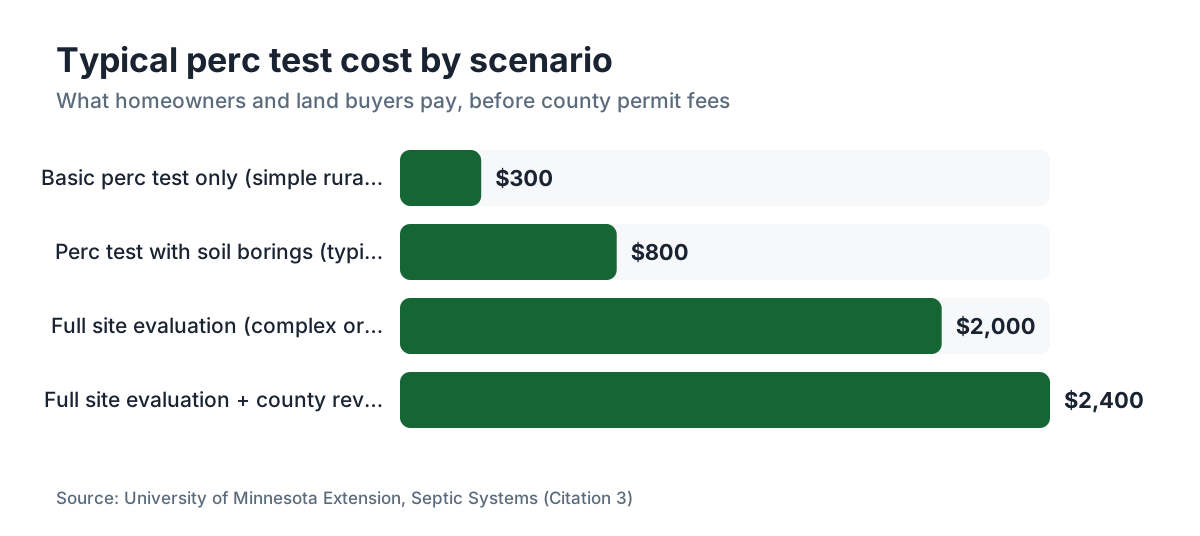
A perc test for a standard residential lot runs $150 to $700. [3] The price depends on your state, how many test holes the code requires, and whether you also need a full soil profile (a soil boring or soil morphology evaluation) on top of the perc test.
When a state requires a full site evaluation, which pairs perc testing with a soil boring and a site survey, the total can hit $1,500 to $3,000. Some rural Southeastern counties see costs as low as $100 for simple parcels. In California or New England, where the rules are heavier and licensed evaluators are scarcer, costs regularly clear $1,000.
Who pays? On a home sale it's negotiable, but the buyer usually eats it when the test is a condition of purchase. On new land subdivisions, the seller or developer almost always pays.
Permit fees pile on. Most county health departments charge a review fee of $50 to $400 on top of the evaluator's bill.
One cost people forget: if the land fails and you want a second opinion, you pay again. Sometimes that's worth it. A borderline 62 MPI result in a state with a 60 MPI cutoff might pass on a second test under better saturation conditions. It's a judgment call, not a guarantee.
What perc rate numbers mean for your septic system
The perc rate translates straight into the size of the drain field your system needs, which drives your overall cost to install a septic system. Here's a general reference built on University of Minnesota Extension guidance and typical state onsite wastewater codes: [4]
| Perc rate (MPI) | Soil type | System option |
|---|---|---|
| Less than 1 | Gravel, coarse sand | Typically too fast; fails or requires engineered system |
| 1 to 30 | Sandy loam, loam | Ideal; conventional system, smaller drain field |
| 31 to 60 | Clay loam, silt loam | Acceptable; larger drain field needed |
| 61 to 120 | Clay-heavy | Borderline; alternative system likely required |
| Greater than 120 | Heavy clay | Typically fails conventional testing |
Most states size the drain field with a formula that runs something like: (gallons per day of design flow) x (soil application rate factor) = square feet of trench bottom. A 3-bedroom home usually carries a design flow of 300 to 450 gallons per day. At 10 MPI, you might need 600 square feet of trench. At 50 MPI, the same house might need 1,500 square feet or more. That gap is real money in excavation, materials, and land you can't use for anything else.
What happens if your land fails a perc test?
A failed perc test is not a death sentence for the property. It means the soil, as tested, won't support a conventional gravity-fed drain field. You still have several paths, and which ones open up depends on your state's rules and how the land failed.
Request a second test. Borderline results, or a test compromised by recent heavy rain or drought, sometimes come out differently under fresh conditions. This works more often than people expect on borderline soils, but it costs money and time.
Commission a full soil morphology study. Some states let a licensed soil scientist judge soil color, texture, and structure at depth as an alternative or supplement to a timed perc test. That study can turn up a portion of the parcel with better subsoil, or show that the perc test underperformed because of test-day conditions.
Consider an engineered or alternative system. Many states approve mound systems, drip irrigation, aerobic treatment units (ATUs), and pressure-dosed systems for land that fails a conventional perc test. These treat wastewater harder before dispersing it, so they work in slower soils. They cost more, often $15,000 to $30,000 against $10,000 to $15,000 for a basic install, and they need more upkeep. The septic system repair burden runs higher too. But they can make an unbuildable lot buildable. [5]
Check for a municipal sewer connection. If the parcel sits in a sewer district or close enough to extend a line, tapping the sewer might be cheaper than fighting soil that flat out refuses to perc.
Sell or renegotiate. Buying land and the test fails? Your contingency may let you walk or renegotiate the price. A failed perc test is a legitimate reason to cut an offer hard, because the cost of an alternative system, or the cost of holding unbuildable land, is real.
Here's what I'd actually do first. Before spending on a second test or an engineer, call two or three septic installers who work in that county and describe the results. Local installers know which soils in the area respond to alternative systems and which ones are hopeless. That 20-minute call is free.
Can you do a perc test yourself?
You can dig holes and fill them with water. What you can't do is produce results a county health department will accept for a permit. Official tests get observed by a county inspector or run by a licensed evaluator, and the paperwork has to match specific state forms and protocols.
A DIY test earns its keep as a screening step before you buy land or hire a pro. Dig a hole 18 inches deep, fill it with water, and if the water is still sitting there 8 hours later, you have strong evidence the site will fail. You haven't proven it will pass, and you can't use the number for anything official, but you may have just saved a $500 evaluator fee on hopeless ground.
That's the honest use case. Don't let anyone sell you a kit or a YouTube tutorial that pretends it substitutes for official testing.
How long does a perc test take from start to permit?
Three phases: scheduling, testing, and review.
Scheduling hangs on evaluator availability and, in many counties, county inspector availability. In rural areas you may wait 2 to 6 weeks to land on an evaluator's calendar. Some busy jurisdictions run backlogs stretching to 3 months.
The test itself, including pre-saturation the night before and the timed test, takes 1 to 2 days on site.
County review of the submitted results, assuming they pass, usually takes 1 to 4 weeks before the permit issues. Some jurisdictions run on a 10-business-day statutory review period. Others have no formal deadline and move at whatever pace staff allows.
Realistic total from "I need a perc test" to "I have a septic permit": 6 to 12 weeks under normal conditions. Plan around that if you're in escrow with a close date.
Perc tests vs. soil morphology evaluations: what's the difference?
This distinction trips up a lot of buyers. A perc test measures hydraulic performance, how fast water moves through soil. A soil morphology evaluation (also called a soil profile or soil boring evaluation) reads soil characteristics by eye: color, texture, structure, mottling, and depth to restrictive layers like hardpan, rock, or the seasonal high water table.
Several states, North Carolina and Virginia among them, have largely dropped timed perc tests in favor of soil morphology evaluations by certified soil scientists. [6] The reason is consistency. Timed perc tests wobble because test-day conditions swing the result. A morphology evaluation, done by someone who knows what they're reading, gives a steadier picture of long-term site performance. Virginia's onsite sewage program has moved substantially toward morphology-based evaluation for permitting. [8]
Other states require both. Some still lean primarily on the perc test.
If you're evaluating land in a state that uses morphology evaluation, you need a licensed soil scientist specifically, more than a PE or an installer. The credential matters, because reading soil color and mottling to infer seasonal saturation is a specialized skill.
What does a failed perc test mean for land value?
A failed perc test with no approved alternative can render land essentially worthless for residential development. Land that can't support a septic system and sits outside a sewer district can't be built on for human habitation in most jurisdictions. Buyers who don't know this make expensive mistakes.
Still, failed results hit value on a spectrum. If the failure was borderline and an alternative system is clearly approvable in the state, the land loses value roughly by the extra system cost, maybe $5,000 to $20,000. If the failure is absolute (dense clay, no alternative path, no sewer access), the land's value as a residential building lot can drop to near zero, leaving only agriculture, forestry, or conservation easement value.
For raw land, I'd treat any lot without a current perc test as untested, no matter what the seller says. Make the perc test, or at least a preliminary site evaluation, a condition of any offer above a very low contingency price. The seller may know something the listing leaves out.
Buying a home that already has a septic system? A septic tank inspection is the more relevant step. The perc test matters at the land-purchase or new-construction stage.
State regulations and what to check locally
There is no single federal standard for perc testing. The EPA sets principles through programs like SepticSmart [1], but the real regulations live at the state level, and many states hand enforcement to county health departments. A perc rate that passes in Georgia might fail in Massachusetts, and a system type approved in Texas might not even be on the approved list in Oregon.
The EPA's guidance on onsite wastewater treatment states that "the soil at a site must be capable of providing adequate treatment of the wastewater and protection of groundwater." [7] How that gets measured is left to states.
Check a few things before you test.
Your state's onsite wastewater management code (often titled something like "Individual Sewage Disposal System Regulations" or "Onsite Wastewater Treatment Rules"). The state department of health or environmental quality usually publishes it.
Your county health department's specific procedures. Counties routinely layer extra requirements on top of state minimums. In Texas, for example, the state delegates onsite septic permitting to counties, each setting its own testing and system approval requirements within state minimums. [9]
The state's list of approved alternative systems. Knowing whether a mound system or ATU is pre-approved matters before you write off land that fails conventional testing.
Operators handling site evaluations for many clients across counties do better with one place to track which county has which rules, which permit deadlines, and which evaluator relationships. That's a workflow problem software like SepticMind is built for: permits, test dates, and county contacts across a job pipeline, without things slipping through the cracks.
How to prepare your land for a perc test
You can't change what your soil is. You can make sure the test reflects your soil honestly instead of scoring worse because of avoidable conditions.
Don't schedule testing right after heavy rain. Saturated soil drains slower than its baseline. Most evaluators know this and push the date themselves, but confirm.
Don't let the site bake dry beforehand either. Pre-saturation exists for this reason, but starting from bone-dry soil can throw off how quickly the pre-saturation stabilizes.
Clear the proposed drain field of heavy vegetation and debris so the evaluator can reach it and place holes in representative spots.
Mark any known underground features: old pipes, filled areas, buried debris. These change where holes can go and how the numbers get read.
Have your site plan or property survey ready. The evaluator needs setback distances from wells, property lines, streams, and anything else that limits where the drain field can sit. The best-draining soil on your lot is worthless if it's 30 feet from a well that requires a 100-foot setback.
Be present for the test if you can. Watching the evaluator work and asking questions is legal, normal, and useful. You'll read your results a lot better once you've seen the holes and heard the evaluator think out loud.
Frequently asked questions
What is a perc test for land and why do I need one?
A perc test measures how fast water absorbs into the soil on your property, recorded in minutes per inch. You need one before a county will issue a septic permit on land not served by municipal sewer. Without a passing result, or an approved alternative, you legally cannot install a septic system, which means you cannot build a home on most rural parcels.
How much does a perc test cost?
For a standard residential lot, a perc test runs $150 to $700 in most states. If the county requires a full site evaluation with soil borings and a site survey alongside the perc test, the total can reach $1,500 to $3,000. Add $50 to $400 for county permit review fees. Costs run highest in California, New England, and states that mandate a licensed soil scientist.
How long does a perc test take?
The testing itself takes one to two days on site, including the overnight pre-saturation step most states require. Getting scheduled with a licensed evaluator and county inspector can take two to six weeks in most areas, longer in busy jurisdictions. After a passing test, county review and permit issuance typically adds one to four weeks. Plan for six to twelve weeks total from start to permit.
What is a passing perc test result?
Most states want a perc rate between 1 and 60 minutes per inch (MPI) for a conventional drain field. The sweet spot is roughly 5 to 30 MPI, which points to sandy loam or loam that drains at a safe, treatable rate. Faster than 1 MPI means the soil is too coarse to treat wastewater. Slower than 60 MPI means it won't absorb enough volume. Exact cutoffs vary by state code.
What to do if your land fails a perc test?
First, confirm whether the result was borderline; a second test under different conditions sometimes changes the outcome. If the failure is clear, ask a licensed soil scientist whether an alternative system like a mound, drip irrigation field, or aerobic treatment unit is approvable in your state. These systems handle slower soils and can make a failing lot buildable, though they cost $5,000 to $20,000 more than conventional systems and need more maintenance.
Can a perc test fail because of the weather?
Yes, test-day conditions genuinely move the result. Soil tested right after heavy rain drains slower than the same soil under normal conditions. Most protocols address this with mandatory pre-saturation meant to standardize the starting point, but a very recent heavy rain can still bias the reading. Scheduling during a stretch of normal or slightly dry weather, then following the pre-saturation protocol, gives the truest picture of your soil's typical performance.
Who performs a perc test?
Depending on state law, perc tests must be performed or supervised by a licensed soil scientist, registered sanitarian, or licensed professional engineer. Many states also require a county health department inspector to observe. Always use an evaluator on your county's approved list; results from an unlicensed tester get rejected, meaning you pay twice. Get the county's list before hiring anyone.
How does a perc test result affect drain field size?
Directly and significantly. Slower-draining soil needs a larger drain field to disperse the same wastewater volume. A 3-bedroom home in sandy loam (10 MPI) might need 600 square feet of trench; the same home in clay loam (50 MPI) might need 1,500 or more. That difference drives excavation cost, land use, and whether the lot is even big enough for the system plus required setbacks from wells and property lines.
Is a perc test the same as a soil evaluation?
No. A perc test is a timed hydraulic test measuring how fast water drains. A soil morphology evaluation is a visual assessment by a soil scientist reading soil color, texture, and mottling to judge drainage and seasonal water table depth. Several states, including North Carolina and Virginia, now rely primarily on morphology evaluations rather than timed perc tests, because morphology results are considered more consistent and less affected by day-of conditions.
Does a perc test expire?
Yes. Most states accept perc test results for two to five years. Some require retesting if more than 12 months have passed since the original test. If you're buying land with an old perc test on file, verify the expiration date with the county health department before relying on it for a permit or purchase. Sellers sometimes present decade-old tests as if they're still valid.
Can I do a perc test myself?
You can dig a hole and fill it with water for a rough informal sense of your soil's drainage, but that result has no official standing. County health departments require tests conducted or supervised by licensed evaluators, often with a county inspector present. A DIY observation is useful only as a preliminary screening before you spend money on a professional test on land that clearly won't drain.
How does a perc test affect land value?
Significantly. Land that passes a perc test, or already holds a septic permit, is buildable and priced accordingly. Land that fails with no approvable alternative loses most of its value as a residential building lot, keeping only agricultural or conservation value. Borderline failures where an alternative system is clearly feasible cut value by roughly the added system cost, typically $5,000 to $20,000.
What alternative septic systems work on land that fails a perc test?
The most common approved alternatives, in states that allow them, are mound systems (raised drain fields built above native soil), drip irrigation dispersal systems, aerobic treatment units (ATUs), and pressure-dosed systems. Each treats wastewater more aggressively before dispersal, compensating for soil that drains too slowly. Availability depends entirely on your state's approved system list; confirm with your county health department before assuming any alternative is an option.
Sources
- US EPA, SepticSmart Program: Proper site evaluation is the first step in protecting public health and local water quality when installing a septic system.
- US EPA, Onsite Wastewater Treatment Systems Manual: Acceptable perc rates for conventional drain fields generally fall between 1 and 60 minutes per inch, with variations by state code.
- University of Minnesota Extension (extension.umn.edu), Septic System Owner's Guide: Perc test and site evaluation costs for residential lots typically range from $150 to over $1,000 depending on state requirements and evaluator fees.
- University of Minnesota Extension (extension.umn.edu), Soil and Septic System Site Evaluation: Perc rate ranges and corresponding soil types and system options used in the comparison table.
- US EPA, Onsite Wastewater Treatment Systems Manual: Alternative and engineered septic systems including mound systems, drip irrigation fields, and aerobic treatment units are approved options for sites that fail conventional perc testing in many states.
- North Carolina Department of Environmental Quality (deq.nc.gov), On-Site Wastewater: North Carolina relies primarily on soil morphology evaluations by certified soil scientists rather than timed perc tests for septic site approval.
- US EPA, Onsite Wastewater Treatment Systems Manual: EPA states that 'the soil at a site must be capable of providing adequate treatment of the wastewater and protection of groundwater.'
- Virginia Department of Health (vdh.virginia.gov), Onsite Sewage and Water Services: Virginia has moved substantially toward soil morphology evaluations over timed perc tests for onsite sewage system permitting.
- Texas Commission on Environmental Quality (tceq.texas.gov), On-Site Sewage Facilities: Texas delegates onsite septic permitting to counties, with each county setting specific testing and system approval requirements within state minimums.
- US EPA SepticSmart, How Your Septic System Works: Septic drain fields disperse treated wastewater into the soil, where microbes and physical filtering provide final treatment before groundwater recharge.
Last updated 2026-07-09