Perc test for a dry well: what you actually need to know
By the SepticMind Editorial Team

TL;DR
- Most states require a percolation test before approving a dry well (also called a seepage pit or drywell).
- The test proves the surrounding soil can absorb water fast enough.
- Without a passing perc rate, a dry well backs up and fails.
- Tests run $150 to $500, take a few hours, and must be certified by a licensed soil evaluator or engineer in most jurisdictions.
What is a perc test and why does it matter for a dry well?
A percolation test, almost always shortened to perc test, measures how fast water soaks into soil at a specific depth and location. You dig a small hole, saturate the surrounding soil, then time how many minutes it takes for one inch of water to drop. That number, expressed as minutes per inch (MPI), tells regulators whether the ground at your site can handle the liquid load you plan to send to a dry well.
A dry well is a buried, perforated structure, usually a concrete or fiberglass cylinder, that receives clear water and lets it seep out through its walls and base into the soil. It is not meant to handle sewage. The most common residential uses are roof drainage, sump pump discharge, and condensate from HVAC equipment. Some older systems used dry wells for laundry water, though most modern codes no longer allow that.
The perc rate matters for one simple reason. If the soil can't absorb water quickly enough, the dry well fills and stays full. Water then backs up into the feed pipe and eventually floods the surface or the basement. A perc test proves that won't happen under normal conditions. A failing test means you redesign, relocate, or pick a different solution.
People confuse dry wells and septic leach fields constantly, so let's clear that up before we go further. A leach field is the disposal end of a full septic system and handles blackwater (toilet waste). A dry well handles only non-sewage water. The two are regulated differently, but many states use a perc test for both, because the underlying question is identical: will this soil absorb water, and how fast [1]?
Do you need a perc test for a dry well in every state?
In most places, yes. The longer answer depends on what the dry well will receive and who reviews the permit.
For stormwater and clear-water dry wells, most county and municipal codes require at least a basic soil evaluation, and a perc test is the most common form that takes. EPA guidance on onsite wastewater systems recommends percolation or soil morphology testing before any ground infiltration structure gets approved [1]. State environmental agencies write their own versions of this requirement. Pennsylvania requires percolation testing for all subsurface infiltration systems under Title 25, Chapter 73 [3]. Virginia requires a soil evaluation by a licensed soil evaluator before a permit for any subsurface drain field, dry well, or seepage pit is issued under 12VAC5-610 [4].
For HVAC condensate or sump pump discharge, some jurisdictions allow a simplified review, especially at very small flow rates, say under 30 gallons per day. A few counties approve a small condensate dry well on a homeowner affidavit with no formal perc test if the soil is visibly sandy or gravelly. That's the exception, not the rule. Don't assume you qualify without calling your local health or building department.
Do you need a perc test for a well that supplies drinking water? Different question entirely. Drinking water wells extract water rather than dispose of it, so they don't need perc tests. The concern for a water supply well is proximity to any infiltration structure, not soil absorption rate. Most states require at least 50 feet of separation between a dry well and a drinking water well, and some require 100 feet [5].
Before you buy materials or dig anything, call your county health or building department, give them the discharge type and volume, and ask exactly what testing a permit requires. Getting this wrong costs a lot more than the permit fee.
How is a perc test for a dry well actually performed?
The process runs in three stages: site prep, pre-soaking, and the timed test.
First, the soil evaluator (or a licensed contractor, if your county allows it) digs a test hole at the location and depth where the dry well will sit. A single hole is common for small residential dry wells. Some jurisdictions require three or more holes in a pattern around the proposed site to check for variability. The hole runs 6 to 12 inches in diameter and reaches the depth of the proposed dry well bottom, which may sit 4 to 10 feet down depending on your design.
Next comes pre-soaking. The hole gets filled with water and left to saturate for a set time, often 4 hours. Some state codes require a 24-hour presoak, especially when clay layers show up. This step matters because soil absorbs water differently dry versus saturated, and a dry well operates in wet conditions most of the time.
Then the timed test begins. Water is added to bring the hole to a standard depth, and the evaluator measures how much the level drops over 30 minutes (some codes use 60-minute intervals). The MPI comes from that drop rate. A common baseline: if the water drops 1 inch in 30 minutes, your rate is 30 MPI.
Perc rates that support a dry well run from about 1 MPI (very fast, sandy soil) to 60 MPI (slow, but still acceptable in many codes). Above 60 MPI, many jurisdictions won't approve a standard dry well because the soil can't absorb water fast enough. Below 1 MPI, the soil may be too fast, which raises contamination risk for nearby water sources [1].
The evaluator then writes a report documenting the soil profile, the groundwater depth observed during the test, and the calculated MPI. That report goes to the permitting authority.
What perc rates pass or fail for a dry well?
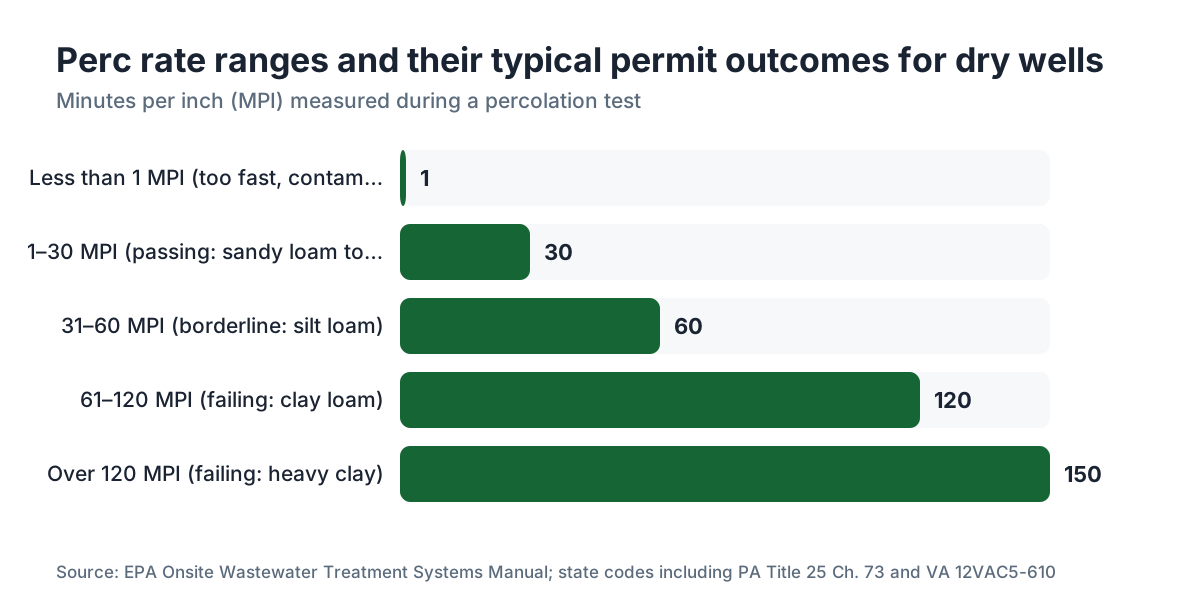
Perc rate requirements vary by state and by the type of water the dry well receives. The table below shows typical ranges. Verify against your specific state code before you rely on any of it.
| Perc Rate (MPI) | Soil Type | Typical Code Outcome |
|---|---|---|
| Less than 1 | Gravel, coarse sand | Too fast in many codes; contamination risk |
| 1 to 30 | Sandy loam, loam | Passing in most jurisdictions |
| 31 to 60 | Silt loam | Passing in some states; borderline in others |
| 61 to 120 | Clay loam | Failing in most codes for standard dry wells |
| Greater than 120 | Heavy clay | Failing everywhere; soil won't absorb adequately |
Groundwater depth matters as much as the MPI. Most states require at least 2 to 4 feet of separation between the bottom of the dry well and the seasonal high water table. If your test hole shows groundwater at 3 feet and the code demands 4 feet of separation, the location fails no matter how good the perc rate looks. North Carolina, for example, requires a minimum of 2 feet of vertical separation above the seasonal high water table for stormwater infiltration structures [11].
Some state codes split "fast" and "slow" perc for different structure types. A soil at 5 MPI might need a larger-diameter dry well or a longer trench configuration instead of a single pit. The perc rate sets the minimum size more than the plain yes-or-no [1].
Here's what trips people up. A perc test done for a septic system on the same property may not be accepted for a dry well permit. The test depths often differ, the test date may fall outside the acceptable window (some codes want a fresh test within 24 months), and the evaluator certification may not match. Ask the permitting office before you assume you can reuse an old test.
How much does a perc test for a dry well cost?
Expect $150 to $500 for a standard residential perc test, with most homeowners landing around $250 to $350 in areas with decent contractor availability. That range comes from local permit databases and contractor estimates compiled by state extension services. There is no single national dataset, so treat the range as a real estimate, not a fixed price [7].
What pushes the cost up: multiple test holes required by code, deep boring to reach design depth (equipment rental adds cost fast below 6 feet), a 24-hour presoak (the evaluator makes two trips), or a hard-to-reach site. In rural areas where licensed soil scientists are scarce, travel fees alone can push a test past $600.
Permit fees are separate. A dry well permit typically runs $50 to $250 depending on the jurisdiction and the discharge volume [7].
If the test fails, you pay again to test a different location on the same property. Most evaluators won't discount the second test because the labor is the same. Some jurisdictions allow a "limited review" alternative for very small systems, and that review may run less, sometimes as little as $75. It also produces less data and may not satisfy every lender or insurer.
A new septic system runs $10,000 to $25,000 across most of the country, and our cost to install septic system breakdown shows the perc test is rarely the expensive part. Even a $500 test is cheap next to installing a system in soil that fails in two years.
Can you do a perc test yourself, or does it require a professional?
In most states you can do the physical digging and pre-soaking yourself, but a licensed professional has to witness and certify the test for the results to count with the permitting authority.
The required credential varies by state. It might be a licensed soil scientist, a licensed professional engineer (PE), a registered sanitarian, or a certified onsite wastewater installer with a specific endorsement. Virginia requires a licensed soil evaluator [4]. Pennsylvania requires either a soil scientist or a licensed sewage enforcement officer [3]. Your county health department's permit application names the credential it accepts.
A fully DIY perc test, where you dig, run the test, measure, and submit the numbers yourself, generally won't be accepted for permit purposes. Running an informal test before you hire the pro is still reasonable. It gives you a rough read on your soil before you spend money on a certified test. If your informal test comes back above 100 MPI, you'll know to explore alternatives before paying a professional to confirm the bad news.
For homeowners doing their own research, University of Minnesota Extension publishes plain-language material on onsite soil evaluation and septic siting that explains the pre-soak and measurement steps without a textbook [8].
One practical note. Some counties keep a designated soil evaluator who works for the county and runs the test as part of the permit process. In those places you pay the permit fee and the county's evaluator shows up at your site. Ask upfront whether your county offers this, because it saves the step of finding and vetting a private evaluator.
What happens when a perc test fails for a dry well?
A failed test isn't necessarily the end. It depends on why it failed.
If the MPI is too high (soil too slow), the first move is relocating the dry well to another spot on the property. Soil types vary a lot within a single lot, especially if the parcel spans a former creek bed or has fill in one area. A second test 20 or 30 feet away sometimes reads completely different.
If relocation isn't possible, some jurisdictions allow an engineered alternative. That might be a larger dry well with more sidewall area, a series of smaller connected pits, or a linear infiltration trench instead of a pit. The engineer sizes the alternative on the actual MPI rather than a standard design assumption.
A high water table is harder to work around. You can't lower it, and most codes won't grant a variance on the separation requirement because contamination risk is real. The usual fallback is moving the water above ground: a French drain to a daylighted outlet, a detention basin, or a tie-in to a municipal storm sewer if one runs at the street.
For sump pump discharge, some homeowners in high-water-table areas use a surface discharge pipe that carries water far enough from the foundation to avoid re-infiltration, with no underground structure at all. That needs no perc test. It also means a wet swale or visible discharge flow in the yard.
A failing septic system is a different animal. See our guide on septic system repair for what that process actually looks like.
How is a perc test for a dry well different from a perc test for a septic system?
The physical procedure is often the same or close to it, but the context, the pass/fail thresholds, and the permitted uses differ in a few ways that matter.
A septic perc test evaluates soil at the depth of the leach field trenches, typically 18 to 36 inches below grade. A dry well perc test often evaluates soil at the depth of the perforated section, which may sit 4 to 10 feet down or more. Soil changes dramatically with depth, so a site that passes at 24 inches for a leach field can fail at 6 feet for a dry well if a clay pan or hardpan layer sits between them.
The acceptable MPI range sometimes differs too. Septic leach field codes often cap at 60 MPI with a floor of 1 or 3 MPI. Dry well codes in some states run a little more lenient on the slow end because the discharged water is clean (roof runoff, condensate) rather than effluent carrying biological load.
The permit path is separate. A septic permit goes through the health department almost everywhere. A dry well permit may go through the health department, the building department, or a stormwater authority depending on how your jurisdiction is organized. Ask which office handles dry wells specifically, because the wrong counter wastes time.
If you're already thinking about septic tank installation or the cost to put in a septic tank, your contractor's septic perc test may or may not satisfy the dry well permit. Get that answer in writing before you assume the two are interchangeable.
When can you skip a perc test for a dry well?
There are real situations where you don't need a perc test. They're narrower than most homeowners hope.
First: if you're replacing an existing permitted dry well in the same location and the original permit is on file, some counties issue a replacement permit without a new test. The reasoning is that the soil was already evaluated. This isn't universal, and the original test may carry an expiration date (commonly 5 to 10 years in most codes).
Second: some very small volume systems are exempt. The threshold moves by jurisdiction. A few places exempt condensate drains from split-system air conditioners if daily discharge stays under 20 to 30 gallons, reasoning the volume is too small to saturate even poor soil. Find out your local threshold before you conclude you qualify.
Third: in some clearly coarse-grained soils, a visual soil assessment by a qualified evaluator can substitute for a formal timed test. If the evaluator reads your soil log and it's clean gravel with no fines, they may certify adequate drainage without timing a water drop. This shows up more in certain western states than in the Northeast or Southeast.
Fourth: if your parcel sits on a high-permeability mapping unit in a published soil survey, some permit offices accept that as a preliminary qualifier, though a full test is usually still needed to confirm.
Default assumption: you need a test. If you skip it without confirming the exemption in writing, you risk installing a dry well that can't be permitted, and that turns into a problem when you sell the property or file an insurance claim.
What soil conditions make a dry well impractical regardless of the perc test?
Some sites won't work for a dry well no matter what the perc test shows. More precisely, the test will fail for structural reasons that can't be engineered around cheaply.
High seasonal water tables are the most common dealbreaker. If groundwater rises within 2 feet of the surface every winter or spring, there's no safe place to put a dry well that meets the vertical separation requirement. This is common in the Northeast, the upper Midwest lake country, and coastal plain areas of the Southeast.
Fractured bedrock close to the surface creates a different problem. Water moves through fractures unpredictably, so contamination can travel far and fast. Many states prohibit subsurface infiltration structures within a set distance of bedrock outcrops or where bedrock sits within 4 to 6 feet of the surface [1].
Expansive soils, mostly clay-heavy soils like Vertisols, absorb water slowly when dry and swell when wet, which cuts permeability further during wet seasons. A perc test run in late summer on clay-heavy soil can read deceptively fast, then fail to hold in the wet season when you actually need the dry well working.
Sloped lots create a risk of subsurface lateral flow reaching a neighbor's property or a surface water body. Most codes require the dry well to sit back from slopes above a certain grade, regardless of the perc rate.
On any property where a dry well is under consideration alongside a new septic system, running the perc test and a full septic tank inspection at the same time saves a second mobilization fee for the evaluator.
How do you find a licensed soil evaluator or perc tester for a dry well?
Start with your county health department or building department. Many keep a list of approved evaluators who already know local code and the exact forms the office accepts. That list is usually the fastest path to a professional who won't waste your time or theirs.
State licensing boards for professional geologists, soil scientists, and engineers publish online directories in most states. The Soil Science Society of America maintains a member directory that includes soil scientists who do site evaluations [9].
When you call an evaluator, ask four things. Are you licensed to certify perc tests in this county specifically? Have you worked with the local permit office on dry well (not septic) applications? What's your fee, and does that include the permit paperwork? How far out are you scheduling?
Lead time matters. In spring and early summer, licensed evaluators book 3 to 6 weeks out because that's peak season for septic permits. If you need a dry well installed before a deadline, start the perc test process well before you plan to break ground.
Operators who juggle multiple residential service calls can use tools like SepticMind to track permit status, schedule evaluators, and coordinate site visits across properties without losing anything in a spreadsheet. For a homeowner, one call to the county list is enough.
What should you do after a dry well perc test passes?
A passing test starts the permit process. It doesn't end it. Here's the typical sequence.
The soil evaluator submits, or hands you, the certified test report. You submit that report to the permitting office along with the permit application, a site plan showing the dry well location relative to property lines, the house, and any wells or water bodies, plus the permit fee. Processing runs from a few days to a few weeks depending on the jurisdiction.
Once the permit is issued, you or your contractor can start installation. Most permits require a pre-installation inspection, a mid-installation inspection (while the pit is open, so the inspector can verify depth, backfill material, and structure), and a final inspection. Don't backfill before the inspector signs off on the open pit.
After installation, keep a copy of the permit, the perc test report, and the as-built drawing showing exactly where the dry well sits. You'll need these when you sell. Buyers' agents increasingly ask for subsurface drainage documentation, and an undocumented dry well surfacing on a septic tank inspection or property inspection can stall a sale.
Maintain the dry well. Unlike a septic tank that needs regular septic tank pumping, a properly installed clean-water dry well shouldn't need pumping often. But it accumulates sediment over years, especially with roof runoff from an unfiltered downspout. Inspecting the inlet pipe every 3 to 5 years is reasonable, and adding a sump or sediment basin upstream is the single best thing you can do to extend the dry well's life. SepticMind helps service operators schedule those checkups automatically and document them so the record transfers cleanly to the homeowner.
Frequently asked questions
Do you need a perc test for a well that supplies drinking water?
No. A drinking water well draws water from the ground; it doesn't discharge into it. Perc tests apply to structures that put water into the soil, like dry wells, leach fields, and seepage pits. For a water supply well, the requirements are setback distances from septic systems and dry wells (commonly 50 to 100 feet depending on state code), not percolation rates.
How long does a perc test for a dry well take?
The timed portion takes 30 minutes to 2 hours. Add the pre-soak and you're looking at a half-day visit at minimum. If your state requires a 24-hour presoak (common in clay-heavy soils), the evaluator makes two separate trips and the full process spans two days. Most evaluators schedule the presoak the day before and run the timed test the next morning.
Can I reuse an old perc test result for a new dry well permit?
Sometimes, but usually not. Most jurisdictions require the test to have been conducted within 2 to 5 years of the permit application, and many require the test at the same depth and location as the proposed structure. A test done for a septic leach field at 24 inches deep won't substitute for a dry well permit that requires testing at 6 feet. Always confirm with your permitting office first.
What is the difference between a dry well and a seepage pit?
They're effectively the same thing, and the terms are used interchangeably in most state codes. Seepage pit is the older term, used historically for pits that received septic effluent. Dry well now usually refers to a perforated structure that receives only non-sewage clear water (roof runoff, sump discharge, condensate). Both rely on soil percolation to function, and both need a perc test for permitting in most states.
What perc rate is required to pass for a dry well?
Most state codes accept perc rates between 1 and 60 minutes per inch (MPI) for standard dry wells. Rates above 60 MPI mean soil that absorbs water too slowly for a conventional pit design. Rates below 1 MPI mean very coarse soil where contamination risk to nearby wells becomes a concern. The exact threshold varies by state and by the type of water the dry well receives, so check your local code.
How deep should a dry well be for a perc test to apply?
The test runs at the depth where the dry well's perforated section will sit. Most residential dry wells are 4 to 10 feet deep, with the perforated section starting below the inlet pipe. The perc test must evaluate soil at that depth rather than near the surface. If your soil has layers (sand on top, clay below), the test at design depth can read completely differently than a shallow test would.
What is the average cost of a perc test for a dry well?
Expect $150 to $500 for a residential perc test, with $250 to $350 most common in mid-range markets. The cost depends on the number of test holes required, site access, required presoak time, and local evaluator availability. Permit fees are additional and typically run $50 to $250. In rural areas with few licensed evaluators, total costs can top $600 including travel.
Can a dry well be installed without a permit?
Technically possible but legally risky. An unpermitted dry well creates liability if it floods a neighbor's property or if stormwater contamination is traced back to it. More practically, it complicates a property sale; it may need to be removed, re-permitted, or disclosed as a defect. In some jurisdictions, installing a dry well without a permit is a civil violation subject to fines. Get the permit.
How far must a dry well be from a septic system or drinking water well?
Setbacks vary by state, but common minimums are 10 to 25 feet from any septic system component and 50 to 100 feet from a drinking water well. Some states add setbacks from property lines (often 5 to 10 feet) and from surface water bodies. Your local health department permit application lists the exact setbacks for your jurisdiction; treat those as hard minimums, not suggestions.
What alternative exists if a perc test fails for a dry well?
Common alternatives include relocating to a higher-permeability area of the property, converting to a surface drainage system (French drain with daylighted outlet), connecting to a municipal storm sewer if available, installing an engineered stormwater detention basin, or using permeable paving to spread infiltration over a wider area. For condensate and small-volume discharge, a simple gravel-filled surface infiltration pad sometimes satisfies code without a full dry well structure.
Does the EPA require a perc test for dry wells?
The EPA doesn't issue permits for individual residential dry wells; that authority sits with state and local agencies. The EPA's Underground Injection Control (UIC) program does classify certain large or industrial dry wells as Class V injection wells and requires registration and compliance with federal standards. For typical residential use (roof drainage, sump pump, condensate), the rules are state and county codes, which most states have aligned with EPA guidance recommending soil permeability testing before any infiltration structure is approved.
How often should a dry well be inspected or cleaned after installation?
There is no universal code-mandated schedule for residential dry wells that receive clean water. Practical guidance from extension services and contractors suggests inspecting the inlet pipe and any sediment trap every 3 to 5 years. Dry wells taking unfiltered roof runoff accumulate sediment faster and may need cleaning after 10 to 15 years. Adding a leaf guard on gutters and a sediment basin or sock filter upstream is the best way to stretch the interval between cleanings.
Sources
- EPA, Onsite Wastewater Treatment Systems Manual (EPA/625/R-00/008): Percolation tests and soil morphology evaluations are recommended before approving any ground infiltration structure, including dry wells and seepage pits, and EPA guidance specifies minimum vertical separation above the seasonal high water table.
- Pennsylvania Code Title 25, Chapter 73, Individual Sewage Systems: Pennsylvania requires percolation testing for subsurface infiltration systems; tests must be conducted by a soil scientist or licensed sewage enforcement officer.
- Virginia Administrative Code 12VAC5-610, Sewage Handling and Disposal Regulations: Virginia requires a soil evaluation by a licensed soil evaluator before a permit for any subsurface drain field, dry well, or seepage pit is issued.
- EPA, Class V Underground Injection Control Wells: Most states require 50 to 100 feet of separation between a dry well or seepage pit and a drinking water well; the EPA UIC program applies to certain commercial and industrial dry wells classified as Class V injection wells.
- National Association of Counties: Dry well and subsurface drainage permit fees at the county level commonly range from $50 to $250 for residential applications.
- University of Minnesota Extension, Onsite Sewage Treatment Program: University of Minnesota Extension publishes plain-language material on onsite soil evaluation and septic siting, including presoak and measurement steps.
- Soil Science Society of America, Member Directory: The Soil Science Society of America maintains a member directory that includes soil scientists who conduct site evaluations and perc testing for permits.
- North Carolina Department of Environmental Quality, Stormwater Program: North Carolina DEQ guidance specifies acceptable perc rate ranges for stormwater infiltration structures and requires a minimum of 2 feet of vertical separation above the seasonal high water table.
Last updated 2026-07-09