Perc test price: what you'll actually pay in 2025
By the SepticMind Editorial Team
TL;DR
- A percolation test costs $250 to $1,000 in most U.S.
- markets, with an average near $500.
- County health departments sometimes run the test themselves for a flat permit fee of $150 to $400.
- Complex sites, multiple test holes, or states with licensed soil evaluator requirements push costs above $1,500.
- The price usually covers soil boring, timing the water drop rate, and a written report.
What does a perc test actually cost?
Most homeowners pay between $250 and $1,000 for a percolation test. The midpoint contractors quote most often sits near $500, but that number hides a wide spread. Where you live, who runs the test, and how many holes your county demands all move the price.
Rural Midwest and Southern counties run cheap. Fees of $200 to $300 are common there, especially when the county health department runs the test itself and folds the cost into a septic permit application. In New England, coastal California, and the Pacific Northwest, licensed soil scientists charge $800 to $1,500 because state rules require a certified evaluator instead of a general contractor [1].
If your lot needs a full soil evaluation alongside the perc test, expect a combined fee of $1,000 to $3,500. That package usually includes the perc test, a soil profile analysis (someone digs down four to six feet and reads the soil horizons by hand), a site survey, and a report the county will accept as a permit application. Don't confuse the two. A perc test alone just times how fast water drains from a hole. The full soil evaluation tells you what kind of system the soil can actually support.
No federal database tracks perc test prices by state. The ranges here come from state health department fee schedules, contractor pricing pages, and county permit offices. Treat every number as a starting range and call your local health department first. They'll tell you whether the county runs the test or you hire a private evaluator.
What factors drive perc test prices up or down?
Location is the biggest variable. States that require a licensed professional soil scientist or a registered sanitarian to conduct and certify the test add a credential premium. Virginia, Massachusetts, and Washington all require a licensed onsite soil evaluator for any system permit [2]. That credential costs money, and you pay for it in the test fee.
Number of test holes matters too. A standard perc test uses one to three holes on a small lot. Larger lots, oddly shaped parcels, or sites where soil changes across the property may need five or more holes to satisfy the county. Each extra hole adds roughly $50 to $150 in labor and time.
Site access is underrated as a cost driver. If the tester has to haul a backhoe or power auger across rough terrain, expect a mobilization charge. Rocky soil that breaks drill bits, lots without road access, and steep grades all push the bill higher.
Season moves the price more than people expect. Cold-climate states often ban testing when the ground is frozen, so spring scheduling gets crowded fast. Some contractors charge a premium during peak season (March through June in most northern states) because demand runs ahead of supply.
Presoaking rules vary by state and county. Some jurisdictions make you pre-soak the test holes with water for 24 hours before the official timing starts, and you may pay for that pre-soak visit as a separate site trip. Others let you do it the same day. Ask your county environmental health office exactly what their protocol requires before you hire anyone.
How does perc test cost compare by state?
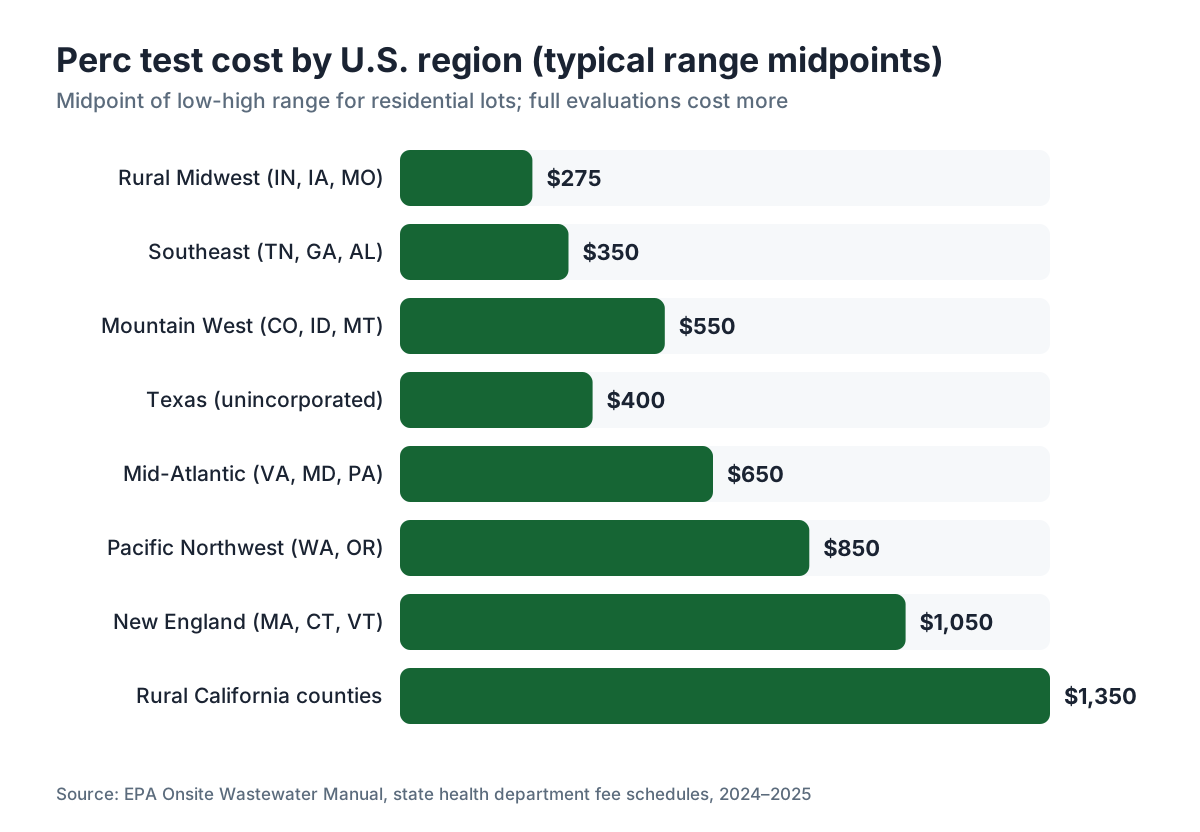
The table below shows representative cost ranges by region, drawn from published county fee schedules and state health department guidance. These are not guarantees. Always verify with your local authority.
| Region | Typical Range | Notes |
|---|---|---|
| Rural Midwest (IN, IA, MO) | $150, $400 | Often county-run, fee bundled with permit |
| Southeast (TN, GA, AL) | $200, $500 | Contractor-run; some counties still administer |
| Mid-Atlantic (VA, MD, PA) | $400, $900 | Licensed evaluator often required |
| New England (MA, CT, VT) | $600, $1,500 | Soil scientist credential required in most states |
| Pacific Northwest (WA, OR) | $500, $1,200 | Licensed OSS designer or certified evaluator |
| Mountain West (CO, ID, MT) | $300, $800 | Varies widely by county density and elevation |
| Texas (unincorporated areas) | $200, $600 | TCEQ-licensed installer sometimes runs test [3] |
| California (rural counties) | $700, $2,000 | County EH departments often conduct; permit fees high |
These ranges reflect the test and evaluation only. They don't include permit fees, which can add another $100 to $500 depending on the county [1].
Who performs the test and does that change what you pay?
Three parties typically run perc tests: county health departments, private septic contractors, and licensed soil scientists or engineers. Each one changes what you pay and what you get.
County-run tests are the cheapest, usually $150 to $400 folded into the septic permit application. You set up the test holes yourself (or hire someone to dig them), the county sends an inspector, they time the water drop, and you get a result. The catch is scheduling. County offices may run a two to eight week backlog, especially in spring.
Private septic contractors often bundle perc testing with the design or installation job. Their fees run $300 to $700, competitive on paper, but remember they have a financial interest in the outcome. That's not an accusation of fraud. It's a structural conflict worth knowing about.
Licensed soil scientists or professional engineers charge the most ($600 to $2,000+) and produce the most defensible reports. Buying rural land as an investment, planning a larger development, or working a site with marginal soils? Pay for an independent licensed evaluator. Their report carries more weight in a permit appeal or a real estate transaction.
SepticMind's service operator directory can help you find licensed evaluators in your county, if you're an operator managing multiple site assessments for clients.
For a standard residential lot with good soil access, a county-run test or a reputable local contractor is fine. Save the licensed soil scientist for hard cases.
What's included in a perc test fee?
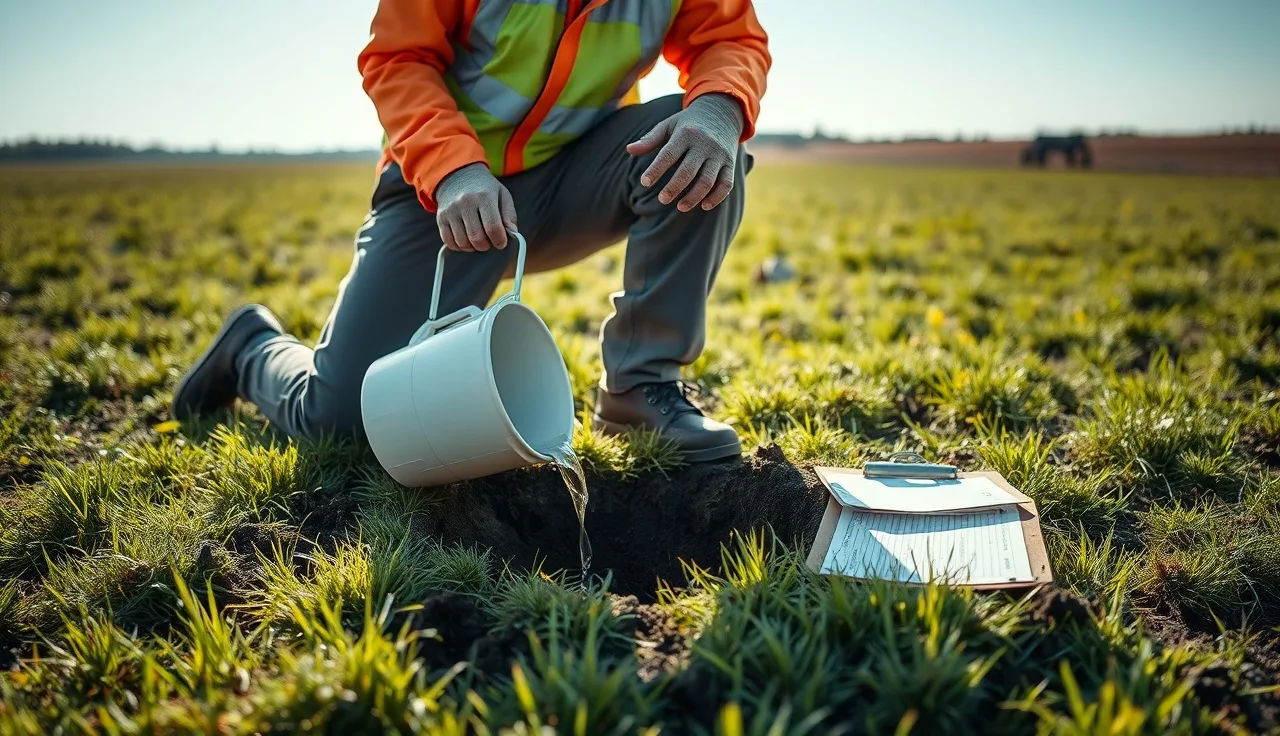
A basic perc test fee covers digging or augering the test holes (usually 6 to 12 inches wide, 24 to 36 inches deep), pre-soaking them if required, timing how fast the water level drops (measured in minutes per inch), and a written result. That's it.
What it typically leaves out: a full soil profile evaluation, a site sketch or topographic survey, hole excavation if the county wants them dug in advance, permit application fees, and any design work for the actual septic system.
If a contractor hands you an all-in quote covering perc testing, soil evaluation, system design, and permit filing, that's a different and larger purchase. Get an itemized breakdown so you know what you're buying. A combined package in that category often runs $1,500 to $5,000 before any installation work begins.
A failed test does not usually mean a refund. You paid for someone's time and expertise. If the test fails, some contractors will credit part of the fee toward alternative system design work, but that's a negotiation, not a standard policy.
How long does a perc test take and does timing affect cost?
The test itself, meaning the actual water timing, takes 30 minutes to four hours depending on how many holes get tested and the county's required observation intervals. EPA guidance describes the standard method as measuring the drop in water level over 30-minute intervals after the pre-soak period [4].
The total site visit, arrival to departure, is usually two to four hours. If the county requires a 24-hour pre-soak, that means two site visits: one to set up and soak the holes, one to run the official test. Some contractors charge for both; others bundle them.
Scheduling lag is a separate problem from test duration. In many counties, you can't book the test until you've filed a permit application and paid the fee. Then you wait for an open slot. The whole cycle, application to test to result, can take two to six weeks in busy spring markets, sometimes longer in understaffed rural health departments.
On a real estate contract with a perc test contingency, build at least 30 days of buffer into your timeline. Sellers who've never dealt with this get blindsided by how long it takes.
What happens if the perc test fails?
A failed perc test doesn't automatically mean the land can't support a septic system. It means a conventional gravity-fed drain field isn't right for that soil. Most states allow alternative systems when standard perc rates fail.
Percolation rates are measured in minutes per inch (MPI). A rate faster than 1 MPI (water drains too quickly through gravel or fractured rock) typically fails because the soil won't filter effluent well enough. A rate slower than 60 MPI (dense clay that barely drains) fails for the opposite reason. The acceptable range in most states runs roughly 1 to 60 MPI, though the specific cutoffs vary by state code [1][5].
If your soil falls outside that range, options include mound systems, aerobic treatment units, drip irrigation systems, or constructed wetlands. Each of those costs a lot more than a conventional system. See our full guide to cost to install septic system for a breakdown.
A failed perc test on a property you're under contract to buy is serious due-diligence information. You can negotiate a price reduction to cover the higher system cost, ask the seller to pay for a soil scientist's alternative evaluation, or walk away if the contract allows it. Don't buy land you can't put a system on until you've verified your alternative system options and their costs.
How is a perc test different from a soil evaluation or soil perc test?
People use these terms interchangeably, and that causes real confusion.
A perc test (or percolation test) is the procedure that times how fast water drains from a test hole. It produces a single number: minutes per inch. That number tells the designer what absorption rate the soil can handle.
A soil evaluation (also called a soil morphology study or soil profile analysis) goes deeper. A trained evaluator digs a pit two to four feet deep and reads the soil layers by color, texture, and structure to assess drainage, depth to restrictive layers, and depth to the seasonal high water table. This is what actually drives system type selection in most modern state codes.
Many states no longer accept a perc test alone. Virginia's regulations (9VAC25-790) require a full soil evaluation that includes morphological assessment, with the perc test as a supplement [2]. Massachusetts requires a percolation test under Title 5 (310 CMR 15.000) but also requires soil evaluation by a certified soil evaluator [6].
When you hire for a "perc test," ask exactly what the deliverable includes. If the county or your system designer needs a full soil evaluation to approve a permit and you only paid for a perc test, you'll be going back to pay again.
Can you DIY a perc test to save money?
Short answer: not for permit purposes.
Every state that requires a septic permit requires the perc test or soil evaluation to be conducted by a county official or a credentialed professional. A homeowner can't self-certify a result that a county health department will accept. Paying for a proper test is unavoidable if you want a legal septic system.
You can still run an informal perc test on your own land before paying for the official one, just to get a rough read on whether the soil sits in the right range. The basic method is the same: dig a hole roughly 12 inches wide and 12 to 24 inches deep, fill it with water, let it drain completely, fill it again, and time the drop over 30 minutes. Divide the drop in inches into 30 to get MPI. No permitting authority will accept this, but it tells you whether you're in grossly problematic territory before you spend money on the official test.
If your informal test shows near-zero drainage (water still sitting there four hours later), call a licensed soil scientist before you make any real estate commitments. You may have a problem that no standard system can solve economically.
For the septic tank inspection and installation process that follows a successful perc test, the official paperwork trail starts with the county-approved test result.
Are perc test costs tax-deductible or reimbursable?
If you're building a new primary residence, the perc test is a site development cost that gets added to your cost basis. That doesn't give you a current-year deduction, but it lowers your taxable gain when you eventually sell.
If the property is investment land, a rental, or commercial, the perc test is a deductible business or investment expense in the year incurred, assuming the project doesn't produce a capitalized asset. If it results in a septic system you install, it becomes part of the depreciable asset basis instead.
If you paid for a perc test on land you ultimately didn't buy (common when deals fall through), that's a capital loss item tied to a failed investment transaction. Talk to a tax professional. The treatment depends on your specific situation.
None of this is tax advice, and none of these rules are simple. The IRS has no dedicated perc test guidance document. The principles above come from general cost basis and investment expense rules under IRC Sections 263 and 1012.
Home insurance doesn't cover perc test costs. Some real estate contracts let buyers recover earnest money if a perc test fails, but that's a contract negotiation point, not a standard rule.
What should you ask before hiring a perc test company?
Before you pay anyone, get clear answers to these questions.
Are you licensed or certified in this state to conduct perc tests for permitting purposes? In many states the answer has to be yes or the result won't be accepted. Ask them to name their license type and number.
Does your fee include soil evaluation or just the timed percolation test? If the county needs both, you need to know upfront.
How many test holes does my county require, and is that included in your quote? Extra holes cost extra money.
Do I need to pre-dig holes before you arrive, or do you handle that? If you have to hire an excavator separately, add $200 to $600 to your total.
What happens if the test fails? Do you offer alternative site assessment or system design services, and at what added cost?
How long until I get a written report, and will the county accept it directly or do I file it myself?
Get the quote in writing. A text message estimate is not a contract. The written quote should spell out number of holes, pre-soak protocol, report format, and what the fee does and doesn't include.
For operators running multiple site assessments, SepticMind's platform tracks test scheduling, results, and permit timelines across your whole job queue, which cuts the administrative overhead a lot when several projects run at once.
How does perc test cost fit into total septic system costs?
The perc test is usually the smallest line item on the path from raw land to working septic system. Here's a rough sequence of what you'll spend.
Perc test and soil evaluation: $250 to $1,500. This is the diagnostic step.
Septic system design and engineering: $500 to $3,000, depending on system complexity. Required in most states before a permit is issued.
County permit fees: $100 to $1,500, varying enormously by jurisdiction.
Septic system installation: $5,000 to $25,000+ for a conventional system. Alternative systems (mounds, aerobic, drip) run $10,000 to $50,000 or more. See the full breakdown in our septic tank installation guide.
So the perc test, even at the high end, is maybe 2% to 5% of the total project. Skimping on the test to save $200, then ending up with incomplete soil data that forces a system redesign partway through construction, is a false economy. Pay for the full soil evaluation the first time.
For ongoing costs after installation, including septic tank pumping every three to five years and periodic septic tank inspection, budget $300 to $700 every few years. The leach field is the component most likely to fail if the perc test data was wrong or the system was undersized.
Frequently asked questions
How much does a perc test cost on average?
The national average is around $500, with a typical range of $250 to $1,000. Simple sites with county-administered tests run $150 to $400. Complex sites with licensed soil scientists in credentialing-heavy states like Massachusetts or Washington can reach $1,500 or more. Always verify with your local county health department before budgeting, since fee structures vary a lot even within a single state.
Who pays for the perc test when buying land?
In most real estate transactions the buyer pays, because they're the one seeking due diligence before committing to the purchase. Some sellers offer perc results from a prior evaluation, but those can be outdated or done under different county protocols. If a prior result is more than two to three years old, order a fresh test. Costs are negotiable as a contract term.
How long does a perc test take?
The timed testing portion takes 30 minutes to four hours depending on the number of holes and required observation intervals. With a mandatory 24-hour pre-soak, the process spans two separate site visits. Total calendar time from filing a permit application to receiving a result is typically two to six weeks, longer in spring when county offices are backlogged. Build at least 30 days of buffer into any real estate contingency.
What is a passing perc test rate?
Most states accept soil that drains between 1 and 60 minutes per inch (MPI) for a conventional gravity-fed drain field. Faster than 1 MPI means the soil won't filter effluent adequately. Slower than 60 MPI means the soil won't absorb enough liquid. The exact cutoffs vary by state code, so check your state's onsite wastewater regulations. Some states set the slow limit at 30 MPI for certain system types.
Can a perc test be done in winter?
In cold-climate states, testing is typically banned when the ground is frozen because frozen soil produces artificially slow drainage rates that don't reflect actual conditions. Most northern states restrict testing to April through November, though the exact window depends on state or county rules. If you're buying land in winter, plan on a spring test and write that contingency timeline into your purchase contract.
Do I need a perc test for an existing house on septic?
Generally no, if the existing system is functioning and permitted. A perc test is required when installing a new system, replacing a failed system on a previously untested site, or significantly expanding a home. Some counties require a perc test as part of a septic inspection during a real estate transaction, but most just require the system be inspected and pumped. Check your county health department's requirements.
How many perc test holes are required?
Most counties require one to three test holes for a standard residential lot. Larger parcels, sites with variable soils, or lots where multiple system locations are being evaluated may require five or more. Each additional hole adds $50 to $150 in cost. Your county health department's permit application packet will specify the minimum number of holes and their required depth and diameter.
What happens if my land fails the perc test?
A failed test rules out conventional gravity-fed drain fields but doesn't necessarily mean the land is unusable. Alternative systems including mound systems, aerobic treatment units, drip irrigation systems, and low-pressure pipe systems can work on soil that fails standard perc requirements. These systems cost more, typically $10,000 to $50,000 for installation. A licensed soil scientist can evaluate whether any alternative system is feasible for your specific site.
Is a perc test the same as a soil test?
No, though people use the terms loosely. A perc test measures how fast water drains from a test hole in minutes per inch. A soil evaluation (or soil morphology study) involves a trained evaluator reading soil layers by color, texture, and structure to assess drainage, depth to restrictive layers, and high water table. Many states now require both for a septic permit. Getting only a perc test when a full soil evaluation is required means you'll pay twice.
Can I do a perc test myself?
You can run an informal percolation test to get a rough read on your soil, but no permitting authority will accept a homeowner self-certification. All states require the official test to be conducted by a county official or a credentialed professional. An informal DIY test is useful for basic due diligence before spending money on the official version, especially if you suspect your soil might be problematic, but it has no legal standing.
How often do perc tests expire?
Most counties accept a perc test result for two to five years before requiring a retest. Some jurisdictions tie expiration to the permit rather than the test itself: if you let a permit lapse, you may need to retest even if the original result is recent. Results can also be challenged if site conditions change significantly, such as after major grading, drainage alterations, or prolonged drought. Check your county's permit validity rules before relying on an older result.
What's the difference between a perc test and a septic inspection?
A perc test evaluates raw land's soil drainage capacity before a septic system is designed or installed. A septic inspection evaluates an existing, installed system to confirm it's functioning correctly, with no signs of failure, backup, or leach field saturation. Perc tests run $250 to $1,000 and happen pre-installation. Septic inspections run $150 to $500 and are typically required during real estate transactions or as part of routine maintenance.
Does the EPA regulate perc tests?
The EPA provides guidance on onsite wastewater treatment through its SepticSmart program and technical manuals, but perc test administration is regulated at the state and county level, not federally. The EPA's 2002 Onsite Wastewater Treatment Systems Manual describes standard percolation testing methodology, but states set their own requirements for who can conduct tests, how many holes are required, and what rates constitute passing results.
Sources
- EPA, Onsite Wastewater Treatment Systems Manual (2002): Standard percolation test methodology, acceptable rate ranges, and permit processes described for onsite wastewater systems
- Virginia DEQ, Sewage Handling and Disposal Regulations 9VAC25-790: Virginia requires licensed onsite soil evaluators for septic system permit applications and full soil evaluations
- Texas Commission on Environmental Quality (TCEQ), On-Site Sewage Facilities: TCEQ licenses installers and investigators who may conduct site evaluations and soil testing for OSSF permits in Texas
- EPA SepticSmart Program: EPA guidance on septic system siting, soil evaluation, and homeowner resources for onsite wastewater treatment
- North Carolina Department of Environmental Quality: State rules specifying acceptable percolation rate ranges and soil morphology requirements for septic permits
- Massachusetts DEP, Title 5 Regulations 310 CMR 15.000: Massachusetts requires both a percolation test and a soil evaluation by a certified soil evaluator under Title 5
- Penn State Extension: Explains soil evaluation methodology including percolation testing and soil morphology for onsite wastewater systems in Pennsylvania
- Washington State Department of Health, Wastewater Management: Washington requires certified OSS designers or licensed engineers to conduct site evaluations and soil testing for septic permits
- California State Water Resources Control Board, Onsite Wastewater Treatment Systems Policy: California county environmental health departments administer perc and soil evaluations; permit fees vary by county
- National Environmental Services Center (NESC), West Virginia University: Technical guidance on percolation testing procedures, pre-soaking requirements, and results interpretation
Last updated 2026-07-10