When is a perc test required for a septic system?
By the SepticMind Editorial Team

TL;DR
- A percolation test is required almost everywhere in the US before a new septic system gets permitted.
- Most states mandate it through their onsite wastewater codes, and local health departments enforce it lot by lot.
- The test measures how fast soil absorbs water, which sets your drain field size.
- No passing perc test, no septic permit.
- Costs run $150 to $600 in most markets.
What is a perc test and what does it actually measure?
A percolation test measures how fast water moves through your soil. That's the whole idea. The number you get, expressed in minutes per inch (MPI), tells engineers and health departments whether your land can absorb a household's daily wastewater without saturating the ground or pushing sewage up to the surface.
Here's what happens during the test. A licensed soil evaluator or engineer digs or bores several holes, typically 6 to 12 inches in diameter and anywhere from 12 to 36 inches deep, depending on your state's protocol. Those holes get pre-soaked for several hours or overnight to mimic saturated soil. Then the tester fills each hole to a set water level and counts how many minutes it takes for the water to drop one inch. That number is the perc rate.
A fast rate (2 to 3 MPI) means gravelly or sandy soil that drinks water quickly. Too fast is its own problem: water moves through before soil bacteria can treat it. A slow rate (above 60 MPI in most state codes) means clay-heavy soil that won't drain. Most codes target roughly 3 to 60 MPI, though the exact acceptable range shifts by jurisdiction. [1]
Some engineers run a soil morphology or permeability test alongside the perc test. A trained soil scientist can often read drainage class straight from the soil profile: the layering, the color mottling, the texture. In several states, a soil profile evaluation now supplements or even replaces the timed perc test for certain system types. The old-school timed perc test still triggers a septic permit in most US counties.
Is a perc test legally required before building a septic system?
Yes, in almost every jurisdiction in the country. The requirement comes from state onsite wastewater rules, not a single federal law. The EPA sets guidance and funds research through programs like SepticSmart, but it does not issue septic permits. That authority sits with states, and in most cases it's handed down to county or local health departments. [2]
Every state has adopted some version of onsite wastewater treatment system (OWTS) rules. All of them require site evaluation, and perc testing is the backbone of that evaluation for conventional systems. No passing perc test result on file, no septic construction permit. Full stop. No permit means no legal installation, and no legal installation means you can't close on a construction loan, can't sell the lot, and can't get a certificate of occupancy.
A few narrow exceptions exist. Some state codes allow alternative system types (mound systems, aerobic treatment units, drip irrigation) on sites that fail a standard perc test, as long as extra engineering backs the design. [3] And on lots served by municipal sewer, a perc test means nothing because there's no septic system to build. But if you're on a rural lot with no public sewer and you want to install a septic system, assume a perc test is required until your local health department tells you otherwise in writing.
For the wider picture of what installation involves, see our guide on septic tank installation and the breakdown of cost to install a septic system.
Which specific situations require a perc test?
The clearest trigger is new construction on a lot without public sewer. Any time someone proposes to build something that generates wastewater and hook it to a new septic system, a perc test comes first.
Beyond new construction, here are the common situations where a perc test is required or strongly recommended:
Vacant land purchase for future development. Plenty of buyers perc test a lot before closing to confirm it can hold a septic system. If the lot fails, the property may be worth far less or flat-out unbuildable. This is due diligence, not always a legal mandate, but it's one of the smarter $300 checks you'll make.
Subdividing land. Split a parcel into multiple lots and most counties want each new lot to show a suitable septic area through perc testing or equivalent soil evaluation. [4]
Replacing a failed septic system. This depends on the state and sometimes the county. Some jurisdictions require a new perc test before permitting a replacement, especially if the drain field moves. Others accept historical test data when the site hasn't changed. Don't assume old data still holds without checking with your health department.
Adding a bedroom or a big expansion. Adding habitable square footage that raises daily sewage flow (bedrooms are the standard proxy for occupancy) often triggers a review of whether the existing system is sized right. That review can force a new perc test.
Real estate transactions. Many lenders, FHA and VA especially, require a septic tank inspection as a condition of financing. Some counties stack a perc verification on top of inspections for older systems.
The short version: if a permit is involved, expect a perc test in the package.
How much does a perc test cost?
Perc test costs run about $150 to $600 for most residential lots, based on market surveys from soil testing firms and extension service guidance. [5] The wide spread reflects how much the work varies. A simple test on a small flat lot in friendly soil takes a few hours. A large or sloped lot with rough access, rock near the surface, or a code that demands extra test holes eats a full day and prices out accordingly.
Here's what drives the number:
- Test hole excavation. If the county wants machine-dug holes, you're paying for a backhoe and operator time on top of the evaluator's fee. Some states allow hand-augered holes for initial testing, which runs cheaper.
- Number of holes required. Most jurisdictions want a minimum of three to five holes; some want more on larger lots.
- Pre-soak requirements. Holes often soak the day before the timing test. That's two site visits, not one.
- Licensed evaluator fees. States that require a licensed soil scientist or PE to certify the test cost more than states that let health department staff run it.
- Report preparation. A formal written report with GPS coordinates, hole logs, and soil descriptions is sometimes required for permit submission.
Some counties run perc tests themselves as part of the permit application fee, which lands at $200 to $500 in many rural counties. Others make you hire a private engineer or soil scientist and submit certified results. Call your county health department first so you know which path applies before you hire anyone.
For total project context, see the full breakdown in cost to put in a septic tank.
What perc rate do you need to pass?
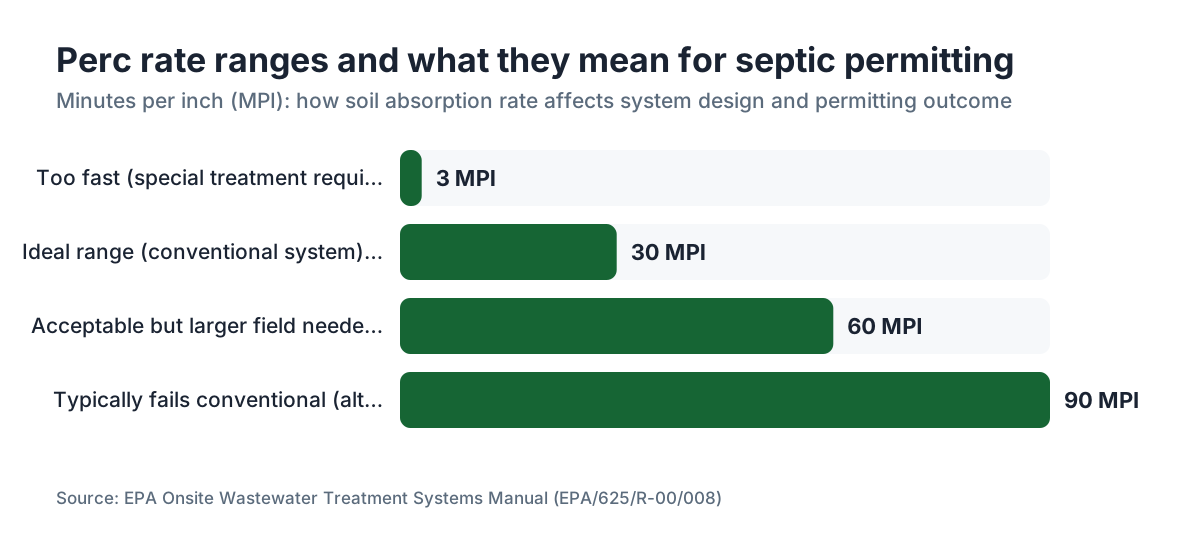
The passing threshold changes by state, but the most common standard across US codes is a perc rate between 3 minutes per inch and 60 minutes per inch (MPI). Land inside that band can usually support a conventional gravity-fed drain field. [1]
Here's what the numbers mean on the ground:
A perc rate faster than 1 to 2 MPI (very sandy or gravelly soil) usually triggers a special soil treatment requirement or a modified design. Water moves through too fast for real biological treatment before it hits groundwater.
A perc rate between 3 and 30 MPI is the comfortable zone. Design is straightforward, drain field sizes stay manageable, and most counties issue a permit on a standard design.
A perc rate between 30 and 60 MPI is slower (clay loam and similar soils). The system still passes in most jurisdictions, but the required drain field grows fast. A household that needs 300 linear feet at 15 MPI might need 600 feet or more at 55 MPI. That hits your lot size and your budget hard.
A perc rate slower than 60 MPI typically fails for a conventional system in most state codes. That doesn't always mean the lot is dead. It may mean you need an engineered alternative: a mound, a low-pressure pipe system, or an aerobic treatment unit. Those cost more, running $10,000 to $30,000 or higher for mound systems against $3,000 to $8,000 for a basic conventional system. [6]
Some state codes measure in inches per hour instead of minutes per inch, or set slightly different cutoffs, so always confirm against your own state's onsite wastewater rules.
How is a perc test done, step by step?
The procedure is more standardized than most homeowners expect, though the exact requirements differ by state.
Step 1: Site review and hole layout. The evaluator walks the lot, marks the proposed drain field area, and works around setbacks (typically 50 to 100 feet from wells, 10 feet from property lines, and set distances from surface water). Your county environmental office usually wants the holes placed inside the proposed leach field area.
Step 2: Digging the holes. Holes go down to the depth in your state code, often 24 to 36 inches. A backhoe or hand auger does the work depending on local rules and soil.
Step 3: Pre-soaking. This is the step that surprises people. Holes get filled with water, allowed to drain, then refilled. Pre-soaking runs a minimum time, often 4 hours for sandy soils and overnight (12 to 24 hours) for clay-heavy soils. The point is to fake saturated spring conditions, the worst case the system has to handle. [1]
Step 4: The timing measurement. On test day, water goes into each hole to a set depth. The tester measures how far the level drops in 30 minutes (some protocols use 10-minute or 15-minute intervals). The slowest readings per hole set that location's perc rate. Multiple holes get averaged, or the worst hole governs, depending on the state.
Step 5: Reporting. The evaluator writes up the hole locations, soil descriptions, water depths, timing intervals, and the final perc rate. That report goes to the county health department with the septic permit application.
The whole thing usually takes two days: one for pre-soaking, one for timing. Budget half a day of your own time if the health department wants the property owner or a rep on site.
What happens if your property fails a perc test?
A failed perc test is a real problem, but it's rarely the end of your project. The outcome hangs on why it failed and what your state's code allows.
The usual culprits are soil that drains too slowly (MPI above 60) or a seasonal high water table sitting too close to the surface. Some soils simply won't treat sewage no matter what you do.
If slow soil is the issue, most states let you apply for an alternative system permit. Mound systems are the go-to: the drain field gets built up above grade with imported engineered fill, lifting the treatment area over the restrictive soil layer. They work, but they cost real money. Other options include drip irrigation, aerobic treatment units (ATUs), and constructed wetlands, depending on what your state approves. [3]
If the high water table is the problem, you may need a larger vertical separation or a pressure-dosed design. Your engineer redesigns around the site's actual limits.
If the lot genuinely can't support any system, your paths narrow to connecting to public sewer (if it's available and feasible), applying for a variance (rarely granted, and usually only for existing structures), or accepting that the lot won't work for a home on septic.
Before you write the lot off, ask for a re-test in a different spot. Soil varies. A location 50 feet from the first test area can perform completely differently. Check too whether the evaluator ran the pre-soak correctly; a rushed test can inflate the MPI reading artificially.
If an alternative system gets you permitted, plan for higher running costs. Aerobic systems need maintenance contracts and more frequent servicing than conventional ones. The leach field guide digs into how drain fields work and fail.
Who is qualified to perform a perc test?
This varies a lot by state, and getting it wrong means your results may not be accepted.
In some states, the county health department runs the perc test as part of the permit review. You apply, pay the fee, and a health department sanitarian comes out. No separate contractor.
In other states, you hire a licensed professional. The required credential differs: some states want a Professional Engineer (PE) with an environmental or civil specialty, others want a Licensed Soil Scientist (LSS), and some accept a licensed sanitarian or a certified OWTS designer. Texas, for example, requires a licensed installer or engineer to design the system and submit site evaluation results under Title 30, Chapter 285. North Carolina requires a Licensed Soil Scientist or a Registered Environmental Health Specialist for soil evaluations. [7]
A few states allow both routes: county staff can run the test, or you can hire a private evaluator who submits results directly. Private evaluators are often faster when the health department has a backlog.
Call your county environmental health or building department before you hire anyone and ask flat out: "Who is authorized to perform a perc test in this county, and what credentials do they need?" Get it in writing if you can. Hire someone who lacks the required license and the county can reject your results outright, sending you back to square one.
Operators juggling job sites across counties can track permit status and soil evaluation requirements per project with software like SepticMind, which keeps job documentation in one place so nothing slips between jurisdictions that all run different rules.
How long is a perc test result valid?
Most perc test results carry an expiration date under state or county code. The common validity window is 2 to 5 years. After that, the county can require a new test before issuing a permit, even if the original showed a passing rate.
The logic is practical. A lot that sat untouched for years may have changed. Trees got cleared, drainage patterns shifted, or the seasonal water table measured differently under recent rainfall.
Some jurisdictions tie validity to the permit application instead of the test date. Submit a permit application inside the valid window and keep it active, and the test data stays good even past the technical validity period. But if the permit expired or you never filed, you likely retest.
Buying vacant land off a seller's positive perc test? Verify the test date, verify the county's current validity rules, and verify the proposed system area hasn't moved. Don't treat a three-year-old passing test as bankable without confirmation from the health department.
State codes change too. A site that passed under an older, looser standard may fail if retested under a newer protocol with tighter pre-soak or depth requirements.
Does a perc test tell you everything you need to know about a site?
No, and this is where buyers and builders get burned. A perc test tells you how fast water moves through the soil at the test depth under the test conditions. That's useful. It's also one data point, not a full site evaluation.
Here's what a perc test alone misses:
Seasonal high water table depth. Run the test in August with the water table low and you learn nothing about March. If the water table climbs to within 18 inches of the surface every spring, your drain field floods seasonally no matter what the summer perc rate said. Many states now require water table monitoring across seasons or ask the evaluator to spot the seasonal high water table through soil mottling (rust-colored and gray streaking that flags periodic saturation).
Whether a compliant field actually fits. A perfect perc rate is useless if the lot is too small to place a drain field the required distance from wells, property lines, buildings, and surface water. A soil evaluator should map out whether a compliant field fits at all.
Long-term performance. The perc test is a snapshot. Soil clogs biologically over years of use, and absorption rates drop. That's why regular septic tank pumping and maintenance matter so much for drain field life.
The EPA's SepticSmart materials state that "proper siting, design, installation, and maintenance are all necessary" for a system to work over time [2], and siting depends on the full site evaluation, well beyond the perc rate.
For everything a real estate deal should cover on the septic side, see the guide on septic tank inspection.
Can you get a septic permit without a perc test?
In limited cases, yes. The alternatives are narrower than most people hope, but they exist.
Soil morphology evaluation is the main substitute in some states. A licensed soil scientist reads the soil profile without running a timed perc test. From soil texture, structure, color, depth to restrictive layers, and similar traits, the scientist sets the soil's hydraulic loading rate directly. Several states, including parts of the Southeast and Pacific Northwest, now accept or even prefer soil morphology over the timed test because it's often more accurate for design. [8]
Engineered alternative system permits sometimes skip the timed perc test if the applicant goes straight to an engineered design using site-specific soil borings and lab permeability data. This route costs more upfront but moves faster where the perc test queue is long.
Grandfathered systems getting repaired rather than replaced may dodge a new perc test, depending on the state. If a conventional system is failing and you're repairing or replacing in-kind without moving the drain field, some states issue the repair permit without full retesting. But "in-kind" gets read narrowly. Change anything significant and the health department can require full evaluation. See septic system repair for what repair permits usually involve.
A variance from the perc requirement exists on paper in most codes but almost never gets granted for new construction. Variances go to existing homes with failing systems where no alternative works and public health is at immediate risk.
Don't plan around dodging the perc test. Plan around passing it, or around designing for a failed result.
How do perc test requirements vary by state?
Every state writes its own rules through its onsite wastewater treatment system code, and the gaps are wide enough that what's true in Georgia may not hold in Oregon.
A few examples of how the rules split:
California requires percolation or permeability testing as part of onsite wastewater permitting, run through county environmental health departments under the State Water Board's OWTS policy. Minimum soil absorption area calculations tie directly to the perc test result. [9]
Texas requires a site evaluation that includes a soil profile description and, for conventional systems, a perc test or accepted soil analysis. The rules live in Title 30, Chapter 285, administered by the Texas Commission on Environmental Quality (TCEQ). [10]
Florida's onsite sewage treatment and disposal rules (Chapter 64E-6, Florida Administrative Code) require percolation testing or soil texture analysis in the site evaluation before a permit issues. The state sets minimum separation distances and soil treatment depths that interact directly with the perc result. [11]
New York layers county rules on top of state standards. Most counties follow the New York State Department of Health's Appendix 75-A, which spells out the percolation test procedure, but some counties tack on stricter local amendments. [12]
The practical move: go to your state's department of environmental quality, department of health, or equivalent agency site and search "onsite wastewater" or "septic system permitting." Download the actual rules document. The perc test section tells you exactly what's required, who can do it, how long results last, and the passing threshold for your state.
SepticMind's operator documentation tools let licensed installers store state-specific code references next to individual job files, which cuts permit errors when a crew works across county lines.
Frequently asked questions
Do I need a perc test to buy land?
You're not legally required to perc test land before buying it, but skipping it is a real gamble. If the land fails after purchase and can't support any approved septic system, you may own a lot nobody can build on. A perc test before closing, or a purchase contract contingent on a passing perc test, is standard due diligence for any rural lot without public sewer access.
How long does a perc test take?
The full process usually spans two days. Day one is digging the test holes and pre-soaking them for 4 to 24 hours depending on soil type and state protocol. Day two is the timed measurement, which runs 1 to 3 hours on site. You'll wait another week or two for the written report and county review before a permit decision comes back.
Can I do my own perc test?
In most states, no. Perc tests for septic permitting must be performed or witnessed by a county sanitarian, licensed soil scientist, or licensed engineer, depending on the jurisdiction. A self-conducted test won't be accepted by the health department. Some states let property owners observe but not conduct the test. Always check your county's specific requirements before hiring anyone or touching the site.
What's the difference between a perc test and a soil evaluation?
A perc test is one method inside a broader site evaluation: it measures timed water absorption. A soil evaluation includes the perc test plus a soil profile description, seasonal high water table assessment, and a check on whether a compliant system fits the lot given setbacks and slope. Many states now require the full soil evaluation, well beyond the timed perc test, for a complete permit application.
How much does it cost to fix a property that fails a perc test?
It depends entirely on why it failed and what your state allows. If a mound system solves it, expect to add $8,000 to $20,000 over a conventional system cost. An aerobic treatment unit can run $10,000 to $20,000 installed. If the lot needs significant engineered fill trucked in first, costs climb higher. Some lots genuinely can't be fixed; there the only option may be connecting to public sewer if it's available.
Does a perc test expire?
Yes. Most states set validity windows of 2 to 5 years from the test date. After that, a new test is required before a permit will issue. Some counties tie validity to an active permit application instead of the test date alone. If you're relying on results from a prior owner or an old application, verify the current validity rules with your county health department before assuming the data still works.
Can you build a house if a perc test fails?
Sometimes. A failed conventional perc test doesn't automatically mean no septic system at all. Many states allow alternative systems, like mound systems, aerobic treatment units, or drip irrigation, on sites that fail a standard test. If no approved alternative can meet setback and treatment requirements on the lot, then no, the site can't legally support a home on onsite septic in most jurisdictions.
Is a perc test the same as a percolation test?
Yes, completely. Perc test, perk test, and percolation test all name the same procedure: a timed measurement of how fast water drains through soil at a set depth. The shortened forms are universal among contractors, engineers, and health departments. You'll see all three spellings in official state code documents, so don't worry if the wording varies.
Do I need a perc test for a replacement septic system?
It depends on your state and county. Some jurisdictions require a full new perc test before permitting any replacement, especially if the drain field location changes. Others accept the original test data or waive retesting for in-kind repairs in the same spot. Call your county health department before starting a replacement and ask specifically whether a new perc test applies to your situation.
What perc rate is required for a standard septic system?
Most state codes require a perc rate between 3 and 60 minutes per inch (MPI) for a conventional gravity-fed drain field. Rates faster than 1 to 2 MPI point to soil that drains too fast for adequate sewage treatment. Rates slower than 60 MPI typically fail for a conventional system, though many states allow alternatives on slower soils. Always verify the exact threshold in your state's onsite wastewater rules.
Does a perc test guarantee a septic system will work long term?
No. A passing perc test confirms the soil can absorb water at the required rate under test conditions. It doesn't guarantee longevity. Long-term performance depends on proper design, correct installation, and regular maintenance including pumping every 3 to 5 years. Biomat buildup in the drain field cuts absorption over time regardless of the original perc result.
Can a perc test be done in winter?
Most states allow perc testing year-round, but frozen ground can make it impractical or impossible in cold-weather states. More to the point, testing when the soil sits at its seasonal worst, meaning saturated spring conditions, is often required by protocol so the result reflects real worst-case performance. Some state codes set seasonal windows for pre-soaking. Check your state's protocol for restrictions before scheduling.
Who orders a perc test, the buyer or the seller?
Either party can order one, and it usually falls to whoever has the most to gain from the answer. On a vacant land sale, sellers sometimes perc test in advance to make the lot more marketable. Buyers often make the contract contingent on a passing result so they can walk without penalty if the lot fails. On a home sale with an existing system, the inspection, not a perc test, is the typical requirement.
Sources
- EPA, Onsite Wastewater Treatment Systems Manual (EPA/625/R-00/008): Acceptable perc rates for conventional drain fields typically fall between 3 and 60 minutes per inch; rates outside this range require alternative designs or indicate unsuitable soil.
- EPA SepticSmart Program: EPA provides guidance and education on septic systems through SepticSmart but does not issue permits directly; states and localities hold permitting authority. Proper siting, design, installation, and maintenance are all necessary for system function.
- EPA, Types of Septic Systems: Alternative onsite systems including mound systems, aerobic treatment units, and drip irrigation systems are approved for sites that fail conventional perc tests in many state codes.
- University of Minnesota Extension, Septic Systems: Site evaluation costs including perc testing for residential lots typically range from a few hundred dollars to over a thousand depending on lot complexity and state requirements.
- Penn State Extension, Septic Systems: Mound systems and other alternative onsite systems cost significantly more than conventional systems; mound system costs commonly range from $10,000 to $30,000 or higher depending on soil and lot conditions.
- North Carolina Department of Environmental Quality, Onsite Wastewater: North Carolina requires a Licensed Soil Scientist or Registered Environmental Health Specialist to perform soil evaluations for onsite wastewater permitting.
- National Environmental Services Center at West Virginia University: Soil morphology evaluation has been adopted in several states as an alternative or supplement to traditional timed percolation tests because it often provides more accurate long-term site characterization.
- California State Water Resources Control Board, Onsite Wastewater Treatment Systems Policy: California requires percolation testing or equivalent soil analysis as part of county-administered onsite wastewater system permitting under state policy.
- Texas Commission on Environmental Quality, On-Site Sewage Facilities (Title 30, Chapter 285): Texas TCEQ rules under Title 30, Chapter 285 require site evaluation including soil profile description and perc testing or soil analysis before an OSSF permit is issued.
- Florida Department of Health, Onsite Sewage Programs (Chapter 64E-6 Florida Administrative Code): Florida Chapter 64E-6 requires percolation testing or soil texture analysis as part of site evaluation before an onsite sewage treatment and disposal system permit can be issued.
- New York State Department of Health, Residential Onsite Wastewater Treatment Systems (Appendix 75-A): New York State Appendix 75-A specifies the required percolation test procedure and acceptable results that counties must use or may supplement with local amendments.
Last updated 2026-07-09