Perc test requirements: what every state and county demands
By the SepticMind Editorial Team
TL;DR
- A perc test measures how fast water soaks into soil, and most states require a passing result before they issue a septic permit.
- Acceptable absorption rates usually run between 1 and 60 minutes per inch.
- Testing depth, soil profile rules, who can test, and minimum lot size all vary by state and county.
- A failing test rarely kills the project.
- Alternative systems exist.
What is a perc test and why do you need one?
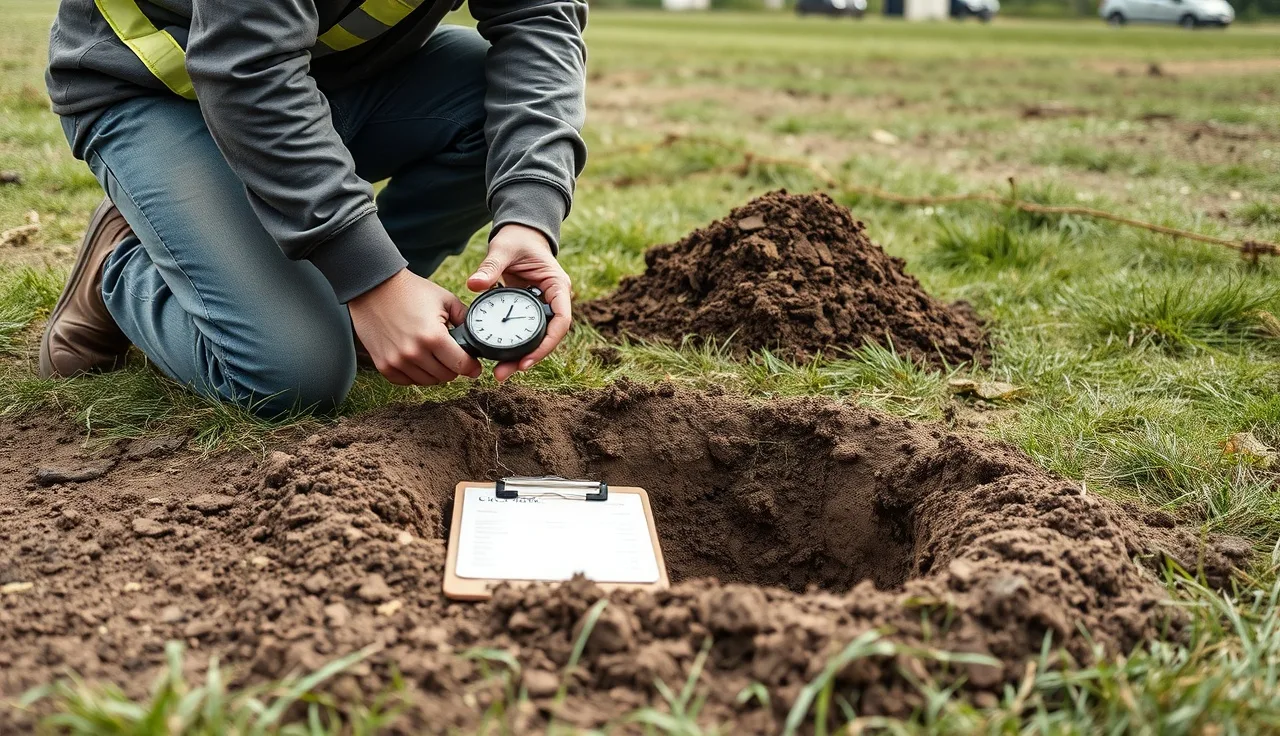
A percolation test, almost always called a perc test, measures how fast water drains through your soil. You dig a hole, fill it with water, and time how long the level takes to drop a set amount. That rate, in minutes per inch (MPI), tells the county health department whether a conventional septic drain field will work on your land.
Most jurisdictions require a passing perc test before they issue a septic permit [1]. No permit, no legal install. No system, no occupancy on a new home that sits off the public sewer. That's the whole stakes of the test.
The idea is simple. A drain field (also called a leach field) treats wastewater by letting it seep into soil. Soil that drains too fast pushes waste through before it can filter out pathogens. Soil that drains too slow backs the effluent up until the system fails. The perc test finds where your dirt lands between those two problems.
Perc testing is usually one piece of a larger site evaluation. Most states also want a soil profile, sometimes called a soil morphology evaluation. That's a separate, deeper hole, typically 3 to 5 feet, where a licensed evaluator reads soil color, texture, and the depth of any limiting layer like rock or a seasonal high water table [2].
What are the standard perc test procedures?
The procedure is mostly standardized by EPA guidance and state health codes, though the details shift from county to county [1]. Here's what a typical test looks like.
Hole preparation. You or a licensed tester digs or augers the test holes, usually 4 to 12 inches across and 12 to 36 inches deep, depending on the drain field depth your jurisdiction plans for. Most states want several holes per site, often three to six, spread across the proposed field.
Presaturation. The holes get filled with water and left to drain overnight, sometimes for a full 24 hours. This soaks the soil and swells the clay to mimic worst-case wet-season conditions. Skip it, and your test either gets rejected or comes back misleadingly fast. That's the single most common reason a test fails on procedure rather than soil.
The timed test. After presaturation, the tester refills each hole to a set depth, usually 6 inches of water over the bottom, then measures the drop over 30 minutes. Some states use shorter intervals. The drop in inches converts to minutes per inch.
Averaging. Results from all holes get averaged, and many states toss the outliers. The final number goes on the permit application.
Several states, including Texas and much of the Southeast, have dropped perc tests entirely in favor of a soil morphology report or a Long-Term Acceptance Rate calculation, which soil scientists consider more reliable. If you're in one of those, ask your county whether the perc test is even still the method they use.
What perc test results actually pass or fail?
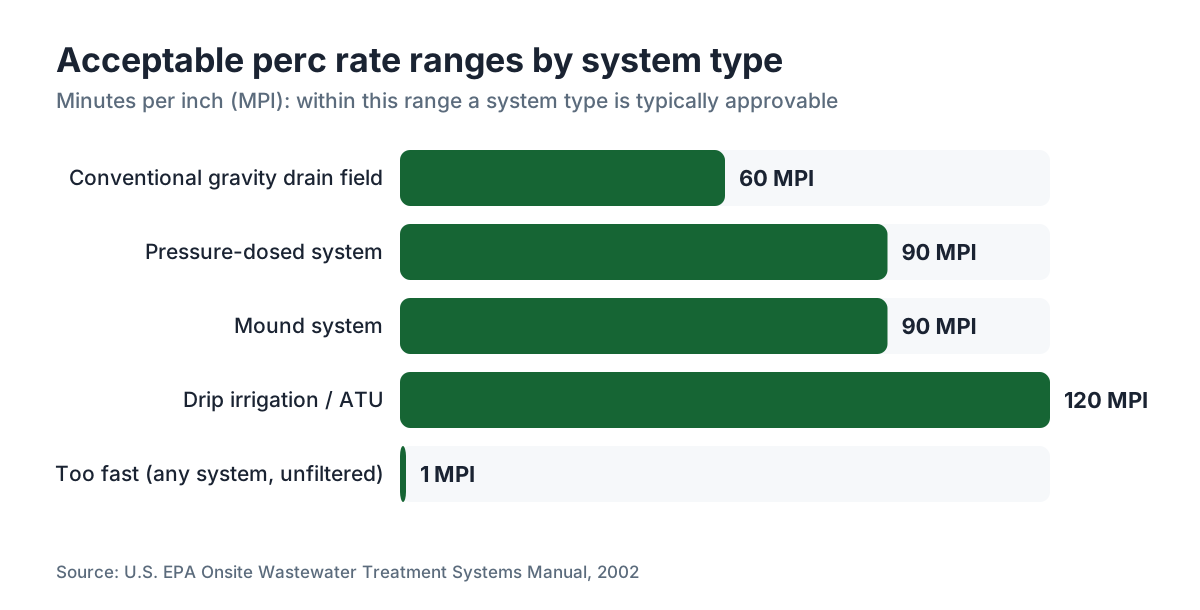
The most widely cited passing range for a conventional gravity drain field is 1 to 60 minutes per inch [1][3]. Faster than 1 MPI, the soil is too coarse to filter. Slower than 60 MPI, it's too dense to take a home's daily wastewater load.
The cutoffs move around more than you'd think. Some states accept up to 90 MPI for mound or pressure-dosed systems. Others cap a conventional system at 45 MPI. A few allow rates as high as 120 MPI if you use an engineered system with soil amendment.
| Perc Rate (MPI) | Typical Interpretation | System Options |
|---|---|---|
| Less than 1 | Too fast (coarse gravel) | May require alternative media filter |
| 1 to 30 | Ideal | Conventional gravity system |
| 31 to 60 | Acceptable | Conventional or pressure-dosed |
| 61 to 90 | Marginal | Pressure-dosed or mound system |
| 91 to 120 | Slow | Engineered alternative only |
| Over 120 | Fails in most jurisdictions | Site may not be approvable |
A failing result rarely means you can't build. It means you need an alternative system: a mound, low-pressure pipe (LPP), drip irrigation, or aerobic treatment unit. All of them cost a lot more than a conventional field [3]. Some counties want a second test or a licensed soil scientist's opinion before they hand you a final denial.
Who is allowed to perform a perc test?
This is where state rules split hardest. Some states let a homeowner dig the test holes, then have a county sanitarian show up to observe and run the actual timing. Others require a licensed soil scientist, registered sanitarian, or professional engineer to run the whole thing start to finish.
County health departments usually post their approved tester lists online. Hire someone off that list and the county may reject the results outright. Call the county environmental health office before you pay anyone.
In a lot of states, the person doing the soil morphology evaluation holds a different credential than the perc tester. You can end up paying two professionals for the same afternoon.
For septic tank installation jobs, most contractors can point you to a tester they work with regularly, which saves time. Two cautions. Make sure that tester is on the county's accepted list. And remember the contractor has a financial stake in a passing result, so on a marginal site, an independent evaluator is worth the money.
What are Alabama perc test requirements?
Alabama perc test requirements come from the Alabama Department of Public Health (ADPH) under the Onsite Sewage Facilities Rules, Chapter 420-3-1 [4]. County Environmental Health offices run the local permits. Acceptable perc rates for a conventional system are 1 to 60 MPI, and the soil profile hole has to reach at least 60 inches deep.
What Alabama asks for:
- A site evaluation done by an ADPH-certified inspector or a Professional Engineer licensed in Alabama.
- Both a percolation test and a soil profile evaluation. The profile hole goes at least 60 inches down.
- Perc rates from 1 to 60 MPI for conventional systems. Anything faster than 1 or slower than 60 needs an alternative design.
- A presoak of at least 8 hours, though most inspectors run it overnight.
- Minimum lot size that depends on perc rate and system type. A commonly cited floor for unsewered residential lots is 20,000 square feet, but that varies by county and design.
- An ADPH-approved permit before any install. Building without one can bring fines and a forced removal of the system.
Northern Alabama counties in karst limestone (think Limestone, Marshall, DeKalb) often carry extra restrictions because water can run straight through fractured rock to groundwater. Expect more scrutiny there, and possibly a geotechnical review stacked on top of the standard perc evaluation [4].
What are Arkansas perc test requirements?
Arkansas perc test requirements sit with the Arkansas Department of Health (ADH), Plumbing and Natural Gas Division, under the Rules Pertaining to Onsite Wastewater Systems [5]. A PDF of those rules is on the ADH site. Acceptable perc rates for conventional systems run 3 to 60 MPI, and profile holes must reach at least 48 inches or a limiting layer, whichever comes first.
What Arkansas asks for:
- Site evaluations by a Registered Environmental Health Specialist (REHS) from the local ADH county health unit, or by a licensed PE or Registered Soil Scientist working under ADH oversight.
- Both perc testing and a soil profile evaluation.
- Perc rates of 3 to 60 MPI for conventional systems. Faster than 3 MPI counts as too permeable and pushes you to an alternative design.
- A daily design flow calculation instead of a fixed statewide lot size. The required drain field area comes from the soil's acceptance rate, the bedroom count, and the estimated daily flow.
- A perc test before an Installation Permit issues, and that permit before any grading, excavation, or install begins.
- A fresh site evaluation (and often a new perc test) before a repair permit issues on a failed system.
The ADH county health unit is your first call for anything site-specific. Fees vary by county because the state sets no uniform schedule, so ask before you assume [5].
How do perc test requirements differ across other states?
There is no federal perc test standard. The EPA's SepticSmart program offers guidance and its Design Manual for onsite systems gets cited constantly, but the actual authority lives with states and counties [1][3].
A few examples show how wide the spread runs.
Tennessee. Regulated by the Tennessee Department of Environment and Conservation. Soil morphology is the primary method and perc tests are secondary. Rates from 6 to 120 MPI can be approvable depending on system type [6].
Florida. The Florida Department of Health sets the rules under Chapter 64E-6 of the Florida Administrative Code. A soil profile evaluation is required and a perc test alone won't cut it. Florida also demands 24 inches of separation between the drain field bottom and the wet-season water table, stricter than most states [7].
Texas. The Texas Commission on Environmental Quality (TCEQ) governs onsite systems under 30 TAC Chapter 285. Texas uses soil texture classification and a Linear Loading Rate, not a traditional perc test. TCEQ's guidance documents walk through the calculation [8].
California. County programs dominate. Most California counties require a perc test under their own protocols, many still based on pre-1990 guidelines. Santa Clara County, for example, wants a 4-hour presoak plus a 30-minute timed test in holes 6 to 8 inches wide. No single state PDF covers every county.
Call your county environmental health department before you spend a dollar. Bring the parcel number. Ask which test method they accept, who's licensed to run it, and what the fee and turnaround look like right now.
How much does a perc test cost?
A perc test costs about $150 to $1,500 depending on the state, who runs it, how many holes are required, and whether a soil profile evaluation comes bundled in [9]. The test itself is cheap next to the system it approves, but it decides everything downstream.
At the low end, some counties charge a flat government fee of $150 to $300 for a sanitarian to observe a test the homeowner has already set up. At the high end, a private licensed soil scientist or PE running a full site evaluation with both a morphology report and a perc test, in a high-cost area, can run $800 to $1,500 or more.
A soil profile evaluation priced on its own usually adds $200 to $500. Tough access or a backhoe rental, common when profile holes have to reach 48 to 60 inches, adds another $300 to $600 for equipment.
For the whole picture, our cost to install septic system breakdown shows the perc test is a small slice of the budget. But if it fails and you need an alternative system, installation costs can double.
Get at least two quotes from licensed evaluators. Make each one confirm their credentials are accepted by your specific county before any work starts.
How long are perc test results valid?
Most states keep perc test results valid for 2 to 5 years. After that, you need a fresh test before a permit will issue. The exact window depends on your state and often your county.
Here's how the ranges tend to shake out:
- 2 years. Common where groundwater protection standards run conservative. Some California counties land here.
- 3 years. A frequent middle ground. Arkansas and Alabama both let results ride for a period their county health units set, so check locally. Some counties treat results as good for only 2.
- 5 years. A few states allow the longer window as long as nothing changed, meaning no new development, grading, or drainage work on or next to the site.
Buying land? Check the test date the second the seller hands you results. An expired test means the county won't issue a permit on it, and the new test lands on you before you can build. This is a genuine due-diligence trap in rural real estate. A septic tank inspection on an existing system and a perc test on a vacant parcel are both things to finish before closing, not after.
What happens if my property fails a perc test?
A failing perc test is rarely a dead end. Your options depend on how far outside the passing range your soil sits and what your county allows. Most states have a pathway for difficult sites.
Option 1: Alternative system design. Mound systems, low-pressure pipe systems, aerobic treatment units (ATUs), and drip irrigation are all built for soils that flunk a conventional perc test. They cost more, sometimes two to three times a conventional system, and they need more maintenance. See the full breakdown at cost to put in a septic tank.
Option 2: Retesting. If the first test ran in dry conditions or the tester botched a step, a second test in wetter soil can land differently. Some counties allow one retest under a new application. This isn't gaming anything. Soil permeability really does swing with the season.
Option 3: Variance or engineer review. Many states let a licensed PE or certified soil scientist petition for a variance if they can show the site handles a modified system safely. Approval rates vary a lot and depend heavily on how the county operates.
Option 4: Connect to municipal sewer. If a public line is close enough, tying in can beat the cost of an alternative septic system, especially on denser suburban lots.
Failed system on an existing home? That's a different road. It's a septic system repair situation, and repair permits in most states also require an updated site evaluation.
Do perc test requirements apply to existing homes too?
If your existing system works, you don't need a new perc test unless you're adding bedrooms, expanding the system, or facing a failure that needs a major repair or replacement. For routine ownership, the test never comes up.
But it does surface in a few situations.
System failure. When a drain field fails and needs replacing, most states treat it like a new install. Arkansas requires a fresh site evaluation and repair permit before any failed-system work begins [5]. Alabama requires an Alteration Permit for significant repairs [4].
Bedroom additions. A new bedroom raises the design flow estimate. Many counties want a new site evaluation to confirm the existing (or a proposed larger) system can carry the extra load.
Property sale. Several states or counties require a septic inspection at the point of sale. The inspection itself doesn't always trigger a new perc test, but if the inspector flags the drain field as undersized or failing, testing can follow.
None of this replaces upkeep. Regular septic tank pumping every 3 to 5 years is the best defense against the kind of drain field failure that drops you back into the permitting process.
How do septic service operators manage perc test workflows?
For septic companies that run site evaluations, the paperwork around perc testing eats real time. Scheduling the test, coordinating the presoak window, hitting county submittal deadlines, and tracking permit expiration dates across dozens of live jobs creates constant friction.
Some operators lean on job management software to hold it together. SepticMind is built for onsite wastewater service businesses, with scheduling and job tracking that keep multi-step permit workflows from slipping. Run more than 10 to 15 perc test jobs a month and the manual approach starts to crack.
For homeowners, the takeaway is simple. Your contractor should be tracking permit deadlines and test validity windows for you. If they can't tell you where your job sits in the process, that's a gap worth raising to their face.
Frequently asked questions
How deep do perc test holes need to be?
Depth depends on your state and the proposed system. Most jurisdictions want perc test holes 12 to 36 inches deep, set at the planned installation depth of the drain field. Soil profile holes are separate and usually reach 48 to 60 inches or down to a limiting layer. Confirm the numbers with your county health department before you dig.
How many perc test holes are required?
Most states require three to six perc test holes spread across the proposed drain field. The exact count depends on lot size and the local health department's protocol, and some counties want one hole per 1,000 square feet of field. Results get averaged, and outliers are often thrown out.
Can a homeowner do their own perc test?
In some states, yes. A homeowner can dig the holes and run the presoak while a county sanitarian observes and times the official test. In others, a licensed soil scientist, registered sanitarian, or professional engineer must run the whole evaluation. Check with your county environmental health office before you attempt any part of it yourself.
What time of year is best for a perc test?
Most agencies prefer a perc test during or right after the wet season, when soil sits at or near field capacity. That gives conservative, slower results that reflect worst-case conditions. Tests run during a summer drought can show artificially fast rates that won't match how the system behaves in spring.
How long does a perc test take?
Presaturation takes 8 to 24 hours, usually overnight. The timed test itself runs 30 to 60 minutes per hole. On-site time for the evaluator during the timed portion is usually 1 to 3 hours. Add travel and report prep, and full results are often ready within a few days of the visit.
What's the difference between a perc test and a soil profile evaluation?
A perc test measures how fast water drains through soil using a timed water-drop method. A soil profile evaluation reads a deep hole for texture, color, horizon depth, and limiting layers like clay or seasonal groundwater. Most states require both, and soil scientists increasingly consider the profile the more reliable of the two.
Does a perc test guarantee a septic permit will be issued?
No. A passing perc test is one requirement among several. You also typically need a satisfactory soil profile, adequate lot size, proper setbacks from wells and property lines, and sometimes a site plan stamped by a licensed designer. The county health department reviews all of it together before issuing a permit.
What perc rate is required in Alabama?
Alabama's onsite wastewater rules require perc rates between 1 and 60 minutes per inch for a conventional gravity drain field. Sites outside that range need an alternative design approved by ADPH or a licensed PE. The profile hole must reach at least 60 inches. County environmental health offices run the permits under ADPH Chapter 420-3-1.
What perc rate is required in Arkansas?
Arkansas requires perc rates between 3 and 60 minutes per inch for conventional systems under ADH rules. Soils faster than 3 MPI count as too permeable. The ADH county health unit must be part of the site evaluation. An Installation Permit based on the perc results is required before any excavation or install begins.
How much does a perc test cost in 2025?
Costs run $150 to $1,500. Government-administered tests in some counties cost $150 to $300. A private licensed soil scientist or PE doing a full site evaluation, both perc testing and a soil morphology report, usually runs $500 to $1,200. Tough access, backhoe rental, or high-cost states push toward the top of the range.
How long are perc test results valid?
Most states let perc results support a permit application for 2 to 5 years. The window varies by state and sometimes by county. Buying land with existing perc results? Verify the test date right away. Expired results mean a full retest before the county issues a new permit.
What happens if a site fails a perc test?
A failing perc test means a conventional drain field won't work there. Your options: design an alternative system (mound, ATU, drip irrigation), request a retest if conditions were poor, seek a variance through a licensed PE, or connect to municipal sewer if it's available. Most states keep an alternative-system pathway open for difficult sites.
Do I need a perc test to replace an existing septic system?
Usually yes, if the drain field needs full replacement. Most states treat that like a new install, requiring an updated site evaluation and a new permit. Partial repairs or tank-only work may not trigger a new perc test, but it varies by state and county. Check with your local environmental health office before starting.
Is a perc test required when buying land?
No law requires one before you buy. But any buyer planning to build on an onsite septic system should make a passing perc test a contingency in the purchase contract. A lot that fails perc and can't be developed is worth far less. This is basic rural real estate due diligence, not an optional extra.
Sources
- U.S. EPA, Onsite Wastewater Treatment Systems Manual (2002): EPA manual describes standard percolation test procedures, acceptable MPI ranges, and recommends presaturation protocols for onsite wastewater site evaluation.
- U.S. EPA, SepticSmart Program: EPA SepticSmart guidance identifies soil evaluation including perc testing as a requirement before septic system permitting and installation.
- U.S. EPA, Design Manual for Onsite Wastewater Treatment and Disposal Systems: Describes acceptable percolation rate ranges for conventional drain fields (1 to 60 MPI) and identifies alternative system options for marginal or failing soils.
- Alabama Department of Public Health, Onsite Sewage Facilities Rules, Chapter 420-3-1: Alabama perc test requirements including acceptable rate range of 1-60 MPI, 60-inch minimum profile hole depth, and ADPH-certified inspector requirement.
- Arkansas Department of Health, Rules Pertaining to Onsite Wastewater Systems: Arkansas requires 3 to 60 MPI perc rates for conventional systems, REHS or licensed professional involvement, and a new site evaluation before a repair permit issues.
- Florida Department of Health, Chapter 64E-6 Florida Administrative Code, Onsite Sewage Treatment and Disposal Systems: Florida requires soil profile evaluation (not perc test alone) and mandates 24-inch minimum separation between drain field bottom and seasonal high water table.
- Texas Commission on Environmental Quality, 30 TAC Chapter 285, On-Site Sewage Facilities: Texas uses soil texture classification and Linear Loading Rate rather than traditional perc testing for onsite sewage facility design.
- Angi, Perc Test Cost Guide: National perc test cost data showing typical range of $150 to $1,500 depending on state, tester credentials, number of holes, and whether soil profile is bundled.
- National Environmental Health Association, NEHA Credentialing: NEHA credentialing standards for Registered Environmental Health Specialists (REHS), referenced in several state onsite wastewater rules including Arkansas.
Last updated 2026-07-09